Quick answer: A diagnostic test is ordered to confirm or rule out a specific condition when you already have a symptom, an abnormal result, or a known risk, while a screening test looks for hidden problems in people who feel fine. The same blood draw or scan can be either one depending on why it was ordered, and that single word in your chart often decides whether insurance pays in full or sends you a bill. Knowing which category your test falls into is the difference between a $0 preventive visit and a surprise $300 invoice.
What is a diagnostic test, and how does it differ from screening?
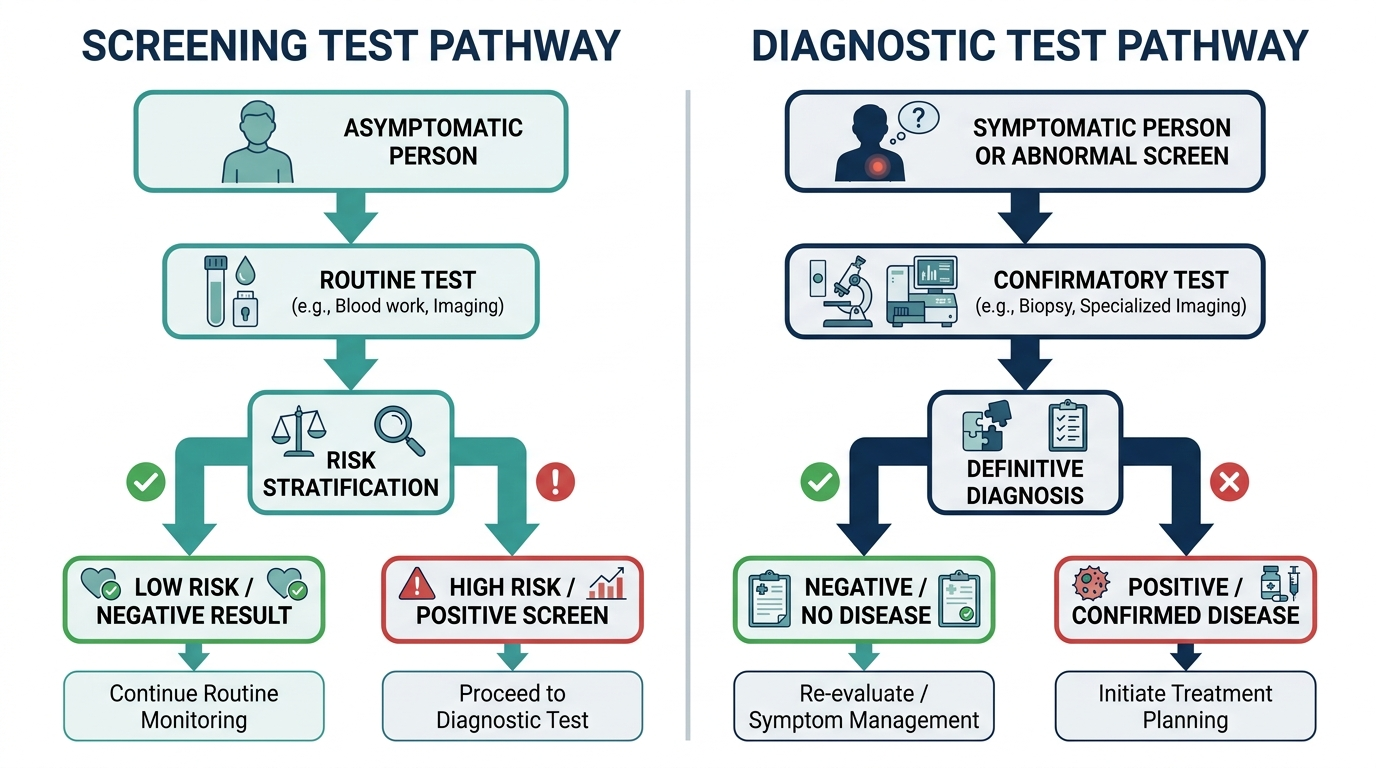
A diagnostic test answers the question “do you have this condition right now?” It is ordered because something already points toward a problem: a lump, chest pain, a fasting glucose that came back high, or a family history that puts you in a watch group. A screening test asks a softer question, “are you at risk for something you cannot yet feel?”, and runs on people with no symptoms at all.
The same blood draw can be a screening test or a diagnostic one, so what would a full annual panel actually flag for you? One at-home Superpower draw checks 100+ biomarkers, physician-reviewed.
The clearest way to see the split is to follow one patient. A 50-year-old with no complaints gets a screening colonoscopy because guidelines say to start at 45. If the doctor finds and removes a polyp, the next colonoscopy is no longer a screen. It is surveillance now, a diagnostic-flavored follow-up, because there is a known finding to chase. Same scope, different label, often a different bill.
Here is the insider detail most people never hear: “screening” and “diagnostic” are billing codes before they are medical concepts. A mammogram coded as screening is covered at 100% under most US plans because of preventive-care rules. The moment a radiologist sees something and orders extra images, the visit flips to diagnostic and your cost share kicks in. Patients walk in expecting free and walk out owing money, not because anything went wrong, but because the code changed mid-appointment.
Screening vs diagnostic vs monitoring: the three jobs a test can do
Most people think there are two buckets. There are really three. A screening test casts a wide net over healthy people. A diagnostic test zooms in on a specific suspicion. A monitoring test (sometimes called surveillance) tracks a condition you already know you have, like an A1C every three months once you are diabetic, or a PSA after prostate cancer treatment. Monitoring is billed like diagnostic, because there is a known reason for it, which is why an established diabetic almost never gets a “free” A1C.
| Property | Screening test | Diagnostic test |
|---|---|---|
| Who it is for | People with no symptoms | People with a symptom, risk, or abnormal result |
| Question it answers | “Are you at risk?” | “Do you have it right now?” |
| Typical trigger | Age or guideline (turn 45, colonoscopy) | A finding (high glucose, a lump, a cough) |
| Insurance under US preventive rules | Often 100% covered, no copay | Deductible and coinsurance apply |
| Goal | Catch hidden problems early | Confirm or rule out a specific condition |
| Example | Screening mammogram at 45 | Breast ultrasound after a lump is felt |
The takeaway is not academic. The front desk codes a test from the reason your provider wrote down. Call to schedule a mammogram and mention “I felt something,” and you have likely converted a screening into a diagnostic. This is not about hiding symptoms. It is about understanding why the same scan costs $0 for your neighbor and $240 for you.

Why does the diagnostic code change my insurance bill?
The code changes your bill because US preventive-care law only protects screening. Under the Affordable Care Act, plans must cover a defined list of preventive screenings at no out-of-pocket cost when coded as preventive and done in-network. A diagnostic test sits outside that shield. It is “medically necessary” rather than “preventive,” so it runs through your deductible and coinsurance.
The mechanics are simple. Your visit generates two codes. A CPT code says what was done (the mammogram). An ICD diagnosis code says why. A mammogram paired with a “routine screening” diagnosis is preventive and free. The same mammogram paired with a “lump in breast” diagnosis is diagnostic and billable. The machine, the technician, and the image are identical. Only the reason changed, and the reason is what the payer reads.
This is also why “free annual physical” claims get murky. The wellness visit is preventive, but if you mention a sore shoulder and the doctor evaluates it, that piece can be billed separately as a problem-focused visit. Same appointment, two bills. The fix is awareness: ask how a test will be coded before it happens, and if a surprise bill arrives, ask whether a coding correction is possible.
What is a blood test, and when is it screening vs diagnostic?
A blood test is any lab analysis run on a sample drawn from a vein (or a fingerstick), measuring things like cholesterol, blood sugar, thyroid hormones, vitamin levels, and blood cell counts. Whether it counts as screening or diagnostic again depends entirely on the reason it was ordered, not on what is in the tube.
Take an A1C, which measures your average blood sugar over about three months. Run on a healthy adult at an annual physical, it is a screen for diabetes. Run on someone who is thirsty all the time, losing weight, and urinating constantly, the same A1C is diagnostic. Prep matters too: fasting is required for an accurate triglyceride and glucose reading, but A1C does not care whether you ate breakfast, which is why doctors lean on it when a patient forgets to fast.
If you want a fuller picture than a single marker, the multi-test order most people mean by a checkup is a complete blood panel, which usually pairs a complete blood count with a metabolic panel and a lipid panel. When someone asks what is a full panel blood test called, that is the answer: there is no single official name, but “comprehensive metabolic panel plus CBC and lipids” is the working version most clinics run, and the foundation for tracking the biomarkers worth tracking over time.
What are the main categories of diagnostic tests?
A diagnostic test is not one thing. It is four broad families, and knowing which family yours belongs to tells you where to go, what it costs, and how invasive it is. The families are lab tests, imaging, biopsy and pathology, and genetic tests. Most workups combine at least two.
Lab tests (blood, urine, stool)
This is the cheapest and most common family. Lab tests analyze a fluid or sample for chemistry, cells, or organisms. A lipid panel reads cholesterol. A urinalysis flags a kidney or bladder issue. A stool test screens for colon cancer or checks for infection. Lab tests are fast, low-risk, and the first stop in almost every diagnostic path because they narrow the field cheaply. A doctor who suspects a thyroid problem orders a TSH before sending you anywhere expensive.
Imaging (X-ray, ultrasound, CT, MRI)
Imaging looks inside the body without cutting. X-rays are fast, cheap, and best for bone. Ultrasound uses sound waves, has no radiation, and is the go-to for soft tissue, pregnancy, and the thyroid. CT stacks X-rays into a 3D view and is the workhorse for trauma, lungs, and abdominal pain. MRI uses magnets, has no radiation, and gives the most detailed soft-tissue picture, which is why it owns the brain, spine, and joints. Cost climbs steeply across that list, and so does the chance your test gets coded diagnostic, because imaging is rarely ordered on a whim.
Biopsy and pathology
When a sample of tissue or cells is removed and studied under a microscope, that is pathology. A biopsy, a Pap smear, and a skin shave all live here. When people ask what are pathological tests, this is the answer: a pathologist examines the actual cells to confirm or rule out disease at the cellular level. These are about as diagnostic as it gets, because you are looking directly at the cells in question rather than at a downstream signal. Pathology is usually the final word that confirms or clears a cancer suspicion that imaging only hinted at.
Genetic and molecular tests
Genetic tests read your DNA to find inherited risk (a BRCA test for breast and ovarian cancer risk), confirm a suspected inherited condition, or guide treatment (tumor genetics that tell an oncologist which drug will work). Molecular tests like PCR detect the genetic material of a virus or bacteria, which is how a COVID PCR or a strep PCR works. They raise a wrinkle the other families do not: a genetic result can change how relatives think about their own risk, so genetic counseling often comes bundled in.
| Family | What it examines | Common examples | Where you go | Invasiveness |
|---|---|---|---|---|
| Lab | Blood, urine, stool | CBC, lipid panel, urinalysis, A1C | Quest, Labcorp, retail clinic | Low (a draw or a cup) |
| Imaging | Internal structures | X-ray, ultrasound, CT, MRI | Radiology center, hospital | Low to moderate |
| Biopsy and pathology | Tissue and cells | Biopsy, Pap smear, skin shave | Clinic or hospital, then a pathology lab | Moderate to high |
| Genetic and molecular | DNA, RNA, pathogens | BRCA, PCR, tumor genetics | Specialized lab, often via a provider | Low (usually a draw or swab) |
How does a diagnostic test actually work, step by step?
From the moment a doctor suspects something to the moment you have an answer, a diagnostic test moves through a predictable sequence that tells you where delays and bills come from.
- The trigger. A symptom, an abnormal screening result, or a risk factor prompts the order. This is the difference-maker for billing: the trigger becomes the diagnosis code.
- The order. A clinician writes the order with that diagnosis code attached. For direct-to-consumer tests, a network physician signs the order so the lab is allowed to run it.
- The sample or scan. You get drawn at a lab site, scanned at a radiology center, or sampled in a clinic. Prep matters here. Fasting for a lipid panel, a full bladder for a pelvic ultrasound, no caffeine before a stress test.
- Analysis. A lab machine, a radiologist, or a pathologist reads the sample. Blood chemistry can return same day. A biopsy read by a pathologist can take several days.
- The result and interpretation. Numbers or images come back, and a clinician puts them in context. A borderline reading on its own means little. Interpretation is the step direct-to-consumer testing often skips.
- The decision. Confirm, rule out, repeat, or escalate. Many conditions need two tests, like the two-step approach where a positive screening test is confirmed by a more specific second test before anyone says “you have it.”
Two-step testing exists for a reason worth knowing. A first test is often tuned to be very sensitive, so it rarely misses a real case but flags some people who do not have the disease. The confirmatory second test is tuned to be very specific, so a positive there is far more trustworthy. Sensitive first, specific second, is the standard pattern for HIV, Lyme disease, and several others. If a first result scares you, ask whether it was the sensitive screen or the specific confirmation.
How do I get a diagnostic test (with or without a doctor)?
You have three realistic routes to a test in the US, and they differ in cost, speed, and how the result gets explained to you.
- Through your doctor. The clinician writes an order, you go to a Quest or Labcorp draw site, and the lab bills your insurance. This is the path most likely to be covered, but it requires an appointment first.
- Direct-to-consumer labs. Companies let you order common panels yourself online, and a network physician signs off on the order so the lab will run it. You still get drawn at a Quest or Labcorp location. This is the fastest legal way to skip the doctor visit, and we cover it in detail in How to Get Lab Tests Without a Doctor’s Order.
- Retail clinics and urgent care. CVS MinuteClinic and urgent care centers run a limited menu of common tests on the spot, useful when you need a quick answer rather than a full workup.
One thing direct-to-consumer ordering does not give you is interpretation. You get numbers, not a clinician walking you through what a borderline reading means. If a result looks off, talk to a clinician before you panic or change anything.
If you are getting blood drawn anyway, it is often smarter to capture a full baseline at once rather than chase single markers across separate visits. Here is how a full-body panel compares on price and coverage.
How much does a diagnostic test cost, and who pays?
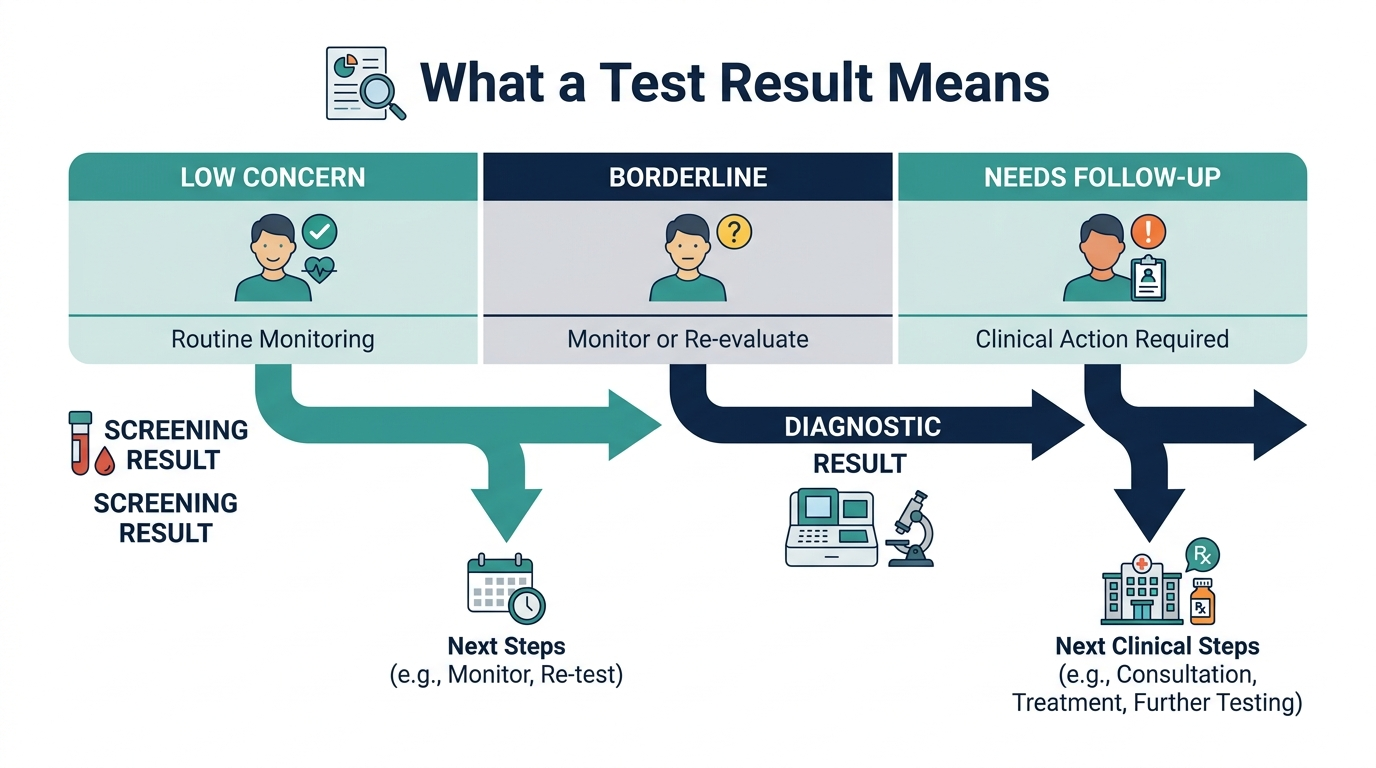
Cost depends almost entirely on that screening-versus-diagnostic label and on whether you run the test through insurance or pay cash. Preventive screens that meet US guidelines are generally covered at 100%. Once a test is diagnostic, your deductible and coinsurance apply, so you could owe anywhere from a small copay to several hundred dollars.
The other huge variable is where the test is run. A comprehensive metabolic panel runs about $29 at a discount lab. The same panel billed through a hospital can hit $250 once facility fees pile on, five to ten times more for an identical result. This is the single biggest lever you control: for routine bloodwork, a standalone lab almost always beats a hospital draw on price.
| Test | Cash price range (2026) | Usually covered as screening? |
|---|---|---|
| Lipid panel (cholesterol) | $15 to $50 | Yes, as preventive |
| A1C (blood sugar) | $20 to $60 | Yes, if risk factors present |
| Comprehensive metabolic panel | $25 to $80 | Often, in a wellness visit |
| Thyroid panel | $30 to $90 | Sometimes, depends on symptoms |
| X-ray (single area) | $100 to $400 | Rarely, usually diagnostic |
| MRI (one body part) | $400 to $3,500 | No, almost always diagnostic |
| Full-body multi-marker panel | $120 to $500+ | Rarely, usually cash or membership |
Medicaid managed-care plans can cover lab work too. If you are asking does Healthfirst Senior Health Partners plan cover laboratory test, the short answer is that medically necessary labs ordered by a participating provider are typically covered, but you should confirm the specific lab is in-network and that the order is coded correctly, because the code is what triggers payment. The pattern holds across plans: necessity plus correct coding equals coverage.
Two more cost notes most people miss. An HSA or FSA can pay for diagnostic tests with pre-tax dollars, which discounts a cash test by your tax rate. And many labs and imaging centers publish a self-pay price lower than what they bill insurance, so if you have a high deductible you have not met, paying cash and skipping the claim can be cheaper. Always ask for the cash price before assuming insurance is the better deal.
The simplest way to actually get this done
Superpower is a full-body lab membership that runs 100+ biomarkers, has each result reviewed by a doctor, and tracks your numbers year over year (about $199/year). It is what we point readers to when they would rather get one clean, complete draw than chase single tests one at a time. Here is superpower reviewed in full.
Common diagnostic tests people ask about (drug, antibody, imaging)
A few specific cases come up constantly, and they each break the simple screening-versus-diagnostic frame in a useful way.
- Drug tests. Employment drug screens are a special category that is neither preventive medicine nor diagnostic in the clinical sense. Yes, AutoZone drug tests as part of its standard hiring process, typically a urine panel, and many retailers and warehouses do the same. These are run for employment policy, not health, so insurance never touches them and you cannot bill a plan for one.
- Antibody tests. If you want to know whether you have past exposure or immunity to something, you buy an antibody test, which checks for the proteins your immune system made in response to an infection or vaccine. You can order many of these direct-to-consumer online or through urgent care, then get drawn at a lab site. An antibody test tells you about the past. A PCR or antigen test tells you about the present, which is the distinction people most often get wrong.
- Imaging. A screening mammogram or low-dose lung CT becomes a diagnostic scan the moment a finding needs a closer look, which is the same coding flip we saw earlier, just with a machine instead of a tube.
What do people get wrong about diagnostic tests?
After enough lab printouts and surprise bills, the same mistakes show up again and again. Avoiding these five saves money and spares panic.
- Assuming “preventive” means “always free.” It does not. Preventive coverage protects the screening, but the moment a finding turns the visit diagnostic, your cost share applies. Ask how a test will be coded before you go.
- Treating a single abnormal number as a diagnosis. One borderline result is data, not a verdict. Labs have day-to-day variation, and a high reading often just means “repeat it” or “look closer,” not “you have the disease.”
- Skipping prep. Eating before a fasting lipid panel inflates your triglycerides, and heavy exercise the day before can bump certain enzymes. Bad prep produces a scary number that sends you back for a redo.
- Confusing antibody and active-infection tests. An antibody test showing you were exposed months ago is not the same as a PCR showing you are infected today. People quarantine or skip treatment based on the wrong one.
- Defaulting to the hospital lab. Routine bloodwork at a hospital outpatient lab can cost many times what a standalone lab charges. For non-urgent panels, the draw site is a price decision, not just a convenience one.
Edge cases: uninsured, minors, employer-required, and Medicare
The standard rules bend in a few situations that affect a lot of people.
If you are uninsured
Cash is your lever. Discount labs publish flat prices with no insurance involved, and many are dramatically cheaper than a hospital. Community health centers offer sliding-scale fees based on income. For a basic panel, an uninsured person paying a discount-lab cash price often pays less than an insured person who has not met their deductible.
For minors
A parent or guardian usually has to consent and order, though most states carve out exceptions for certain sensitive tests (some sexually transmitted infection and reproductive tests) that a minor can get confidentially. Direct-to-consumer lab services typically require you to be 18, so a teen’s tests generally route through a pediatrician.
Employer-required tests
Pre-employment drug screens, DOT physicals, and some occupational health tests are paid for by the employer and run outside your health insurance entirely. You do not get to bill a plan, and the results go to the employer under the program’s rules, not into your normal medical record.
On Medicare
Medicare covers a defined set of screening tests at no cost (certain cancer screens, an annual wellness visit, diabetes screening for at-risk patients), but diagnostic tests fall under Part B and carry the standard 20% coinsurance after the deductible. The same screening-flips-to-diagnostic trap applies: a screening colonoscopy is free, but if a polyp is removed, Medicare can reclassify it and a coinsurance charge appears.
Which test should you choose? A simple decision guide
If you are deciding what to order or where to go, the choice usually comes down to why you are testing.
- You feel fine and want a baseline. Go preventive. Use covered screenings through your provider, or a cash full-body panel if you want broader coverage than guidelines fund. This is the one case where “screening” pricing works for you.
- You have a specific symptom. See a clinician. A symptom needs a diagnosis code and interpretation, and trying to self-order around it usually just delays the real workup.
- You need speed, not depth. Retail clinic or urgent care for a single quick answer (strep, flu, a basic metabolic check).
- You want broad numbers without a doctor visit, and you can interpret them or will follow up. Direct-to-consumer labs, then take anything abnormal to a clinician.
- Cost is the deciding factor. Get the cash price from a discount lab, check whether your HSA or FSA can cover it, and compare that against your remaining deductible before running it through insurance.
Whatever you pick, build the habit of asking one question at the front desk: “Is this being coded as screening or diagnostic?” That single sentence prevents most surprise bills, because it surfaces the label while you can still ask why.
Don’t just read about your health, track it.
A single result is a snapshot. Superpower re-tests 100+ markers over time so you can watch them move as you change sleep, food, and training.
FAQ
What is the difference between a diagnostic test and a screening test?
A diagnostic test confirms or rules out a condition in someone who already has a symptom, a risk factor, or an abnormal result. A screening test looks for hidden problems in people with no symptoms. The same blood draw or scan can be either one depending on why it was ordered, and that label decides how it is billed.
Why did my “free” test get billed?
Because the code changed. Preventive screening is covered at 100% under US rules, but the moment a finding turns the visit diagnostic, or you mention a symptom that makes it problem-focused, your deductible and coinsurance apply. The procedure is identical. Only the diagnosis code, and therefore the bill, changed.
What is a full panel blood test called?
There is no single official name, but the common bundle is a comprehensive metabolic panel plus a complete blood count and a lipid panel. Some labs and memberships market broader versions as a “full-body” or “baseline” panel running dozens to hundreds of markers.
What are the main types of diagnostic tests?
Four families: lab tests (blood, urine, stool), imaging (X-ray, ultrasound, CT, MRI), biopsy and pathology (tissue and cells under a microscope), and genetic or molecular tests (DNA and pathogen detection). Most workups combine at least two of these.
What are pathological tests?
Pathological tests examine actual tissue or cells under a microscope, like a biopsy or a Pap smear. A pathologist studies the sample to confirm or rule out disease at the cellular level, which makes pathology one of the most definitive forms of diagnostic testing.
Does AutoZone drug test?
Yes. AutoZone runs pre-employment drug screening as part of standard hiring, usually a urine test. It is an employment requirement rather than a medical or diagnostic test, so it is not billed to health insurance and the results go to the employer, not your medical record.
How do I buy an antibody test?
You can order one through a direct-to-consumer lab online, at urgent care, or with a doctor’s order, then have blood drawn at a Quest or Labcorp site. Antibody tests show past exposure or immune response, not whether you are currently infected. For a current infection you need a PCR or antigen test.
Will insurance cover my laboratory test?
Usually, if the test is medically necessary, ordered by an in-network provider, and coded correctly. Preventive screens are often covered at 100%, while diagnostic tests are subject to your deductible and coinsurance. Confirm the lab is in-network before you go, and ask how the test will be coded.
Where can I get a test without seeing a doctor first?
Direct-to-consumer lab services let you order common panels yourself, with a network physician approving the order, then you get drawn at a standard lab site. Retail clinics like CVS MinuteClinic also run a limited menu on a walk-in basis. You will get numbers, but not a clinician’s interpretation, so take anything abnormal to a provider.
Is a cash price ever cheaper than using insurance?
Often, yes. Many labs and imaging centers publish a self-pay price lower than what they bill insurance, and if you have a high deductible you have not met, paying cash can cost less than running a claim. An HSA or FSA lets you pay with pre-tax dollars on top of that. Always ask for the cash price before assuming insurance is the better deal.
Vital Signs Today may earn a commission if you buy through links on this page. It does not affect our editorial assessments.