
Last updated 18 June 2026. Educational content, not medical advice. Talk to a licensed clinician before starting any peptide or hormone therapy.
Short answer: No. Peptides are chains of amino acids that signal your body’s own systems; steroids are cholesterol-derived compounds that cross cell membranes and rewrite gene activity directly. They share no molecular class, no mechanism, and no legal category. Anabolic steroids are Schedule III controlled substances under U.S. federal law. Most research peptides are not scheduled at all.
Peptides and steroids work through completely different mechanisms. Curious what either one is doing to your own markers? One at-home Superpower draw checks 100+ biomarkers, physician-reviewed.
The confusion is understandable. Both words appear in the same conversations about muscle, recovery, and performance. Both involve injections. Both can influence hormones. But “both involve injections” is about as meaningful as “cars and bicycles both have wheels.” The underlying machinery is fundamentally different, and so are the risks, the side effects, and the legal consequences of using each one.
This article explains the real difference, clearly, without gym-forum shorthand.
Full-body lab membership: 100+ biomarkers, doctor-reviewed, tracked over time.
What exactly is a peptide?
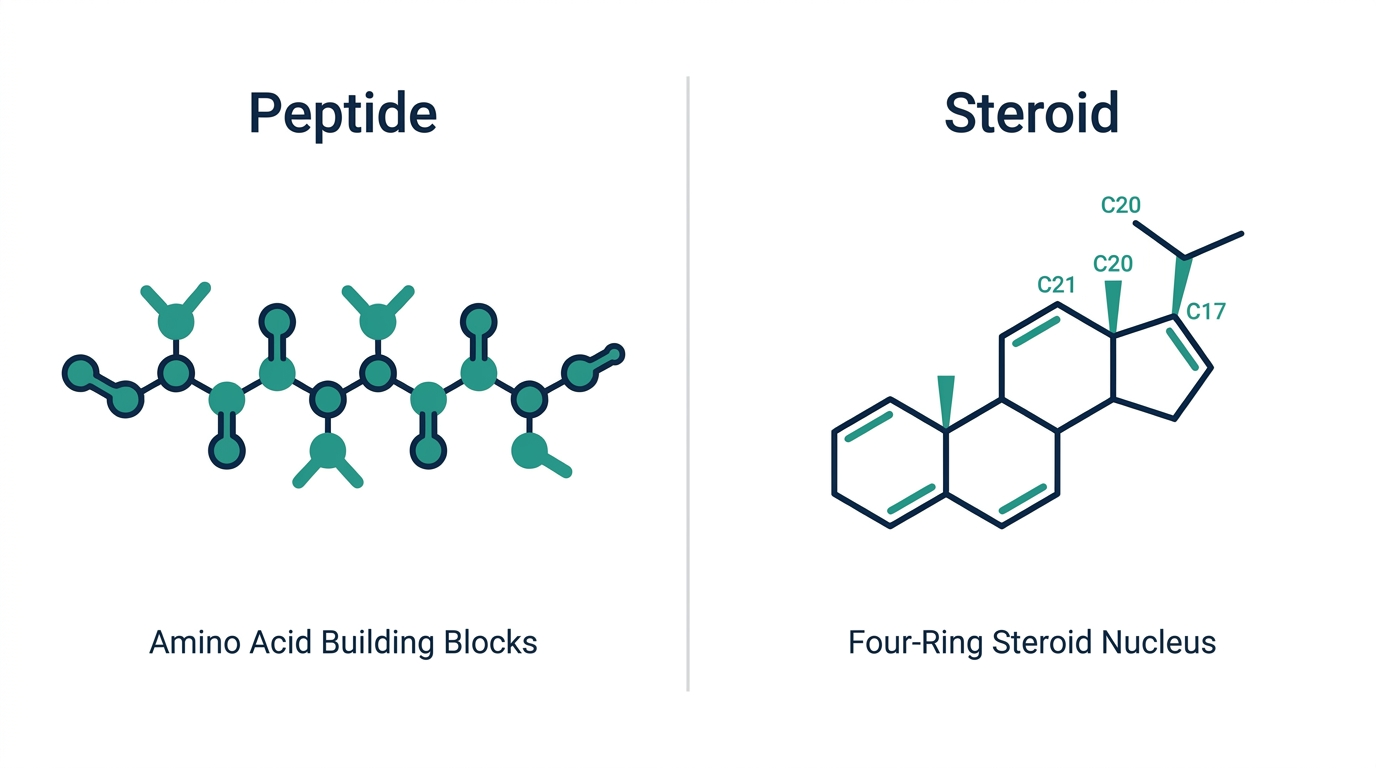
A peptide is a short chain of amino acids connected by peptide bonds. Two amino acids linked together form a dipeptide. Fifty amino acids linked together form a polypeptide. Proteins are simply very long polypeptide chains; the distinction between “peptide” and “protein” is mostly one of length, with the convention drawing the line around 50 amino acids.
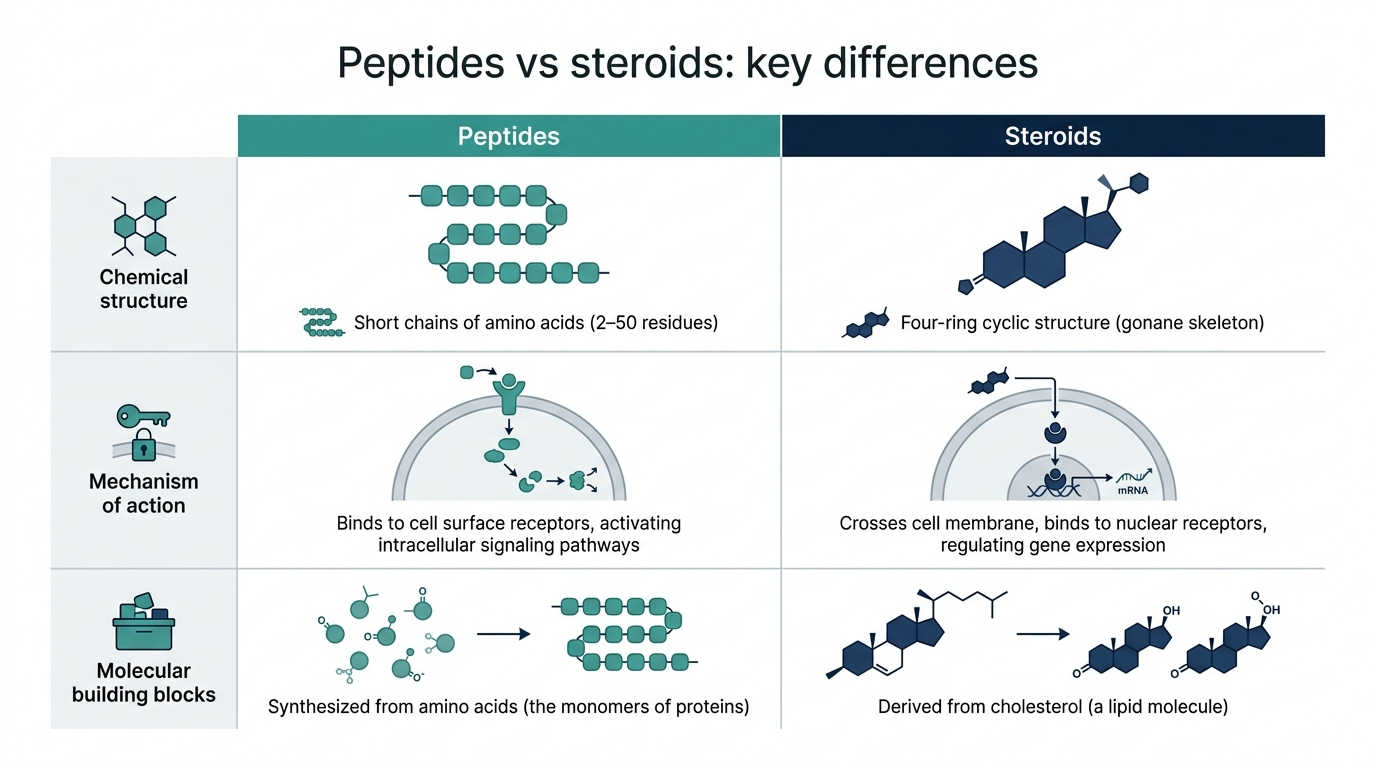
Your body already makes thousands of peptides naturally. Insulin is a peptide. Oxytocin is a peptide. Growth hormone releasing hormone (GHRH) is a peptide. GLP-1, the molecule that drugs like semaglutide (Ozempic, Wegovy) mimic, is a peptide. Even the collagen in your skin is a protein made of repeating peptide sequences. Peptide hormones are water-soluble and travel freely in the bloodstream, which means they bind to receptors on the outside of cells, triggering internal signaling cascades through secondary messengers like cyclic AMP.
Peptides do not enter the cell nucleus. That matters enormously, as we will see in a moment.
Therapeutically, the word “peptide” now covers everything from collagen powder stirred into coffee to injectable research compounds to FDA-approved GLP-1 drugs prescribed by physicians. The category is extraordinarily broad, and that breadth is part of why it gets conflated with steroids.
What exactly is a steroid?
Steroids are a class of organic compounds defined by a specific four-ring carbon skeleton called the sterane nucleus. Every steroid shares this structure, regardless of what it does biologically. All steroid hormones are derived from cholesterol, synthesized primarily in the adrenal glands, gonads, and placenta.
Your body makes steroids too. Cortisol is a steroid. Estrogen is a steroid. Testosterone is a steroid. Aldosterone, which regulates blood pressure, is a steroid. Vitamin D, structurally, is a steroid. When people say “steroids” in the context of athletics or performance, they almost always mean anabolic-androgenic steroids (AAS): synthetic derivatives of testosterone engineered to maximize muscle-building (anabolic) effects while minimizing, though never eliminating, masculinizing (androgenic) effects.
Because steroids are lipid-soluble rather than water-soluble, they do something peptides cannot: they pass straight through the cell membrane without needing a surface receptor. Once inside, they bind to intracellular receptors. The steroid-receptor complex then migrates into the nucleus, attaches to specific DNA sequences called steroid response elements (SREs), and directly influences which genes get activated or suppressed. This is genomic action. Peptides, working from the cell surface, trigger signaling cascades. Steroids walk into the control room and change the wiring.
The structural comparison side by side
| Feature | Peptides | Anabolic Steroids |
|---|---|---|
| Chemical class | Amino acid polymer | Cholesterol-derived lipid |
| Solubility | Water-soluble | Fat-soluble (lipophilic) |
| Receptor location | Cell surface (membrane receptors) | Intracellular (cytoplasm / nucleus) |
| Mechanism | Signal transduction, second messengers | Direct gene transcription regulation |
| Body produces naturally? | Yes (insulin, GLP-1, oxytocin, etc.) | Yes (testosterone, cortisol, estrogen) |
| Synthetic versions used clinically? | Yes (semaglutide, sermorelin, BPC-157) | Yes (testosterone replacement, prednisone) |
| Speed of effect | Faster onset, shorter duration | Slower onset, longer duration |
| Degraded by | Proteases (broken into amino acids) | Liver enzymes (CYP450 system) |
| U.S. legal status (synthetic) | Mostly unscheduled; some FDA-approved | Schedule III controlled substance |
| Post-cycle suppression | Typically none | HPTA shutdown in almost all cases |
Why do people confuse them?
The confusion has at least three sources, and none of them are stupid.
First, both classes include hormones. Testosterone (a steroid) and growth hormone (a protein/peptide) are both “hormones.” Both can be prescribed. Both are misused in athletics. The word “hormone” does not specify molecular class, so the two categories blur together in casual conversation.
Second, research peptides are sold in vials that look exactly like injectable steroids. The freeze-dried powder, the bacteriostatic water, the insulin syringe, the subcutaneous or intramuscular injection: the ritual is identical. If you only see the packaging, you cannot tell the difference. The underground gym market historically grouped everything injectable under the informal label “gear,” which is how peptides end up in the same mental drawer as Deca and Trenbolone.
Third, some peptides are genuinely designed to influence the same hormonal axes that steroids affect. CJC-1295 and Ipamorelin, for instance, stimulate the pituitary to release more growth hormone. That is different from injecting synthetic GH directly, but the goal, more GH activity, overlaps. People hear “growth hormone peptide” and assume it is a synonym for “growth hormone steroid,” which is not a thing that exists, but the conflation feels logical if you do not know the mechanism.
Personally, I think the conflation is also partly marketing. Calling a peptide a “natural steroid alternative” is a phrase designed to borrow the known potency of steroids while disclaiming the risks. That framing is misleading in both directions: peptides are generally not as potent as AAS for rapid hypertrophy, and they are not primarily interesting because of what steroids do. They are interesting for entirely different reasons.
How do their effects actually differ?
Anabolic steroids work broadly. When testosterone or a synthetic AAS binds to androgen receptors, it affects every tissue that carries those receptors, which is most of the body. You get increased muscle protein synthesis, yes, but also increased red blood cell production, accelerated bone density changes, altered lipid metabolism, effects on the brain and mood, androgenic effects on hair follicles and skin, and, critically, suppression of the hypothalamic-pituitary-testicular axis (HPTA).
HPTA suppression means the brain detects excess androgens and stops sending the signals that prompt your testes to make testosterone. During a steroid cycle, your natural testosterone production approaches zero. Post-cycle therapy with SERMs like tamoxifen or clomiphene is considered essential in harm-reduction practice because without it, recovery of natural testosterone can take months and sometimes fails to complete. That is not a fringe side effect. It is the expected pharmacological response to exogenous androgen use, and the estimated overall mortality risk among chronic AAS abusers is roughly double or triple that of the general male population.
Peptides, by contrast, work through narrower, more targeted pathways. A growth hormone secretagogue like Ipamorelin stimulates the pituitary’s GHRP receptors to pulse out more GH, but only through the body’s own control system. Because the HPTA is not directly suppressed, no post-cycle therapy is needed. A gut-repair peptide like BPC-157 appears to work primarily through the nitric oxide system and local growth factor signaling in injured tissue, with effects concentrated near the site of injury. It does not tank your testosterone in the process.
Do not believe the claim, common in fitness forums, that “peptides are just safer steroids.” They are not safer versions of the same thing. They are different tools for different purposes. BPC-157 cannot do what testosterone propionate does. Testosterone propionate cannot do what BPC-157 does. Comparing them directly is like asking whether a scalpel is a safer wrench.
What is the legal difference?
This is where the distinction matters most practically.
Anabolic steroids are Schedule III controlled substances under the U.S. Controlled Substances Act, meaning possession without a valid prescription is a federal crime. The Anabolic Steroid Control Act of 2004 closed the designer-steroid loophole that had let prohormones skate through the 1990s. WADA bans nearly every anabolic steroid from competition, with no therapeutic use exemption pathway for most.
Most research peptides occupy a fundamentally different legal space. TB-500, for example, is not a DEA-scheduled controlled substance. Neither is BPC-157, CJC-1295, Ipamorelin, or most of the compounds you will encounter in the research-peptide market. Selling them “for research use only” is legal. Using them on yourself is a different, murkier question, but you are not committing a federal drug possession crime in the way that carrying testosterone cypionate without a prescription would be.
The regulatory landscape for peptides is shifting fast in 2026. In February 2026, HHS Secretary Kennedy announced that roughly 14 peptides, including BPC-157, TB-500, CJC-1295, and Ipamorelin, are expected to move back toward compounding-eligible status, after the FDA had placed them in a restricted Category 2 list in late 2023. A Pharmacy Compounding Advisory Committee (PCAC) meeting scheduled for July 23 to 24, 2026, will evaluate specific compounds for reclassification. If reclassified to Category 1, licensed 503A compounding pharmacies could dispense them with a physician prescription. That is not FDA approval of the compounds as finished drugs, but it opens a legitimate clinical pathway that did not exist before.
For FDA-approved peptides, the path is already clear: semaglutide (Ozempic, Wegovy) and tirzepatide (Mounjaro, Zepbound) are fully legal prescription drugs dispensed through licensed pharmacies, with the weight-loss data to back them up. In head-to-head comparisons, tirzepatide at 15 mg produced approximately 17.8% mean body weight loss versus 13.9% with semaglutide 2.4 mg. These are peptides by chemistry and FDA-approved pharmaceuticals by regulatory status simultaneously.
Which peptides actually have clinical evidence?
The evidence base varies enormously across the peptide category, and conflating FDA-approved GLP-1 drugs with grey-market research compounds is another version of the same confusion.
Strong, FDA-approved evidence: Semaglutide and tirzepatide for weight loss and type 2 diabetes. Sermorelin and tesamorelin for growth hormone deficiency. Insulin and its analogues for diabetes. These are peptides in the strict chemical sense and approved drugs in the regulatory sense.
Early but promising human evidence: BPC-157 has only three published human studies as of March 2026, all small pilot studies, but a randomized, double-blind, placebo-controlled Phase 2 trial evaluating its effect on acute hamstring muscle strain is now registered on ClinicalTrials.gov (NCT07437547). A 2025 systematic review in Orthopaedic Sports Medicine noted that preclinical evidence is compelling but human data is still too limited to draw firm clinical conclusions.
Cosmetic with real data: Topical GHK-Cu (copper peptide) has 50 years of research behind it. A 2023 double-blind split-face study in 60 participants aged 40 to 65 found a 0.05% GHK-Cu serum produced a 22% increase in skin firmness and 16% reduction in fine lines at 12 weeks by optical profilometry, per Grand Ingredients’ review of the clinical evidence. That is modest but real, and entirely different from what injectable steroids do to skin.
Mostly preclinical: TB-500, Melanotan II, AOD-9604, and most growth hormone secretagogues have animal data but limited controlled human trials. Strong rodent results repeatedly fail to translate cleanly to humans in pharmacology, which is worth keeping front of mind.
What about peptides and sports testing?
Here the regulatory worlds cross. WADA bans many peptides in competition, including all growth hormone releasing peptides (GHRPs) and growth hormone releasing hormones (GHRHs), because the intent, to elevate GH levels above natural baseline, is the same as if you injected synthetic GH, even if the mechanism is different. The legality in civil law (no federal Schedule III status) does not mean permissibility in sport. If you are a tested athlete and your sport uses WADA rules, assume any peptide that influences GH or IGF-1 is banned and verify before using it.
This catches people off guard: something legal to possess in the U.S. can simultaneously be banned by your sport’s governing body. Those are two separate frameworks with no obligation to align.
Anabolic steroids are banned in virtually every major sport, full stop, with no nuance needed. This is one area where the two categories converge: both are performance-relevant, both are routinely tested for, and both will end a competitive career if found.
The myth worth busting
The most persistent myth in this space is that peptides are a “clean” version of what steroids do. This framing appears constantly in supplement marketing and casual fitness advice, and it is wrong in a specific way worth naming.
The claim implies a spectrum where steroids are at one extreme and peptides are the tame version of the same thing. But peptides and steroids do not occupy two ends of one spectrum. They are different categories entirely. A GH secretagogue peptide does not do a weaker version of what testosterone does. It does something that testosterone does not do at all: stimulate pulsatile GH release through the pituitary axis without suppressing your own testosterone. Comparing BPC-157 to Trenbolone and calling one “cleaner” is a category error, like saying peppermint tea is a cleaner version of whiskey because both are liquids.
Where the framing does partial justice to reality is on side-effect profile: for most people, most peptides carry fewer severe or irreversible risks than anabolic steroids, not because peptides are weaker steroids, but because they do not trigger HPTA shutdown, do not cause the same cardiovascular and hepatic strain, and do not produce the androgenic effects that drive acne, hair loss, and virilization. That difference is real. It just does not come from peptides being “natural steroids.” It comes from them being a different class of compound entirely.
Full-body lab membership: 100+ biomarkers, doctor-reviewed, tracked over time.
The practical decision map
If you are trying to figure out which lane applies to you, the honest map looks like this:
You want medically supervised weight loss: The peptide lane is already the mainstream clinical lane. Semaglutide and tirzepatide are prescription peptides accessible through thousands of telehealth providers. Steroids are not indicated for weight loss and introduce hormonal risks that compound the metabolic problems you are trying to solve.
You want testosterone replacement for clinically low testosterone: This is the legitimate steroid lane, prescription testosterone is an FDA-approved steroid hormone therapy, accessible through licensed men’s health clinics like Defy Medical or Hone Health. Research peptides are not testosterone and cannot substitute.
You want tissue repair or recovery support: BPC-157 and TB-500 sit in the thawing grey zone, likely moving toward licensed compounding by late 2026. The legal clinical route is emerging; the research-chemical route is available now but carries purity and accountability risks.
You want skin anti-aging without injections: Topical copper peptides (GHK-Cu) are openly sold, cosmetically effective at studied concentrations, and carry no comparison to steroids whatsoever.
You want rapid, dramatic muscle mass gains: This is what anabolic steroids do better than any peptide currently available. The tradeoff is Schedule III status, HPTA suppression, cardiovascular risk, and all the clinical weight that comes with that.
Curious what your own levels look like?
Baseline 100+ biomarkers today and retest as life changes, all in one membership with physician review.
Frequently asked questions
Are peptides classified as steroids legally in the U.S.?
No. Anabolic steroids are Schedule III controlled substances under the Anabolic Steroid Control Act. Most research peptides are not scheduled substances under DEA classification. FDA-approved peptide drugs like semaglutide are regulated as prescription pharmaceuticals, not controlled substances.
Can peptides suppress testosterone like steroids do?
Most research peptides do not suppress the hypothalamic-pituitary-testicular axis (HPTA). Growth hormone secretagogues like Ipamorelin and CJC-1295 stimulate GH without directly affecting testosterone production. Anabolic steroids suppress testosterone production in virtually every user, often requiring post-cycle therapy for recovery. This is one of the most meaningful clinical differences between the two classes.
Are GLP-1 drugs like Ozempic peptides or steroids?
Peptides. Semaglutide (Ozempic, Wegovy) and tirzepatide (Mounjaro, Zepbound) are synthetic peptides that mimic naturally occurring gut hormones. They are not steroids by any chemical or regulatory definition. They are FDA-approved prescription drugs for type 2 diabetes and obesity.
Can you get drug-tested for peptides in sport?
Yes. WADA bans most growth hormone releasing peptides and secretagogues in competition, including all GHRPs and GHRHs. Peptides are not Schedule III substances in U.S. civil law, but “legal to possess” and “permitted in sport” are two separate frameworks. If you are a tested athlete, verify any peptide against WADA’s prohibited list before use.
Are peptides safer than steroids?
For most people considering them for recovery or anti-aging, research peptides carry a different and generally less severe risk profile than anabolic steroids, specifically because they do not cause HPTA suppression, hepatotoxicity, or the androgenic effects associated with AAS. However, “safer” is not a binary, and the research base for most injectable research peptides in humans is still thin. The meaningful comparison is against the peptide’s specific risks, not against steroids as a category.
Are collagen peptides anything like steroids?
No. Collagen peptides are short amino acid chains derived from hydrolyzed collagen protein, taken orally as a supplement, and have no hormonal activity. They are not injected, not regulated as drugs, and bear no meaningful relationship to steroids or to injectable research peptides. The word “peptide” covers a very wide range.
Is BPC-157 a steroid?
No. BPC-157 is a 15-amino acid synthetic peptide, not a steroid. It has no four-ring carbon structure, no androgenic activity, and does not suppress the HPTA. As of April 2026, the FDA removed BPC-157 from its Category 2 restricted list, and it is expected to move toward compounding-eligible status following the July 2026 PCAC meeting. It remains a research peptide without FDA drug approval as of this writing.
Author: [CAN XAC NHAN: ten + credential tac gia/reviewer health cua Vital Signs Today, vd “Medically reviewed by [name], [credential]”]. Educational content, not medical advice. Sources linked inline.
Full-body lab membership: 100+ biomarkers, doctor-reviewed, tracked over time.
Primary sources
- Biology LibreTexts: Types of Hormones
- Creative Proteomics: Steroid Hormones vs Peptide Hormones
- ScienceDirect: Steroid Hormone overview
- DEA: Drug Scheduling
- Evolutionary.org: How Testosterone Supplementation Shuts Down HPTA
- Gameday Men’s Health: Are Peptides Steroids?
- Peptides.org: Peptides vs Steroids
- Meto.co: FDA Peptide Approval 2026
- BSCG: What’s Changing With Peptide Regulation in 2026
- PMC: Tirzepatide vs Semaglutide Systematic Review
- Sage Journals: BPC-157 in Orthopaedic Sports Medicine 2025
- ClinicalTrials.gov: BPC-157 Hamstring Strain Trial NCT07437547
- Grand Ingredients: GHK-Cu Clinical Evidence
- Superpower: Biomarker Blood Testing
Related reading
Vital Signs Today may earn a commission if you buy through links on this page. It does not affect our editorial assessments.