Last updated 18 June 2026. Educational content, not medical advice. Prescription peptides require a licensed clinician. Research peptides are not approved for human use. Talk to your doctor before starting anything.
Short answer: FDA-approved peptides for weight loss, specifically semaglutide (Wegovy) and tirzepatide (Zepbound), are the most rigorously tested weight-loss drugs in history, and they are considered safe for most adults under medical supervision. Unregulated “research peptides” sold online are a different category entirely: independent testing found purity as low as 5% in some samples, and the FDA has received more than 455 adverse event reports linked to compounded semaglutide alone as of early 2025. The safety question is not really about “peptides” as a single bucket. It is about which peptide, from which source, under what oversight.
Semaglutide and tirzepatide are the most tested weight-loss drugs in history, but do you know your own metabolic starting point? One at-home Superpower draw checks 100+ biomarkers, physician-reviewed.
What exactly is a “weight-loss peptide”?
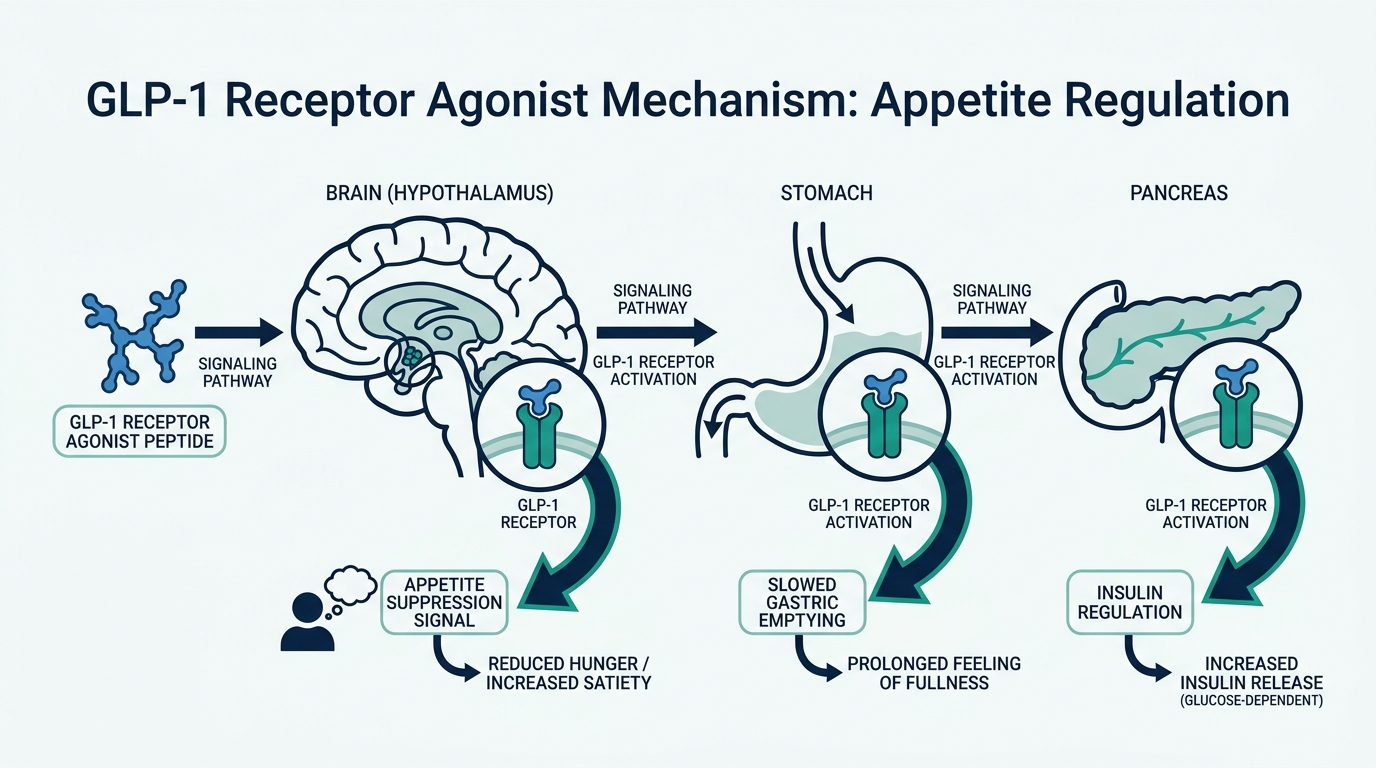
The word peptide covers an enormous range. A peptide is simply a chain of amino acids, shorter than a full protein, that signals cells to do something. When people ask whether peptides are safe for weight loss, they are usually thinking of one of three very different categories, and those categories have almost nothing in common from a safety standpoint.
The first category is FDA-approved incretin drugs: semaglutide and tirzepatide, both of which are peptide hormones that mimic and amplify natural gut signals that suppress appetite and slow gastric emptying. These have undergone Phase 3 trials with tens of thousands of participants, carry full prescribing information, and are available only by prescription.
The second category is growth-hormone secretagogues: peptides like sermorelin, CJC-1295, and ipamorelin, which stimulate the pituitary gland to release more growth hormone. These are available through telehealth clinics with a prescription, but their evidence base for weight loss specifically is far thinner than the GLP-1 drugs.
The third category is research peptides: unregulated compounds like AOD-9604, melanotan, and others sold online “for laboratory research only.” These have no FDA approval, no mandatory quality control, and no clinician standing behind the dose on the label.
The confusion between these three lanes is where most of the dangerous decisions happen.
How well do FDA-approved weight-loss peptides actually work?
The simplest way to actually get this done
Superpower is a full-body lab membership that runs 100+ biomarkers, has each result reviewed by a doctor, and tracks your numbers year over year (about $199/year). It is what we point readers to when they would rather get one clean, complete draw than chase single tests one at a time. Here is superpower reviewed in full.
The efficacy data for the approved GLP-1 drugs is genuinely striking. In the SURMOUNT-1 trial, participants on the highest tirzepatide dose lost an average of 22.5% of their body weight over 72 weeks. That is roughly 52 pounds from a 230-pound starting weight, on medication alone.
Semaglutide (Wegovy) achieved an average 14.9% body weight reduction in its pivotal STEP 1 trial, published in the New England Journal of Medicine. Both numbers dwarf anything that had been achieved with previous weight-loss medications.
Retatrutide, a triple-receptor agonist from Eli Lilly targeting GLP-1, GIP, and glucagon receptors simultaneously, now has Phase 3 data. The TRIUMPH-1 trial results announced May 21, 2026 showed an average 28.3% body weight loss at 80 weeks at the 12 mg dose, with those starting above a BMI of 35 losing up to 30.3% of body weight (an average 85 pounds) by week 104. Retatrutide is not yet FDA-approved; it is still moving through the approval process.
The critical point for the safety question: these numbers come from supervised clinical trials where every adverse event was captured, measured, and reported. The same cannot be said for anything bought from an unregulated online vendor.
Full-body lab membership: 100+ biomarkers, doctor-reviewed, tracked over time.
What are the real side effects of GLP-1 weight-loss peptides?
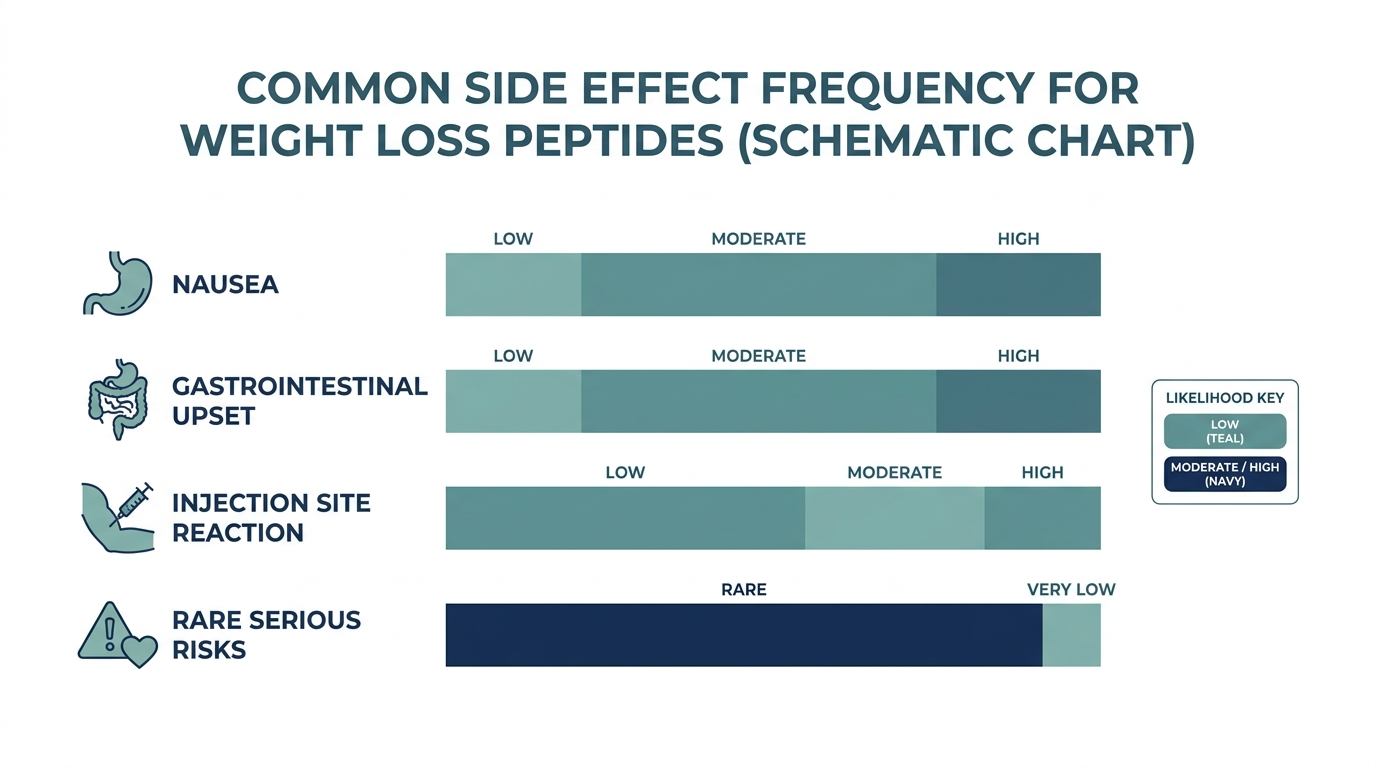
The approved GLP-1 drugs are well-documented: the side effect profile is dominated by gastrointestinal symptoms. In TRIUMPH-1, nausea occurred in 42.4% of participants on the 12 mg retatrutide dose, vomiting in 25.3%, and diarrhea in 32.0%. These numbers are consistent with what was seen in semaglutide and tirzepatide trials. Most GI side effects are dose-dependent, meaning they peak during dose escalation and taper as the body adjusts.
The side effects people do not hear enough about are the structural ones.
Lean mass loss. In the SURMOUNT-1 DXA substudy of 255 participants, roughly 25% of total weight lost was lean mass, not fat. The three-to-one fat-to-muscle ratio is better than caloric restriction alone, but it is not zero. Research published in 2025 in Diabetes, Obesity and Metabolism confirmed these SURMOUNT-1 body composition findings. Losing 15% of body weight but 25% of that from muscle has real implications for metabolism and function, particularly for older adults.
Bone density. A 2024 randomized controlled trial found that 52 weeks of once-weekly semaglutide reduced hip bone mineral density by 2.6% and lumbar spine density by 2.1% compared to placebo, with increased bone resorption. GoodRx’s analysis of GLP-1 bone effects notes that fractures remain rare but risk is elevated for women and adults over 75.
Ozempic face. The rapid loss of subcutaneous facial fat produces sunken cheeks, loss of skin elasticity, and more prominent bone structure. Dr. Paul Jarrod Frank coined the term after seeing it repeatedly in patients. Dermatology literature now covers it formally. This is a direct consequence of rapid fat loss, not a unique drug effect, and it happens faster with GLP-1 drugs than with any previous weight-loss method.
The thyroid cancer question. The FDA carries a boxed warning about medullary thyroid carcinoma (MTC) on all GLP-1 drugs. A 2026 analysis published in Diabetes, Obesity and Metabolism examined clinical trial data and post-marketing surveillance and found no meaningful association between liraglutide or semaglutide use and thyroid cancer risk in humans. The MTC signal originated in rodent studies at doses far above clinical levels. The boxed warning remains as a precaution, but the human data, so far, does not support the fear.
Pancreatitis. Early concerns about acute pancreatitis with GLP-1 drugs have not been substantiated. Long-term cardiovascular outcome trials and a 2025 propensity-matched U.S. study in PMC found GLP-1 users had no elevated pancreatitis risk and, in some analyses, a lower lifetime risk.
Personally, the bone density finding is the one I think gets undersold by the telehealth marketing material. Anyone over 45 starting a GLP-1 drug who is not specifically addressing calcium, vitamin D, and resistance training is taking a risk that will not show up until years later.
Do growth-hormone secretagogues help with weight loss?
Sermorelin, CJC-1295, ipamorelin, and related secretagogues are in a different class from GLP-1 drugs, with a much thinner clinical evidence base for weight loss specifically.
Sermorelin is FDA-approved to treat growth hormone deficiency in children, and it is available through telehealth clinics with a prescription for adult off-label use. Through licensed telehealth providers, it runs $175 to $225 a month. The weight-loss mechanism is indirect: higher GH pulses can improve body composition, shifting fat-to-muscle ratio over months, not the acute appetite suppression of a GLP-1 drug.
CJC-1295 and ipamorelin are not FDA-approved medications. Their evidence base for weight loss is limited to small, early-phase studies, and no randomized controlled trials specific to these peptides were listed on ClinicalTrials.gov as of February 2026. The commonly reported side effects are mild: water retention, injection-site reactions, headache, and tingling. What is unknown is more important than what is known.
Do not believe anyone who presents these as equivalent to tirzepatide or semaglutide for weight loss. The GLP-1 drugs have Phase 3 trial data in thousands of people. The secretagogues have case reports and forum threads. Those are not the same level of evidence.
What about research peptides sold online?
AOD-9604 is a useful case study. It is a fragment of human growth hormone that was specifically developed for weight loss by Metabolic Pharmaceuticals in Australia. It entered human trials, showed early promise in a 12-week study (2.6 kg vs. 0.8 kg for placebo), and then failed to induce significant weight loss in a 24-week Phase 2b trial of 536 subjects. Development was halted in 2007. It has never been approved by the FDA, and as of April 2026 it cannot be obtained through US compounding pharmacies.
That story matters because it illustrates the full arc: a peptide designed for weight loss, funded for clinical development, tested in human trials, with a good safety record, that nevertheless did not clear the efficacy bar. The research peptides sold by online vendors have not cleared any clinical bar at all, and their purity track record is grim. The FDA had received more than 455 adverse event reports linked to compounded semaglutide as of early 2025, many involving dosing errors from patients self-administering from multidose vials with no clinical support.
Independent testing of peptide samples has found purity results ranging from 5% to over 99%. Independent testing data cited by PBS NewsHour showed only 78% of samples were “acceptable” by purity, identity, and quantity standards, meaning more than one in five vials tested failed on at least one dimension.
The research-use-only label is not a technicality you can wave off. It is the entire legal framework that lets these compounds be sold. It transfers every risk of purity, dosing, and safety to you.
Telehealth GLP-1 program with provider visits and pharmacy coordination.
How to actually preserve muscle while losing weight on peptide therapy
This is the insider knowledge that most people starting GLP-1 therapy do not get at their first telehealth intake. The SURMOUNT-1 body composition data makes the risk plain, but the clinical literature on how to address it is also clear.
A 2026 review published in Pharmaceuticals on optimizing GLP-1 weight loss found that resistance training combined with adequate protein intake can reduce lean mass loss by 50% to 95% compared to dietary restriction alone. The recommended protein intake for someone on a GLP-1 drug is 1.2 to 1.6 grams per kilogram of body weight per day, which is meaningfully higher than the average American’s intake and often hard to hit when appetite is suppressed to the point the drug achieves.
A 2025 PMC study on protein intake in GLP-1 users found that most GLP-1 users hit hypocaloric intake levels that make adequate protein intake genuinely difficult without intentional planning. The suppressant works so well that patients often cannot eat enough of anything, protein included.
The practical upshot: if your telehealth provider prescribes a GLP-1 drug and does not also discuss protein targets and resistance exercise, that conversation is missing. You should ask for it.
A very early-stage finding that is worth watching: in a Phase 2 study, combining semaglutide with bimagrumab, a myostatin inhibitor, lowered the lean-mass fraction of total weight loss to roughly 7%, versus the 25% seen with semaglutide alone. This is not available outside a trial, but it suggests the lean-mass problem may be pharmacologically solvable within a few years.
Peptide weight-loss comparison: what the evidence actually says
| Peptide / class | Approval status | Clinical evidence for weight loss | Typical weight-loss result | Main safety concerns |
|---|---|---|---|---|
| Semaglutide (Wegovy) | FDA-approved | Robust Phase 3 (STEP 1 trial) | ~14.9% body weight | GI side effects, lean mass loss, bone density |
| Tirzepatide (Zepbound) | FDA-approved | Robust Phase 3 (SURMOUNT-1) | ~22.5% body weight | GI side effects, lean mass loss |
| Retatrutide | Phase 3 complete, not yet approved | TRIUMPH-1 Phase 3 data (2026) | ~28.3% body weight | GI side effects including dysesthesia 12.5% |
| Liraglutide (Saxenda) | FDA-approved | Phase 3 data | ~8% body weight | GI side effects, heart rate increase |
| Sermorelin | FDA-approved (peds GHD); off-label adult | Limited; indirect via GH | Modest; body composition improvement | Water retention, cortisol changes |
| CJC-1295 / Ipamorelin | Not FDA-approved | Small early-phase studies only | Not established | Unknown long-term profile |
| AOD-9604 | Not FDA-approved | Phase 2b failed efficacy bar (2007) | Not established | Good safety record, no efficacy |
| Research peptides (generic) | Not FDA-approved | None for human weight loss | Unknown | Purity 5-99%, no oversight, dosing errors |
The gap between the top half and the bottom half of that table is not a nuance. It is the difference between a drug that has been tested in thousands of people with every adverse event captured versus a compound where the only thing standing between you and a contaminated vial is a PDF you probably cannot verify.
What does getting a peptide prescription actually cost?
The cost landscape shifted significantly in 2026. The FDA proposed in April 2026 to remove semaglutide, tirzepatide, and liraglutide from the 503B bulks list, with the comment period closing June 29, 2026. If finalized, this closes the last major avenue for large-scale compounding of GLP-1 drugs, which has been the engine behind the $199 to $299 compounded programs offered by telehealth platforms.
For brand-name drugs, Zepbound starts at $299/month at Ro for cash-pay patients, with 43% of insured users paying $50/month or less. Compounded GLP-1 programs that are still operating within compliant 503A pathways (small-volume pharmacy for individual patients) run approximately $199 to $299/month. Brand-name tirzepatide and semaglutide at retail without insurance can exceed $1,000/month.
Sermorelin through telehealth clinics like Marek Health, Defy Medical, or Hone Health runs $175 to $225 a month.
None of this is covered by insurance for weight loss as the primary indication. Budget for it before you start, not after your third invoice.
Don’t just read about your health, track it.
A single result is a snapshot. Superpower re-tests 100+ markers over time so you can watch them move as you change sleep, food, and training.
Frequently asked questions
Are peptides safe for weight loss?
FDA-approved peptide drugs (semaglutide, tirzepatide, liraglutide) are safe for most adults under medical supervision, with well-documented but manageable side effects. Unregulated research peptides sold online carry unknown purity, no clinical validation, and no oversight. The answer depends entirely on which peptide and from which source.
What is the safest peptide for weight loss?
The safest options are the FDA-approved GLP-1 drugs: tirzepatide (Zepbound) and semaglutide (Wegovy). Both have undergone extensive Phase 3 trials and have established safety profiles monitored by post-market surveillance. They require a prescription from a licensed clinician, which is part of what makes them safer, not an obstacle to access.
Do weight-loss peptides cause muscle loss?
Yes, to some extent. In SURMOUNT-1, roughly 25% of total weight lost on tirzepatide was lean mass. Resistance training plus 1.2 to 1.6 g of protein per kilogram of body weight daily can substantially offset this. Lean mass loss is not unique to peptide therapy; it occurs with all forms of significant caloric restriction.
Is retatrutide safe?
The TRIUMPH-1 Phase 3 trial reported May 2026 showed GI side effects (nausea 42.4%, vomiting 25.3%, diarrhea 32.0%) and a skin tingling side effect (dysesthesia) in 12.5% of participants at the highest dose. The discontinuation rate due to adverse events was 11.3%. Retatrutide is not FDA-approved as of June 2026.
Are compounded semaglutide and tirzepatide still available?
The FDA has received more than 455 adverse event reports tied to compounded semaglutide, largely from dosing errors. Large-scale 503B compounding of GLP-1 drugs is being shut down, with an FDA proposal published April 30, 2026 pending finalization. Small-volume 503A compounding for individual patients may continue under specific clinical conditions. The landscape is changing week to week.
What happens if you stop taking weight-loss peptides?
Most of the weight returns. Trials consistently show that stopping GLP-1 therapy leads to regain of roughly two-thirds of the weight lost within a year. This is not a willpower problem; it reflects that the underlying appetite-suppression mechanism disappears with the drug. Long-term use or very gradual taper with lifestyle maintenance is the clinical consensus for durable outcomes.
Can I buy weight-loss peptides without a prescription?
You can buy compounds labeled “research use only” from online vendors without a prescription. This is not the same as safe access to a weight-loss treatment. It means the compound has not been approved for human use, carries no guarantee of purity, and has no licensed clinician, pharmacist, or monitoring attached to it. For any peptide you actually intend to use on yourself, the prescription route is the only one with real accountability behind it.
Telehealth GLP-1 program with provider visits and pharmacy coordination.
Author: Vital Signs Today Editorial Team, [credential]”]. Educational content, not medical advice. Sources linked inline.
Primary sources:
– Eli Lilly TRIUMPH-1 Phase 3 results (May 2026)
– Lilly SURMOUNT-1 NEJM publication press release
– SURMOUNT-1 DXA body composition substudy, DOM 2025
– GLP-1 thyroid cancer risk analysis, DOM 2026
– GLP-1 pancreatitis propensity-matched analysis, PMC 2025
– FDA proposal to remove GLP-1 drugs from 503B bulks list (April 2026)
– GLP-1 muscle preservation review, Pharmaceuticals 2026
– Protein intake in GLP-1 users, PMC 2025
– Ozempic face systematic review, PMC 2025
– PBS NewsHour: Are peptides safe?
– Superpower blood biomarker testing
Want a real clinician to run the numbers, not a guess?
Joi + Blokes is a telehealth clinic that prescribes GLP-1 medication (Zepbound, compounded semaglutide and tirzepatide), hormone therapy (TRT, HRT), thyroid care, and peptides after a real lab panel and clinician review, with no membership or consult fee (prescriptions from about $59/month, lab panels from $149). If the scale will not budge, this is where you find out whether insulin, thyroid, or hormones are the real reason. Here is Joi + Blokes reviewed in full.
Related reading
Related: best GLP-1 telehealth providers for 2026.
Vital Signs Today may earn a commission if you buy through links on this page. It does not affect our editorial assessments.