
Last updated 18 June 2026. Educational content, not medical advice. Retatrutide is an investigational drug not approved by the FDA. Talk to a licensed clinician before making any weight-management decision.
Short answer: As of June 2026, the only fully legal way to get pharmaceutical-grade retatrutide is enrollment in Eli Lilly’s TRIUMPH Phase 3 clinical trial program, searchable on ClinicalTrials.gov using the keyword “retatrutide.” Compounding pharmacies cannot legally dispense it. Research-chemical vendors sell it labelled “for research use only,” which is a legal fiction that transfers all risk to the buyer and carries serious quality concerns backed by independent testing data.
Retatrutide is only available through a clinical trial right now, so what can you check about your metabolism in the meantime? One at-home Superpower draw checks 100+ biomarkers, physician-reviewed.
Why is everyone suddenly searching for retatrutide?
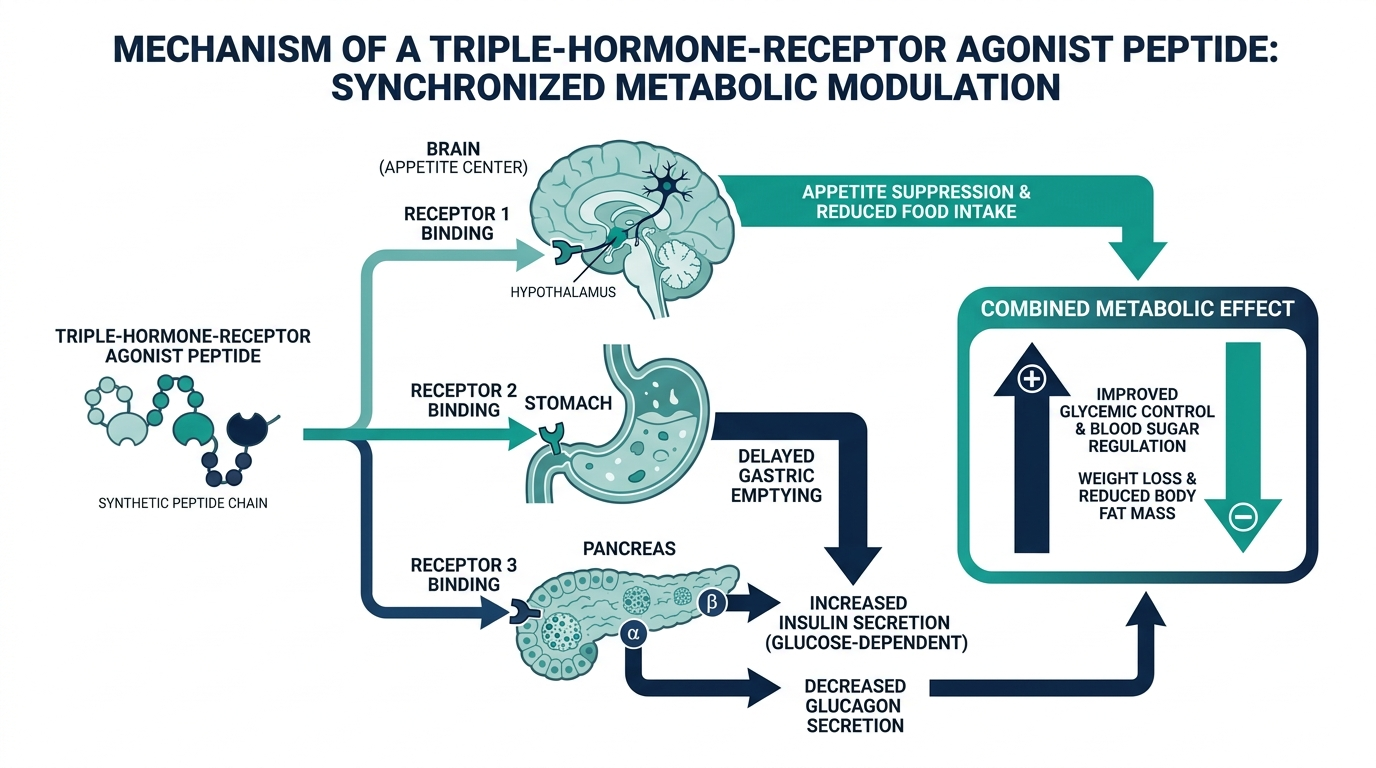
Because the trial data is genuinely jaw-dropping, and word travels faster than FDA approvals do.
On May 21, 2026, Eli Lilly announced the topline results of TRIUMPH-1, the pivotal Phase 3 obesity trial for retatrutide. Adults with obesity taking the 12 mg weekly dose lost an average of 70.3 lbs, equal to 28.3% of starting body weight, over 80 weeks across 2,339 participants. Among people with a starting BMI of 35 or higher who stayed on the drug through 104 weeks, average weight loss reached 30.3%, an average of 85 lbs. For context: 45.3% of participants lost at least 30% of their body weight. That threshold had previously been associated almost exclusively with bariatric surgery.
That is not a rounding error over semaglutide or tirzepatide. It is a category shift. So when people ask “where to get retatrutide,” they are asking because the data looks better than anything currently on the market. That motivation is completely understandable. The honest answer to their question is more complicated than most vendor pages admit.
Full-body lab membership: 100+ biomarkers, doctor-reviewed, tracked over time.
How does retatrutide actually work, and why do the numbers look so different?
Semaglutide (the active ingredient in Wegovy) is a GLP-1 receptor agonist. It mimics one gut hormone. Tirzepatide (Zepbound) adds a second target, GIP. Retatrutide goes a step further: it simultaneously activates GLP-1, GIP, and the glucagon receptor, giving it three independent mechanisms to suppress appetite, improve insulin sensitivity, and increase resting energy expenditure.
That triple mechanism is why the Phase 2 data from 2023 first turned heads, showing 24.2% mean weight loss at 48 weeks. And it is why the TRIUMPH-4 Phase 3 results from December 2025 landed at 28.7% mean body-weight reduction at 68 weeks in participants with obesity and knee osteoarthritis. The glucagon component is the differentiator: while GLP-1 and GIP primarily restrain intake, glucagon directly increases the calories the body burns at rest, which compounds the deficit over months.
The catch is that the glucagon agonism is also responsible for a higher GI side-effect burden. In TRIUMPH-4 Phase 3 data, nausea affected 43.2% of participants at the 12 mg dose, diarrhea hit 33%, and vomiting occurred in 20 to 21%. These numbers are meaningfully higher than tirzepatide or semaglutide at comparable doses.
Nobody selling you grey-market retatrutide is monitoring your dose escalation schedule or adjusting when the GI effects spike. A trial site and a telehealth clinic would be. That gap matters more than it sounds.
The four routes people actually use, and the real legal status of each
The forums, the vendor pages, and the “access guide” listicles all describe four pathways. What they often skip is the actual legal scaffolding under each one.
| Route | Legal status | Cost range | Quality guarantee | Timeline to access |
|---|---|---|---|---|
| TRIUMPH clinical trial | Fully legal, free | $0 (drug + monitoring paid by Lilly) | Pharmaceutical-grade, FDA-monitored | 4-8 weeks for screening |
| Compounding pharmacy | Explicitly prohibited by FDA | $400-$800/month where claimed | None: product sourced from research vendors | Not a compliant route |
| Telehealth + “compounded” | Legal grey zone, often misleading | $200-$400/month | Pharmacy oversight absent in most cases | Weeks |
| Research peptide vendor | Legal to sell “for research”; not for human use | $180-$280 per 10mg vial | No regulatory oversight; buyer verifies COA | Days |
Personally, I think the compounding route is the most misunderstood of the four, and the one where buyers are most likely to get a confidently-wrong answer from someone with a white-coat-adjacent profile photo.
Here is what the FDA actually said. In September 2025, the agency sent warning letters to more than 50 GLP-1 compounders and issued explicit language that retatrutide “cannot be used in compounding under federal law.” The statutory reasoning is precise: 503A pharmacies require active ingredients to appear on the FDA’s evaluated bulk substances list, or in the USP/National Formulary, or as components of FDA-approved drugs. Retatrutide meets none of those criteria. It is investigational. It has no approved version to compound from, no shortage exemption to shelter under (unlike semaglutide and tirzepatide during 2022-2025), and no listed pathway back in. This is not a grey area that will resolve in six months. It is a structural prohibition.
What the telehealth platforms selling “compounded retatrutide” are actually doing, per independent reporting: they are either sourcing from research peptide vendors and relabelling the product, or operating compounding pharmacies that are deliberately non-compliant and expect enforcement action eventually. If you buy from them, you are paying clinic-tier prices for research-vendor-tier product, without the research-vendor price and with a clinical veneer that creates false confidence about quality.
Do not believe any platform that tells you they have found a “compliant” compounding pathway for retatrutide in 2026. The FDA’s language is not ambiguous, and the platforms saying otherwise are betting you won’t read the primary source.
The clinical trial route: what it actually involves
This is the route nobody talks about because it has no affiliate code, but it is the only one where you get pharmaceutical-grade retatrutide, monitored by a clinician, at no cost to you.
The TRIUMPH program is Eli Lilly’s Phase 3 trial umbrella for retatrutide. It spans eight pivotal trials enrolling more than 5,800 participants total, plus a separate cardiovascular outcomes study called TRIUMPH-Outcomes (NCT06383390) with approximately 10,000 participants. As of June 2026, several trials remain actively recruiting:
- TRIUMPH-7 (NCT07035093): obesity with chronic low back pain
- TRIUMPH-8 (NCT07232719): general obesity
- TRIUMPH-9 (NCT07357415): obesity without type 2 diabetes
The general enrollment criteria for most TRIUMPH arms: age 18 or older, BMI 30 or higher (or BMI 27 with a weight-related comorbidity), no current use of GLP-1 medications or other prescription weight-loss drugs, no recent bariatric surgery, and no personal or family history of medullary thyroid carcinoma or multiple endocrine neoplasia type 2.
Practical realities of participation: you commit to frequent clinic visits every 4 to 12 weeks depending on the trial phase, you may be randomized to placebo in some arms (TRIUMPH-3 uses a 3:1 active-to-placebo ratio), and you will need to stop any current GLP-1 treatment before enrollment. The drug, all monitoring labs, and all trial-related medical care are provided at no charge. You can call 1-877-CTLILLY (1-877-285-4559) or search ClinicalTrials.gov by filtering “retatrutide” with status “Recruiting” to find the nearest active site.
Insider detail that most access guides leave out: if you are currently on tirzepatide or semaglutide, a washout period of at least 30 days is typically required before trial enrollment can begin. Plan that into your timeline before assuming you can transfer directly from one program to the other.
The research vendor route: what the quality data actually shows
If you decide to go the research-vendor route anyway, you should at minimum understand what 2,980 independent tests across 185 vendors have actually found. Finnrick Analytics has, as of June 8, 2026, analyzed that many retatrutide samples from December 17, 2024 onward. The median finding is better than most people expect: purity between the 5th and 95th percentile runs from 98.74% to 99.95% HPLC. For the vendors near the top of the ratings, the molecule is real and relatively pure.
But the quantity variance is the hidden problem. The 95th-percentile variance in actual quantity versus advertised quantity is plus or minus 47%. A vial labelled “10 mg” may contain 5.3 mg or it may contain 14.7 mg. That variance compounds directly onto any dose calculation you do. And among the 185 vendors tested, more than 50 received E or F ratings. Nexaph, for instance, received an E rating across 95 samples. Peptide Sciences received an E rating across 40 samples before shutting down in March 2026, with scores ranging from 0.0 to 10.0. Multiple samples in that vendor’s batch set showed “does not contain retatrutide” flags, meaning some vials were outright substitutions.
The vendors that consistently score in the A range on Finnrick as of mid-2026 include Paradigm Peptide, Peptide Partners, and Lipeptides, all of which publish third-party COAs from independent labs with verifiable batch keys.
The four-point COA checklist that separates a real supplier from a lottery ticket:
- HPLC purity at or above 98% (the community floor for research-grade; below 95% is a hard pass).
- Mass spectrometry identity confirmation that the molecule is LY3437943, not a cheaper lookalike. Purity alone tells you how much of something is in the vial; MS tells you what it is.
- Batch-matched and independently verifiable. The batch number on the COA must match the vial you receive. A single generic PDF reused across a product line is not a COA; it is a prop.
- Third-party lab with a verifiable key. The labs the research community trusts for peptide identity work are Janoshik Analytical (reports carry a unique key you enter at Janoshik’s own site to confirm authenticity), Krause Analytical, and BTLabs. A “COA from our in-house lab” is meaningless.
Even a clean COA does not solve the quantity variance problem. And it does not solve the sterility problem, because the reconstitution is yours to handle. These are structural limitations of the route, not QC issues you can shop your way out of.
The GLP-1 telehealth route: the honest case for approved alternatives
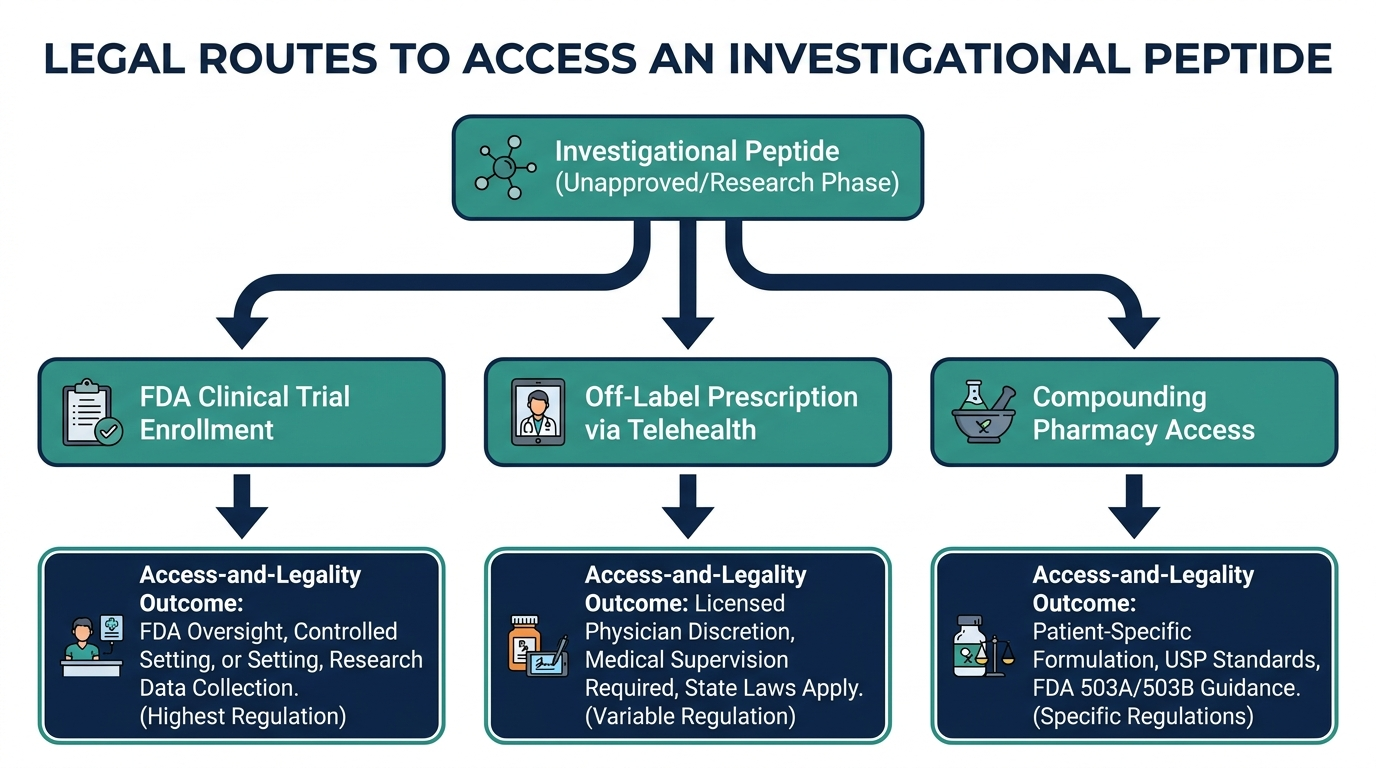
Here is what the retatrutide forums rarely say plainly: the approved GLP-1 drugs are more effective today than they were two years ago, they are available, and for most people who are not willing to enroll in a trial, they are the strongest medically supervised weight-loss intervention that currently exists.
Tirzepatide (Zepbound) produced 22.5% mean body-weight loss in the SURMOUNT-1 trial over 72 weeks. In the head-to-head SURMOUNT-5 trial (NCT06662383), tirzepatide 15 mg achieved 20.2% versus semaglutide 2.4 mg at 13.7% over 72 weeks in people with obesity and no type 2 diabetes. Neither number is 28.3%, but both are real, both have FDA approval, both come with a pharmacy label and a prescribing physician, and both are available now through licensed telehealth platforms.
A legitimate GLP-1 telehealth clinic has five non-negotiables: a licensed physician, NP, or PA actually prescribing after a real intake; medication from a named, verifiable pharmacy; mandatory baseline lab work before the first dose; structured follow-up and protocol adjustment triggered by labs; and pricing that reflects what the bundle actually includes.
Named platforms operating at that standard include Hone Health, Marek Health, and Defy Medical. Sermorelin runs $175 to $225 per month through these channels. Broad GLP-1 weight-loss programs range from $199 to $399 per month, none of it covered by insurance regardless of the clinical rationale.
Telehealth GLP-1 program with provider visits and pharmacy coordination.
What the side effect data says that most “access” articles skip
If you are evaluating retatrutide against approved alternatives, the GI side-effect profile deserves honest attention. The TRIUMPH-4 Phase 3 data shows nausea at 43.2% and diarrhea at 33% on 12 mg. In Phase 2, nausea ranged from 14% at the 1 mg dose to 60% at 12 mg, with a steep dose-dependent curve. Vomiting occurred in 20 to 21% of Phase 3 participants.
Tirzepatide Phase 3 data shows nausea in roughly 30% of participants at 15 mg. Semaglutide at 2.4 mg showed nausea in about 44% during the STEP 1 trial, closer to retatrutide’s range. The difference is that semaglutide and tirzepatide have five years of real-world use data on dose-escalation management, whereas retatrutide has trial-site teams managing each case. The grey-market buyer manages it alone.
The TRIUMPH-4 data also found that starting at 2 mg rather than 4 mg as the initial dose significantly reduced nausea incidence without affecting the eventual weight-loss outcome at maintenance. That is a clinically meaningful insight. It is also a detail that only trial physicians and knowledgeable clinicians are positioned to act on, because it requires adjusting the escalation schedule based on individual tolerance, not just following the vial label.
What the comparison table looks like when you include availability
The data comparisons usually show weight loss percentages and stop there. Here is the fuller picture.
| Drug | Mechanism | Mean weight loss | FDA approved | Available now | Safety monitoring standard |
|---|---|---|---|---|---|
| Semaglutide 2.4 mg (Wegovy) | GLP-1 agonist | ~15% (STEP 1, 68 weeks) | Yes | Yes, via telehealth | Physician-supervised |
| Tirzepatide 15 mg (Zepbound) | GLP-1 + GIP dual agonist | ~22.5% (SURMOUNT-1, 72 weeks) | Yes | Yes, via telehealth | Physician-supervised |
| Retatrutide 12 mg | GLP-1 + GIP + glucagon triple agonist | ~28.3% (TRIUMPH-1, 80 weeks) | No (NDA expected Q4 2026) | Clinical trial only (legal); research vendor (unregulated) | Trial site or none |
The last column is the one that matters most for a buying decision. Retatrutide’s weight-loss advantage over tirzepatide is roughly 6 percentage points. Whether that gap is worth trading a supervised, legal, pharmacy-dispensed protocol for an unsupervised, unregulated vial from a vendor with no accountability is a question only you can answer, but it deserves to be asked explicitly.
What I would actually do in June 2026
Personally, I would start at ClinicalTrials.gov and filter for retatrutide trials with “Recruiting” status before I looked at any vendor page. The trial route is free, the drug is pharmaceutical grade, the dose escalation is supervised, and the side-effect management is handled by people who do this for a living. If you qualify and there is a site within reasonable distance, this is not even a close call.
If you do not qualify for a trial or there is no site near you, the honest next step is a licensed telehealth clinic with tirzepatide or semaglutide, not a research vendor. Zepbound’s 22.5% weight-loss result is not a consolation prize. It is, as of today, the second-strongest weight-loss outcome ever documented in a randomized controlled trial. Treating it as a backup plan only makes sense if you have internalized how good the approved options actually are.
If, after reading the COA section and the Finnrick data above, you still want to purchase from a research vendor: check Finnrick before you check prices, demand a batch-matched COA with HPLC purity above 98% and a Mass Spec identity confirmation from Janoshik, Krause Analytical, or BTLabs, verify the COA key on the lab’s own site, and do not reconstitute a peptide for the first time without reading a detailed sterility protocol. A quantity variance of up to 47% means your dose calculations need a safety margin built in from the start.
The myth worth busting directly: “research grade” is not a lower tier of the same pharmaceutical standard. It is a different regulatory category entirely, one with no mandatory testing requirements, no sterility standards, no dispensing oversight, and no accountability chain. Calling it “research grade” implies a grade. There isn’t one.
Curious what your own levels look like?
Baseline 100+ biomarkers today and retest as life changes, all in one membership with physician review.
Frequently asked questions
Is retatrutide available by prescription in 2026?
No. Retatrutide is investigational and has not received FDA approval. Eli Lilly is expected to submit a New Drug Application in Q4 2026. Assuming priority review, the earliest projected FDA approval is late 2027, with market availability likely in Q1 to Q2 2028. No physician can legally prescribe it outside of a clinical trial at this time.
Can a compounding pharmacy legally make retatrutide?
No. The FDA explicitly stated in September 2025 warning letters that “retatrutide cannot be used in compounding under federal law.” Both 503A and 503B compounding pharmacies require the active ingredient to appear on specific FDA-evaluated lists. Retatrutide appears on none of them. Telehealth platforms that advertise “compounded retatrutide” are sourcing from research vendors and presenting the product with clinical framing.
What are the TRIUMPH clinical trials and how do I enroll?
TRIUMPH is Eli Lilly’s Phase 3 trial program for retatrutide. Multiple arms remain actively recruiting as of June 2026, including TRIUMPH-7 (low back pain), TRIUMPH-8 (general obesity, NCT07232719), and TRIUMPH-9 (obesity without diabetes, NCT07357415). Enrollment criteria typically require BMI 30 or above, age 18 or older, and no current GLP-1 use. Search ClinicalTrials.gov for “retatrutide” filtered by “Recruiting” or call 1-877-CTLILLY to find a site.
How much does retatrutide cost from research vendors?
Roughly $180 to $280 per 10 mg vial from vendors that pass independent quality checks, with typical monthly costs at maintenance dose running $850 to $1,350 depending on the protocol. This does not include bacteriostatic water, syringes, or any clinical monitoring.
How does retatrutide compare to tirzepatide and semaglutide?
In their respective Phase 3 trials, retatrutide produced 28.3% mean weight loss at 80 weeks, tirzepatide produced 22.5% at 72 weeks, and semaglutide produced approximately 15% at 68 weeks. No direct head-to-head trial of retatrutide versus the other two has reported yet. Retatrutide’s advantage comes from its triple-receptor mechanism (GLP-1, GIP, and glucagon), which adds a resting energy expenditure component the other two lack.
When will retatrutide be available at pharmacies?
Eli Lilly is expected to submit its NDA in Q4 2026. Under priority review, FDA approval could come in late 2027, with commercial pharmacy availability in Q1 to Q2 2028. Until then, the only regulated access route is clinical trial enrollment.
What are the main side effects of retatrutide?
The most common are GI: in Phase 3 TRIUMPH-4 data, nausea affected 43.2% of participants at 12 mg, diarrhea occurred in 33%, vomiting in 20 to 21%, and constipation in 22 to 25%. These are highest during the dose-escalation phase and decrease at stable maintenance doses. Starting the escalation at 2 mg rather than 4 mg meaningfully reduced nausea in trial data without affecting the final weight-loss outcome.
Author: Vital Signs Today Editorial Team, [credential]”]. Educational content, not medical advice. Sources linked inline.
Primary sources:
– Eli Lilly TRIUMPH-1 press release (May 21, 2026): https://investor.lilly.com/news-releases/news-release-details/lillys-triple-agonist-retatrutide-delivered-powerful-weight-loss
– Eli Lilly TRIUMPH-4 press release (December 2025): https://investor.lilly.com/news-releases/news-release-details/lillys-triple-agonist-retatrutide-delivered-weight-loss-average
– AJMC TRIUMPH-1 coverage: https://www.ajmc.com/view/retatrutide-achieves-up-to-30-3-average-weight-loss-in-phase-3-triumph-1-trial
– Finnrick retatrutide vendor testing database: https://www.finnrick.com/products/retatrutide
– Finnrick Peptide Sciences rating: https://www.finnrick.com/products/retatrutide/peptide-sciences
– FDA 503A bulk substances list and compounding policy: https://www.fda.gov/drugs/human-drug-compounding/bulk-drug-substances-used-compounding-under-section-503a-fdc-act
– GLP3 Planner retatrutide compounding analysis: https://glp3planner.com/resources/retatrutide-compounding-pharmacy
– ClinicalTrials.gov TRIUMPH-8 (NCT07232719): https://clinicaltrials.gov/study/NCT07232719
– ClinicalTrials.gov TRIUMPH-Outcomes (NCT06383390): https://clinicaltrials.gov/study/NCT06383390
– Retaweightloss.com monthly approval status update: https://www.retaweightloss.com/article/retatrutide-approval-status-2026-monthly-update
– Heally patient access guide: https://getheally.com/patients/news/how-to-get-retatrutide-in-2026-understanding-your-options
– Peptide Dossier availability guide: https://peptidedossier.com/guides/retatrutide-availability/
Related reading
Related: best GLP-1 telehealth providers for 2026.