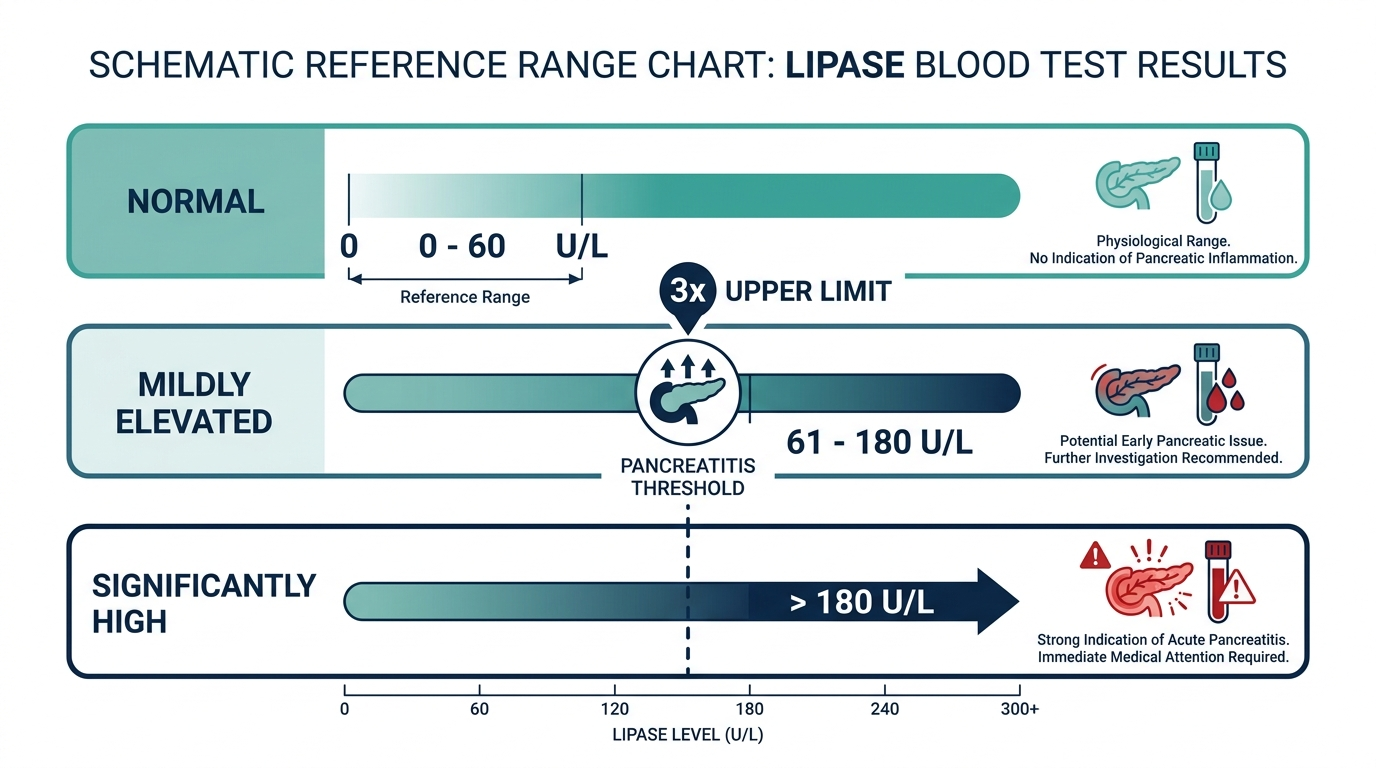
- High lipase usually means your pancreas is irritated or inflamed, and a level three or more times the upper limit of normal (for example, above roughly 480 U/L when the normal ceiling is 160 U/L) is a core criterion for diagnosing acute pancreatitis.
- Most labs treat a normal serum lipase as roughly 0 to 160 U/L, though reference ranges vary by lab, so a “high” flag is judged against your own report’s listed range, not a universal number.
- A mildly high lipase that is under three times the upper limit can come from kidney disease, certain medications, diabetes, or bowel problems rather than pancreatitis, so context and symptoms decide what it means.
What a high lipase result means and the cutoff
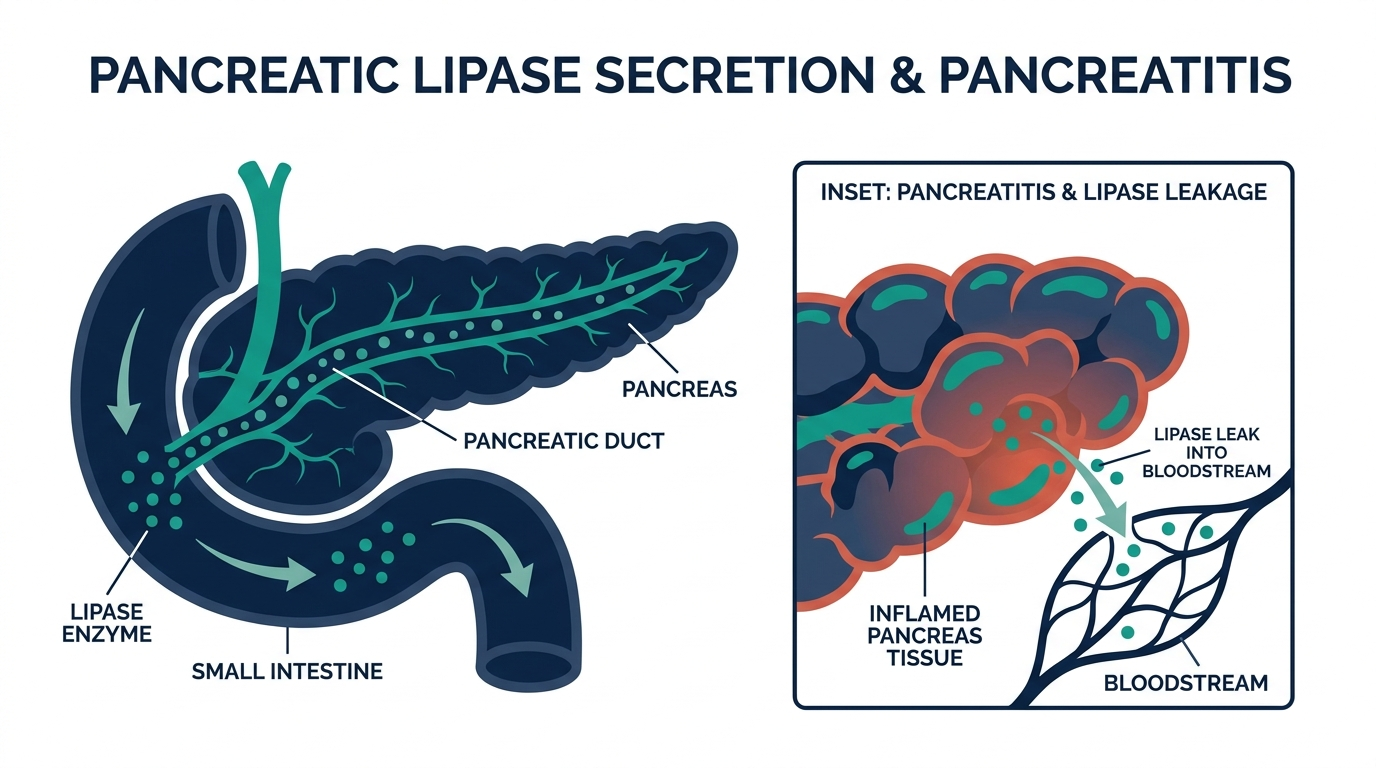
A high lipase result means your blood holds more of the fat-digesting enzyme lipase than expected, which most often points to an irritated or inflamed pancreas. Most labs consider 0 to 160 units per liter (U/L) a normal serum lipase, and a value at or above three times the upper limit of normal, roughly 480 U/L in that example, is a recognized diagnostic threshold for acute pancreatitis (Cleveland Clinic; StatPearls, Acute Pancreatitis).
Lipase is made mainly by the pancreas to break down dietary fat. When pancreatic cells are damaged, the enzyme leaks into the bloodstream and the level climbs. Reference ranges differ between laboratories, so always read your result against the range printed on your own report. The “three times the upper limit” rule is what clinicians actually use, and at that cutoff lipase carries a specificity for pancreatitis of about 99 to 100 percent, meaning a high value rarely fires falsely (StatPearls).
High lipase points to your pancreas, but one number rarely tells the whole story. See what else is going on. One at-home Superpower draw checks 100+ biomarkers, physician-reviewed.
What causes high lipase
The leading cause of a markedly high lipase, three or more times normal, is acute pancreatitis, most commonly triggered by gallstones or heavy alcohol use, which together account for the majority of cases (StatPearls, Acute Pancreatitis). Lower-level elevations have a wider list of causes.
Common drivers of a high lipase include:
- Acute pancreatitis: gallstones blocking the pancreatic duct or alcohol injury are the top two triggers.
- Chronic pancreatitis or pancreatic duct blockage: ongoing damage or a tumor pressing on the duct.
- Kidney disease: reduced clearance lets lipase accumulate, often producing a mild rise (MedlinePlus).
- Medications: some opioids, certain diabetes drugs, diuretics, and others can raise lipase.
- Bowel problems: a blocked or inflamed intestine, including conditions like cholecystitis or celiac disease.
Diabetic ketoacidosis and even some healthy people with no disease can also show elevations, which is why the number is never read alone.
Symptoms of high lipase, or when it is silent
High lipase itself causes no symptoms; what you feel comes from the condition behind it. When pancreatitis is the cause, the classic sign is sudden, severe upper-abdominal pain that often radiates to the back, frequently with nausea and vomiting (Cleveland Clinic). A mild elevation from kidney issues or medication can be completely silent.
Symptoms that often accompany a truly high lipase from pancreatitis include:
- Upper belly pain: steady and intense, worse after eating, often wrapping to the back.
- Nausea and vomiting: that does not relieve the pain.
- Fever and rapid heartbeat: signs the inflammation is significant.
- Swollen, tender abdomen: that hurts to touch.
If your lipase is only modestly raised and you feel fine, the result may reflect a non-pancreatic cause, and your clinician will look at the full picture rather than the enzyme in isolation.
When high lipase is dangerous
High lipase becomes dangerous when it reflects acute pancreatitis, because severe cases can lead to organ failure, infection, and death, with overall mortality around 1 percent rising sharply in severe disease (StatPearls, Acute Pancreatitis). Severe upper-abdominal pain plus a lipase three times normal is a combination that warrants urgent care.
Importantly, the height of the lipase number does not predict how severe the pancreatitis is. A level of 2,000 U/L is not automatically worse than 600 U/L; severity is judged by clinical signs, imaging, and other labs, not by the enzyme peak (StatPearls). Warning features that signal danger include relentless pain, persistent vomiting, fever, confusion, a racing pulse, low blood pressure, or trouble breathing. These point to systemic inflammation and require emergency evaluation rather than a routine recheck.

What to do next and when to see a doctor
If you have a high lipase with severe abdominal pain, vomiting, or fever, seek emergency care the same day, because acute pancreatitis is diagnosed when lipase is at least three times the upper limit of normal alongside typical pain or imaging findings (StatPearls, Acute Pancreatitis). If you feel well and the elevation is mild, contact your clinician to plan the next step.
Reasonable next steps usually include:
- Review the full result: compare your value to your report’s range and note how many times above the ceiling it sits.
- Discuss your symptoms and history: alcohol use, gallstones, kidney function, and current medications all matter.
- Expect possible imaging: an abdominal ultrasound or CT scan may be ordered to look at the pancreas and gallbladder.
- Repeat or trend the test: a single mild elevation is often rechecked to see if it falls.
Do not try to self-treat a high lipase with diet alone. The cause, not the number, drives the plan.
The insider nuance: lipase can be normal even in pancreatitis
An important detail clinicians know is that a normal lipase does not fully rule out pancreatitis, and a high lipase is not always pancreatitis. Documented case reports describe acute pancreatitis confirmed on imaging despite normal serum lipase and amylase, particularly when testing is done very late or very early in the attack (PMC, Acute Pancreatitis With Normal Amylase and Lipase).
The flip side also happens. Case series have reported people with lipase elevated well above the pancreatitis threshold who had no pancreatitis at all, instead carrying causes like kidney impairment or bowel disease, a pattern sometimes called hyperlipasemia without pancreatitis (PMC, Hyperlipasemia Sans Pancreatitis). The practical takeaway is that lipase is a strong clue, not a verdict. It is most useful when paired with your symptoms and, when needed, imaging, which is why your clinician interprets the value rather than the lab printout alone.
Why lipase is the preferred pancreas test
If you have both an amylase and a lipase result, the lipase usually carries more weight, and it helps to know why. Both are pancreatic enzymes that leak into blood when the pancreas is injured, but lipase has two practical advantages for diagnosing acute pancreatitis.
- Higher specificity. Lipase comes mostly from the pancreas, while amylase also comes from the salivary glands. That makes a high lipase a cleaner signal that the pancreas, specifically, is the problem. At the three-times-normal cutoff, lipase specificity for pancreatitis is very high.
- A longer diagnostic window. Lipase rises within hours and can stay elevated for up to about 8 to 14 days, whereas amylase often falls back to normal within 3 to 7 days. A patient who waits a few days before seeking care may still show a high lipase after the amylase has normalized.
For these reasons many hospitals now order lipase first, or lipase and amylase together, and treat lipase as the more reliable of the two. It is a good example of how one enzyme can quietly replace another in everyday practice as the evidence accumulates.

Causes of high lipase, grouped for clarity
A high lipase is a clue whose meaning depends heavily on how high it is and what else is going on. Sorting the causes by category makes them easier to think through with your clinician.
- Pancreatic (the main worry): acute pancreatitis, a flare of chronic pancreatitis, a blocked pancreatic duct, or a pancreatic tumor. Marked elevations, three or more times normal, most often live here.
- Biliary and gut: gallstones (a leading trigger of pancreatitis), an inflamed gallbladder (cholecystitis), bowel obstruction, and conditions like celiac disease.
- Reduced clearance: kidney disease slows how fast lipase is filtered out, commonly producing a mild rise even without any pancreas problem.
- Metabolic: diabetic ketoacidosis and very high blood triglycerides, the latter being an important and sometimes overlooked cause of pancreatitis itself.
- Medications: some opioids, certain diabetes drugs, and diuretics, among others, can nudge lipase up.
- Idiopathic or benign: some people, including otherwise healthy individuals, carry a persistently elevated lipase with no disease, a pattern reported as hyperlipasemia without pancreatitis.
The rule of thumb: the higher the value and the more it is paired with classic abdominal pain, the more it points to pancreatitis. A mild elevation in someone who feels well more often traces back to kidneys, medications, or a benign quirk.
The two big pancreatitis triggers, and what raises your risk
Because acute pancreatitis is the reason a high lipase matters most, it is worth understanding what sets it off. Two causes dominate:
- Gallstones. A stone can lodge where the bile and pancreatic ducts meet, damming pancreatic enzymes behind it and inflaming the gland. This is a leading cause, especially in women and older adults.
- Heavy alcohol use. Alcohol is directly toxic to pancreatic tissue over time and is the other top trigger, particularly with sustained heavy drinking.
Other contributors worth knowing about:
- Very high triglycerides, which can independently provoke pancreatitis and are a reason cholesterol and triglyceride panels matter.
- Certain medications and, occasionally, procedures on the bile ducts.
- Smoking, which raises risk and worsens outcomes.
The practical prevention angle: moderating alcohol, addressing gallstones when they cause trouble, controlling triglycerides, and not smoking are the levers with the most evidence behind them. None of this replaces medical care during an acute attack, but it shapes long-term risk.
What happens after a pancreatitis diagnosis
If a high lipase and your symptoms lead to a pancreatitis diagnosis, it helps to know the general shape of care so the process is less frightening. Acute pancreatitis is managed in a medical setting, and the core principles are consistent:
- Resting the pancreas. Early care often involves withholding food briefly and giving intravenous fluids, then reintroducing eating as tolerated. This is why trying to eat through severe pain at home is discouraged.
- Fluids and monitoring. Generous IV fluids and close monitoring of vital signs and labs are central, because the danger is systemic inflammation, not the enzyme number.
- Pain control. The pain can be severe and is treated actively.
- Treating the cause. If gallstones are responsible, gallbladder surgery may be recommended to prevent recurrence. If alcohol or triglycerides are the driver, addressing those is key.
Most mild cases recover within days. Severe cases, which are the minority, can involve complications and a longer course, which is exactly why prompt evaluation of severe abdominal pain with a high lipase matters. Recovery and prevention hinge on tackling the underlying trigger, not on the lipase value itself.

Sample interpretation scenarios
Lipase, like most enzymes, tells its story in context. These teaching examples show how the same direction of result can mean very different things. They illustrate the reasoning; they do not replace your clinician reading your chart.
- Lipase 4 times normal, severe upper abdominal pain radiating to the back, nausea. This meets a core criterion for acute pancreatitis and is a same-day emergency.
- Lipase mildly high, no abdominal pain, known reduced kidney function. The tilt is toward reduced clearance rather than pancreatitis. The kidneys, not the pancreas, likely explain it.
- Lipase very high but the person feels well, with normal imaging. This can be hyperlipasemia without pancreatitis, from causes like kidney or bowel issues, or a benign persistent elevation. The number alone is not a verdict.
- Normal lipase but classic pancreatitis symptoms, especially very early or very late in the attack. A normal value does not fully exclude pancreatitis. Imaging and clinical judgment carry the diagnosis when enzymes are equivocal.
- Lipase high alongside very high triglycerides. The elevated triglycerides may be the trigger, which changes both treatment and prevention.
Across every scenario, lipase is a strong clue rather than a standalone answer. Its power comes from being read with your symptoms, kidney function, triglycerides, and, when needed, imaging.
Preparation and factors that can skew the result
Lipase is a robust test, but a few things influence the number or its interpretation.
- Fasting and alcohol. Some labs ask you to fast and avoid alcohol before testing, since both can affect results. Follow the specific instructions you are given.
- Kidney function. Because impaired kidneys clear lipase more slowly, reduced kidney function can raise the value on its own, which is why lipase is interpreted alongside kidney markers.
- Medications. Certain drugs can raise lipase, so an accurate medication list helps your clinician interpret a borderline result.
- Timing in an acute event. Lipase rises within hours and stays up for over a week, so timing matters less than it does for amylase, but a test done extremely early can still lag the symptoms.
- Repeat when in doubt. A mild, isolated elevation in someone who feels well is often rechecked to see whether it falls, rather than acted on immediately.
Who should have lipase tested, and how it fits a panel
Lipase is not a routine wellness screen for healthy people. It is ordered when there is a reason to look at the pancreas. You are most likely to have it checked if you have:
- Acute, severe upper abdominal pain with nausea or vomiting, where pancreatitis is a real possibility.
- Known pancreatic disease, such as chronic pancreatitis, that needs monitoring.
- Major risk factors, especially gallstones, heavy alcohol use, or very high triglycerides.
- Unexplained abdominal symptoms that a clinician wants to sort out alongside imaging and other labs.
When lipase appears on a broader biomarker panel, its value is context. Seen next to kidney markers, triglycerides, liver enzymes, and glucose, a mildly out-of-range lipase can be interpreted correctly rather than triggering alarm. A lipase read in isolation invites overreaction; a lipase read as one line in a full panel, and ideally trended over time, is far easier to judge. This is the same principle that runs through every marker in this article: the number is a starting point, and the surrounding picture is what gives it meaning.
Common misconceptions about a high lipase
A few misunderstandings cause unnecessary worry, so they are worth stating plainly.
- “A very high number means very severe disease.” The magnitude of a lipase elevation does not predict how severe pancreatitis is. A level of 2,000 U/L is not automatically worse than 600 U/L. Severity is judged by clinical signs, imaging, and other labs.
- “High lipase always means pancreatitis.” Kidney disease, medications, bowel problems, diabetic ketoacidosis, and benign persistent elevations can all raise lipase without pancreatitis, especially when the rise is mild and there is no pain.
- “A normal lipase rules pancreatitis out.” Documented cases show imaging-confirmed pancreatitis with normal enzymes, particularly when tested very early or very late in the attack. Symptoms and imaging still matter.
- “I can lower it with diet at home.” You treat the cause, not the number. A high lipase with concerning symptoms needs medical evaluation, not a home remedy.
Getting these straight is the difference between a measured response and needless panic. Lipase is one of the most useful markers in abdominal medicine precisely because clinicians read it wisely, in context, rather than reacting to the printout alone.
Lipase versus amylase, and why one number can lag the other
For decades amylase was the standard pancreas test, and many people still expect to see it ordered. Lipase has largely replaced it as the first choice because it is more specific to the pancreas and stays elevated longer. Amylase is made by the salivary glands as well as the pancreas, so it can rise for reasons that have nothing to do with the pancreas, such as mumps or a salivary duct problem. Lipase comes overwhelmingly from the pancreas, which is why a high lipase points more cleanly at pancreatic injury.
Timing is the other difference that trips people up. After the pancreas is inflamed, lipase typically rises within a few hours and can stay high for up to a week or more, while amylase tends to climb and fall faster. If you present a day or two after your pain started, amylase may already have returned toward normal while lipase is still clearly elevated, which is exactly the scenario where lipase earns its keep. That is also why ordering both is sometimes useful: a discrepancy between them can hint at how long a process has been going on, or whether the source is truly pancreatic.
Watching lipase fall over time can be as informative as the first high value. During recovery from an episode of pancreatitis, a clinician often expects the number to trend down as the gland settles, and a lipase that stays stubbornly high or climbs again can prompt a closer look for a complication such as a fluid collection or an ongoing blockage. The single reading answers the question of whether the pancreas is irritated. The trend answers the more useful question of whether it is getting better, which is why serial testing during recovery is common.
Don’t just read about lipase, track it.
A single result is a snapshot. Superpower re-tests lipase and 100+ markers over time so you can watch them move as you change sleep, food, and training.
Frequently asked questions
What lipase level is considered dangerously high?
A lipase at or above three times the upper limit of normal, roughly 480 U/L when the ceiling is 160 U/L, is the threshold linked to acute pancreatitis. The danger comes from the pancreatitis itself, not from a specific number, so severe pain with that level needs urgent care.
Can high lipase mean something other than pancreatitis?
Yes. Kidney disease, certain medications, bowel obstruction, cholecystitis, celiac disease, and diabetic ketoacidosis can all raise lipase. Mild elevations especially may not be pancreatitis, which is why clinicians weigh your symptoms and history rather than reading the number alone.
Does the height of the lipase number show how severe pancreatitis is?
No. According to StatPearls, the magnitude of lipase elevation does not predict pancreatitis severity. A very high value is not automatically worse than a moderately high one. Severity is judged by clinical signs, imaging, and other labs.
How long does lipase stay elevated?
In acute pancreatitis, lipase typically rises within hours and can stay elevated for up to 8 to 14 days, longer than amylase, which is one reason lipase is the preferred test. Persistent elevation after symptoms resolve should be discussed with your clinician.
Should I fast before a lipase blood test?
Lipase is often measured without special fasting, but some labs or panels ask you to fast and to avoid alcohol beforehand because both can affect results. Follow the specific instructions your ordering clinician or lab provides for the most accurate reading.
Sources
- Cleveland Clinic, Lipase Blood Test
- MedlinePlus, Lipase Tests
- StatPearls (NCBI Bookshelf), Acute Pancreatitis
- PMC, Acute Pancreatitis With Normal Amylase and Lipase
- PMC, Hyperlipasemia Sans Pancreatitis: A Case Series
This article is for general educational purposes and is not medical advice. It cannot diagnose or treat you and does not replace your clinician. Always discuss your lab results and any health decisions with a qualified healthcare professional.
Related: find the right at-home biomarker test.
Vital Signs Today may earn a commission if you buy through links on this page. It does not affect our editorial assessments.