- A low lipase result usually means the pancreas cells that make the enzyme are damaged and no longer producing enough, most often from a long-standing condition rather than a sudden problem.
- The two conditions most commonly linked to low lipase are cystic fibrosis and chronic pancreatitis, both of which gradually destroy the pancreatic cells that release digestive enzymes (Cleveland Clinic; MedlinePlus).
- A single low lipase value is rarely an emergency by itself, but if it comes with weight loss, greasy or floating stools, or ongoing belly pain, you should see a doctor for further pancreas testing.
If your blood test flagged lipase as low, you are looking at a clue about how well your pancreas is making digestive enzymes. Lipase is the enzyme that breaks down fat in your food, and your pancreas is the main place it comes from. A low reading is far less common than a high one, and it points in a different direction: instead of irritation or inflammation, it suggests the enzyme factory may be running down. Here is what the number means and what to do about it.
What does low lipase mean and what is the cutoff?
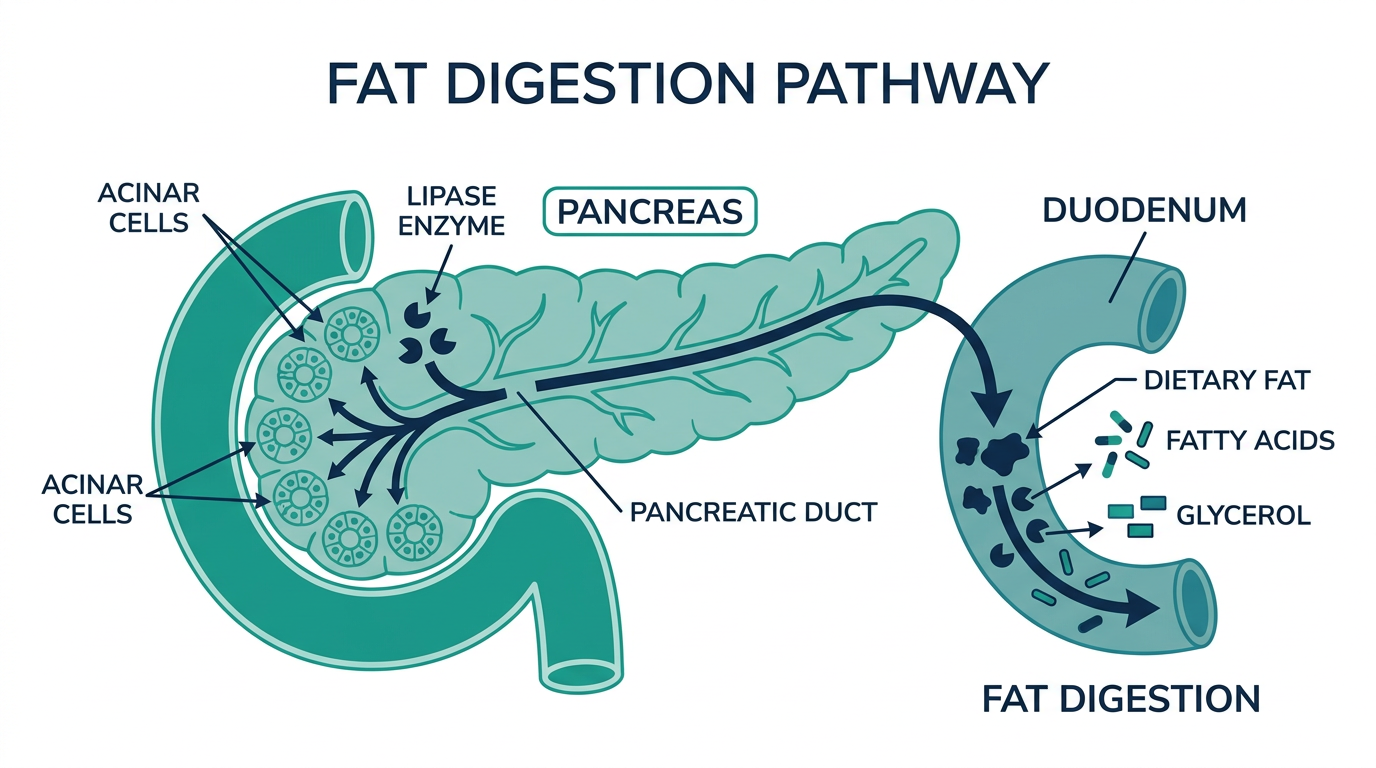
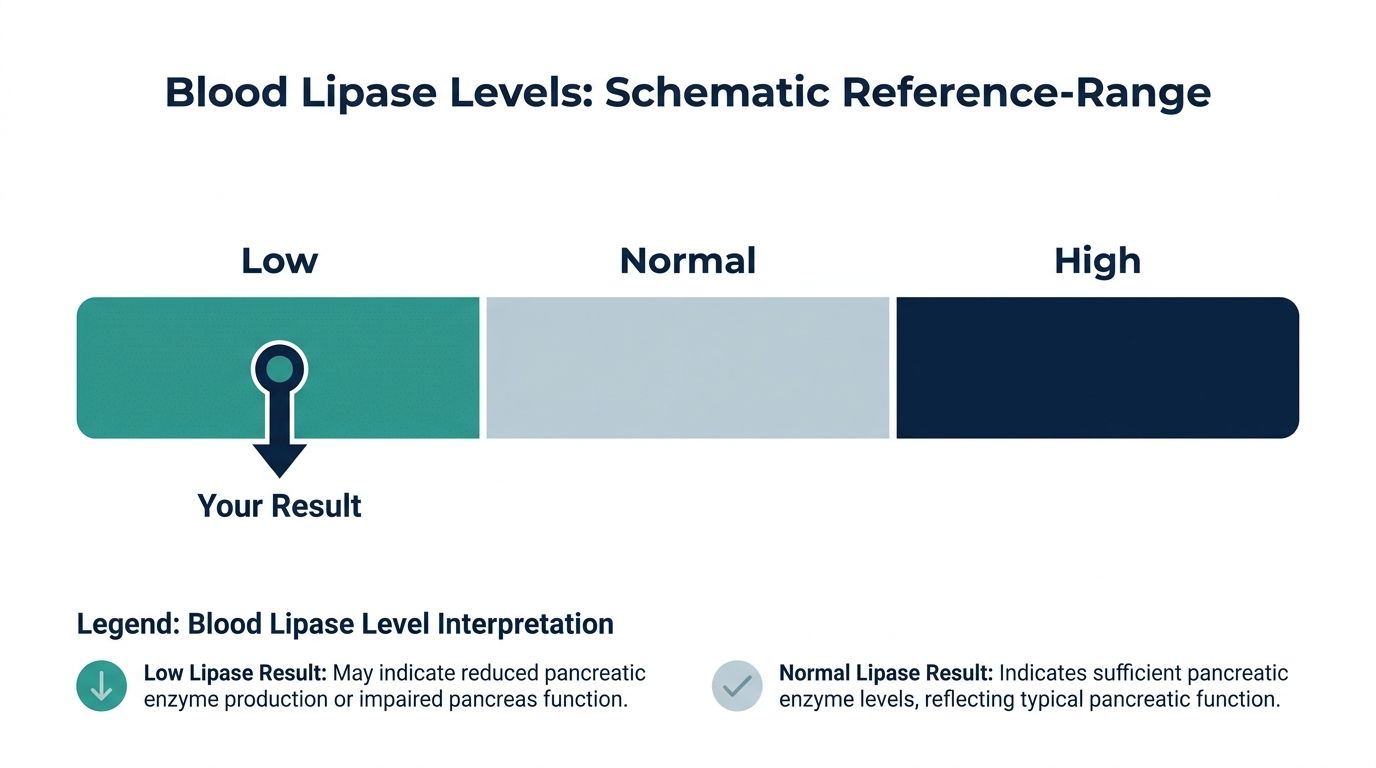
A low lipase result generally means your pancreas is not making enough of the enzyme, often because the cells that produce it have been damaged over time. Most labs report a normal lipase range of 0 to 160 units per liter (U/L), so “low” usually means a result sitting near the bottom of that scale or below your lab’s stated floor (Cleveland Clinic).
Low lipase often points to pancreas function over time. See the fuller digestive and metabolic picture. One at-home Superpower draw checks 100+ biomarkers, physician-reviewed.
Because the normal range starts at 0, there is no single universal “too low” cutoff the way there is for many other labs. Some research suggests a serum lipase under about 20 U/L can accompany advanced pancreatic disease, and very low values may reflect reduced pancreatic function. The exact interpretation depends on your lab’s reference interval, your age, your sex, and your overall health, so always read your result against the range printed on your own report.
What causes low lipase?
Low lipase is most often caused by long-term damage to the pancreatic cells that produce digestive enzymes. The two conditions named most consistently by major sources are cystic fibrosis and chronic pancreatitis (Cleveland Clinic; MedlinePlus). Both slowly wear down the pancreas until it can no longer release enough enzyme into the blood and gut.
- Chronic pancreatitis: repeated or ongoing inflammation that progressively scars the pancreas. As tissue is destroyed, enzyme output drops, which is why lipase can read low in long-standing disease (MedlinePlus).
- Cystic fibrosis: a genetic disorder in which thick secretions block the pancreatic ducts and damage the gland, leading to insufficient enzyme production over time.
- Pancreatic insufficiency: a broader term for when the pancreas cannot make enough digestive enzymes, which can follow either condition above.
Certain medicines can also nudge lipase results, so context matters when reading any single value.
What are the symptoms, or is it silent?
A low lipase number itself causes no symptoms. What you may notice instead are the signs of poor fat digestion when the pancreas cannot supply enough enzymes. The classic clue is steatorrhea: pale, greasy, foul-smelling stools that float and are hard to flush, often paired with unexplained weight loss despite a normal appetite.
Other clues that the pancreas may be struggling include bloating, abdominal discomfort, gas after fatty meals, and signs of malnutrition over time. MedlinePlus lists abdominal pain that may spread to the back, nausea, vomiting, diarrhea, fever, and jaundice among the symptoms that prompt pancreas testing in the first place. Many people, though, have a slightly low lipase with no symptoms at all, which is why doctors read the number alongside how you actually feel.
When is a low lipase result dangerous?
A low lipase value on its own is rarely an emergency. It becomes concerning when it reflects established pancreatic damage that is causing your body to miss nutrients. The danger is not the number, it is the malnutrition, vitamin deficiency, and weight loss that can follow when fat is not absorbed.
Seek prompt care if a low lipase result comes with persistent weight loss, ongoing greasy stools, severe or constant abdominal pain, or jaundice (yellowing of the skin or eyes). These can point to advanced chronic pancreatitis or another serious pancreatic problem that needs evaluation. Some research links very low lipase, in the single digits, with reduced pancreatic function and rarely with pancreatic cancer, which is another reason a markedly low value with symptoms deserves a doctor’s review rather than watchful waiting.

What should you do next and when should you see a doctor?
If your lipase is low, the first step is to bring the result to your doctor and review it in context, since a single mildly low value with no symptoms often needs nothing more than a recheck. Your clinician may repeat the test, look at amylase alongside it, and ask about digestion, weight, and stool changes (MedlinePlus).
See a doctor without delay if low lipase comes with any of these:
- Weight loss you cannot explain, especially with a normal or large appetite.
- Greasy, floating, or foul stools that suggest fat is not being absorbed.
- Persistent abdominal pain, nausea, or vomiting.
- Jaundice, fever, or a fast heartbeat.
Depending on findings, your doctor may order a stool elastase test, imaging of the pancreas, or referral to a gastroenterologist. If pancreatic insufficiency is confirmed, prescription enzyme replacement can restore digestion.
The insider nuance most people miss
Here is the detail that trips people up: doctors order lipase mainly to catch HIGH levels, not low ones. Lipase is the go-to blood test for acute pancreatitis, where a level three or more times the upper limit signals an inflamed pancreas. Because the test is built to flag the high end, a low value is often noticed only by accident on a routine panel.
That matters for interpretation. A lone low lipase with no symptoms is frequently a normal-variant or lab-related finding, not proof of disease. The same number means something very different in someone with years of belly pain and weight loss, where it can be the fingerprint of a pancreas that has burned out after chronic injury (MedlinePlus). The number is only as meaningful as the story around it, which is exactly why your clinician weighs symptoms, history, and companion labs before drawing any conclusion.
The bigger picture: exocrine pancreatic insufficiency
A low lipase is best understood as one possible fingerprint of a larger condition called exocrine pancreatic insufficiency, or EPI. The pancreas has two roles: an endocrine role that releases hormones like insulin, and an exocrine role that pumps out digestive enzymes, including lipase for fat, amylase for starch, and proteases for protein. EPI is what happens when the exocrine side can no longer produce enough of those enzymes to digest food properly.
When lipase output falls, dietary fat passes through only partially digested. That single mechanism explains most of the symptoms people notice: greasy, floating, foul-smelling stools (steatorrhea), weight loss despite eating normally, bloating, and gas after fatty meals. Because fat carries the fat-soluble vitamins A, D, E, and K, prolonged fat malabsorption can quietly lead to deficiencies in those vitamins, which is one of the more important and overlooked consequences of untreated EPI. The low number on a lab report is a hint; EPI is the condition that gives it meaning.

Why blood lipase is not the best test for EPI
Here is a nuance worth knowing: while a low blood lipase can raise suspicion of pancreatic insufficiency, it is not the most reliable way to diagnose it. Blood lipase was designed to catch high levels in acute pancreatitis, and a low value is often noticed only incidentally. When a clinician genuinely suspects EPI, they usually turn to tests built for that job:
- Fecal elastase-1. This stool test measures an enzyme the pancreas makes that survives digestion, so it reflects how much enzyme the pancreas is actually producing. A low fecal elastase is one of the more practical, widely used indicators of pancreatic insufficiency.
- Fecal fat testing. Measuring fat in the stool, sometimes over 72 hours, directly documents whether fat is being malabsorbed.
- Imaging. A CT scan, MRI/MRCP, or endoscopic ultrasound can show a scarred, calcified, or shrunken pancreas that fits chronic damage.
The practical message: if your blood lipase is low and you have digestive symptoms, the next step is usually one of these targeted tests, not simply repeating the lipase. Blood lipase opens the question; stool and imaging answer it.
Chronic pancreatitis vs cystic fibrosis: two roads to a low lipase
The two most consistently cited causes of a low lipase damage the pancreas in different ways and at different life stages, which affects how each is recognized.
- Chronic pancreatitis is repeated or ongoing inflammation that scars the pancreas over years, gradually destroying the enzyme-producing cells. It is often linked to long-term heavy alcohol use, smoking, or recurrent gallstone attacks, and it typically shows up in adults with a history of belly pain and, later, malabsorption. As the gland burns out, both its enzyme output and, sometimes, its pain can decline, while digestion worsens.
- Cystic fibrosis is a genetic condition in which thick secretions plug the pancreatic ducts and damage the gland, often from early in life. Many people with cystic fibrosis develop pancreatic insufficiency and need enzyme support, which is why it is a classic cause of low enzyme output.
Other contributors include pancreatic surgery that removes enzyme-producing tissue, and broader pancreatic insufficiency following either condition. Knowing which road applies shapes both the workup and the long-term plan.
How pancreatic insufficiency is treated
The encouraging part of this story is that when low enzyme output is confirmed, it is very treatable. The cornerstone is pancreatic enzyme replacement therapy, often abbreviated PERT.
- What it is. Prescription capsules containing digestive enzymes (including lipase) that you take with meals and snacks, replacing what the pancreas can no longer make.
- How it is taken. Dosing is based on the fat content of meals and is taken with food so the enzymes mix in as digestion happens. Taking it at the wrong time, such as long before or after eating, reduces its effect.
- What it fixes. Properly dosed enzyme replacement can resolve steatorrhea, restore weight, and improve absorption of nutrients and fat-soluble vitamins.
- Companion care. Clinicians often check and replace fat-soluble vitamins (A, D, E, K), address the underlying cause (for example, stopping alcohol and smoking in chronic pancreatitis), and involve a dietitian.
None of this is something to self-manage with over-the-counter products. Diagnosis and enzyme dosing belong with a clinician, ideally a gastroenterologist, because the goal is not just a better lab number but restored digestion and prevented deficiency.
Sample interpretation scenarios
Because a low lipase means so little in isolation and so much in context, these teaching examples show how the same result is judged differently. They illustrate the reasoning and do not replace your clinician reviewing your chart.
- Slightly low lipase, no symptoms, found on a routine panel. This is frequently a normal-variant or lab-related finding. A recheck, and attention to symptoms, is usually all that is warranted.
- Low lipase with greasy floating stools and unexplained weight loss. This pattern points toward pancreatic insufficiency and calls for targeted testing such as fecal elastase and possibly imaging.
- Low lipase in someone with a long history of alcohol use and recurrent belly pain. Chronic pancreatitis that has scarred the pancreas is a leading consideration.
- Low lipase in a younger person with lifelong digestive and respiratory issues. Cystic fibrosis and its pancreatic effects belong on the list.
- Markedly low lipase with weight loss and jaundice. This deserves prompt evaluation rather than watchful waiting, to rule out advanced pancreatic disease.
The throughline is consistent with the rest of pancreatic testing: the number is a clue, and symptoms, history, and companion tests are what give it a diagnosis.
Preparation and factors that affect a low reading
A few practical points help you and your clinician read a low lipase correctly.
- Fasting and alcohol. Some labs ask you to fast and avoid alcohol before the draw, since both can influence enzyme results. Follow your specific instructions.
- Medications. Certain drugs can affect lipase readings, so share a complete medication and supplement list.
- Read against your own range. Because the normal range starts at 0, there is no universal low cutoff. Interpret your value against your lab’s stated floor and your clinical picture.
- Do not over-read a single value. A lone low result in someone who feels well is easily over-interpreted. Repeating the test and adding amylase and, if needed, fecal elastase is the sensible path.
- Watch the trend. As with most markers, a value tracked over time and read alongside symptoms is far more informative than a single isolated reading.
The fat-soluble vitamin connection
One consequence of low enzyme output that patients rarely anticipate is vitamin deficiency. When fat is not properly digested and absorbed, the vitamins that ride along with dietary fat, vitamins A, D, E, and K, can fall short over time. Each shortfall has its own signature, which is why clinicians managing pancreatic insufficiency keep an eye on all four.
- Vitamin A. Important for vision and immune function; low levels can affect night vision and skin.
- Vitamin D. Central to bone health and calcium balance; deficiency contributes to weakened bones, a real concern in chronic pancreatic disease.
- Vitamin E. An antioxidant important for nerve and muscle health.
- Vitamin K. Needed for normal blood clotting; a deficiency can show up as easy bruising or bleeding.
This is a key reason a low lipase with malabsorption symptoms is worth taking seriously even when it feels manageable day to day. The digestion problem is visible in the stool, but the nutritional problem builds quietly underneath. Correcting the enzyme shortfall with treatment, and checking and replacing these vitamins as needed, prevents complications that would otherwise accumulate over months and years.
Common misconceptions about a low lipase
A few misunderstandings lead people to either panic or dismiss a low result. Clearing them up helps you respond appropriately.
- “Low lipase means I have cancer.” Most low values are not cancer. The common associations are chronic pancreatitis and cystic fibrosis. A markedly low value with weight loss and jaundice does warrant prompt evaluation, but a mild, symptom-free result usually does not signal malignancy.
- “I can fix it by eating more fat or taking a supplement.” Diet does not set your blood lipase, and over-the-counter products are not a substitute for prescription enzyme replacement when true insufficiency is confirmed. The fix is diagnosing and treating the cause.
- “A low number always means disease.” Because the normal range starts at zero, a value near the bottom can be a normal variant or a lab artifact, especially with no symptoms. Context decides.
- “Lipase is the test for pancreatic insufficiency.” It is not the best one. Fecal elastase and imaging are the targeted tools; blood lipase mainly raises the question.
The unifying lesson is the same one that runs through every pancreatic marker: a single value is a starting clue. Read alongside symptoms, history, and the right follow-up tests, a low lipase becomes genuinely useful, and, when it does reflect insufficiency, the condition it points to is highly treatable.
Low lipase versus low amylase: why doctors read the two enzymes together
Lipase is rarely the only pancreatic enzyme on a report. Amylase, which breaks down carbohydrates, is usually measured alongside it, and the relationship between the two adds context a single low lipase value cannot give on its own. Both enzymes come largely from the pancreas, so when the gland is progressively damaged, both tend to drift down together over the years. A low lipase paired with a low amylase points more firmly toward long-standing loss of pancreatic tissue than a low lipase sitting next to a normal amylase does.
The two enzymes are not interchangeable, though. Lipase is generally the more specific pancreatic marker, because amylase is also made by the salivary glands and can be released from other tissues. That is why a high lipase carries more weight than a high amylase when doctors are chasing acute inflammation, and it is part of why a low lipase is treated as a slightly more meaningful clue about pancreatic reserve than a low amylase alone. Reading them as a pair, rather than fixating on one line, is how clinicians avoid over-reading a single soft result.
There is a practical takeaway here. If your report shows a low lipase, look one line over for amylase, and note whether it is low, normal, or high. A low lipase with a distinctly high amylase is an unusual combination that usually reflects a non-pancreatic source of amylase rather than a failing pancreas, and it is exactly the sort of pattern worth flagging to your clinician. A low lipase with a low amylase and symptoms of poor fat digestion is the pattern that most deserves a closer look at how well the pancreas is making enzymes in the first place.
Curious where your lipase really sits?
Baseline lipase and 100+ biomarkers today and retest as life changes, all in one membership with physician review.
Frequently asked questions
Is low lipase serious?
Usually not on its own. A mildly low value with no symptoms is often harmless or lab-related. It becomes more serious when paired with weight loss, greasy stools, or ongoing belly pain, which can signal chronic pancreatic damage that needs evaluation.
What is the normal range for lipase?
Most labs report 0 to 160 U/L as normal, though ranges vary slightly by lab, age, and sex (Cleveland Clinic). Always compare your result to the reference range printed on your own report rather than a general figure.
Can low lipase be caused by diet?
Diet alone does not typically cause a low blood lipase level. Low values reflect pancreatic enzyme production, not food intake. That said, certain medicines can affect lipase readings, so mention everything you take when you discuss your result.
What conditions cause low lipase levels?
The most commonly cited causes are cystic fibrosis and chronic pancreatitis, both of which damage the pancreatic cells that make the enzyme (Cleveland Clinic; MedlinePlus). Broader pancreatic insufficiency from these conditions can also lower the result.
Should I retest if my lipase is low?
Often yes. A single low value is easy to over-read, so doctors commonly repeat the test, check amylase too, and ask about symptoms before deciding anything. Follow your clinician’s guidance on timing and any added tests.
Sources
- Cleveland Clinic, Lipase Blood Test: What It Is and Understanding the Results
- MedlinePlus, Lipase Tests
- Medscape, Lipase: Reference Range, Interpretation, Collection and Panels
This article is for general educational purposes and is not medical advice. It cannot diagnose or treat you and does not replace your clinician. Always discuss your lab results and any health decisions with a qualified healthcare professional.
Related: compare the best at-home biomarker and blood tests.
Vital Signs Today may earn a commission if you buy through links on this page. It does not affect our editorial assessments.