- A low total protein result means the combined level of albumin and globulin in your blood falls below the normal range of about 6.3 to 8.0 g/dL, which most labs and Cleveland Clinic use as the reference.
- The most common reasons for low total protein are liver disease, kidney disease, poor nutrition, and conditions that cause your gut to lose protein, because your liver makes most blood proteins and your kidneys are supposed to keep them in.
- Mild low total protein is often harmless and reversible, but a result paired with leg swelling, jaundice, or foamy urine should be reviewed by a clinician promptly because it can flag serious liver or kidney disease.
Part of our Comprehensive Metabolic Panel guide.
What does a low total protein result mean, and what is the cutoff?
A low total protein result means the combined amount of albumin and globulin in your blood is below the normal reference range, which Cleveland Clinic lists as 6.3 to 8.0 g/dL (MedlinePlus uses a slightly wider 6.0 to 8.3 g/dL). Anything under your lab’s lower limit is called hypoproteinemia. Total protein is not one substance. It is two big groups added together:
Low total protein on your labs? See the liver, kidney, and nutrition markers that explain why. One at-home Superpower draw checks 100+ biomarkers, physician-reviewed.
- Albumin: about 3.5 to 5.0 g/dL, made by your liver, keeps fluid inside your blood vessels and carries hormones and drugs.
- Globulins: about 2.0 to 3.5 g/dL, a mix that includes antibodies for your immune system.
Because the number is a sum, a low result rarely tells the whole story on its own. Your clinician will usually look at the albumin and globulin split, plus the albumin to globulin (A/G) ratio, to figure out which part dropped and why. Ranges vary slightly by lab, so always compare your value to the reference printed on your own report.

What causes low total protein in the blood?
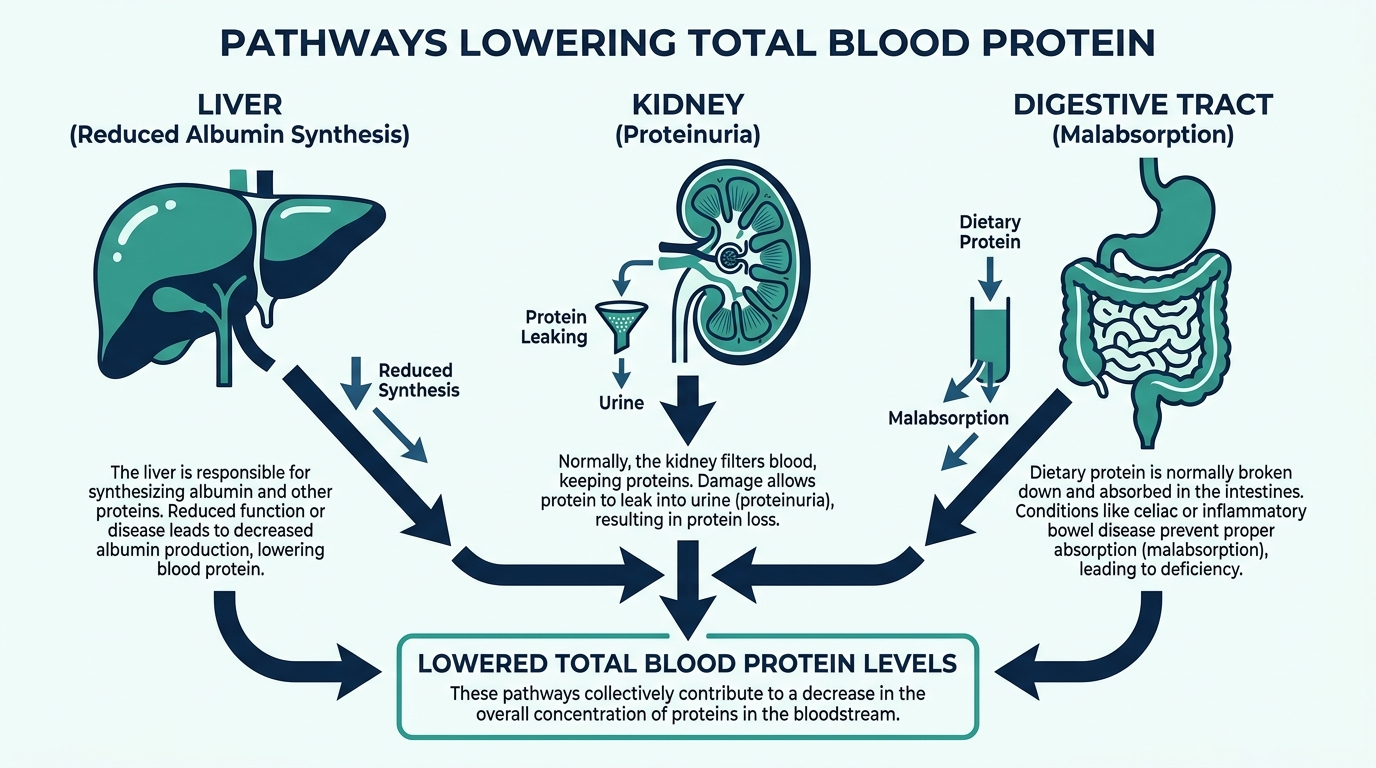
Low total protein usually comes from one of four problems: your body is not making enough protein, not absorbing enough, losing too much, or your blood is diluted. Cleveland Clinic notes the liver makes most blood proteins, so liver disease is a leading cause. The main drivers are:
- Liver disease: cirrhosis, hepatitis, and fatty liver reduce the liver’s ability to make albumin.
- Kidney disease: nephrotic syndrome lets protein leak out into the urine instead of staying in the blood.
- Poor nutrition or malabsorption: very low protein intake, or gut conditions like celiac disease and Crohn’s disease that block absorption.
- Protein loss from the gut: protein-losing enteropathy, where protein escapes through the intestinal wall.
- Dilution and other causes: overhydration, heart failure with fluid retention, severe burns, chronic infection, and some cancers.
Pregnancy and breastfeeding can also lower the number for ordinary, non-dangerous reasons, because plasma volume rises and demand goes up.
What are the symptoms, or is it silent?
Mild low total protein is often completely silent and shows up only on a routine blood panel. Symptoms appear mainly when protein, especially albumin, drops far enough that fluid leaks out of your blood vessels. The hallmark sign Cleveland Clinic describes is edema, swelling in the legs, feet, hands, or face, because albumin normally holds fluid inside the vessels.
Other clues that can accompany low total protein include:
- Fatigue and weakness: a general run-down feeling.
- Hair, skin, and nail changes: dry or brittle hair that falls out, flaky skin, and weak nails.
- Frequent infections: when low globulins mean fewer antibodies.
- Jaundice: yellowing of the skin or eyes, which points toward liver disease.
- Foamy urine: a possible sign that the kidneys are leaking protein.
Because the early stage is silent, the result itself is often the first warning. That is why one out-of-range number is worth a conversation, not a panic.
When is low total protein dangerous?
Low total protein is dangerous mainly because of what it can reveal, not the number alone. Cleveland Clinic warns it may be a sign of serious conditions like kidney disease or liver disease, which can be life-threatening without treatment. The further your albumin falls, the higher the risk, because severe albumin loss can cause widespread swelling and, in extreme malnutrition, a condition called kwashiorkor.
Seek care quickly if a low total protein result comes with any of these red flags:
- Severe or spreading swelling, especially in the belly (ascites) or around the eyes.
- Yellow skin or eyes, dark urine, or confusion, which suggest the liver is struggling.
- Foamy urine or sudden weight gain from fluid, which can point to the kidneys.
- Shortness of breath or chest tightness, which may mean fluid is building up.
An isolated, mildly low value in someone who feels well is far less concerning and is often rechecked rather than treated urgently.

What should you do next, and when should you see a doctor?
The first step is to read your result in context, not in isolation. A single, mildly low total protein in a person who feels fine is commonly repeated to confirm it, since labs vary and even being well hydrated or recently fasting can shift the number. Practical next steps:
- Compare to your lab’s range: use the reference numbers printed on your own report, not a generic figure.
- Check the breakdown: ask whether albumin, globulin, and the A/G ratio were measured, because they point to the cause.
- Review your intake: note recent crash diets, illness, or gut symptoms that could explain it.
- Expect follow-up tests: liver function tests, kidney function tests, or a urine protein check are common next moves.
See a doctor soon if the low result repeats, if it comes with any red-flag symptom above, or if you have a known liver, kidney, or digestive condition. See a doctor urgently for severe swelling, jaundice, breathing trouble, or confusion.
The insider nuance most people miss
Here is what clinicians weigh that a lone number hides: the direction of the albumin to globulin split usually matters more than the total. Total protein is a sum, so a low total can come from low albumin, low globulin, or both, and each points somewhere different. Low albumin with normal globulin leans toward liver or kidney trouble or poor nutrition. Low globulin can suggest an immune or antibody problem. A normal total can even hide a problem if low albumin is masked by high globulin from chronic inflammation.
This is why a “low total protein” headline rarely stands alone in real practice. The MedlinePlus total protein panel is typically reported alongside the A/G ratio for exactly this reason. If your report shows only the total, it is reasonable to ask your clinician for the albumin and globulin values so the result can be interpreted properly rather than guessed at.
Total protein reference ranges and its components
Total protein is a sum, so reading it well means knowing the ranges of its parts. The table below shows the common adult reference values. Because the total blends two very different protein groups, the breakdown often matters more than the headline number. Always compare to the range printed on your own report.
| Measure | Typical adult range | What it reflects |
|---|---|---|
| Total protein | About 6.3 to 8.0 g/dL (Cleveland Clinic) | Albumin plus globulin combined. |
| Albumin | About 3.5 to 5.0 g/dL | Liver-made; holds fluid in vessels and carries substances. |
| Globulin | About 2.0 to 3.5 g/dL | A mix including antibodies and transport proteins. |
| A/G ratio | Usually a little above 1.0 | Albumin divided by globulin; direction is a clue. |
MedlinePlus cites a slightly wider total range of 6.0 to 8.3 g/dL, a reminder that labs differ. The key insight is that a low total can arise from a drop in albumin, a drop in globulin, or both, and each points somewhere different. This is why clinicians rarely stop at the total and instead read the components and the ratio together.

The biology: what blood proteins do and where they come from
Understanding what these proteins do makes a low result far less mysterious. Blood proteins are workhorses, and the two main groups have distinct jobs.
- Albumin is made almost entirely by the liver. Its biggest role is holding fluid inside your blood vessels through a force called oncotic pressure. It also ferries hormones, medications, calcium, and other substances through the bloodstream.
- Globulins are a diverse family. Some are antibodies made by immune cells to fight infection, while others transport iron, copper, and other cargo or participate in clotting and inflammation.
Because albumin comes from the liver and is held in by the kidneys, a low albumin often points to a problem with making protein (liver), keeping protein (kidney), or supplying the raw materials (nutrition). Globulins tell a different story, since a low level can reflect an immune or antibody issue while a high level often accompanies chronic inflammation or infection. Seeing the total as the sum of these two independent systems is exactly how clinicians decide where to look next. It also explains why the same total protein value can carry completely different implications from one person to the next, since the mix of albumin and globulin behind that number can differ widely even when the sum looks identical.
Reading the A/G ratio: what the direction tells you
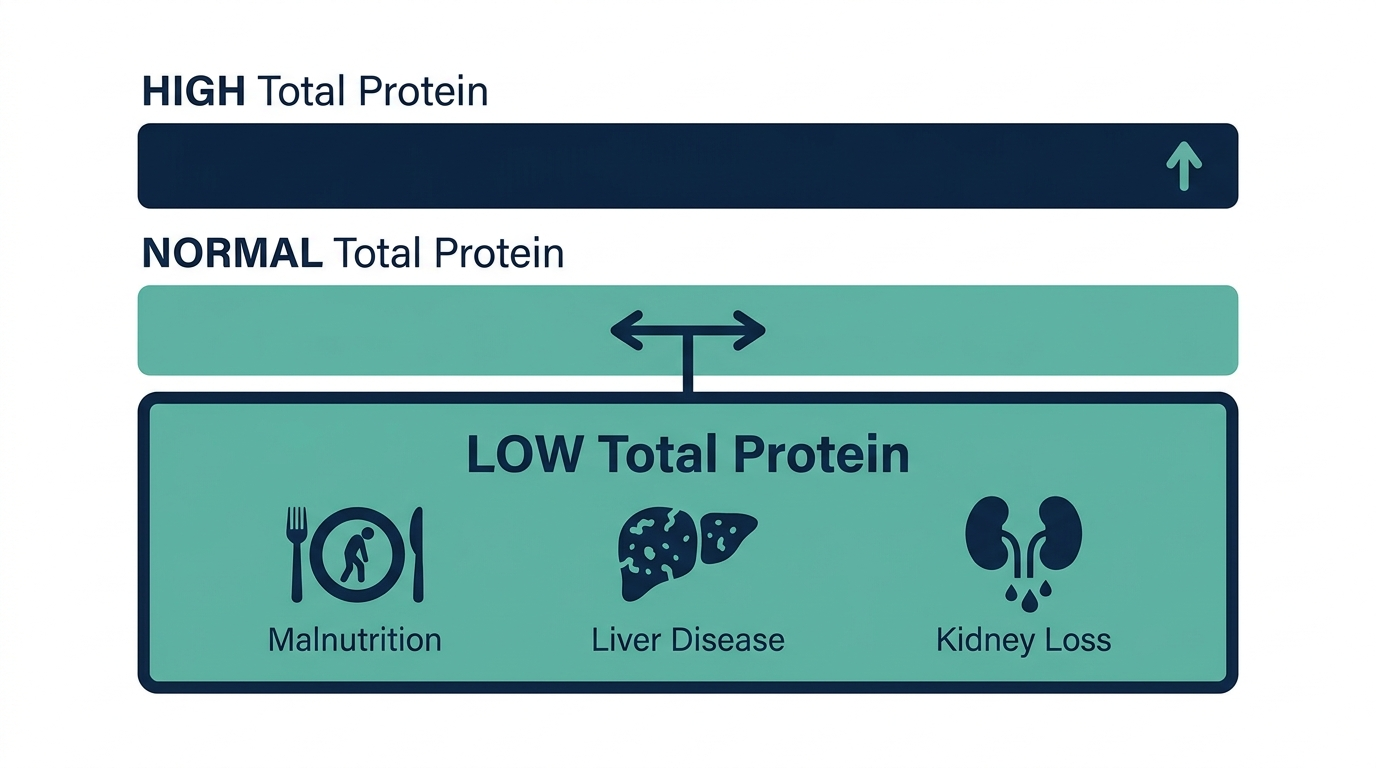
The albumin to globulin ratio is one of the most useful pieces of information hiding inside a total protein result, because its direction narrows the cause. A normal ratio sits a little above one, meaning albumin slightly outweighs globulin. When that balance shifts, it points somewhere specific.
- Low ratio (albumin down or globulin up): can suggest liver disease reducing albumin, kidney loss of albumin, or chronic inflammation raising globulin.
- High ratio (globulin down): can suggest an immune or antibody deficiency, or certain genetic conditions.
- Normal ratio with low total: may reflect dilution from overhydration or a proportional drop, such as in some nutritional states.
Consider how this plays out. A low total protein with a low A/G ratio driven by low albumin steers a clinician toward liver, kidney, or nutrition. The same low total with a preserved albumin but low globulin points instead toward the immune system. This is why a bare total protein number, without albumin, globulin, and the ratio, leaves the most important clue on the table.
What can skew a total protein result
Before treating a low value as a fixed fact, it helps to know what can move it. Several everyday factors influence the number.
- Hydration status: overhydration dilutes the blood and lowers total protein, while dehydration concentrates it and raises the number.
- Recent illness or inflammation: acute illness can shift both albumin and globulin, so a result taken during illness may not reflect baseline.
- Pregnancy: rising plasma volume naturally lowers the concentration, a normal change rather than a disease.
- Prolonged tourniquet time during the draw: a technical factor that can nudge the reading.
- Recent low protein intake or crash dieting: can temporarily lower levels.
The practical lesson is that a single low value, especially if you were recently unwell or well hydrated, often deserves a repeat test. A trend across readings is far more reliable than one snapshot.
Companion tests that pinpoint the cause
A low total protein is a starting point that usually prompts a small set of follow-up tests, chosen based on the suspected cause.
- Albumin and globulin with A/G ratio: the first breakdown, since it directs everything that follows.
- Liver function tests (ALT, AST, bilirubin): if low albumin suggests the liver is not making enough protein.
- Kidney function and urine protein: to check whether protein is leaking into the urine, as in nephrotic syndrome.
- Nutritional markers: to assess intake and absorption when malnutrition or a gut condition is suspected.
- Protein electrophoresis: a specialized test that separates the globulin fractions when an immune or antibody problem is suspected.
Reading these together is what turns a vague low total into a specific diagnosis. A low albumin with abnormal liver enzymes tells a different story than a low albumin with heavy protein in the urine.
Sample interpretation scenarios
Concrete examples show how the same low total protein can mean different things. These illustrate clinical reasoning and are not personalized advice.
- Low total, low albumin, abnormal liver enzymes: points toward the liver not making enough protein, prompting a liver workup.
- Low total, low albumin, foamy urine with protein in the urine: suggests the kidneys are leaking protein, as in nephrotic syndrome.
- Low total with a normal albumin but low globulin: shifts attention to the immune system and may lead to protein electrophoresis.
- Mildly low total in a well person who is well hydrated: often a dilution effect or lab variation, commonly rechecked before any action.
The common thread is that the components and the surrounding tests, not the total alone, determine what happens next. It is also worth remembering that many low results improve once the cause is addressed. Correcting nutrition, treating a gut condition, or managing the underlying liver or kidney problem often brings the number back toward normal over weeks to months, which is why clinicians tend to recheck total protein and albumin during treatment rather than acting on a single reading.
Common misconceptions about low total protein
Because “protein” sounds like something you simply eat more of, low total protein is widely misunderstood. A few clarifications help.
- “I can fix it by eating more protein.” Only if the cause is poor intake or mild malabsorption. When liver disease, kidney loss, or gut loss is driving it, diet alone will not correct the number, and the underlying condition must be treated.
- “A low total always means something serious.” A mild, isolated dip in a well person is often harmless and simply rechecked, especially if hydration or lab variation explains it.
- “The total protein number is enough.” It rarely is. Without albumin, globulin, and the A/G ratio, the most useful clue is missing.
- “Protein in my blood test is the same as dietary protein grams.” They are related but not the same. Blood protein reflects production, loss, and dilution, not just how much protein you ate yesterday.
The reliable habit is to ask for the albumin, globulin, and ratio, look at the trend, and let follow-up tests, not assumptions, identify the cause.
Tracking total protein over time, not as a one-off
One of the most useful shifts in thinking is to treat total protein as a trend rather than a single verdict. Blood proteins turn over slowly, so albumin in particular reflects the past few weeks rather than the past few hours. That makes a series of readings far more informative than any lone value.
A practical way to follow the number:
- Anchor to a baseline: a result taken when you feel well, at a similar time of day and hydration state, gives you a reference to compare future draws against.
- Watch the direction, not just the label: a value drifting down over several tests can matter more than a single reading sitting just inside or just outside the range.
- Retest after a change: if you correct nutrition, treat a gut condition, or manage a liver or kidney problem, a follow-up in several weeks shows whether the number is responding.
- Keep the components together: tracking albumin and globulin alongside the total lets you see which part is moving, which is where the real signal lives.
This is why clinicians often recheck total protein and albumin during treatment rather than acting on one snapshot. A stable trend inside the range is reassuring, while a steady decline is a prompt to look harder even before the number crosses the lower limit.
How age, sex, and life stage shift the number
Reference ranges are built for a general adult population, but a few normal life factors can nudge total protein without signaling disease. Knowing them prevents unnecessary worry over a mildly low reading.
- Pregnancy: plasma volume rises substantially, which dilutes blood proteins and can lower the total for entirely benign reasons.
- Older adults: total protein tends to run slightly lower with age, partly reflecting changes in muscle mass, appetite, and hydration rather than a specific illness.
- Children: ranges differ from adults and shift as a child grows, so pediatric results are read against age-specific references.
- Recent hydration and posture: being well hydrated or lying down before a draw can lower the reading modestly compared with a dehydrated, upright state.
None of these replaces a clinician’s judgment, but they explain why the same value can be perfectly normal in one person and worth a second look in another. The safest approach is to interpret your result against the reference range for your own age and situation, and to flag any result that arrives with symptoms rather than treating the bare number as the whole story.
Turn what you just learned about low protein total into action.
Superpower lets you test low protein total and 100+ biomarkers from home, then re-check them over time so you can actually see progress, physician-reviewed at every step.
Frequently asked questions
Is low total protein serious?
It depends. A mildly low result in someone who feels well is often harmless and is simply rechecked. But low total protein can signal serious liver or kidney disease, especially when paired with swelling, jaundice, or foamy urine, so any persistent or symptomatic result needs a doctor’s review.
Can low protein be fixed by eating more protein?
Sometimes. If the cause is poor intake or mild malabsorption, improving diet can help. But if the low level comes from liver disease, kidney disease, or protein loss through the gut, eating more protein alone will not fix it. The underlying condition has to be treated.
What total protein level is considered too low?
Any value below your lab’s lower limit counts as low. Cleveland Clinic uses a normal range of 6.3 to 8.0 g/dL, so results under about 6.3 g/dL are generally flagged as low. Always check the specific reference range printed on your own report, as labs differ.
Can dehydration affect a total protein result?
Yes, but usually in the opposite direction. Dehydration concentrates the blood and tends to raise total protein, while overhydration dilutes it and can lower the number. This is one reason a single out-of-range result is often repeated before any conclusions are drawn.
Does low total protein cause swelling?
It can. Albumin keeps fluid inside your blood vessels, so when it drops far enough, fluid leaks into tissues and causes edema in the legs, feet, hands, or face. Swelling is the classic sign Cleveland Clinic links to low blood protein and warrants medical evaluation.
Sources
- Cleveland Clinic, Low Protein in Blood (Hypoproteinemia)
- MedlinePlus, Total Protein and Albumin/Globulin (A/G) Ratio
- MedlinePlus Medical Encyclopedia, Total protein
- StatPearls (NCBI Bookshelf), Protein-Losing Enteropathy
- Clinical Methods (NCBI Bookshelf), Serum Albumin and Globulin
This article is for general educational purposes and is not medical advice. It cannot diagnose or treat you and does not replace your clinician. Always discuss your lab results and any health decisions with a qualified healthcare professional.
Related: find the right at-home biomarker test.
Vital Signs Today may earn a commission if you buy through links on this page. It does not affect our editorial assessments.