- A normal eGFR for most adults is about 90 to 120 mL/min/1.73 m2, and Cleveland Clinic puts a typical adult value at around 100; an eGFR of 60 or higher with no other signs of kidney damage is generally considered normal.
- eGFR falls naturally with age even in healthy kidneys, dropping from an average of about 116 mL/min/1.73 m2 at ages 20 to 29 to about 75 by age 70 and over (Cleveland Clinic).
- The 2021 CKD-EPI equation that calculates eGFR uses age and sex but no longer uses race, so a single creatinine value gives slightly different eGFR results for men and women (National Kidney Foundation).
Estimated glomerular filtration rate, or eGFR, is the single most useful number on a kidney blood panel. It estimates how many milliliters of blood your kidneys filter each minute. The tricky part is that a “good” eGFR for a 25 year old and a “good” eGFR for a 75 year old are not the same number. This guide gives you the real reference values by age and sex from authoritative sources, and explains when a result actually signals a problem.
Part of our Comprehensive Metabolic Panel guide.
Curious how your eGFR compares to a typical adult value of 100? See your full kidney panel. One at-home Superpower draw checks 100+ biomarkers, physician-reviewed.
What is a normal eGFR level?
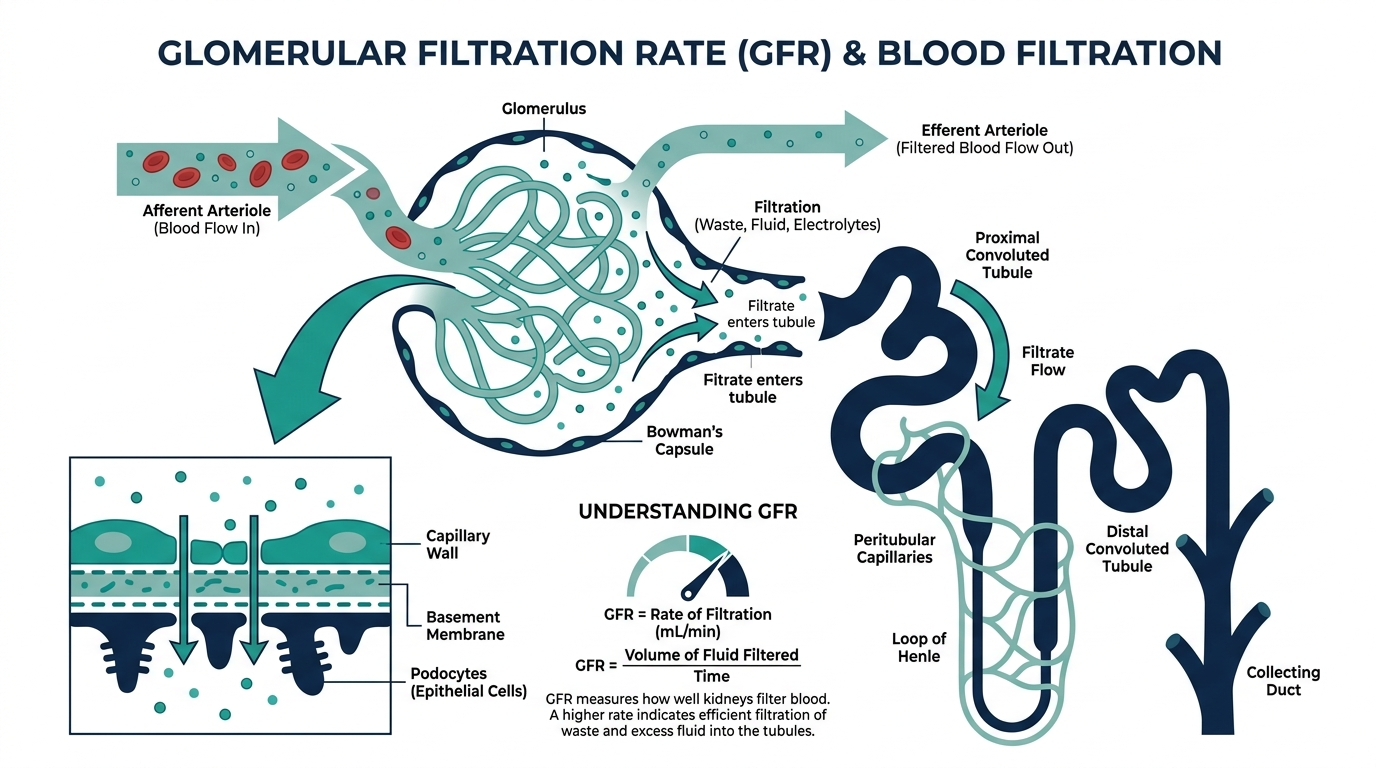
For most healthy adults, a normal eGFR is roughly 90 to 120 mL/min/1.73 m2, and Cleveland Clinic describes a typical adult value as about 100. An important nuance often missed: an eGFR between 60 and 89 is classified as normal when there are no other markers of kidney damage such as protein in the urine, because mildly reduced numbers are common with age (National Kidney Foundation).
The number is reported in mL/min/1.73 m2, which standardizes the result to an average adult body surface area so people of different sizes can be compared. Labs rarely report eGFR values above 90 with an exact figure; many simply state “greater than 90” or “greater than 60” because the equation is most accurate in the lower, clinically important range. So a result that just reads “>90” is reassuring, not incomplete.
There is a difference between a normal eGFR and an optimal one. Standard lab reference simply flags anything at or above 60, with no damage markers, as acceptable, but for your age higher and stable is better. A 40 year old sitting at 65 is technically inside the normal band, yet that value is low for the decade and worth a repeat test with a urine check. The habit worth building is to read your eGFR against the age average in the table below, not only against the lab’s one size fits all cutoff. Reference ranges also vary slightly from lab to lab, so compare results within the same lab where you can.
eGFR or creatinine: which number should you watch?
eGFR is calculated from creatinine, so the two move together, but eGFR is the more useful of the pair because it already corrects for your age and sex. A creatinine of 1.1 mg/dL means something very different in a 25 year old man and a 78 year old woman. eGFR folds those variables in and hands you a single filtration estimate. When you get a metabolic panel, glance at creatinine, but anchor on eGFR and its trend across draws.
eGFR normal range by age
The simplest way to actually get this done
Superpower is a full-body lab membership that runs 100+ biomarkers, has each result reviewed by a doctor, and tracks your numbers year over year (about $199/year). It is what we point readers to when they would rather get one clean, complete draw than chase single tests one at a time. Here is superpower reviewed in full.
Average eGFR declines steadily with age, falling from about 116 mL/min/1.73 m2 in your twenties to about 75 by age 70 and over (Cleveland Clinic). The table below shows the population average for each decade. These are typical values for people without kidney disease, not strict cutoffs, so your own healthy number can sit somewhat above or below the average for your age.
| Age group (years) | Average eGFR (mL/min/1.73 m2) | What it means |
|---|---|---|
| 20 to 29 | 116 | Peak kidney function |
| 30 to 39 | 107 | Still near peak |
| 40 to 49 | 99 | Gradual decline begins |
| 50 to 59 | 93 | Mild, expected drop |
| 60 to 69 | 85 | Lower but usually normal for age |
| 70 and over | 75 | Reduced filtration is common and often benign |
Source: Cleveland Clinic, eGFR average values by age. Values are population averages for people without kidney disease.
Notice the pattern: kidney function peaks between roughly age 25 and 35, then drifts downward by about 6 to 7 mL/min/1.73 m2 every decade after about age 35 to 40, a change documented in studies of healthy kidney donors (NCBI, Ageing and the Glomerular Filtration Rate). This is why a value of 75 can be perfectly healthy at 75 but worth investigating at 30.
How is eGFR measured, and why does creatinine matter?
Your kidneys’ true filtration rate cannot be measured directly in routine care. Measuring actual GFR requires injecting a tracer such as iohexol and timing how fast it clears, which is slow, costly, and reserved for research or transplant work. So labs estimate it. They take the creatinine from your blood draw and feed it, along with your age and sex, into the 2021 CKD-EPI equation. That estimate is the “e” in eGFR.
Creatinine is a waste product your muscles produce at a fairly steady rate. Healthy kidneys clear it efficiently, so when filtration drops, creatinine rises and the calculated eGFR falls. The weakness of a creatinine based estimate is that it assumes an average muscle mass. A bodybuilder, someone on creatine supplements, or a person who just ate a large steak can show a higher creatinine and a falsely low eGFR. At the other end, a frail or very low muscle person can have a deceptively normal eGFR because they make little creatinine to begin with.
When doctors add cystatin C
To get around the muscle problem, clinicians can order a second marker called cystatin C, a protein made by nearly all cells at a steady rate and largely independent of muscle. An eGFR based on cystatin C, or better still a combined creatinine plus cystatin C estimate, is more accurate and is recommended when a creatinine based result does not fit the clinical picture, for example in people at the extremes of body size or those making an important treatment decision that hinges on kidney function (National Kidney Foundation). If your creatinine based eGFR looks off for who you are, asking whether a cystatin C is warranted is a reasonable question.
How does sex change the range?
Sex shifts the result because the 2021 CKD-EPI equation, the formula nearly all US labs use, assigns slightly different coefficients to men and women: the constant is 142 for men and 143 for women, with different creatinine thresholds (0.9 mg/dL for men, 0.7 mg/dL for women) (Medscape, CKD-EPI 2021). The practical effect is that men and women with the same creatinine level usually get different eGFR numbers.
This sex adjustment exists because, on average, men carry more muscle mass than women, and muscle releases creatinine. Higher baseline creatinine in men is therefore expected and is built into the math rather than treated as a red flag. The 2021 update also removed race as a variable, a change adopted across US health systems because the older race coefficient overestimated eGFR in Black patients and could delay care (National Kidney Foundation).
- Men: tend to show modestly higher eGFR at the same creatinine because the equation accounts for greater muscle mass.
- Women: tend to show modestly lower creatinine but comparable eGFR once the formula adjusts.
- Both: the age based decline pattern applies equally; sex shifts the level, age shifts the trend.
How do you prepare for an eGFR test?
An eGFR does not usually need fasting, but a few controllable things can nudge creatinine and skew the estimate for a day. If you want the cleanest read, these are the levers that actually matter:
- Skip a big meat meal the night before. Cooked meat contains creatinine that briefly raises your blood level and can drop the calculated eGFR by a few points. A normal dinner is fine, an all you can eat steakhouse the night before is not ideal.
- Pause creatine supplements for a few days. Creatine monohydrate, common in gym stacks, raises creatinine independent of any kidney issue. Tell the lab or your clinician if you take it, or hold it before testing.
- Avoid intense exercise for 24 hours. A hard workout, especially heavy lifting, transiently raises creatinine from muscle turnover.
- Be normally hydrated. Showing up dehydrated lowers eGFR, and a sensible amount of water beforehand keeps the reading honest. Do not overdo it, chugging water does not flush your kidneys to a better number.
- Bring your medication list. Some drugs, including trimethoprim and cimetidine, block creatinine secretion and lower eGFR without harming the kidney. Your clinician needs to know what you take to interpret the result.
Timing matters less than consistency. If you are tracking eGFR over time, try to test under similar conditions each time, same rough time of day, similar hydration, and no heavy meat or workout the day before, so you are comparing like with like.
What makes eGFR rise or fall with age?
eGFR falls with age mainly because the number of working filtering units, called nephrons, gradually drops and blood flow through the kidneys slows; the normal loss is roughly 0.7 to 1.0 mL/min per year after about age 40 (NCBI, Ageing and the Glomerular Filtration Rate). This is structural aging, not disease, and it happens even in people who never develop chronic kidney disease.
But the eGFR number can also move for reasons that have nothing to do with long term kidney health, which is why a single reading is never the whole story:
- Hydration and acute illness: dehydration, vomiting, or a fever can temporarily lower eGFR; rehydrating often brings it back up.
- Muscle mass and diet: very muscular people or those eating a large amount of cooked meat before the test can raise creatinine and lower the calculated eGFR without any kidney problem.
- Medications: some drugs, including certain blood pressure medicines and NSAIDs, can shift creatinine and eGFR.
- Chronic conditions: diabetes and high blood pressure accelerate the natural decline and are the leading drivers of true kidney damage.
Because of this variability, clinicians look for a sustained change across at least two readings about 90 days apart before diagnosing chronic kidney disease.
When is an out-of-range result a concern?
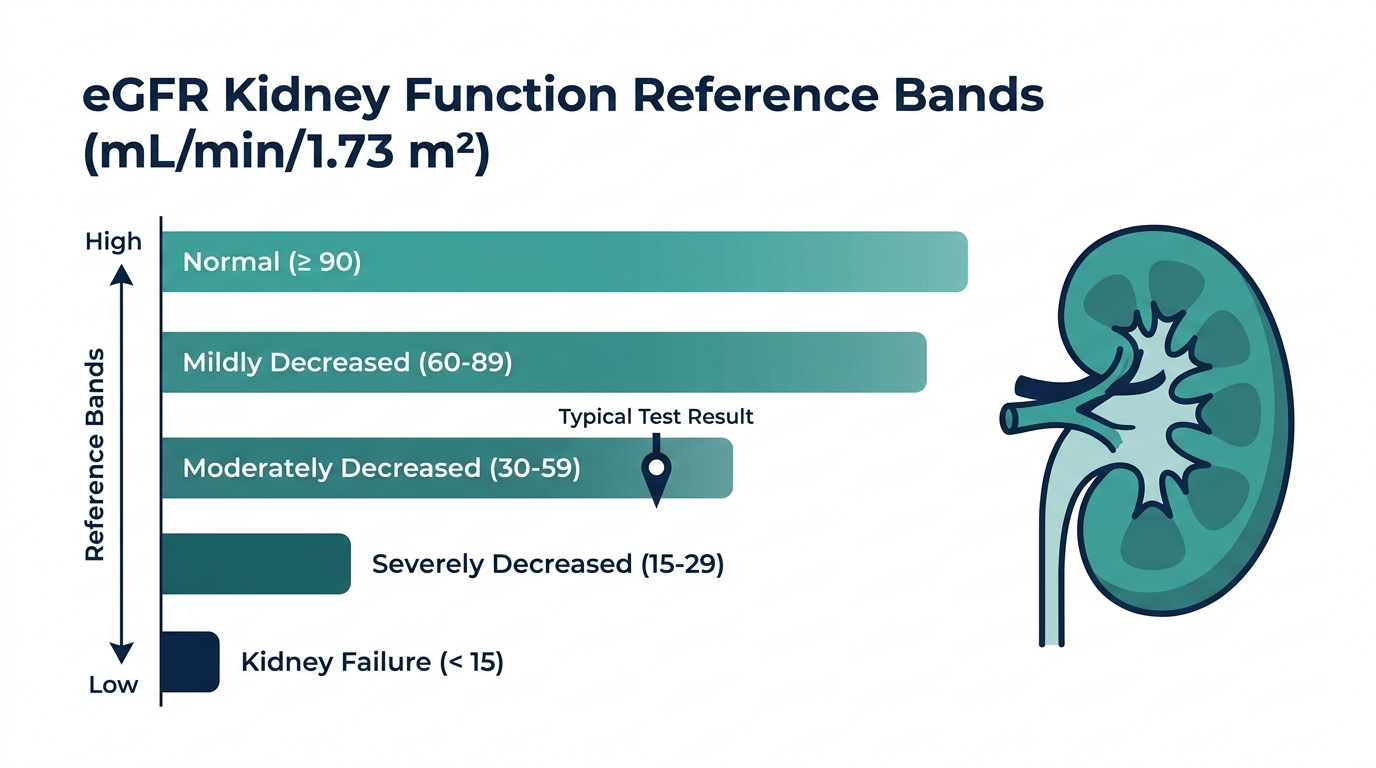
An eGFR result is most concerning when it stays below 60 mL/min/1.73 m2 for three months or longer, which meets the threshold for chronic kidney disease, or when any drop comes with protein in the urine or a falling trend over time (National Kidney Foundation). Cleveland Clinic stages kidney disease by eGFR as follows.
- Stage 1 (eGFR 90 or above): normal filtration; concern only if other signs of kidney damage are present.
- Stage 2 (eGFR 60 to 89): mildly reduced; often normal for age unless paired with damage markers.
- Stage 3 (eGFR 30 to 59): moderate loss of function; warrants monitoring and a care plan.
- Stage 4 (eGFR 15 to 29): severe loss; preparation for possible dialysis or transplant begins.
- Stage 5 (eGFR below 15): kidney failure; dialysis or transplant is usually needed (Cleveland Clinic).
The key questions your clinician will weigh: Is the number low for your age, or just low? Is it stable or falling? Is there protein in the urine? A single eGFR of 70 in a healthy 72 year old usually needs nothing more than routine follow up. The same number in a 35 year old with diabetes deserves a closer look.
Two quick real world reads make the point. A 68 year old with an eGFR of 72, stable across two draws, a normal urine albumin, and no diabetes is showing textbook healthy aging and needs only routine follow up. A 34 year old with an eGFR of 72 that was 88 a year ago, plus a mildly high urine albumin, is the one to work up. Same number, opposite meaning. The value on the page is close to meaningless until you place it against age, trend, and the urine result.
Symptoms that can come with a low eGFR
Early kidney decline is famously silent, which is exactly why the blood number matters more than how you feel. Most people with a mildly reduced eGFR notice nothing. When symptoms do appear, usually at stage 3 or beyond, they can include tiredness and trouble concentrating, swelling in the ankles or around the eyes, foamy urine, needing to urinate more at night, itchy skin, and poor appetite. None of these are specific to the kidney, so they are a prompt to test, not a diagnosis on their own.
The second number your clinician wants: urine albumin
eGFR is only half of a kidney assessment. The other half is a urine albumin to creatinine ratio, or uACR, which detects protein leaking into the urine, an early sign of kidney damage that often shows up before eGFR falls. Kidney disease is staged on both axes at once: a G stage from eGFR (G1 to G5) and an A stage from albuminuria (A1 under 30 mg/g, A2 30 to 300, A3 above 300). This is why a normal eGFR paired with a high uACR still counts as kidney disease, and why a low but stable eGFR with a normal uACR is often just aging.
What to do if your eGFR is low
A single low reading is a flag, not a verdict. The standard next steps are practical:
- Retest, do not panic. Because hydration, meat, and illness all move the number, a lone low eGFR is repeated, usually with a urine uACR, before anything is concluded.
- Confirm the trend over about 90 days. Chronic kidney disease requires a reduced eGFR that persists for three months, so two readings a season apart tell a very different story than one.
- Protect the kidney you have. Controlling blood pressure and blood sugar, easing off routine NSAID use, staying hydrated, and not smoking are the levers with the most evidence behind them for slowing decline.
- Know the referral line. A sustained eGFR below 30, a rapidly falling trend, or a persistently high uACR are the usual triggers for a nephrology referral.
Turn what you just learned into action.
Superpower lets you test 100+ biomarkers from home, then re-check them over time so you can actually see progress, physician-reviewed at every step.
Frequently asked questions
Is an eGFR of 60 bad?
Not necessarily. An eGFR of 60 to 89 is classed as normal when there are no other signs of kidney damage, and it is common with age. An eGFR of exactly 60 that is stable and has no protein in the urine is usually monitored rather than treated (National Kidney Foundation).
What is a normal eGFR for a 70 year old?
For people aged 70 and over, the average eGFR is about 75 mL/min/1.73 m2, according to Cleveland Clinic. Values somewhat below this can still be normal for age, especially when stable and without protein in the urine.
Can eGFR improve or go back up?
Yes, in some cases. eGFR that dropped from dehydration, illness, or certain medications often recovers once the cause is corrected. The gradual age related decline does not reverse, but treating diabetes and high blood pressure can slow further loss.
Does muscle mass affect eGFR?
Yes. Because creatinine comes from muscle, very muscular people can have higher creatinine and a lower calculated eGFR without any kidney problem. Eating a large amount of cooked meat shortly before the test can have a similar temporary effect.
Why did the eGFR formula remove race?
The 2021 CKD-EPI equation dropped race because the older race coefficient overestimated eGFR in Black patients and could delay diagnosis and care. US labs now use the race free version for everyone (National Kidney Foundation).
What is a dangerously low eGFR?
An eGFR below 15 mL/min/1.73 m2 defines kidney failure (stage 5) and usually means dialysis or a transplant is needed soon. An eGFR of 15 to 29 (stage 4) is severe and prompts planning for those treatments. These are the ranges that need urgent specialist care, as opposed to the mildly reduced values that are common with age.
How often should I check my eGFR?
For a healthy adult, eGFR is typically checked as part of a routine metabolic panel every year or two. If you have diabetes, high blood pressure, or a family history of kidney disease, or if a prior result was borderline, your clinician will usually check it more often, along with a urine albumin test.
Can dehydration cause a low eGFR?
Yes. Dehydration reduces blood flow through the kidneys and temporarily lowers eGFR. This kind of dip often corrects once you rehydrate, which is one reason a single low result is repeated before any diagnosis is made.
Is a high eGFR something to worry about?
Usually not. A value reported as greater than 90 or greater than 120 is generally reassuring. Very high numbers are occasionally seen with low muscle mass, or in specific settings such as early hyperfiltration in diabetes, so context matters, but on its own a high eGFR is far less concerning than a low or falling one.
Sources
- Cleveland Clinic, Estimated Glomerular Filtration Rate (eGFR): Test and Levels
- National Kidney Foundation, Estimated GFR (eGFR) Test
- NCBI PMC, Ageing and the Glomerular Filtration Rate: Truths and Consequences
- Medscape, eGFR using CKD-EPI (2021 update)
This article is for general educational purposes and is not medical advice. It cannot diagnose or treat you and does not replace your clinician. Always discuss your lab results and any health decisions with a qualified healthcare professional.
Vital Signs Today may earn a commission if you buy through links on this page. It does not affect our editorial assessments.