
- You can raise HDL cholesterol mainly through lifestyle: regular aerobic exercise, losing excess weight, quitting smoking, and replacing trans fats and refined carbs with healthy unsaturated fats and fiber.
- HDL is considered low below 40 mg/dL in men and below 50 mg/dL in women, and consistent habits can lift it by roughly 5 to 10 percent over a few months (Cleveland Clinic; Mayo Clinic).
- Raising HDL with a single drug such as niacin has not reduced heart attacks in trials, so the goal is a healthier overall lipid profile, not a higher HDL number alone (AIM-HIGH, NEJM).
HDL, or high-density lipoprotein, is often called the “good” cholesterol because it helps carry cholesterol away from your arteries back to your liver. A higher HDL is generally linked with lower heart risk, and many people want practical ways to move it in the right direction. This guide walks through what counts as low, why it matters, and the evidence-based steps that actually help.
Part of our Lipid Panel guide.
Trying to raise HDL through lifestyle changes, but do you know your starting number and full lipid picture? One at-home Superpower draw checks 100+ biomarkers, physician-reviewed.
What counts as low HDL?
HDL is considered low when it falls below 40 mg/dL in men and below 50 mg/dL in women, according to the Cleveland Clinic. A normal range runs from 40 to 80 mg/dL in men and 50 to 80 mg/dL in women, and a level of 60 mg/dL or higher is often viewed as protective. HDL is the one cholesterol number you generally want to be high rather than low.
HDL is the only standard lipid value with a built-in sex difference, because women typically carry higher HDL than men. For children and teens, a normal HDL sits around 45 to 80 mg/dL (Cleveland Clinic). Your result comes from a fasting or non-fasting lipid panel, and a single low reading is best confirmed with a repeat test before you act on it.
How HDL is measured, and what moves the number
HDL is one of the most stable values on a lipid panel, which is good news for interpreting it. Unlike triglycerides, which swing with your last meal, HDL and total cholesterol change little whether you fast or not, so many labs now accept a non-fasting draw. The number that does get distorted by a recent fatty meal is triglycerides, and because standard panels calculate LDL from HDL and triglycerides, an unfasted sample can throw off the LDL estimate more than the HDL itself. If your report looks off, ask whether it was fasting and whether triglycerides were high enough to make the calculated LDL unreliable.
Reference cutoffs also vary slightly between labs, so treat the 40 and 50 mg/dL lines as guides rather than bright walls. What matters more than one reading is the trend across a few draws and how HDL sits next to the rest of your panel. A one-off HDL of 39 mg/dL in an otherwise clean profile means something very different from a persistent low HDL alongside high triglycerides and a rising waistline.
Why raise it?
The simplest way to actually get this done
Superpower is a full-body lab membership that runs 100+ biomarkers, has each result reviewed by a doctor, and tracks your numbers year over year (about $199/year). It is what we point readers to when they would rather get one clean, complete draw than chase single tests one at a time. Here is superpower reviewed in full.
Raising HDL matters because low HDL is one of the markers tied to higher cardiovascular risk, alongside high LDL and high triglycerides. People with very low HDL tend to show more coronary heart disease in observational studies (NCBI/PMC). HDL helps shuttle excess cholesterol out of artery walls, a process called reverse cholesterol transport.
That said, here is the nuance clinicians wish more people knew. HDL is a useful signal of overall metabolic health, but pushing the number up in isolation does not automatically buy you fewer heart attacks. The lifestyle steps that raise HDL also lower triglycerides, improve blood sugar, and trim waistline fat, and that whole package is what protects your heart. Think of HDL as a dashboard light, not the engine itself.
What pushes HDL down in the first place?
Raising HDL is easier when you know what is holding it low, because most low HDL is the visible edge of something bigger. The usual drivers cluster around metabolism and lifestyle.
- Insulin resistance and metabolic syndrome. This is the big one. When the body handles sugar poorly, triglycerides rise and HDL falls together, almost like a seesaw. A low HDL paired with high triglycerides is one of the clearest fingerprints of insulin resistance, and it often shows up years before blood sugar itself looks abnormal.
- Excess weight, especially around the middle. Visceral fat around the organs is metabolically active and drags HDL down. This is why waistline loss tends to move HDL more than losing the same weight elsewhere.
- Physical inactivity. A sedentary week lets HDL settle at the low end. Regular aerobic movement is one of the few things that reliably nudges it up.
- Smoking. Tobacco lowers HDL directly, and the number often rebounds within weeks to months of quitting.
- Diet skewed to refined carbs and sugar. Ironically, very low-fat diets built on white starch and sugar can lower HDL while raising triglycerides. The fat is not the enemy here, the refined carbohydrate is.
- Genetics and certain medications. Some people simply inherit lower HDL, and drugs such as anabolic steroids and certain beta-blockers can suppress it. Genetics set your starting line, not your ceiling.
Read that list again and a pattern jumps out: the same handful of factors that lower HDL also raise heart risk on their own. That is the real reason low HDL matters, and why fixing the drivers beats chasing the number.
Evidence-based ways to raise HDL
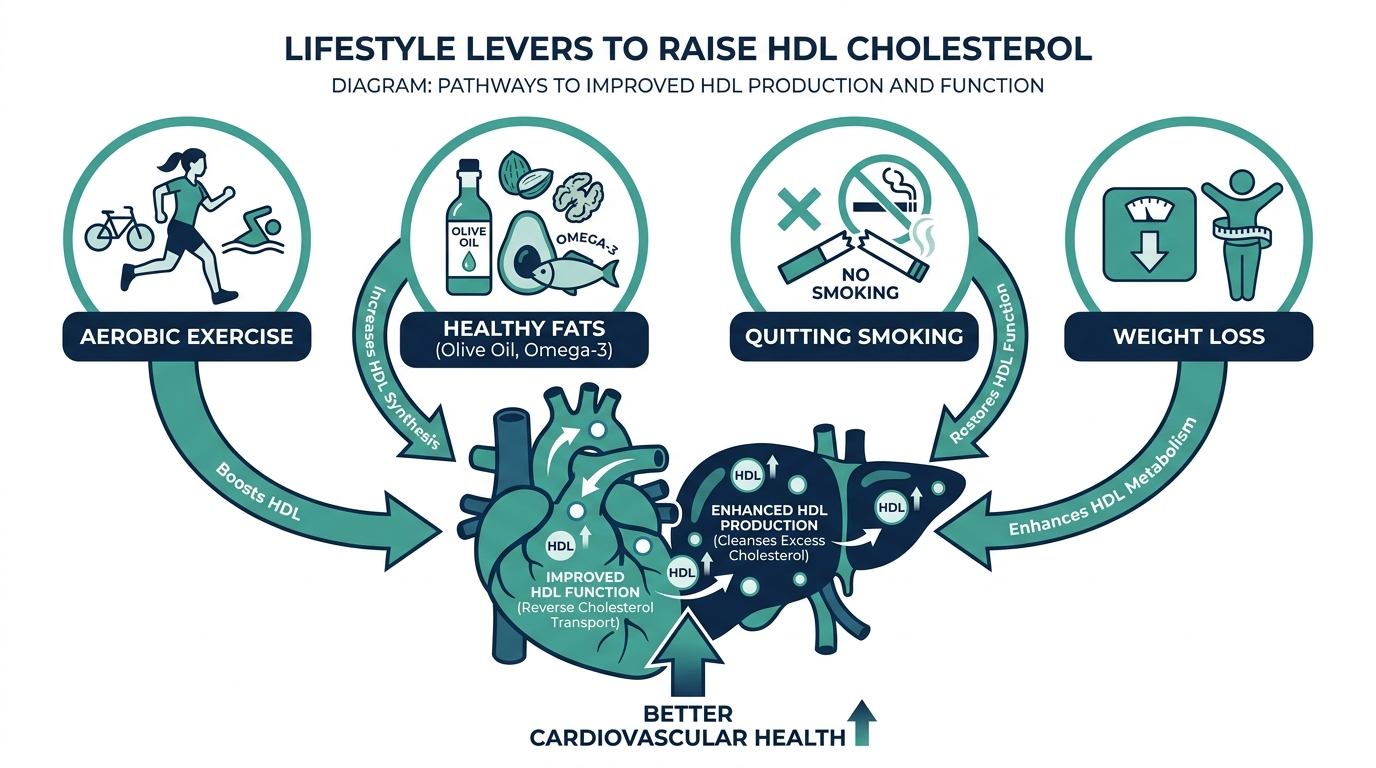
The most reliable ways to raise HDL are physical activity, weight loss, quitting smoking, and swapping harmful fats for healthy ones. Mayo Clinic notes that as little as 60 minutes of moderate aerobic exercise per week can begin to nudge HDL upward while lowering triglycerides. Below are the levers grouped by category.
Diet
- Cut trans fats: Trans fats raise LDL and lower HDL at the same time, so removing partially hydrogenated oils and many fried and packaged baked goods helps on both fronts (Mayo Clinic).
- Choose healthy unsaturated fats: Olive oil, nuts, seeds, fatty fish, and avocado support a better lipid profile. Mayo Clinic reports that fiber from avocado can improve HDL.
- Add soluble fiber and whole foods: Vegetables, fruits, legumes, and whole grains improve the overall panel and help with weight.
- Watch refined carbs and sugar: Diets heavy in sugar and white starch tend to lower HDL and raise triglycerides.
Lifestyle
- Exercise regularly: Aim for at least 30 minutes of brisk activity five days a week, or about 25 minutes of vigorous exercise three days a week (Mayo Clinic). Aerobic, high-intensity, and strength training all help.
- Lose excess weight: Trimming extra body fat, especially around the waist, can raise HDL.
- Quit smoking: Stopping can raise HDL, and the effect is often notable in women (Mayo Clinic).
- Alcohol, with caution: Moderate intake has been linked with higher HDL, but no clinician advises starting to drink for this reason given the broader risks.
Supplements and medical options
Here is where expectations need a reset. Niacin (vitamin B3) raises HDL substantially, yet the large AIM-HIGH trial found no reduction in heart attacks or strokes when niacin was added to statin therapy, and it was stopped early (NEJM; AIM-HIGH). Because of this, doctors no longer prescribe drugs simply to raise HDL. Omega-3 fish oil mainly lowers triglycerides rather than meaningfully raising HDL. Any supplement should be discussed with your clinician, since the priority is your full lipid picture and overall risk, not the HDL number alone.
How HDL connects to the rest of your panel
HDL becomes far more useful when you read it alongside two other numbers. The first is the triglyceride to HDL ratio, which you can calculate from your own report by dividing your triglycerides by your HDL. A ratio around 2 or below is reassuring, while a ratio much higher hints at insulin resistance even when glucose looks normal. The second is non-HDL cholesterol, which is simply your total cholesterol minus HDL and captures all the cholesterol carried in the particles that actually clog arteries. Many cardiologists now watch non-HDL and, where available, ApoB, more closely than HDL itself, because those numbers track the harmful side of the ledger. The takeaway is not that HDL is worthless. It is that a low HDL is a prompt to look at the company it keeps.
One more nuance worth carrying to your next visit: higher is not infinitely better. Very high HDL, well above 80 to 100 mg/dL, has not been shown to add protection and in some studies tracks with worse outcomes, which is part of why the field shifted away from treating HDL as a target to chase. The healthy sweet spot is a normal HDL sitting inside a clean overall profile, not a record-breaking number.
What this looks like in practice
Picture a 45-year-old with an HDL of 37 mg/dL, triglycerides of 190, a widening waistline, and a desk job. On paper the low HDL is the flagged value, but the pattern is textbook early insulin resistance. Rather than reaching for a supplement, the productive plan is 150 minutes of brisk walking a week, swapping sugary drinks and refined snacks for whole foods and healthy fats, and aiming to lose a few inches at the waist. Over about three months, triglycerides often fall first and fastest, HDL creeps up 5 to 10 percent, and the waist shrinks. The HDL number improving is really a signal that the underlying metabolism is improving, which is the outcome that protects the heart.
How long does it take?
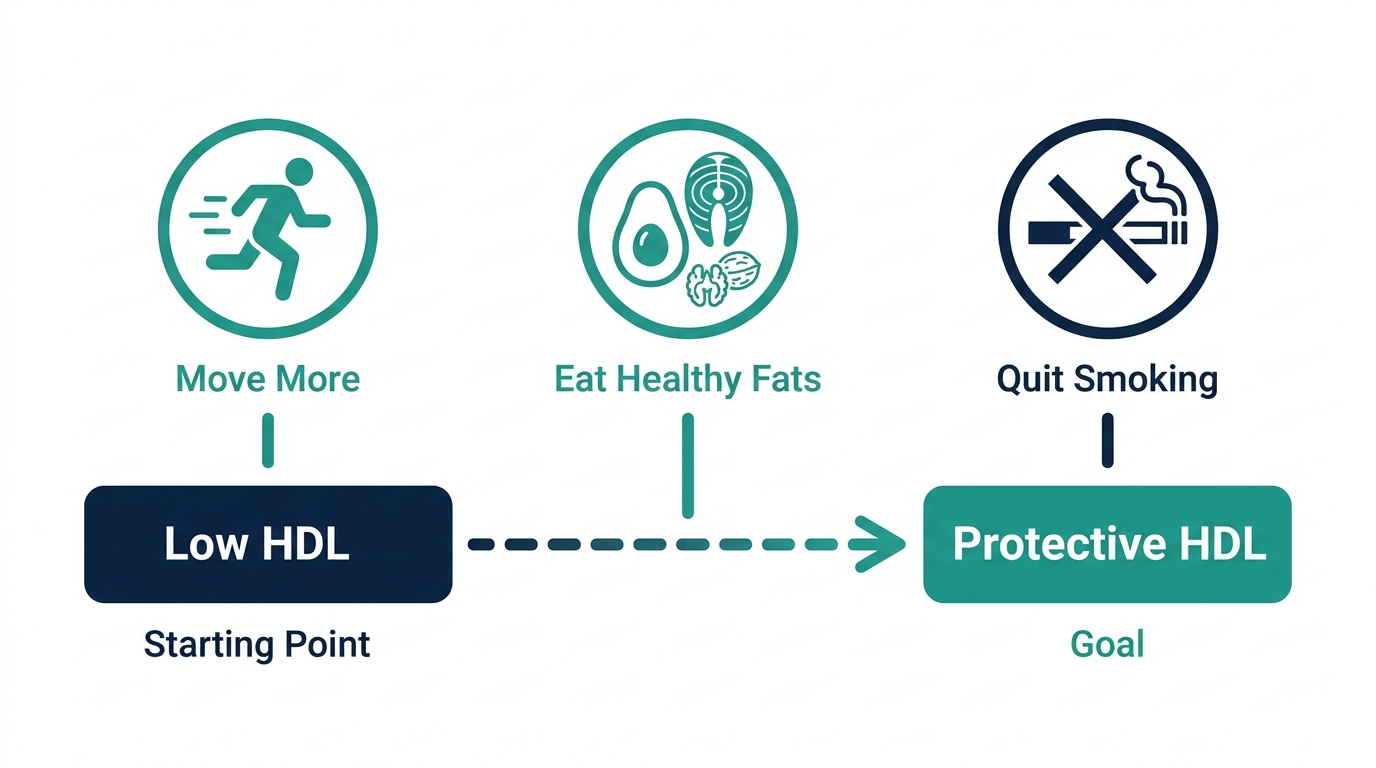
Most people see HDL changes over roughly 6 to 12 weeks of consistent lifestyle effort, with realistic gains of about 5 to 10 percent for HDL when habits stick (Mayo Clinic; Cleveland Clinic). HDL tends to respond more slowly than triglycerides, which can drop within days to weeks of cutting sugar and alcohol.
The pace depends on your starting point and which levers you pull. Quitting smoking and meaningful weight loss often produce the clearest HDL improvements, while diet tweaks alone move it more gently. Plan to recheck your lipid panel about 8 to 12 weeks after making changes so you can see the trend rather than reacting to one number.
When to see a doctor
See a doctor if your HDL is below 40 mg/dL (men) or 50 mg/dL (women), especially alongside high LDL, high triglycerides, diabetes, high blood pressure, or a family history of early heart disease (Cleveland Clinic). These combinations raise overall cardiovascular risk and deserve a full assessment.
Your clinician can interpret HDL in context with the rest of your panel and your personal risk factors, order repeat testing, and decide whether any medication is warranted for LDL or triglycerides. Booking a visit also makes sense if HDL stays low despite several months of solid lifestyle changes, or if you have symptoms such as chest pain, which always needs prompt evaluation.
Curious what your own levels look like?
Baseline 100+ biomarkers today and retest as life changes, all in one membership with physician review.
Frequently asked questions
What is the fastest way to raise HDL?
There is no overnight fix. The quickest reliable levers are regular aerobic exercise, quitting smoking, and losing excess weight, which together can lift HDL by roughly 5 to 10 percent over several weeks to months (Mayo Clinic). Cutting trans fats and refined sugar supports the change.
Can exercise alone raise HDL?
Yes, exercise alone can help. As little as 60 minutes of moderate aerobic activity per week can begin to raise HDL while lowering triglycerides, and most benefit comes from about 150 minutes weekly (Mayo Clinic). Pairing exercise with weight loss usually works better than either alone.
Does niacin still help raise HDL?
Niacin does raise HDL, but the AIM-HIGH trial showed it did not reduce heart attacks or strokes when added to statins, and it was stopped early (NEJM). Doctors no longer prescribe drugs purely to raise HDL, so discuss any niacin use with your clinician first.
Is HDL of 60 mg/dL good?
Yes. HDL of 60 mg/dL or higher is generally viewed as protective against heart disease, and a normal range runs from 40 to 80 mg/dL in men and 50 to 80 mg/dL in women (Cleveland Clinic). Higher HDL is one favorable signal within your overall lipid profile.
What foods raise HDL cholesterol?
Foods rich in healthy unsaturated fats and fiber help, including olive oil, fatty fish, nuts, seeds, and avocado, which Mayo Clinic links to improved HDL. Vegetables, fruits, legumes, and whole grains support the broader lipid profile, while trans fats and excess sugar work against you.
Should I be worried about a low HDL if my LDL is normal?
It is worth attention rather than alarm. A low HDL with an otherwise clean panel is a nudge to look at lifestyle and to check your triglyceride to HDL ratio, since low HDL often travels with early insulin resistance that the LDL number does not capture. Bring the pattern to your clinician, who will weigh it against your blood pressure, blood sugar, waist, and family history rather than treating the single value.
Does intermittent fasting or a low-carb diet raise HDL?
For many people, yes, because both approaches tend to cut refined carbs and lower triglycerides, and HDL often rises as triglycerides fall. Results vary by person and by how the diet is actually built, so a low-carb plan loaded with processed meat is not the goal. The reliable win comes from reducing sugar and refined starch while keeping healthy fats and fiber, then rechecking your panel after a couple of months.
Can medications lower my HDL?
Some can. Anabolic steroids notably suppress HDL, and certain older beta-blockers and other agents can nudge it down. If your HDL dropped after starting a new medication, do not stop it on your own. Raise it with your prescriber, who can weigh whether the drug is the cause and whether an alternative makes sense for your overall risk.
Sources
- Cleveland Clinic, HDL: Why It’s “Good” Cholesterol
- Cleveland Clinic, Cholesterol: Understanding Levels and Numbers
- Mayo Clinic, HDL cholesterol: How to boost your good cholesterol
- Mayo Clinic, Top 5 lifestyle changes to improve your cholesterol
- New England Journal of Medicine, Niacin in Patients with Low HDL (AIM-HIGH)
- NCBI/PMC, Clinical characteristics of patients with extremely low HDL cholesterol
This article is for general educational purposes and is not medical advice. It cannot diagnose or treat you and does not replace your clinician. Always discuss your lab results and any health decisions with a qualified healthcare professional.
Related: best GLP-1 telehealth providers for 2026.
Vital Signs Today may earn a commission if you buy through links on this page. It does not affect our editorial assessments.