
Related: vitamin D blood test: the full guide · What a high vitamin D result means
- To raise vitamin D, most adults need a daily dose of about 1,000 to 2,000 IU of vitamin D3, taken with a meal that contains fat, because vitamin D is fat soluble (NIH Office of Dietary Supplements).
- Blood levels usually start rising within 2 to 4 weeks, and a deficiency below 20 ng/mL typically returns to normal after roughly 6 to 8 weeks of consistent supplementation (StatPearls, NCBI).
- Fatty fish is the strongest food source, with a 3.5 ounce serving of wild salmon supplying close to 988 IU of vitamin D, while most other foods give only small amounts (PMC, NIH).
Low vitamin D is one of the most common nutrient gaps clinicians see, and the fix is usually simple once you know your starting number. This guide walks through what counts as low, why it matters, and the evidence based ways to bring your level back up safely.
What counts as low vitamin D?
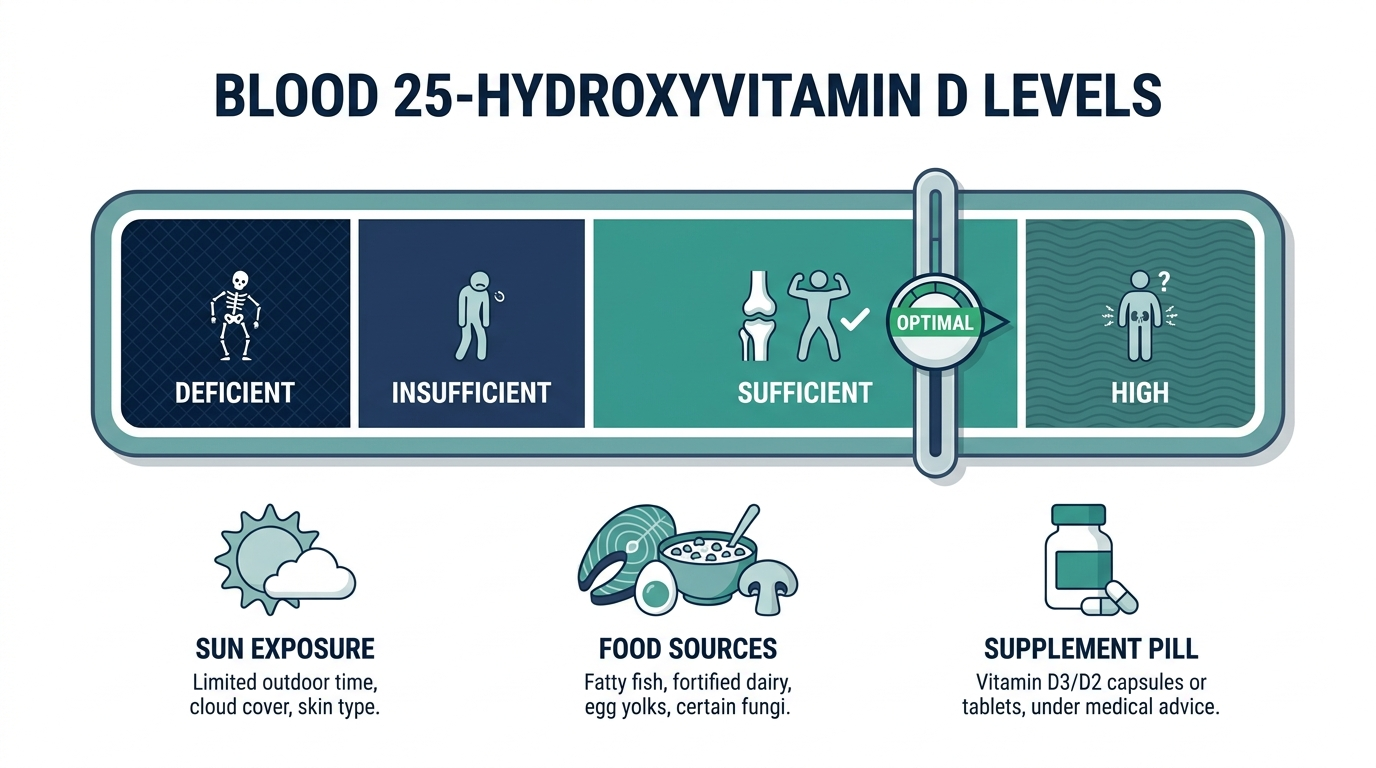
Vitamin D status is measured by a blood test called 25-hydroxyvitamin D, or 25(OH)D, reported in nanograms per milliliter (ng/mL). The Institute of Medicine classifies a level under 12 ng/mL as deficient, 12 to 20 ng/mL as insufficient, and 20 to 50 ng/mL as sufficient for most healthy adults (StatPearls, NCBI). The Endocrine Society uses a stricter clinical cutoff and considers anything below 30 ng/mL as deficient, which is why two doctors may interpret the same result differently.
Knowing your exact number matters because the correction plan changes with severity. A reading of 18 ng/mL needs far less than a reading of 8 ng/mL. If you have not been tested, ask for a 25(OH)D test before you start high dose supplements, so you and your clinician can target a dose to your actual level rather than guessing.
Two practical notes about the test itself. First, the standard measure is total 25(OH)D, and you do not need to fast for it, so you can draw it alongside a routine panel at any time of day. Second, reference cutoffs vary between labs and between guideline bodies, which is the single most common source of confusion. The same 24 ng/mL is called sufficient by the Institute of Medicine and deficient by the Endocrine Society. Rather than fixating on which side of a line you fall on, look at the number, your symptoms, and your risk factors together.
Who is most likely to have low vitamin D?
Deficiency is common, but it is far from random. Understanding why your level is low often tells you how hard you will have to work to raise it. The strongest risk factors, drawn from the NIH Office of Dietary Supplements, cluster into a few groups.
- Limited sun exposure. People who spend most daylight hours indoors, cover their skin, live at northern latitudes, or go through a long winter make little vitamin D from sunlight for months at a time.
- Darker skin. Melanin reduces the skin’s ability to produce vitamin D from UVB, so people with darker skin often need more sun or a higher supplemental dose to reach the same level.
- Older age. Skin becomes less efficient at making vitamin D with age, and older adults often spend less time outdoors, which is part of why the RDA rises after 70.
- Higher body weight. Vitamin D is fat soluble and gets sequestered in body fat, so people with obesity often need a larger dose to move their blood level, and may take longer to correct.
- Malabsorption conditions. Celiac disease, Crohn disease, and other conditions that impair fat absorption also impair vitamin D absorption, so the usual dose may not be enough.
- Certain medications. Some drugs, including certain steroids and anticonvulsants, speed the breakdown of vitamin D and can push levels down.
If two or three of these describe you, a maintenance dose that works for the average person may fall short, which is exactly why testing beats guessing.
Why raise it?
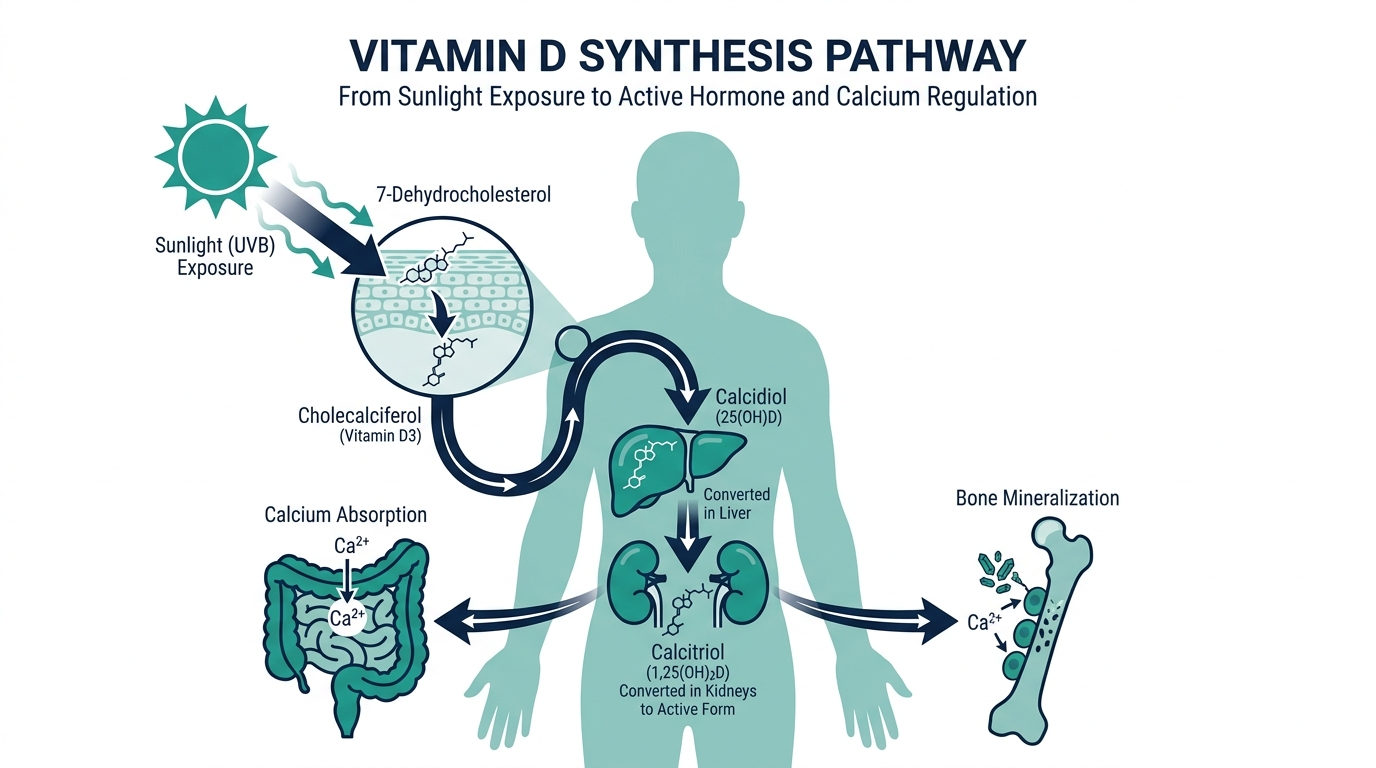
Vitamin D helps your gut absorb calcium and keeps bones strong, so a sustained shortfall can weaken the skeleton. In adults, severe long term deficiency causes osteomalacia, a softening of the bones, and contributes to osteoporosis and fracture risk (NIH Office of Dietary Supplements). The recommended dietary allowance exists precisely to protect bone health: 600 IU (15 mcg) per day for adults 19 to 70, and 800 IU (20 mcg) per day for adults over 70.
Beyond bone, vitamin D supports muscle function and immune signaling. Older adults with low levels can experience muscle weakness that raises fall risk. While vitamin D is not a cure for general fatigue or mood problems, correcting a true deficiency removes a real, measurable cause of bone and muscle harm, which is reason enough to bring a low level back into range.
Evidence-based ways to raise vitamin D
The fastest reliable way to raise vitamin D is a daily D3 supplement, usually 1,000 to 2,000 IU for maintenance, with diet and sensible sun exposure as support (NIH; StatPearls). Most people cannot reach target levels from food alone, because very few foods carry meaningful amounts. Below are the four levers, from gentlest to strongest.
Diet: Fatty fish leads by a wide margin. A 3.5 ounce serving of wild salmon supplies roughly 988 IU, while farmed salmon averages closer to 240 IU (PMC). Beef liver, cheese, and egg yolks provide small amounts, and UV exposed mushrooms add some. In the United States, most milk is fortified with about 400 IU per quart, and many cereals and plant milks are fortified too. Diet alone rarely corrects a deficiency, but it builds a steady baseline.
Supplements: Choose vitamin D3 (cholecalciferol) over D2 (ergocalciferol), because D3 tends to raise blood levels higher and for longer (NIH Office of Dietary Supplements). Take it with a meal that includes some fat for better absorption. For maintenance in healthy adults, 1,000 to 2,000 IU daily is common. The tolerable upper intake level for adults is 4,000 IU (100 mcg) per day, so do not exceed that without medical supervision.
Lifestyle: Skin makes vitamin D when exposed to UVB sunlight, so short, regular daylight exposure helps, especially in spring and summer. Output drops sharply in winter, at higher latitudes, with darker skin, and with sunscreen or full clothing. Sunlight is a useful supplement to diet and pills, but it is unreliable as a sole strategy because it depends on geography, season, and skin protection habits.
Medical treatment: For a confirmed level below 12 ng/mL, clinicians often prescribe a loading regimen, such as 6,000 IU daily or 50,000 IU weekly for about 8 weeks, then a maintenance dose of 1,000 to 2,000 IU per day once the level passes 30 ng/mL (StatPearls, NCBI). These higher doses should be doctor directed and followed by a repeat blood test.
Getting more out of the same dose
A few practical details separate a supplement that works from one that quietly underperforms. Consistency beats size, so a steady daily dose produces more stable blood levels than an occasional large one. Timing with a fat-containing meal genuinely matters, because vitamin D absorbs poorly on an empty stomach. Adequate magnesium supports the enzymes that convert vitamin D into its active form, so a diet short on greens, nuts, and whole grains can blunt your response even at a reasonable dose. And absorption is not the same as need, which is why the honest measure of whether your regimen is working is not how you feel but what your repeat 25(OH)D shows. If the number has not moved after a couple of months on a steady dose, the answer is usually a dose adjustment or a look for malabsorption, not simply pushing the pills higher on your own.
How vitamin D connects to calcium and PTH
Vitamin D does not act alone. Its main job is helping the gut absorb calcium, and when vitamin D runs low, blood calcium tends to dip. The body responds by raising parathyroid hormone (PTH), which pulls calcium out of your bones to keep the blood level steady, a state called secondary hyperparathyroidism. This is the quiet mechanism behind long-term bone loss from deficiency, and it is why a full workup for low vitamin D sometimes includes calcium and PTH, not just the 25(OH)D itself. Reading these three together tells a clearer story than any one alone. It also explains the ceiling on supplementation: pushing vitamin D too high can raise calcium into a dangerous range, so more is not better once your level is comfortably in range.
What this looks like in practice
Take a common case. An office worker in a northern city gets a routine panel in February showing 25(OH)D of 16 ng/mL, with tiredness and some vague muscle aches. The clinician confirms it is insufficient, starts 2,000 IU of D3 daily taken with lunch, and suggests a bit more outdoor time as spring arrives. A repeat test at ten weeks reads 34 ng/mL, and the person shifts to a 1,000 to 2,000 IU maintenance dose to hold the level, especially through the next winter. No megadoses, no guesswork, just test, correct, and recheck. For someone carrying extra weight or with a malabsorption condition, the same plan might need a higher dose and a longer runway, which is exactly why the recheck matters.
How long does it take?
Vitamin D levels typically begin rising within 2 to 4 weeks of consistent supplementation, and a mild to moderate deficiency usually returns to the normal range after about 6 to 8 weeks (StatPearls, NCBI). Severe deficiency, or low levels driven by poor absorption or obesity, can take several months to fully correct.
Because the rise is gradual, most clinicians retest 25(OH)D after 8 to 12 weeks rather than sooner, which gives the level time to plateau and shows whether your current dose is enough. If your follow up number is still low, your clinician may raise the dose or look for an underlying cause. Patience and consistency matter more than taking an occasional large dose, since steady daily intake produces the most stable blood levels.
When to see a doctor
See a doctor before starting high dose vitamin D, and especially if you have symptoms of deficiency such as bone pain, frequent fractures, or persistent muscle weakness, since these warrant a 25(OH)D test (NIH; StatPearls). A clinician can confirm the diagnosis and tailor a dose to your level rather than a generic amount.
Get prompt medical advice if you have kidney disease, conditions that affect fat absorption such as celiac or Crohn disease, or if you take medications that interact with vitamin D, because these change how you process and need the vitamin. Also seek care if you have taken high doses and feel nausea, excessive thirst, or confusion, which can signal vitamin D toxicity. Routine monitoring with a blood test keeps your correction plan both effective and safe.
Frequently asked questions
How can I raise my vitamin D fast?
The quickest reliable method is a daily vitamin D3 supplement taken with a fatty meal, often 1,000 to 2,000 IU for maintenance or a doctor prescribed loading dose for true deficiency. Levels usually start rising within 2 to 4 weeks (StatPearls, NCBI).
What is the best vitamin D to take?
Vitamin D3 (cholecalciferol) is generally preferred over D2, because D3 raises blood levels higher and keeps them up longer, according to the NIH Office of Dietary Supplements. Take it with food that contains some fat for better absorption.
How much vitamin D should I take per day?
The RDA is 600 IU for adults 19 to 70 and 800 IU for those over 70. Many adults use 1,000 to 2,000 IU daily for maintenance. Do not exceed the 4,000 IU upper limit without medical guidance (NIH Office of Dietary Supplements).
Can I get enough vitamin D from food alone?
Usually not. Very few foods carry meaningful amounts, and fatty fish like wild salmon (about 988 IU per 3.5 ounces) is the main exception. Diet builds a baseline, but most people need sunlight or supplements to correct a deficiency (PMC, NIH).
How long until my vitamin D level returns to normal?
Mild to moderate deficiency usually normalizes in about 6 to 8 weeks of consistent daily D3, with levels starting to rise within 2 to 4 weeks. Severe cases can take several months. Clinicians typically retest after 8 to 12 weeks (StatPearls, NCBI).
Is a weekly 50,000 IU dose better than a daily pill?
Both can work, and the choice is mostly about the situation. High weekly or monthly doses are typically used under medical direction to correct a confirmed deficiency quickly, then people usually switch to a steady daily maintenance dose. For routine upkeep, a smaller daily dose tends to give the most stable blood level and is easier to remember. Very large intermittent doses are not something to self-prescribe, and the loading regimens above should be doctor directed and followed by a repeat test.
Can too much vitamin D be harmful?
Yes. Vitamin D is fat soluble and can build up, and excessive intake raises blood calcium, which can cause nausea, excessive thirst, confusion, and, over time, kidney problems. The tolerable upper intake level for adults is 4,000 IU per day, and going above that should only happen under medical supervision with monitoring. Toxicity comes almost entirely from over-supplementation, not from sun or food, so the caution applies to high-dose pills.
Does magnesium help vitamin D work?
Magnesium is a cofactor for the enzymes that activate vitamin D, so a diet chronically low in magnesium can blunt your response to a supplement. This is not a reason to add another pill reflexively. It is a reason to keep magnesium-rich foods such as leafy greens, nuts, seeds, legumes, and whole grains in the rotation. If your level will not budge despite a sensible dose, mention it to your clinician, who can check whether an underlying issue is at play.
Sources
- NIH Office of Dietary Supplements, Vitamin D Fact Sheet for Health Professionals
- NIH Office of Dietary Supplements, Vitamin D Fact Sheet for Consumers
- StatPearls, NCBI Bookshelf, Vitamin D Deficiency
- PMC, Vitamin D in Wild and Farmed Atlantic Salmon
- MedlinePlus, Vitamin D
This article is for general educational purposes and is not medical advice. It cannot diagnose or treat you and does not replace your clinician. Always discuss your lab results and any health decisions with a qualified healthcare professional.
Related reading
Related: which GLP-1 telehealth service fits you.
Vital Signs Today may earn a commission if you buy through links on this page. It does not affect our editorial assessments.