
High uric acid, called hyperuricemia, is the buildup of urate in the blood that can trigger gout flares and kidney stones. The good news is that the number on your lab report responds to specific, well-studied changes. This guide walks through what counts as high, why it matters, and the diet, lifestyle, and medical steps shown to bring the level down.
- Hyperuricemia is generally defined as a serum uric acid above 7.0 mg/dL in men and above 6.0 mg/dL in women, and crystals start forming above the saturation point of about 6.8 mg/dL (StatPearls, NCBI).
- You can lower uric acid by cutting alcohol, organ meats, shellfish, and sugary drinks, losing excess weight, staying hydrated, and, when needed, taking a urate-lowering drug like allopurinol.
- For anyone treated with medication, the American College of Rheumatology sets a target serum urate below 6.0 mg/dL, because reaching it reduces gout flares over time (ACR, 2020 guideline).
What counts as high uric acid?
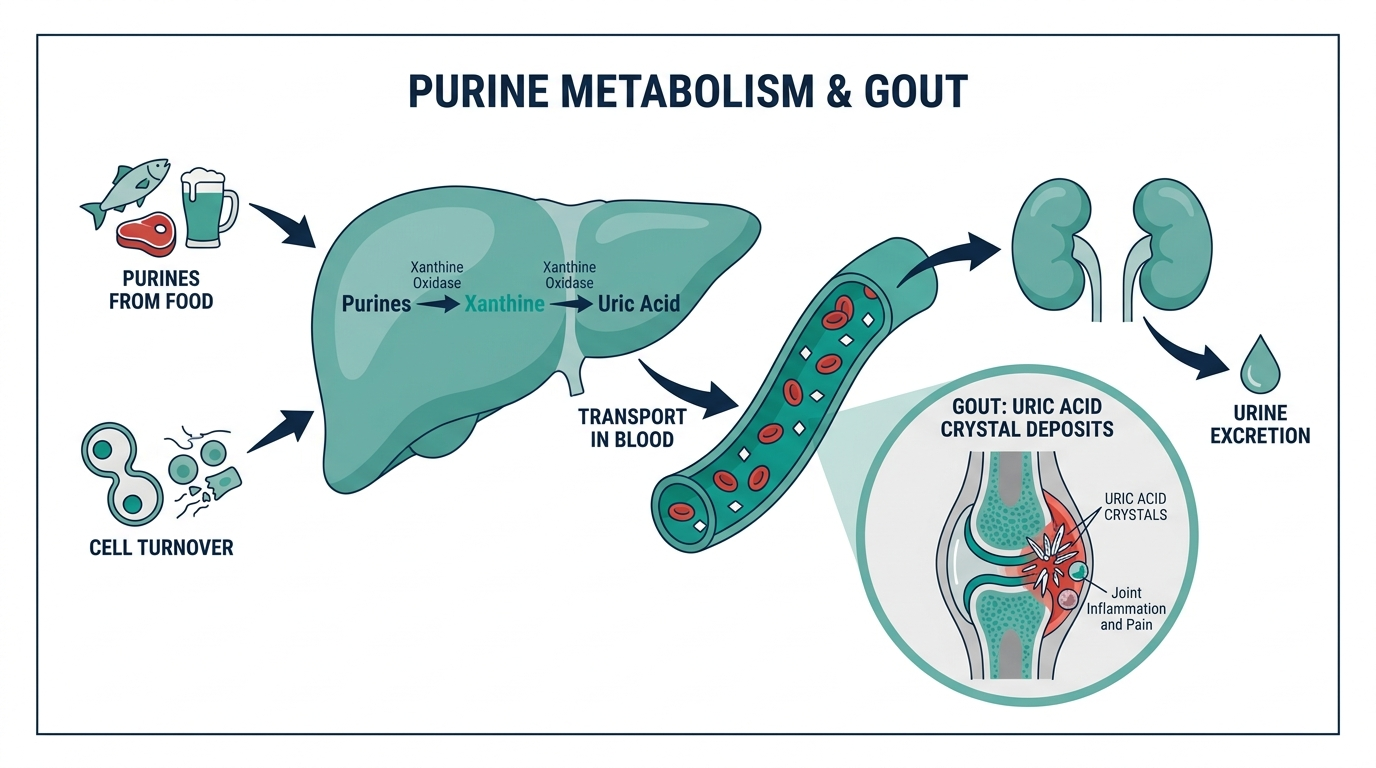
Uric acid is considered high when serum urate exceeds 7.0 mg/dL in men or 6.0 mg/dL in women, the thresholds StatPearls uses to define hyperuricemia (NCBI). The chemical tipping point is about 6.8 mg/dL, the level at which urate stops dissolving and starts forming the needle-shaped crystals behind gout.
High uric acid can trigger gout flares before you notice anything, so do you know your current level? One at-home Superpower draw checks 100+ biomarkers, physician-reviewed.
The normal reference range is roughly 3.4 to 7.0 mg/dL for men and 2.4 to 6.0 mg/dL for women (StatPearls, NCBI). Risk rises sharply with the number: the incidence of gouty arthritis goes up about 5-fold at urate levels of 7 to 8.9 mg/dL and up to 50-fold above 9 mg/dL. Many people with a high reading have no symptoms at all, which is called asymptomatic hyperuricemia and is usually managed with lifestyle changes rather than drugs.
Reading your number: from safe to crystal-forming
The single most useful figure to anchor on is 6.8 mg/dL, the point at which urate stops dissolving in the blood and begins forming crystals. Everything about gout risk revolves around that saturation line. Below it, existing crystals can slowly dissolve. Above it, new crystals keep seeding joints and kidneys. This is also why treatment targets sit below 6.0 mg/dL rather than merely inside the lab’s normal range, because a comfortable margin under saturation is what actually clears deposits.
It helps to separate the number from the disease. Plenty of people carry a urate of 7.5 mg/dL for years and never have a flare, which is asymptomatic hyperuricemia, usually handled with lifestyle rather than drugs. Others have painful gout at levels that look only mildly high. The blood value tells you your chemical risk, but the crystals, the flares, and any kidney stones tell you the clinical story. Both matter, and your clinician weighs them together rather than treating a lone number.
Why lower it?
The simplest way to actually get this done
Superpower is a full-body lab membership that runs 100+ biomarkers, has each result reviewed by a doctor, and tracks your numbers year over year (about $199/year). It is what we point readers to when they would rather get one clean, complete draw than chase single tests one at a time. Here is superpower reviewed in full.
Lowering uric acid matters because sustained high levels let urate crystals deposit in joints and kidneys, driving gout attacks, tophi, and uric acid kidney stones (StatPearls, NCBI). Once levels stay below the 6.8 mg/dL saturation point, existing crystals can slowly dissolve and new ones stop forming.
Roughly 80 to 90 percent of hyperuricemia comes from the kidneys under-excreting uric acid, with the remaining 10 to 20 percent from overproduction (StatPearls, NCBI). That matters for treatment, because hydration and certain drugs work on the excretion side. Beyond gout, persistently high urate is associated with hypertension and chronic kidney disease, so the reading is worth taking seriously even before your first painful flare. Bringing it down protects joints and kidneys and, for people on therapy, cuts the frequency of flares.
What is actually raising your uric acid?
Because urate is made by the body and cleared by the kidneys, high levels come from making too much, clearing too little, or, most often, a bit of both. Naming your side of that equation shapes the fix.
The kidneys are under-excreting (the common one)
Roughly 80 to 90 percent of high readings come from kidneys that do not clear urate efficiently, not from overproduction. Reduced kidney function, dehydration, and certain drugs all tip the balance toward retention. This is why hydration and uricosuric medicines, which push the kidneys to excrete more, are such useful levers.
Diet, alcohol, and fructose
Food is the part people can see. Organ meats, anchovies, sardines, and large red-meat portions deliver a heavy purine load, beer supplies both purines and alcohol, and sugary drinks sweetened with high-fructose corn syrup drive urate production from the inside. None of these is usually the sole cause, but together they can push a borderline number over the line.
Metabolic syndrome and insulin resistance
High uric acid travels in company. It clusters with excess weight, high blood pressure, high triglycerides, and insulin resistance, and insulin resistance itself reduces how much urate the kidneys excrete. That overlap is why weight loss and better blood sugar control often lower urate as a side effect of improving the whole metabolic picture.
Overproduction and cell turnover
A smaller share of cases come from making too much urate, for example in psoriasis, some blood disorders, or during rapid cell breakdown. These are less common but important, because they change which drugs work best.
Medications and genetics
Thiazide and loop diuretics, low-dose aspirin, and some immunosuppressants raise urate, while genetics set your baseline and explain why gout runs in families. Reviewing your medication list with a clinician sometimes uncovers a fixable contributor before any new drug is added.
Evidence-based ways to lower uric acid
The most effective approach combines diet and lifestyle changes with medication when the level stays high or flares continue. The ACR conditionally recommends limiting alcohol, purines, and high-fructose corn syrup for people with gout regardless of how active the disease is (ACR, 2020 guideline). Below are the levers, grouped by type.
Diet
Diet alone typically shifts uric acid by about 1 mg/dL, so it helps most people but rarely does the whole job. Focus on removing the heaviest contributors:
- Cut high-purine animal foods: organ meats (liver, kidney), anchovies, sardines, and large portions of red meat raise urate the most (Mayo Clinic).
- Limit alcohol, especially beer: beer and spirits are repeatedly linked to higher uric acid and more flares; the ACR advises limiting alcohol (ACR, 2020 guideline).
- Drop sugary drinks: sodas and juices sweetened with high-fructose corn syrup increase urate production (Mayo Clinic).
- Add tart cherries: a randomized crossover trial in 26 overweight adults found tart cherry juice lowered serum urate by 19.2 percent versus an increase on placebo (PMC, NIH).
- Favor low-fat dairy, vegetables, and whole grains: these are associated with lower urate and form the base of a gout-friendly plate (Mayo Clinic).
Note on vitamin C: while some studies suggest 500 mg/day may modestly lower urate, the ACR conditionally recommends against adding vitamin C supplements specifically to treat gout (ACR, 2020 guideline).
Lifestyle
Weight loss and hydration are the two lifestyle moves with the clearest payoff, since excess body weight and dehydration both push urate higher. Losing excess weight gradually lowers serum urate and reduces flares, and the ACR conditionally recommends a weight-loss program for people with gout who are overweight or obese (ACR, 2020 guideline).
Steady fluid intake helps the kidneys clear urate, which is the pathway responsible for roughly 80 to 90 percent of high readings (StatPearls, NCBI). Aim to spread water through the day rather than drinking in bursts. Avoid crash diets and very high-protein fads, which can temporarily spike uric acid. Where possible, review medicines with your clinician, since some diuretics and low-dose aspirin can raise levels, while certain blood pressure drugs like losartan have a mild urate-lowering effect.
Medical options
When uric acid stays high or gout keeps flaring, urate-lowering therapy is the proven fix, and allopurinol is the recommended first-line drug (ACR, 2020 guideline; AAFP). It is dosed up gradually and aimed at a serum urate below 6.0 mg/dL, the target the ACR ties to fewer flares over time.
- Allopurinol: first-line xanthine oxidase inhibitor that reduces uric acid production; started low and titrated to target (ACR, 2020 guideline).
- Febuxostat: an alternative xanthine oxidase inhibitor when allopurinol is not tolerated.
- Probenecid: a uricosuric that helps the kidneys excrete more urate, used in selected patients.
The ACR also recommends starting urate-lowering therapy during an acute flare rather than waiting for it to resolve, alongside anti-inflammatory cover (ACR, 2020 guideline).
How should you test uric acid, and what reads alongside it?
A serum uric acid is a simple blood draw, but a couple of practical details change how much you can trust a single result. First, a value taken during an acute gout flare can be misleadingly normal or even low, because urate shifts out of the blood as it deposits in the inflamed joint. If your level looks fine in the middle of a classic attack, it is worth rechecking a few weeks later once the flare has settled. Second, heavy drinking, a large purine-rich meal, or dehydration in the day or two before the test can nudge the number up, so a reading taken after a weekend of beer and barbecue is not your true baseline.
Uric acid also rarely travels alone. Clinicians usually read it next to kidney function, since creatinine and eGFR reveal whether under-excretion is part of the story, and next to the metabolic markers it clusters with, such as fasting glucose, triglycerides, and blood pressure. A high urate sitting alongside reduced kidney function or clear metabolic syndrome is a different, higher-priority picture than an isolated high number in an otherwise healthy person.
How fast can it change?
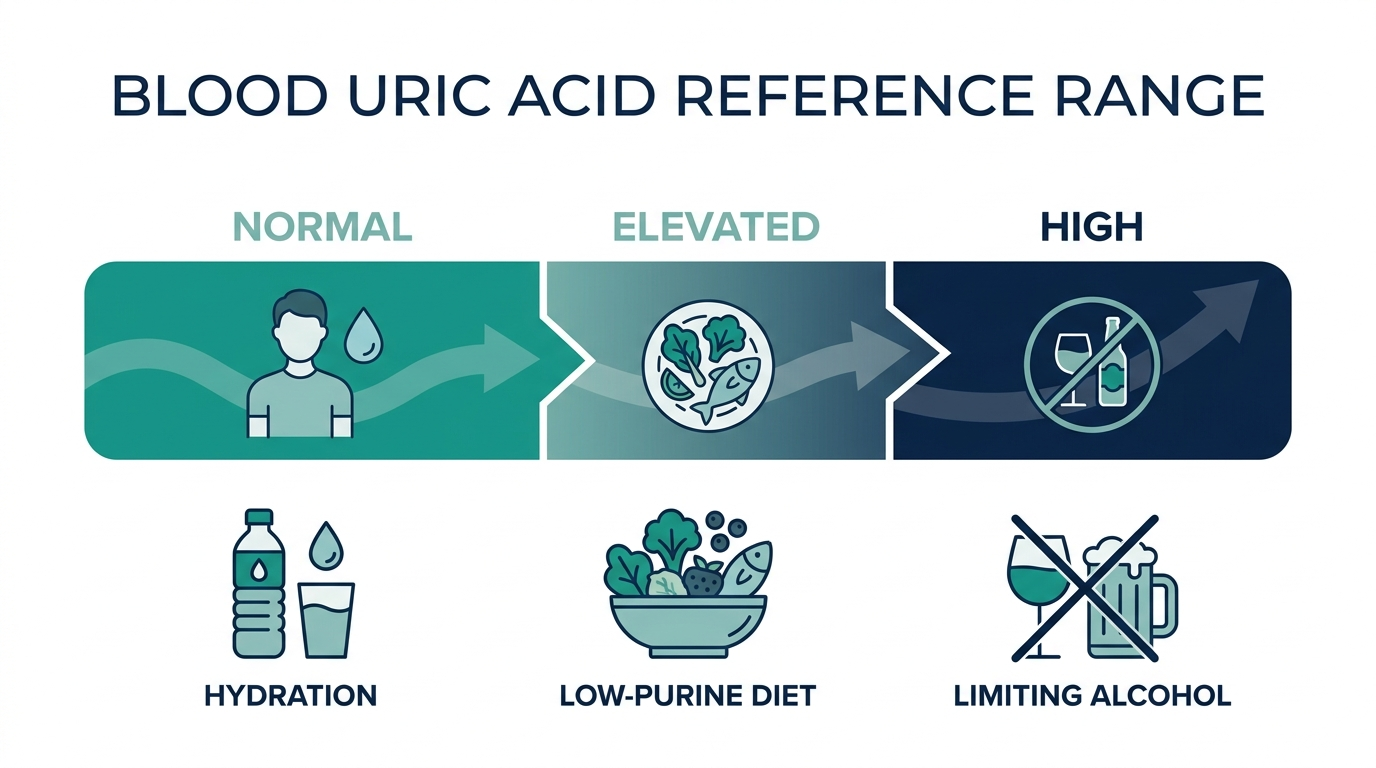
Diet and lifestyle changes can begin moving uric acid within a few weeks, but the shift is modest, often around 1 mg/dL from diet alone. Medication works faster and further: allopurinol is titrated over weeks to months until repeat blood tests confirm serum urate is under 6.0 mg/dL (ACR, 2020 guideline).
Patience matters because dissolving existing crystals takes longer than lowering the blood number. Flares can even increase in the first months of urate-lowering therapy as crystals break down, which is why clinicians often add anti-inflammatory prophylaxis. Most people who reach and hold the under-6 target see flares drop substantially over the following year.
A realistic example
Picture a 45-year-old man who wakes at 3 a.m. with a red-hot, intensely painful big toe. In the emergency department his uric acid reads 6.5 mg/dL, which looks almost reassuring. It is a trap. During a flare, urate can drop as it crystallizes in the joint, so a normal-looking number does not rule out gout. Six weeks later, symptom-free, his repeat level is 8.9 mg/dL, and the true picture is clear.
His first instinct is to stop eating red meat and hope the problem disappears. Diet helps, but on its own it usually moves urate by only about 1 mg/dL, not enough to get him safely under the 6.0 target from 8.9. Because he has now had two flares, his clinician starts low-dose allopurinol, titrated up over a few weeks with anti-inflammatory cover, and pairs it with less beer, fewer sugary drinks, weight loss, and steady hydration. That combination, not diet alone, is what finally holds his level below saturation and quiets the flares.
When do you need medication or a doctor?
You should see a clinician about medication if you have recurrent gout flares, tophi, uric acid kidney stones, or chronic kidney disease with gout, since these are the situations where the ACR strongly recommends urate-lowering therapy (ACR, 2020 guideline). A single high reading without symptoms usually does not require drugs.
See a doctor promptly for a sudden, intensely painful, hot, swollen joint, which may be an acute gout attack needing treatment. Also seek care for severe flank pain that could signal a kidney stone, or if your uric acid is very high, for example above 9 mg/dL, where gout risk climbs sharply (StatPearls, NCBI). Your clinician can confirm the diagnosis, check kidney function, review your medicines, and decide whether lifestyle changes alone are enough or whether to start therapy and pick a target.
Turn what you just learned into action.
Superpower lets you test 100+ biomarkers from home, then re-check them over time so you can actually see progress, physician-reviewed at every step.
Frequently asked questions
What is the fastest way to lower uric acid?
Medication, specifically allopurinol, lowers uric acid faster and further than diet, and is titrated to a target below 6.0 mg/dL (ACR, 2020 guideline). For quick non-drug help, cut alcohol and sugary drinks, drink more water, and avoid organ meats and shellfish.
What foods flush out uric acid?
No food flushes urate instantly, but water, low-fat dairy, vegetables, whole grains, and tart cherries are linked to lower levels. One trial found tart cherry juice cut serum urate by 19.2 percent versus placebo (PMC, NIH).
What is a dangerous uric acid level?
Levels above 7.0 mg/dL in men and 6.0 mg/dL in women are high, and crystals form above about 6.8 mg/dL (StatPearls, NCBI). Above 9 mg/dL, gout risk rises up to 50-fold, so that reading warrants medical attention.
Does drinking water lower uric acid?
Staying well hydrated helps the kidneys excrete uric acid, the pathway behind roughly 80 to 90 percent of high readings (StatPearls, NCBI). Water supports lower levels but usually works best combined with diet changes and, when needed, medication.
Can high uric acid go away without medication?
Asymptomatic high uric acid is often managed with weight loss, less alcohol, fewer sugary drinks, and more water, without drugs. But recurrent gout, tophi, or stones usually need urate-lowering therapy to reach the under-6 mg/dL target (ACR, 2020 guideline).
Does coffee raise or lower uric acid?
For most people, regular coffee is associated with slightly lower uric acid over time, not higher, and long-term coffee drinking has been linked to a lower risk of gout in observational studies. It is not a treatment, and adding sugar or drinking it while dehydrated undoes the benefit, but you do not need to give up coffee to manage a high urate. Water remains the more important fluid for helping the kidneys clear urate.
Should I stop my allopurinol during a gout attack?
No. If you are already taking allopurinol when a flare hits, keep taking it at the usual dose, because stopping and restarting causes urate to swing, which can actually prolong the attack. The flare is treated separately with anti-inflammatory medication while the allopurinol continues. Stopping urate-lowering therapy mid-flare is one of the most common self-inflicted mistakes in gout care.
Is all seafood off-limits with high uric acid?
No, the load varies a lot. The heaviest hitters are anchovies, sardines, mussels, scallops, and herring, which are worth limiting. Many other fish and shellfish carry a more moderate purine load and can fit into a gout-friendly plate in sensible portions. The bigger, more consistent dietary levers are cutting beer, spirits, and high-fructose corn syrup drinks, which tends to matter more than fine-tuning which fish you eat.
Sources
- StatPearls (NCBI Bookshelf), Hyperuricemia
- American Academy of Family Physicians, Management of Gout: Update from the American College of Rheumatology
- PMC (NIH), Role of Diet in Hyperuricemia and Gout
- Mayo Clinic, Gout diet: What is allowed, what is not
- Arthritis Foundation, Cherries May Help Gout Symptoms
This article is for general educational purposes and is not medical advice. It cannot diagnose or treat you and does not replace your clinician. Always discuss your lab results and any health decisions with a qualified healthcare professional.
Related: best GLP-1 telehealth providers for 2026.
Vital Signs Today may earn a commission if you buy through links on this page. It does not affect our editorial assessments.