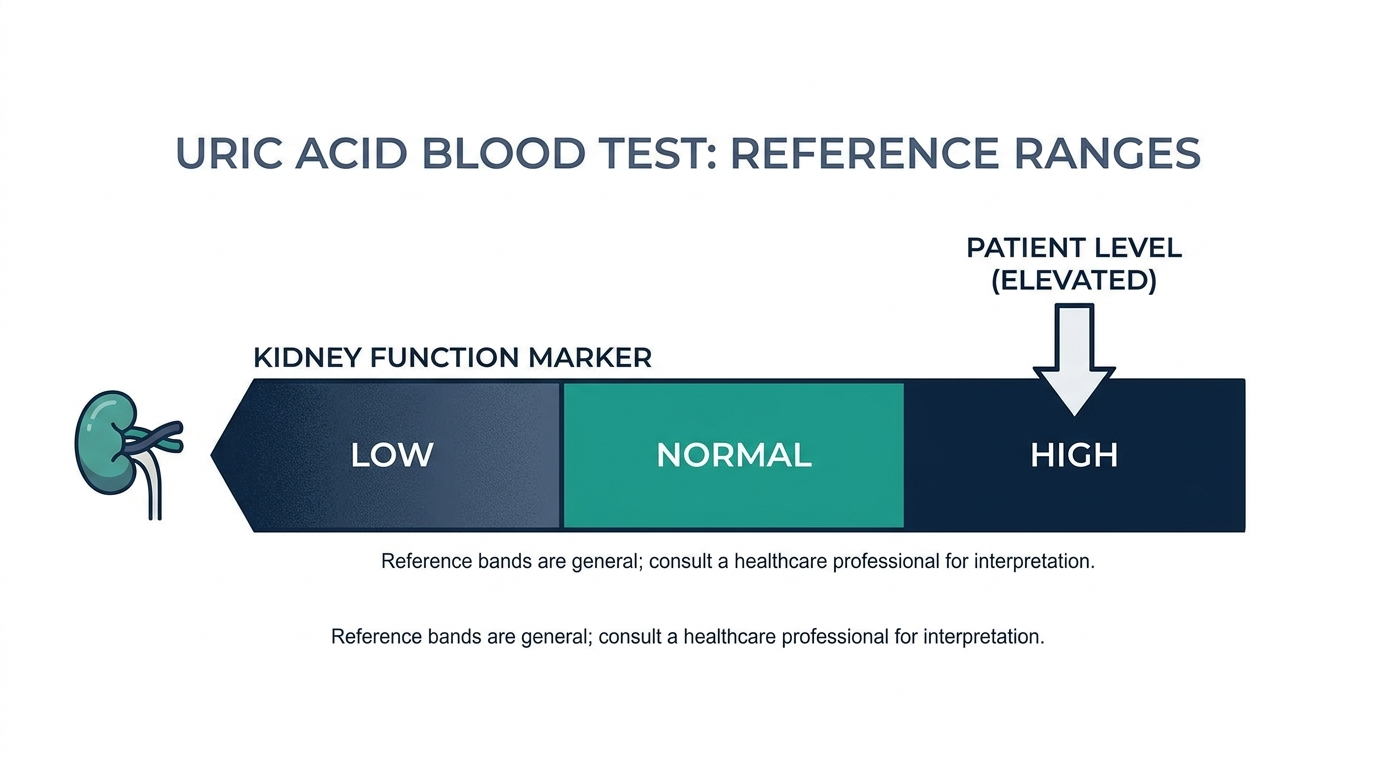
- A high uric acid result, called hyperuricemia, usually means a serum urate level above about 6.0 mg/dL in women or 7.0 mg/dL in men, the point near which urate crystals can start to form (StatPearls, NCBI).
- In roughly 90 percent of cases, high uric acid comes from the kidneys not flushing it out fast enough rather than the body making too much, and many people with elevated levels have no symptoms at all (StatPearls, NCBI).
- High uric acid matters because urate that exceeds the saturation point of about 6.8 mg/dL can crystallize and trigger gout attacks or uric acid kidney stones, so a flagged result is worth discussing with your clinician (StatPearls, NCBI).
What does a high uric acid result mean, and what is the cutoff?
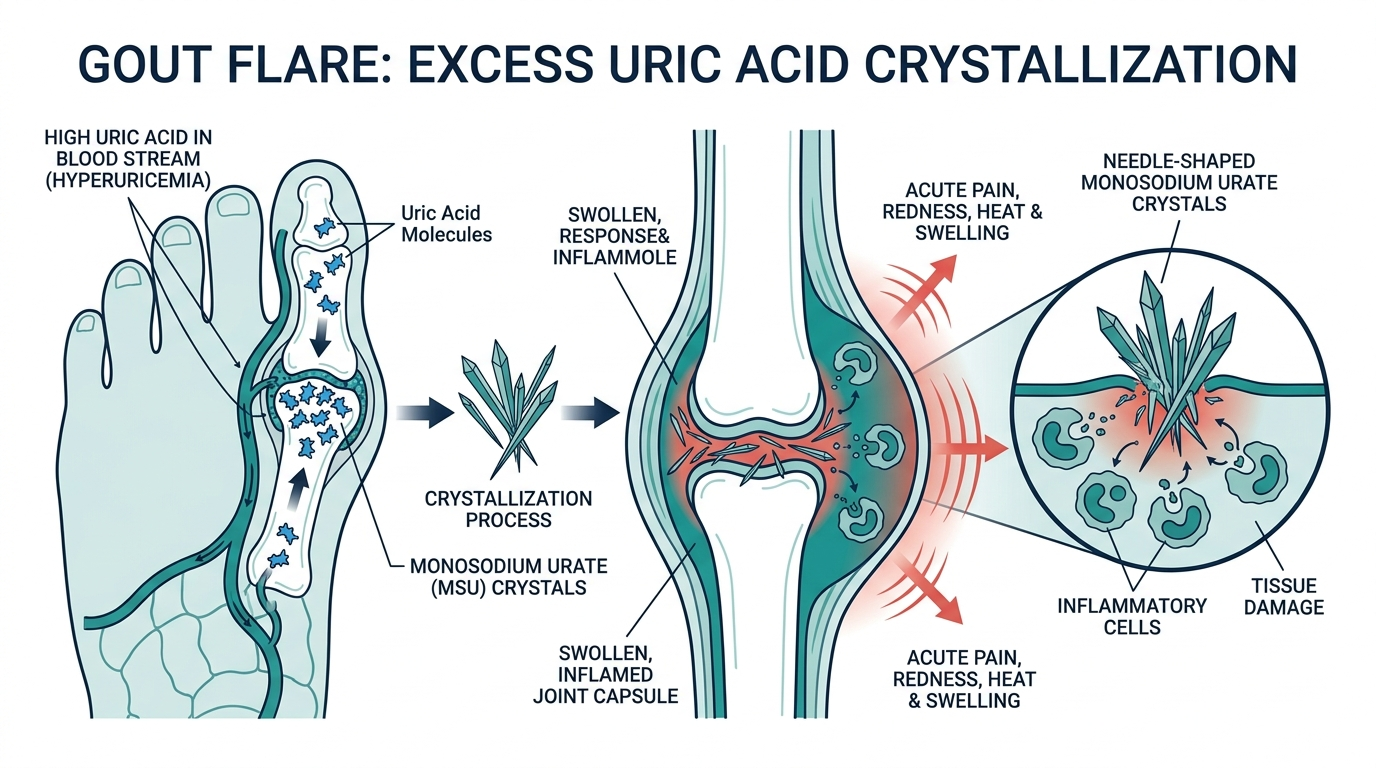
A high uric acid result means your blood holds more urate than your kidneys are clearing, a state doctors call hyperuricemia. The common laboratory cutoff is roughly above 6.0 mg/dL in women and 7.0 mg/dL in men (StatPearls, NCBI). The number that matters most biologically is the saturation point of about 6.8 mg/dL, because above that level urate can no longer stay dissolved and may form sharp monosodium urate crystals.
Uric acid is the waste product your body makes when it breaks down purines, compounds found in your own cells and in foods like organ meats and certain seafood. Most of it leaves through the kidneys in urine. Reference ranges vary slightly between labs, so always read your result against the range printed on your own report. A single high reading is a signal to look closer, not a diagnosis by itself.
High uric acid can start forming crystals before symptoms hit, so where does your number actually sit? One at-home Superpower draw checks 100+ biomarkers, physician-reviewed.

What causes high uric acid?
About 90 percent of high uric acid cases come from the kidneys under-excreting urate rather than the body overproducing it (StatPearls, NCBI). Overproduction accounts for roughly one third of cases and can overlap with poor clearance. The drivers fall into a few groups.
- Reduced excretion: chronic kidney disease, dehydration, and medications such as diuretics, low-dose aspirin, and niacin.
- Overproduction: diets heavy in organ meats, red meat, shellfish, alcohol (especially beer), and fructose-sweetened drinks.
- Rapid cell turnover: chemotherapy, tumor lysis, and hemolysis flood the blood with purines.
- Metabolic links: obesity, high blood pressure, insulin resistance, and metabolic syndrome.
Genetics also play a part. Some people inherit kidneys that hold onto urate, which is why gout can run in families even with a careful diet.
What are the symptoms, or is it silent?
High uric acid is usually silent. Most people with elevated levels, a condition called asymptomatic hyperuricemia, feel nothing and only learn about it from a routine blood test (StatPearls, NCBI). Symptoms appear only once crystals form and cause disease.
When symptoms do arrive, they tend to be specific and hard to miss. The classic one is a gout flare: a sudden, intensely painful, red, hot, and swollen joint, most often the base of the big toe, that can wake you at night. Uric acid kidney stones are another signal, causing sharp flank or back pain, blood in the urine, and painful urination. These crystals account for an estimated 5 to 10 percent of all kidney stones (StatPearls, NCBI). Many people cycle between flares and pain-free stretches for years.
When is high uric acid dangerous?
High uric acid becomes dangerous mainly when it crystallizes, and risk climbs as levels rise above the saturation threshold of about 6.8 mg/dL (StatPearls, NCBI). The higher and longer your urate stays elevated, the greater the chance of a gout flare or stone.
Beyond gout, sustained hyperuricemia is associated with hypertension, chronic kidney disease, and cardiovascular disease, though doctors still debate how much is cause versus marker. A specific emergency is tumor lysis syndrome, where cancer treatment releases a surge of purines that can spike uric acid and acutely injure the kidneys, requiring urgent care. Red flags that warrant prompt attention include a hot swollen joint with fever, severe one-sided flank pain, or visible blood in the urine. These point to active crystal disease rather than a number on a page.

What to do next, and when to see a doctor
The first step is to confirm the result and look at the whole picture, because one isolated high reading rarely needs treatment on its own (StatPearls, NCBI). Your clinician may repeat the test, review your medications, and check kidney function before deciding anything.
Practical, evidence-aligned moves include staying well hydrated, moderating alcohol and especially beer, cutting back on organ meats and sugary drinks, and managing weight and blood pressure. If you have had gout flares or stones, your doctor may discuss urate-lowering medication with a target often set below 6.0 mg/dL. See a doctor promptly if you develop a sudden hot painful joint, signs of a kidney stone, or if your uric acid is high alongside reduced kidney function. Do not start or stop any medication based on a lab value alone.
Insider nuance: the asymptomatic-but-high dilemma
Here is what surprises many patients. Most major guidelines, including those from the American College of Physicians, do not recommend treating asymptomatic hyperuricemia with medication, even when the number looks alarming (StatPearls, NCBI). Drug therapy is generally reserved for people who have had gout flares, uric acid stones, or specific risk situations.
Why hold off? Urate-lowering drugs carry their own risks, and not everyone with a high level will ever develop crystals. The flip side, often missed, is that during the first weeks of starting urate-lowering therapy, flares can temporarily get worse as old crystals dissolve, which is why doctors often add short-term prophylaxis. So a high reading is a conversation starter about your personal risk, not an automatic prescription. Context, symptoms, and trend over time matter far more than a single value.
How your body makes and clears uric acid
To read a high uric acid result well, it helps to understand where the number comes from. Uric acid is the end product of purine breakdown. Purines are building blocks of DNA and RNA, and they come from two sources: the natural turnover of your own cells and the food you eat. Your liver converts purines into uric acid, and the kidneys clear most of it in urine, with a smaller share leaving through the gut.
The balance between production and clearance is what sets your level. In humans, uric acid sits near its solubility limit even in health, which is unusual for a waste product and explains why small shifts can tip someone over the line. When production rises, clearance falls, or both, urate accumulates. This framing matters because it tells you the two levers behind almost every high result: make less, or clear more. Most treatment and lifestyle advice maps onto one of those two levers.
The stages from high uric acid to gout
Gout does not appear overnight. It develops through recognizable stages, and knowing where you are changes what the result means for you.
- Asymptomatic hyperuricemia: the level is high but no crystals have caused trouble yet. Most people at this stage never progress, which is why medication is usually not started here.
- Acute gout flare: crystals trigger a sudden, intensely painful, red, hot joint, classically the base of the big toe. The pain often peaks within hours and can wake you at night.
- Intercritical period: the pain-free stretch between flares. The urate problem is still there even though the joint feels normal, which is the trap that leads people to stop caring.
- Chronic tophaceous gout: after years of uncontrolled urate, crystals build into visible lumps called tophi and can damage joints permanently.
The key insight is that the disease is silent between attacks. A high number in the intercritical period is not a false alarm, it is the underlying condition still present. That is why the trend over time matters more than any single reading.
Diet and uric acid: what actually moves the number
Diet gets most of the attention, and while it is only part of the story, some foods clearly push urate up. The mechanism is twofold: purine-rich foods add raw material, and fructose uniquely speeds uric acid production inside cells.
| Food group | Effect on uric acid |
|---|---|
| Organ meats (liver, kidney) | Very high purine load, among the strongest dietary drivers. |
| Red meat and game | High purine, a moderate to strong driver. |
| Shellfish and oily fish (anchovies, sardines, mussels) | High purine, can trigger flares in susceptible people. |
| Beer and spirits | Alcohol both adds purines (beer especially) and reduces urate clearance. |
| Sugary drinks and high-fructose foods | Fructose accelerates uric acid production, an often overlooked driver. |
| Low-fat dairy, coffee, cherries | Associated with lower urate or fewer flares in studies, generally considered favorable. |
A practical point that surprises people: sugary soda can matter as much as steak, because fructose drives urate production directly. Cutting sweet drinks is often one of the higher-yield changes. That said, diet alone rarely normalizes a genuinely high level in someone whose kidneys under-excrete urate, which is why food is a supporting move, not a cure.
The panel uric acid is read with
A uric acid value gains meaning from the numbers around it. Clinicians read it in context, and these are the usual companions.
- Creatinine and eGFR: assess kidney clearance, the driver in most high cases. High uric acid with a low eGFR points to under-excretion.
- Fasting glucose and lipids: high uric acid clusters with insulin resistance, high triglycerides, and metabolic syndrome.
- Blood pressure: hyperuricemia and hypertension often travel together.
- Complete blood count: relevant when rapid cell turnover, such as in blood cancers, is a suspected source of extra purines.
Because high uric acid rarely stands alone, an isolated elevated result is often the first clue to a broader metabolic picture rather than a gout diagnosis on its own.

How to prepare and what can distort the result
A few factors can shift a uric acid reading enough to mislead, so knowing them helps you avoid a false alarm or false reassurance.
- Recent diet and alcohol. A purine-heavy meal or a night of drinking before the draw can nudge the number up. A fasting morning sample after a typical diet is more representative.
- Hydration. Dehydration concentrates the blood and can transiently raise urate, while good hydration supports clearance.
- Medications. Diuretics, low-dose aspirin, and niacin raise urate, while some other drugs lower it. Tell your clinician what you take.
- Timing around a flare is counterintuitive. Uric acid can actually read normal or even low during an acute gout attack, because urate is being deposited into the joint. A normal level in the middle of a classic flare does not rule out gout, and rechecking a few weeks later is often more informative.
That flare-timing quirk is one of the most common sources of confusion. If your joint is screaming gout but the number looks fine, the timing may be the reason.
Reading real result combinations
The same high uric acid can mean different things depending on the surrounding picture. Here are patterns clinicians recognize.
- High uric acid, normal kidneys, no symptoms: asymptomatic hyperuricemia. Usually watched, not medicated, with attention to diet, weight, and alcohol.
- High uric acid with a classic big-toe flare: strongly suggests gout, though the diagnosis is confirmed by the clinical picture and sometimes joint fluid analysis.
- High uric acid with a low eGFR: points to reduced kidney clearance as the driver and prompts a look at kidney health.
- High uric acid with high glucose, triglycerides, and blood pressure: part of a metabolic syndrome cluster, where the urate is one signal among several.
- Sharply high uric acid during cancer treatment: raises concern for tumor lysis syndrome, a medical emergency needing urgent care.
The number opens the question. The companions and your symptoms answer it.
How high uric acid is treated when it needs treating
Treatment is not automatic, and it is layered. The decision to treat depends far more on symptoms and complications than on the number alone.
- Lifestyle first for most people. More fluids, less alcohol especially beer, fewer sugary drinks and organ meats, and weight and blood pressure management can modestly lower urate and reduce flare risk.
- Treating a flare is separate from lowering urate. During an acute attack, the goal is to calm the inflammation, not to rush the urate down, because a sudden shift can worsen the flare.
- Urate-lowering medication for the right people. This is generally reserved for those with recurrent gout, tophi, uric acid stones, or specific risk situations, with a target often set below 6.0 mg/dL to keep urate under the saturation point.
- Expect a bumpy start. In the first weeks of urate-lowering therapy, flares can temporarily increase as old crystals dissolve, which is why doctors often add short-term flare prevention at the beginning.
The theme is patience and context. A single high number does not equal a prescription, and starting treatment is a decision made with your clinician based on your whole history.
Who should have uric acid checked
Uric acid is not a universal screening test, but it earns its place in several situations.
- Anyone who has had a gout flare or a uric acid kidney stone.
- People with a sudden hot, swollen, painful joint being evaluated for the cause.
- Those starting cancer treatment with a high risk of tumor lysis, where urate is monitored closely.
- People with metabolic syndrome features, since high uric acid clusters with them.
- Anyone on long-term diuretics or other urate-raising medicines, when clinically relevant.
For a healthy person with no symptoms or risk factors, an isolated high uric acid on a routine panel is usually a prompt to look at diet, weight, and hydration and to recheck, not an immediate cause for medication. The value carries the most weight when read alongside symptoms and a rising trend over time.
Uric acid kidney stones
Beyond gout, high uric acid can crystallize in the urinary tract to form stones, which account for an estimated 5 to 10 percent of all kidney stones (StatPearls, NCBI). These stones form more readily when the urine is persistently acidic and concentrated, which is why hydration and, in some cases, medication to make the urine less acidic are part of prevention.
Signs of a uric acid stone include sharp flank or back pain that may radiate, blood in the urine, and painful or frequent urination. Anyone with recurrent stones and high uric acid should have both the urate level and the urine chemistry evaluated, because the prevention strategy for uric acid stones differs from that for the more common calcium stones. This is another reason a high uric acid result is worth understanding rather than ignoring, even in the absence of joint pain.
Tracking uric acid over time instead of reading one number
A single uric acid result is a snapshot, and uric acid is one of the more variable markers on a standard panel. It rises and falls with what you ate the day before, how hydrated you were, whether you had been fasting, alcohol from the previous evening, and even a recent bout of intense exercise, which can transiently push the level up. A reading of 7.2 mg/dL on a morning after a steak dinner and two beers does not carry the same weight as a reading of 7.2 mg/dL that shows up repeatedly across several calm, well-hydrated mornings. This is why clinicians rarely act on a single borderline value and instead look for a pattern.
The practical move is to re-check the level a few weeks apart under similar conditions, ideally fasting and after a normal, low-alcohol day, so the numbers are comparable. Keep the results in one place, whether a note on your phone or a lab portal, and watch the trend rather than fixating on a one-time figure. A level that is stable and only mildly elevated is a different situation from one that is climbing over successive tests. If you have started a treatment such as allopurinol, tracking the trend is how you and your doctor confirm the dose is actually pulling the number down toward the target, usually below 6 mg/dL for people with gout. A downward trend that stalls above target is a signal the plan needs adjusting.
Trending also protects you from overreacting to lab-to-lab differences. Two labs can use slightly different methods and reference ranges, so a value that looks alarming at one lab may sit inside normal at another. Comparing your own results measured the same way over time is far more informative than comparing a single number against a generic chart.
Common mistakes people make with a high uric acid result
The most frequent error is assuming that a high number automatically means gout is coming. Many people with elevated uric acid never develop gout, and the risk depends on how high the level is and how long it stays there, not on crossing a single threshold once. Treating an asymptomatic reading as an emergency leads to unnecessary worry and sometimes unnecessary medication.
The opposite mistake is just as common: ignoring a persistently high level because nothing hurts. Because early urate buildup is silent, people often wait until a first painful attack before taking the number seriously, by which point crystals may already have been accumulating for years. A high result with no symptoms is still worth a conversation with a doctor about diet, weight, and whether monitoring or treatment makes sense.
A third mistake is blaming diet alone. Purine-rich food does raise uric acid, but for most people the body’s own production and how efficiently the kidneys clear urate matter more than the last meal. Cutting out every high-purine food while ignoring alcohol, sugary drinks sweetened with fructose, dehydration, or an underlying kidney issue often produces disappointing results. Finally, many people stop their prescribed urate-lowering medication once an attack settles, which is exactly when consistent treatment matters most, because stopping and restarting can itself trigger new flares.
Turn what you just learned about uric acid into action.
Superpower lets you test uric acid and 100+ biomarkers from home, then re-check them over time so you can actually see progress, physician-reviewed at every step.
Frequently asked questions
Is a uric acid level of 7 high?
A level of 7.0 mg/dL is at or just above the typical upper limit, roughly 7.0 for men and 6.0 for women (StatPearls, NCBI). It sits near the 6.8 mg/dL saturation point, so it is worth discussing with your clinician, especially if repeated.
Can high uric acid go away on its own?
Sometimes. If a temporary cause like dehydration, a crash diet, or a new diuretic raised it, levels can fall once that resolves. Lifestyle changes such as more fluids and less alcohol and sugar often lower it modestly. Persistent elevation usually needs a doctor’s review.
What foods cause high uric acid?
Purine-rich and fructose-rich foods drive it up most: organ meats, red meat, shellfish, beer and other alcohol, and sugary or high-fructose drinks (StatPearls, NCBI). Cutting these back, staying hydrated, and managing weight can help reduce serum urate.
Does high uric acid always mean gout?
No. Most people with high uric acid never develop gout and have no symptoms, a state called asymptomatic hyperuricemia (StatPearls, NCBI). Gout occurs only when urate crystals actually form in a joint, which is more likely the higher and longer levels stay elevated.
How can I lower my uric acid fast?
There is no safe instant fix. Drinking more water, stopping alcohol, and avoiding high-purine and sugary foods can lower it over days to weeks. For real reduction in people with gout, doctors prescribe urate-lowering medication, often targeting below 6.0 mg/dL. Always work with your clinician.
Sources
- StatPearls (NCBI Bookshelf), Hyperuricemia
- MedlinePlus, Uric Acid Blood Test
- Cleveland Clinic, Gout
- National Kidney Foundation, Uric Acid Stones
This article is for general educational purposes and is not medical advice. It cannot diagnose or treat you and does not replace your clinician. Always discuss your lab results and any health decisions with a qualified healthcare professional.
Vital Signs Today may earn a commission if you buy through links on this page. It does not affect our editorial assessments.