Disclosure: Vital Signs Today may earn a commission if you buy through links on this page, at no extra cost to you. This does not influence our evidence-based assessments. We are not a medical provider; talk to a clinician before acting on test results.
You scanned your complete blood count, and next to “PLT” was a number with a little L beside it, or maybe a value that looked uncomfortably small compared to the reference range. PLT is shorthand for platelet count, and a low one is the kind of result that makes people open a new browser tab fast. Here is the calm version of what it means, where the real danger lines are, and the one twist that fools even experienced clinicians.
Platelets are not red cells or white cells. They are tiny cell fragments whose entire job is to plug leaks and start clots. So when the number drops, the question is always the same: is your blood losing some of its ability to stop a bleed, and if so, how much.
Part of our Complete Blood Count guide.
What does low plt mean in a blood test?
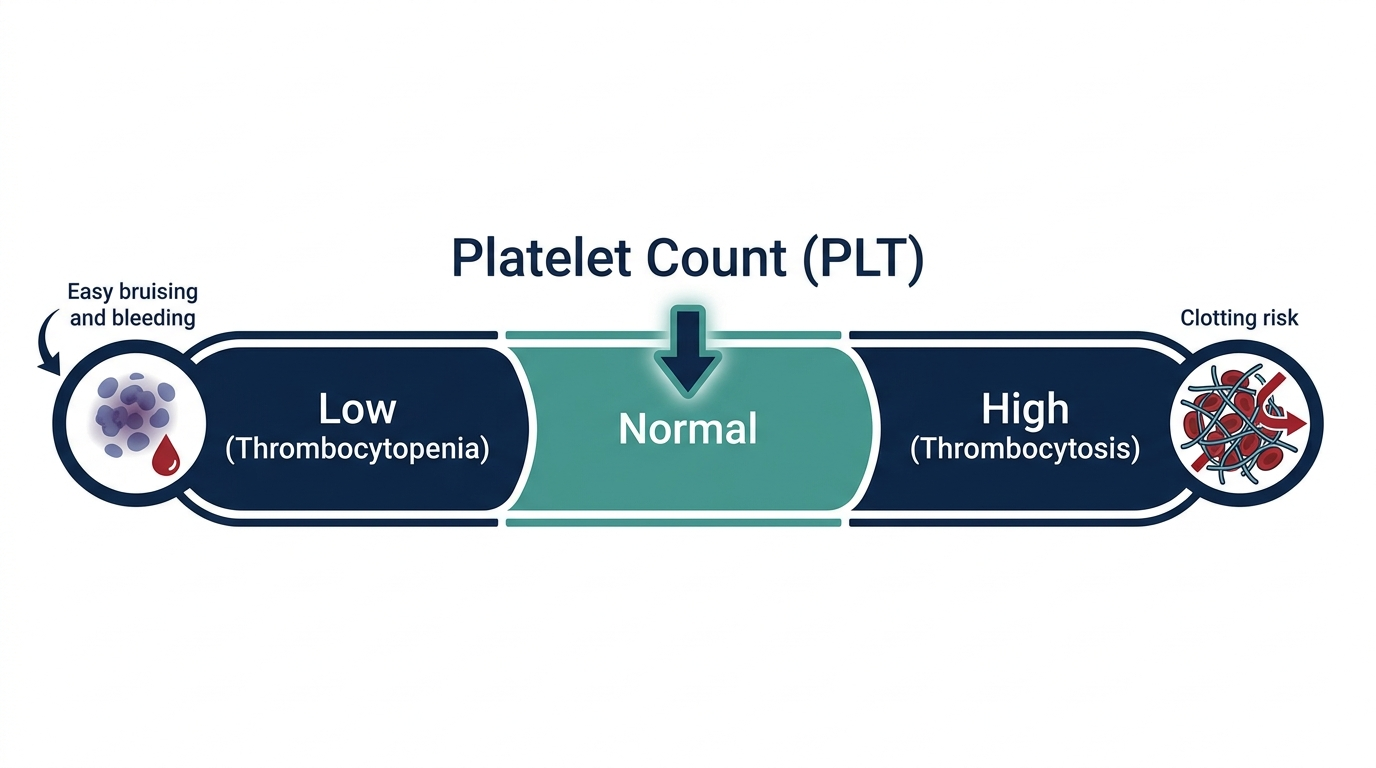
A low PLT means your platelet count has fallen below the normal range, a condition doctors call thrombocytopenia (Cleveland Clinic). A normal adult platelet count runs roughly 150,000 to 450,000 platelets per microliter of blood, so anything under about 150,000 gets flagged as low (Cleveland Clinic). In plain terms, your body has fewer of the cell fragments that form clots, which can mean you bruise more easily or bleed a little longer than you used to.
The single most useful thing to understand is that “low” is a wide territory, not a cliff. A count of 145,000 and a count of 15,000 are both technically low, but they live in completely different worlds. The number itself is what tells you which conversation you are in, which is why the threshold matters far more than the simple label.
What causes a low platelet count?
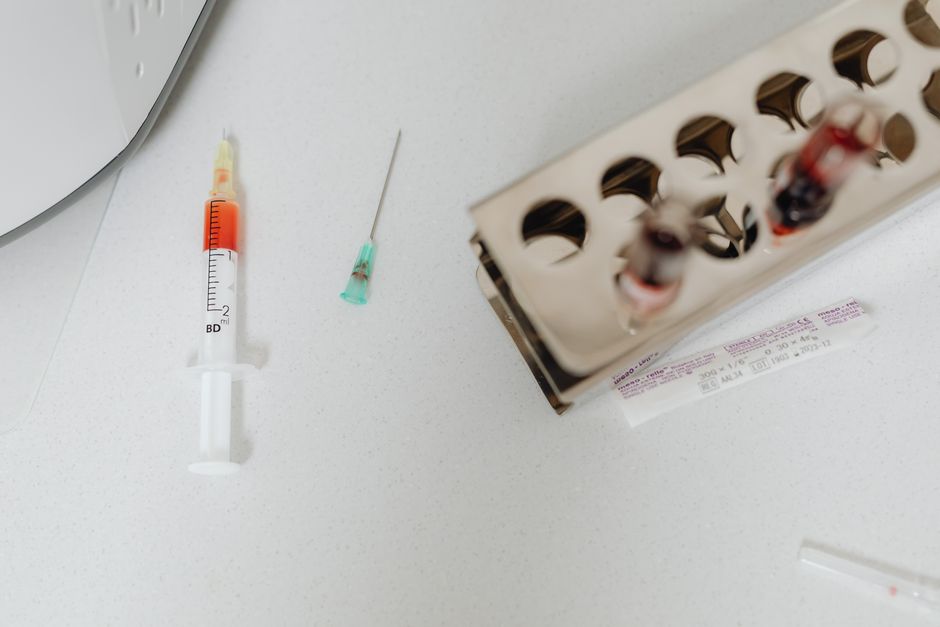
Doctors sort the causes of low platelets into two big buckets: your body is not making enough, or your body is destroying or trapping them too fast (Cleveland Clinic). Here is the real differential, with the more common everyday causes first.
- Medications. A long list of common drugs can drop platelets, including certain antibiotics, seizure medications, and heparin (Cleveland Clinic). This is one of the first things a good clinician checks.
- Viral infections. Mononucleosis, hepatitis, and other viruses commonly knock platelets down temporarily, and the count usually recovers as you do (MedlinePlus).
- Alcohol use and liver disease. Heavy alcohol use and cirrhosis both suppress platelet production and are frequently missed causes (MedlinePlus).
- Immune thrombocytopenia (ITP). Here your immune system mistakenly attacks your own platelets, which is a leading cause of an isolated low count with an otherwise normal blood panel (NHLBI).
- Pregnancy. A mild dip called gestational thrombocytopenia is common and usually harmless (MedlinePlus).
- Vitamin B12 or folate deficiency. A shortage of these nutrients can lower platelet production along with red cells (MedlinePlus).
- Bone marrow and blood disorders. Leukemia, lymphoma, aplastic anemia, and chemotherapy or radiation directly cut platelet production (Cleveland Clinic). These are less common but more serious, which is why doctors take a low count seriously rather than waving it off.
- An enlarged spleen. A big spleen can trap and hoard platelets, lowering the number circulating in your blood even though your marrow is making plenty (Cleveland Clinic).
The pattern matters. An isolated low platelet count with normal red and white cells points one way, often toward medications, a virus, or ITP. A low platelet count alongside low red and white cells points somewhere more serious and demands prompt attention.
What are the symptoms of a low platelet count?
Here is the part that surprises people: a mildly low platelet count usually causes no symptoms at all. Many people learn they have thrombocytopenia only because a routine blood test flagged it, and they felt completely fine (Cleveland Clinic). Symptoms tend to show up only as the count falls further.
When signs do appear, they are almost all about bleeding and bruising (MedlinePlus):
- Petechiae, pinpoint red or purple dots, usually on the lower legs, often the very first visible clue.
- Purpura, larger purple, red, or brown patches under the skin.
- Easy or unexplained bruising from bumps too minor to remember.
- Bleeding that will not stop from a small cut, or frequent nosebleeds and bleeding gums.
- Heavy or prolonged menstrual periods.
- Blood in your urine or stool, which is a more concerning sign.
Petechiae are worth knowing by sight. Unlike a normal rash, they do not fade when you press a glass against them, because they are tiny spots of bleeding under the skin rather than inflammation on top of it.
When is a low platelet count dangerous or a medical emergency?
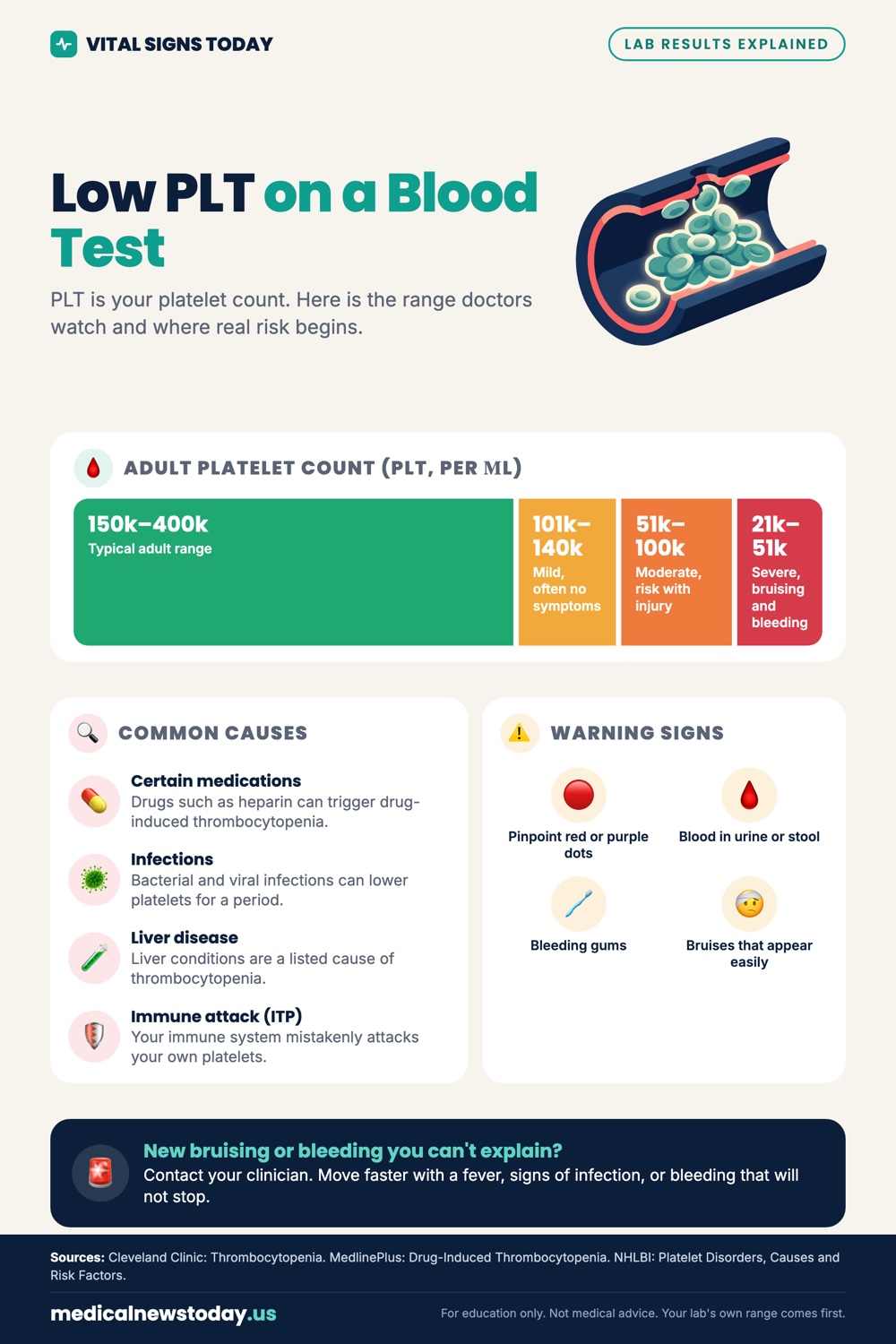
This is where the actual number earns its importance. Clinicians grade thrombocytopenia by severity, and the bands tell you roughly where you stand (Cleveland Clinic):
- Mild: about 101,000 to 140,000 per microliter. Usually no symptoms and often just monitored.
- Moderate: about 51,000 to 100,000 per microliter. Bleeding risk starts to creep up, mostly with injury or surgery.
- Severe: about 21,000 to 50,000 per microliter. Spontaneous bruising and bleeding become more likely.
A practical line to remember: once your platelets drop below 50,000 per microliter, your bleeding risk rises even during ordinary everyday activities, and your provider will watch you closely (Cleveland Clinic). The lower it goes from there, the higher the stakes.
The genuine emergency is internal bleeding. Severe thrombocytopenia raises the risk of dangerous internal bleeding, including in the gut or the brain (Cleveland Clinic). Get emergency care right away for any of these red flags: bleeding that will not stop, blood in your vomit, urine, or stool, a sudden severe headache, confusion, or vision changes, or widespread petechiae appearing fast. These are signs your blood may not be able to control a bleed, and they do not wait for a scheduled appointment.
What should you do about a low platelet count?
Start by not panicking and not self-diagnosing from a single value. A low PLT is a finding, not a diagnosis, and the right next step depends entirely on how low it is and what the rest of your blood count looks like.
Here is the typical path a clinician follows:
- Repeat the test. A surprising share of low results are not real (more on that below), so confirming the number is step one before anyone worries.
- Review your medications and alcohol use, two of the most common and most fixable causes (Cleveland Clinic).
- Look at the whole CBC and a blood smear. Whether your red and white cells are also off changes the entire picture.
- Targeted follow-up for infection, immune causes, liver health, or nutrient deficiencies, depending on the clues.
Treatment is not automatic. A mild, stable count often needs nothing more than monitoring (NHLBI). When treatment is needed, it targets the cause: stopping a culprit drug, treating an infection, steroids or other immune therapies for ITP, and platelet transfusions reserved for very low counts or active bleeding (Cleveland Clinic). On the lifestyle side, while your count is low it is sensible to avoid alcohol, skip aspirin and similar blood-thinning pain relievers unless your doctor approves them, use a soft toothbrush, and be careful with contact sports and sharp tools.
When should you see a doctor?
If a routine test flagged a low PLT and you feel fine, you do not need the emergency room, but you do need a real conversation with your clinician rather than a shrug. The number deserves an explanation, and “let’s recheck it” is a perfectly good first answer.
Move faster if you notice the symptoms that signal the count may be meaningfully low: petechiae, unexplained bruising, bleeding gums or frequent nosebleeds, or unusually heavy periods. And treat it as an emergency for any bleeding that will not stop, blood in your stool, urine, or vomit, or a sudden severe headache with confusion. When in doubt about whether bleeding is normal, it is reasonable to call. Platelet problems are one area where erring toward caution genuinely pays off.
The insider catch: your low PLT may not be real
This is the detail that gets missed constantly, and it can save you from a frightening workup. Sometimes a low platelet count is a laboratory artifact, not a real drop in your body. It is called pseudothrombocytopenia, and it is far more common than patients realize.
Here is the mechanism. Standard blood collection tubes use an anticoagulant called EDTA. In a subset of people, EDTA triggers their platelets to clump together in the tube. The automated analyzer counts those clumps as single large objects rather than the dozens of individual platelets they contain, so it reports a falsely low number even though the platelets in your actual bloodstream are perfectly normal (Haematologica).
How common is this? In outpatients whose blood shows a low platelet count, EDTA-dependent pseudothrombocytopenia accounts for roughly 15 to 17 percent of cases, making it about the second most frequent reason a count comes back low (Haematologica). That is close to one in six. The condition is completely benign and needs no treatment, but failing to recognize it can launch a person into unnecessary tests and even inappropriate therapy.
The fix is simple and worth asking about if your low count came out of the blue with no symptoms. The lab can examine a blood smear under a microscope to look for platelet clumps, or redraw your blood into a tube with a different anticoagulant such as sodium citrate. If the count normalizes, your platelets were fine all along. Any isolated, unexpected low platelet result with no bleeding and no other abnormal cells deserves this question before anyone reaches for a bone marrow biopsy.

What platelets are and where the count comes from
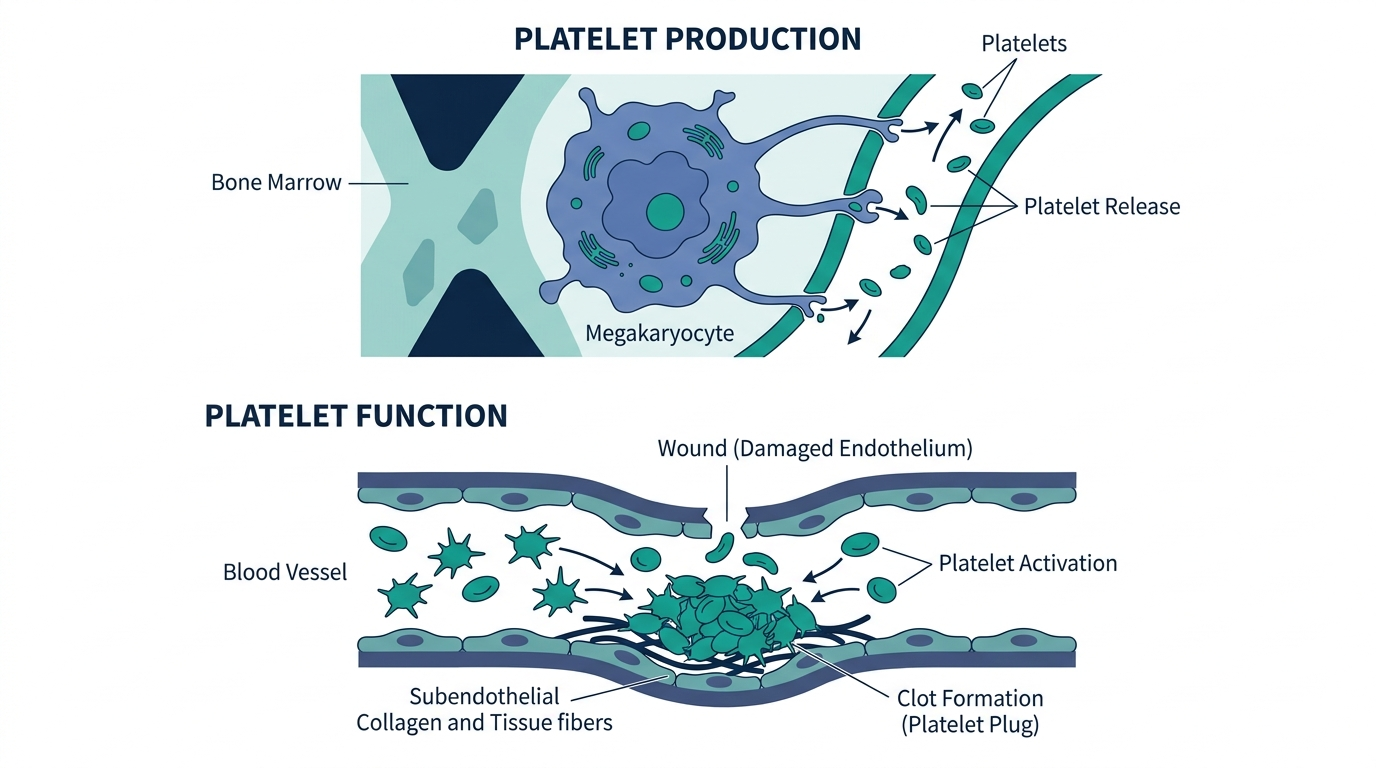
Understanding a low count is easier once you know what platelets are and how your body keeps them stocked. Platelets, also called thrombocytes, are not whole cells. They are tiny fragments that break off from very large parent cells in your bone marrow called megakaryocytes. Each megakaryocyte can shed thousands of platelets into the bloodstream.
A few facts about their lifecycle explain many low results:
- They are made in the bone marrow. Anything that damages or crowds the marrow, such as chemotherapy, leukemia, or aplastic anemia, cuts production at the source.
- They live only about 8 to 10 days. Because platelets turn over quickly, the count reflects a constant balance between production and removal. Tip that balance toward faster destruction, as in ITP, and the number falls even when the marrow works fine.
- About a third are stored in the spleen at any moment. This is why an enlarged spleen can lower the circulating count: it simply holds onto more of them, even though total body platelets may be normal.
This three-part picture, production, lifespan, and storage, maps directly onto the two big buckets of causes. Low production points at the marrow. Fast destruction or trapping points at the immune system, the spleen, or an active clotting process. Knowing which mechanism is at work is exactly what your clinician’s workup is trying to sort out.
How a low PLT is read alongside the rest of your CBC
A platelet count almost never travels alone. It is reported on the complete blood count, and the neighboring values change what a low PLT means. The most important question is whether the low platelets are isolated or part of a broader drop.
| Companion value | Why it matters next to a low PLT |
|---|---|
| Red blood cells and hemoglobin | Low platelets plus anemia can point toward marrow disease, blood loss, or a nutrient deficiency affecting all cell lines. |
| White blood cells | Low platelets with abnormal white cells raise concern for leukemia, infection, or marrow suppression. |
| Mean platelet volume (MPV) | The average size of your platelets. Large young platelets (high MPV) suggest the marrow is churning out replacements, hinting at destruction. Small platelets can point elsewhere. |
| Blood smear | A microscope look that catches platelet clumps (the artifact), abnormal cells, or giant platelets the machine cannot. |
Want to check your platelets?
Three ways to get it measured. Pick whichever fits you.
Affiliate links: we may earn a commission at no extra cost to you. A lab test does not replace a visit with your clinician.
The single most useful glance when you see a low PLT is at your red and white cell lines. An isolated low platelet count with everything else normal usually points toward medications, a virus, or ITP. A low platelet count sitting next to low red cells and abnormal white cells is the pattern that moves the workup up in urgency.
How to prepare for the test and what can distort the result
A platelet count is part of a routine CBC and needs no special fasting. But several factors can affect the number or its accuracy, and knowing them prevents overreacting to a single value:
- The collection tube itself. As covered above, the EDTA anticoagulant in standard tubes can make platelets clump in a subset of people, faking a low count. A redraw into a different tube settles it.
- Recent viral illness. A cold, flu, or other infection can temporarily lower platelets, so a count taken while you are sick may rebound once you recover.
- Alcohol in the days before. Heavy drinking suppresses platelet production and can show up on a test done soon after.
- Medications. Tell your clinician about all drugs and supplements, since many can lower platelets. Do not stop a prescribed medication on your own to “clean up” a result.
- Pregnancy. A mild dip is common and usually benign, but it should still be noted so the count is interpreted correctly.
- Timing and repeat testing. Because a single value can mislead, a confirmatory repeat draw is often the most informative step of all.
Reading your result: a few worked scenarios
Context turns a number into meaning. Here is how the interpretation shifts across common situations:
- PLT 140,000, everything else normal, you feel fine. This is mild and just below the cutoff. Often the plan is simply to recheck, and many such counts prove stable or normalize.
- PLT 90,000 after a recent viral infection. A moderate dip with an obvious trigger. The count typically recovers as you do, so a repeat test after recovery is the usual move.
- PLT 30,000, isolated, with petechiae but normal red and white cells. This pattern fits immune thrombocytopenia (ITP), where the immune system destroys platelets. It warrants prompt evaluation and often treatment.
- PLT 40,000 alongside anemia and abnormal white cells. The multi-line drop is the concerning one, pointing toward the marrow and needing urgent workup rather than watchful waiting.
- PLT 60,000 with no symptoms, and it normalizes on a redraw into a citrate tube. Classic pseudothrombocytopenia. The platelets were fine all along, and no treatment is needed.
Living safely with a low platelet count
If your count is genuinely low and being monitored, some sensible day-to-day precautions reduce bleeding risk while the cause is sorted out. These are general safety measures, not a substitute for your clinician’s specific advice:
- Avoid aspirin and NSAIDs like ibuprofen unless your doctor approves them, since they further impair clotting.
- Limit or avoid alcohol, which both lowers platelets and thins the blood’s clotting ability.
- Use a soft toothbrush and an electric razor to reduce bleeding from small nicks and gums.
- Be cautious with contact sports and sharp tools, and take care to prevent falls, especially if your count is in the severe range.
- Tell every provider, including your dentist, before any procedure so bleeding risk can be planned for.
- Know your red flags. Seek urgent care for bleeding that will not stop, blood in urine, stool, or vomit, or a sudden severe headache with confusion.
The overarching principle is simple: a low PLT is a reason to identify the cause and take reasonable precautions, not to live in fear. Most mild cases need only monitoring, and even more serious ones are highly treatable once the underlying reason is found.
Frequently asked questions
What platelet count is considered dangerously low?
Risk climbs as the number falls. Below 50,000 per microliter, your bleeding risk rises even with everyday activities, and counts in the severe range of roughly 21,000 to 50,000 can cause spontaneous bruising and bleeding (Cleveland Clinic). Very low counts raise the risk of dangerous internal bleeding and need urgent care.
Can a low platelet count go back to normal on its own?
Often, yes. When the cause is a temporary one such as a viral infection or pregnancy, the count usually recovers as the underlying issue resolves (MedlinePlus). Other causes need treatment, which is why the right move is to identify why it is low rather than just wait.
What is the most common cause of a low platelet count?
There is no single answer, but medications, viral infections, and immune thrombocytopenia (ITP) are among the most frequent causes of an isolated low count (NHLBI). Heavy alcohol use and liver disease are also common and easily overlooked.
Does a low PLT always mean something serious?
No. Many low counts are mild, harmless, or even a lab artifact. Up to roughly one in six low outpatient counts is pseudothrombocytopenia, a false reading caused by platelets clumping in the collection tube rather than a true drop (Haematologica). A repeat test often settles it.
Should I worry about a low platelet count if I have no symptoms?
A mildly low count with no bleeding is usually monitored rather than treated, and many people have no symptoms at all (Cleveland Clinic). Still, talk with your clinician so the cause is identified and the number is rechecked.
This article is for general educational purposes and is not medical advice. It cannot diagnose or treat you and does not replace your clinician. Always discuss your lab results and any health decisions with a qualified healthcare professional.
Vital Signs Today may earn a commission if you buy through links on this page. It does not affect our editorial assessments.