Disclosure: Vital Signs Today may earn a commission if you buy through links on this page, at no extra cost to you. This does not influence our evidence-based assessments. We are not a medical provider; talk to a clinician before acting on test results.
Related: albumin blood test: the full guide
Your blood panel came back and one line is flagged low: albumin. Maybe it sat inside a comprehensive metabolic panel or a liver panel, a single number with an L next to it, and now you are trying to figure out whether it is a clerical curiosity or a real warning. Here is the honest version that most quick explainers skip. Albumin is one of the most useful single numbers on your whole report, and when it drops, your body is almost always telling you something specific about your liver, your kidneys, your gut, or how hard your immune system is currently working.
Albumin is not a vague wellness score. It is a real protein with two concrete jobs, and a low value points to a fairly short list of explanations. Let me walk you through what it actually means, what is worth worrying about, and what is usually nothing.
Part of our Comprehensive Metabolic Panel guide.
What does low albumin mean in a blood test?
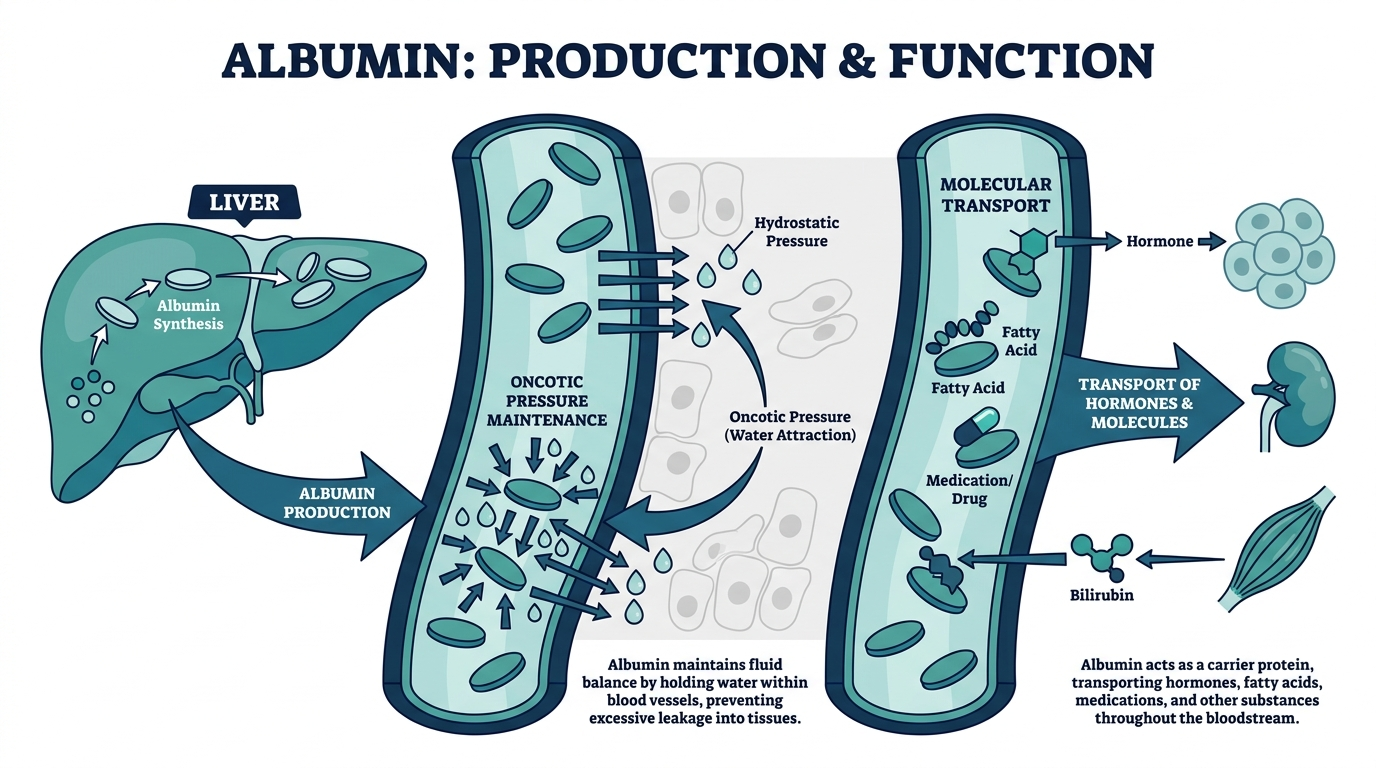
What does low albumin mean in a blood test? In plain terms, it means your liver is making less albumin than normal, your body is losing it faster than it can replace it, or both. Albumin is a protein made by your liver that keeps fluid inside your blood vessels and ferries hormones, vitamins, and medications around your body (Cleveland Clinic). When the level falls, that fluid balance and transport system is under strain.
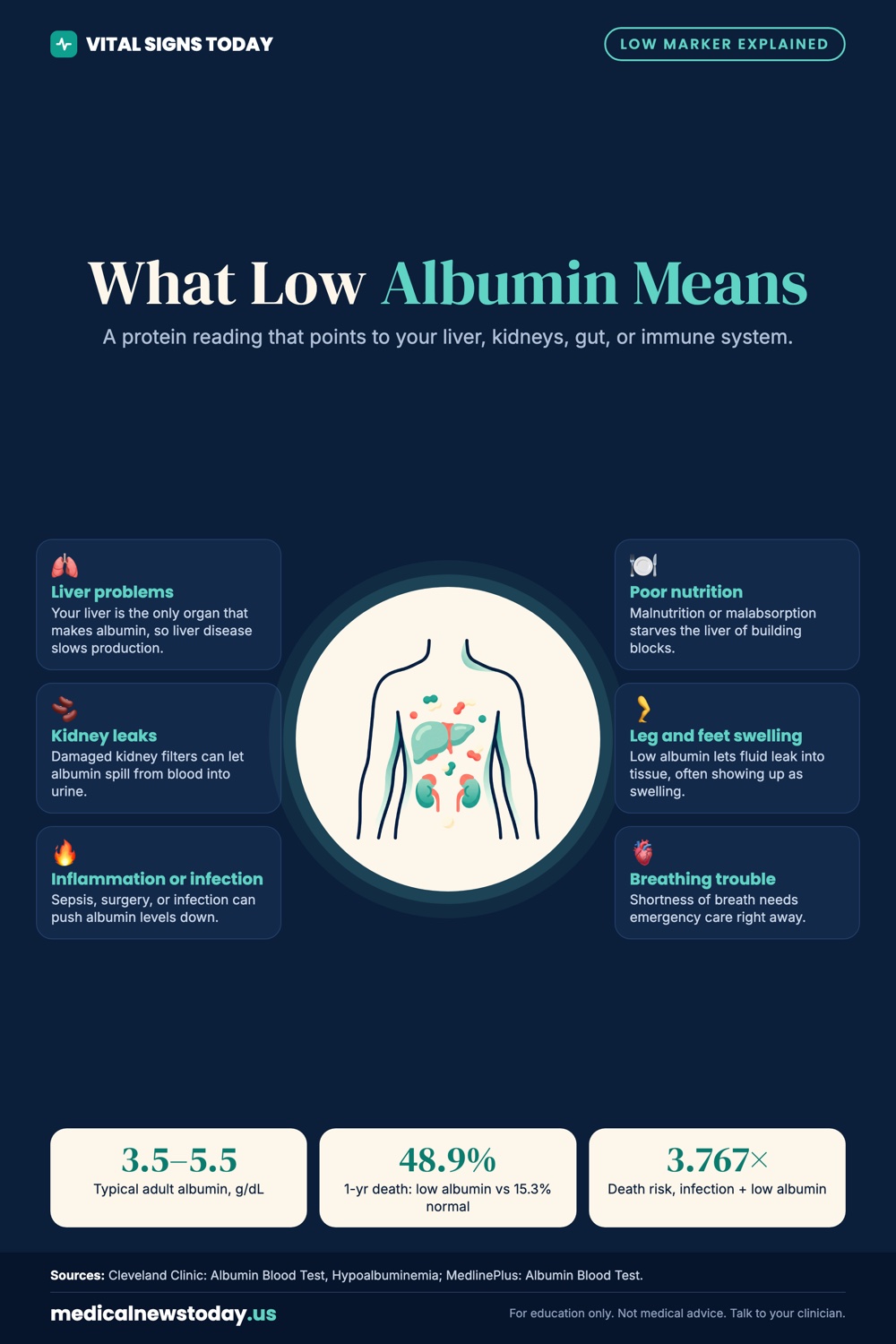
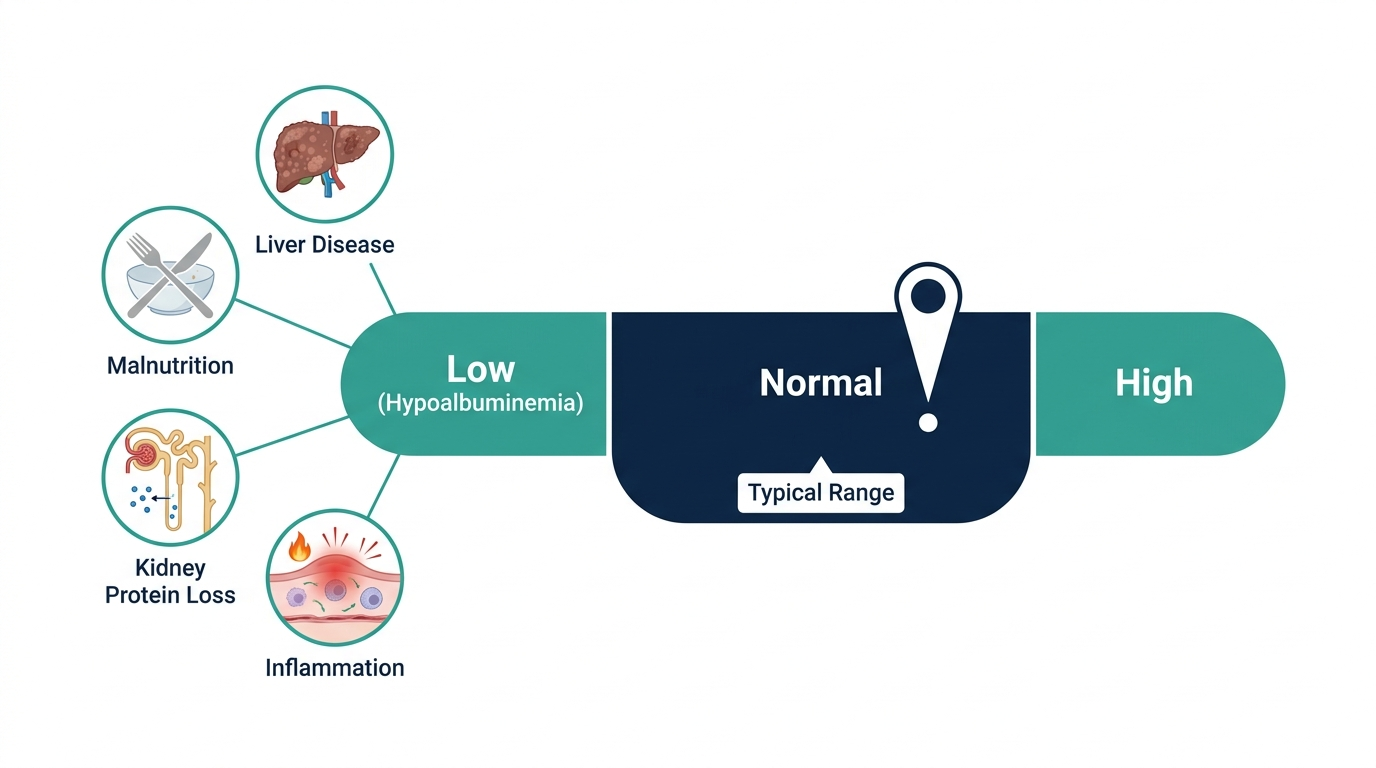
The numbers that matter: a normal adult albumin level runs from about 3.5 to 5.5 grams per deciliter (g/dL). Anything below roughly 3.5 g/dL is considered low, a state doctors call hypoalbuminemia (Cleveland Clinic). Reference ranges vary slightly between labs and instruments, so the smartest move is to read your result against the range printed on your own report rather than a number you found online.
One thing to settle right away. A mildly low albumin, say 3.3 or 3.4 g/dL, in someone who feels well is a very different signal from a 2.0 g/dL in someone with swollen legs. The number alone is a clue, not a diagnosis. What it does reliably is tell your clinician to look closer.

What causes a low albumin?
A low albumin is almost never a standalone disease. It is a downstream consequence of something else, and there are really only four broad mechanisms: your liver makes too little, your kidneys leak it out, your gut loses or fails to build it, or inflammation burns through it. Here are the real culprits, roughly in order of how often they show up (Cleveland Clinic):
- Liver disease. Your liver is the only organ that makes albumin, so conditions like cirrhosis, hepatitis, and fatty liver disease can throttle production directly (MedlinePlus). This is why albumin is part of standard liver panels.
- Kidney disease, especially nephrotic syndrome. Healthy kidneys keep large proteins in the blood. Damaged filters let albumin spill into the urine, sometimes in large amounts, which drives blood levels down (Cleveland Clinic).
- Inflammation and infection. During systemic inflammation your liver shifts priorities away from albumin and your body breaks it down faster, so acute illness and chronic inflammatory conditions both pull the number down (PMC).
- Digestive disease. Inflammatory bowel disease, celiac disease, and other malabsorption disorders, including a category called protein-losing enteropathy, mean protein is lost through the gut or never absorbed in the first place (MedlinePlus).
- Malnutrition or very low protein intake. If your liver does not get the raw material, it cannot build albumin. Severe undernutrition and prolonged poor intake show up here (Cleveland Clinic).
- Other drains. Severe burns, major surgery, sepsis, heart failure, thyroid disease, diabetes, and lupus can all lower albumin through a mix of loss, dilution, and inflammation (Cleveland Clinic).
There are also benign and temporary reasons. Albumin runs lower during pregnancy, can dip if you have not eaten for 24 to 48 hours, and can be nudged by certain medications, including birth control pills (MedlinePlus). So context, your symptoms, your medications, and the rest of the panel decides which story applies.
What are the symptoms of a low albumin?
Mild low albumin often causes no symptoms at all. It is frequently picked up incidentally on routine bloodwork in someone who feels fine, which is exactly why the lab number is valuable. It catches a problem before you would.
When albumin drops far enough, the classic sign is swelling, called edema. Because albumin is what holds fluid inside your blood vessels, low levels let fluid seep into the tissues. The most common pattern reported is swelling in the feet and legs (Cleveland Clinic). Other symptoms that can appear include:
- Fatigue and a general lack of energy
- Loss of appetite
- Loss of muscle tone
- Difficulty breathing
- Dark-colored urine and frequent urination
Many of these symptoms belong to the underlying condition as much as to the low albumin itself. Swollen legs plus protein in the urine point one direction (kidney). Fatigue plus jaundice and a swollen abdomen point another (liver). The pattern matters more than any single complaint.
When is a low albumin dangerous or a medical emergency?
Low albumin itself is rarely the thing that lands you in the emergency room. The danger comes from how low it is, how fast it dropped, and what is driving it.
Two situations deserve urgency. First, the symptoms of the underlying cause. Cleveland Clinic advises seeking emergency care for heart-related symptoms such as shortness of breath, difficulty breathing, or a racing heartbeat (Cleveland Clinic). Those can signal fluid backing up into the lungs or a failing heart, and they do not wait.
Second, the depth of the number in a sick person. A severely low albumin in someone who is acutely ill is a recognized red flag, not because the protein is low in isolation but because it is a sensitive readout of how much stress the body is under. In hospitalized patients, hypoalbuminemia is an independent predictor of worse outcomes regardless of the underlying disease (PMC), and in patients arriving with infection it is an independent risk factor for short-term mortality (PMC). A slowly drifting, mildly low albumin in someone who feels well is a different animal from a sharply falling one in someone who is unwell.
Bottom line: a low albumin discovered on a routine panel is a reason to investigate, not panic. A low albumin alongside breathlessness, chest symptoms, severe swelling, or an acute illness is a reason to be seen promptly.

What should you do about a low albumin?
You do not treat the number. You find and treat the cause, and the number follows. Here is the practical sequence that usually unfolds.
- Confirm and contextualize. Your clinician reads albumin alongside the rest of the panel: total protein, the albumin to globulin ratio, liver enzymes, and kidney markers. A repeat test may be ordered, since a single value can be skewed by hydration, recent fasting, or illness.
- Find the leak or the shortfall. Depending on the picture, this means liver function tests, a urine test to check whether albumin is being lost in the urine, kidney function tests, and a look for inflammation or infection (MedlinePlus).
- Treat the driver. Treatment targets the underlying condition, for example blood pressure medication for kidney or heart disease, antibiotics for infection, anti-inflammatory treatment for inflammatory causes, and dialysis when kidney disease is advanced (Cleveland Clinic).
- Address nutrition where relevant. If intake or absorption is part of the problem, a referral to a dietitian to support adequate protein and calories is common (Cleveland Clinic). Note the nuance: simply eating more protein does not reliably raise albumin when the real problem is liver disease, kidney loss, or inflammation. Food helps when malnutrition is the cause, not when it is not.
If you are otherwise healthy and the value is only slightly low, your clinician may simply recheck it. Trends over time are often more informative than one isolated reading.
When should you see a doctor?
If a low albumin turns up on your report, bring it to the clinician who ordered the test, even if you feel fine. It belongs in a conversation, because the value only makes sense next to your symptoms, your history, and the rest of the panel.
Seek care sooner, rather than at your next routine visit, if you notice new or worsening swelling in your legs, ankles, or abdomen, persistent fatigue, loss of appetite, or yellowing of the skin or eyes. And treat shortness of breath, difficulty breathing, or a racing heart as an emergency (Cleveland Clinic). When in doubt about whether symptoms are urgent, it is reasonable to call your clinician or seek care rather than wait and watch.
The part most people miss: low albumin is often a stress gauge, not just a protein number
Here is the insight that changes how you read this result. Clinicians and patients alike tend to assume low albumin means malnutrition, so the instinct is to eat more protein and move on. That is frequently the wrong model. In a large share of cases, especially in older adults and anyone with chronic or acute illness, low albumin is driven by inflammation, not by diet.
During systemic inflammation, the body increases the breakdown of albumin and the liver redirects its protein-making capacity toward other tasks, so serum albumin falls even when nutrition is adequate (PMC). This is why albumin behaves as a negative acute-phase reactant and why it tracks so tightly with outcomes. It is partly acting as a quiet, inexpensive mirror of how much background inflammatory stress your body is carrying.
Two practical consequences follow. First, do not assume a low albumin is a nutrition problem and try to fix it with a protein shake. If the driver is inflammation, kidney loss, or liver disease, more protein will not move the number and may delay the real workup. Second, do not dismiss a low albumin just because you eat well and feel okay. Because albumin is sensitive to inflammation, a persistently low value can be an early prompt to look for what is smoldering underneath rather than a result to wave away.

How albumin reference ranges shift with age, sex, and the lab that ran your sample
The 3.5 to 5.5 g/dL window is a useful anchor, but it is not a fixed line that applies identically to everyone. Three variables move it, and understanding them keeps you from over-reading a value that sits just outside the printed range.
Age. Albumin tends to run a touch lower at the two ends of life. Newborns and infants have lower values because their liver synthesis is still maturing, and albumin drifts down again in older adults. That later decline is partly physiological, tied to reduced synthesis and a higher background of low-grade inflammation, and partly a reflection of the illnesses that accumulate with age. A reading of 3.6 g/dL in a healthy 80-year-old carries a different weight than the same number in a 30-year-old, and a good clinician reads it in that context.
Sex and pregnancy. Differences between men and women are small, but pregnancy is a large and predictable exception. Blood volume expands substantially through pregnancy, and that extra plasma dilutes albumin. A pregnant woman can show an albumin well below the standard adult floor and be entirely healthy, because the low number reflects dilution rather than any loss or synthesis problem (MedlinePlus). This is one of the most common reasons a “low” albumin turns out to be nothing at all.
The lab and its method. Albumin is most often measured by a dye-binding method, usually bromocresol green (BCG) or bromocresol purple (BCP). The two methods do not always agree, and BCG in particular can read slightly higher because it binds some other proteins along with albumin. This is why two labs can report modestly different numbers on the same blood, and why the reference range is printed on your own report. When you compare results over time, try to compare tests run by the same lab, since a small shift between two different instruments can look like a real change when it is only a method difference.
The practical rule: read your value against your own report’s range, weigh it against your age and situation, and pay more attention to a trend across several tests than to a single number sitting a decimal outside the line.
The companion markers: total protein, globulin, and the albumin-to-globulin ratio
Albumin is rarely interpreted alone. On a comprehensive metabolic panel it sits beside total protein, and from those two the lab calculates globulin and the albumin-to-globulin (A/G) ratio. Reading the four together often tells you more than any one line.
Total protein is the sum of albumin plus all the globulins in your blood. Albumin usually makes up a little more than half of it. If total protein is low and albumin is the reason, that points toward the same short list: liver, kidney, gut, or inflammation. If total protein is normal but albumin is low, globulins must be elevated to compensate, which reframes the question entirely.
Globulin is not a single substance but a mixed family that includes antibodies (immunoglobulins), transport proteins, and clotting factors. It is calculated by subtracting albumin from total protein. A rising globulin can reflect chronic infection, chronic inflammation, autoimmune disease, or, less commonly, a blood disorder affecting antibody-producing cells.
The A/G ratio divides albumin by globulin and typically sits somewhere above 1, meaning albumin normally outweighs globulin. A low A/G ratio, driven either by falling albumin or rising globulin, is a nonspecific flag that prompts a closer look. A high A/G ratio is less commonly worrisome but can appear with certain conditions.
Here is why this matters for a low albumin specifically. If your albumin is low and your globulin is high, keeping total protein near normal, the story is more likely to be chronic inflammation or an immune process than pure liver failure or malnutrition. If your albumin is low and total protein is also low, a synthesis or loss problem moves up the list. The combination narrows the search before a single extra test is ordered.
Want to check your albumin?
Three ways to get it measured. Pick whichever fits you.
Affiliate links: we may earn a commission at no extra cost to you. A lab test does not replace a visit with your clinician.
How to prepare, and what can falsely lower your albumin
Albumin does not usually require fasting on its own, but it often rides inside a comprehensive metabolic panel that does include a glucose measurement, so you may be asked to fast for eight to twelve hours for the panel as a whole. Follow the instruction attached to your specific order.
Several everyday factors can nudge an albumin value in ways that have nothing to do with disease. Knowing them prevents a false alarm:
- Hydration status. This is the single biggest technical confounder. Dehydration concentrates your blood and can push albumin artificially high, while overhydration or fluids given through an IV can dilute it and push it artificially low. A “low” albumin drawn while you are receiving IV fluids may simply be diluted.
- Posture and tourniquet time. Prolonged tourniquet application during the draw and being upright for a long period before the test can shift protein readings slightly. These are small effects but real, which is one more reason a single borderline value gets rechecked.
- Recent illness. Because albumin falls with inflammation, a value drawn during or just after an infection can read low and then recover on its own once you are well. Retesting after recovery separates a transient dip from a persistent one.
- Medications. Certain drugs, including estrogen-containing birth control pills and some others, can lower albumin modestly (MedlinePlus). Bring your full medication and supplement list to the appointment so your clinician can factor it in.
- Prolonged fasting. Going 24 to 48 hours without food can lower albumin, which is a reason a value drawn after an unusually long fast may not represent your baseline (MedlinePlus).
Reading it in context: three worked scenarios
The same low albumin can mean very different things depending on what surrounds it. Here are three patterns that show how clinicians reason through it.
Scenario one: low albumin, protein in the urine, swollen legs. A person notices puffy ankles, and the panel shows albumin at 2.6 g/dL. A urine test finds significant protein spilling out. This combination points toward the kidney, specifically a nephrotic pattern where damaged filters leak albumin into the urine faster than the liver can replace it. The next steps center on kidney function and figuring out why the filter is leaking.
Scenario two: low albumin, abnormal liver enzymes, a history of heavy drinking. Albumin comes back at 3.0 g/dL alongside elevated liver enzymes and a low platelet count. Because the liver is the only place albumin is made, a chronically injured liver produces less of it. Here the low albumin is one piece of a liver picture, and the workup follows the liver.
Scenario three: low albumin, normal urine, normal liver enzymes, a raised inflammatory marker. Albumin sits at 3.2 g/dL, but the urine is clean and the liver looks fine, while a marker of inflammation such as C-reactive protein is elevated. This is the pattern of albumin behaving as a negative acute-phase reactant. The low number is tracking inflammation, not diet or organ failure, and the search shifts to finding what is inflaming the body (PMC). Eating more protein would not move this number.
The lesson running through all three: albumin is a pointer, and the direction it points depends entirely on its companions. This is why your clinician looks at the whole panel rather than reacting to one flagged line.
Who should watch this number, and how often
For a healthy adult, albumin comes along for the ride whenever a comprehensive metabolic panel is ordered, which is a routine part of many annual checkups. There is no need to chase it in isolation if you feel well and your other markers are normal.
Closer monitoring makes sense for specific groups. People with known liver disease, chronic kidney disease, inflammatory bowel disease, or heart failure often have albumin followed over time, because a downward trend can signal that the underlying condition is progressing. Older adults, particularly those who are frail or recovering from illness, are watched because a falling albumin can flag rising inflammatory burden or declining nutritional reserves. Anyone recovering from major surgery, severe burns, or a serious infection may have albumin tracked as one gauge of recovery.
The key point for follow-up is that the trend beats the snapshot. A stable albumin at the low end of normal is usually reassuring. An albumin that is drifting down test after test, even while still technically in range, deserves attention because it may be catching a slow change before it becomes obvious in how you feel.
Common misunderstandings about low albumin
A few myths cause more confusion around this result than almost any other on the panel. Clearing them up changes how you respond to a flagged value.
- “Low albumin means I am not eating enough protein.” This is the most common and most misleading assumption. Diet is only one of several causes, and in adults with chronic or acute illness, inflammation and organ problems drive far more low albumin than food does (PMC). A protein shake does not fix a number that is low because of inflammation, kidney loss, or liver disease.
- “A low value means something is seriously wrong right now.” Not on its own. A mildly low albumin in someone who feels well is frequently benign or transient, especially if it followed an illness, a long fast, or IV fluids. The number earns concern when it is markedly low, falling fast, or paired with symptoms.
- “Albumin infusions raise low albumin and fix the problem.” Giving albumin intravenously is a specific hospital intervention for particular situations, not a general fix for a low reading, and it does not address the reason the level dropped. The durable answer is treating the cause, after which the number recovers on its own.
- “One low reading is enough to act on.” A single value can be thrown off by hydration, timing, and method. Clinicians frequently confirm a borderline result with a repeat test and read it alongside total protein, liver enzymes, kidney markers, and a urine check before drawing conclusions.
Frequently asked questions
What albumin level is considered low?
A normal adult albumin level runs from about 3.5 to 5.5 g/dL, so a value below roughly 3.5 g/dL is considered low, a state called hypoalbuminemia (Cleveland Clinic). Reference ranges vary slightly by lab, so compare your result to the range printed on your own report.
What is the most common cause of low albumin?
There is no single cause, but the usual drivers are liver disease, kidney disease that leaks albumin into the urine, inflammation or infection, digestive diseases that lose or fail to absorb protein, and malnutrition (MedlinePlus). Your other lab values and symptoms point to which one applies.
Can low albumin be fixed by eating more protein?
Only when malnutrition or low intake is the actual cause. If the driver is liver disease, kidney loss, or inflammation, extra dietary protein generally will not raise the number, and the real fix is treating the underlying condition (Cleveland Clinic).
Is low albumin serious?
It depends on how low it is, how fast it fell, and the cause. A mildly low value in someone who feels well is a reason to investigate, while a severely low value in an acutely ill person is a recognized warning sign, since hypoalbuminemia independently predicts worse outcomes in hospitalized patients (PMC).
What symptoms does low albumin cause?
Mild low albumin often causes no symptoms. When it drops further, the classic sign is swelling in the feet and legs, sometimes with fatigue, loss of appetite, loss of muscle tone, or difficulty breathing (Cleveland Clinic).
This article is for general educational purposes and is not medical advice. It cannot diagnose or treat you and does not replace your clinician. Always discuss your lab results and any health decisions with a qualified healthcare professional.
Vital Signs Today may earn a commission if you buy through links on this page. It does not affect our editorial assessments.