Disclosure: Vital Signs Today may earn a commission if you buy through links on this page, at no extra cost to you. This does not influence our evidence-based assessments. We are not a medical provider; talk to a clinician before acting on test results.
Related: LDL normal range by age (full chart)
Your lipid panel came back, and next to the line marked LDL is a number bigger than you hoped, maybe with a flag beside it. Your eyes went straight to the words “bad cholesterol,” your stomach dropped, and now you are trying to figure out whether this is a quiet warning or a five-alarm fire. Here is the calm, accurate version, because the difference between an LDL of 135 and an LDL of 250 is enormous, and almost no lab report bothers to explain it.
LDL is the one cholesterol number that has earned the right to make you pause. But pausing is not panicking, and a single high reading is the start of a conversation, not a verdict.
Part of our Lipid Panel guide.
What does high LDL mean in a blood test?
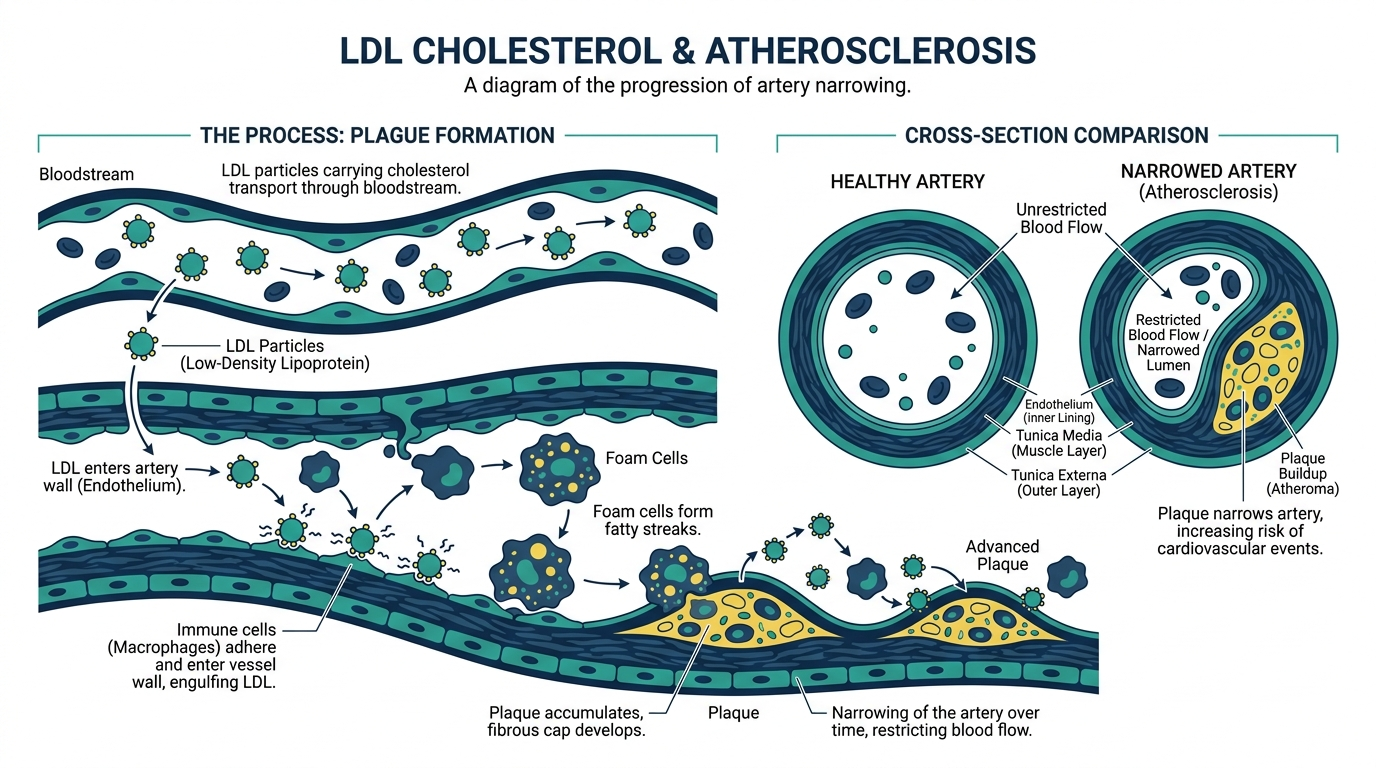
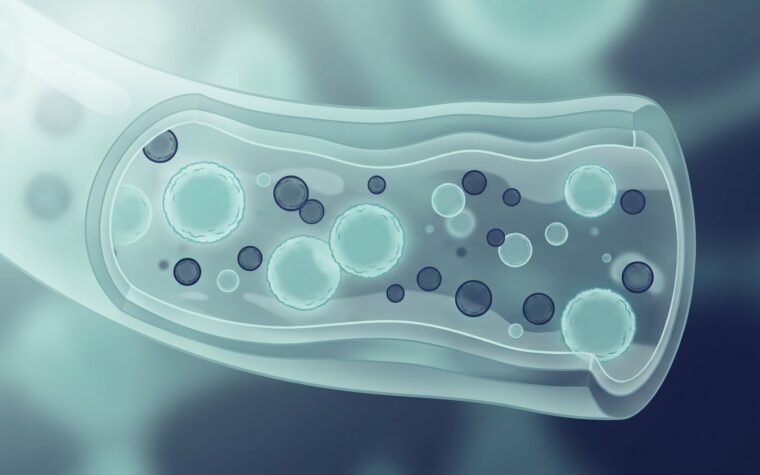
A high LDL in a blood test means there is too much low-density lipoprotein cholesterol circulating in your blood, and that excess is the main raw material your body uses to build plaque inside artery walls (MedlinePlus). LDL is the particle that delivers cholesterol into your arteries. When there is more of it than your body can clear, the surplus gets deposited, hardens over years, and narrows the pipes that feed your heart and brain.
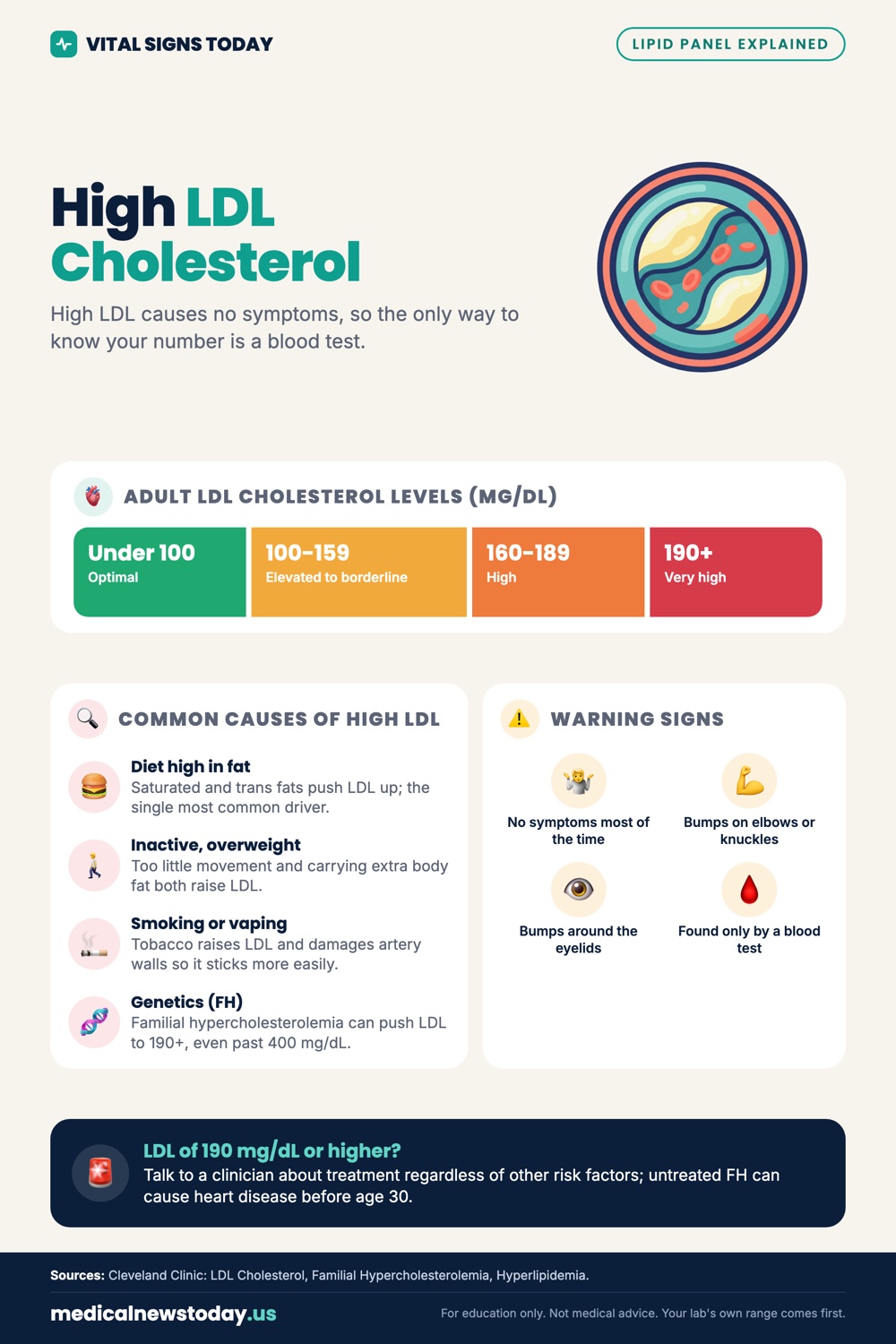
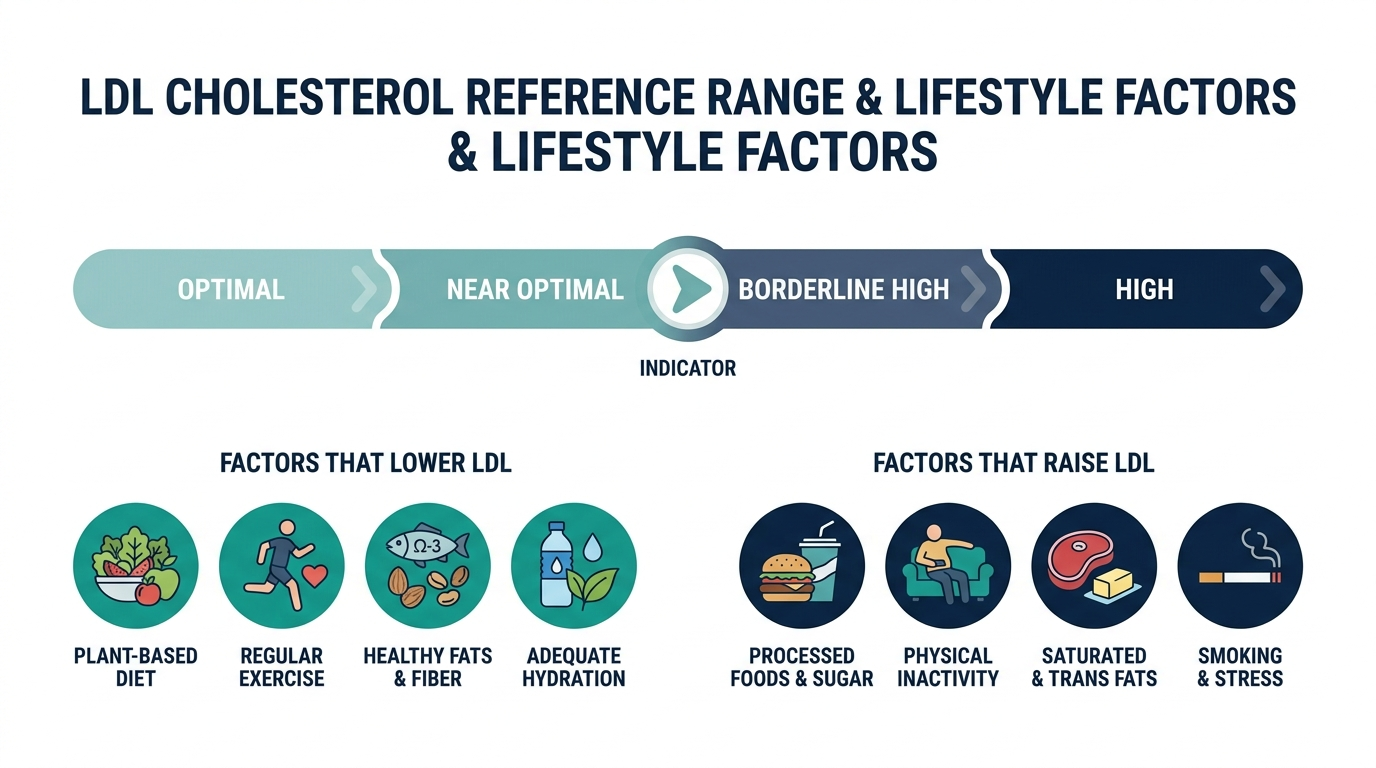
The cutoffs that matter, measured in milligrams per deciliter (mg/dL), are clearer than most people realize (Cleveland Clinic):
- Below 100 mg/dL: the target for most adults.
- 100 to 129 mg/dL: elevated, above optimal.
- 130 to 159 mg/dL: borderline high.
- 160 to 189 mg/dL: high.
- 190 mg/dL or higher: very high.
So the honest answer to “what counts as high” depends on who you are. For a healthy 35-year-old, anything over 100 is worth attention and 160-plus is genuinely high. For someone who has already had a heart attack or has atherosclerosis, the goal drops to below 70 mg/dL, which means a “normal-looking” 110 may still be too high for them (Cleveland Clinic). LDL is not read in a vacuum. It is read against your personal risk.

What causes a high LDL?
Most high LDL is built from ordinary daily life, not a rare disease. The causes, most common first (NHLBI, Cleveland Clinic):
- Diet high in saturated and trans fats. Fatty meats, full-fat dairy, fast food, and many baked goods push LDL up. This is the single most common driver.
- Inactivity and excess weight. Too little movement and carrying extra body fat both raise LDL and lower the protective HDL.
- Smoking and vaping. Tobacco in any form, including smokeless products, raises LDL and damages artery walls so the cholesterol sticks more easily (NHLBI).
- Other medical conditions. Diabetes, chronic kidney disease, an underactive thyroid, and sleep apnea all nudge LDL higher (NHLBI).
- Certain medications. Some blood pressure drugs, steroids, diuretics, and HIV medicines can raise LDL as a side effect.
- Age and biology. LDL tends to climb with age, and in women it often jumps after menopause.
- Genetics, especially familial hypercholesterolemia (FH). An inherited gene change makes the body unable to clear LDL efficiently. People with FH can run an LDL of 190 mg/dL or higher from young adulthood, and in severe inherited cases LDL can climb past 400 mg/dL (Cleveland Clinic).
The practical question your clinician is really asking when they see a high LDL is which bucket you fall into: a lifestyle-driven number that diet and movement can move, or a genetic number that lifestyle alone will never fully fix.
What are the symptoms of a high LDL?
This is the part that catches people off guard. High LDL has no symptoms. You cannot feel it, you will not notice it day to day, and there is no ache or warning sign that tells you your number is climbing (MedlinePlus). That is exactly what makes it dangerous. The damage happens silently inside artery walls for years or decades, and the first “symptom” for many people is the event itself: chest pain, a heart attack, or a stroke.
A blood test is the only way to know your LDL. That is the whole reason a lipid panel exists. You do not test because you feel bad. You test because you cannot feel this at all.
There is one narrow exception. People with very high, often inherited LDL can develop visible cholesterol deposits: firm bumps over the elbows, knuckles, or tendons (xanthomas), yellowish patches around the eyelids (xanthelasma), or a pale ring around the colored part of the eye. Cleveland Clinic describes these as bumps on the elbows or around the eyelids in familial hypercholesterolemia (Cleveland Clinic). If you see those, that is not a maybe. That is a reason to get tested soon.

When is a high LDL dangerous or a medical emergency?
Let me be precise here, because this is where people either over-worry or under-worry. A high LDL number on its own is never an acute emergency. There is no LDL value that requires a same-day trip to the ER. Cholesterol does its harm slowly, over years, by feeding plaque buildup (atherosclerosis) that narrows arteries and eventually starves the heart or brain of blood (Cleveland Clinic).
The red-flag thresholds that mean “act sooner, not someday”:
- LDL of 190 mg/dL or higher. At this level, clinicians consider familial hypercholesterolemia and usually recommend treatment regardless of other risk factors, because lifetime exposure to LDL this high is what drives early heart disease (Cleveland Clinic).
- A high LDL plus a strong family history of early heart attack or stroke. Untreated FH can cause heart disease by age 30, which is why family history changes the urgency (Cleveland Clinic).
- A high LDL alongside diabetes, kidney disease, high blood pressure, or smoking. These stack, and the combined risk is far greater than the LDL number alone suggests.
The true emergency is not the LDL value. It is what untreated high LDL eventually produces: crushing chest pain, sudden weakness or speech trouble, or shortness of breath. Those are heart attack and stroke symptoms, and they require calling emergency services immediately. The number is the warning. The event is the emergency. The whole point of treating LDL is to make sure the second one never happens.
What should you do about a high LDL?
First, confirm and contextualize. A single high reading should be repeated, ideally after a proper fast if your clinician used a fasting panel, and read alongside your total cholesterol, HDL, triglycerides, blood pressure, blood sugar, and family history. Your real target is set by your overall cardiovascular risk, not by the LDL line in isolation (Cleveland Clinic).
Then, depending on how high and how risky:
- Lifestyle first for borderline and moderately high numbers. Shift toward a Mediterranean-style diet, cut saturated and trans fats, move at least 30 minutes most days, reach a healthy weight, and stop all tobacco (Cleveland Clinic). For lifestyle-driven LDL, these changes can move the number meaningfully.
- Medication when lifestyle is not enough or risk is high. Statins are the first-line drug and the most evidence-backed way to lower LDL (MedlinePlus). For very high or genetic LDL, treatment is usually needed from the start, because diet alone will not bring a 220 down to target.
- Treat the things that raise it. Get diabetes, thyroid, and kidney issues managed, and review any medication that could be pushing your LDL up.
The mindset that works: high LDL is one of the most modifiable risk factors in all of medicine. Few numbers respond this well to action.
When should you see a doctor?
See a clinician to review any LDL result that is flagged high, and do not wait if your LDL is 160 or above, if it is 190 or above, or if you have a family history of high cholesterol or early heart disease (Cleveland Clinic). Book sooner if you also have diabetes, high blood pressure, kidney disease, or you smoke, since those multiply the risk your LDL carries.
If you have never had your cholesterol checked, that itself is a reason to go. Most adults should be screened every 4 to 6 years, and more often in the 40-to-65 window when cholesterol tends to peak (MedlinePlus). And if you ever notice the physical signs of very high cholesterol, the bumps on tendons or yellow patches near the eyes, make the appointment regardless of when you last tested.
The insider read: the “high LDL” on your report may not be measured at all
Here is the nuance almost no patient knows, and it changes how much you should trust a single scary number. On most standard lipid panels, your LDL is not directly measured. It is calculated, usually with the Friedewald equation, from your total cholesterol, HDL, and triglycerides. That math has a well-known weakness: when triglycerides are high, especially after a non-fasting blood draw or a heavy meal the night before, the equation can underestimate or distort LDL.
What that means in practice: a borderline result drawn right after a big dinner is not the same as a clean fasting number. It is one reason clinicians repeat an abnormal LDL rather than acting on a single draw, and why a fasting panel is often requested for confirmation (Cleveland Clinic). If your LDL came back surprisingly high and your triglycerides were also high that day, ask whether a repeat fasting test, or a directly measured LDL, would give a truer picture.
The other commonly missed point: two people with an identical LDL of 130 can carry very different risk. The number counts particles loosely. Markers like apolipoprotein B or lipoprotein(a) can reveal that a “normal-ish” LDL is hiding more risk than it shows, which is exactly why your clinician weighs the whole picture, not one line on the page.

How to prepare for an LDL test so the number you get is real
The single biggest reason people chase a “high LDL” that was never truly high is preparation. Because standard LDL is calculated from triglycerides, and triglycerides swing sharply with food, what you did in the 12 hours before the draw can shift the printed LDL more than most patients expect.
Get the cleanest reading by handling these before the appointment:
- Ask whether it is a fasting or non-fasting panel. Many modern labs accept non-fasting lipid draws for routine screening, but if your triglycerides tend to run high, or your clinician wants to confirm a borderline LDL, a 9 to 12 hour water-only fast gives the most reliable calculated LDL.
- Skip the heavy meal the night before. A fatty dinner can keep triglycerides elevated into the morning, which distorts a calculated LDL upward. A normal, moderate dinner is fine.
- Hold alcohol for 24 hours. Alcohol raises triglycerides acutely, and a couple of drinks the evening before a test is a common hidden reason for a surprising result.
- Take your usual medications unless told otherwise. If you are already on a statin, you generally keep taking it, because the goal is to see your treated number. Do not stop a prescribed drug to “get a cleaner” reading without asking.
- Do not do a hard workout the morning of the draw. Intense exercise can transiently shift lipid values, so a rest morning is preferable.
- Flag recent illness, pregnancy, or a major weight change. Acute infection, the days after surgery, and pregnancy can all move lipids temporarily, so a result taken then may not reflect your baseline.
If your LDL comes back high and none of the above were controlled, the honest next step is often a repeat under clean conditions before anyone reaches for a prescription pad. One flagged number under messy conditions is a reason to retest, not to panic.
How LDL is read alongside the rest of your lipid panel
LDL almost never travels alone on a lab report. It sits inside a lipid panel, and the other numbers change what a given LDL actually means for you. Reading them together is how a clinician turns one flagged line into a real risk picture.
| Panel value | What it adds to the LDL story |
|---|---|
| Total cholesterol | The sum of LDL, HDL, and a fraction of triglycerides. A high total driven by high HDL is very different from one driven by high LDL. |
| HDL (“good”) cholesterol | Higher HDL is protective. A high LDL is more worrying when HDL is also low, because the ratio between them tracks risk better than LDL alone. |
| Triglycerides | High triglycerides both raise risk and distort calculated LDL. When they are high, your clinician trusts the calculated LDL less. |
| Non-HDL cholesterol | Total cholesterol minus HDL. It captures all the plaque-forming particles at once and is often a better target than LDL when triglycerides are elevated. |
| VLDL | A cholesterol-carrying particle estimated from triglycerides, useful context when triglycerides run high. |
Want to check your LDL?
Three ways to get it measured. Pick whichever fits you.
Affiliate links: we may earn a commission at no extra cost to you. A lab test does not replace a visit with your clinician.
Two quick interpretation scenarios show why the panel matters more than any single line:
- LDL is 145 but HDL is 75 and triglycerides are low. The high-ish LDL is softened by strong protective HDL and a clean triglyceride number. Risk is real but more moderate, and lifestyle is often the first move.
- LDL is 130 but HDL is 34 and triglycerides are 280. The LDL looks only borderline, yet the low HDL and high triglycerides signal a pattern (often linked to insulin resistance) that carries more risk than the LDL number alone suggests. Here non-HDL cholesterol becomes the smarter target.
The lesson: never let one number, high or reassuring, decide the story. LDL is a chapter, not the whole book.
Beyond standard LDL: the advanced markers worth asking about
For most people, a standard lipid panel is enough. But if you have a strong family history of early heart disease, a borderline LDL you cannot explain, or you simply want a more precise read, there are markers that see risk a basic LDL can hide.
- Apolipoprotein B (ApoB). Every plaque-forming particle carries exactly one ApoB molecule, so ApoB counts the actual number of dangerous particles rather than the cholesterol they carry. Two people with the same LDL can have very different ApoB, and the one with more particles carries more risk.
- Lipoprotein(a), or Lp(a). A largely inherited particle that raises cardiovascular risk independently of LDL. It is measured once in a lifetime for most people, and a high Lp(a) can explain heart disease in a family whose LDL numbers looked unremarkable.
- LDL particle number (LDL-P). A direct count of LDL particles that can reveal a “discordant” result, where LDL cholesterol looks fine but particle number is high, meaning hidden risk.
- High-sensitivity C-reactive protein (hs-CRP). A marker of vascular inflammation. Inflammation is part of how cholesterol becomes plaque, so hs-CRP adds context to an LDL result.
You do not need all of these. The point is that a standard LDL is a screening tool, not the final word, and if your situation is high-stakes or confusing, these are the tests to raise with your clinician rather than accepting a single calculated number as destiny.
Common misconceptions about high LDL
Few numbers on a lab report generate more myths than LDL. Clearing these up changes what you do next.
- “My total cholesterol is normal, so my LDL is fine.” Not necessarily. A normal total can hide a high LDL if your HDL is high enough to mask it. You have to read the components, not just the total.
- “High LDL means I ate too much cholesterol.” Dietary cholesterol matters less than most people think. Saturated and trans fats, which the liver turns into LDL, drive the number far more than the cholesterol in food itself.
- “I feel great, so my LDL cannot be high.” High LDL is completely silent until it causes an event. Feeling well tells you nothing about your number.
- “If I start a statin I can eat whatever I want.” Medication and lifestyle work together. A statin lowers LDL, but diet, movement, weight, and not smoking still shape your overall cardiovascular risk.
- “One low reading means I am cured and can stop testing.” LDL responds to what you are doing right now. Numbers drift back up if habits or medication change, which is why periodic re-testing matters.
- “LDL is the only cholesterol number that counts.” LDL is central, but HDL, triglycerides, and non-HDL cholesterol all shape your true risk, and in some people ApoB or Lp(a) tell the real story.
Who should get tested, and how often to track LDL
Because LDL is silent, testing schedule is the whole game. General guidance from major clinical sources looks like this:
- Most healthy adults: a cholesterol check roughly every 4 to 6 years, starting in early adulthood, with more attention through the 40-to-65 window when cholesterol tends to peak.
- Adults with risk factors: if you have diabetes, high blood pressure, obesity, kidney disease, or you smoke, expect more frequent testing, often yearly, at your clinician’s direction.
- Family history of early heart disease or very high cholesterol: earlier and more frequent screening, sometimes beginning in childhood or adolescence when familial hypercholesterolemia runs in the family.
- Anyone on cholesterol-lowering treatment: re-testing a few weeks to months after starting or changing a statin, to confirm the number is moving toward target, then periodically after that.
Once you have a result, the next steps follow a simple logic. A normal LDL means keep your habits and test on schedule. A borderline LDL means tighten diet, movement, and weight, then recheck in a few months to see if it moved. A high or very high LDL, or any high LDL stacked with diabetes, smoking, or family history, means a clinician visit to decide whether lifestyle alone is enough or medication belongs in the plan. Tracking the trend over time tells you far more than any single draw, because the direction your LDL is heading is what predicts your future, not one number frozen on one morning.
Frequently asked questions
What LDL level is considered high?
For most adults, LDL of 160 to 189 mg/dL is high and 190 mg/dL or above is very high, while 130 to 159 mg/dL is borderline high. The target for most people is below 100 mg/dL, and below 70 mg/dL for those with existing heart disease (Cleveland Clinic).
Does a high LDL cause any symptoms?
No. High LDL produces no symptoms and builds plaque silently for years, which is why a blood test is the only way to detect it (MedlinePlus). The exception is very high, often inherited LDL, which can cause visible cholesterol bumps near the elbows or eyelids (Cleveland Clinic).
Is a high LDL a medical emergency?
The number itself is never an acute emergency, because LDL causes harm slowly over years through plaque buildup (Cleveland Clinic). The emergency is what untreated high LDL can eventually cause: a heart attack or stroke, which need immediate care.
What causes a high LDL?
The most common causes are a diet high in saturated and trans fats, inactivity, excess weight, and smoking. Diabetes, kidney disease, an underactive thyroid, some medications, age, and inherited familial hypercholesterolemia can also raise it (NHLBI).
Can I lower a high LDL without medication?
Often yes for borderline or moderately high lifestyle-driven LDL, through a heart-healthy diet, regular exercise, weight loss, and quitting tobacco (Cleveland Clinic). Very high or genetic LDL usually needs medication such as a statin in addition to lifestyle changes (MedlinePlus).
This article is for general educational purposes and is not medical advice. It cannot diagnose or treat you and does not replace your clinician. Always discuss your lab results and any health decisions with a qualified healthcare professional.
Vital Signs Today may earn a commission if you buy through links on this page. It does not affect our editorial assessments.