Your results come back and one line is flagged in red: LDH, with an “H” next to it. The number sits higher than the reference range, and your mind immediately jumps to the worst thing it can think of. Take a breath. LDH is one of the least specific markers in all of laboratory medicine, which sounds like bad news but is actually the opposite. A high LDH almost never points to one thing, and on its own it diagnoses nothing.
Here is what most explainers get wrong. They treat a high LDH like a verdict. It is closer to a smoke detector. It tells you something somewhere released its contents into your blood, and the entire job from there is figuring out what, and whether it even matters.
An elevated LDH flag can come from dozens of causes, most of them minor. See the full picture with 100+ biomarkers. One at-home Superpower draw checks 100+ biomarkers, physician-reviewed.
What does high LDH mean in a blood test?
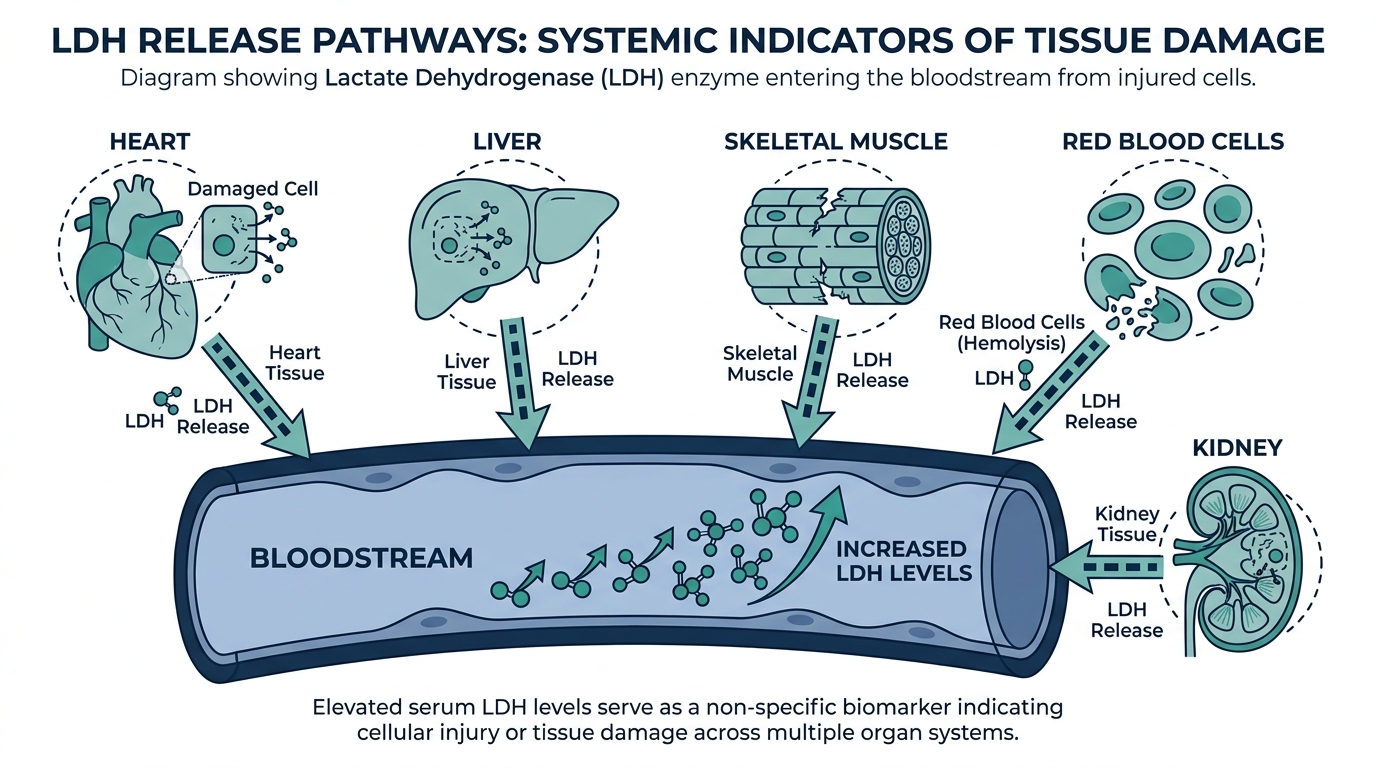
A high LDH on a blood test means lactate dehydrogenase, an enzyme packed inside nearly every cell in your body, has leaked into your bloodstream in larger than normal amounts. That happens when cells get damaged or break open and spill their contents. Because LDH lives almost everywhere, from your heart and liver to your muscles and red blood cells, a raised level is a general signal of tissue stress or turnover, not a diagnosis of any single disease (Cleveland Clinic).
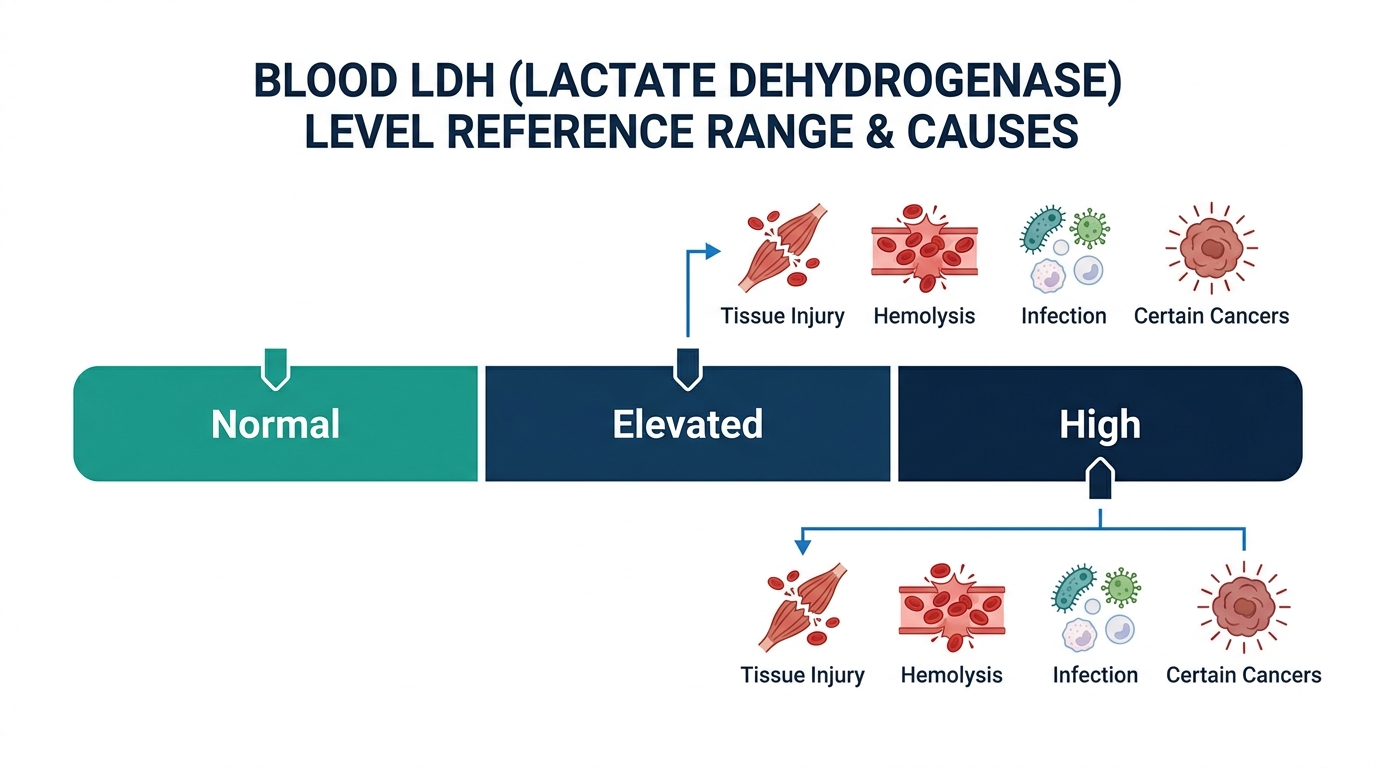
Most labs put the normal adult range somewhere around 135 to 225 units per liter. Cleveland Clinic, for example, lists 135 to 225 U/L for males and 135 to 214 U/L for females, and notes children normally run higher than adults (Cleveland Clinic). The MedlinePlus encyclopedia cites a commonly used reference of roughly 122 to 222 U/L (MedlinePlus). The exact cutoff that counts as “high” depends on your lab’s instrument and calibration, so the only range that matters for your result is the one printed on your own report. Anything above that line is flagged high.
The practical translation: a high LDH says cells are turning over faster than usual. It does not say which cells, or why. That is the question the rest of your workup answers.
What causes a high LDH?
The list of things that raise LDH is long because the enzyme is so widespread. Here are the real culprits, ordered roughly from common and benign to less common and serious (Cleveland Clinic, MedlinePlus):
- A hemolyzed sample. This is the single most common reason for a surprise high LDH in an otherwise healthy person. If red blood cells rupture in the tube during or after the blood draw, they dump LDH into the sample and the result reads high even though nothing is wrong with you (MedlinePlus). More on this trap below.
- Strenuous exercise. A hard workout damages muscle fibers and pushes LDH up temporarily. So can certain medicines, including aspirin (MedlinePlus).
- Muscle injury or muscle disease, including a recent strain, a fracture, or muscular dystrophy (Cleveland Clinic).
- Liver disease, such as hepatitis, which releases LDH as liver cells are injured.
- Infections, including mononucleosis, meningitis, encephalitis, and HIV (Cleveland Clinic).
- Anemia from red cell breakdown. Hemolytic anemia, where red cells are destroyed inside the body, is a classic cause because red cells are loaded with LDH (StatPearls, NCBI).
- Heart, lung, kidney, or pancreas damage, including heart attack, lung injury, kidney disease, and pancreatitis (Cleveland Clinic).
- Certain cancers. Lymphoma, leukemia, multiple myeloma, testicular cancer, and metastatic melanoma can all elevate LDH because rapidly dividing tumor cells produce and shed a lot of it (Cleveland Clinic).
Notice the shape of that list. The most likely explanation for a mildly high LDH in someone who feels fine is something boring: a rough blood draw or a trip to the gym the day before. The serious causes tend to come with other abnormal labs and actual symptoms. A high LDH in isolation, with a clean rest of the panel, is rarely the start of a horror story.
What are the symptoms of a high LDH?
Here is the part that trips people up. A high LDH itself has no symptoms. LDH is a number, not a disease, and the enzyme floating in your blood does not make you feel anything. You will never feel “high LDH” the way you might feel a fever or a headache.
What you may feel are the symptoms of whatever is raising it. If iron-poor or hemolytic anemia is behind the number, you might notice fatigue, pale skin, shortness of breath, or a faster heartbeat. If it is a liver problem, you might see yellowing of the skin or eyes, dark urine, or pain in the upper right belly. If it is an infection, you will likely have fever, swollen glands, or feel run down. Muscle causes show up as soreness or weakness.
This is exactly why a high LDH is read in context, never alone. The enzyme is the alarm. Your symptoms and the rest of your labs are what tell the clinician which room the smoke is coming from.

When is a high LDH dangerous or a medical emergency?
The number alone almost never makes something an emergency. What makes it urgent is the company it keeps. A mildly elevated LDH, say a little above your lab’s ceiling, with no symptoms, is the most common pattern and usually warrants nothing more than a recheck.
The picture changes when LDH is very high or paired with red flags. A markedly elevated LDH that comes with severe symptoms, crushing chest pain, breathlessness, confusion, signs of a serious infection, or rapidly dropping blood counts, is worth getting checked promptly because the underlying cause, not the LDH, is the thing that can hurt you. In hemolysis severe enough to crash your red cell count, the LDH can climb dramatically alongside falling hemoglobin (StatPearls, NCBI). In cancer, the height of the LDH carries real weight. In non-Hodgkin lymphoma, a high LDH at diagnosis reflects greater tumor bulk and tracks with worse survival, which is why oncologists treat it as a genuine prognostic marker rather than a curiosity (PMC, LDH in non-Hodgkin lymphoma).
The honest rule of thumb: a modestly high LDH with a normal rest of the panel is a follow-up item, not a 911 call. A very high LDH, or one alongside alarming symptoms or other abnormal results, deserves prompt medical attention so the cause gets found.
What should you do about a high LDH?
The first move is almost always to repeat the test, ideally after a clean draw and without a hard workout in the day or two beforehand. Because LDH rises with exercise and with sample mishandling, a single high value with no symptoms genuinely may mean nothing (MedlinePlus). A great deal of patient anxiety evaporates the moment a repeat comes back normal.
If it stays high, the next step is figuring out the source, not treating the LDH itself. A clinician reads it against the rest of your blood work. Your complete blood count, liver enzymes, kidney function, and symptoms point toward a tissue. From there, more targeted tests follow the trail. One specific tool is the LDH isoenzyme test, which measures the five different forms of LDH and helps localize which tissue, heart, liver, muscle, or blood, is the likely source of the damage (MedlinePlus).
As for lifestyle: there is no “lower your LDH” diet, because LDH is a downstream readout, not a target. You do not treat a smoke detector by waving the alarm quiet, you find the fire. The right action is to address whatever the workup uncovers, whether that is iron for anemia, treatment for an infection, or a referral if something more serious turns up. LDH then becomes a useful way to track whether that underlying problem is improving.
The insider read: the high LDH that is not real
Here is the clinical nuance that gets missed constantly. The most common reason a healthy person gets a high LDH flag is not disease at all. It is hemolysis in the tube. Red blood cells are absolutely stuffed with LDH, and if they break open during a difficult draw, while sitting too long, during rough handling, or even from being shot through a hospital’s pneumatic tube system, the cells spill enzyme straight into the sample and the analyzer dutifully reports an elevated LDH (PMC, hemolyzed specimens). The number is high. You are fine.
This is why an experienced clinician’s first question about an isolated high LDH is often “was the sample hemolyzed?” Labs can usually flag visible hemolysis, and a tell is when LDH and potassium are both up together, since both leak from the same ruptured red cells. The fix is embarrassingly simple: redraw and rerun. Yet patients get sent down rabbit holes of worry, and occasionally extra testing, over a number that was never measuring their body in the first place.
The flip side is the trap of false reassurance. High-dose vitamin C can push an LDH reading falsely low, which can mask a real elevation (Cleveland Clinic). So the smart way to use LDH is to treat any single value, high or low, as a question rather than an answer, and to weigh it against your symptoms and the rest of the panel before drawing any conclusion.
When should you see a doctor?
Always discuss a flagged LDH with the clinician who ordered the test, even if you feel perfectly well. For most people that conversation ends with a simple plan to recheck. See a doctor sooner rather than later if your high LDH comes with symptoms that point to a cause: persistent fatigue, unexplained weight loss, drenching night sweats, swollen lymph nodes, yellowing skin or eyes, dark urine, ongoing fever, or significant muscle weakness. Seek urgent care for severe chest pain, sudden shortness of breath, or confusion, which are about the underlying problem rather than the lab value. The goal is never to chase the LDH down on its own. It is to let one nonspecific number prompt the right questions.
The five faces of LDH: isoenzymes and what they localize
Total LDH is deliberately blunt because the enzyme comes in five slightly different forms, called isoenzymes, and each one concentrates in different tissues. When total LDH is high and the source is unclear, a lab can break it into these five fractions to point toward the tissue that is leaking (MedlinePlus).
| Isoenzyme | Main tissue source | What a rise can suggest |
|---|---|---|
| LDH-1 | Heart and red blood cells | Heart muscle injury or red cell breakdown (hemolysis) |
| LDH-2 | Reticuloendothelial system and white blood cells | Often the dominant fraction normally; shifts with blood disorders |
| LDH-3 | Lungs | Lung injury or processes affecting lung tissue |
| LDH-4 | Kidneys and pancreas | Kidney or pancreatic injury |
| LDH-5 | Liver and skeletal muscle | Liver injury or muscle damage |
The pattern matters more than any single fraction. A classic teaching example is the LDH-1 to LDH-2 relationship: normally LDH-2 is higher than LDH-1, but when LDH-1 rises above LDH-2, that flip points toward the heart or red cells as the source. In practice, isoenzyme testing has been largely replaced for heart attack by more specific markers like troponin, but the concept still explains why one high total LDH can mean liver in one person and red cell breakdown in another. It is the same enzyme wearing five different uniforms.
LDH in the anemia and hemolysis workup
One of the most useful real-world roles for LDH is helping confirm whether red blood cells are being destroyed inside the body, a process called hemolysis. Red cells are packed with LDH, so when they rupture, the enzyme spills out and the level climbs. But LDH never stands alone here. Clinicians read it as part of a small panel of markers that, together, make hemolysis unmistakable:
- Haptoglobin, a protein that mops up free hemoglobin, drops low during hemolysis because it gets used up.
- Indirect (unconjugated) bilirubin rises as the broken-down heme is processed, which is why brisk hemolysis can cause mild jaundice.
- Reticulocyte count climbs as the marrow ramps up to replace lost red cells.
The signature of active hemolysis is a high LDH with a low haptoglobin, a raised indirect bilirubin, and a rising reticulocyte count, all pointing the same direction. This is a good illustration of how LDH earns its keep not as a diagnosis but as one voice in a chorus. A high LDH with all of these normal makes hemolysis unlikely, while a high LDH with all of them abnormal makes it very likely.
Why oncologists take a high LDH seriously
LDH has a specific and well-established role in cancer care, and it is worth understanding without letting it frighten you out of proportion. Rapidly dividing tumor cells produce and shed large amounts of LDH, and they also rely heavily on the metabolic pathway LDH drives. As a result, the height of the LDH can reflect how much tumor is present.
In non-Hodgkin lymphoma, a high LDH at diagnosis reflects greater tumor bulk and is built into prognostic scoring, tracking with outcomes, which is why oncologists treat it as a genuine marker rather than a curiosity (PMC, LDH in non-Hodgkin lymphoma). It is also followed in some other cancers, including testicular cancer and melanoma, as one input into staging and monitoring. The crucial context: this role applies to people who already have a cancer diagnosis or a strong clinical suspicion. LDH is far too nonspecific to screen for cancer in a healthy person. A high LDH in someone who feels well, with a normal blood count and no other red flags, is not a cancer test coming back positive.
Reading the degree of elevation
How high the LDH climbs is itself a clue, and it helps calibrate how much attention a result deserves:
- Mildly high, just above the reference ceiling, is the most common pattern and the least specific. Recent exercise, a minor illness, or a slightly hemolyzed sample can all do this. It usually warrants a recheck, not a workup.
- Moderately high is more likely to reflect a real process such as liver injury, an infection, or ongoing hemolysis, and it is read carefully against the rest of the panel.
- Very high, several times the upper limit, narrows the field toward significant tissue breakdown, marked hemolysis, or a substantial tumor burden, and it earns a prompt, thorough evaluation.
None of these levels is a diagnosis on its own. But pairing the degree of elevation with your symptoms and your other labs is how a clinician decides between reassurance and a deeper look.
A worked example of interpreting a high LDH
Picture three people whose reports each show an LDH about 1.5 times the upper limit.
- A 30-year-old who ran a half marathon two days before the draw, feels great. Skeletal muscle turnover from the race is a tidy explanation. The sensible plan is a repeat after a week of normal activity, which typically comes back normal.
- Someone with fatigue, mild yellowing, a low haptoglobin, and a high reticulocyte count. Here the same LDH fits active hemolysis, and the workup focuses on why red cells are breaking down.
- A person whose lab noted the sample was hemolyzed, with potassium also high. This is the false alarm. LDH and potassium leaking together from ruptured cells in the tube point to a handling artifact, and a clean redraw settles it.
Same multiple of the upper limit, three entirely different stories. The number is identical. The context is everything, which is the defining truth of this particular marker.
Turn what you just learned about LDH into action.
Superpower lets you test LDH and 100+ biomarkers from home, then re-check them over time so you can actually see progress, physician-reviewed at every step.
Frequently asked questions
Should I be worried about a high LDH?
Not on the strength of one flagged number. A high LDH is a nonspecific signal of cell or tissue turnover, not a diagnosis, and the most common cause in a healthy person is a hemolyzed sample or recent hard exercise (MedlinePlus). Your clinician interprets it alongside your symptoms and the rest of your labs.
What is a normal LDH level?
Most adult reference ranges fall around 135 to 225 units per liter, with Cleveland Clinic listing 135 to 225 U/L for males and 135 to 214 U/L for females (Cleveland Clinic). Ranges vary slightly by lab, so compare your result to the range printed on your own report.
Can a high LDH be a mistake?
Yes, and it often is. If red blood cells break open in the tube during or after the draw, they release LDH and the result reads falsely high even though you are healthy (PMC, hemolyzed specimens). A repeat test after a clean draw frequently comes back normal.
Does a high LDH mean cancer?
Usually not. Many ordinary things raise LDH, from exercise and infections to liver and muscle injury (Cleveland Clinic). Certain cancers such as lymphoma can elevate it, and in those cases the level helps gauge disease burden and prognosis, but LDH alone cannot diagnose cancer (PMC, LDH in non-Hodgkin lymphoma).
How do I lower a high LDH?
You do not treat the number directly, because LDH is a readout of an underlying process rather than a target itself. The level falls when the cause is addressed, whether that is treating an infection, healing a muscle injury, or managing anemia (MedlinePlus). Repeat testing then shows whether the problem is improving.
This article is for general educational purposes and is not medical advice. It cannot diagnose or treat you and does not replace your clinician. Always discuss your lab results and any health decisions with a qualified healthcare professional.
Vital Signs Today may earn a commission if you buy through links on this page. It does not affect our editorial assessments.