
Disclosure: Vital Signs Today may earn a commission if you buy through links on this page, at no extra cost to you. This does not influence our evidence-based assessments. We are not a medical provider; talk to a clinician before acting on test results.
Related: What a low basophils result means
You scanned your complete blood count, hit the row labeled basophils, and saw an “H” next to it or a number sitting above the reference range. Maybe it is 2 percent. Maybe the absolute count reads a little high. Either way, basophils are the one line on the report most people have never heard of, which makes a flag there feel oddly menacing.
Here is the calm version, and the honest version. Basophils are the rarest white blood cell in your blood, so they swing around easily and a “high” reading is usually reactive and harmless. But basophils are also one of the few lines on a CBC that, when persistently elevated for no clear reason, doctors take seriously as a quiet hint of something in the bone marrow. Knowing which camp your result falls into is the whole game.
Part of our Complete Blood Count guide.
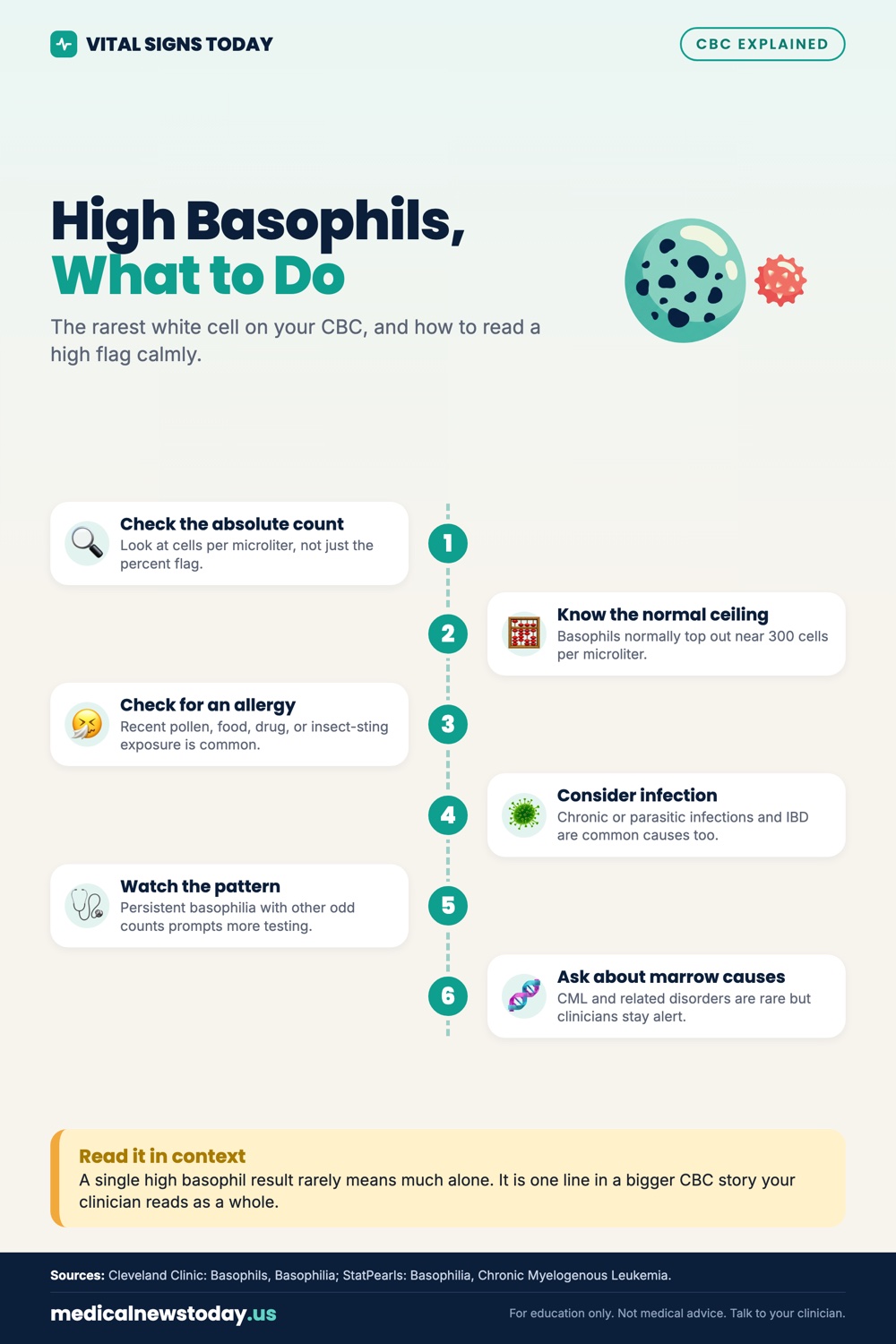
What does a high basophils mean in a blood test?
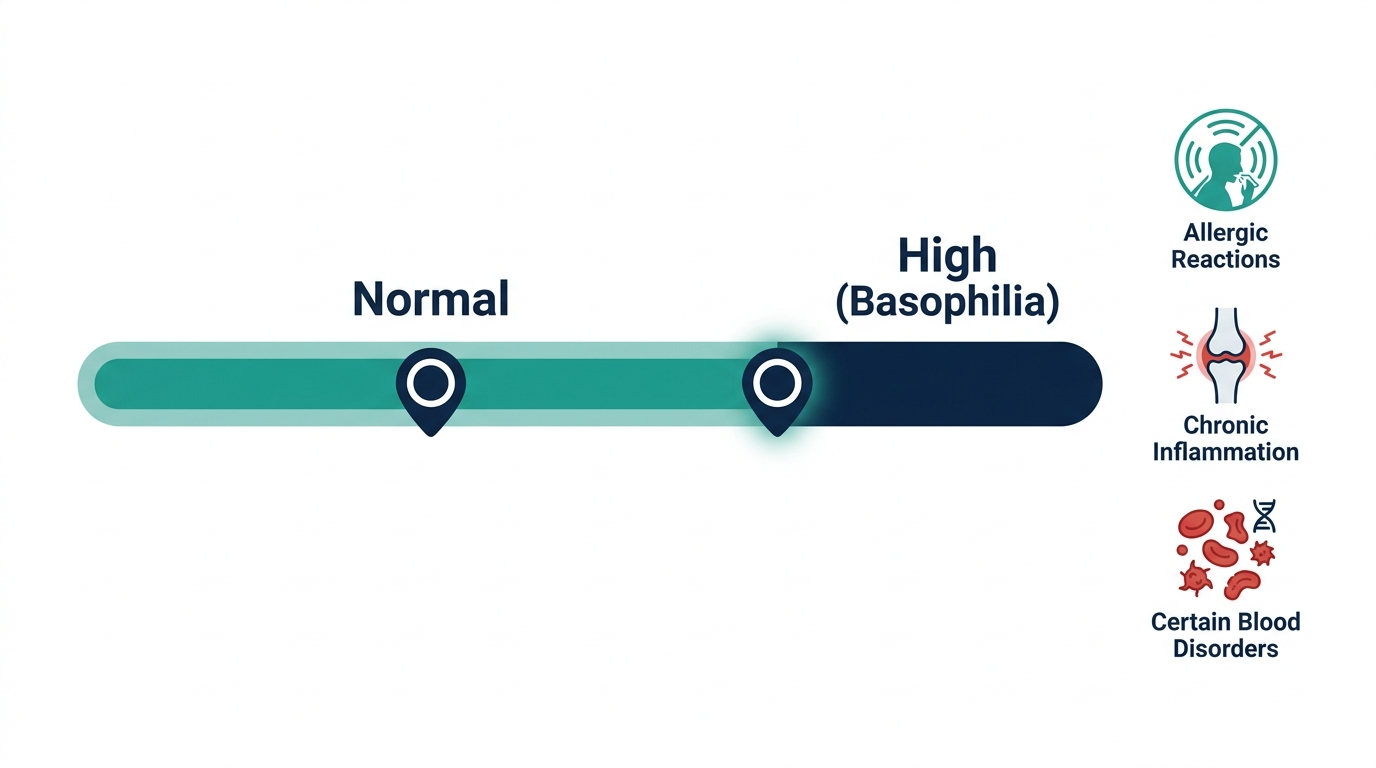
A high basophils result means your blood contains more basophils than expected, a state clinicians call basophilia. Basophils are a type of white blood cell that releases histamine and helps drive allergic reactions and inflammation, and they are normally the least common white cell you have (Cleveland Clinic). In plain terms, a high basophil count tells you your immune system is revved up about something, and the job is to figure out what.
On the numbers, a normal basophil count runs about 0.5 to 1 percent of your white blood cells, which works out to roughly 0 to 300 basophils per microliter of blood in healthy adults (Cleveland Clinic). Clinically, most labs flag basophilia when the absolute basophil count climbs above about 200 cells per microliter, although the exact cutoff shifts by lab and local population (NCBI StatPearls). The practical takeaway: a basophil percentage of 2 percent or more, or an absolute count above your lab’s ceiling, is the point where someone should ask why.
One thing to anchor on before you panic. Because basophils start from such a tiny base, a count that looks dramatically “doubled” on paper can still be a trivial absolute change. Always read the absolute number, not just the percentage.

What causes a high basophils?
Most high basophil results are reactive, meaning your marrow is responding to something temporary. A smaller share point to a problem in the bone marrow itself. Here is the real differential, most common first (Cleveland Clinic):
- Allergies and allergic reactions. Pollen, foods, medications, and insect venom can all push basophils up, because these cells are central to the histamine response.
- Infections, especially chronic or parasitic ones. Influenza, tuberculosis, and some viral and parasitic infections can drive basophilia (NCBI StatPearls).
- Chronic inflammation and autoimmune disease. Inflammatory bowel disease, rheumatoid arthritis, and similar conditions keep the immune system on a slow boil.
- Hypothyroidism. An underactive thyroid is a recognized, if underappreciated, cause of mild basophilia (Cleveland Clinic).
- Myeloproliferative neoplasms and leukemia. The less common but important group: chronic myeloid leukemia (CML), polycythemia vera, primary myelofibrosis, essential thrombocythemia, and acute myeloid leukemia (NCBI StatPearls).
The split that matters most is reactive versus neoplastic. Reactive basophilia comes and goes with the allergy or infection that triggered it. Neoplastic basophilia sticks around, climbs, and travels with other abnormal counts. That distinction, not the single number, is what your clinician is actually weighing.
What are the symptoms of a high basophils?
Basophilia itself causes no symptoms. There is no feeling that goes with a high basophil count, which is why most people only discover it on a routine blood test (Cleveland Clinic). Whatever symptoms exist belong to the condition driving the count up, not to the basophils.
So the useful move is to look past the basophil line and notice what else is going on. Depending on the cause, you might see itching, hives, or skin rashes if allergy or an inflammatory skin condition is at play, fever and fatigue with infection, or the more concerning constellation of unexplained fatigue, night sweats, easy bruising, frequent infections, or a feeling of fullness from an enlarged spleen if a marrow disorder is behind it (Cleveland Clinic). The basophil number is the smoke. Your symptoms tell you where the fire is.

When is a high basophils dangerous or a medical emergency?
A mildly elevated basophil count on its own is not an emergency, and it does not need a same-day trip to urgent care. The danger is not in the number, it is in the pattern. Basophilia becomes a red flag when it is persistent, unexplained, and accompanied by other abnormal blood counts.
The specific concern is chronic myeloid leukemia and related myeloproliferative neoplasms. In CML, basophils and eosinophils are characteristically increased, and basophilia appearing alongside a high neutrophil count with a left shift should raise concern for a myeloproliferative neoplasm, prompting cytogenetic testing to rule out CML (NCBI StatPearls). In CML, a rising basophil fraction is also one of the markers doctors watch, because climbing basophils can signal the disease shifting into a more aggressive phase (NCBI StatPearls, CML).
Treat these as reasons to be seen promptly rather than to wait for the next annual checkup: a basophil count that is high on repeat tests, basophilia combined with a high total white count, low hemoglobin, or abnormal platelets, or basophilia with unexplained weight loss, drenching night sweats, bone pain, or an enlarged spleen. None of these mean you have leukemia. They mean the question deserves a real answer.
What should you do about a high basophils?
The first step is almost always the simplest: repeat the test. Because basophils are so few in number and so reactive, a single high reading is often a blip that resolves on its own. Your provider will typically confirm it with another complete blood count with differential, the same test that measures each white cell type separately (MedlinePlus).
From there, the workup follows the most likely cause. Expect your clinician to review the rest of your CBC, ask about allergies, recent infections, and medications, and check the other counts that travel with basophils. If an obvious trigger like a current allergy or infection is present, treating that and rechecking the count later is reasonable, since reactive basophilia fades when the trigger does (NCBI StatPearls). If basophilia persists without explanation, or the rest of the blood picture looks off, the path leads toward further testing, which can include thyroid studies, inflammatory markers, a peripheral blood smear, and, where a marrow disorder is suspected, cytogenetic or molecular testing and sometimes a referral to a hematologist.
On lifestyle, the honest answer is that there is no diet or supplement that “lowers basophils” directly, and you should be skeptical of anything that claims to. The count follows the underlying cause. Managing a known allergy, treating an infection, or controlling an inflammatory condition is what brings basophils back in line. Chasing the number itself is the wrong target.
When should you see a doctor?
If a routine blood test flags high basophils and you feel completely well, the reasonable plan is to discuss it with your provider and likely recheck the count, not to spiral. Basophilia is a finding to interpret, not a diagnosis to fear (Cleveland Clinic).
See a doctor sooner, and more insistently, if the high basophils stick around on a repeat test, if they show up alongside other abnormal blood counts, or if you have symptoms like persistent fatigue, unexplained weight loss, night sweats, easy bruising or bleeding, frequent infections, or left-sided abdominal fullness. Those are the signals that move basophilia from a curiosity to something worth a careful look (NCBI StatPearls).
The part most people never hear: read basophils as a trend, not a snapshot
Here is the insider point that rarely survives into the patient-facing summary. With basophils, a single value tells you very little, and the percentage can actively mislead you. Because the normal count is so close to zero, a result that reads as “200 percent of the upper limit” might be a clinically meaningless absolute change, while a steady, modest climb across several tests can be far more important than one alarming-looking spike.
This is exactly why experienced clinicians do not get excited about one high basophil reading in an otherwise normal CBC, but they do pay close attention to basophilia that is persistent and rising, especially when it travels with a high neutrophil count and a left shift, which is the fingerprint that makes them think about CML rather than a passing allergy (NCBI StatPearls). The number that matters is not today’s basophil count. It is the shape of the line over time. If your basophils were flagged once, the single most useful thing you can do is make sure it gets rechecked, so that one dot becomes a trend your doctor can actually read.
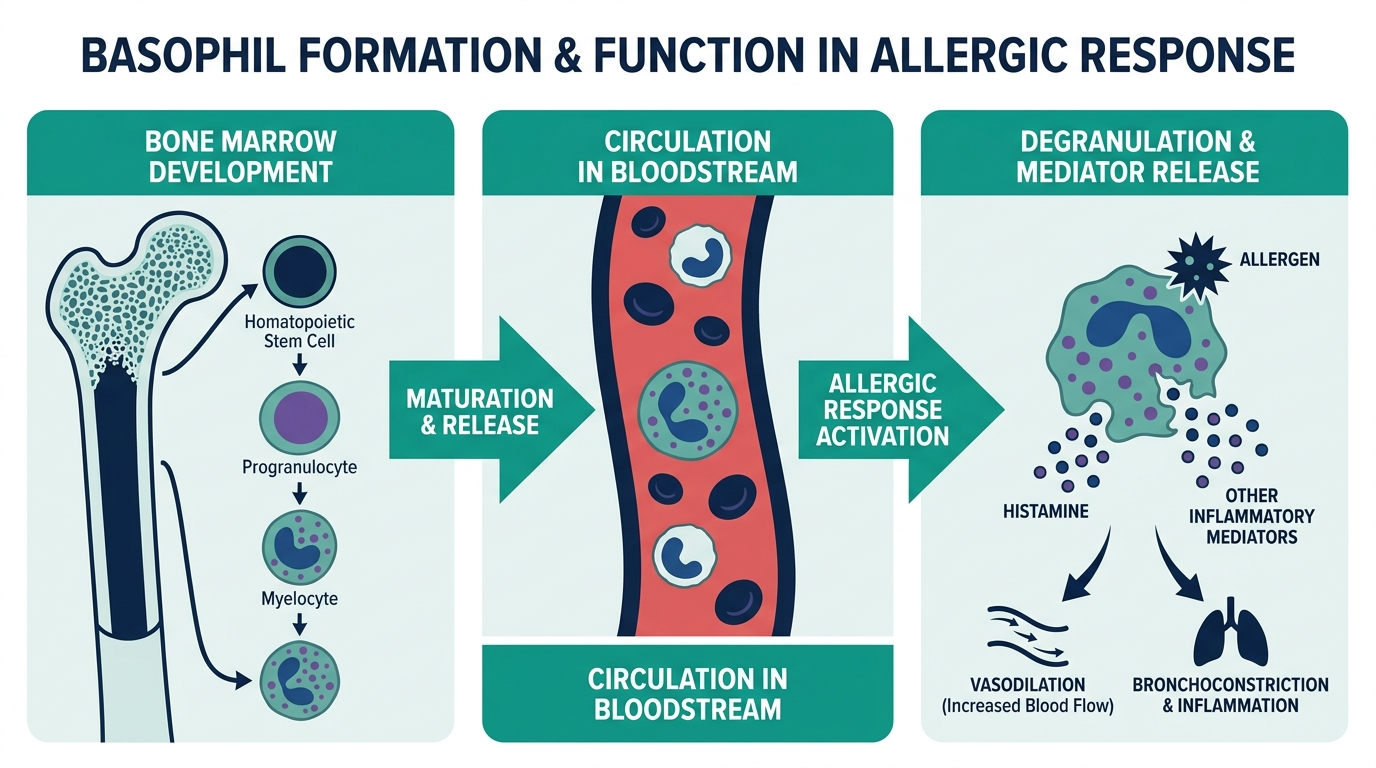
What basophils actually do in the body
To read a basophil count well, it helps to know what these cells are for. Basophils are granulocytes, meaning they are packed with tiny granules, and those granules are loaded with histamine and heparin. When basophils are activated, they release those chemicals, which is why they sit at the center of allergic and inflammatory responses.
Histamine is the molecule behind the classic allergy picture: the itch, the swelling, the runny nose, the hives. Heparin is a natural blood thinner. Basophils also carry receptors that bind IgE, the antibody class tied to allergies, so when your body meets an allergen it is sensitized to, basophils help trigger the reaction. They work closely with mast cells, their tissue based cousins, and with eosinophils, which is one reason these cells often move together on a differential. Understanding this role explains why allergies, parasites, and chronic inflammation are the everyday reasons a basophil count drifts up: those are exactly the situations that call this cell into action.
How the test is done and what can affect the count
A basophil count is not a test you order by itself. It comes from the complete blood count with differential, which sorts and counts each type of white cell. A standard venous draw is all it takes, and a basic CBC generally does not require fasting, so you can usually eat and drink normally beforehand.
Because basophils are so few, several ordinary factors can move the count, and knowing them helps you avoid overreacting to a blip:
- Timing relative to an allergy or infection. A count drawn during allergy season or an active infection can read higher than one drawn when you are well. The same person can look different week to week.
- Automated counting limits. Because the absolute number is tiny, automated analyzers are less precise for basophils than for the more abundant white cells. A flagged basophil result is sometimes confirmed by a manual review of a stained blood smear, where a technologist counts the cells by eye.
- Percentage versus absolute count. A shift in another cell line can change the basophil percentage without the basophils themselves changing much. This is exactly why the absolute count is the more reliable number to watch.
- Medications and recent events. Certain drugs and states like an underactive thyroid can nudge the count, which is worth mentioning to your clinician if a result is unexpected.
The practical rule mirrors the rest of this article: confirm a surprising basophil result with a repeat, and trust the absolute count over the percentage.
Want to check your basophils?
Three ways to get it measured. Pick whichever fits you.
Affiliate links: we may earn a commission at no extra cost to you. A lab test does not replace a visit with your clinician.
Markers read alongside basophils
A basophil count only becomes meaningful in the company of the rest of the differential. The cells that travel with it are what turn a lone flag into a pattern.
- Eosinophils. Basophils and eosinophils often rise together in allergic and parasitic conditions, so a joint elevation strengthens the case for an allergic or parasitic driver.
- Neutrophils. This is the pairing clinicians watch most closely. Basophilia together with a high neutrophil count and immature neutrophils spilling into the blood, a pattern called a left shift, is the fingerprint that raises concern for chronic myeloid leukemia.
- Total white blood cell count. A high basophil count in the setting of an overall high white count carries more weight than the same basophil number in an otherwise normal CBC.
- Hemoglobin and platelets. When basophilia appears alongside anemia or abnormal platelets, the combination points toward a marrow process rather than a passing allergy.
Reading these together is the whole reason a full panel beats a single value. One comprehensive draw that captures the entire differential lets a clinician see instantly whether basophilia is traveling alone, which is reassuring, or in worrying company, which is not.
Interpreting a high basophil result: worked scenarios
Realistic combinations show how much the surrounding numbers change the meaning of the same basophil flag.
- Basophils flagged high, everything else normal, active seasonal allergies. Almost certainly reactive. The sensible move is to manage the allergy and recheck later, expecting the count to settle.
- Basophils and eosinophils both up, itching or a rash present. Fits an allergic or inflammatory picture. The workup focuses on the trigger, not the basophils themselves.
- Basophils high, neutrophils high with a left shift, an enlarged spleen. This is the combination that prompts testing for chronic myeloid leukemia, including cytogenetic or molecular studies. It is not a diagnosis, but it earns a prompt, focused evaluation.
- Mild basophilia with an underactive thyroid. Hypothyroidism is a recognized, benign cause. Treating the thyroid and rechecking is reasonable.
- A single high reading that is normal on repeat. The most common outcome of all. One dot is often just noise given how few basophils there are.
The through line is that a basophil number is never interpreted alone. Who you are, how you feel, and what the rest of the count shows decide what it means.
Common misconceptions about high basophils
- “High basophils means leukemia.” This is the fear that drives most people to search, but it is far from the most common cause. Allergy, infection, and inflammation account for the great majority of high basophil results.
- “A doubled percentage is a big deal.” Not necessarily. Because the baseline is so close to zero, a percentage that looks alarming can be a trivial absolute change. The absolute count is the number to trust.
- “There is a diet or supplement that lowers basophils.” There is not, and claims otherwise deserve skepticism. The count follows its cause, so managing the allergy, infection, or inflammation is what moves it.
- “High basophils are making me feel unwell.” Basophilia itself causes no symptoms. Any symptoms belong to the underlying condition, not to the basophils.
- “One high reading needs an urgent workup.” Usually the right first step is simply a repeat test. It is a persistent, rising trend in worrying company, not a single flag, that warrants a deeper look.
What a low or zero basophil count means
Almost everyone who looks up basophils is worried about a high number, but many reports show a low count or even a result of zero, and this quietly generates its own anxiety. Here the reassurance is genuine and simple. Because basophils are the rarest white cell, making up only a small fraction of the total, the normal range already sits very close to zero. Many labs cannot reliably distinguish a low-normal count from none at all, so a reported value of zero on a routine differential is frequently a limitation of counting such a scarce cell rather than a sign of disease.
Low basophils, a state sometimes called basopenia, can accompany situations that broadly ramp up the body, such as acute infection, physical stress, or the effects of steroid medications and an overactive thyroid. Even then, the finding rarely stands on its own, because a low basophil count in isolation carries little clinical weight and is not something clinicians typically chase. The whole picture of the complete blood count matters more than this one line.
The practical rule mirrors the one for high counts. A zero or low basophil result, in someone who feels well and whose other blood cells look normal, is almost always a non-event that needs no action beyond the routine. It becomes worth a second look only when it travels with other abnormalities on the same panel or with symptoms that point somewhere specific. On its own, it is one of the least alarming numbers on a blood test.
Questions people ask about a high basophil result
A few questions surface again and again once someone sees a flagged basophil count, and clear answers tend to defuse the worry faster than general reassurance. Should I repeat the test, and when? For a mildly elevated absolute count in someone who feels well, repeating in a few weeks is usually the sensible move, since a single value can drift with everyday allergy or a passing infection and often normalizes on its own.
Does the percentage or the absolute number matter more? The absolute count, nearly always. Because basophils sit so close to zero, the percentage can swing dramatically while the true number barely moves, so a report showing a doubled percentage may reflect a change too small to mean anything. Anchoring to the absolute value keeps you from overreacting to statistical noise.
What would make my clinician look deeper? Not the basophils alone, but the company they keep. A persistently rising count, especially alongside abnormalities in other white cells, red cells, or platelets, or unexplained symptoms such as itching, night sweats, or an enlarged spleen, is what prompts a fuller evaluation. Framed that way, a lone high basophil reading on an otherwise normal panel is a prompt to retest and watch the trend, not a reason to assume the worst. Bringing these specific questions to your clinician turns an ambiguous flag into a concrete, low-stress plan.
Frequently asked questions
Is a high basophils count something to worry about?
Usually not on its own. A high basophil count, called basophilia, is most often a reactive response to allergies, infection, or inflammation, and it causes no symptoms by itself (Cleveland Clinic). It becomes more concerning when it is persistent, unexplained, or paired with other abnormal blood counts, which is when your clinician will look closer.
What basophil level is considered high?
Normal basophils run about 0.5 to 1 percent of white blood cells, roughly 0 to 300 per microliter (Cleveland Clinic). Most labs consider an absolute basophil count above about 200 cells per microliter to be elevated, though the cutoff varies by lab (NCBI StatPearls). Compare against the reference range on your own report.
Can high basophils mean leukemia?
It can, but it is far from the most common cause. Persistent, unexplained basophilia, particularly alongside a high neutrophil count, can be a clue to chronic myeloid leukemia or another myeloproliferative neoplasm, which is why doctors order cytogenetic testing when the pattern fits (NCBI StatPearls). A single mildly high reading in an otherwise normal CBC rarely points there.
Do high basophils cause symptoms?
No. Basophilia produces no symptoms of its own, so it is typically found incidentally on a blood test (Cleveland Clinic). Any symptoms you have come from the underlying cause, such as itching from an allergy or fatigue from an infection.
How do you lower high basophils?
You treat the cause, not the number. There is no diet or supplement that reliably lowers basophils directly. Reactive basophilia resolves when the triggering allergy, infection, or inflammation is managed, and persistent basophilia is addressed by treating the underlying condition (NCBI StatPearls).
This article is for general educational purposes and is not medical advice. It cannot diagnose or treat you and does not replace your clinician. Always discuss your lab results and any health decisions with a qualified healthcare professional.
Vital Signs Today may earn a commission if you buy through links on this page. It does not affect our editorial assessments.