Disclosure: Vital Signs Today may earn a commission if you buy through links on this page, at no extra cost to you. This does not influence our evidence-based assessments. We are not a medical provider; talk to a clinician before acting on test results.
Related: bilirubin blood test: the full guide · How to bring bilirubin back into range
You opened your lab report, scrolled to the liver panel, and there it was: bilirubin, flagged high. Maybe your eyes look a little yellow in the bathroom mirror, maybe they look completely normal and the number caught you off guard. Either way, the question is the same. A high bilirubin can mean something as harmless as a gene you were born with, or it can be the first hint that your liver or bile ducts are in trouble. The difference matters enormously, and the good news is that the report itself usually holds the clue.
Here is what most quick explainers skip. There is no single high bilirubin. There are two flavors, and which one is elevated tells a completely different story.
Part of our Liver Function Tests guide.

What does high bilirubin in blood test mean?
High bilirubin in a blood test means your body is making bilirubin faster than it can clear it, or clearing it too slowly. Bilirubin is the yellow-orange pigment left over when your body breaks down old red blood cells. Your liver normally grabs it, processes it, and dumps it into bile so it can leave the body in stool (MedlinePlus). When that assembly line backs up at any point, bilirubin spills into your blood and the level climbs.
For children and adults, a total bilirubin between about 0.2 and 1.3 mg/dL is generally considered normal, though the exact cutoff varies slightly by laboratory (Cleveland Clinic). Anything above your lab’s upper limit gets flagged. In plain terms, a high bilirubin is a backup signal: somewhere between the breakdown of red cells and the exit through bile, traffic is jammed. The whole job now is finding where the jam is.
One more thing the number alone will not tell you. A bilirubin of 1.5 mg/dL and a bilirubin of 15 mg/dL are not the same conversation. A mildly high result with everything else on the panel normal is usually benign. A sharply high result, or one paired with abnormal liver enzymes, is the kind that earns a phone call from your doctor.
What causes a high bilirubin?
The single most useful step your clinician takes is splitting your total bilirubin into two parts: direct (also called conjugated) and indirect (also called unconjugated). Normally, 90 percent or more of the bilirubin in your blood is the unconjugated kind (Cleveland Clinic, liver test interpretation). Which fraction is driving your high number narrows the cause dramatically.
Mostly indirect (unconjugated) bilirubin. This points away from liver damage and toward two common, usually mild causes:
- Gilbert syndrome. An inherited, harmless quirk in how the liver processes bilirubin, present in roughly 3 to 7 percent of Americans (Cleveland Clinic, Gilbert’s syndrome). It is the single most common reason a healthy young person shows a mildly high bilirubin with an otherwise spotless panel.
- Hemolysis, meaning red blood cells are breaking down faster than normal, as in hemolytic anemia, sickle cell disease, or a transfusion reaction (MedlinePlus). Here the production side is overwhelmed, not the liver.
Mostly direct (conjugated) bilirubin. This is the fraction that implies actual liver or bile duct disease (Cleveland Clinic, liver test interpretation). The usual suspects, roughly in order of how often they turn up:
- Liver cell injury, such as viral hepatitis, mononucleosis, toxic or drug-induced hepatitis, cirrhosis, or liver failure (MedlinePlus).
- Blocked bile ducts (cholestasis), classically from gallstones, but also cholecystitis, cholangitis, or a tumor pressing on the duct (Cleveland Clinic). With the exit plugged, processed bilirubin has nowhere to go and floods back into the blood.
- Inherited liver conditions beyond Gilbert syndrome, such as Wilson disease and Crigler-Najjar syndrome (MedlinePlus).
And do not forget the boring explanations. Certain medicines, some foods, intense exercise, fasting, and dehydration can all nudge bilirubin upward, sometimes enough to trip the flag (Cleveland Clinic). In newborns, a high bilirubin is extremely common because an immature liver simply has not ramped up yet (MedlinePlus).
What are the symptoms of a high bilirubin?
Here is a fact that surprises a lot of people: a mildly high bilirubin often has no symptoms at all. You feel completely fine and only know because the lab flagged it. Symptoms appear when the level climbs high enough for the pigment to become visible, and that takes more than a small bump.
The headline symptom is jaundice, the yellow tint in your skin and the whites of your eyes. Jaundice typically does not become visible until bilirubin reaches roughly two to three times the normal range, with scleral icterus best appreciated above about 3 mg/dL (StatPearls, Hyperbilirubinemia (NCBI)). So if your number is just over the line, expect no color change at all. When bilirubin is genuinely high, the classic cluster is:
- Yellowing of the eyes first, then the skin.
- Dark, tea-colored or cola-colored urine.
- Pale, clay-colored stool, a strong hint that bile is not reaching the gut.
- Itching, sometimes intense, especially when bile ducts are blocked.
- In some causes, fatigue, abdominal pain, fever, or chills (Cleveland Clinic).
The pale-stool-plus-dark-urine combination is worth memorizing. Together they suggest the bile duct is obstructed, which is one of the causes that more often needs a procedure rather than watchful waiting.

When is a high bilirubin dangerous or a medical emergency?
Most mildly high bilirubin results are not emergencies. The level itself is less alarming than the pattern around it. Treat these as reasons to be seen urgently:
- Jaundice that appears quickly, especially with fever, chills, and pain in the upper right belly. That triad can signal cholangitis, an infected blocked bile duct, which is a genuine emergency (Cleveland Clinic).
- High bilirubin alongside abnormal liver enzymes, confusion, easy bruising or bleeding, or a swollen belly, which can point toward serious liver dysfunction.
- Any jaundice in a newborn, taken seriously because very high bilirubin in the first days of life can cross into the brain and cause lasting harm. Newborns are monitored closely, and treatment such as phototherapy is used when levels climb too high for the baby’s age, so any newborn jaundice should be assessed by a clinician (Cleveland Clinic, jaundice in newborns).
For an adult, the danger is rarely the bilirubin molecule doing direct harm. The danger is what a high conjugated bilirubin reveals about the liver or bile system behind it. A 1.4 in an otherwise healthy adult is a footnote. A rising bilirubin with climbing liver enzymes and new symptoms is a story that needs a fast ending.
What should you do about a high bilirubin?
Step one is almost always to look at the rest of the panel, not to panic over one number. The path forward depends entirely on the pattern:
- Get it fractionated. If your report only shows total bilirubin, ask whether direct and indirect were measured. That split is what separates the harmless from the serious (Cleveland Clinic, liver test interpretation).
- Check the company it keeps. Normal liver enzymes (ALT, AST, ALP) and normal blood counts alongside a mildly high, mostly indirect bilirubin strongly favor something benign like Gilbert syndrome.
- Expect follow-up tests when warranted. Depending on the picture, that may mean a full liver panel, a complete blood count and reticulocyte count to look for hemolysis, hepatitis testing, or imaging such as an ultrasound to check the bile ducts (MedlinePlus encyclopedia).
- Address the obvious. If a new medication, heavy drinking, a recent fast, or dehydration could be the trigger, those are worth discussing and sometimes simply correcting before chasing exotic diagnoses.
Treatment, when it is needed at all, targets the underlying cause rather than the bilirubin number. Gilbert syndrome needs no treatment whatsoever (Cleveland Clinic, Gilbert’s syndrome). Gallstones blocking a duct may need a procedure. Hepatitis is treated as hepatitis. The bilirubin is the smoke alarm, not the fire.

When should you see a doctor?
See a clinician promptly if you notice yellowing of your eyes or skin, dark urine, pale stools, persistent itching, or unexplained fatigue and right-sided abdominal pain. Go in urgently, or to an emergency department, if jaundice arrives suddenly with fever and pain, or if there is confusion, bleeding, or a rapidly swelling abdomen.
If your only finding is a mildly high bilirubin on a routine panel with no symptoms and everything else normal, it is still worth a conversation, but it is rarely cause for alarm. Bring the actual numbers, including the direct and indirect breakdown if you have it, so your clinician can interpret the pattern rather than a single isolated value (MedlinePlus).
The part most people never hear: why your high bilirubin might be a non-event
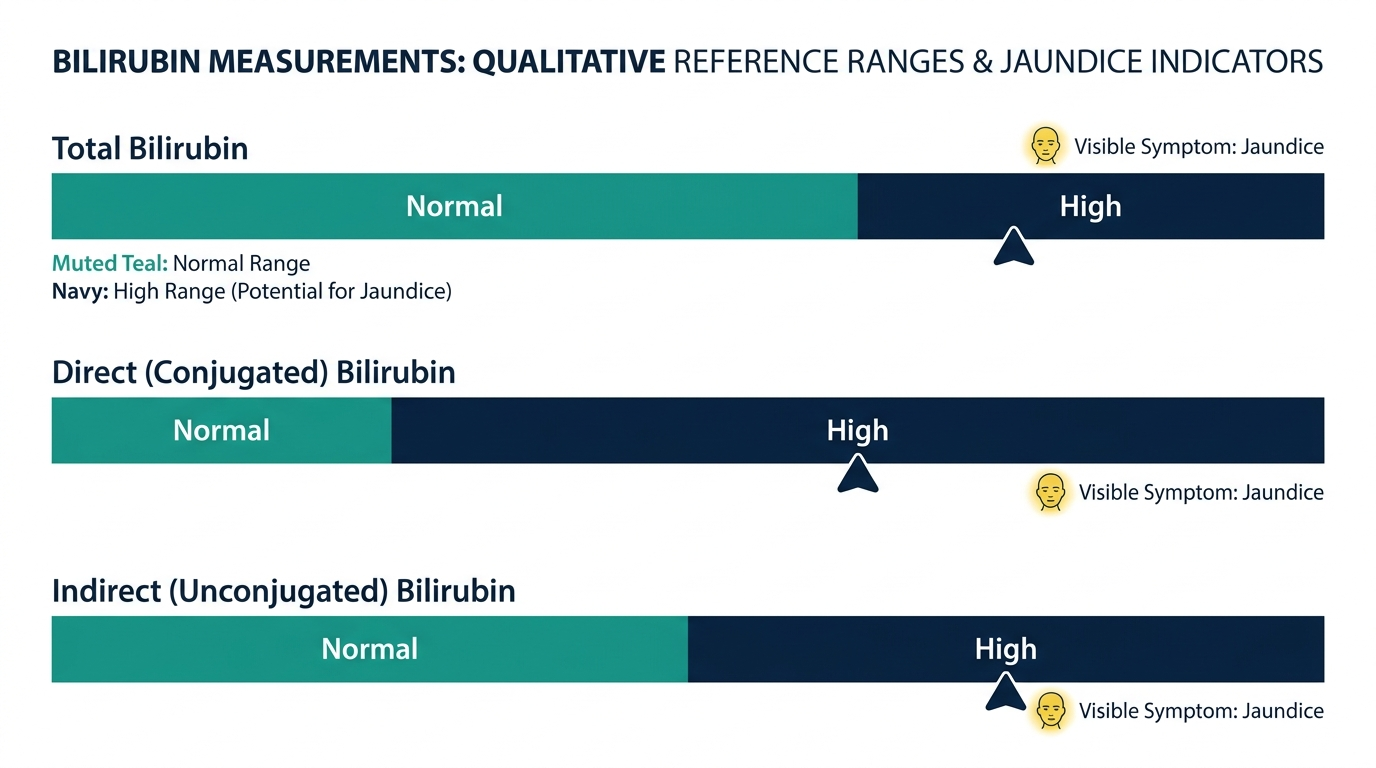
Here is the insider nuance that gets lost in patient-facing summaries. When bilirubin is high but it is almost entirely the indirect (unconjugated) fraction, and every other liver test is normal, liver disease is effectively off the table (Cleveland Clinic, liver test interpretation). In a young, healthy person with no anemia, that pattern is the textbook fingerprint of Gilbert syndrome, which affects around 5 percent of people and needs no imaging, no biopsy, and no treatment.
The twist that trips people up: Gilbert syndrome bilirubin goes up when you fast, get sick, get dehydrated, overexert, or are stressed (Cleveland Clinic, Gilbert’s syndrome). That means the very conditions under which blood is often drawn, an early-morning fasting lab after a poor night’s sleep, can push a Gilbert result into the flagged zone and frighten an otherwise healthy person. A repeat test when well-fed and rested often reads lower.
There is a mirror-image trap on the other side. Clinicians sometimes assume a high conjugated bilirubin automatically means a blocked bile duct, but an elevated direct bilirubin shows up across liver injury, cholestasis, and infiltrative disease alike (Cleveland Clinic, liver test interpretation). The lesson for you as a patient is the same in both directions: the fraction and the rest of the panel decide the meaning. One bilirubin number, read alone, is one of the most over-interpreted lines on the whole report.
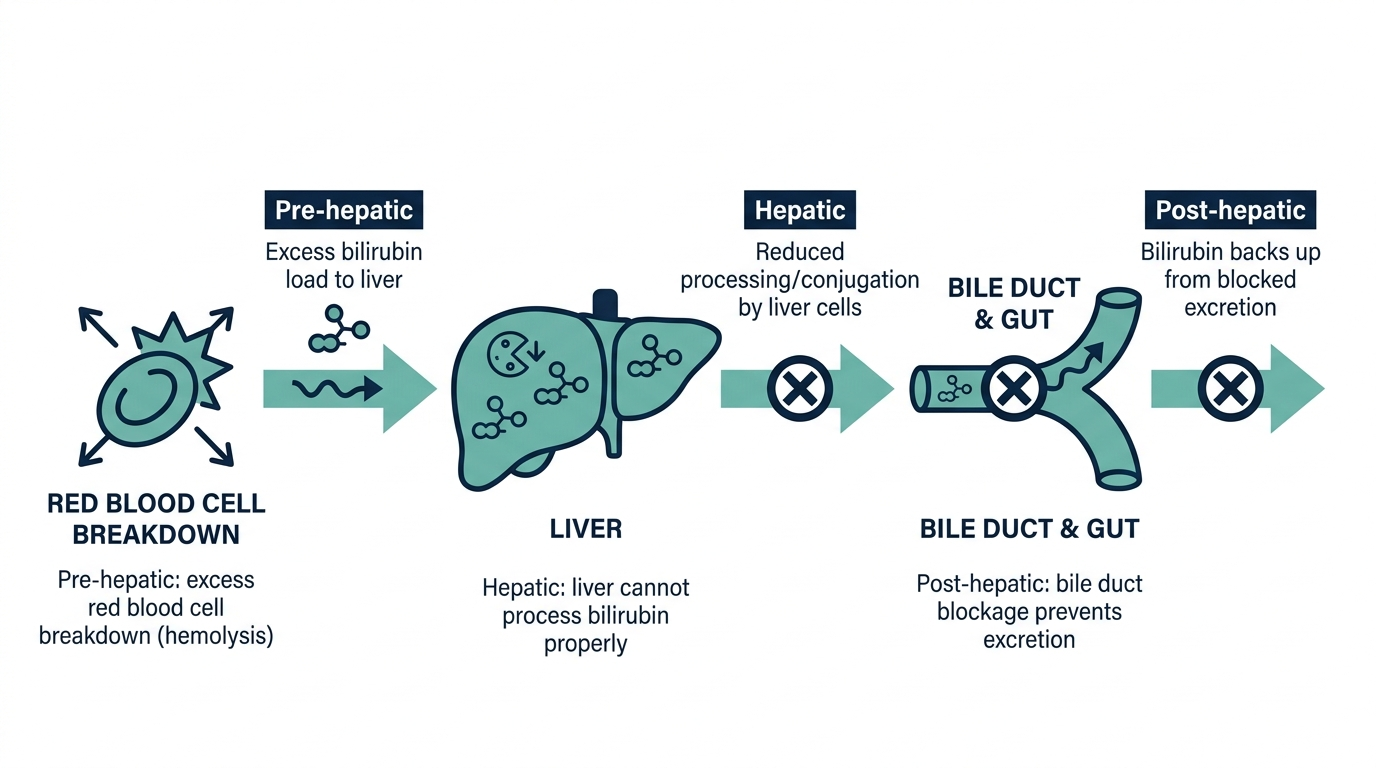
The bilirubin pathway: pre-hepatic, hepatic, post-hepatic
Clinicians mentally sort every high bilirubin into one of three zones along the pathway the pigment travels. Knowing these three zones lets you read your own report far more intelligently than a single number allows.
- Pre-hepatic (before the liver). Here the problem is too much bilirubin being made, usually because red blood cells are breaking down faster than normal (hemolysis). The liver is healthy but overwhelmed. This raises the indirect (unconjugated) fraction, because the extra pigment has not yet been processed. Gilbert syndrome also sits functionally near this zone: the liver simply conjugates a little slowly, so unconjugated bilirubin backs up.
- Hepatic (inside the liver). Here liver cells themselves are injured, as in hepatitis or cirrhosis, so the processing step falters. This tends to raise both fractions, often with liver enzymes ALT and AST climbing alongside.
- Post-hepatic (after the liver). Here processed bilirubin cannot escape because the bile ducts are blocked, classically by a gallstone or a tumor. Conjugated (direct) bilirubin floods back into the blood, and the enzyme ALP (alkaline phosphatase) usually rises sharply. This is the pattern behind pale stools and dark urine.
Reading which zone you are in comes down to two questions: which fraction is high, and which liver enzymes moved with it. That is why fractionating the bilirubin and looking at the whole panel does almost all the diagnostic work.
Reading bilirubin alongside the rest of the liver panel
Bilirubin is one line in a liver panel, and its meaning shifts depending on what the enzymes are doing. Two broad enzyme patterns matter most:
| Pattern | What moves | Points toward |
|---|---|---|
| Hepatocellular | ALT and AST high, ALP relatively normal | Liver cell injury such as viral hepatitis, alcohol, or drug toxicity |
| Cholestatic | ALP and often GGT high, ALT/AST relatively normal | Blocked or obstructed bile flow, such as gallstones or a duct tumor |
| Isolated bilirubin | Bilirubin high, all enzymes normal | Gilbert syndrome or hemolysis, not liver disease |
Want to check your bilirubin?
Three ways to get it measured. Pick whichever fits you.
Affiliate links: we may earn a commission at no extra cost to you. A lab test does not replace a visit with your clinician.
That last row is the reassuring one and the most common source of unnecessary worry. A high bilirubin with completely normal ALT, AST, and ALP, especially the indirect fraction, effectively takes liver and bile duct disease off the table. GGT deserves a special mention: when ALP is high, a high GGT confirms the source is the liver or bile ducts rather than bone, which is the other place ALP comes from. This is exactly the kind of cross-check that keeps a high bilirubin from being over-interpreted.
Medications, supplements, and habits that raise bilirubin
Before assuming disease, it is worth ruling out things you may be doing or taking. Several everyday factors can nudge bilirubin upward:
- Fasting and dehydration, which raise unconjugated bilirubin, especially in people with Gilbert syndrome. Since many blood draws happen fasting and early, this alone can trip the flag.
- Intense exercise shortly before the draw, which can bump the level.
- Alcohol, which stresses the liver and can raise bilirubin and enzymes together.
- Certain medications that either injure the liver or interfere with bilirubin transport. Some drugs raise bilirubin without any true liver damage by blocking its processing, which is a benign effect but can look alarming on paper.
The practical move is to give your clinician an honest list of your medications, supplements, recent alcohol, and whether you fasted or exercised hard before the test. Sometimes the entire explanation for a flagged bilirubin is on that list, and correcting it and repeating the test resolves the question without any deeper workup (Cleveland Clinic).
What the follow-up workup usually looks like
If your clinician decides a high bilirubin needs chasing, the sequence is fairly predictable, and knowing it removes a lot of anxiety about the unknown:
- Fractionate the bilirubin into direct and indirect if that was not already done. This single step often redirects the entire workup.
- Rule out hemolysis if the indirect fraction is high, using a complete blood count, a reticulocyte count, and markers like haptoglobin and LDH to see whether red cells are breaking down.
- Test the liver with a full panel and, if injury is suspected, hepatitis serologies and a review of medications and alcohol.
- Image the bile ducts with an abdominal ultrasound if the direct fraction and ALP suggest obstruction, since ultrasound is the usual first look for gallstones and dilated ducts (MedlinePlus encyclopedia).
Not everyone needs all of these. A young, well person with an isolated indirect bilirubin and a normal blood count may need nothing beyond a repeat test to confirm the Gilbert pattern. The extent of the workup scales with the pattern, not with the single number.
Worked examples: same number, different meaning
Consider three adults who each show a total bilirubin of 2.0 mg/dL.
- A 24-year-old who fasted overnight, feels fine, indirect fraction, normal enzymes and blood count. This is the classic Gilbert fingerprint. The likely plan is reassurance and perhaps a repeat when well-fed, with no imaging or biopsy.
- A 45-year-old with fatigue, ALT and AST several times normal, mixed fractions. This is a hepatocellular pattern pointing toward liver cell injury, and it leads to hepatitis testing and a careful review of medications and alcohol.
- A 60-year-old with pale stools, dark urine, itching, high ALP, and a high direct fraction. This is a cholestatic pattern that raises concern for a blocked bile duct and typically leads promptly to an ultrasound.
The number 2.0 is identical in all three. The fraction and the enzyme company it keeps turn it into three very different stories, which is the entire reason a bilirubin should never be read in isolation.
Frequently asked questions
Is high bilirubin always serious?
No. A mildly high bilirubin with normal liver enzymes and blood counts is often harmless, frequently caused by Gilbert syndrome, which affects roughly 3 to 7 percent of people and needs no treatment (Cleveland Clinic, Gilbert’s syndrome). It becomes more concerning when the direct fraction is high or when it comes with abnormal liver tests or symptoms.
What is a normal bilirubin level?
For children and adults, a total bilirubin of roughly 0.2 to 1.3 mg/dL is generally considered normal, though ranges vary by lab (Cleveland Clinic). Newborns naturally run higher. Always compare your result to the reference range printed on your own report.
At what bilirubin level do you turn yellow?
Jaundice, the yellowing of skin and the whites of the eyes, usually does not become visible until bilirubin reaches about two to three times the normal range, with scleral icterus best appreciated above roughly 3 mg/dL (StatPearls, Hyperbilirubinemia (NCBI)). A result just over the upper limit typically causes no visible color change.
What does the difference between direct and indirect bilirubin mean?
Indirect (unconjugated) bilirubin rising on its own usually points to harmless causes like Gilbert syndrome or to red blood cell breakdown, while a high direct (conjugated) bilirubin implies liver or bile duct disease (Cleveland Clinic, liver test interpretation). Fractionating the total is the key step in finding the cause.
Can fasting or dehydration raise bilirubin?
Yes. Fasting, dehydration, illness, stress, and overexertion can all push bilirubin up, especially in people with Gilbert syndrome (Cleveland Clinic, Gilbert’s syndrome). A repeat test taken when rested and well-hydrated often reads lower.
This article is for general educational purposes and is not medical advice. It cannot diagnose or treat you and does not replace your clinician. Always discuss your lab results and any health decisions with a qualified healthcare professional.
Vital Signs Today may earn a commission if you buy through links on this page. It does not affect our editorial assessments.