Disclosure: Vital Signs Today may earn a commission if you buy through links on this page, at no extra cost to you. This does not influence our evidence-based assessments. We are not a medical provider; talk to a clinician before acting on test results.
You scanned your metabolic panel, hit the line that says anion gap, and saw a number lower than the range printed next to it. Maybe it was flagged, maybe it was not, but it caught your eye. Here is the first thing worth knowing, and it is the thing most online explainers bury: a genuinely low anion gap is rare, and more often than not the lab is wrong before your body is.
That does not mean you should ignore it. A real low anion gap can point to something specific, including a diagnosis you do not want missed. Here is what the number actually means and what to do with it.
Part of our Comprehensive Metabolic Panel guide.
What is anion gap blood test low, and what does it mean?
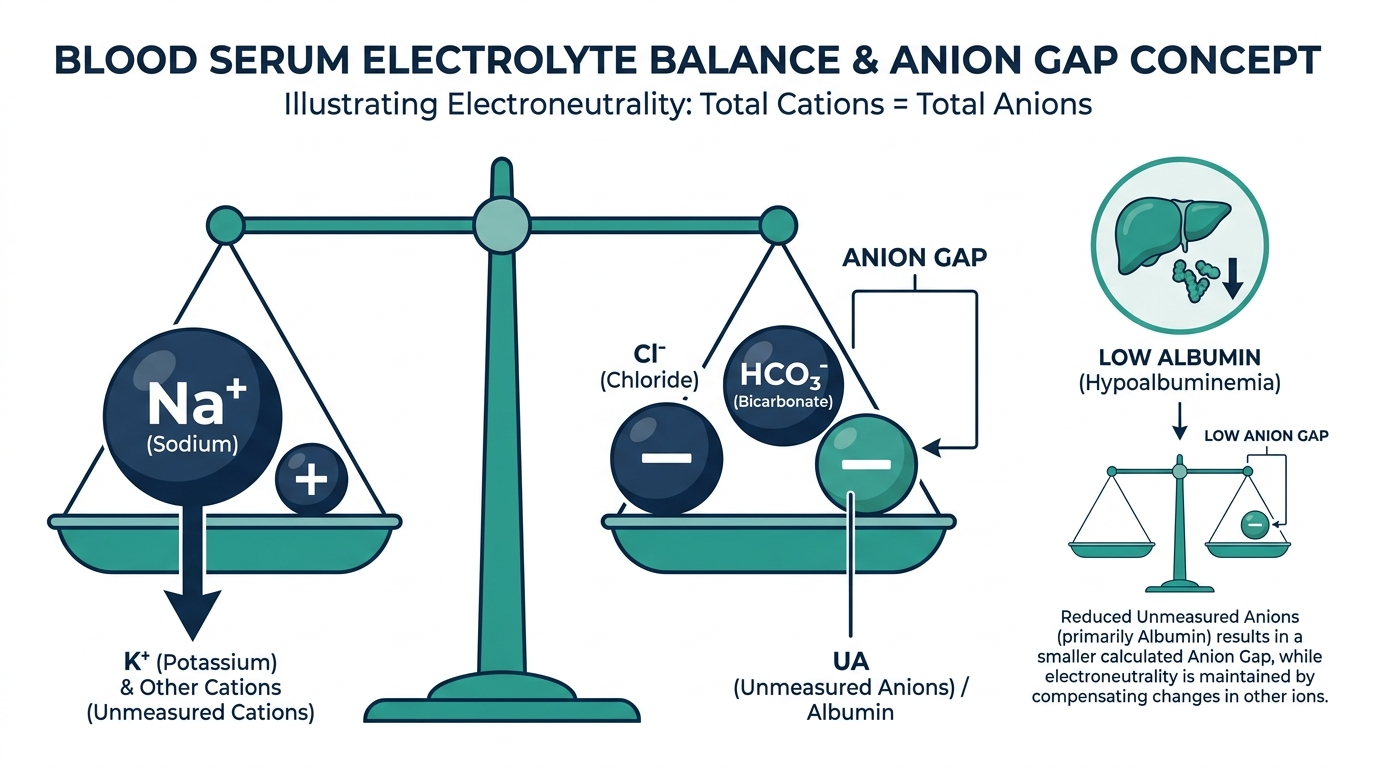
The anion gap is not something the lab measures directly. It is a calculation. Your blood carries positively charged ions (mainly sodium) and negatively charged ions (mainly chloride and bicarbonate), and the anion gap is the difference between them, worked out with the formula anion gap = sodium − (chloride + bicarbonate) (Cleveland Clinic Journal of Medicine). The gap exists because there are other charged particles in your blood that the standard panel never counts, and the biggest of those uncounted negative charges is the protein albumin.
So when the anion gap drops, in plain terms it usually means the math is being pulled down by either too few uncounted negative charges or too many uncounted positive charges. The single most common real-world reason is low albumin (Cleveland Clinic). Albumin normally supplies a chunk of the gap, so when albumin falls, the gap falls with it.
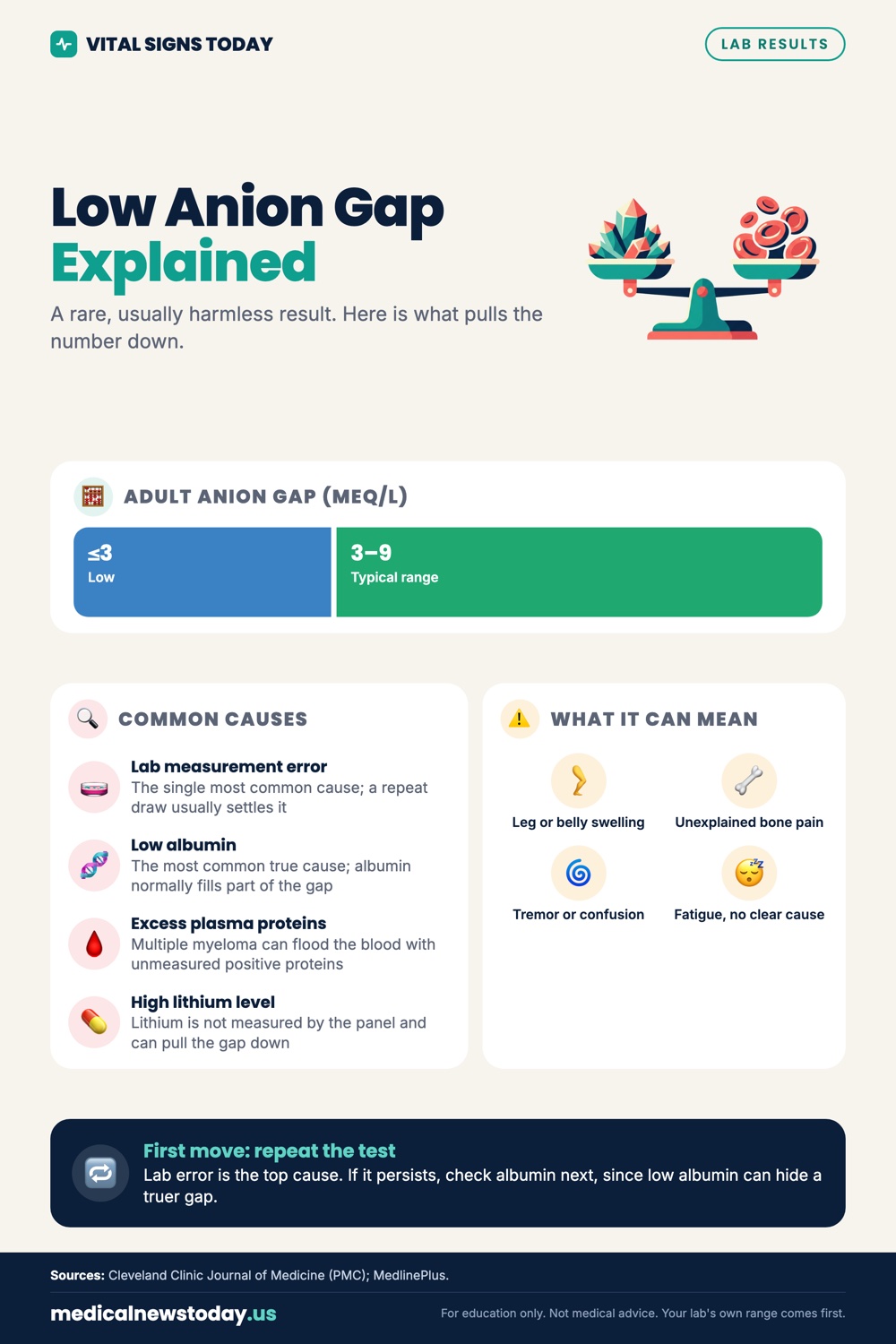
As for the cutoff: a low anion gap is generally defined as 3 mEq/L or less (Cleveland Clinic Journal of Medicine). Exact reference ranges differ by lab and by whether potassium is folded into the calculation, so the number printed on your own report is the one that matters. The honest headline is this: a low anion gap is rare enough that your provider will usually have you retested before reading anything into it at all (MedlinePlus).

What causes a low anion gap?
Here is the real differential, ordered the way a clinician actually thinks about it, most common first.
- Laboratory error. This is the leading cause, full stop. Measurement error in the sodium, chloride, or bicarbonate values is the most common reason an anion gap comes back low (Cleveland Clinic Journal of Medicine). Because the gap is a small difference between three larger numbers, a tiny analytical slip in any one of them throws the result off. This is why step one is almost always a repeat draw.
- Low albumin (hypoalbuminemia). The most common true physiological cause. Albumin is a negatively charged protein, so when it drops, the gap drops (Cleveland Clinic). Low albumin itself comes from liver disease, kidney disease, poor protein intake or malnutrition, inflammation, sepsis, recent surgery, or severe burns.
- Excess positively charged proteins. Plasma cell disorders such as multiple myeloma can flood the blood with positively charged immunoglobulins, which mop up the gap and can even push it negative (Cleveland Clinic Journal of Medicine). This is the cause you do not want to miss, which is why an unexplained, repeatedly low gap sometimes earns a look for a paraprotein.
- Lithium toxicity. Lithium is a positive ion the standard panel does not measure, so a high lithium level can drag the anion gap down or negative (Cleveland Clinic Journal of Medicine). Relevant if you take lithium for bipolar disorder.
- Other ions and interferences. Bromide, iodide, and certain other halides can cause the analyzer to overread chloride, falsely lowering the gap. High calcium (hypercalcemia), high magnesium (hypermagnesemia), and high potassium are less common contributors (Cleveland Clinic Journal of Medicine).
Notice the shape of this list. Two of the top causes (lab error and low albumin) are common and usually benign in their own right, while the rarer ones (myeloma, lithium) are the reasons a stubbornly low gap deserves a second look rather than a shrug.
What are the symptoms of a low anion gap?
This is the part that surprises people. A low anion gap by itself has no symptoms. It is a calculated number, not a disease, so it does not make you feel anything. You will never wake up feeling like your anion gap is low.
Any symptoms you do have come from the underlying cause, not the gap. If low albumin is behind it, you might notice swelling in the legs or abdomen, fatigue, or signs of the liver or kidney condition that lowered the albumin. If multiple myeloma is the driver, the warning signs are bone pain, unexplained fatigue, frequent infections, or kidney trouble. If lithium toxicity is the cause, you might feel tremor, nausea, confusion, or unsteadiness. The takeaway: do not hunt for symptoms of a low anion gap. Look at why it is low and let that condition tell its own story.
When is a low anion gap dangerous or a medical emergency?
The number on its own is almost never the emergency. The danger lives in two scenarios.
First, what it can be hiding. This is the single most important clinical fact about a low anion gap, and it is the one most patients never hear. A low albumin level can mask a high anion gap metabolic acidosis (Cleveland Clinic Journal of Medicine). In plain English, your true gap might actually be high, signalling something serious like a dangerous acid buildup, but because your albumin is low, the raw number looks deceptively normal or even low. The dangerous process gets camouflaged. That is why clinicians correct the gap for albumin (more on that next) rather than trusting the raw figure.
Second, what it can be pointing to. A persistently low or negative anion gap that is not explained by lab error or low albumin can be a flag for a plasma cell disorder such as multiple myeloma, or for lithium toxicity in someone on lithium (Cleveland Clinic Journal of Medicine). Neither is diagnosed from the gap alone, but both are reasons to investigate rather than ignore. Lithium toxicity in particular is a true emergency: if you take lithium and develop tremor, vomiting, confusion, or unsteadiness, that needs urgent medical attention regardless of what your anion gap reads.

What should you do about a low anion gap?
The sequence is straightforward, and it almost always starts the same way.
- Repeat the test. Because lab error is the most common cause, a repeat electrolyte panel is the first move (Cleveland Clinic Journal of Medicine). If the redraw is normal, you are likely done.
- Check your albumin. If the low gap is real, the next question is whether albumin is low, since that is the most common true cause (Cleveland Clinic). Your clinician can correct the gap for albumin to see whether a higher, more concerning gap is being hidden.
- Find the cause of the low albumin. If albumin is low, the workup turns to why, which can mean looking at liver function, kidney function, nutrition, and inflammation.
- Consider the rarer causes when nothing else fits. If the gap stays low or goes negative with normal albumin and no lab error, that is when paraprotein testing for myeloma, or a lithium level in someone on lithium, becomes reasonable (Cleveland Clinic Journal of Medicine).
There is no lifestyle fix for the anion gap number itself, and you should not try to raise it. Treatment, when any is needed, is aimed entirely at the underlying condition.
The insider read: why your clinician corrects the gap for albumin
Here is the nuance that separates a careful read from a careless one, and it is routinely missed. The anion gap was built around a normal albumin of roughly 4 g/dL. When albumin falls, the gap falls with it for purely mechanical reasons, and clinicians adjust for this using a correction: corrected anion gap = measured anion gap + 2.5 × (4 − measured albumin) (Cleveland Clinic Journal of Medicine). The rule of thumb baked into that formula is that the gap drops by about 2.5 mEq/L for every 1 g/dL fall in albumin.
Why does this matter to you? Imagine a raw anion gap that looks reassuringly low. Plug in a low albumin and the corrected gap can leap into clearly abnormal territory, revealing a high anion gap acidosis that the raw number had quietly covered up (Cleveland Clinic Journal of Medicine). The common misread is to glance at a low or normal-looking gap in a sick patient with low albumin and assume all is well. The expert move is to correct first, then interpret. If your albumin is low, ask whether your gap was corrected. It is a one-line calculation that can change the entire picture.
When should you see a doctor?
If a low anion gap is the only odd finding and the rest of your panel looks fine, this is a routine conversation with your regular provider, not a reason to rush anywhere. Bring it up at your next visit and ask whether a repeat test is worth it.
Move faster if the low gap comes with low albumin, if it is persistent or negative across more than one draw, or if you have symptoms pointing to an underlying cause: bone pain, unexplained weight loss, frequent infections, or notable swelling and fatigue. And treat it as urgent if you take lithium and feel tremor, vomiting, confusion, or unsteadiness, since that combination can signal lithium toxicity (Cleveland Clinic Journal of Medicine). When in doubt, the safest path is to talk with your provider about whether your result needs follow-up (MedlinePlus).

The electrolytes behind the number, and why the gap is so fragile
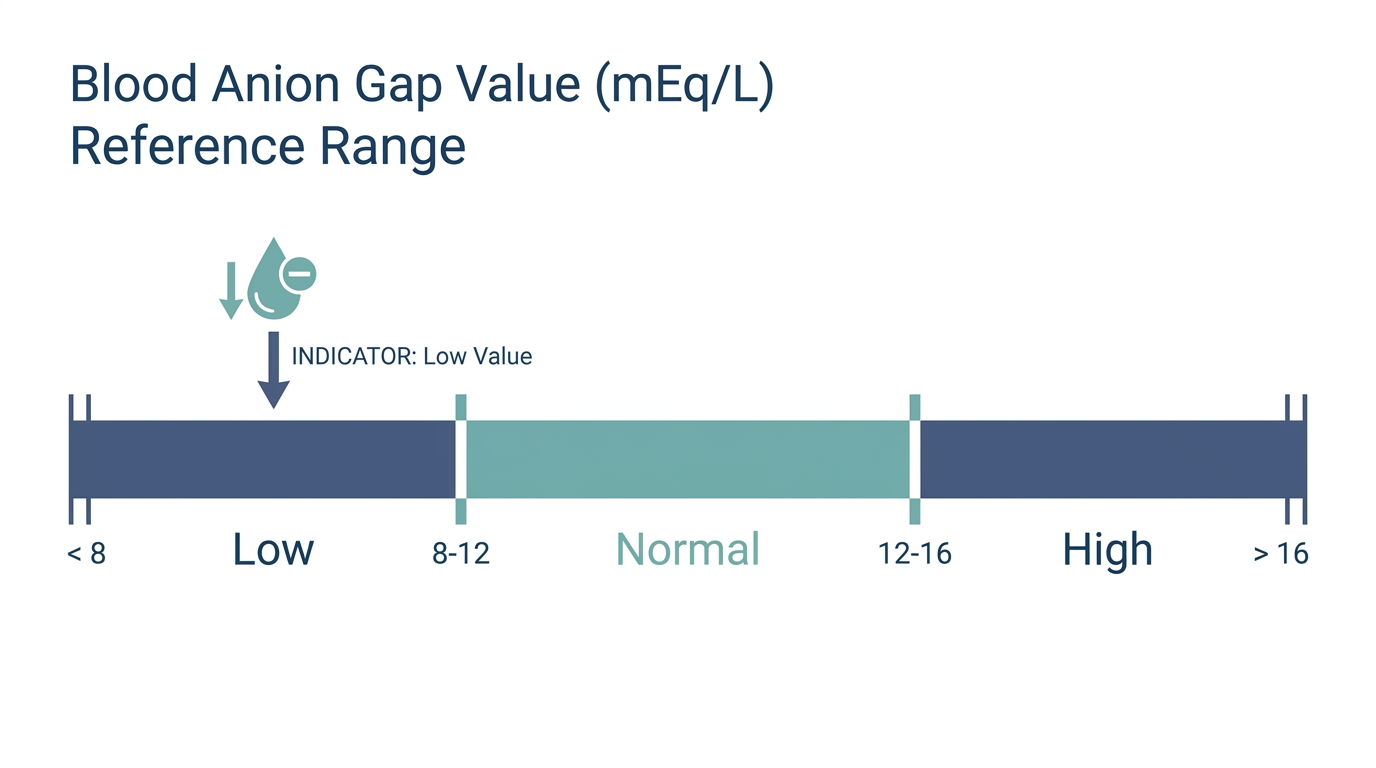
To understand why a low anion gap is so often a false alarm, it helps to see how the number is built. Your blood must stay electrically neutral, meaning total positive charges equal total negative charges. The standard panel measures only some of them. The anion gap is simply the measured positives minus the measured negatives, which leaves a “gap” filled by the charged particles the panel does not count.
- Sodium is the main measured positive ion, and it is the largest single number in the equation, typically around 140 mEq/L.
- Chloride is a main measured negative ion, usually around 100 mEq/L.
- Bicarbonate is the other measured negative ion, usually in the low-to-mid 20s mEq/L.
Here is the fragility. The gap is a small number, often in the single digits, produced by subtracting two large numbers from another large number. A tiny analytic error in sodium, chloride, or bicarbonate gets magnified in the final gap. Shift chloride up by just a few units through a measurement quirk, and the gap can drop into “low” territory even though nothing in your body has changed. This is precisely why lab error is the leading cause of a low result and why a repeat draw is almost always the first response.
How a low anion gap is read alongside the rest of your metabolic panel
The anion gap is never interpreted alone. It is derived from your basic or comprehensive metabolic panel, and the companion values tell your clinician whether a low gap is meaningful or noise.
| Panel value | Why it matters for a low anion gap |
|---|---|
| Albumin | The single most important companion. Low albumin is the most common true cause of a low gap and is also what triggers a correction calculation. |
| Bicarbonate (CO2) | Part of the gap equation and a key marker of acid-base status. A low bicarbonate with a “normal-looking” gap in a sick patient is a clue to correct for albumin. |
| Chloride | Part of the equation. A falsely high chloride from certain interferences can artificially lower the gap. |
| Sodium | The anchor positive ion. A measurement error here directly moves the gap. |
| Total protein and calcium | Abnormalities here can hint at a paraprotein disorder like myeloma when the low gap is otherwise unexplained. |
Want to check your anion gap?
Three ways to get it measured. Pick whichever fits you.
Affiliate links: we may earn a commission at no extra cost to you. A lab test does not replace a visit with your clinician.
The practical rule: whenever a low anion gap appears, the first two things worth checking on the same report are albumin and bicarbonate. Together they usually explain whether the low number is a harmless artifact or something that needs correcting and following up.
Worked examples: how correcting for albumin changes the story
Because the albumin correction is the concept most patients never hear, two simple worked examples show why it matters. The formula clinicians use is corrected anion gap = measured anion gap + 2.5 × (4 − measured albumin), where 4 g/dL is a normal albumin.
- Example 1, the reassuring case. A measured gap of 6 with a normal albumin of 4.0. The correction adds nothing, so the corrected gap is still 6. A genuinely low-normal gap with normal albumin is usually not worrisome once lab error is ruled out.
- Example 2, the hidden problem. A measured gap of 8, which looks fine, but albumin is only 2.0. The correction adds 2.5 times 2, or 5, giving a corrected gap of 13. That moves the result from “unremarkable” toward a range that can signal a real acid buildup the raw number was masking.
The lesson is not to run this math yourself, but to know it exists. If your albumin is low and no one mentioned correcting the gap, that is a fair question to ask your clinician. It is a single line of arithmetic that can flip a result from ignorable to important.

Low versus high anion gap: opposite meanings
Patients often mix up the two directions, and they point almost opposite ways. A high anion gap is the more clinically loaded finding: it typically means unmeasured acids have built up in the blood, from causes such as diabetic ketoacidosis, lactic acidosis, kidney failure, or certain poisonings. A low anion gap, by contrast, is usually about the accounting rather than acid, most often lab error or low albumin, and only occasionally a real signal like a paraprotein or lithium.
So the emotional weight differs. A high gap in a symptomatic person is often an active problem demanding attention now. A low gap is usually a prompt to double-check the lab and the albumin, and to investigate only if it persists without explanation. Both are calculated numbers with no symptoms of their own, and both are read in the context of your bicarbonate, your albumin, and how you actually feel.
What can distort an anion gap result
Several ordinary factors can nudge the gap without any true disease. Being aware of them prevents overreaction to one reading:
- Analyzer and reagent variation. Because the gap magnifies small errors in sodium, chloride, and bicarbonate, differences between labs and machines can shift a borderline result.
- Whether potassium is included. Some labs fold potassium into the formula and some do not, which changes the reference range. Compare only to your own report’s range.
- Certain halides and substances. Bromide or iodide can cause the analyzer to overread chloride, falsely lowering the gap.
- Timing and hydration. Marked changes in fluid status can shift electrolytes and therefore the calculated gap.
- Sample handling. Delays or issues with the blood sample can alter measured electrolytes.
There is no patient prep, such as fasting, that specifically improves an anion gap, since it rides along on a routine metabolic panel. The most reliable interpretation comes from a repeat test plus a look at albumin, not from any single perfectly timed draw.
Common misconceptions about a low anion gap
- “A low number must mean something is wrong with me.” Most often it means the lab should recheck, or that your albumin is low. A truly abnormal gap is uncommon.
- “A normal or low gap means my acid-base balance is fine.” Not if your albumin is low. A low albumin can hide a real acidosis, which is exactly why the corrected gap exists.
- “I can raise my anion gap with diet or supplements.” There is no lifestyle target for the gap itself. Treatment, when needed, addresses the underlying cause, and the number follows.
- “The gap is directly measured.” It is a calculation from three measured electrolytes, which is why small measurement errors matter so much.
- “One low reading needs a big workup.” Usually the opposite. Step one is repeating the test, and many low results normalize on the redraw.
Frequently asked questions
What does a low anion gap mean in a blood test?
It usually means the calculated difference between your measured positive and negative electrolytes is small, most often because of a lab measurement error or a low albumin level (Cleveland Clinic). A genuinely low gap is rare, so providers typically repeat the test before reading anything into it (MedlinePlus).
What number counts as a low anion gap?
A low anion gap is generally defined as 3 mEq/L or less, though exact reference ranges vary by lab and by whether potassium is included in the calculation (Cleveland Clinic Journal of Medicine). Always compare your value to the range printed on your own report.
Is a low anion gap dangerous?
The number itself is rarely dangerous, but it can mask a high anion gap metabolic acidosis when albumin is low, and it can occasionally flag conditions like multiple myeloma or lithium toxicity (Cleveland Clinic Journal of Medicine). That is why an unexplained low gap is investigated rather than ignored.
Does a low anion gap cause symptoms?
No. A low anion gap is a calculated value and produces no symptoms on its own. Any symptoms you have come from the underlying cause, such as the swelling and fatigue of low albumin or the bone pain of myeloma (Cleveland Clinic).
What should I do if my anion gap is low?
Start by having the test repeated, since lab error is the most common cause, then check albumin and let your clinician correct the gap for it if albumin is low (Cleveland Clinic Journal of Medicine). Talk with your provider about whether further testing is needed (MedlinePlus).
This article is for general educational purposes and is not medical advice. It cannot diagnose or treat you and does not replace your clinician. Always discuss your lab results and any health decisions with a qualified healthcare professional.
Vital Signs Today may earn a commission if you buy through links on this page. It does not affect our editorial assessments.