
Disclosure: Vital Signs Today may earn a commission if you buy through links on this page, at no extra cost to you. This does not influence our evidence-based assessments. We are not a medical provider; talk to a clinician before acting on test results.
You scanned your metabolic panel, saw sodium and potassium sitting comfortably in range, and then your eye snagged on chloride. It came back low. Most patients have a rough idea of what sodium does, but chloride is the quiet partner in the electrolyte family, the one nobody explains. So a low number feels vaguely alarming and completely opaque at the same time.
Here is what actually matters. Chloride almost never moves on its own. It is a passenger, and where it sits usually tells a story about your fluids, your acid-base balance, or a medication you are taking. Read correctly, a low chloride is one of the more informative footnotes on your report.
Part of our Comprehensive Metabolic Panel guide.
What does low chloride mean in a blood test?
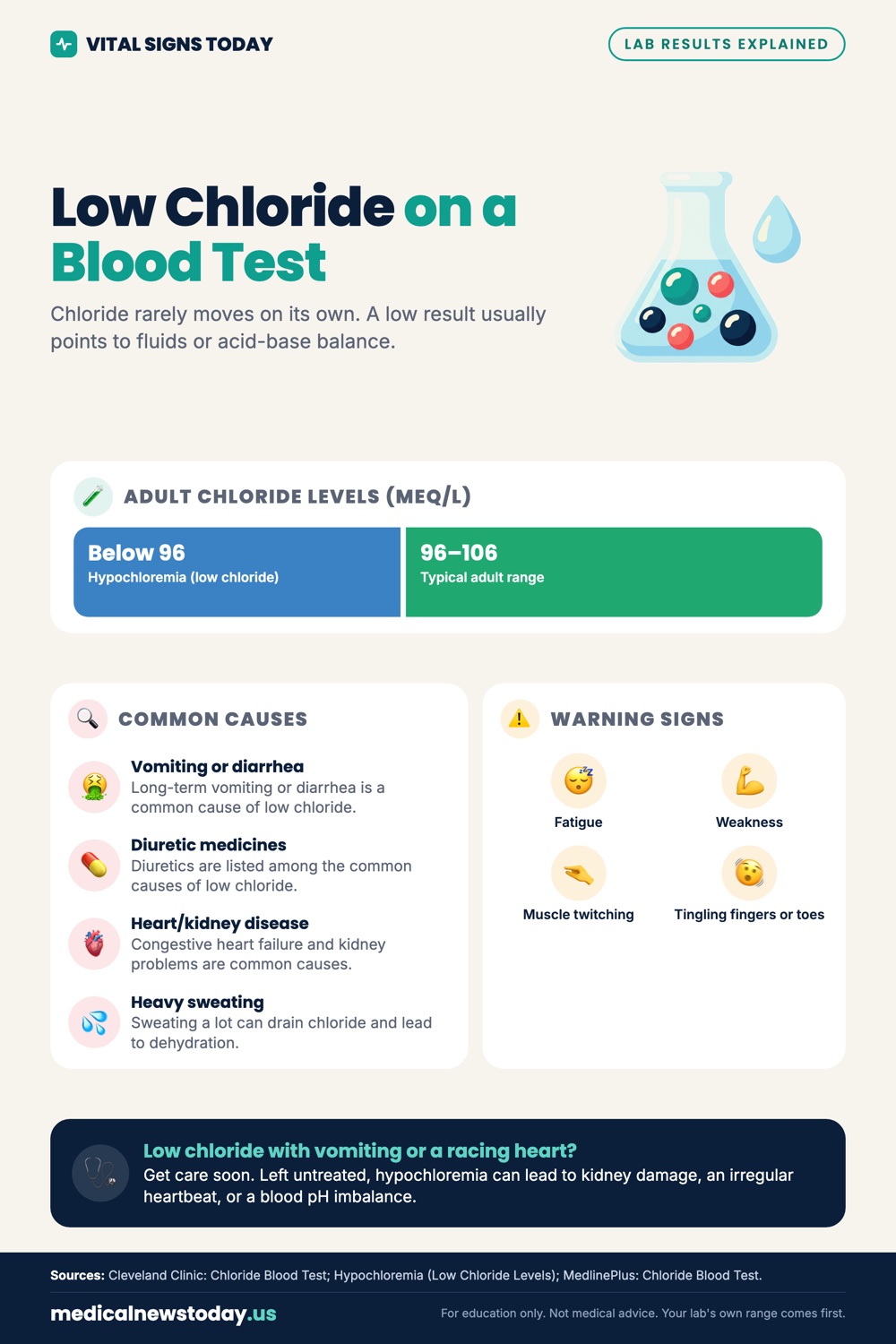
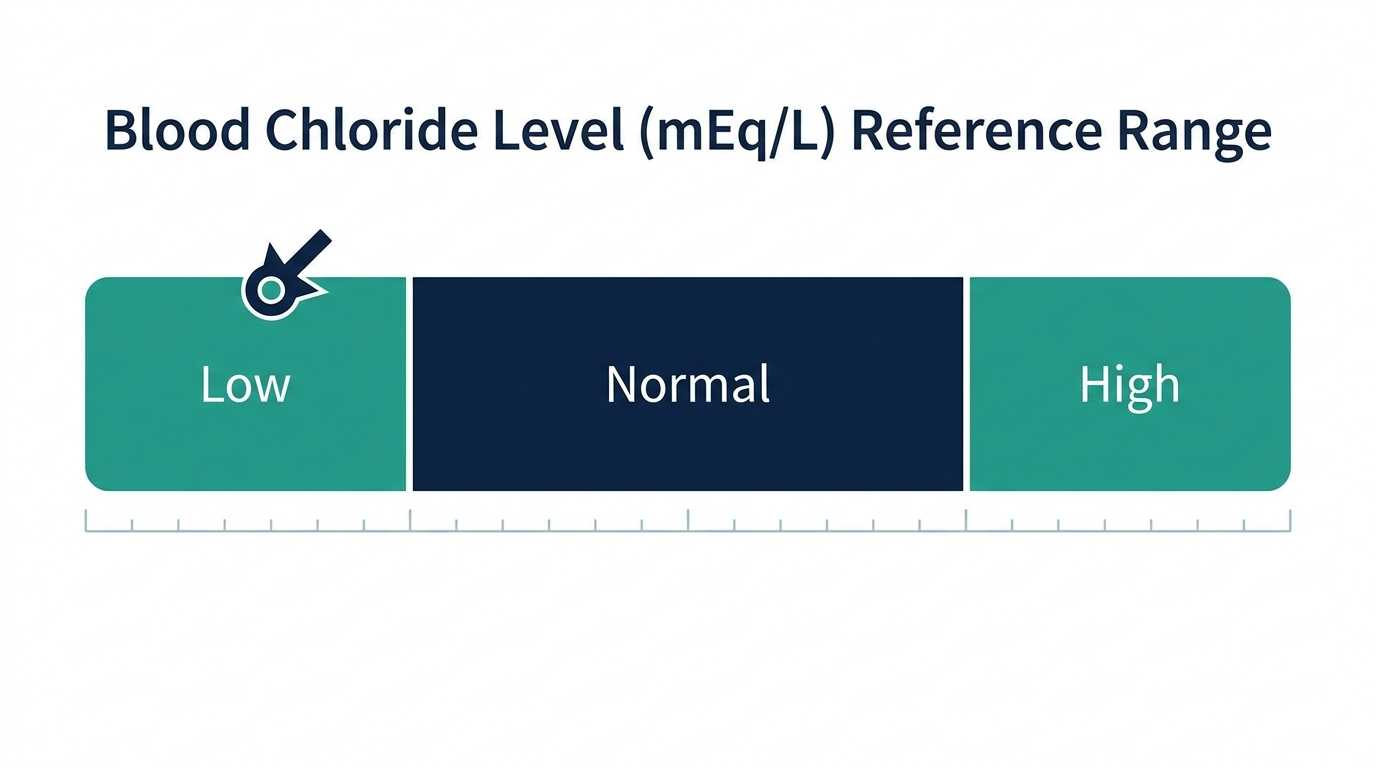
A low chloride means the concentration of chloride in your blood has fallen below your lab’s reference range, a state clinicians call hypochloremia. For most adults the normal range runs about 96 to 106 milliequivalents per liter, so anything under roughly 96 mEq/L (the same as mmol/L) is flagged as low (Cleveland Clinic). The exact cutoff varies slightly by laboratory, so read your result against the range printed on your own report.
Chloride is one of your major electrolytes, working alongside sodium, potassium, and bicarbonate to control fluid balance, nerve and muscle function, and the acid-base balance (the pH) of your blood (MedlinePlus). It usually shows up on a comprehensive metabolic panel (CMP), a basic metabolic panel (BMP), or an electrolyte panel. The single most useful thing to know is this: a low chloride is rarely a disease in itself. It is a signal that points at something else, most often a fluid shift, an acid-base disturbance, or a drug.

What causes a low chloride?
The real differential is short and, once you see it grouped, surprisingly logical. Chloride drops for one of a few reasons: you are losing it, you are diluting it, or your body is trading it for bicarbonate. Here are the common causes, roughly in order of how often they turn up (Cleveland Clinic).
- Prolonged vomiting or gastric loss. Stomach fluid is rich in hydrochloric acid, so when you vomit repeatedly or have fluid suctioned from your stomach, you lose chloride and acid together. This is one of the cleanest causes of low chloride.
- Diuretic medications. Loop and thiazide diuretics push chloride out through the urine. In heart failure especially, this is a leading driver, and higher diuretic doses tend to lower chloride further (PMC, hypochloremia in heart failure).
- Heart failure, liver disease, and kidney disorders. These conditions cause the body to retain water, which dilutes chloride, and they often involve the diuretics that worsen it (Cleveland Clinic).
- Metabolic alkalosis. When your blood becomes too alkaline, bicarbonate rises and chloride falls to balance the charge. Vomiting, diuretics, and overuse of bicarbonate antacids all push you this way (MedlinePlus).
- Excessive sweating and dehydration. Heavy sweating from heat or intense exercise drains chloride along with sodium.
- Addison disease and SIADH. These hormonal conditions disturb sodium and water handling, and chloride follows (MedlinePlus).
- Chronic lung disease. In conditions like emphysema, the kidneys hold onto bicarbonate to compensate for retained carbon dioxide, and chloride drops to make room.
Notice the pattern. Vomiting, diuretics, and metabolic alkalosis are really the same plumbing problem seen from different angles, which is why they dominate the list.
What are the symptoms of a low chloride?
Here is the honest answer most people are not told: a low chloride usually causes no symptoms of its own. Cleveland Clinic is blunt about it, hypochloremia typically does not produce symptoms and is found on a blood test, not because you felt unwell (Cleveland Clinic).
When people do feel something, it usually comes from the underlying cause or from the acid-base shift that travels with significant chloride loss. Those signs can include:
- Dehydration, ongoing vomiting, or diarrhea (the cause, not the chloride itself)
- Fatigue, weakness, or sleepiness
- Muscle cramps, twitching, or the tingling that can accompany metabolic alkalosis (MedlinePlus)
- Nausea and lightheadedness
- An irregular heartbeat in more serious cases
So if your chloride is mildly low and you feel fine, that is genuinely common. The number is doing its job as a quiet messenger, not as a symptom generator.
When is a low chloride dangerous or a medical emergency?
A mildly low chloride on a routine panel, with everything else in range and no symptoms, is rarely an emergency. The danger lives at the extremes and in the company chloride keeps. Left untreated, significant hypochloremia can contribute to an irregular heartbeat, kidney strain, and a blood pH imbalance (Cleveland Clinic).
There is no single universal panic number for chloride the way there is for potassium, because the risk depends heavily on context. What raises the stakes is the underlying picture: severe ongoing vomiting causing dehydration and alkalosis, a deeply abnormal acid-base balance, or hypochloremia layered on top of serious heart, liver, or kidney disease. In hospitalized patients, low chloride is consistently linked to worse outcomes, and that is the part worth taking seriously even when you feel okay (more on that below).
Treat it as urgent if a low chloride comes packaged with red flags: relentless vomiting or diarrhea you cannot keep ahead of, confusion, fainting, a racing or irregular heartbeat, severe muscle cramping or twitching, or trouble breathing. Those point to a fluid or acid-base crisis that needs same-day medical attention, not a wait-and-see approach.

What should you do about a low chloride?
The fix is almost always aimed at the cause, not at chloride itself. You do not eat more salt to push a number up. Depending on what is driving it, your clinician may take any of these steps (Cleveland Clinic):
- Rehydrate. If vomiting, diarrhea, or sweating drained you, replacing fluids (sometimes intravenous saline, which is sodium chloride) often corrects chloride directly.
- Revisit your medications. If a diuretic or an antacid is the culprit, adjusting the dose or the drug may be all that is needed. Do not stop a prescribed medication on your own.
- Treat the underlying condition. When heart failure, liver disease, kidney disease, or a hormonal disorder is behind it, managing that condition is the real lever.
- Recheck and look at the whole panel. Chloride is interpreted next to sodium, potassium, and especially bicarbonate. A repeat panel and the full electrolyte picture usually clarify whether this is a fluke or a trend.
For a single, mildly low value with no symptoms and no concerning context, the answer is frequently a simple recheck rather than treatment. The goal is to understand the story, not to chase the number in isolation.
The insider read: chloride is a hidden acid-base and heart-failure signal
Here is the nuance that separates a quick glance from a real interpretation. Most patients, and plenty of busy readers, assume chloride just rides along with sodium. Usually it does. The clinically interesting moments are when it does not.
First, the acid-base trick. Bicarbonate and chloride sit on opposite ends of a seesaw. When chloride is low but bicarbonate is high, that combination is a fingerprint of metabolic alkalosis, often from vomiting or diuretics, and it tells a clinician more than either number alone. So a low chloride with a high CO2 (bicarbonate) on your panel is not random, it is a coherent acid-base story.
Second, the part that genuinely surprises people. In heart failure, low chloride has emerged as one of the strongest blood markers of prognosis, arguably more telling than the low sodium that doctors have watched for decades. A large meta-analysis found hypochloremia in about 14 percent of heart failure patients overall and 27 percent at hospital discharge, and described it as an important marker of prognosis rather than hyponatremia (PMC, hypochloremia in heart failure). Among hospitalized and critically ill patients, low chloride has been independently associated with higher all-cause mortality (PMC, hypochloremia and mortality in the coronary care unit), and in acute heart failure it has tracked with worse outcomes (PMC, hypochloremia in acute heart failure).
This does not mean a low chloride on your routine checkup is a death sentence. The general population result and the sick-hospitalized-patient result are different worlds. The point is that chloride deserves more respect than its usual footnote status. In the right clinical setting it is a sensitive readout of fluid overload, diuretic burden, and acid-base strain. The common misread is to wave it off because sodium looks fine. Look at chloride and bicarbonate together, and in the context of any heart, liver, or kidney disease, and the number starts to talk.
When should you see a doctor?
If a low chloride turned up on routine bloodwork and you feel well, the right move is to bring it up at your next appointment and ask how it fits with your sodium, potassium, and bicarbonate. Ask specifically whether any of your medications could explain it.
See a doctor promptly if your chloride is low and you have been vomiting or having diarrhea for more than a day or two, are taking a diuretic, or live with heart, liver, or kidney disease. Seek same-day or emergency care if you have severe or persistent vomiting, signs of dehydration, confusion, fainting, a fast or irregular heartbeat, or severe muscle cramps. Those suggest a fluid or acid-base problem that needs to be corrected, not monitored from home.

Why chloride falls: the biology of losing it
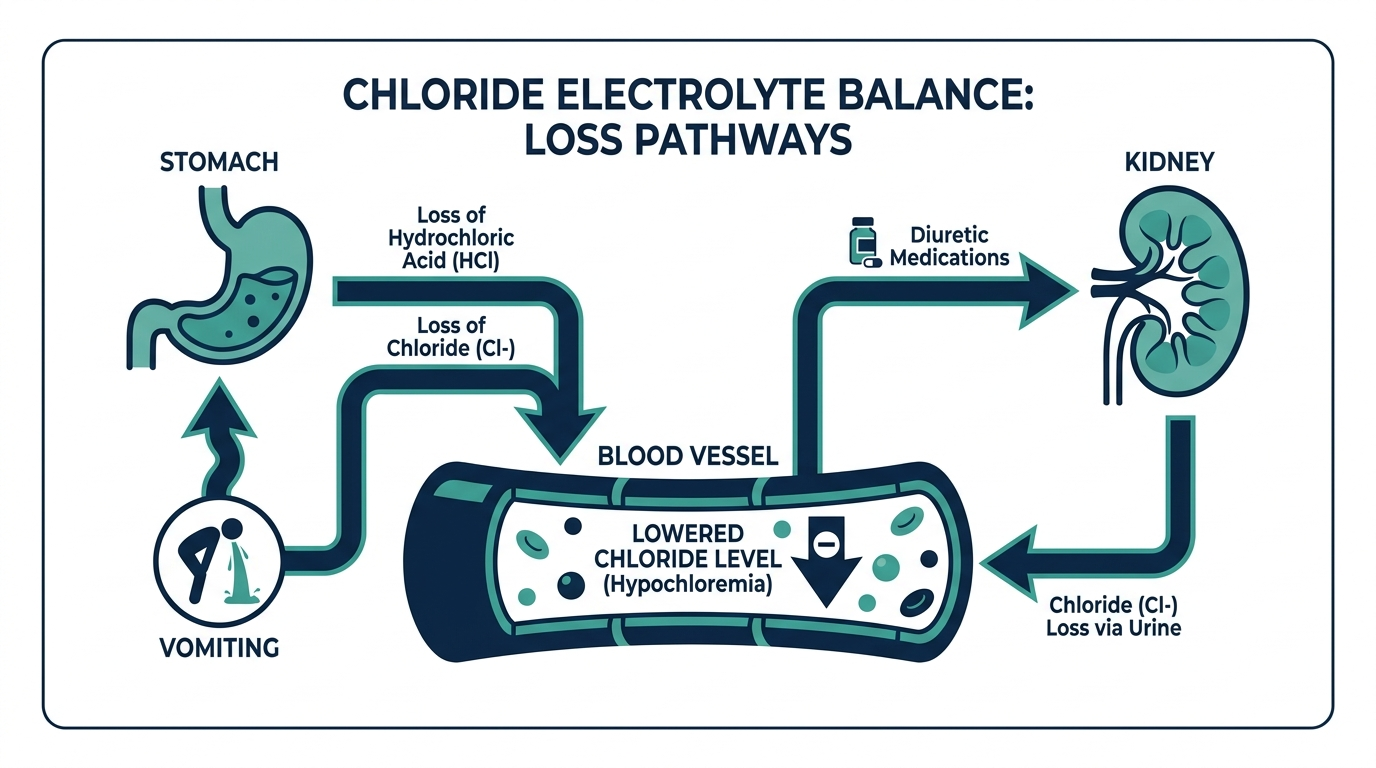
Chloride is the main negatively charged ion outside your cells, and it earns a low reading in one of three ways: you lose it, you dilute it, or your body swaps it out for bicarbonate to protect blood pH. Each mechanism explains a cluster of causes.
The loss route is the most literal. Stomach acid is hydrochloric acid, so vomiting or gastric suction pours chloride and acid out together, which is why prolonged vomiting is one of the cleanest causes of a low chloride. The kidneys can also dump chloride into the urine, and diuretics deliberately harness that mechanism, which is why they are such a common driver. The dilution route is different: in heart failure, liver disease, and some kidney disorders, the body holds onto excess water, and that extra fluid thins the chloride concentration even when the total amount of chloride has not changed much. The trade route is the acid-base one: when blood turns too alkaline, bicarbonate rises and chloride falls to keep the electrical charges balanced (MedlinePlus). Reading which of these three is at work is the whole game, and the rest of the panel usually tells you.
The numbers to read alongside a low chloride
Chloride is a passenger, and its companions decide what the low value means.
| Marker | Why it matters when chloride is low | Typical adult reference |
|---|---|---|
| Bicarbonate (CO2) | The seesaw partner. Low chloride with high bicarbonate signals metabolic alkalosis. | Roughly 22 to 29 mEq/L |
| Sodium | Chloride usually tracks sodium. If sodium is also low, think dilution from fluid overload. | Roughly 135 to 145 mEq/L |
| Potassium | Often low alongside chloride in vomiting and diuretic use, and worth correcting together. | Roughly 3.5 to 5.0 mEq/L |
| Anion gap | Sodium minus chloride and bicarbonate. Helps frame the acid-base picture. | Roughly 8 to 16 mEq/L |
Want to check your chloride?
Three ways to get it measured. Pick whichever fits you.
Affiliate links: we may earn a commission at no extra cost to you. A lab test does not replace a visit with your clinician.
The most informative pairing is chloride with bicarbonate. When chloride is low and bicarbonate is high, that is a coherent fingerprint of metabolic alkalosis, most often from vomiting or diuretics, and it tells a clinician far more than sodium does. This is exactly the pattern that gets missed when someone glances at a normal sodium and waves the chloride off.
Chloride-responsive versus chloride-resistant alkalosis
Here is a distinction that rarely reaches the patient version but drives real treatment decisions. When a low chloride comes with metabolic alkalosis, clinicians sort it into two families using a urine chloride test.
- Chloride-responsive alkalosis. The urine chloride is low, meaning the body is holding onto every chloride ion it can. This is the classic picture of vomiting, prior diuretic use, and volume depletion, and it corrects with saline, which supplies both fluid and chloride. It is sometimes called contraction alkalosis, because losing fluid concentrates bicarbonate as chloride falls.
- Chloride-resistant alkalosis. The urine chloride is higher, and saline alone does not fix it. This points toward hormonal drivers such as excess mineralocorticoid activity, and the treatment targets that underlying process rather than simply replacing fluid.
You will not run this test yourself, but knowing the split explains why a clinician may ask for a urine sample and why not every low chloride responds to the same fix. The number is the opening clue, and the urine chloride is what tells the two roads apart.

Reading your low chloride: three scenarios
- Low chloride, high bicarbonate, recent vomiting, low potassium. This is contraction alkalosis from gastric loss. Rehydration with saline and potassium replacement typically corrects the whole picture.
- Low chloride, low sodium, on a diuretic for heart failure. This leans toward dilution and diuretic burden. The plan is a careful look at fluid status and the diuretic regimen rather than adding salt (PMC, hypochloremia in heart failure).
- Mildly low chloride, everything else normal, no symptoms. This is often a minor, transient finding. A simple recheck, ideally well hydrated, usually settles whether it means anything.
Test preparation and what can distort the result
- Hydration and recent fluids. Heavy fluid intake or IV fluids can shift the concentration, and dehydration can mask or unmask a low value. Fluid status on the day matters.
- Recent vomiting or diarrhea. An acute bout right before the draw can lower chloride transiently, so a value taken mid illness may not reflect your settled state.
- Medications. Diuretics and bicarbonate antacids lower chloride, so the timing of doses relative to the draw affects the reading (MedlinePlus).
- Sample handling and assay differences. Reference ranges vary by lab, which is why your own report’s range is the one that counts, and a surprising isolated value is often repeated before action.
As with the other electrolytes, the strongest defense against a misread is a repeat panel drawn under stable conditions. A true, meaningful hypochloremia persists and travels with a coherent acid-base story. A one off usually does not.
Who should watch this number, and how often
For most people, a mildly low chloride on a routine panel with no symptoms needs only a recheck. Closer attention pays off for specific groups: people with heart failure, where a falling chloride is one of the more telling prognostic markers and reflects fluid overload and diuretic burden (PMC); people on loop or thiazide diuretics, whose chloride should be watched as doses change; people with liver or kidney disease prone to fluid retention; and anyone with prolonged vomiting, diarrhea, or heavy sweating.
In these settings the value of repeated measurement is the trend across several panels alongside sodium, potassium, and bicarbonate. A stable low chloride in a well person on a diuretic may be expected, while a chloride that is drifting down over time, especially in heart failure, is a signal worth bringing to the clinician managing the condition.
Common misconceptions about a low chloride
- “I should eat more salt to fix it.” Not on your own. A low chloride is treated by addressing the cause, whether rehydration, a medication change, or managing an underlying condition, not by adding table salt (Cleveland Clinic).
- “Sodium is normal, so the chloride is nothing.” This is the classic miss. Chloride can carry a distinct acid-base and heart-failure signal that sodium does not, especially when bicarbonate is high or heart failure is present (PMC).
- “A low chloride means my kidneys are failing.” Usually not by itself. Vomiting, diuretics, and fluid shifts are the common drivers. Kidney function is judged by eGFR and creatinine, not by chloride alone.
- “I can feel when it is low.” Typically you cannot. Hypochloremia is usually silent, and any symptoms come from the underlying cause or an accompanying acid-base shift (Cleveland Clinic).
Frequently asked questions
What is a low chloride level on a blood test?
A low chloride, or hypochloremia, is a chloride result below your lab’s reference range, generally under about 96 mEq/L for adults, since the typical adult range is roughly 96 to 106 mEq/L (Cleveland Clinic). Always compare your value to the range printed on your own report.
What is the most common cause of low chloride?
The most common drivers are prolonged vomiting, diuretic medications, and fluid-retaining conditions like heart failure, often through dilution or metabolic alkalosis (Cleveland Clinic). Excessive sweating and dehydration can also lower it.
Does low chloride cause symptoms?
Usually not. Hypochloremia typically causes no symptoms and is found on a blood test (Cleveland Clinic). Any symptoms you feel usually come from the underlying cause, such as vomiting or dehydration, or from an associated acid-base shift.
Is low chloride dangerous?
A mildly low value with no symptoms is rarely an emergency, but untreated significant hypochloremia can contribute to irregular heartbeat, kidney strain, and pH imbalance (Cleveland Clinic). In heart failure and hospitalized patients, low chloride is linked to worse outcomes (PMC).
How is low chloride treated?
Treatment targets the cause, not the number, and may include rehydration or IV saline, adjusting medications such as diuretics or antacids, and managing any underlying condition (Cleveland Clinic). A single mildly low result with no symptoms is often simply rechecked.
This article is for general educational purposes and is not medical advice. It cannot diagnose or treat you and does not replace your clinician. Always discuss your lab results and any health decisions with a qualified healthcare professional.
Vital Signs Today may earn a commission if you buy through links on this page. It does not affect our editorial assessments.