
Disclosure: Vital Signs Today may earn a commission if you buy through links on this page, at no extra cost to you. This does not influence our evidence-based assessments. We are not a medical provider; talk to a clinician before acting on test results.
Part of our Complete Blood Count guide.
You got your blood work back, scanned the white blood cell section, and somewhere in there sat three letters with a four digit number beside them: ANC. No asterisk, no flag, so you moved on. Here is what the report does not tell you. ANC is the single number that decides, in real time, how vulnerable you are to infection right now. Doctors treating cancer patients, transplant patients, and anyone on certain medications watch it more closely than almost any other line on the page.
Most people never give it a second look until a doctor calls about it. By then it helps to already understand what it means.
What is ANC in a blood test?
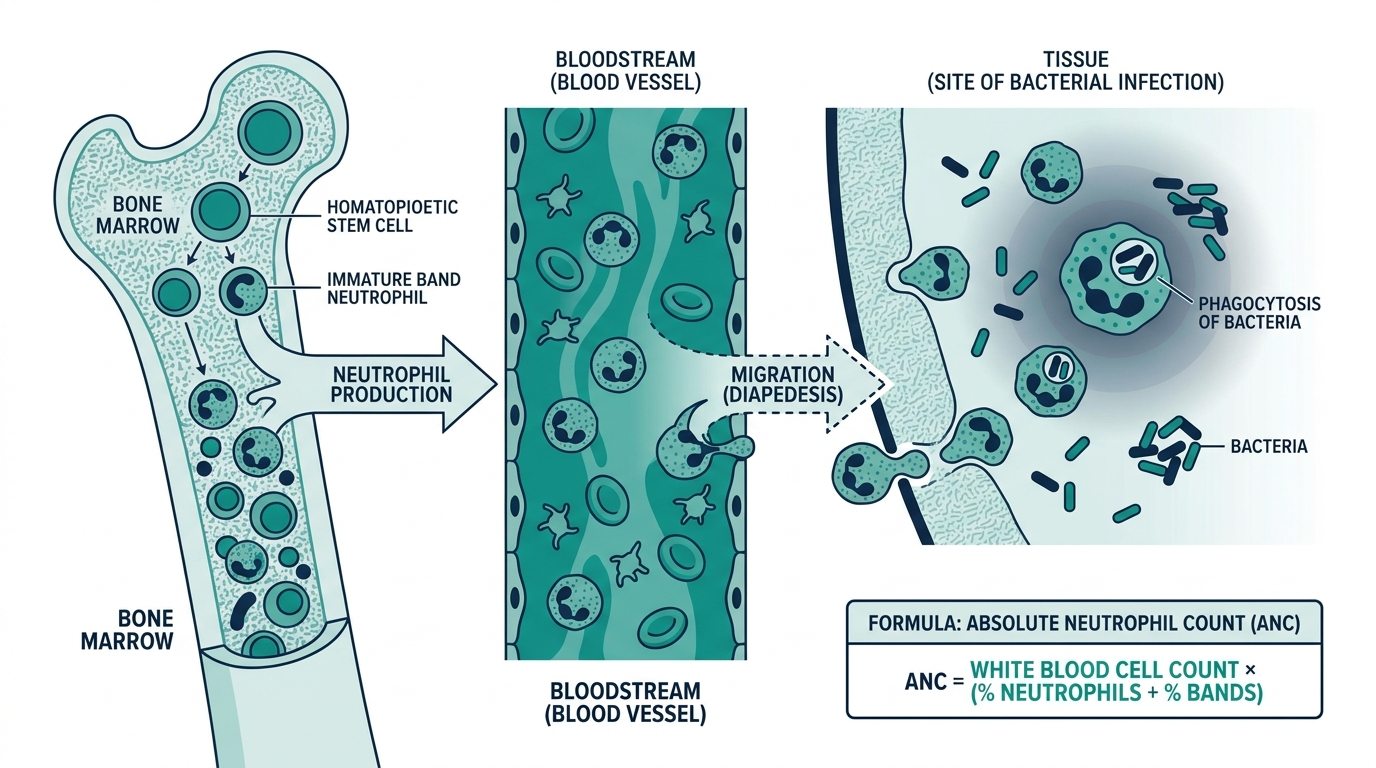
ANC stands for absolute neutrophil count, and it measures how many neutrophils, your body’s frontline infection fighting white blood cells, are circulating in your blood right now. It is reported as a number of cells per microliter and is derived from your complete blood count (CBC). Neutrophils are the most common type of white blood cell and your first line of defense against bacteria and fungi (Cleveland Clinic). In plain terms: when someone asks what is ANC in a blood test, the honest one line answer is that it is a headcount of your infection fighting troops.
That headcount matters because neutrophils are first responders. When bacteria break through a cut or settle in your lungs, neutrophils swarm the site within hours. If you do not have enough of them, an ordinary infection can turn serious fast. ANC puts a precise number on how big that frontline army is.
What does ANC actually measure, and how is it calculated?
ANC is not measured directly by a single dial. It is calculated from two other numbers on your CBC: your total white blood cell count and the percentage of those cells that are neutrophils. The standard formula is the total WBC count multiplied by the combined percentage of mature neutrophils (called segs or PMNs) plus immature ones (called bands), divided by 100 (StatPearls, NCBI Bookshelf).
So if your white count is 5,000 cells per microliter and 60 percent of them are neutrophils, your ANC is 3,000. This is worth knowing because two people can have the same total white count but very different ANC values. A normal looking white count can still hide a dangerously low neutrophil count if a different cell type is making up the bulk. The ANC strips away that ambiguity and tells you exactly how many infection fighters you actually have. People search this under many phrasings, what is anc on a blood test, what is anc blood test, what’s anc in blood test, but they are all asking about this same calculated headcount.
What is a normal ANC in a blood test?
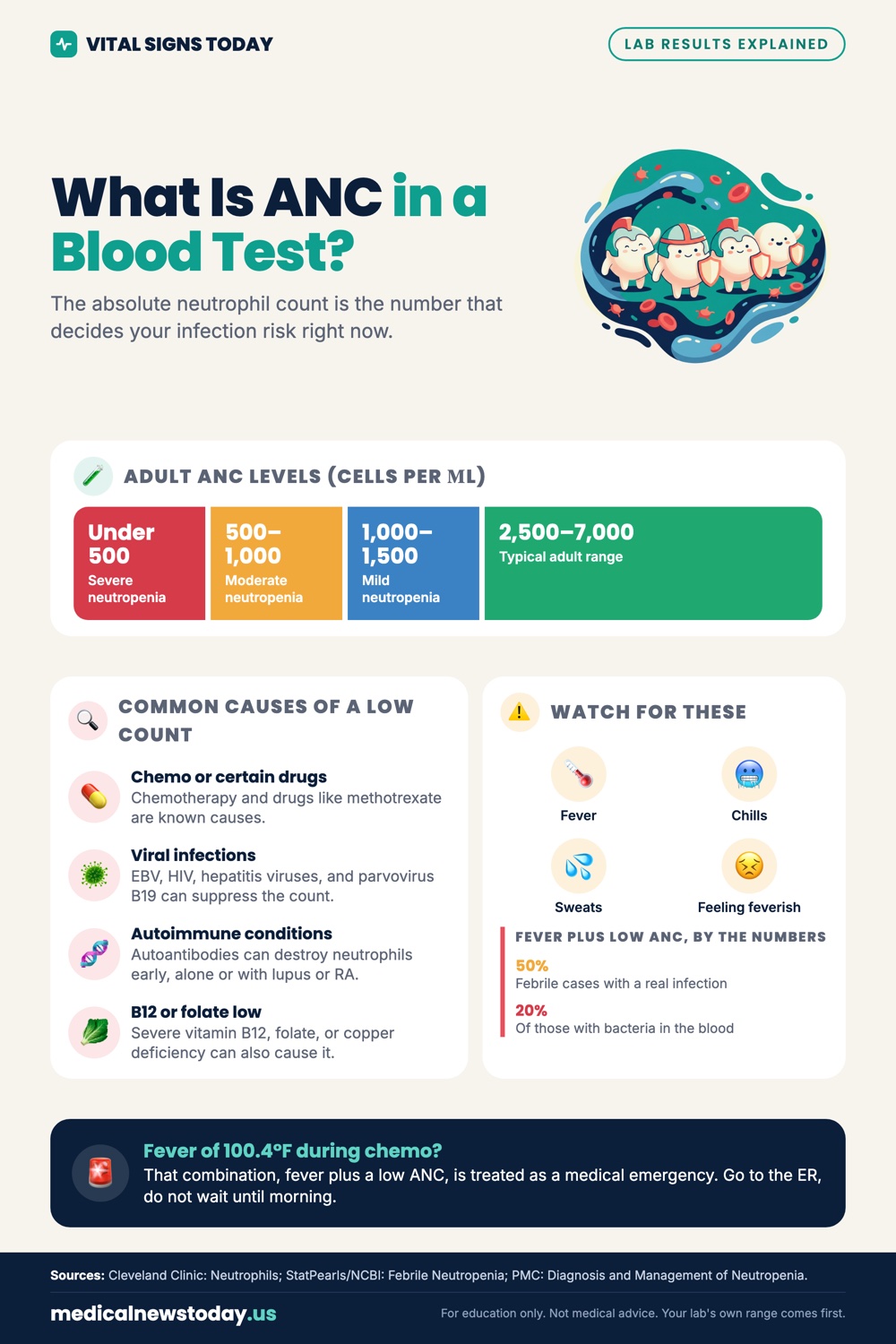
A normal absolute neutrophil count in a healthy adult generally falls between about 2,500 and 7,000 neutrophils per microliter of blood (Cleveland Clinic). The exact cutoffs vary slightly by laboratory and instrument, and many labs report neutropenia, a low count, starting below 1,500 cells per microliter (StatPearls, NCBI Bookshelf).
The practical takeaway when reading what is anc in blood test results: anything comfortably inside that band is reassuring, while a result drifting below 1,500 is the point at which clinicians start paying attention and asking why. Always compare your number to the reference range printed on your own report, because that is the range your lab actually calibrated for its equipment.

What does a low ANC mean?
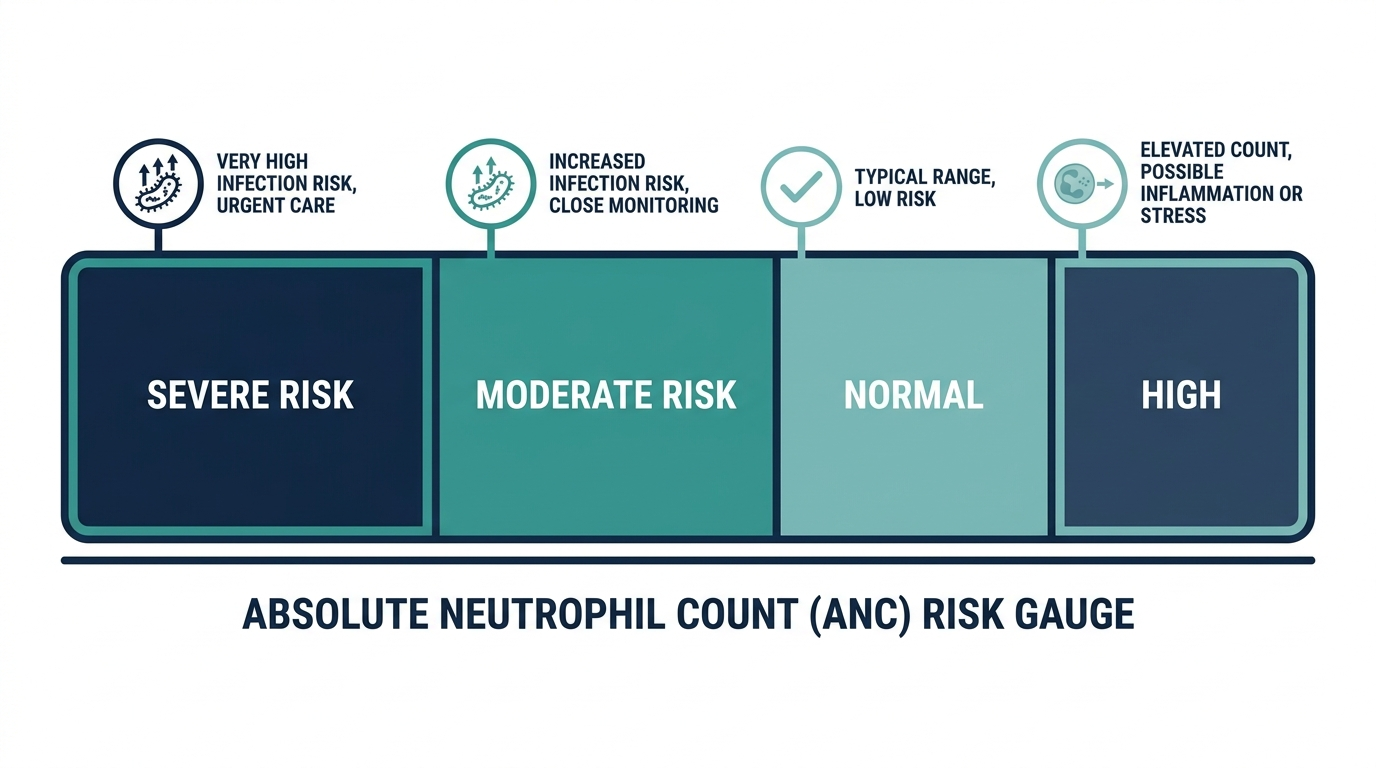
A low ANC, called neutropenia, means you have fewer infection fighting neutrophils than normal, which raises your risk of infection. How much risk depends heavily on how low the number goes, and clinicians grade it in tiers (PMC, diagnosis and management of neutropenia):
- Mild neutropenia: ANC of 1,000 to 1,500 cells per microliter. Often causes no symptoms at all.
- Moderate neutropenia: ANC of 500 to 1,000. Infection risk is rising.
- Severe neutropenia: ANC below 500. This is the threshold where the risk of serious, life threatening infection climbs sharply (PMC, diagnosis and management of neutropenia).
- Profound neutropenia: ANC below 100. The body can lose control of even its own resident bacteria.
Common causes include chemotherapy and other medications, viral infections, autoimmune conditions, vitamin B12 or folate deficiency, and bone marrow disorders. The reason the 500 mark gets so much weight is concrete. Below it, the microbes that normally live harmlessly in your mouth and gut can slip across and cause bloodstream infection, because there are too few neutrophils left to hold the line (StatPearls, NCBI Bookshelf).
Here is the insider point that rarely reaches the patient version. In cancer care, a low ANC plus a fever is treated as a medical emergency on its own, before any other test comes back. It has a name, febrile neutropenia, and roughly half of these patients turn out to have an infection, with those in profound neutropenia far more likely to have bacteria in their bloodstream (StatPearls, NCBI Bookshelf). That is why oncology teams tell patients on chemo that a fever of 100.4 F means go to the emergency room now, not in the morning. The ANC is the reason a symptom that would be trivial for most people becomes urgent for them.
What does a high ANC mean?
A high ANC, called neutrophilia, means you have more circulating neutrophils than normal, generally above roughly 7,000 cells per microliter (Cleveland Clinic). Far more often than not, this is your immune system working exactly as designed rather than a sign of disease.
The most common trigger is simply an active bacterial infection, where the bone marrow ramps up neutrophil production to fight it off. But the list is broad and includes physical or emotional stress, strenuous exercise, smoking, pregnancy, recent surgery or injury, and corticosteroid medications, all of which can push neutrophils into the bloodstream (StatPearls, neutrophilia). A persistently and markedly elevated ANC with no obvious cause is the situation that warrants a closer look, since in rarer cases it can point to bone marrow disorders. A single mildly high reading after a stressful week or a recent cold usually is not.

Why is ANC read together with the rest of the CBC?
ANC rarely tells the whole story alone. Because it is calculated from your total white count and your neutrophil percentage, clinicians read it alongside the other white cell types, your hemoglobin, and your platelets to see the bigger picture (StatPearls, NCBI Bookshelf). The pattern matters as much as any single value.
For example, a low ANC alongside low red cells and low platelets points toward a bone marrow problem affecting all cell lines, which is a different and more serious situation than an isolated low ANC with everything else normal. An isolated dip, by contrast, is more likely to be a passing viral effect, a medication, or a benign inherited pattern. The ANC is a powerful number, but it is a single instrument in a larger panel, and reading it in isolation is how both false alarms and missed problems happen.
The part most people never hear: a low ANC can be perfectly normal for you
Here is where the ANC gets genuinely surprising, and where a lot of unnecessary worry comes from. A significant share of healthy people, particularly those of African, Middle Eastern, and West Indian ancestry, naturally run a lower neutrophil count than standard reference ranges assume, with no increased risk of infection whatsoever. This is now called Duffy-null associated neutrophil count, or DANC (American Society of Hematology).
The numbers are striking. Roughly two thirds of people who identify as Black in the United States carry the Duffy-null variant, and in one study the median ANC in Duffy-null individuals was about 2,820 cells per microliter versus about 5,005 in others (PMC, ANC by Duffy status in healthy Black and African American adults). Many of these people sit just under the conventional 1,500 cutoff and get labeled neutropenic when nothing is wrong with them.
This is not a trivial labeling quirk. Because standard reference ranges were largely built on populations of European descent, people with DANC have been subjected to unnecessary, expensive, and invasive testing, and worse, have had chemotherapy delayed or stopped and been excluded from clinical trials over a number that was always normal for their biology (American Society of Hematology). The American Society of Hematology now advocates for Duffy informed reference ranges precisely because of this. The lesson for any patient: a number flagged as low is a question, not a verdict. If your ANC sits modestly below the standard range and you feel well with no other abnormalities, ask your clinician whether your personal baseline, including your ancestry, has been taken into account before any aggressive workup begins.

Symptoms of a low ANC, and the red flags that mean go now
A low ANC on its own often produces no symptoms at all, which is exactly what makes it dangerous. You can feel completely fine while your infection defenses are thin. The symptoms that do appear are usually the signs of an infection that a normal neutrophil count would have crushed quietly. Watch for:
- Fever, which is the single most important warning sign when your ANC is low
- Sore throat, mouth ulcers, or new sores that are slow to heal
- Recurrent or lingering skin infections, boils, or abscesses
- Chills, sweating, or feeling suddenly and unusually unwell
- Burning with urination or a productive cough that does not settle
If you have a known low ANC, whether from chemotherapy, a medication, or a diagnosed condition, treat a temperature of 100.4 F (38 C) as an emergency, not something to sleep off. In severe neutropenia the usual signs of infection can be blunted, because it is the neutrophils themselves that produce pus, swelling, and redness. That means a serious infection can be present with almost no local signs, so a fever may be the only clue you get. When in doubt, call your care team or go to the emergency room the same day rather than waiting to see if it passes.
What actually pushes your ANC down: a closer look at causes
Neutropenia comes from three broad mechanisms: the marrow not making enough neutrophils, neutrophils being destroyed faster than they are replaced, or neutrophils shifting out of the bloodstream and into tissues. Knowing which category you fall into is what turns a scary number into a plan.
- Reduced production: chemotherapy is the classic cause, but radiation, some cancers that invade the bone marrow, aplastic anemia, and deficiencies of vitamin B12, folate, or copper also slow neutrophil production.
- Medications beyond chemo: a long list of common drugs can suppress neutrophils, including certain antibiotics, some antithyroid drugs, certain antiseizure and antipsychotic medications, and some anti-inflammatory agents. This is why any new medication is worth reviewing when an unexplained low ANC appears.
- Increased destruction: autoimmune conditions such as lupus and rheumatoid arthritis can drive the body to clear its own neutrophils, and some viral infections do the same temporarily.
- Infections themselves: a severe infection can consume neutrophils faster than the marrow can supply them, which is why a very low ANC can sometimes be both cause and consequence.
Viral illnesses are the most common everyday reason for a mild, temporary dip. A common cold or flu can nudge the ANC down for a week or two, and it usually recovers on its own. A persistent, unexplained low ANC, or one paired with low red cells and platelets, is the pattern that warrants a proper workup rather than watchful waiting.
How a low ANC is investigated
When a low ANC is real and not explained by an obvious cause like recent chemotherapy, clinicians work through it step by step rather than jumping to the worst case. A typical sequence looks like this:
- Repeat the CBC. A single low value is often confirmed with a repeat draw, because a one-off dip from a recent virus or lab variation is common. Trend beats snapshot.
- Review the timeline and medications. The clinician looks at whether the drop lines up with a new drug, a recent infection, or a chemotherapy cycle.
- Check the rest of the panel. Whether red cells and platelets are also low tells the team if this is an isolated neutrophil problem or a whole-marrow issue.
- Look at the smear and ancestry. A blood smear shows the shape and maturity of the cells, and, as covered above, a modestly low count in someone of African, Middle Eastern, or West Indian ancestry may reflect Duffy-null biology rather than disease.
- Escalate only if needed. Persistent, unexplained, or severe neutropenia may lead to nutrient testing, autoimmune screening, or, in select cases, a bone marrow evaluation.
Living with a low ANC: practical precautions
If you are told your ANC is low enough to raise infection risk, especially during chemotherapy, a handful of everyday habits meaningfully reduce your exposure without turning life into a bubble. These are the standard precautions oncology teams give:
- Wash your hands often and well, and ask household members to do the same
- Avoid crowds and anyone with an active cold, flu, or fever
- Take care with food safety: cook meat thoroughly, wash produce, and avoid unpasteurized products during periods of severe neutropenia
- Keep cuts and scrapes clean and covered, and see a dressing through properly
- Practice careful oral hygiene, since the mouth is a common entry point for infection
- Keep a working thermometer at home and know your care team’s after-hours number
None of this changes your ANC, but it lowers the chance that a thin defense line ever gets tested. The goal is simple: fewer exposures while the count is low, and fast action if a fever appears.
Does anything affect the accuracy of an ANC result?
ANC does not require fasting, and a routine CBC can be drawn at any time of day. A few practical factors are still worth knowing so you interpret a result fairly:
- Time of day and activity: neutrophil counts can rise transiently after heavy exercise, acute stress, or a recent meal, so a mildly high reading right after a hard workout may not reflect your baseline.
- Recent illness: an infection in the days before your draw can push the count up or, with some viruses, down. Retesting once you are well gives a truer baseline.
- Medications: steroids can raise the count, while the drugs listed above can lower it. Note what you take so the result can be read in context.
- Lab and instrument differences: because ANC is calculated from the white count and neutrophil percentage, small differences between analyzers can shift the final number slightly. This is why you compare to your own report’s range.
The most useful thing you can do with an ANC is watch it over time rather than react to a single value. A stable number in the reassuring band, or a modestly low but stable count with no other abnormalities, is a very different story from a count that is falling draw over draw. Trend is the signal.
Reading your ANC as a trend: recovery, nadir, and why one number is never enough
A single ANC is a snapshot, and for anyone whose count moves, the direction it is heading often matters more than the value on any one day. This is clearest in chemotherapy, where the count follows a predictable rhythm. After a cycle, neutrophils fall to their lowest point, called the nadir, then climb back as the bone marrow recovers. Care teams do not react to the low value alone. They ask how low it went, how long it stayed there, and whether it is now rising, because a count of 800 on the way up is a very different situation from the same 800 on the way down.
The rate of recovery carries information too. A brisk climb back toward the normal band suggests a marrow that is responding well, while a count that stays flat and low for longer than expected can prompt a closer look at what is holding production back. This is why doctors often draw serial counts rather than repeating a single test, and why the timing of the draw relative to a medication dose changes how the result should be read.
The same logic applies far from cancer care. A mildly low ANC that has been stable across several past reports is far more reassuring than a new drop from a previously normal count, because a stable baseline usually reflects your normal, whereas a fresh decline is a change that deserves an explanation. If you have old blood work, it is worth lining up your ANC values in order and looking at the shape of the line, not just the latest figure. A steady trend and a falling trend send very different messages, and only the history reveals which one you are looking at.
Want to check your neutrophils?
Three ways to get it measured. Pick whichever fits you.
Affiliate links: we may earn a commission at no extra cost to you. A lab test does not replace a visit with your clinician.
Frequently asked questions
What is an ANC blood test used for?
An ANC blood test, derived from your complete blood count, measures how many infection fighting neutrophils you have circulating. It is used to assess your risk of infection, monitor patients on chemotherapy or other medications that suppress the bone marrow, and investigate abnormal white blood cell counts (Cleveland Clinic).
What is a normal ANC in a blood test?
A normal absolute neutrophil count in a healthy adult is generally about 2,500 to 7,000 cells per microliter, with many labs flagging neutropenia below 1,500 (Cleveland Clinic). Always compare your result to the reference range on your own report.
What does a low ANC mean in a blood test?
A low ANC means neutropenia, fewer infection fighting cells than normal. Risk rises as the number falls, with an ANC below 500 considered severe and a sharply higher risk of serious infection (PMC, diagnosis and management of neutropenia).
Can a low ANC be normal?
Yes. Many healthy people of African, Middle Eastern, and West Indian ancestry naturally have a lower ANC, known as Duffy-null associated neutrophil count, with no increased infection risk (American Society of Hematology). It is often mislabeled as neutropenia.
Why does my doctor watch my ANC during chemotherapy?
Chemotherapy can suppress neutrophil production, and a low ANC plus fever, called febrile neutropenia, is a medical emergency where about half of patients have an infection (StatPearls, NCBI Bookshelf). The ANC tells the team how protected you are between treatments.
This article is for general educational purposes and is not medical advice. It cannot diagnose or treat you and does not replace your clinician. Always discuss your lab results and any health decisions with a qualified healthcare professional.
Vital Signs Today may earn a commission if you buy through links on this page. It does not affect our editorial assessments.