
Part of our Complete Blood Count guide.
You scanned your complete blood count, hit a row labeled “Monocytes” with a small percentage and an absolute number beside it, and kept moving. No red flag, no asterisk, so it felt safe to ignore. Here is what most lab printouts never explain. Monocytes are the cleanup crew and the early-warning system of your immune defense, and the size of that crew on any given day says something about what your body is dealing with right now.
Most explainers reduce monocytes to a single line: high means infection. That is true but thin. The real value of this number shows up when you read it in context, and that is what we will do here.
What is monocytes on blood test?
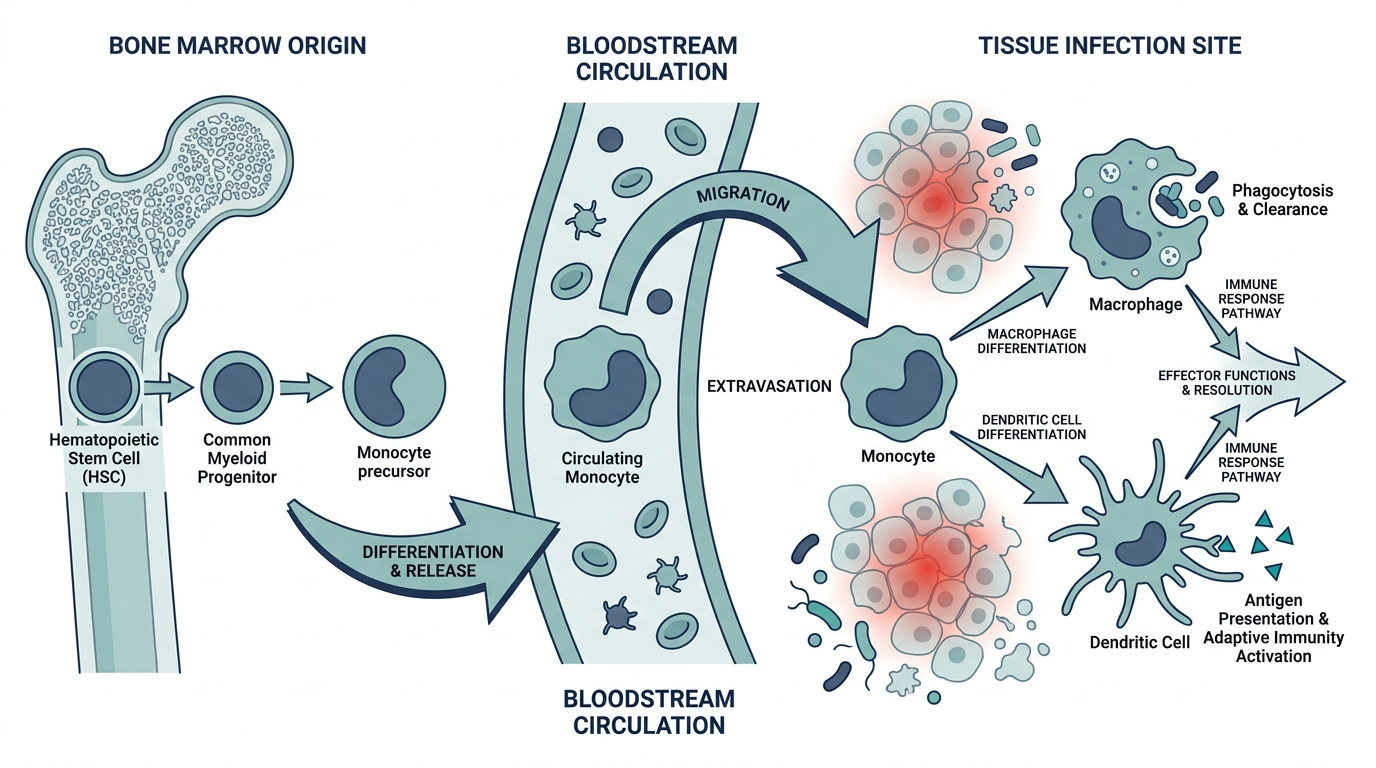
Monocytes on a blood test are a type of white blood cell counted as part of your complete blood count with differential, and they make up roughly 2 to 8 percent of your total white cells (MedlinePlus). In plain terms, a monocyte is one of five white blood cell types your body uses to fight infection, and this line on your report tells you how large that particular squad is. A typical adult has about 200 to 800 monocytes per microliter of blood (Cleveland Clinic).
Monocytes are the biggest white blood cells you have. They patrol your bloodstream, and when they sense trouble they slip into your tissues and transform into macrophages and dendritic cells, the cells that swallow germs whole and flag invaders for the rest of your immune system (Cleveland Clinic). That dual job, eating debris and raising the alarm, is why the monocyte line moves when something is going on.

What are monocytes in a blood test, and what do they do?
Monocytes in a blood test are the body’s frontline scavengers, and their core job is to find, engulf, and destroy bacteria, viruses, fungi, and dead or damaged cells (MedlinePlus). They also clear away cellular trash and help kick-start the wider immune response, so they sit at the crossroads of fighting infection and cleaning up afterward.
Your blood differential breaks white cells into five types: neutrophils, lymphocytes, monocytes, eosinophils, and basophils (MedlinePlus). Each does a different job, which is why the lab counts them separately instead of lumping them into one white cell number. Neutrophils are the rapid responders to bacteria, lymphocytes handle viruses and long-term memory, and monocytes are the heavy-duty cleaners that arrive a bit later and stay in the tissues as macrophages.
Here is a way to remember it. If neutrophils are the firefighters who rush the blaze, monocytes are the crew that shows up afterward to haul out the wreckage and watch for flare-ups. That is why a shifting monocyte count often reflects the recovery or chronic phase of a problem, not just the first hour of it.
What is a normal monocytes blood test level?
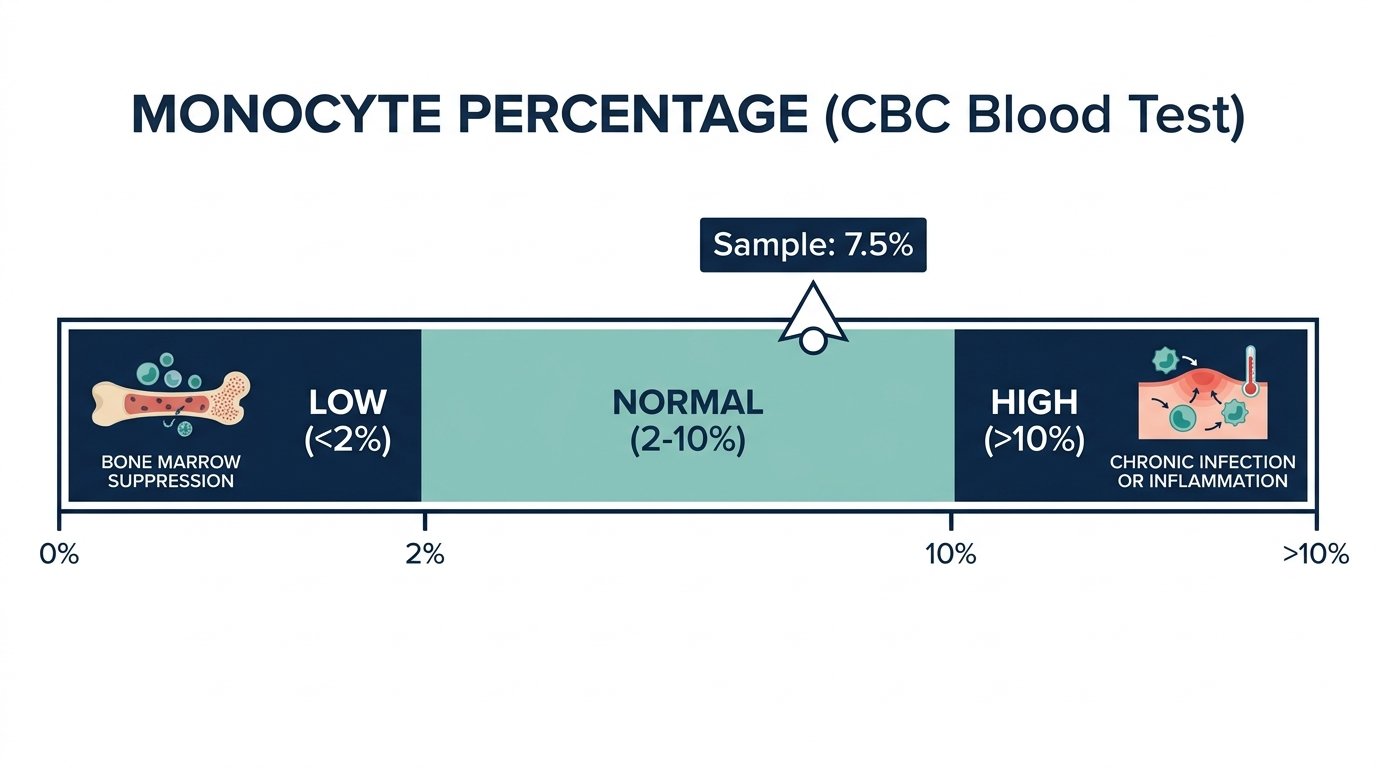
A normal monocyte result is about 2 to 8 percent of your white blood cells, which works out to roughly 200 to 800 monocytes per microliter in a healthy adult (Cleveland Clinic). Your report may show this two ways: the percentage (monocyte %) and the absolute count (often written as “monocytes absolute” or “MONO #”). Both describe the same cells on different scales.
The absolute count is usually the more reliable number to watch. The percentage can swing simply because another white cell type rose or fell, since the percentages always add up to 100. The absolute count tells you the actual quantity of monocytes circulating, independent of what the other cells are doing. Always compare your value against the reference range printed on your own report, because instruments and labs calibrate slightly differently (MedlinePlus).
What does monocytes mean in a blood test when the count is high?
A high monocyte count, called monocytosis, usually means your body is dealing with an infection, inflammation, or is recovering from one. In adults, monocytosis is generally defined as a count above 1,000 cells per microliter, or monocytes making up more than 10 percent of your white cells (Cleveland Clinic). It is a signal to look closer, not a diagnosis on its own.
The common reasons monocytes climb include (Cleveland Clinic):
- Infections, especially the recovery phase of viral illnesses like mononucleosis, plus tuberculosis and other chronic infections.
- Autoimmune and inflammatory conditions, such as rheumatoid arthritis, lupus, and inflammatory bowel disease.
- Chronic stress and physical exertion, which can nudge the count upward temporarily.
- Blood disorders and certain cancers, including some leukemias and lymphomas, which are far less common but the reason a persistently high count gets investigated.
Here is the insider point that rarely reaches the patient summary. A single mildly elevated monocyte number, caught right after a cold or a rough week, is usually meaningless. Monocytes are recovery cells, so they routinely tick up while your body is mopping up after a recent infection. What experienced clinicians actually care about is a count that stays high across repeated tests with no obvious infection to explain it. Persistence, not a one-time bump, is the trigger for deeper investigation. If your monocytes were high once and normal the next time, that pattern is reassuring on its own.

What does a low monocyte count mean?
A low monocyte count, called monocytopenia, means you have fewer of these cells than expected, and it is far less common than a high count. On its own a mildly low monocyte number is often not a cause for alarm, but a meaningfully reduced count can point to a problem with how your bone marrow is producing immune cells (Cleveland Clinic).
Causes of low monocytes include aplastic anemia, a bloodstream infection, serious burns, HIV, and the aftermath of chemotherapy, all of which can suppress bone marrow output (Cleveland Clinic). Because monocytes help fight germs, a sustained low count can weaken your defenses, so it is interpreted alongside your other white cell counts rather than in isolation. If your monocytes read slightly low but your total white count and the rest of your differential look fine, it is usually nothing to chase.
Why are monocytes read together with the rest of the differential?
Monocytes rarely tell the full story alone, which is why they are always reported next to neutrophils and lymphocytes in the differential. The pattern across all the white cell types is what points toward a cause. A high monocyte count with high lymphocytes suggests a recovering viral infection, while a high neutrophil count points more toward an active bacterial one (MedlinePlus).
This is also where one of the more interesting research threads comes in. Clinicians increasingly look at the relationship between monocytes and lymphocytes as a single number, the monocyte-to-lymphocyte ratio, because it captures the balance between inflammatory drive (monocytes) and immune defense (lymphocytes). Research has studied this ratio as a prognostic marker in conditions such as liver cancer, though the evidence is genuinely mixed and the cutoff values differ from study to study (PMC, monocyte and lymphocyte ratio meta-analysis). The honest takeaway is that the ratio is a research and risk-stratification tool, not something you should calculate at home and worry over.
The practical lesson holds regardless: one cell line in isolation can mislead you, while the shape of the whole differential is what a clinician actually reads. Your monocyte number is one instrument in a small orchestra (Cleveland Clinic).
The part most people never hear: monocytes are a window into chronic inflammation
This is where the monocyte line goes from a minor infection clue to something genuinely worth understanding. Because monocytes mature into the macrophages that drive long-term inflammation in tissues, a chronically nudged-up monocyte count can be a quiet readout of the low-grade, simmering inflammation that researchers increasingly tie to aging, heart disease, and metabolic problems.
The reason this matters: the same monocytes that clean up after an infection are also the cells that infiltrate arterial walls and contribute to the plaque buildup behind cardiovascular disease (Cleveland Clinic). That is the biological bridge between an immune cell count and long-term heart risk. It is part of why investigators keep returning to monocyte-based markers when they look for cheap, routine blood values that hint at hidden inflammatory load (PMC, monocyte and lymphocyte ratio meta-analysis).
None of this means a single elevated monocyte result should send you spiraling. It will not diagnose you with anything. But it does reframe the number. Instead of a throwaway line to scroll past, your monocyte count is a small, recurring signal about how much background immune work your body is doing. When it stays elevated without a clear infection, that is a reasonable reason to look closer with your clinician rather than to look away.
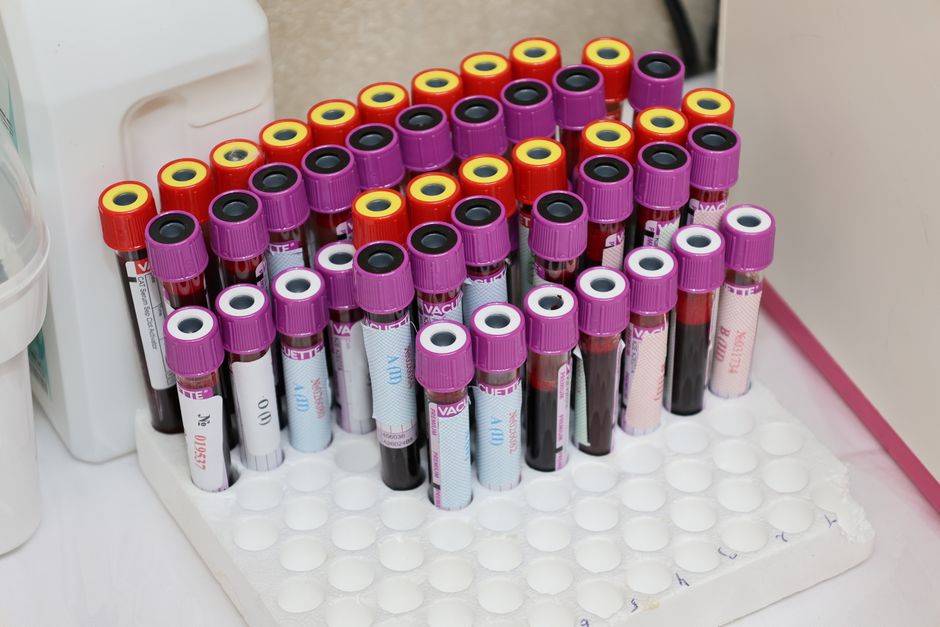
Worked examples: reading your monocyte number in context
The monocyte line becomes far easier to interpret when you see how it behaves inside real patterns. These illustrate the reasoning a clinician uses, not a self-diagnosis.
- Monocytes mildly high, lymphocytes also up, recovering from a recent viral illness: a classic recovery-phase picture. Monocytes are cleanup cells, so a bump while your body mops up after mono or another virus is expected and usually just monitored.
- Monocytes high, neutrophils high, feeling acutely unwell: points toward an active infection or inflammation, read in the context of your symptoms rather than the monocyte value alone.
- Monocytes high on one test, normal on the next, no symptoms: a reassuring pattern. A one-time bump that resolves is almost always benign.
- Monocytes persistently high across several tests with no infection to explain it: this is the pattern that earns a closer look, because persistence without a clear cause is what distinguishes a routine bump from something worth investigating.
- Monocyte percentage high but absolute count normal: often a relative shift caused by another white cell line falling, which is why the absolute number is the one to anchor on.
The unifying lesson is that a monocyte value is read as part of the whole differential and across time, not as an isolated dot. The same number can be trivial in one context and meaningful in another.
What can move your monocyte count, and how to prep
Before reading much into a single value, it helps to know how many ordinary factors can nudge the monocyte count, usually in harmless and temporary ways.
- Recent or recovering infection, which is the single most common reason monocytes tick up.
- Physical and emotional stress, including hard exercise, surgery, or a demanding stretch of illness, which can transiently raise the count.
- Chronic inflammatory conditions, such as autoimmune disease or inflammatory bowel disease, which can keep the count elevated over longer periods.
- Medications, including corticosteroids, which can influence white cell counts.
- Time of collection and recent illness, since counts shift during and after the body’s response to a problem.
A CBC with differential usually requires no fasting and no special preparation. The most useful thing you can bring is context: note whether you were recently ill, unusually stressed, or started a new medication, because that background frequently explains a mildly abnormal monocyte result without any deeper cause. As with other CBC markers, keeping your testing conditions reasonably consistent makes your trend line more meaningful.
Symptoms and red flags worth reporting
A mildly abnormal monocyte count is usually silent, so symptoms are what help separate a benign fluctuation from something that needs attention.
- Persistent, unexplained fatigue alongside a monocyte count that stays elevated.
- Drenching night sweats, unexplained weight loss, or persistent fever, the classic systemic symptoms that raise the priority of any abnormal white cell finding.
- Swollen lymph nodes or an enlarged spleen sensation, which alongside a high count warrant a closer look.
- Frequent or unusually severe infections, which are the concern when monocytes are low and defenses may be reduced.
- An abnormality that does not normalize on a repeat test weeks after any illness has passed.
The guiding principle is the same across the differential: an isolated, mild abnormality in someone who feels well is usually watched or rechecked, while an abnormality that is marked, persistent, or paired with those systemic symptoms is what prompts a workup. Telling your clinician how you feel supplies half the interpretation.

What happens after a persistently high monocyte count
If your monocytes stay elevated on repeat testing without an obvious infection, the next steps follow a logical order rather than jumping to worst-case conclusions.
- Confirm and repeat. Because a single bump is so often benign, the first move is usually to recheck the count and see whether it persists.
- Read the whole CBC. Your clinician examines the other white cell lines, red cells, and platelets, since a broad abnormality across cell lines carries different weight than an isolated monocyte rise.
- Look for a cause. A review of your history for chronic infection, autoimmune disease, or inflammatory conditions often explains the finding.
- Consider a blood smear. A specialist may examine the cells under the microscope to see whether they look normal and varied or abnormal and uniform.
- Refer when warranted. A markedly and persistently high count, especially with other abnormal cell lines, is when a hematologist may be involved.
One specific condition worth naming is chronic myelomonocytic leukemia (CMML), a bone marrow disorder characterized by a persistently elevated monocyte count. It is uncommon, and the vast majority of high monocyte results are not this. The point is not to alarm you but to explain why a stubbornly high count that no infection accounts for is taken seriously enough to investigate rather than ignore.
Who is tested and how often to monitor
Almost nobody orders a monocyte count on its own. It arrives inside the CBC with differential that accompanies routine physicals, illness evaluations, and pre-operative checks, so most people already have several old monocyte values on file.
Closer attention to the count makes sense for people with:
- A known chronic inflammatory or autoimmune condition, monitored so the trend can be followed.
- A blood or bone marrow disorder, where serial counts track the course.
- Ongoing immunosuppressive treatment, where changes in white cell counts guide care.
- Unexplained systemic symptoms, in whom the count is one input to a wider evaluation.
For a healthy person with no risk factors, the monocyte count that appears on routine labs at a normal checkup interval is enough. And as with every marker on the CBC, the real value is the trend across time. A monocyte count that has been stable and normal for years reads very differently from one that has just begun to climb.
Common misconceptions about monocytes
A few persistent misunderstandings lead people to over-read or under-read this number:
- “High monocytes mean I have cancer.” By far the most common cause of a raised count is a recent or resolving infection or ordinary inflammation. Blood cancers are an uncommon reason and are only considered when the count is high and persistent without another explanation.
- “A normal monocyte count means my immune system is perfect.” A single marker cannot certify overall immune health, which is why monocytes are read as one part of the full differential.
- “My monocyte percentage went up, so something is wrong.” The percentage can rise simply because another white cell line fell, with no real change in the monocyte quantity, which is why the absolute count is the number to trust.
- “One abnormal result needs immediate action.” An isolated, mild abnormality is usually rechecked rather than acted on, since the trend and any accompanying symptoms carry the real information.
Reading monocytes well means holding the number as one recurring signal about your body’s immune and cleanup activity, interpreted against the rest of your differential, your symptoms, and your own trend over time.
Frequently asked questions
Is a high monocyte count something to worry about?
Usually not on its own. A high monocyte count, or monocytosis, most often reflects an infection your body is fighting or recovering from, or ongoing inflammation, and it is defined as a count above 1,000 cells per microliter in adults (Cleveland Clinic). A count that stays high across repeat tests with no clear cause is what prompts further evaluation.
What is a normal monocyte level on a blood test?
A normal monocyte count is about 2 to 8 percent of your white blood cells, or roughly 200 to 800 cells per microliter in a healthy adult (Cleveland Clinic). Always compare your result to the reference range printed on your own lab report.
What does it mean if my monocytes are low?
A low monocyte count, called monocytopenia, can result from bone marrow problems such as aplastic anemia, a bloodstream infection, severe burns, HIV, or chemotherapy (Cleveland Clinic). A mildly low value with an otherwise normal differential is often not a concern.
Can monocytes be high without an infection?
Yes. Beyond infection, monocytes can rise with autoimmune and inflammatory conditions like rheumatoid arthritis and lupus, with chronic stress and physical exertion, and less commonly with certain blood disorders and cancers (Cleveland Clinic).
Should I use the percentage or the absolute monocyte count?
The absolute count is generally more reliable, because the percentage can shift simply when another white cell type changes (MedlinePlus). Read the absolute number against your report’s reference range, and let your clinician interpret it alongside the rest of your differential.
This article is for general educational purposes and is not medical advice. It cannot diagnose or treat you and does not replace your clinician. Always discuss your lab results and any health decisions with a qualified healthcare professional.
Vital Signs Today may earn a commission if you buy through links on this page. It does not affect our editorial assessments.