
You scanned your metabolic panel, saw sodium, potassium, chloride, and CO2 all sitting inside their reference ranges, and then noticed a line near the bottom labeled anion gap with a number you have never thought about. It is not an electrolyte you can eat or drink. It is not something the lab even drew separately. So what is it, and why does it sometimes set off alarms when every individual electrolyte looks fine?
Here is what most explainers miss. The anion gap is not a substance at all. It is a math trick clinicians use to catch hidden acid in your blood before the rest of the panel gives it away. Understanding it tells you why one calculated number can matter more than the values it was built from.
Part of our Comprehensive Metabolic Panel guide.
What is anion gap in a blood test?
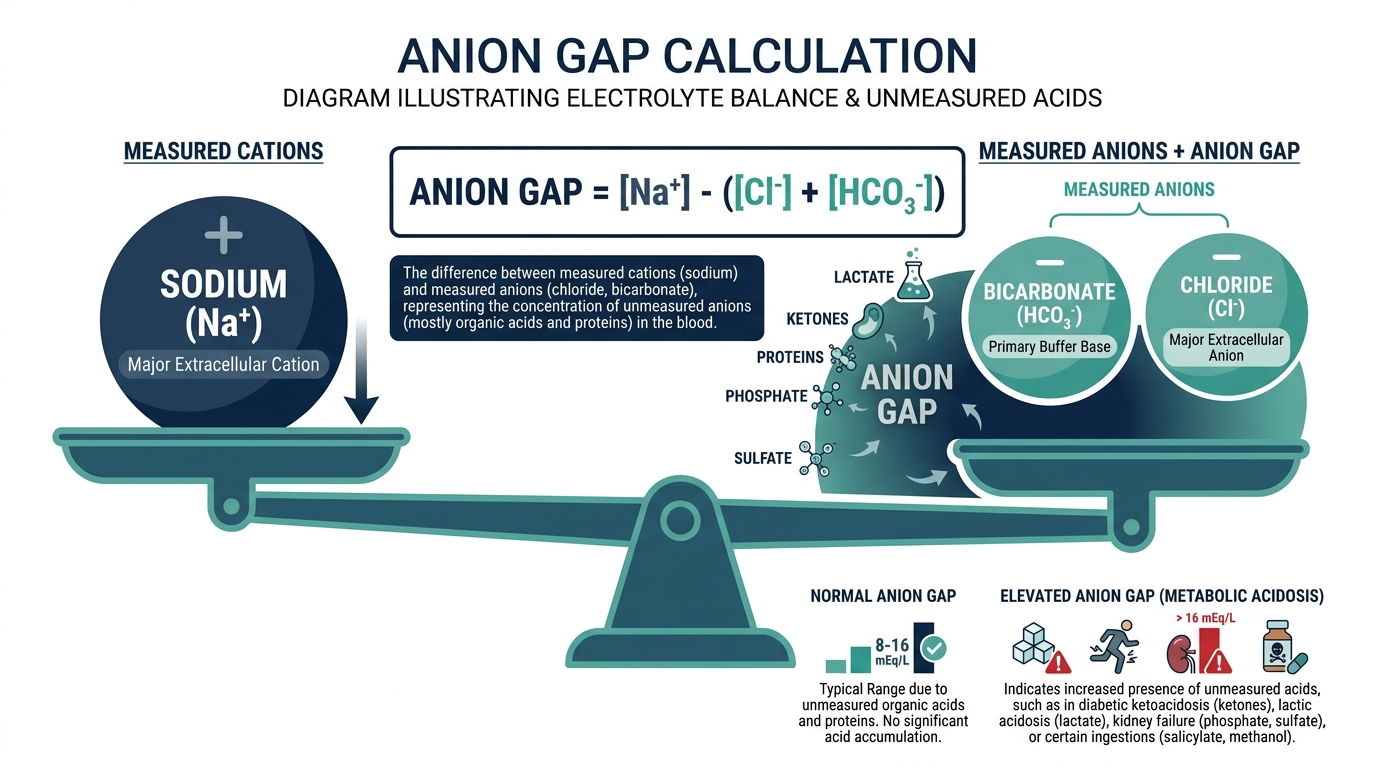
The anion gap in a blood test is a calculated number that estimates the difference between the positively charged and negatively charged particles (electrolytes) in your blood (Cleveland Clinic). Your lab does not measure it directly. A computer derives it from electrolytes already on your basic or comprehensive metabolic panel, mainly sodium, chloride, and bicarbonate (reported as CO2).
The standard formula is sodium minus the sum of chloride and bicarbonate, written as Na minus (Cl + HCO3). Some labs add potassium to the sodium side. A normal anion gap is usually in the range of 8 to 12 mEq/L when potassium is left out, or roughly 12 to 16 mEq/L when potassium is included (StatPearls, NCBI). In plain terms: the anion gap is a balance check. When acids you cannot see start piling up, the gap widens, and that is the signal clinicians are watching for.

What does anion gap mean in a blood test?
What anion gap means in a blood test is simple once you see the logic. Your blood must stay electrically neutral, so the total positive charges and total negative charges always equal each other. The lab only measures a few of each. The “gap” is the chunk of negative charges that routine tests do not capture, things like phosphate, sulfate, lactate, and proteins (StatPearls, NCBI).
In a healthy person that unmeasured chunk is small and stable. When an abnormal acid floods the bloodstream, for example ketones in uncontrolled diabetes or lactate during shock, it brings extra negative charges with it. Those charges are not on the standard panel, so they show up as a bigger gap. That is why the anion gap can flag a problem even when sodium, chloride, and CO2 each look acceptable on their own. It is the bloodhound for acid that has no dedicated test of its own.
What is a normal anion gap level?
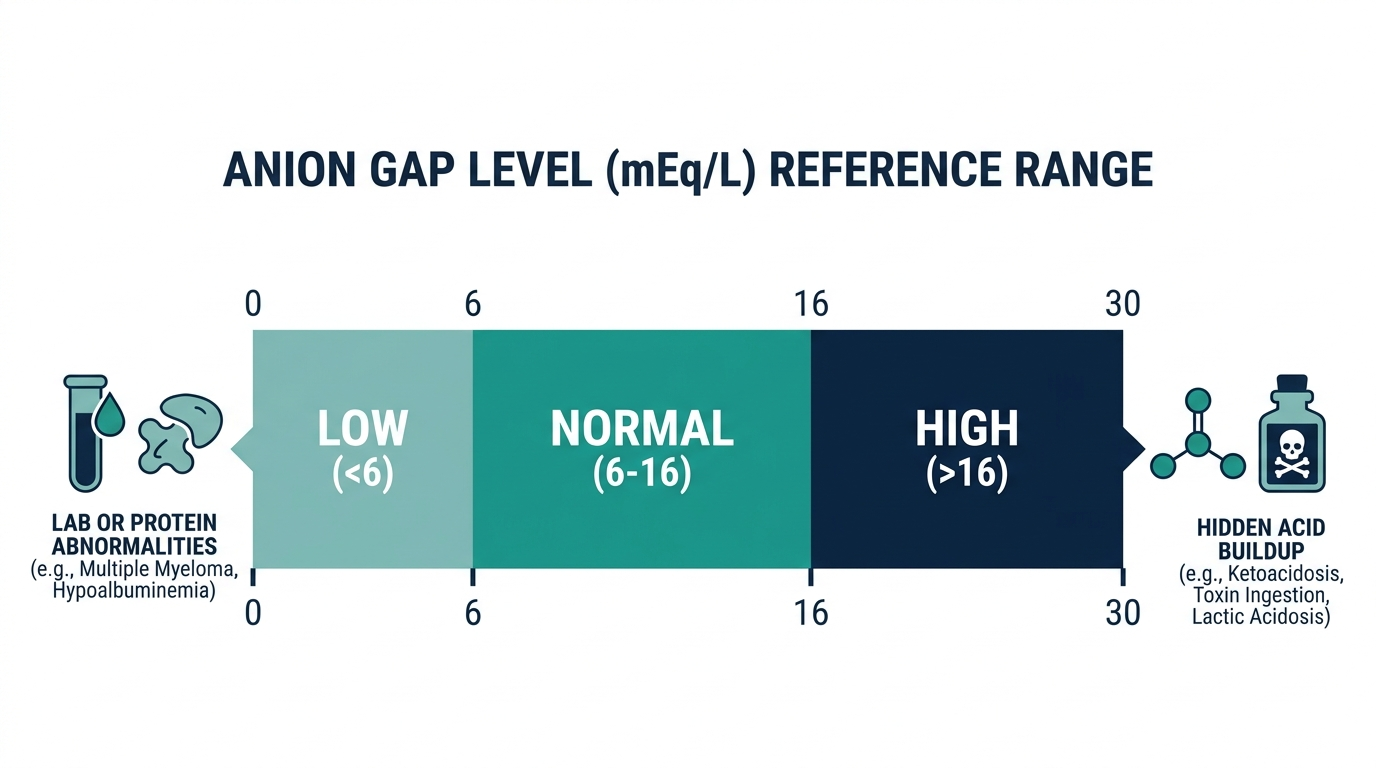
A normal anion gap is generally about 8 to 12 mEq/L using the common formula that excludes potassium, and around 12 to 16 mEq/L when potassium is part of the calculation (StatPearls, NCBI). There is one wrinkle that matters: Cleveland Clinic stresses there is no single universal normal anion gap, because each lab calibrates its own range based on its instruments and methods (Cleveland Clinic).
So the practical takeaway is to read your result against the reference range printed on your own report, not against a number you found online. A value a few points above the top of your lab’s range is the point where a clinician starts asking what acid might be hiding underneath.
What does a high anion gap mean?
A high anion gap usually means there is too much acid in your blood, a state called high anion gap metabolic acidosis (Cleveland Clinic). It is not a diagnosis by itself. It is a pointer toward a fairly defined list of causes, and figuring out which one is the real clinical work.
The classic culprits behind a high anion gap include (StatPearls, NCBI):
- Ketoacidosis. Most often diabetic ketoacidosis, where ketone acids build up fast. Starvation and heavy alcohol use can do it too.
- Lactic acidosis. From shock, sepsis, low oxygen, or severe exertion, when tissues produce lactate faster than the body clears it.
- Kidney failure (uremia). Failing kidneys cannot excrete acids and retained anions, so they accumulate.
- Toxic ingestions. Methanol, ethylene glycol (antifreeze), and aspirin (salicylate) overdose all generate acid that widens the gap.
Clinicians remember these with mnemonics like MUDPILES or the newer GOLDMARK, both of which are just memory aids for the same short list of acids (StatPearls, NCBI). When the gap is high, the next step is almost always to chase the specific cause: a glucose and ketone check, a lactate level, kidney function, and a careful history.
Here is the insider point that rarely makes it into the patient summary. A high anion gap is one of the few lab values that can be a genuine emergency on its own. A markedly widened gap in someone who is breathing fast, confused, or has fruity-smelling breath can mean diabetic ketoacidosis or a toxic poisoning that needs treatment within hours, not days (Cleveland Clinic). That is the opposite of most quietly abnormal lab numbers. The anion gap is less a long-term risk marker and more a real-time smoke detector.

What does a low anion gap mean?
A low anion gap is uncommon, and most of the time it is not caused by acid problems at all (Cleveland Clinic). The single most frequent reason is low albumin (hypoalbuminemia). Albumin is a negatively charged protein, so when its level drops the calculated gap shrinks even when nothing is wrong with your acid balance.
Because albumin distorts the math, this is one of the most overlooked traps in reading the anion gap. Many clinicians use a corrected anion gap, adding roughly 2.5 mEq/L back for every 1 g/dL that albumin sits below normal, so a dangerous acidosis is not hidden by a low protein level (StatPearls, NCBI). Beyond low albumin, a low anion gap can occasionally point to issues such as certain kidney, heart, or liver problems, or some cancers, which is why it should be interpreted in context rather than dismissed (Cleveland Clinic).
Why is anion gap measured with an electrolyte panel?
The anion gap is calculated alongside an electrolyte panel because it needs those exact electrolytes to exist, and because it adds information none of them give individually. Your provider may order an anion gap test together with an electrolyte panel to look more closely at your acid and base balance (MedlinePlus).
An electrolyte panel measures sodium, potassium, chloride, and bicarbonate, and is used to find out whether your body has a fluid imbalance or an imbalance in acid and base levels (MedlinePlus). The anion gap takes three of those numbers and turns them into a single sensitivity check. Each electrolyte can fall inside its own normal range while the relationship between them quietly drifts. The gap catches that drift. Think of the panel as the individual instruments and the anion gap as the chord they make when played together. One off note can be inaudible until you hear them combined.
This is also why bicarbonate (CO2) carries so much weight in the calculation. Bicarbonate is the base that helps maintain your body’s acid-base balance, and a low bicarbonate is itself a sign of acidosis (MedlinePlus). When acid consumes bicarbonate, the gap widens. The anion gap and bicarbonate are really two views of the same struggle to keep your blood pH steady.
The two families of metabolic acidosis, and why the gap sorts them
The single most useful thing the anion gap does is split metabolic acidosis into two branches, because each branch has a completely different cause list and a different workup. When acid builds up, clinicians immediately ask one question: is the gap wide or normal?
High anion gap metabolic acidosis happens when an unmeasured acid is added to the blood. The acid brings its own negative charges (the conjugate base), and because those charges are not on the standard panel, the gap widens. This is the branch that includes diabetic ketoacidosis, lactic acidosis, kidney failure, and toxic ingestions.
Normal anion gap metabolic acidosis (also called hyperchloremic acidosis) is different. Here the body loses bicarbonate rather than gaining a mystery acid, and chloride rises to take bicarbonate’s place. Because a measured anion (chloride) replaces the lost bicarbonate, the charges stay balanced and the gap stays normal even though the blood is genuinely acidic. The classic causes are severe diarrhea, which flushes bicarbonate out through the gut, and renal tubular acidosis, a kidney handling problem. This is why a normal anion gap does not rule out acidosis, a point that trips up even careful readers.
So the gap is not just a yes-or-no acid detector. It is a fork in the road that tells the clinician which of two very different problem lists to work through.

MUDPILES and GOLDMARK, unpacked
The memory aids for a high anion gap acidosis are worth understanding rather than memorizing, because each letter is a real mechanism.
- Ketoacids come from diabetic ketoacidosis, prolonged starvation, or heavy alcohol use, when the body burns fat for fuel and produces acidic ketone bodies.
- Lactate accumulates when tissues run short of oxygen, as in shock, sepsis, or extreme exertion, or when the liver cannot clear it fast enough.
- Uremic acids build up when failing kidneys cannot excrete the acids and phosphates the body makes every day.
- Toxic alcohols and drugs such as methanol, ethylene glycol (antifreeze), and salicylate (aspirin) either are acids themselves or are metabolized into acids. These are the causes that make a high gap a poisoning emergency.
The older MUDPILES mnemonic and the newer GOLDMARK list are simply two ways of grouping this same short menu of acids. What matters for a reader is the logic underneath: a wide gap means an acid was added, and there is a finite, well-defined list of what that acid usually is.
Symptoms that travel with a dangerous gap
The anion gap number itself is silent, but the acidosis it flags often is not. A markedly widened gap tends to appear alongside a cluster of symptoms that deserve urgent attention.
- Rapid, deep breathing (Kussmaul respirations), the body’s attempt to blow off carbon dioxide and offset the acid, is one of the most telling signs.
- Confusion, drowsiness, or difficulty concentrating, as the acid affects brain function.
- Fruity-smelling breath, a hallmark of the ketones in diabetic ketoacidosis.
- Nausea, vomiting, and abdominal pain, common in both ketoacidosis and some poisonings.
- A racing heartbeat and low blood pressure, especially when shock is driving a lactic acidosis.
A high gap with any of these features is not a number to schedule a follow-up around. It is a reason to seek emergency care, because the underlying causes can worsen within hours.
Correcting the gap for albumin, with a worked example
Because albumin is a major unmeasured negative charge, a low albumin lowers the baseline gap and can mask a real acidosis. This is one of the most practical adjustments in the whole topic, and it is easy to follow. The common correction adds roughly 2.5 mEq/L back to the gap for every 1 g/dL that albumin sits below a normal value near 4 g/dL.
Consider a patient whose calculated anion gap reads 12, which looks perfectly normal, but whose albumin is only 2 g/dL. Albumin is 2 g/dL below the reference point of 4, so the correction adds about 2 times 2.5, or 5 mEq/L. The corrected gap is roughly 17, which is elevated. Without the correction, a genuine high-gap acidosis would have been dismissed as normal. This is exactly why clinicians treating sick, malnourished, or hospitalized patients, who often have low albumin, routinely correct the gap before trusting it.

How the gap guides treatment, not just diagnosis
The anion gap is not only a way in; it is also a way to track a patient back to health. In diabetic ketoacidosis, for example, the goal of treatment is to clear the ketone acids, and the closing of the anion gap is one of the signals clinicians use to judge whether therapy is working and when it is safe to step down intensive treatment. A gap that is narrowing toward normal suggests the underlying acid is being cleared, while a gap that stays stubbornly wide despite treatment prompts a search for a second problem. This monitoring role is a big part of why the gap earns its keep: it is cheap, it is calculated automatically from tests already being run, and it moves in real time as the patient improves or deteriorates.
Reading three sample results the way a clinician does
The gap only means something in the company of the numbers around it. Here is how the same calculation leads to different conclusions.
- Gap 22, glucose very high, ketones present, breathing rapid. This reads as diabetic ketoacidosis until proven otherwise. The wide gap plus high glucose plus ketones plus Kussmaul breathing is a coherent emergency picture, and the response is urgent care, not a repeat draw.
- Gap 10, bicarbonate low, chloride high, recent severe diarrhea. A normal gap with a genuinely low bicarbonate points to normal anion gap (hyperchloremic) acidosis from gastrointestinal bicarbonate loss. The normal gap is the clue that the problem is lost base, not added acid.
- Gap 6, albumin 2.2 g/dL, patient hospitalized and undernourished. A low gap here is almost entirely explained by low albumin. After correcting for albumin, the true gap may be normal or even elevated, which is why the correction is done before drawing conclusions.
Who is this number really for, and what happens next
The anion gap is not a marker most healthy people need to think about on its own, because it rides for free on panels drawn for other reasons. It becomes clinically important mainly in acute settings: someone arriving unwell, a person with diabetes who is sick or dehydrated, a patient with known kidney disease, or anyone with a suspected poisoning. In those situations the gap is one of the first values a clinician glances at.
If your routine panel shows a mildly high gap and you feel well, the usual path is straightforward: the clinician confirms the value is truly out of your lab’s range, considers simple explanations like dehydration or a recent result quirk, checks related numbers such as bicarbonate and albumin, and decides whether to repeat the panel. A markedly high gap, or a high gap with any symptoms, moves quickly to targeted tests for the specific acid: glucose and ketones, a lactate level, kidney function, and a careful medication and exposure history. The gap points the direction; the follow-up tests name the cause.
Common misunderstandings about the anion gap
- “A normal anion gap means my acid balance is fine.” Not necessarily. Normal anion gap metabolic acidosis, from diarrhea or certain kidney problems, is real acidosis with a normal gap. The gap sorts acidosis into types; it does not rule it out.
- “The anion gap is an electrolyte I can change with diet.” No. It is a calculated relationship among electrolytes, not a substance you eat, drink, or supplement.
- “A slightly high gap is an emergency.” Context decides. A gap a point or two above range in a well person is often minor, while a markedly high gap with rapid breathing or confusion is urgent. The number and the person are read together.
- “A low gap means I am healthy.” Usually a low gap just reflects low albumin, and occasionally it hints at other conditions. It is interpreted in context rather than treated as reassurance.
Frequently asked questions
Is a high anion gap something to worry about?
It can be, more than most lab abnormalities. A high anion gap suggests too much acid in your blood (metabolic acidosis), and the causes range from diabetic ketoacidosis to kidney failure to poisoning (Cleveland Clinic). A markedly high gap with symptoms like rapid breathing or confusion can be a medical emergency, so it should always be evaluated promptly by a clinician.
What is a normal anion gap level?
A normal anion gap is generally about 8 to 12 mEq/L without potassium, or roughly 12 to 16 mEq/L when potassium is included (StatPearls, NCBI). There is no single universal value, so always compare your result to the reference range on your own lab report (Cleveland Clinic).
What does a high anion gap usually mean?
It usually means high anion gap metabolic acidosis, an excess of acid in the blood. Common causes include ketoacidosis, lactic acidosis, kidney failure, and toxic ingestions such as methanol, ethylene glycol, or aspirin (StatPearls, NCBI). The number points to a cause that then needs to be confirmed with other tests.
Why would my anion gap be low?
The most common reason is low albumin, a negatively charged blood protein, which mathematically shrinks the gap without any acid problem (StatPearls, NCBI). A low anion gap is rare and can occasionally relate to kidney, heart, liver, or other conditions, so it is interpreted in context (Cleveland Clinic).
Do I need a separate blood draw for the anion gap?
No. The anion gap is calculated from electrolytes already measured on a metabolic or electrolyte panel, mainly sodium, chloride, and bicarbonate, so no extra needle stick is needed (MedlinePlus).
This article is for general educational purposes and is not medical advice. It cannot diagnose or treat you and does not replace your clinician. Always discuss your lab results and any health decisions with a qualified healthcare professional.
Vital Signs Today may earn a commission if you buy through links on this page. It does not affect our editorial assessments.