
Related: How to bring BUN back into range
You scanned your blood work, saw your cholesterol and glucose, and somewhere in the metabolic panel you hit three letters: BUN. A number sat next to it, no flag, no asterisk, so you moved on. Here is what most people miss. BUN is one of the oldest and most quietly useful numbers on the page, and it is telling you something specific about an organ you almost never think about until it is in trouble: your kidneys.
Most explainers stop at “it checks your kidneys.” That is true, but it leaves out the part that actually makes BUN worth understanding, which is how often it moves for reasons that have nothing to do with kidney disease at all.
Part of our Comprehensive Metabolic Panel guide.
What is BUN in a blood test?
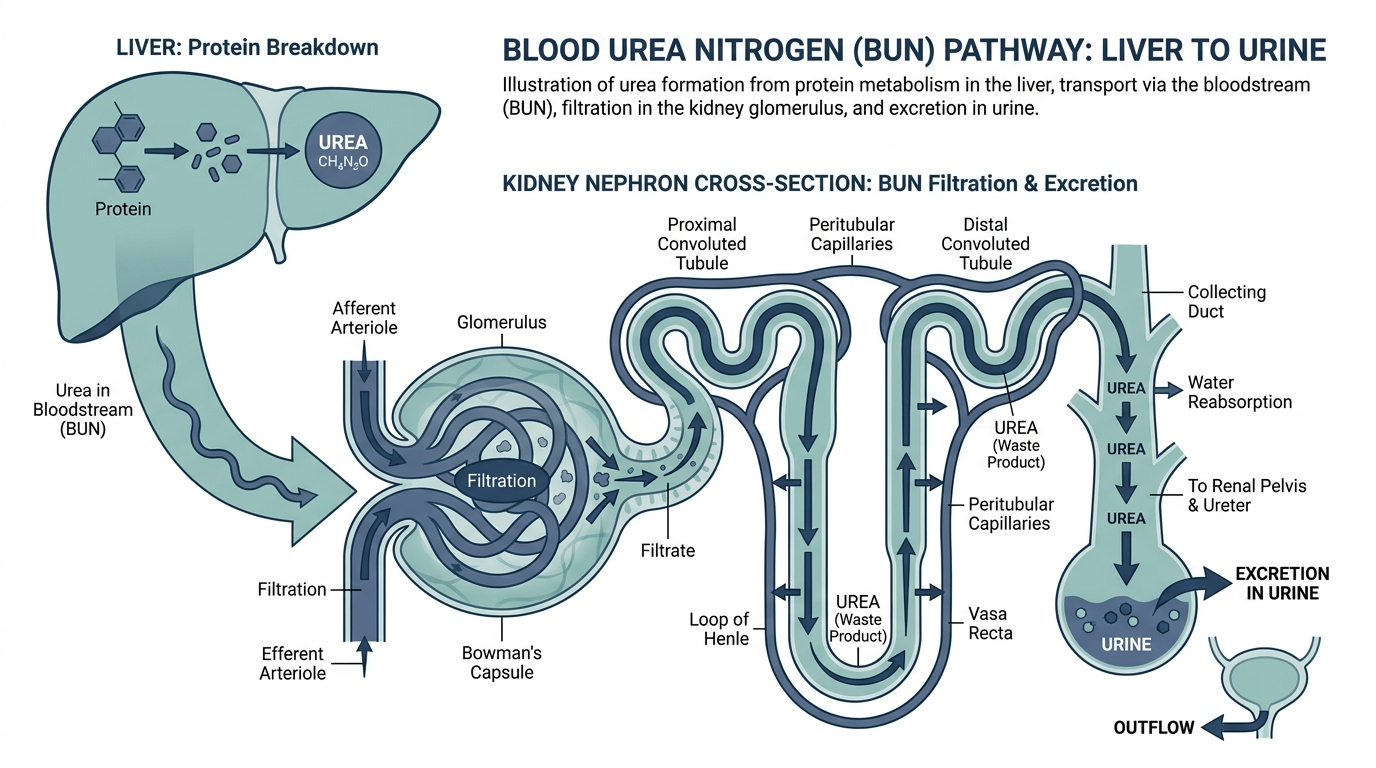
BUN stands for blood urea nitrogen, and it measures the amount of urea nitrogen in your blood, a waste product your body makes when it breaks down protein. Urea forms in your liver, travels through your blood to your kidneys, and your kidneys filter it out into your urine (Cleveland Clinic). The BUN test is most often ordered to check how well your kidneys are working (MedlinePlus). In plain terms: BUN is a measure of how much protein waste is building up in your bloodstream, and healthy kidneys keep that number low.
That single idea, waste in equals waste out, is the key to everything below. When your kidneys filter well, urea leaves your body efficiently and BUN stays in a normal band. When filtering slows down, or when too much urea is being made, the number climbs.

What does BUN mean in a blood test and what does it actually measure?
BUN measures the nitrogen portion of urea circulating in your blood, reported in milligrams per deciliter (mg/dL). Urea is the main way your body gets rid of the nitrogen left over after it uses dietary protein for fuel and repair. So a BUN result is really a snapshot of two things at once: how much protein your body is breaking down, and how well your kidneys are clearing the resulting waste (MedlinePlus).
This is why people ask what BUN means on a blood test and get a frustratingly hedged answer. The number alone cannot tell you which of those two factors moved. A high-protein diet, a recent workout, or mild dehydration can nudge it up without a single thing being wrong with your kidneys. That is also why BUN is rarely read in isolation, a point we come back to below.
What is a normal BUN level?
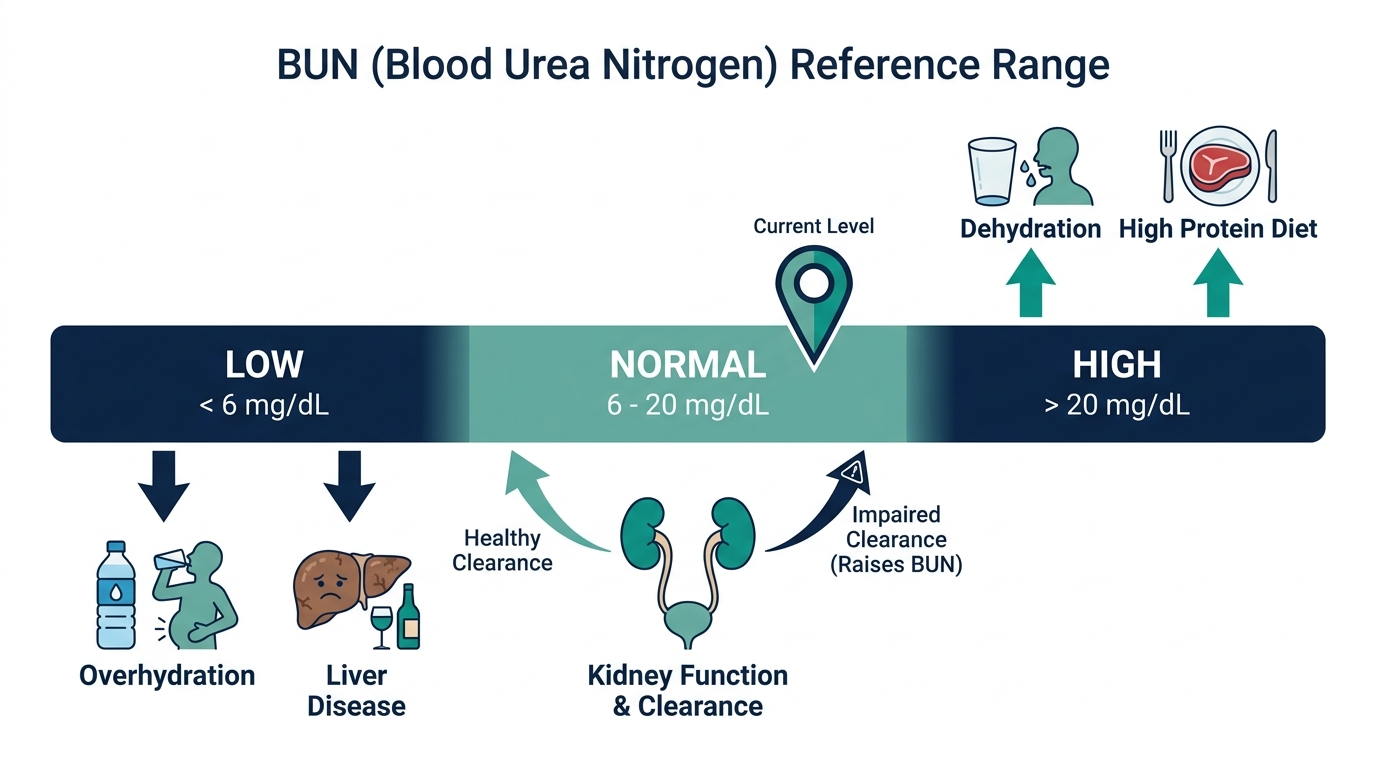
A normal BUN is generally about 6 to 20 mg/dL, although the exact range varies slightly by laboratory (MedlinePlus). The cutoffs also shift a little with age and sex. MedlinePlus lists roughly 6 to 21 mg/dL for adult women, 8 to 24 mg/dL for adult men, and 7 to 20 mg/dL for children, reflecting differences in muscle mass and protein turnover (MedlinePlus).
Here is the practical takeaway: always read your result against the reference range printed on your own report, because that is the range your lab actually calibrated its instruments to. A 22 on one lab’s scale may be flagged high while the same value sits inside normal on another.
What does a high BUN mean?
A high BUN means urea is accumulating in your blood faster than your kidneys are clearing it, but it is a clue, not a diagnosis. The list of causes is longer than most people expect, and only some of them involve the kidneys themselves (MedlinePlus):
- Kidney disease or kidney failure, where the filtering units simply cannot keep up.
- Dehydration. Less fluid means more concentrated blood and slower urea clearance, which is one of the most common reasons a BUN comes back high in an otherwise healthy person.
- Heart problems, including congestive heart failure and heart attack, which reduce blood flow to the kidneys (MedlinePlus).
- Gastrointestinal bleeding, because blood in the gut is digested protein, which raises urea production.
- A very high-protein diet or breakdown of body tissue, which feeds more nitrogen into the system (Cleveland Clinic).
Now here is the insider point that rarely makes it into the patient version. Clinicians do not panic over a single elevated BUN, because BUN is unusually sensitive to hydration and diet. The first question a good clinician asks about a high BUN is not “is this kidney disease” but “is this person dry.” A patient who skipped fluids before a fasting blood draw can post a high BUN that normalizes completely after a glass of water and a meal. That is exactly why BUN is almost always interpreted next to creatinine, which we get to in a moment.

What does a low BUN mean?
A low BUN is usually less concerning than a high one, and on its own it rarely signals an emergency. It means less urea is being made or your blood is more diluted than usual. The common causes include a low-protein diet or malnutrition, drinking large amounts of fluid (overhydration), and liver disease (MedlinePlus).
The liver connection is worth flagging. Because urea is manufactured in the liver, severe liver disease can drop BUN even when the kidneys are working perfectly (MedlinePlus). So a low BUN is one of those results that only makes sense in context, which is why it should be read by a clinician who can see the rest of your panel and your history.
Why is BUN measured together with creatinine?
BUN rarely tells the full story alone, so it is read next to creatinine, another waste product cleared by the kidneys, and the comparison between the two is what makes BUN genuinely useful. Creatinine comes from muscle metabolism and is far less affected by diet and hydration, so it acts as a steadier reference point. When both BUN and creatinine are high together, kidney failure becomes much more likely (Cleveland Clinic).
Clinicians often look at the BUN-to-creatinine ratio to figure out where a problem sits:
- High BUN with a high ratio often points to something before the kidney, like dehydration or reduced blood flow, where the kidney itself is structurally fine but starved of fluid.
- High BUN with a high creatinine and a more normal ratio shifts suspicion toward the kidney tissue itself.
- BUN read alongside creatinine and eGFR gives a fuller map of kidney function than any one number can.
This pairing is the whole reason BUN survives on modern panels. By itself it is noisy. Anchored to creatinine, that same noise becomes signal, separating a dehydrated patient from one with failing kidneys using two cheap, routine numbers.
The part most people never hear: BUN as a quiet risk signal
This is where BUN goes from a routine kidney check to something researchers actively study as a prognostic marker. Over the last decade, a growing body of work has found that BUN and the BUN-to-creatinine ratio track with survival across very different groups of patients, often independent of the obvious risk factors.
In a large study of the general population, the relationship between the BUN-to-creatinine ratio and all-cause mortality was U-shaped, meaning both unusually low and unusually high ratios carried higher risk. The lowest mortality clustered in a middle band of roughly 11.4 to 14.6, which the authors suggested may reflect a healthy balance of protein intake and metabolism (PMC, BUN/creatinine ratio and all-cause mortality). In sicker populations the signal is sharper. Among patients with vasculitis and acute kidney injury, BUN was an independent predictor of both short-term and long-term death, with mortality risk climbing steeply once BUN crossed about 32 mg/dL (PMC, prognostic value of BUN in vasculitis).
Why would a humble waste product predict outcomes? The honest answer is that BUN is a sensitive mirror of several stresses at once: kidney function, hydration, protein breakdown, and the body’s neurohormonal state. A persistently high BUN can be a quiet readout of a body under strain rather than a single disease. You will not get a diagnosis from one elevated BUN, but a number that stays high across repeat tests is a reasonable reason to look closer rather than scroll past.

Reading the BUN-to-creatinine ratio like a clinician
Since the ratio is where BUN earns its keep, it helps to know the actual numbers clinicians reach for. A normal BUN-to-creatinine ratio generally sits between about 10 and 20 to 1, and where your ratio falls outside that band points toward different categories of problem (MDCalc).
- Ratio above 20 (prerenal pattern): This usually points to a problem before the kidney, meaning the kidney tissue is fine but not getting enough blood or fluid. Dehydration, heart failure, and gastrointestinal bleeding are the classic culprits. BUN rises out of proportion to creatinine because a fluid-starved kidney reabsorbs more urea while creatinine stays relatively steady.
- Ratio between 10 and 20: The typical normal band, and when both BUN and creatinine are elevated within this ratio, suspicion shifts toward the kidney tissue itself, an intrinsic renal problem.
- Ratio below 10: Often reflects something other than kidney filtering, such as liver disease, a low-protein diet, or muscle breakdown, since these change how much urea is produced relative to creatinine.
One honest caveat that the literature itself stresses: the ratio is a useful pointer, not a verdict. It cannot reliably separate every cause of kidney injury on its own, and it is one input among several rather than a standalone test (PMC). Still, for a quick read on whether a high BUN is more likely dehydration or true kidney trouble, it is one of the most practical calculations in routine medicine.
Things that shift your BUN that have nothing to do with disease
Because BUN reflects both protein turnover and hydration, a surprising number of everyday factors can nudge it. Knowing these prevents a lot of needless worry over a mildly abnormal result.
- Your last meal. A large steak dinner the night before a draw loads your system with protein to break down, temporarily raising BUN.
- How much you drank. Under-hydration concentrates the blood and slows urea clearance, while heavy fluid intake dilutes it. This is why the same person can post different BUN values on different mornings.
- Intense exercise and muscle breakdown. Hard training or any process that breaks down tissue feeds more nitrogen into the system.
- Certain medications. Some drugs raise BUN, including corticosteroids and, in some situations, diuretics that affect fluid balance, while others can lower it. This is worth mentioning to your clinician if your BUN looks off.
- Age and muscle mass. Older adults and people with more muscle tend to run different baselines, which is part of why reference ranges shift by age and sex.
The practical upshot: a mildly high or low BUN in someone who feels well, drinks normally, and has a normal creatinine is rarely alarming on its own. Context is everything, and a single number pulled out of that context can mislead more than it informs.
Symptoms that make a high BUN worth acting on
A number on a page matters more when it is paired with how you feel. A mildly elevated BUN in a well person is usually just noise. But when urea and other wastes build up because the kidneys are genuinely struggling, a cluster of symptoms called uremia can appear, and these are the signals that turn a lab value into a reason to seek care promptly.
- Persistent fatigue, weakness, or trouble concentrating.
- Nausea, loss of appetite, or a metallic taste.
- Swelling in the legs, ankles, or around the eyes.
- Noticeably less urine, or urine that looks foamy.
- Confusion or difficulty thinking clearly in more advanced cases.
None of these prove kidney disease by themselves, since they overlap with many ordinary conditions. But a high BUN accompanied by several of them, especially alongside a high creatinine, is a different situation from an isolated high BUN in someone who feels perfectly fine. If your result is flagged and you also feel unwell in these ways, that pairing is worth a same-week conversation with your clinician rather than a wait-and-see.

How BUN fits with eGFR and the fuller kidney picture
BUN and creatinine are two pieces of a larger kidney assessment, and the number that has increasingly taken center stage is eGFR, the estimated glomerular filtration rate. Where BUN is sensitive and noisy and creatinine is steadier, eGFR uses creatinine along with your age and sex to estimate how much blood your kidneys filter per minute, which is the closest routine proxy for overall kidney function.
Think of it as a layered read. BUN is the quick, hydration-sensitive gauge. Creatinine anchors it. eGFR translates creatinine into a functional score that defines the stages of chronic kidney disease. A clinician looking at a high BUN will almost always glance at all three together, because BUN answers “is waste building up right now,” creatinine answers “how much of that is the kidney versus diet and fluid,” and eGFR answers “how well are these kidneys actually filtering overall.” No single one tells the whole story, which is exactly why they travel together on a metabolic panel.
Who should pay closest attention to BUN, and how often
For a healthy person, BUN is simply part of a routine metabolic panel and rarely needs standalone attention. But certain groups have real reason to watch it more closely and repeat it on a schedule their clinician sets.
- People with diabetes or high blood pressure, the two leading drivers of chronic kidney disease, who benefit from regular kidney monitoring.
- Anyone with known kidney disease, where BUN alongside creatinine and eGFR tracks whether function is stable or declining.
- People on medications that affect the kidneys, where periodic checks catch trouble early.
- Older adults, in whom kidney function naturally declines and dehydration is more common.
- People with heart failure, given the tight link between cardiac output and kidney blood flow.
For these groups, the value of BUN is not in any single reading but in the trend. A number that drifts upward across several tests, even while staying technically within range, can be a more meaningful signal than one isolated flag. That is the difference between using BUN as a snapshot and using it as a moving picture of how your kidneys are holding up over time.
Common misconceptions about the BUN number
A few persistent misunderstandings cause people to over-read or under-read this result. Clearing them up makes the number far less intimidating.
- “A high BUN means kidney disease.” Not by itself. Dehydration is one of the most common reasons an otherwise healthy person posts a high BUN, and it resolves with fluids. The kidney question only sharpens when creatinine rises too.
- “BUN measures a toxin that is poisoning me.” Urea is a normal waste product your body makes every day from protein. In ordinary amounts it is simply cleared. It only becomes a problem when it accumulates because clearance has failed.
- “A low BUN is dangerous.” A low BUN is usually the least worrying of the two directions and often just reflects a lower-protein diet or generous fluid intake. Its main use is as a clue in context, such as flagging possible liver issues.
- “My number changed, so something is wrong.” BUN fluctuates naturally with meals and hydration. A single reading a few points different from last time is expected, not alarming. The trend across several tests carries the real meaning.
Read this way, BUN becomes what it was always meant to be: a cheap, fast, sensitive early gauge that is powerful precisely because it is easily moved, as long as you interpret it alongside creatinine, eGFR, your symptoms, and how you have been eating and drinking.
Frequently asked questions
What is a BUN blood test used for?
A BUN blood test is used mainly to check how well your kidneys are filtering waste from your blood, and it is a routine part of a basic or comprehensive metabolic panel (Cleveland Clinic). It can also help monitor known kidney disease and is interpreted alongside creatinine and eGFR.
What is a normal BUN level?
A normal BUN is generally about 6 to 20 mg/dL, though the range varies slightly by lab, age, and sex (MedlinePlus). Always compare your result to the reference range printed on your own report.
Should I worry about a high BUN?
Not from one result alone. A high BUN is a clue, not a diagnosis, and common causes include dehydration, a high-protein diet, and heart or kidney problems (MedlinePlus). Your clinician will usually look at it alongside creatinine to sort out the cause.
What does a low BUN mean?
A low BUN usually reflects a low-protein diet, malnutrition, overhydration, or liver disease, since urea is made in the liver (MedlinePlus). On its own it is rarely an emergency but should be interpreted in context.
Why is BUN measured with creatinine?
Because BUN is sensitive to diet and hydration, it is read next to creatinine, which is steadier, and the two together help separate dehydration from true kidney disease (Cleveland Clinic). When both are high together, kidney failure is more likely.
This article is for general educational purposes and is not medical advice. It cannot diagnose or treat you and does not replace your clinician. Always discuss your lab results and any health decisions with a qualified healthcare professional.
Vital Signs Today may earn a commission if you buy through links on this page. It does not affect our editorial assessments.