Part of our Complete Blood Count guide.
You scanned your complete blood count, saw your hemoglobin was fine, and relaxed. Then your eyes snagged on three letters tucked in with the red cell numbers: MCH. No flag, no asterisk, so you moved on. Here is what most people miss. MCH is one of the first numbers a hematologist actually looks at to figure out what kind of anemia someone has, often before anything else on the page is even out of range.
Most explainers reduce MCH to a single line about anemia. It is more useful than that, and once you understand what it really measures, you read your own results differently.
What is MCH in blood test results?
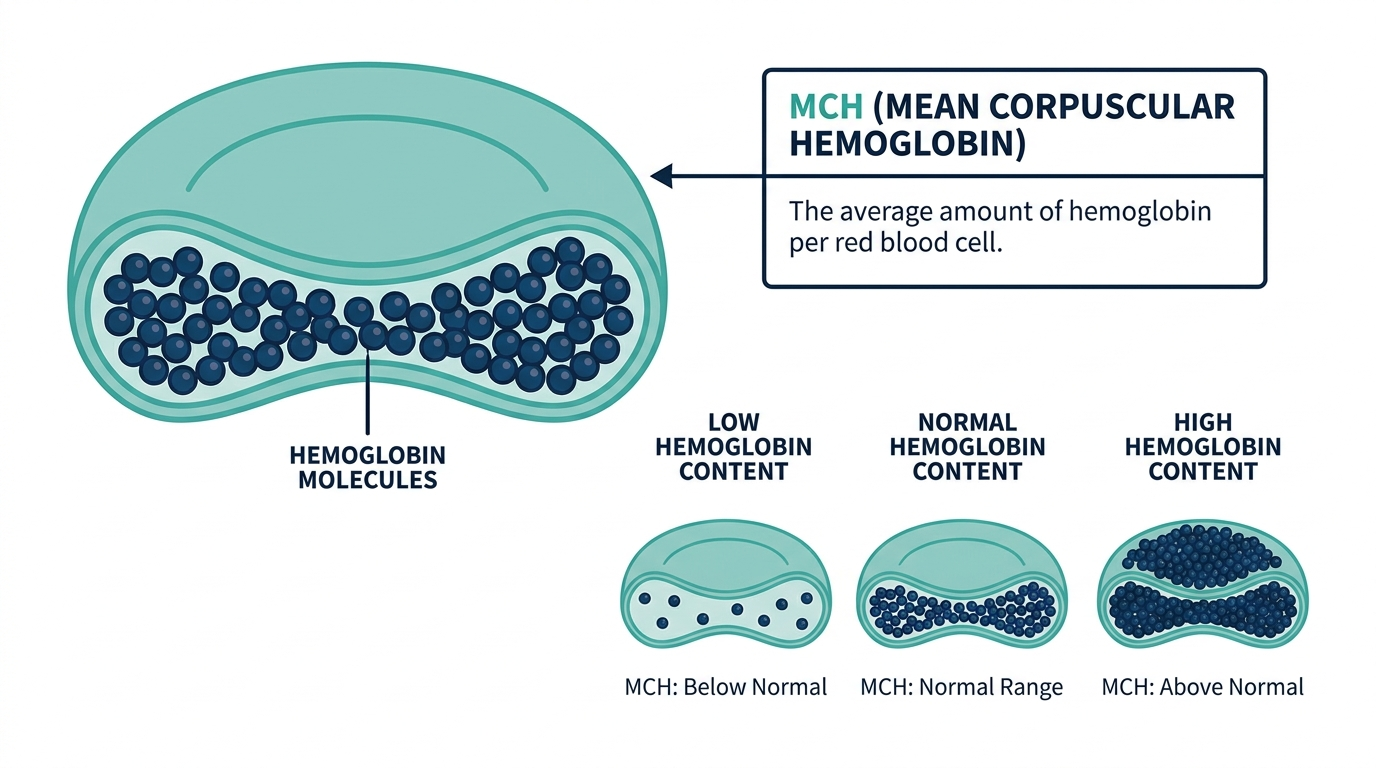
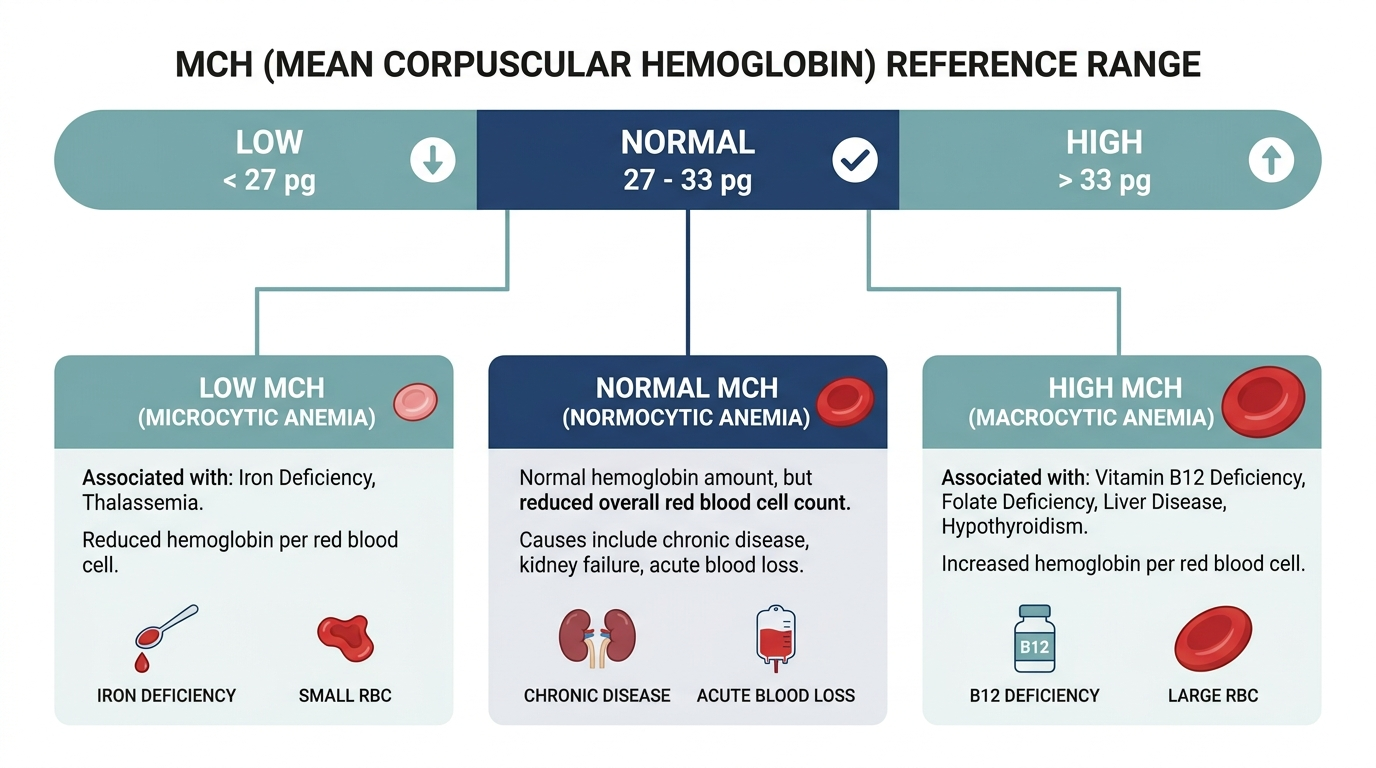
MCH stands for mean corpuscular hemoglobin, and it measures the average amount of hemoglobin packed inside a single red blood cell. It is reported automatically as one of your red blood cell indices on a standard complete blood count (CBC) (Cleveland Clinic). Hemoglobin is the iron-rich protein that lets your red cells carry oxygen, so MCH is essentially asking a simple question: how much oxygen-carrying cargo is each cell loaded with? A typical adult MCH sits around 27 to 33 picograms per cell.
That one idea, hemoglobin per cell, is the thread that runs through everything below. When red cells are built with too little hemoglobin, MCH drops. When they are built unusually large and hemoglobin-heavy, MCH climbs.
What does MCH actually measure?
MCH is not measured directly. It is calculated from two numbers your analyzer already has: your total hemoglobin and your red blood cell count (NCBI Clinical Methods). In plain terms, the lab takes all the hemoglobin in your sample and divides it evenly across all your red cells to get an average per-cell figure, reported in picograms. A picogram is a trillionth of a gram, so these are tiny weights, which is why the value is in single and double digits rather than the larger numbers you see elsewhere on the report.
People constantly confuse MCH with its near-twin, MCHC (mean corpuscular hemoglobin concentration). They sound almost identical but answer different questions. MCH is the absolute amount of hemoglobin in a cell. MCHC is how concentrated that hemoglobin is relative to the cell’s volume, reported in grams per deciliter (MedlinePlus). Think of a cell as a water bottle. MCH is how much liquid is in the bottle. MCHC is how strong the mixture is. A big cell can hold a lot of hemoglobin (high MCH) while still being relatively dilute (normal MCHC), which is exactly why both numbers exist.
What is a normal MCH level?
A normal MCH for adults is generally about 27 to 33 picograms per cell, regardless of sex, though the exact cutoff varies slightly by laboratory and instrument (Cleveland Clinic). Older reference texts express the same idea as roughly 29 plus or minus 2 picograms per cell (NCBI Clinical Methods). Always read your result against the reference range printed on your own report, because that is the range your lab actually calibrated its machines to.
Here is the practical takeaway. A result a point or two outside the range, with everything else normal, is usually a minor finding. The number becomes meaningful when it lines up with your hemoglobin and your red cell size to tell a consistent story.
What does a low MCH mean?
A low MCH means your red blood cells carry less hemoglobin than usual, which makes them appear pale, the condition clinicians call hypochromia. The single most common reason is iron deficiency (Cleveland Clinic). Without enough iron, your bone marrow simply cannot build hemoglobin properly, so the cells it produces come out underfilled.
The usual suspects behind a low MCH include:
- Iron deficiency, often from slow blood loss such as heavy periods or a bleeding source in the gut, which is the classic driver of low MCH (Cleveland Clinic).
- Thalassemia and other hemoglobinopathies, inherited conditions where the body makes structurally abnormal or insufficient hemoglobin (Cleveland Clinic).
- Anemia of chronic disease, driven by long-running inflammation from infection, kidney disease, liver disease, or cancer, which interferes with how the body uses iron (Cleveland Clinic).
There is a useful detail here that gets buried in most patient summaries. In iron deficiency, the markers tend to move in a predictable order, and the hemoglobin-related indices including MCH can drift down early, before a full-blown anemia is obvious (PMC, CBC parameters in iron deficiency). So a low MCH on an otherwise unremarkable CBC is not noise to ignore. It can be the first quiet hint that your iron stores are running low, which is exactly the kind of signal that gets lost when a report just says everything is normal.
What does a high MCH mean?
A high MCH usually means your red cells are larger than normal and therefore carrying more hemoglobin each, a pattern that points toward macrocytic anemia. The most common drivers are deficiencies of vitamin B12 or folate, the two nutrients your marrow needs to build red cells of the right size (Cleveland Clinic). When those run short, the marrow produces fewer, oversized cells, and because each cell is bigger, its average hemoglobin content goes up.
Other recognized causes of an elevated MCH include long-term heavy alcohol use, an underactive thyroid, certain liver conditions, and some medications including chemotherapy (Cleveland Clinic). A high MCH is a prompt to look at vitamin levels and a few lifestyle and medication factors, not a diagnosis on its own.
Why is MCH read together with MCV?
MCH rarely tells the full story alone. Clinicians read it next to MCV, the average size of your red cells, and that pairing is the backbone of how anemia gets classified (Cleveland Clinic). The logic is intuitive once you see it: bigger cells (high MCV) tend to hold more hemoglobin (high MCH), and smaller cells (low MCV) tend to hold less (low MCH). The two indices usually move in the same direction, and when they do not, that mismatch is itself a clue.
A simplified version of how the two combine:
- Low MCH with low MCV (microcytic, hypochromic): the classic signature of iron deficiency anemia or thalassemia trait.
- High MCH with high MCV (macrocytic): points toward vitamin B12 or folate deficiency, or causes like alcohol use and liver disease.
- Normal MCH with normal MCV: often a normocytic picture, which can appear in anemia of chronic disease or early in a deficiency.
This is why MCH earns its place on the report. With one cheap, automatically calculated number, a clinician can sort a vague complaint of fatigue into a much narrower list of likely causes before ordering a single follow-up test. A normal MCV alone can be misleading when cell sizes vary widely, because the extremes average out, which is exactly why the indices are read as a set rather than one at a time (Cleveland Clinic).
The part most people never hear: why MCH alone can fool you
Here is the insider caveat that almost never makes it into a patient handout. MCH is a calculated average, and averages hide what is happening at the edges. Because MCH is derived from total hemoglobin divided by red cell count, two people with very different blood can land on the same MCH. Someone with a mix of pale, underfilled cells and a few oversized ones can average out to a perfectly normal MCH while their blood is anything but normal underneath.
This is exactly why hematologists treat the red cell indices as a starting point, not a verdict. The reference texts are blunt about it: an evaluation of anemia is not complete without examining a well-prepared peripheral blood smear under the microscope, because the indices alone cannot reveal certain abnormalities that an experienced eye can spot directly (NCBI Clinical Methods). It is also why MCH is best read alongside MCV and RDW. MCV gives you the average size, RDW tells you how varied the sizes are, and MCH ties in the hemoglobin load. The practical lesson for you is simple. A single MCH value, high, low, or normal, is a clue and never the whole answer. The story lives in the pattern across the whole CBC, not in any one line.

The whole red cell index family, and what each one adds
MCH is one of a small set of numbers your analyzer reports together, and understanding how they divide up the labor makes any one of them far easier to read. They answer four different questions about the same red cells.
| Index | Question it answers | Units |
|---|---|---|
| MCV (mean corpuscular volume) | How big is the average cell? | Femtoliters (fL) |
| MCH (mean corpuscular hemoglobin) | How much hemoglobin does the average cell carry? | Picograms (pg) |
| MCHC (mean corpuscular hemoglobin concentration) | How concentrated is the hemoglobin inside the cell? | Grams per deciliter (g/dL) |
| RDW (red cell distribution width) | How much do the cell sizes vary? | Percent |
Read as a set, they tell a coherent story. MCV and MCH almost always move together, because bigger cells hold more hemoglobin. MCHC catches whether a cell is packed or diluted regardless of its size. And RDW is the quiet tiebreaker: a high RDW means your cells are a mix of sizes, which itself points toward specific diagnoses. When someone learns to glance at all four at once, a vague CBC turns into a surprisingly specific map.
Using the Mentzer index to separate iron deficiency from thalassemia
Here is a genuinely useful trick that clinicians reach for when a low MCH and small cells raise the question of iron deficiency versus thalassemia trait, two conditions that look similar on a basic CBC but need completely different follow-up. It is called the Mentzer index, and you can compute it from numbers already on your report.
The Mentzer index is simply your MCV divided by your red blood cell (RBC) count, using the published cutoff of 13 (Mentzer index). The interpretation follows directly from the biology.
- Index above 13 favors iron deficiency. In iron deficiency, the marrow makes fewer cells and they are small, so both the RBC count and the MCV drop, pushing the ratio above 13.
- Index below 13 favors thalassemia trait. In thalassemia, the body makes a normal or high number of cells that are small, so the RBC count stays up while MCV falls, pulling the ratio below 13.
- Index of 13 to 13.5 is borderline and does not settle the question on its own.
This is a screening aid, not a diagnosis. An index above 13 points toward iron studies such as ferritin to confirm iron deficiency, while an index below 13 points toward hemoglobin electrophoresis to confirm a thalassemia trait. It matters because the wrong assumption here is costly: giving iron to someone who actually has thalassemia does not help and can cause iron overload. A low MCH is the doorway to this question, and the Mentzer index is one of the first calculations through it.
What to do after a low MCH result
If your MCH came back low, especially alongside a low MCV, the path forward is usually orderly rather than alarming. Low MCH is one of the most workable findings on a CBC because its leading cause, iron deficiency, is both common and treatable.
- Expect iron studies next. Ferritin, which reflects your iron stores, is the key follow-up. A low ferritin confirms iron deficiency and, importantly, points toward finding the cause of the iron loss.
- Look for a source of blood loss. In menstruating people, heavy periods are a frequent cause. In others, a slow gastrointestinal bleed must be considered, which is why unexplained iron deficiency sometimes prompts a look at the gut.
- Consider intake and absorption. Low dietary iron, or conditions that impair absorption such as celiac disease, can drive it too.
- Understand the timeline of correction. With treatment, hemoglobin recovers over weeks, but rebuilding iron stores and normalizing indices like MCH can take several months, which is why treatment usually continues well after you feel better.
The reassuring frame is that a low MCH caught early is a gift, because it can flag iron deficiency before it becomes a symptomatic anemia. The number gave you a head start.

What to do after a high MCH result
A high MCH, usually paired with a high MCV, sends the workup in a different direction, toward the nutrients and factors that govern red cell size.
- Check B12 and folate. These are the classic drivers of large, hemoglobin-heavy cells, and both are easily measured and correctable.
- Review alcohol intake honestly. Chronic heavy drinking is a very common cause of a raised MCH and MCV, sometimes appearing before other signs.
- Test thyroid function. An underactive thyroid can enlarge red cells and is worth ruling out.
- Review medications and liver health. Certain drugs, including some chemotherapy agents, and liver disease can all raise MCH.
As with a low result, a high MCH is a prompt, not a diagnosis. The value of the number is that it narrows a broad symptom like fatigue down to a short, checkable list of causes, most of which are straightforward to test for.
Reading MCH in context: a few real patterns
Because MCH only means something alongside its companions, here are patterns that recur and how they are typically read.
- Low MCH, low MCV, high RDW: a classic iron deficiency picture, where cells are small, underfilled, and varied in size as the marrow transitions.
- Low MCH, low MCV, normal or low RDW, high RBC count: raises suspicion for thalassemia trait, where cells are uniformly small, which is exactly the scenario the Mentzer index helps sort.
- High MCH, high MCV: points toward B12 or folate deficiency, alcohol, thyroid, or liver causes.
- Normal MCH and MCV but high RDW: can be an early sign of a developing deficiency, because a mix of old normal cells and new abnormal ones has not yet shifted the averages.
The consistent lesson is that no single index, MCH included, delivers a verdict. It contributes one line to a story that the full CBC, and sometimes a blood smear examined under the microscope, tells far more reliably than any number alone (NCBI Clinical Methods).
Things that can throw off an MCH result
Because MCH is calculated from hemoglobin and red cell count, anything that distorts either of those inputs can distort the MCH, sometimes producing a spuriously abnormal value that does not reflect your true blood. Knowing these prevents an unnecessary scare over an artifact.
- Sample handling issues. A poorly mixed or clotted tube, or a sample that sat too long, can skew the automated counts and therefore the calculated indices. This is one reason a startling one-off result is sometimes simply repeated.
- Cold agglutinins. In some conditions, red cells clump at cooler temperatures, which can fool an analyzer into miscounting and produce falsely elevated MCH or MCHC. A lab will often flag or rerun these.
- Very high white cell counts or lipemia. Extremely high white blood cell counts or a fatty, lipemic sample can interfere with the hemoglobin measurement, nudging the calculated MCH.
- Recent transfusion. If you have received donor blood, your indices reflect a blend of your own and donor cells, so the numbers can be temporarily mixed and harder to interpret.
None of this means the test is unreliable in general. It simply means that a single surprising MCH, particularly one that does not fit the rest of your CBC or how you feel, is often worth a repeat before anyone reads too much into it. Unlike some markers, MCH needs no fasting or special preparation, so a clean repeat draw is easy to obtain when a result looks out of place.
Frequently asked questions
What does MCH mean in a blood test?
MCH stands for mean corpuscular hemoglobin, the average amount of hemoglobin in a single red blood cell. It is one of your red blood cell indices on a complete blood count and helps classify the type of anemia (Cleveland Clinic).
What is a normal MCH level?
A normal MCH for adults is generally about 27 to 33 picograms per cell, regardless of sex, though ranges vary slightly by lab (Cleveland Clinic). Compare your result to the reference range printed on your own report.
What does a low MCH mean?
A low MCH means your red cells carry less hemoglobin than normal and appear pale. The most common cause is iron deficiency, and it can also reflect thalassemia or anemia of chronic disease (Cleveland Clinic).
What is the difference between MCH and MCHC?
MCH is the absolute amount of hemoglobin in a red cell, while MCHC is how concentrated that hemoglobin is relative to the cell’s volume, reported in grams per deciliter (MedlinePlus). MCH is the amount, MCHC is the concentration.
Can MCH be high or low without me feeling sick?
Yes. Red cell indices including MCH can drift before symptoms or a full anemia appear, for example in early iron deficiency (PMC, CBC parameters in iron deficiency). An out-of-range MCH on an otherwise normal CBC is a reason to look closer, not to panic.
This article is for general educational purposes and is not medical advice. It cannot diagnose or treat you and does not replace your clinician. Always discuss your lab results and any health decisions with a qualified healthcare professional.
Vital Signs Today may earn a commission if you buy through links on this page. It does not affect our editorial assessments.