
Educational content, not medical advice. Talk to a licensed clinician before starting any supplement protocol.
Short answer: Hydrolyzed collagen peptides are absorbed intact through the small intestine, reach your bloodstream within 30 minutes, and accumulate in skin, cartilage, and connective tissue where they stimulate fibroblasts to produce new collagen. Four independent randomized controlled trials show a +40% increase in skin elasticity at 12 weeks; a 2024 RCT found a 43% reduction in joint pain at 6 months; and a 2025 study published in npj Aging observed a 1.4-year reduction in biological age at 6 months of daily use.
Collagen peptides reach your bloodstream within 30 minutes, so what does the rest of your connective-tissue profile look like? One at-home Superpower draw checks 100+ biomarkers, physician-reviewed.
What exactly are collagen peptides, and how do they differ from regular collagen?
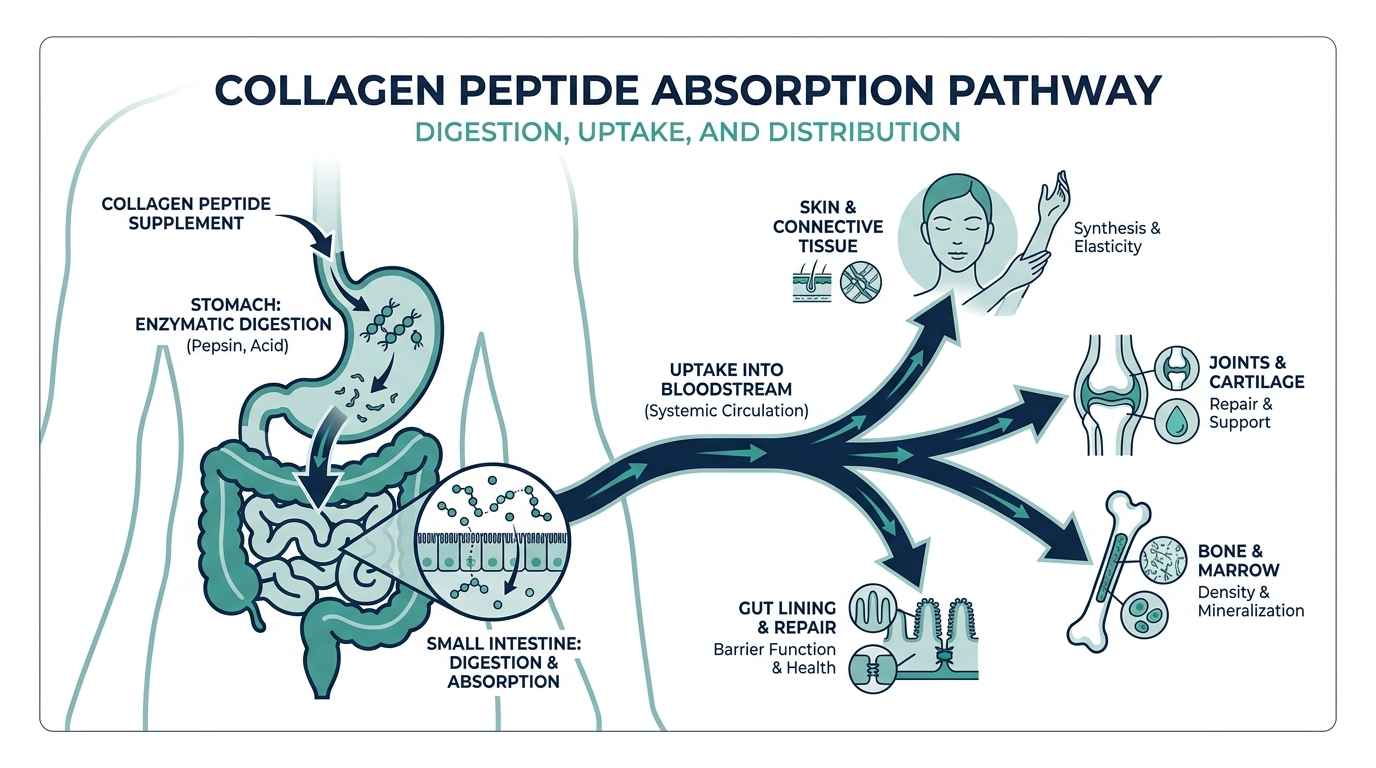
Collagen is the most abundant structural protein in the body, making up roughly 30% of total protein mass. It forms the scaffold for skin, tendons, ligaments, bones, and cartilage. The problem with eating raw collagen, think bone broth or gelatin, is that molecules are too large to be efficiently absorbed.
Collagen peptides (also called hydrolyzed collagen) solve that by breaking the protein into short-chain amino acid sequences, primarily dipeptides and tripeptides, through enzymatic hydrolysis. The dominant bioactive unit is Gly-Pro-Hyp. Molecular weight drops from roughly 300,000 Da in raw collagen to 2,000 to 5,000 Da in hydrolyzed form, which is small enough for intestinal transport.
The practical takeaway: “collagen protein” and “collagen peptides” on a label are not interchangeable. Products listing just “collagen protein” may not have gone through full hydrolysis and could behave more like gelatin.
How do collagen peptides actually get into your body?
Most supplement marketing skips straight from “you swallow it” to “it builds your skin,” and that gap is where a lot of skepticism lives. The absorption story is more interesting than the label copy suggests.
Research in the Journal of Agricultural and Food Chemistry showed that the tripeptide Gly-Pro-Hyp is partially hydrolyzed at the intestinal brush border by aminopeptidase N, releasing Pro-Hyp, which is then transported intact via the PEPT1 transporter. Highly concentrated Gly-Pro-Hyp and its hydrolyzed form appear in bloodstream plasma within 30 minutes of ingestion, peaking at 1 to 2 hours.
A 2024 randomized, double-blind crossover trial published in Frontiers in Nutrition confirmed that all tested collagen hydrolysates produced measurable plasma peptide concentrations regardless of molecular weight or source, which cuts against the marketing arms race over which brand uses the “smallest” peptides.
More recently, a 2025 study in Food & Function found a second pathway nobody talks about much: collagen peptides modulate gut microbiota composition and activate the TGF-beta pathway, which in turn drives skin collagen synthesis. This means part of the benefit is indirect, mediated through the microbiome, not just direct deposition in tissue.
Personally, I find the microbiota pathway the most underrated piece of the whole collagen conversation, because it is the kind of mechanism that explains why some people see surprisingly broad effects from supplementation that you would not predict from a skin-only model.
What does collagen do for your skin? (The strongest evidence in this category)
Skin is where the clinical evidence is densest, and the results are more consistent than I expected when I first looked at the trial data.
Four independent randomized, double-blind, placebo-controlled trials on oral collagen peptide supplementation produced a pooled +40% increase in skin elasticity after 12 weeks compared to placebo. A separate 2024 RCT in an East Asian population published in the Journal of Cosmetic Dermatology found significant improvements in visible signs of skin aging and nail health.
The most striking recent result comes from a 2025 clinical study published in npj Aging, a Nature family journal. Human participants supplementing with a specific collagen amino acid formulation showed measurable improvements in skin features within 3 months and a 1.4-year reduction in biological age (p = 0.04) within 6 months. The same paper found that the minimal effective unit is a proper ratio of glycine to proline to hydroxyproline, and the research team verified this by running the same formulation in C. elegans (increasing lifespan) and in mice aged 20 months (improved grip strength, reduced fat accumulation).
Two new clinical trials are currently running in 2026: NCT07516756 on bioactive collagen peptides and skin physiology, and NCT07529249 on skin barrier function in women with dry skin. These are not yet published, but the ongoing investment in this area is itself a signal.
Timeline for skin: Most people notice hydration and softness changes around week 3 to 4. Elasticity and wrinkle reduction appear in controlled studies at 8 to 12 weeks. Biological age effects took 6 months of consistent daily use in the npj Aging trial.
Full-body lab membership: 100+ biomarkers, doctor-reviewed, tracked over time.
Does collagen help joints and tendons? What the pain numbers actually say
The joint evidence is well-developed and often undersold by the skin-focused marketing.
A 2023 review in the Heliyon journal covering collagen supplementation in orthopedic conditions found that oral collagen intake for 4 to 6 months decreases joint pain by up to 43% and improves joint mobility by up to 39% in symptomatic populations. The mechanism is not mysterious: collagen peptides accumulate in cartilage after absorption, stimulate chondrocytes (the cells that maintain cartilage) to produce more extracellular matrix, and inhibit glycine-mediated cytokine release, which reduces local inflammation directly.
Type II collagen (found in UC-II, a different product from Type I/III powder) targets cartilage specifically and is often recommended for osteoarthritis. Type I/III collagen, which is what products like Vital Proteins Collagen Peptides provide, focuses more on skin, tendon, and ligament support. These are not interchangeable if your goal is cartilage repair specifically. Most collagen powders on shelves contain Type I and III, not Type II. Read the label.
The recommended dose for joint outcomes in most trials is 10 grams per day, with some studies using up to 15 grams. Skin-focused studies often use as little as 2.5 to 5 grams. This matters if you are buying a product dosed at 5 grams and expecting joint relief.
Bone density: what a 2025 meta-analysis found
A 2025 meta-analysis published in Frontiers in Nutrition assessed collagen peptide supplementation on bone and muscle health across multiple controlled studies. The results showed significant increases in bone mineral density (BMD) at the femoral neck and lumbar spine, particularly in postmenopausal women.
The effect is amplified when collagen peptides are combined with calcium and vitamin D. An earlier RCT had already shown that postmenopausal women taking specific collagen peptides plus calcium and vitamin D had measurably higher levels of bone formation biomarkers after 12 months compared to calcium and vitamin D alone.
Do not believe claims that collagen peptides alone can prevent or reverse osteoporosis in high-risk individuals. The honest framing is: collagen peptides appear to be a useful adjunct to an evidence-based bone health protocol (calcium, vitamin D, weight-bearing exercise), not a standalone therapy.
Hair and nails: where the evidence is real but often overstated
Nails have the cleanest data in this category. A 24-week RCT giving 25 participants 2.5 grams of bioactive collagen peptides daily found a 12% increase in nail growth rate and a 42% decrease in broken nail frequency. Benefits persisted four weeks after stopping, which suggests collagen is working on nail matrix cell activity rather than simply hydrating the nail plate.
Hair growth is less clear. Most positive studies use multi-ingredient formulas (marine collagen plus iron, selenium, and amino acids), which makes it impossible to isolate collagen’s contribution. If you see a supplement claiming collagen alone grew hair in a clinical trial, ask for the actual paper.
One thing the hair research does agree on: hydrolyzed collagen provides glycine and proline that are precursors to keratin synthesis, which is mechanistically plausible as a hair support pathway, even if the isolated clinical evidence is thin.
Gut health: promising mechanism, early human data
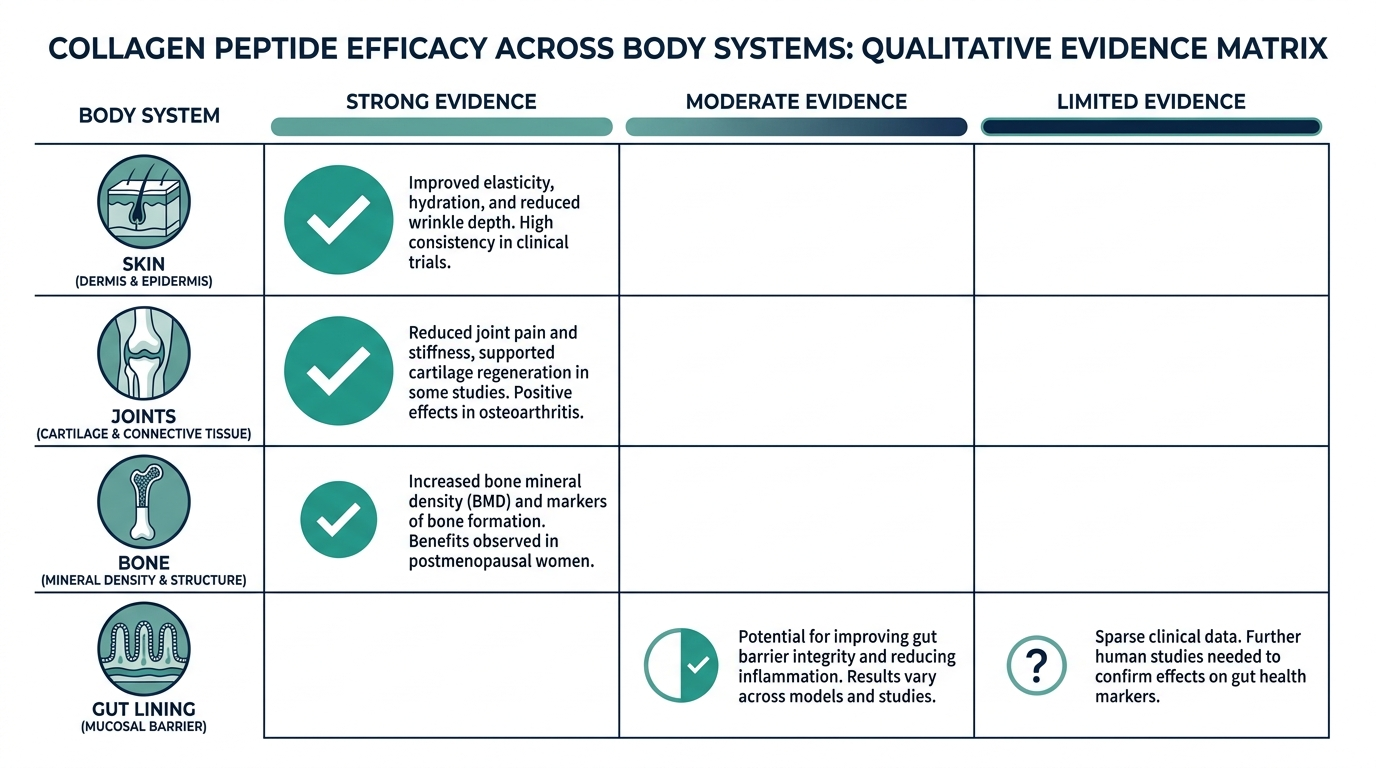
Glycine and proline, the two amino acids that dominate collagen’s composition, are critical for maintaining the integrity of the intestinal epithelium. The hypothesis that collagen peptides could support a “leaky gut” (intestinal permeability) is mechanistically reasonable and supported by cell models.
Human clinical data is early but encouraging. Research reviewed in a November 2025 update from the Collagen Stewardship Alliance found that collagen peptides positively influence gastrointestinal homeostasis in several contexts, including in major burn patients (where gut barrier disruption is a clinical problem). The gut microbiota pathway found in the 2025 Food & Function study adds another mechanism for why collagen supplementation might produce effects beyond just connective tissue.
The honest position for 2026: gut health is a legitimate research direction for collagen peptides, but the evidence base is not as mature as for skin or joints. I would not choose a collagen supplement primarily for gut benefits yet.
What does the research actually say about muscle?
This is the area where marketing gets most ahead of the evidence. Collagen peptides are not a complete protein. They lack tryptophan entirely and are low in leucine, the key amino acid for triggering muscle protein synthesis. A gram-for-gram comparison against whey or a complete EAA blend for muscle building is not a fair contest, and collagen peptides lose.
That said, the 2025 Frontiers in Nutrition meta-analysis found some positive signals for muscle health, particularly in older adults, where connective tissue quality limits functional strength as much as muscle fiber mass does. Collagen’s contribution to tendon and ligament strength may allow more effective strength training, which indirectly supports muscle mass. Several trials have combined collagen with resistance exercise and found better outcomes than exercise alone in older adults.
Collagen peptides support the connective tissue scaffold that holds muscle in place and transmits force. They do not directly build muscle fiber. If you are primarily a gym-focused buyer, collagen is a useful add-on, not a protein replacement.
How do collagen peptides compare to each other? A sourcing and format guide
Not all collagen peptides perform the same, and the differences matter more than most product pages admit.
| Source | Type | Primary target | Notes |
|---|---|---|---|
| Bovine (grass-fed) | I, III | Skin, tendons, bones | Most studied form; Vital Proteins flagship uses this |
| Marine (fish) | I | Skin, bioavailability | Smaller peptide size, faster absorption reported; higher cost |
| Porcine (pork) | I, III | Skin, connective tissue | Effective but avoided by some buyers |
| Chicken | II | Cartilage, joints | UC-II uses 40mg undenatured; better for OA-specific goals |
| Egg membrane | I, V, X | Skin, joint | Niche; often in blended formulas |
Vital Proteins Collagen Peptides (20g/serving, Type I and III, grass-fed bovine) is one of the most widely available products in this category and now ships in 90% less plastic packaging using FSC-certified paperboard. It is available at Costco in 1.5 lb bags and most major retailers. For joint-specific goals, a Type II product like UC-II at 40mg undenatured collagen is more appropriate.
Hydrolyzed type I & III collagen peptides, third-party tested, unflavored.
Myth-buster: does your stomach just digest collagen peptides into amino acids, wasting the bioactive sequences?
This is the most common objection, and it was a legitimate scientific concern a decade ago. Current evidence says: not mostly, no.
The PEPT1 transporter in the small intestine actively shuttles intact di- and tripeptides into the bloodstream without fully breaking them down to free amino acids. The 2024 crossover study in Frontiers in Nutrition directly measured specific collagen-derived peptides in plasma post-ingestion and confirmed they circulate intact. The concern that collagen is just digested into generic amino acids, making it no better than eating any other protein, is outdated.
That said, complete digestion does happen to a portion of ingested collagen. The bioactive peptide fraction is real but not 100% of what you swallowed. This is why dose matters: studies using 2.5 to 5 grams can get skin effects; joint and bone protocols need 10 to 15 grams.
How long before you see results? A realistic timeline
| Benefit | First signals | Established effect in trials |
|---|---|---|
| Skin hydration | 3 to 4 weeks | 8 weeks (consistent finding) |
| Skin elasticity / wrinkles | 8 to 12 weeks | 12 weeks (+40% elasticity) |
| Joint pain reduction | 6 to 8 weeks | 4 to 6 months (43% pain reduction) |
| Nail strength | 8 to 12 weeks | 24 weeks (12% growth rate) |
| Bone density | 6 to 12 months | 12 months (adjunct to calcium + D) |
| Biological age (composite) | Not measurable directly | 6 months (1.4 yr reduction) |
The consistent theme across every category: 8 to 12 weeks is a minimum trial period, and 6 months is where the more structural benefits materialize. Taking collagen for 2 weeks and concluding it does not work is not how the trials are run, and it is not a fair test.
Curious what your own levels look like?
Baseline 100+ biomarkers today and retest as life changes, all in one membership with physician review.
FAQ
Does collagen peptide supplementation actually work or is it marketing hype?
It is neither pure marketing nor a miracle. The skin elasticity evidence is strong and replicated across independent trials. Joint pain reduction at 4 to 6 months is well-supported. The 2025 npj Aging study showing 1.4-year biological age reduction is peer-reviewed but newer and will need replication. Muscle-building claims are overstated. The honest summary: it works for what it is tested for, at the doses and durations tested.
What is the right dose of collagen peptides per day?
Skin and nail research consistently uses 2.5 to 10 grams daily. Joint and bone protocols use 10 to 15 grams. Most popular products like Vital Proteins are dosed at 20 grams per serving, which covers the high end of any studied range. If budget is a factor, 10 grams per day captures most of the joint and skin research.
Is marine collagen better than bovine?
Marine collagen has a smaller average peptide size and slightly faster absorption in some studies, but the 2024 crossover trial in Frontiers in Nutrition found no significant difference in bioavailable peptide concentrations between sources and molecular weights tested. Choose based on dietary preferences (marine for pescatarian buyers, bovine for general use) rather than absorption marketing.
Should I take collagen peptides with vitamin C?
Yes, and this is one of the better-supported combination effects. Vitamin C is a required cofactor for the enzymes that hydroxylate proline and lysine in collagen synthesis (prolyl hydroxylase and lysyl hydroxylase). Without adequate vitamin C, your body cannot complete the collagen triple helix. Taking 50 to 250 mg alongside your collagen serving is mechanistically sound, and several trials include vitamin C in their protocols.
Can collagen peptides cause any side effects?
Collagen peptides have a high safety profile in the research literature. The most commonly reported effects are minor gastrointestinal discomfort at high doses (above 20 grams), and occasional taste or texture sensitivity. People with fish, shellfish, or egg allergies should check the source. Collagen is not a complete protein and should not replace dietary protein sources.
Does the body’s collagen production really decline with age?
Yes, measurably. Cleveland Clinic estimates that the body produces approximately 1% less collagen in the skin each year after age 20. UV exposure, smoking, high sugar intake, and chronic stress accelerate that decline. This production loss is the mechanism underlying most age-related changes in skin, joint, and bone tissue.
Will collagen peptides help me if I am already young and healthy?
The biggest effect sizes in the research are seen in people over 35 and in populations with existing deficits (dry skin, brittle nails, joint discomfort). If you are under 30 with no connective tissue complaints, the marginal benefit is likely smaller. The preventive case exists mechanistically, but the trial evidence skews toward symptomatic and older populations.
Hydrolyzed type I & III collagen peptides, third-party tested, unflavored.
Author: Vital Signs Today Editorial Team. Educational content, not medical advice. Sources linked inline.
Primary sources
- npj Aging: Collagen amino acid composition reduces biological age in humans (2025)
- Frontiers in Nutrition: Efficacy of collagen peptide supplementation on bone and muscle health, meta-analysis (2025)
- PMC / Frontiers in Nutrition: Absorption of bioactive peptides following collagen hydrolysate intake, RCT (2024)
- Food & Function: Collagen peptides promote skin collagen synthesis via gut microbiota and TGF-beta (2025)
- ScienceDirect / Heliyon: Collagen supplementation in skin and orthopedic diseases, literature review
- PMC: Collagen supplementation in skin and orthopedic diseases, PMC version
- Journal of Cosmetic Dermatology: Influence of collagen peptide supplementation on visible signs of skin and nail aging, East Asian RCT (2024)
- ACS JAFC: Oral ingestion of collagen hydrolysate — Gly-Pro-Hyp absorption into bloodstream and skin
- Cleveland Clinic: Collagen overview and age-related decline
- Vital Proteins Collagen Peptides product page
- Costco: Vital Proteins Collagen Peptides 1.5 lb
- ClinicalTrials.gov NCT07516756: Effect of collagen peptides on skin health
- ClinicalTrials.gov NCT07529249: Evaluation of oral collagen peptides on skin barrier function
- Collagen Stewardship Alliance: Science Update November 2025
Related reading
Vital Signs Today may earn a commission if you buy through links on this page. It does not affect our editorial assessments.