
Last updated 18 June 2026. Educational content, not medical advice. Talk to a licensed clinician before starting any supplement program.
Short answer: Collagen peptides are hydrolyzed fragments of collagen protein that survive digestion and accumulate in the bloodstream as hydroxyproline-containing dipeptides. The strongest clinical evidence supports improved skin hydration and elasticity (68% hydration gain in 8 weeks at 5 g/day in one randomized trial), reduced joint pain in osteoarthritis, and faster tendon collagen synthesis after exercise. Hair and nail benefits have supporting evidence but are less robust. Most research uses doses of 5 to 15 g daily.
Curious if collagen peptides are actually doing anything for you? Your bloodwork can show what your skin can’t. One at-home Superpower draw checks 100+ biomarkers, physician-reviewed.
Why does your body need collagen in the first place?
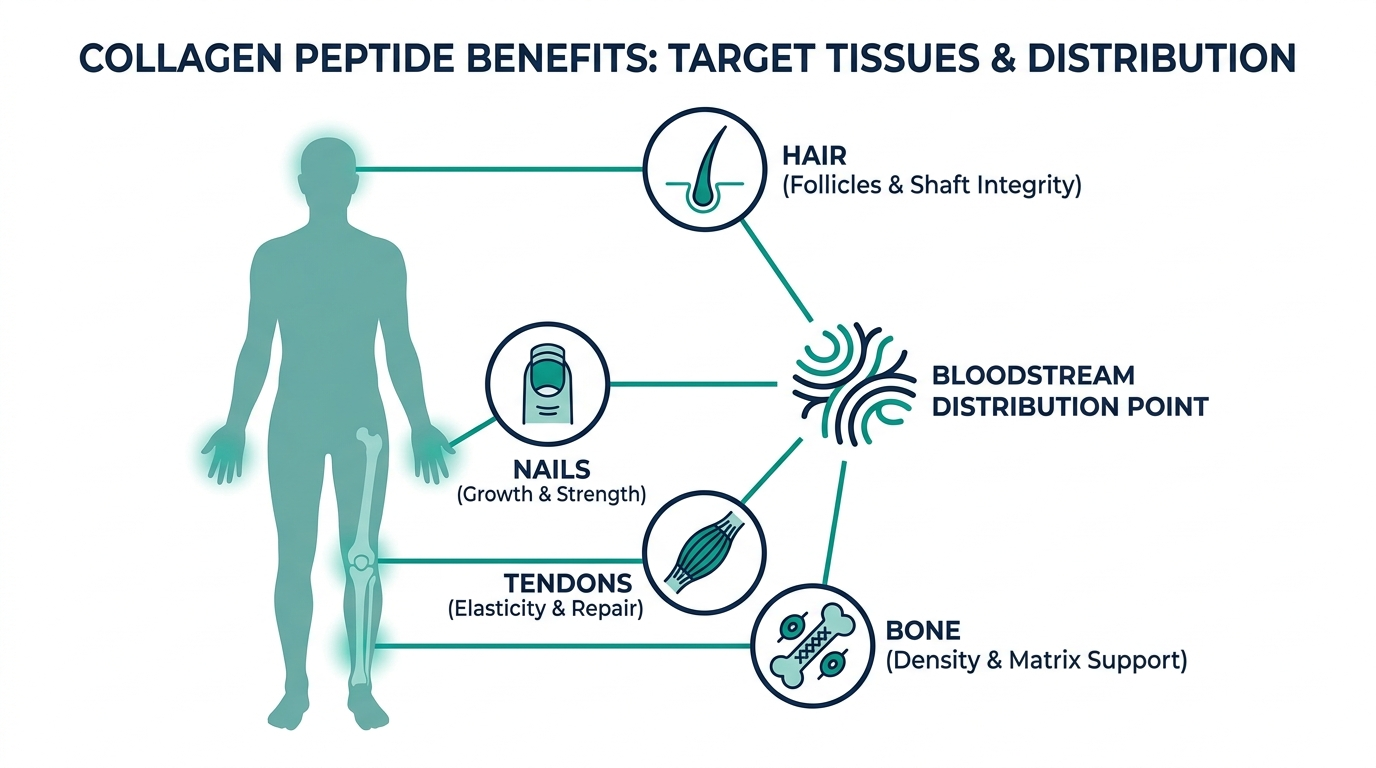
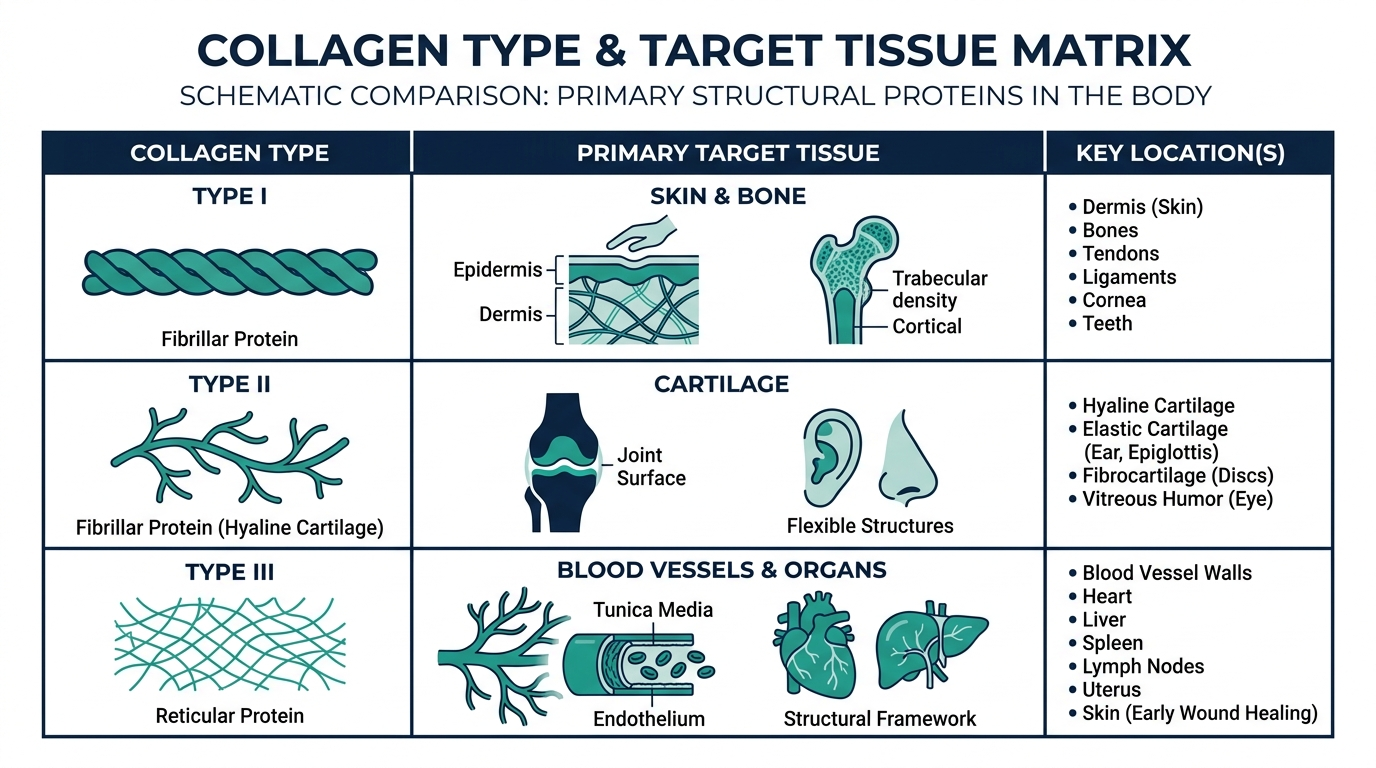
Collagen is the most abundant protein in the human body, accounting for roughly 30% of total protein mass. It is the structural scaffold behind your skin’s firmness, your tendons’ tensile strength, your joint cartilage, and the lining of your gut. There are at least 28 distinct collagen types, but Types I, II, and III cover the vast majority of what supplements target.
The problem is that your body does not stockpile collagen indefinitely. Starting around age 25, collagen production falls at roughly 1% per year. By age 40, you have lost approximately 15% of peak collagen levels; by 50, that figure climbs to 25 to 30%. UV exposure, smoking, and excess sugar accelerate degradation on top of that natural decline. The visible signs, thinner skin, stiffer joints, slower tendon repair, are downstream effects of a production deficit that starts quietly and compounds over decades.
Collagen peptides are one attempt to reverse that equation from the inside, by flooding the bloodstream with the specific amino acids and short peptide fragments the body uses as both raw materials and cellular signals.
What exactly are collagen peptides, and how do they actually work?
Whole collagen from food (gelatin, bone broth, cartilage) is a large, triple-helix protein molecule. When manufacturers hydrolyze it, either enzymatically or with heat and acid, they break it into short fragments typically 2,000 to 5,000 Daltons in molecular weight. These fragments, called hydrolyzed collagen or collagen peptides, dissolve in water, survive gastric digestion far better than intact collagen, and appear in the bloodstream within one to two hours of ingestion.
The mechanism is more sophisticated than “eat collagen, grow collagen.” A 2024 randomized crossover study published in Frontiers in Nutrition demonstrated that specific hydroxyproline-containing dipeptides, particularly Hydroxyproline-Glycine (Hyp-Gly) and Proline-Hydroxyproline (Pro-Hyp), accumulate in human serum after ingestion and appear to act as signaling molecules that stimulate fibroblasts to produce new collagen. These dipeptides are not found in ordinary dietary protein; they require the specific amino acid sequence of collagen as a starting material.
This is the part that surprises most people: it is not just the amino acids that matter, it is the specific peptide fragments. Plain whey protein or chicken breast will not trigger the same fibroblast response, because the resulting amino acids do not reassemble into hydroxyproline dipeptides.
Brush border enzymes in the small intestine, including aminopeptidase N and dipeptidyl peptidase-IV, are responsible for releasing these bioactive fragments from larger collagen hydrolysate chains, according to ScienceDirect research published in 2025.
Full-body lab membership: 100+ biomarkers, doctor-reviewed, tracked over time.
Does collagen actually improve skin? What do the studies show?
Skin is the most-studied application, and the evidence is genuinely encouraging, with important caveats about funding.
A 2024 randomized, double-blind, placebo-controlled trial published on PubMed Central enrolled 72 women aged 40 to 60, split evenly between a tuna-derived collagen peptide group and placebo. After 8 weeks of 5 g daily:
- Facial skin hydration rose 68.2% in the collagen group versus 3.5% in placebo.
- Facial skin elasticity increased 16.2% while placebo actually declined 10.6%.
- Skin density increased 26.0% (placebo: decreased 2.1%).
- Benefits persisted across a 2-week post-discontinuation monitoring window.
A separate 2025 study published on PubMed Central on bioactive collagen peptides found lasting improvements in skin hydration, firmness, and dermal structure after 12 weeks, attributed to the high hydroxyproline content and low molecular weight of the specific peptides used.
Do not believe every collagen beauty brand that cites “a meta-analysis showing improvement.” A widely discussed 2025 meta-analysis of 23 randomized trials did find overall improvement in hydration, elasticity, and wrinkles, but when researchers removed trials funded by pharmaceutical or supplement companies, the associations weakened significantly in higher-quality studies. The tuna collagen trial above is independent; many others are not.
The practical takeaway: marine collagen peptides (Type I, 2,000 to 5,000 Daltons) have the strongest independent skin data. Dose range in successful trials: 2.5 to 10 g daily for 8 to 12 weeks minimum. Topical serums with collagen peptides work at the surface but do not replicate the fibroblast-signaling mechanism of oral intake.
Can collagen peptides help with joint pain?
Joint cartilage is primarily Type II collagen, and the evidence here has improved considerably since 2020.
A multi-collagen supplement (Types I, II, III) tested in patients with osteoarthritis over 8 weeks improved pain, balance, and walking ability versus placebo. Osteoarthritis pain reductions of up to 43% with improved mobility have been reported across multiple controlled trials. A systematic review from Orthopedic Reviews covering Type I collagen hydrolysate supplementation found consistent support for joint function benefits, with typical doses of 10 g daily.
For athletes and active people, there is a more specific mechanism worth knowing. A landmark 2017 study (Shaw et al., American Journal of Clinical Nutrition) tested 5 g and 15 g of vitamin-C-enriched gelatin taken 1 hour before intermittent exercise. The 15 g dose produced a 153% increase in the bone collagen synthesis marker PINP, compared to 59.2% with 5 g and 53.9% with placebo. The amino acid spikes in blood, including glycine and proline, peaked at 1 hour. The practical implication: timing collagen intake 30 to 60 minutes before exercise, with vitamin C present, appears to amplify connective tissue synthesis during the repair window that follows.
A 2024 systematic review with meta-analysis in PMC confirmed that combining collagen peptide supplementation with long-term physical training enhanced strength, musculotendinous remodeling, and functional recovery compared to exercise alone.
Personally, the pre-exercise timing detail is one I rarely see mentioned on supplement labels. Most products just say “take daily.” The research says when matters at least as much as how much.
What about gut health?
The gut lining is made largely of collagen and connective tissue, and glycine, one of collagen’s most abundant amino acids, plays a direct role in maintaining tight junctions between intestinal epithelial cells. When those junctions weaken, a condition often called increased intestinal permeability or “leaky gut,” undigested food particles and bacterial fragments can enter the bloodstream and trigger systemic inflammation.
A 2024 study found that collagen peptide supplementation enhanced populations of beneficial gut bacteria while reducing pro-inflammatory species. A separate 2024 study found that bioactive peptides from hydrolyzed collagen boosted butyrate production, a short-chain fatty acid that plays a central role in calming gut inflammation and reinforcing the mucosal barrier.
The honest qualifier: most gut-collagen research is in animal models or small human trials. The Collagen Science Update from the Collagen Stewardship Alliance (November 2025) flagged that larger human RCTs on leaky gut specifically are still sparse. The mechanism is sound; the clinical evidence is not yet as strong as for skin or joints.
Do collagen peptides support hair and nails?
Nails: yes, with solid controlled data. A 2017 randomized controlled trial gave 2.5 g of bioactive collagen peptides daily to 25 participants with brittle nails for 24 weeks, reporting significant reductions in brittleness and breakage. A 2024 follow-up study in 66 adults aged 30 to 60 tested 2.5, 5, and 10 g doses and confirmed dose-dependent improvements in nail quality, with 95% of the 63 completers showing benefit.
Hair: the picture is more complicated. Research reviewed in the Journal of Cosmetic Dermatology (2024) found that collagen combined with micronutrients and antioxidants improved hair thickness and reduced shedding, but isolating collagen’s specific contribution is difficult because most hair trials use combination formulas. A Superpower.com guide on the current evidence notes that direct causation for hair growth from oral collagen remains to be proven in large, independent trials.
Worth noting: your hair follicles are surrounded by a collagen-rich dermal papilla, and follicle fibroblasts express collagen-stimulating receptors. The biological pathway makes sense. The clinical proof is still catching up.
Can collagen peptides help with muscle and body composition?
This is a more nuanced story than some fitness influencers imply. Collagen is not a high-quality muscle protein. It is low in leucine, the essential amino acid most responsible for triggering muscle protein synthesis, and it scores poorly on the PDCAAS (Protein Digestibility Corrected Amino Acid Score) relative to whey or egg. If you are comparing gram-for-gram protein quality for building muscle mass, whey wins.
However, collagen peptides do appear to improve the quality of connective tissue surrounding muscle, which affects force transmission and injury resilience. A 2024 systematic review and meta-analysis in CISS covering long-term resistance training combined with collagen supplementation found improvements in maximal strength and muscle size beyond what exercise alone produced, an effect the researchers attributed to better tendon and fascial function rather than direct muscle hypertrophy.
The specific dose matters here too. A ScienceDirect study found that 30 g of hydrolyzed collagen produced a greater collagen synthesis response after resistance exercise than 15 g or 0 g, specifically in resistance-trained young men. Most collagen products contain 10 to 20 g per serving; for connective tissue and athletic recovery goals, the higher end of that range is better supported.
How do different collagen types and sources compare?
| Source | Primary type | Best for | Molecular weight | Absorption note |
|---|---|---|---|---|
| Marine (fish scales/skin) | Type I | Skin hydration, wrinkles, elasticity | 2,000 to 5,000 Da | ~1.5x higher bioavailability than bovine |
| Bovine (hide) | Types I and III | Skin, joints, gut, muscle support | 2,000 to 5,000 Da | Provides two types in one supplement |
| Chicken (cartilage) | Type II | Joint cartilage, osteoarthritis pain | Varies | Specific to articular cartilage applications |
| Multi-collagen (blend) | Types I, II, III | Broadest coverage | Varies | Commonly 10 g doses in studies |
Marine collagen has approximately 1.5 times higher bioavailability than bovine sources, largely due to smaller peptide size and higher hydroxyproline concentration. If skin is your primary goal, marine is the evidence-favored choice. If joints are the priority, or you want broader coverage, bovine or a multi-collagen blend is more practical.
Personally, I would not overthink the source if budget is a constraint. Both marine and bovine hydrolyzed collagen have clinical trial support. The bigger variable is dose consistency and whether you actually take it every day.
Hydrolyzed type I & III collagen peptides, third-party tested, unflavored.
What is the right dose, and when should you take it?
Most research clusters around 5 to 15 g daily. Here is a practical dose guide by goal:
- Skin elasticity and hydration: 2.5 to 5 g daily, consistent for at least 8 weeks before expecting visible changes.
- Joint pain and cartilage support: 10 g daily, with a 12 to 24 week minimum timeline.
- Athletic recovery and tendon synthesis: 15 to 30 g taken 30 to 60 minutes before exercise, with vitamin C present.
- Nail brittleness: 2.5 g daily for 24 weeks is the most-studied protocol.
- Gut support: 10 to 15 g daily; evidence is weaker, but the dose range overlaps with other goals.
Vitamin C is important, and frequently overlooked. Vitamin C is a required cofactor for hydroxylation of proline and lysine residues during collagen synthesis, meaning that without adequate vitamin C, the body cannot properly form the triple-helix structure even when amino acids are plentiful. The Shaw et al. study was specifically designed with vitamin C-enriched gelatin for this reason. Most collagen supplements do not include it; taking a separate vitamin C (250 to 500 mg) alongside is a cheap, evidence-backed pairing.
Timing relative to meals matters less than timing relative to exercise, and consistency matters most of all. Collagen remodeling is slow; benefits in clinical trials typically emerge at 8 weeks and continue to improve through 12 to 24 weeks.
What collagen peptides cannot do (myths worth busting)
Myth: Any collagen supplement builds muscle like protein powder. Collagen is low in leucine, the key muscle protein synthesis trigger. It supports connective tissue, not primary muscle mass. Do not replace your whey or plant protein with collagen if muscle growth is your goal.
Myth: Eating collagen is the same as eating gelatin or bone broth. Bone broth varies enormously in collagen content; one study found collagen levels in commercial bone broth ranging from negligible to modest, nothing approaching a clinical dose. Hydrolyzed collagen peptides are manufactured to a consistent molecular weight and dose, which bone broth is not.
Myth: Topical collagen cream and oral collagen peptides work the same way. Topical collagen molecules are too large to penetrate the dermis in meaningful amounts, so they function as occlusives and humectants, not structural builders. The fibroblast signaling from oral peptides does not happen from a cream.
Myth: You will see results in two weeks. Every trial that showed significant skin or joint improvement ran for at least 8 weeks, most for 12 to 24. Two-week before-and-after marketing photos are not the trial window.
Are collagen peptides safe?
Across the clinical trial record, hydrolyzed collagen is among the most consistently well-tolerated supplements studied. No serious adverse events have been reported in multiple randomized controlled trials. Common benign effects include mild bloating in a small subset of users at higher doses.
The practical safety cautions are:
– People with fish or shellfish allergies should avoid marine collagen specifically.
– Bovine collagen is not appropriate for people avoiding beef for religious, ethical, or health reasons.
– If you are taking blood-thinning medications, check with your clinician, as high-dose amino acid supplements can affect coagulation factors in rare cases.
– Collagen is not a regulated drug; quality varies significantly between brands. Look for products with third-party testing (NSF, Informed Sport, or USP certification), and verify that the label states the source and molecular weight.
Don’t just read about your health, track it.
A single result is a snapshot. Superpower re-tests 100+ markers over time so you can watch them move as you change sleep, food, and training.
Frequently asked questions
What are the main benefits of collagen peptides?
The best-supported benefits in clinical research are improved skin hydration and elasticity, reduced joint pain in osteoarthritis, enhanced tendon collagen synthesis after exercise, and reduced nail brittleness. Gut health and hair benefits have supporting evidence but require more large-scale human trials.
How long does it take for collagen peptides to work?
Meaningful changes in skin hydration and elasticity are typically seen at 8 weeks of consistent daily intake. Joint and tendon benefits have been measured at 12 to 24 weeks. Two-week timelines are not supported by the clinical literature.
Is 10 g of collagen peptides per day enough?
For joint and general connective tissue support, 10 g is the most common dose used in successful trials. For skin specifically, 2.5 to 5 g has shown effect. For athletic tendon recovery, 15 to 30 g before exercise is the studied range. Ten grams daily is a reasonable baseline for most goals.
Do I need vitamin C with collagen peptides?
Yes, ideally. Vitamin C is a required cofactor for the enzymatic steps that form stable collagen. The foundational Shaw et al. study used vitamin C-enriched gelatin specifically for this reason. Taking 250 to 500 mg vitamin C alongside your collagen dose is inexpensive and evidence-backed.
Is marine collagen better than bovine collagen for skin?
Marine collagen has approximately 1.5 times higher bioavailability than bovine due to smaller peptide size, and it is predominately Type I, which is the main structural collagen in skin. For skin-specific goals, marine is the better-evidenced choice. Bovine provides both Type I and III and is more cost-effective for broad connective tissue support.
Can collagen peptides help with leaky gut?
The mechanism is plausible: glycine supports tight junctions and butyrate production improves gut barrier integrity. A 2024 study found collagen peptides boosted beneficial gut bacteria and butyrate levels. However, large-scale human clinical trials specifically on intestinal permeability are still limited, and the Collagen Stewardship Alliance’s November 2025 science update flagged this as an area needing more research.
Do collagen peptides work for men, or are they mainly for women?
Most published trials have enrolled predominantly female participants, which is a real limitation of the literature. The biological mechanisms, fibroblast signaling, collagen synthesis, tendon remodeling, are not sex-specific. The athletic recovery data (Shaw et al., tendon synthesis studies) was conducted in resistance-trained men. There is no evidence that the benefits are sex-limited; the trial demographics simply reflect where commercial interest in skin studies has historically been.
Hydrolyzed type I & III collagen peptides, third-party tested, unflavored.
Author: Vital Signs Today Editorial Team, [credential]”]. Educational content, not medical advice. Sources linked inline.
Primary sources:
– PMC: Tuna collagen peptides RCT, 72 women, 8 weeks (2024)
– PMC: Bioactive collagen peptides, sustained effects RCT (2025)
– Frontiers in Nutrition: Bioactive peptide absorption crossover study (2024)
– ScienceDirect: Hydroxyproline dipeptide brush border absorption (2025)
– PMC: Collagen peptides systematic review: body composition, synthesis, recovery (2021)
– PMC: Meta-analysis: collagen + physical training, strength and remodeling (2024)
– ScienceDirect: 30 g vs 15 g hydrolyzed collagen and resistance exercise synthesis (2024)
– CISS: Collagen supplementation + long-term resistance training meta-analysis (2024)
– Orthopedic Reviews: Type I collagen hydrolysate: bones, muscles, joints systematic review
– Journal of Cosmetic Dermatology: Collagen for skin, hair, nails, muscles review (2024)
– ScienceDirect: Collagen peptides and gut microbiome
– Collagen Stewardship Alliance: Collagen Science Update November 2025
– Cleveland Clinic: Collagen overview and types
– Amazon: Vital Proteins Collagen Peptides
Related reading
Vital Signs Today may earn a commission if you buy through links on this page. It does not affect our editorial assessments.