Quick answer: A vitamin B6 test measures pyridoxal-5-phosphate (PLP), the active form of B6 in your blood. The standard reference range is roughly 5 to 50 ng/mL (20 to 200 nmol/L), though labs vary slightly. Deficiency causes nerve pain, skin rashes, and depression; excess from supplements can trigger the same nerve damage it is supposed to prevent. The test costs $29 to $120 cash at Quest or Labcorp, or it is included in comprehensive wellness panels.
What Is a Vitamin B6 Test and Why Does It Matter?
A vitamin B6 test specifically measures PLP, the coenzyme form that your liver converts from dietary B6 before your cells can use it. Measuring total B6 in diet logs tells you intake; measuring PLP in blood tells you whether your body is actually activating and retaining it. The distinction matters because absorption drops with age, alcohol use, inflammatory bowel disease, and certain medications, meaning your dietary intake can look fine on paper while your tissue levels run low for years.
B6 is a cofactor in over 100 enzymatic reactions. It sits at the intersection of amino acid metabolism, neurotransmitter synthesis (serotonin, dopamine, GABA), and red blood cell production. That broad footprint explains why both deficiency and toxicity produce overlapping, easy-to-misattribute symptoms like fatigue, mood swings, and tingling in the hands and feet.
Most routine blood panels do not include B6 automatically. You have to request it, which is why clinically significant imbalances often go undetected for a year or more. If you are building a thorough baseline, it belongs alongside your best biomarkers to test list, particularly if you supplement, follow a restrictive diet, or have unexplained neurological symptoms.
What Does B6 Actually Do in the Body?
Pyridoxal-5-phosphate is indispensable for making neurotransmitters. Without adequate PLP, the enzyme aromatic L-amino acid decarboxylase cannot convert 5-HTP into serotonin or L-DOPA into dopamine. That single bottleneck connects B6 status directly to mood regulation, sleep quality, and stress resilience.
Beyond neurotransmitters, PLP drives:
- Homocysteine clearance: PLP-dependent enzymes convert homocysteine to cysteine via transsulfuration. Low B6 pushes homocysteine upward, which is independently associated with cardiovascular and cognitive risk.
- Heme synthesis: The enzyme ALA synthase requires PLP to begin building hemoglobin. B6 deficiency can cause a microcytic, hypochromic anemia that mimics iron deficiency on a CBC but does not respond to iron supplementation.
- Glycogen breakdown: Glycogen phosphorylase depends on PLP, so muscle glycogen release during fasting or exercise is impaired when B6 is low.
- Immune function: PLP is required for lymphocyte proliferation. Sub-optimal B6 status correlates with reduced antibody response.
Because PLP is involved in so many pathways, a complete blood panel will occasionally hint at B6 trouble through secondary markers, such as elevated homocysteine or unexplained anemia, before overt symptoms appear.
Vitamin B6 Normal Range: What Your Lab Report Actually Means
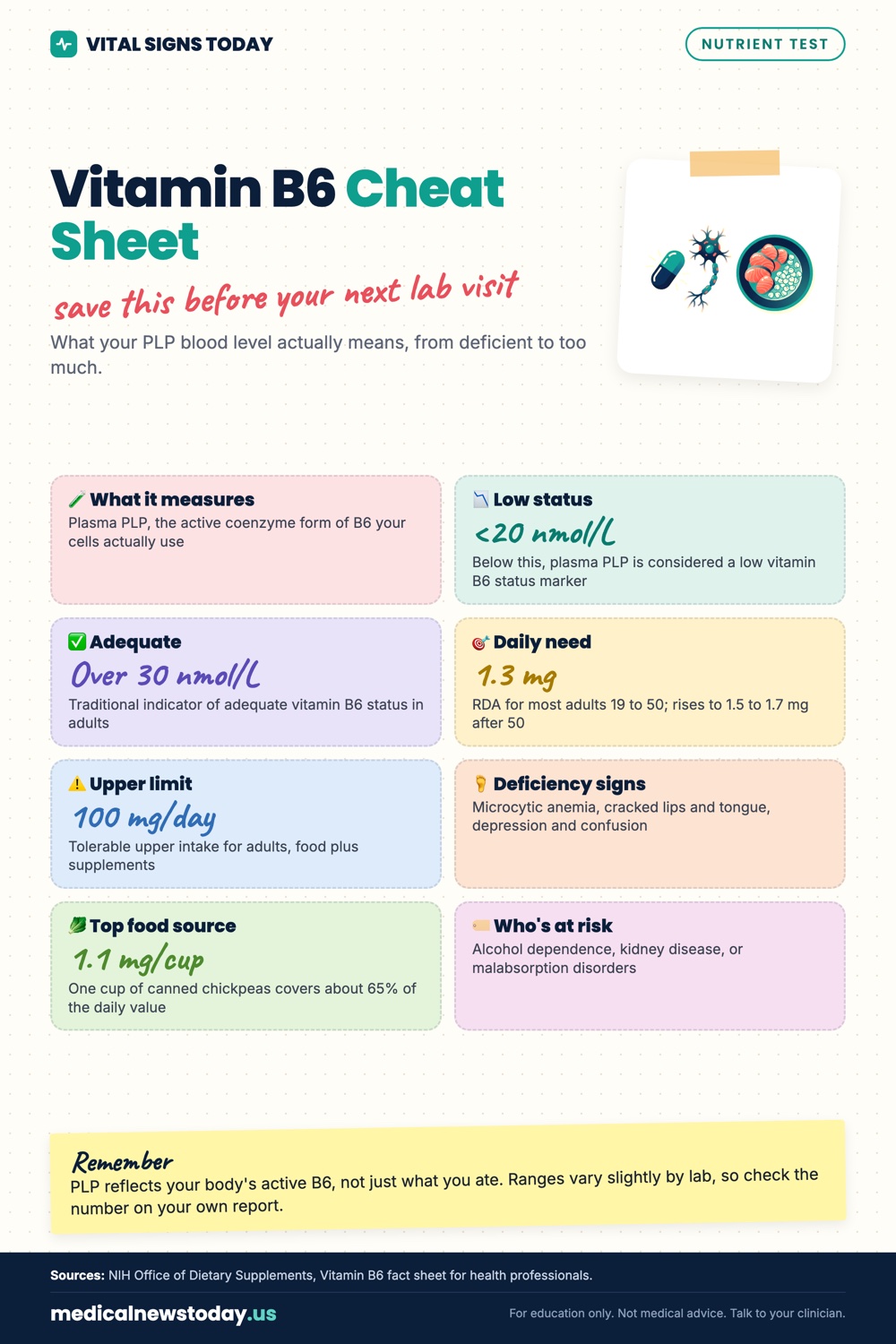
The reference range for serum PLP sits between 5 and 50 ng/mL (approximately 20 to 200 nmol/L) at most US reference labs, but Quest and Labcorp each calibrate their assays independently, so the specific numbers on your printout may differ by 10 to 15 percent. Always interpret results against the range printed on your own report.
| PLP Level (ng/mL) | Interpretation | Clinical Concern |
|---|---|---|
| Below 5 | Deficient | Neurological symptoms, anemia risk, elevated homocysteine likely |
| 5 to 20 | Low-normal / suboptimal | May be sufficient for basic metabolism but insufficient for optimal neurotransmitter synthesis |
| 20 to 50 | Adequate (most adults) | Covers enzymatic demand; lower end acceptable for sedentary non-supplementers |
| 50 to 100 | Elevated, likely from supplementation | Not acutely harmful, but monitor for neuropathy symptoms if sustained |
| Above 100 | Potentially toxic range | Sensory neuropathy possible; review supplement dose immediately |
One clinical nuance: PLP in plasma reflects recent intake more than tissue stores. If someone has been taking high-dose B6 and stops three days before the draw, their result can look normal while symptoms persist. Honest timing disclosure to your ordering clinician matters.
B6 Deficiency Symptoms: What It Feels Like When Levels Are Low
Classic B6 deficiency presents as a triad of peripheral neuropathy, dermatitis, and glossitis (a red, swollen tongue), though this full picture is uncommon in otherwise healthy Americans. What clinicians see far more often is a partial picture: burning or tingling feet, fatigue that does not resolve with sleep, and mood instability that gets diagnosed as depression before anyone checks PLP.
Groups at genuine risk for B6 deficiency include:
- People with celiac disease, Crohn’s, or ulcerative colitis (malabsorption)
- Chronic alcohol users (acetaldehyde degrades PLP)
- Patients on isoniazid (TB drug), penicillamine, or certain anti-seizure medications that act as PLP antagonists
- Adults over 65 (declining gastric acid reduces absorption)
- Pregnant women, particularly in the first trimester when nausea is common and dietary intake falls
- People eating very high protein diets without a corresponding B6 increase (PLP demand rises proportionally with protein metabolism)
The psychiatric angle deserves special mention. PLP is the rate-limiting cofactor for converting tryptophan to serotonin. A person with PLP in the 5 to 10 ng/mL range may experience clinically significant low mood, anxiety, and poor sleep despite an otherwise unremarkable panel. Psychiatrists who use functional lab testing now routinely include PLP in treatment-resistant depression workups.
High B6 Toxicity: The Risk Most Supplement Users Miss
B6 toxicity is real, underdiagnosed, and almost entirely self-inflicted through high-dose supplements. The paradox is uncomfortable: people take B6 to reduce nerve symptoms, then develop sensory neuropathy from taking too much of it.
The tolerable upper intake level (UL) set by the National Institutes of Health is 100 mg per day for adults, but sensory neuropathy cases have been documented at doses as low as 50 mg per day taken for months. Many B-complex supplements stack 25 to 50 mg of B6 per capsule, and people who take multiple products simultaneously can hit 100 to 200 mg without realizing it. Check every label in your supplement stack, not just the standalone B6 bottle.
High B6 toxicity symptoms include:
- Numbness and tingling in hands and feet (same as deficiency, which adds to diagnostic confusion)
- Difficulty walking and balance problems in severe cases
- Photosensitive skin rashes
- Nausea at very high oral doses
The good news: B6 neuropathy is largely reversible once the supplement is stopped, though recovery can take months if exposure was prolonged. The bad news: some clinicians order a PLP test after symptoms appear, see a high result, and correctly reduce the supplement, but the patient attributes recovery to a new treatment rather than dose reduction. The vitamin b6 test is what definitively closes that loop.
Pyridoxal-5-Phosphate Test vs. Vitamin B6 Total: Which One Should You Order?
Most labs offer two options: a total vitamin B6 assay (which includes all B6 vitamers) and a specific pyridoxal-5-phosphate test. Order PLP. Here is why.
Dietary B6 exists in three forms: pyridoxine (plants), pyridoxal (animal foods), and pyridoxamine. All three must be converted to PLP before cells can use them. Measuring total B6 captures the unconverted forms, which can be high even if the conversion pathway is impaired. PLP is the bioactive endpoint. It is what your neurons and enzyme systems actually use.
At Quest, the test is listed as “Vitamin B6 (Pyridoxal-5-Phosphate), Plasma” (order code 779X or similar). At Labcorp it appears as “Vitamin B6 (Pyridoxal Phosphate), Plasma.” Both measure PLP directly via HPLC assay. Some panels loosely labeled “vitamin B6” at smaller regional labs measure total B6 by immunoassay, which is less precise. When in doubt, ask the lab specifically whether the assay measures PLP or total B6 vitamers.
For a full picture of micronutrient status, pairing PLP with a vitamin d test, vitamin a test, and vitamin e test in a single blood draw is far more efficient than ordering them separately over several months.
How B6 Fits With B12 and Folate: The Methylation Trio
B6 rarely acts alone, and reading it in isolation is one of the most common interpretation mistakes. It sits inside a three-vitamin team, B6, B12, and folate, that together keep homocysteine in check. Folate and B12 handle the remethylation arm, recycling homocysteine back into methionine. B6 handles the transsulfuration arm, draining homocysteine off into cysteine. If any one of the three runs low, homocysteine climbs, which is why a clinician who sees a high homocysteine on a panel should reflexively check all three rather than guess.
The practical consequence is that a normal-looking B6 does not rule out a methylation problem, and a low B6 does not automatically mean B6 is the whole story. This is why the highest-yield way to order B6 is inside a small cluster with B12, folate, and homocysteine rather than as a lone test. The four results interpreted together tell you where the bottleneck actually sits. Ordering B6 alone and treating a mildly low value with a megadose can mask a B12 deficiency that needed attention, and untreated B12 deficiency causes its own, sometimes irreversible, nerve damage.
Best Food Sources of Vitamin B6
For most people who are not malabsorbing, diet covers B6 easily, and food never carries the neuropathy risk that high-dose capsules do. The adult requirement is modest, 1.3 mg per day for adults up to 50, rising to 1.5 mg for women and 1.7 mg for men after 50. A few standard reference points using USDA and NIH values:
- Chickpeas, 1 cup canned: about 1.1 mg, nearly a full day in one serving
- Beef liver, 3 ounces: about 0.9 mg
- Tuna, 3 ounces: about 0.9 mg
- Salmon, 3 ounces: about 0.6 mg
- Chicken breast, 3 ounces: about 0.5 mg
- Potatoes, 1 cup boiled: about 0.4 mg
- Banana, 1 medium: about 0.4 mg
- Fortified breakfast cereals: often 0.4 mg or more per serving, depending on brand
Notice how spread out the sources are across animal and plant foods. That breadth is exactly why frank dietary deficiency is uncommon in people who eat normally. When B6 does run low, the cause is usually something interfering with absorption or metabolism, alcohol, inflammatory bowel disease, certain medications, or age, rather than a plate that simply lacks the vitamin. That is the reason a low result should trigger a look for a cause, not just a bigger supplement.
How Much Does a Vitamin B6 Test Cost?
Cash-pay pricing for a standalone PLP test runs $29 to $120 depending on the lab, your zip code, and whether you use a direct-to-consumer ordering service or an in-network lab under insurance.
| Where You Order | Approximate Cash Price | Notes |
|---|---|---|
| Walk-in labs (Quest, Labcorp) via Ulta Lab Tests or LabTests Online | $29 to $55 | Order online, get requisition, walk in; no physician needed |
| Own Your Labs / Any Lab Test Now | $45 to $80 | More locations in suburban and rural areas |
| CVS MinuteClinic or urgent care order | $60 to $120 plus visit fee | Convenient but adds a visit cost; insurance may cover if medically indicated |
| Comprehensive wellness panel (includes PLP) | $150 to $350 for the full panel | Best value per test when you want 20 or more markers at once |
| HSA/FSA eligible | Yes (most B6 tests qualify) | Keeps your out-of-pocket lower; confirm with your plan |
Medicare covers PLP testing when a clinician documents a medically appropriate indication such as peripheral neuropathy, anemia workup, or chronic alcohol use disorder. Without that documentation, Medicare will not reimburse the test as a standalone wellness screen.
The most common smart-money move is ordering B6 alongside other micronutrients in a single venipuncture. You pay one blood draw fee and get a full micronutrient picture for roughly what a single specialty test would cost.
The simplest way to actually get this done
Superpower is a full-body lab membership that runs 100+ biomarkers, has each result reviewed by a doctor, and tracks your numbers year over year (about $199/year). It is what we point readers to when they would rather get one clean, complete draw than chase single tests one at a time. Here is superpower blood test reviewed in full.
How the Test Is Done: What to Expect at the Lab
The vitamin b6 test is a simple blood draw, typically from a vein in the crook of your arm. Most labs require you to fast for 10 to 12 hours beforehand, and some specifically ask you to avoid B6 supplements for 24 to 48 hours before the draw to get a steady-state tissue reading rather than a post-dose spike. If toxicity is the clinical question, you actually want to measure at peak, so discuss timing with whoever is ordering.
The sample is processed by high-performance liquid chromatography (HPLC), which separates and quantifies PLP with high specificity. Results typically return in 2 to 5 business days. The test does not require any imaging, urine collection, or special preparation beyond fasting and, optionally, supplement pause.
One practical note: PLP is light-sensitive. Labs protect the sample with amber tubes or foil during processing. If you are using a smaller regional lab and results come back suspiciously low, ask whether the sample was light-protected. Degradation in transit is a known source of false-low results that, unfortunately, sometimes goes unacknowledged.
What to Do With Your Results
A low PLP result (below 20 ng/mL, especially below 10) warrants a conversation with a clinician to identify the cause before just supplementing. The distinction between malabsorption, dietary insufficiency, and drug interaction changes the intervention. Supplementing aggressively on top of undiagnosed Crohn’s, for example, may still not correct the deficiency if absorption is impaired.
If your PLP comes back high (above 50 or 100 ng/mL) and you are symptomatic, the first step is auditing your supplement stack completely. Add up B6 from every source: standalone B6, B-complex, prenatal multivitamins, energy drink powders, and fortified foods you eat daily. Reduce total B6 intake below 20 mg per day and retest in 8 to 12 weeks.
If your result is within range but on the low end of normal (5 to 20 ng/mL) and you have relevant symptoms, talk to a clinician about your results and consider dietary optimization first. Chicken, turkey, tuna, salmon, chickpeas, and potatoes are all rich sources. One 3-ounce serving of cooked chicken breast delivers about 0.9 mg of B6, roughly 53 percent of the 1.7 mg daily requirement for adult men.
For ongoing tracking, particularly if you have conditions that affect B6 metabolism, retesting every 12 months alongside your annual labs makes sense. A single point-in-time result tells you where you are; a trend line tells you whether your diet, supplement protocol, or medication is actually working.
A Realistic Scenario
Consider a 34-year-old with a year of tingling in both feet and low mood that two clinicians have treated as anxiety. She takes a B-complex, a prenatal-style multivitamin, and a pre-workout powder, each of which she thinks of as harmless. Nobody has added up the B6 across all three. A PLP test comes back at 140 ng/mL, well into the toxic range, and the tingling is not a deficiency at all but nerve irritation from roughly 120 mg of B6 a day across her stack. The fix is not another supplement. It is stopping the B6 sources and rechecking in 8 to 12 weeks, with the neuropathy expected to fade slowly as the level falls. Without the test she would likely have kept taking B6 to fix the very symptom it was causing. That closed loop, symptom to cause to correction, is what the number buys you.
FAQ
What is a normal vitamin B6 range?
Most US labs report a PLP reference range of 5 to 50 ng/mL (20 to 200 nmol/L). Values below 5 ng/mL indicate deficiency; values above 50 to 100 ng/mL suggest excess, usually from supplements. The exact numbers vary by lab, so read the reference range printed on your specific result rather than memorizing a universal number.
What are the symptoms of B6 deficiency?
Peripheral neuropathy (burning or tingling feet and hands), fatigue, depression or low mood, glossitis (inflamed tongue), and a specific type of anemia that does not respond to iron. Skin rashes around the eyes and mouth are a classic sign in textbooks, though less commonly the presenting complaint today. Symptoms tend to appear gradually after months of suboptimal intake.
Can too much B6 be dangerous?
Yes. Sensory neuropathy from B6 excess is well-documented at doses above 50 to 100 mg per day sustained for months. The upper tolerable limit is set at 100 mg/day, but individual sensitivity varies. Because many B-complex products contain 25 to 50 mg per serving, stacking multiple supplements is the most common way people unknowingly exceed safe levels.
Is the pyridoxal-5-phosphate test the same as a vitamin B6 test?
They are often used interchangeably, but PLP is the preferred assay. A true PLP test measures only the active coenzyme form your cells use. A “total B6” assay includes unconverted dietary forms, which can be high even when your body’s enzymatic machinery is not working well. If given a choice, specify PLP when ordering.
How much does a vitamin B6 test cost without insurance?
Cash pricing ranges from about $29 to $120. Direct-to-consumer services like Ulta Lab Tests or Walk-In Lab offer standalone PLP draws at Quest or Labcorp for $29 to $55. Urgent care or MinuteClinic orders run higher once the visit fee is included. HSA and FSA funds are typically accepted, which reduces effective out-of-pocket cost.
Do I need to fast before a vitamin B6 blood test?
Most labs request a 10 to 12 hour fast. More importantly, some labs ask you to pause B6 supplements 24 to 48 hours before the draw to avoid measuring a transient post-dose spike. If the clinical question is toxicity from supplementation, your clinician may instruct you to take your normal dose the day of the draw instead. Clarify the instructions when you schedule.
Does vitamin B6 affect homocysteine?
Yes, directly. PLP-dependent enzymes perform transsulfuration, converting homocysteine to cysteine. When B6 is insufficient, this pathway slows and homocysteine accumulates. Elevated homocysteine is associated with cardiovascular and cognitive risk, so a clinician seeing high homocysteine on a panel should routinely check B6 alongside B12 and folate.
Who is most likely to have low B6?
People with inflammatory bowel disease, chronic alcohol use, older adults over 65, those taking isoniazid or penicillamine, pregnant women (especially in early pregnancy), and anyone eating a very high-protein diet without increasing B6-rich foods proportionally. Athletes also have higher B6 turnover due to increased protein metabolism during training and recovery.
Can I get a B6 test without a doctor’s order?
In most US states, yes. Direct-to-consumer lab services let you order a PLP test online, print a requisition, and walk into a Quest or Labcorp patient service center without a physician order. Results are delivered to your secure patient portal. Some states still require a physician intermediary, so check whether your state is on the direct-to-consumer eligible list when you sign up.
Why do high and low B6 cause the same symptoms?
It is one of the stranger facts in micronutrient testing, and it trips up patients and clinicians alike. Both a deficiency and an excess of B6 can produce tingling, numbness, and burning in the hands and feet. The mechanisms differ, but the sensation overlaps, which means you cannot tell from symptoms alone which way your level has gone. This is precisely why the test matters more here than for many other vitamins. Guessing wrong and adding B6 to treat what is actually toxicity makes the problem worse, so the number, not the symptom, has to guide the decision.
How long does it take B6 toxicity to resolve after stopping supplements?
Recovery is usually gradual rather than immediate. Once the offending supplements stop, blood levels fall over weeks, but nerve symptoms can take several months to fully settle, and the longer and higher the exposure, the slower the recovery tends to be. Most cases improve substantially, though very prolonged high-dose use can leave some lingering sensory changes. Rechecking PLP about 8 to 12 weeks after stopping confirms the level has actually come down and that no hidden source is still feeding it.
Should I test B6 if I take a B-complex?
It is worth considering, especially if you also take a multivitamin, a prenatal, or fortified powders, because B6 stacks silently across products. Many people who take a single reasonable-looking B-complex are fine, but the risk climbs fast when several supplements overlap. If you have any tingling, numbness, or balance issues and take more than one B-containing product, adding up the labels and checking a PLP level is a sensible move before you assume the symptom is something else.