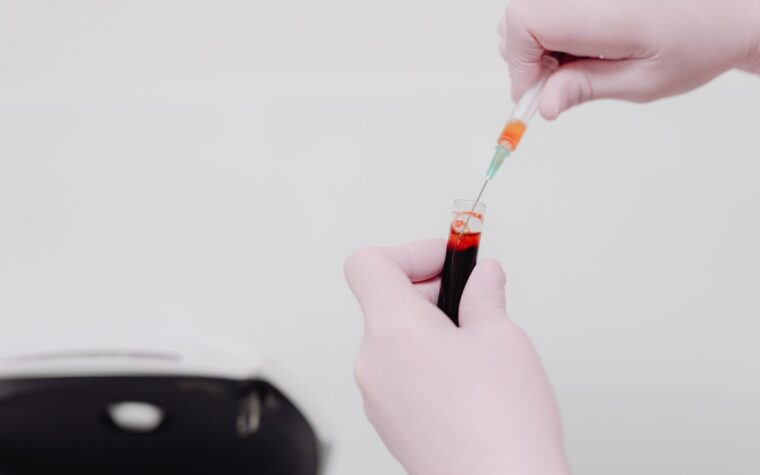
Quick answer: A vitamin A test measures serum retinol, the circulating form of vitamin A, in a standard blood draw. The normal adult range runs from 30 to 65 micrograms per deciliter (mcg/dL). Levels below 20 mcg/dL signal clinical deficiency; levels above 100 mcg/dL raise concern for toxicity from excess supplementation. Most labs offer the test as a standalone order or within a micronutrient panel for $40 to $180 cash price depending on the facility.
What does a vitamin A test actually measure?
The test quantifies retinol, the alcohol form of preformed vitamin A, that circulates bound to retinol-binding protein (RBP) and transthyretin in your plasma. This is distinct from beta-carotene, the plant-derived precursor that your body converts to retinol with variable efficiency. Some extended micronutrient panels report both values separately, which matters because high beta-carotene does not guarantee adequate retinol in people with thyroid dysfunction or genetic variants affecting conversion.
Retinol is a fat-soluble vitamin, meaning the liver stores a substantial reserve. Serum retinol stays within the normal range until hepatic stores are depleted by roughly 90 percent. That means a single low reading is genuinely informative, but a normal reading does not always rule out early depletion if the liver is still releasing stored vitamin A at a compensated rate.
A full-picture assessment may pair the retinol test with RBP4, zinc (because zinc deficiency impairs RBP synthesis and falsely suppresses retinol transport), and liver function markers. If you are also thinking about fat-soluble vitamin D status alongside this, the vitamin D test covers a related pathway worth reviewing together.
Vitamin A normal range: what the numbers mean in practice
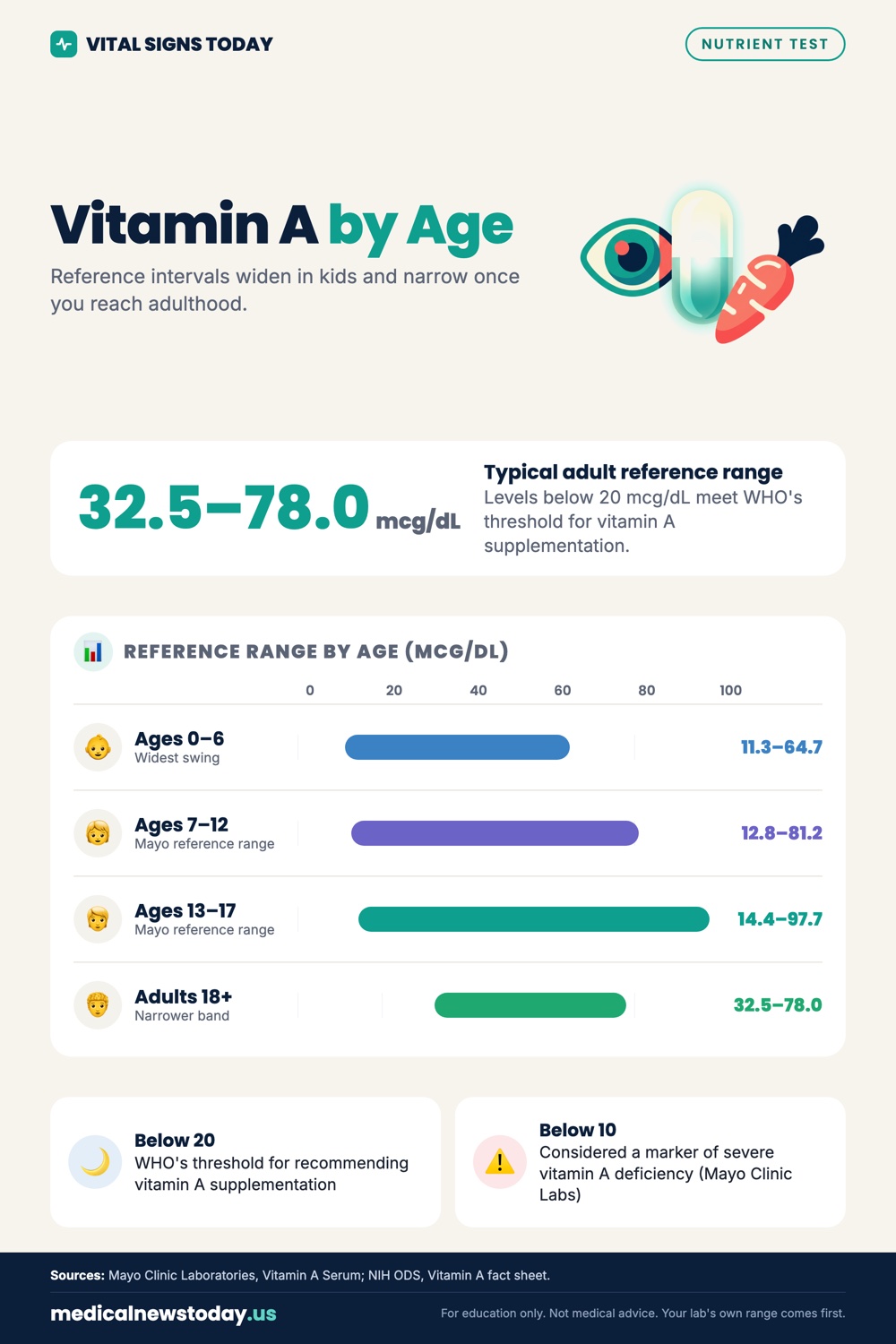
Reference intervals vary slightly by laboratory method, but the widely accepted adult range in US clinical use is 30 to 65 mcg/dL (1.05 to 2.27 micromol/L in SI units). Children have narrower ranges that shift by age group.
| Category | Serum Retinol (mcg/dL) | Clinical interpretation |
|---|---|---|
| Deficiency (clinical) | Below 20 | Night blindness risk, immune impairment, skin changes |
| Marginal deficiency | 20 to 29 | Functional impact possible, especially under illness stress |
| Adequate (adult) | 30 to 65 | Normal range for most US reference labs |
| Upper adequate | 65 to 100 | Generally fine; watch for supplement stacking |
| Elevated / potential toxicity | Above 100 | Liver stress, bone pain, teratogenic risk in pregnancy |
One detail labs rarely print on the report: pregnancy shifts risk dramatically. A retinol level that is merely “upper adequate” outside pregnancy carries real teratogenic risk in the first trimester. Clinicians who order this test in women of childbearing age treat 65 mcg/dL as a softer ceiling when preformed vitamin A supplementation is involved. Talk to a clinician about your results if you are pregnant or planning to conceive.
What does an optimal retinol level look like, not just a normal one?
The reference range tells you where disease begins, not where healthy physiology sits comfortably. Most well-nourished adults with intact liver stores land in the middle of the range, roughly 40 to 60 mcg/dL, and that is the band worth aiming for. A value of 32 is inside the normal range, but if it used to read 50 and has quietly drifted down, the direction is the finding, not the fact that it still technically clears the deficiency cutoff. Vitamin A rewards trend reading because the liver buffers the number so effectively that a single snapshot can look reassuring while stores are actually being drawn down.
There is a second reason the raw number can mislead. Retinol travels bound to retinol-binding protein, and that protein moves with your protein status, your zinc status, and your inflammatory state. A retinol of 28 in someone with low zinc or active inflammation may reflect a transport problem rather than a true store deficit. This is why experienced clinicians interpret a borderline retinol against zinc, protein, and an inflammatory marker rather than treating the isolated value as the whole story. A number without its context is a guess dressed up as data.
Vitamin A deficiency symptoms: what shows up before the lab does
Night blindness is the earliest and most specific clinical sign of vitamin A deficiency, and it tends to appear before serum retinol drops below 20 mcg/dL. If you struggle to adapt when moving from a lit room to a dim environment, that symptom alone is worth flagging to a clinician before assuming it is just tired eyes.
Other symptoms follow a predictable sequence as stores deplete further:
- Dry, rough skin (follicular hyperkeratosis): small bumps on the upper arms and thighs that look like permanent goosebumps. Misdiagnosed as eczema or keratosis pilaris, but vitamin A deficiency is often the underlying driver.
- Frequent infections: vitamin A maintains the integrity of mucosal barriers in the gut and respiratory tract. People with marginal deficiency catch respiratory infections more easily and recover more slowly.
- Dry eyes and Bitot’s spots: Bitot’s spots are foamy white patches on the conjunctiva, a sign of moderate-to-severe deficiency rarely seen in the US except in people with malabsorption disorders.
- Poor wound healing: retinol is required for epithelial cell differentiation. Slow-healing cuts or skin sores after surgery are a underappreciated signal.
- Impaired taste and smell: less well-known, but vitamin A contributes to sensory epithelium maintenance.
In the US, outright deficiency is uncommon in healthy adults eating a varied diet. The groups at genuine risk are people with fat malabsorption (Crohn’s disease, celiac, bariatric surgery, cystic fibrosis), heavy alcohol users (alcohol depletes hepatic retinol), and anyone living in prolonged caloric restriction without attention to micronutrient density.
Vitamin A toxicity: the other side of the test that most people miss
Vitamin A toxicity from food is nearly impossible. You cannot overdose on beta-carotene from vegetables (your body downregulates conversion). The problem is preformed vitamin A, specifically retinyl palmitate and retinyl acetate found in supplements, cod liver oil, and fortified foods. These bypass conversion and accumulate directly in the liver.
Acute toxicity from a single massive dose causes nausea, headache, dizziness, and peeling skin. Chronic toxicity is more insidious. People taking 25,000 IU or more of preformed vitamin A daily for months can develop elevated intracranial pressure, liver fibrosis, bone pain, and fragility fractures, all with serum retinol still hovering in the high-normal range before it ticks above 100 mcg/dL.
The supplement market has made this worse. Many multivitamins stack retinyl palmitate from the vitamin A content with additional beta-carotene, then the user adds a separate "immune support" formula and a daily cod liver oil capsule. It is surprisingly easy to reach 15,000 to 20,000 IU daily without realizing it. A retinol blood test is the only objective way to audit where you actually sit.
If you are tracking multiple fat-soluble vitamins, it is worth running a vitamin B6 test alongside, because B6 toxicity from supplementation follows a similar quiet accumulation pattern that also shows up late on symptoms alone.
How much vitamin A do you actually need, and where does it come from?
The recommended dietary allowance for adults is about 900 micrograms of retinol activity equivalents (RAE) per day for men and 700 for women, with a tolerable upper intake level of 3,000 micrograms RAE of preformed vitamin A daily. That upper limit is the number that matters for anyone taking supplements, because it is set by preformed retinol, not by the carotenoids in vegetables. Converted to the older IU labeling, 3,000 micrograms RAE of preformed vitamin A is roughly 10,000 IU, which is easier to reach through stacked supplements than most people assume.
Vitamin A reaches you through two very different doors. Preformed retinol comes from animal foods: liver is by far the densest source, followed by cod liver oil, egg yolks, butter, and whole-milk dairy. Provitamin A carotenoids come from plants: sweet potato, carrots, spinach, kale, and cantaloupe are the heavy hitters. The body converts carotenoids to retinol on demand and throttles that conversion down as stores fill, which is precisely why you cannot reach toxicity from a plate of carrots but can from a daily liver habit or a poorly audited supplement shelf.
This split explains a common lab surprise. Two people can eat what looks like a similar amount of vitamin A on paper, yet the one relying mostly on plant carotenoids may test lower, because conversion efficiency varies with genetics, thyroid function, and gut fat absorption. A vegan or low-fat dieter with a marginal retinol is often not eating too little total vitamin A, but too little of the preformed kind their body can use without conversion.
Who should get a retinol blood test and why
Not everyone needs this test annually. The highest-yield candidates are:
- People with fat malabsorption disorders (IBD, celiac, short bowel syndrome, post-bariatric surgery). Fat-soluble vitamins including A, D, E, and K are all at risk. A baseline retinol test at diagnosis and annually after is standard of care in many GI practices.
- Supplement users taking cod liver oil, high-dose multivitamins, or preformed vitamin A above 5,000 IU/day. Toxicity monitoring, not deficiency screening, is the point here.
- Anyone with unexplained night blindness at any age. In adults, this is usually retinol deficiency until proven otherwise.
- Children with recurrent ear infections or respiratory infections. Marginal vitamin A deficiency amplifies susceptibility to respiratory pathogens. US pediatricians do not routinely test for this, but it is worth asking if infections are frequent.
- Pregnant women or those trying to conceive who are using supplements. The teratogenic risk of excess preformed vitamin A in the first trimester is well-established, and many prenatal vitamins already supply 100 percent of the daily value.
- Heavy alcohol users. Alcohol depletes hepatic retinol, and ironically, combining alcohol with supplemental vitamin A accelerates liver damage. Testing retinol in this context is both a deficiency and a safety check.
For people who want a comprehensive view of their micronutrient status rather than chasing single tests, the best biomarkers to test framework is a useful starting point to prioritize what actually moves the needle.
How the vitamin A test is done and what to expect
The test is a standard venous blood draw, usually 5 to 10 mL. No fasting is required by most labs, though Quest Diagnostics recommends an overnight fast (8 to 12 hours) before their retinol panel because recent high-fat meals can transiently shift results. Check with your specific lab for their protocol.
The sample must be protected from light immediately after collection. Retinol is photosensitive and degrades quickly under fluorescent lab lighting. Reputable labs wrap the collection tube in foil or use amber-coated tubes. If you are ordering through a direct-to-consumer service, confirm they use light-protected collection because degraded samples will return a falsely low result.
Turnaround time is typically 3 to 5 business days. This is longer than a basic metabolic panel because retinol requires HPLC (high-performance liquid chromatography) for accurate quantification, not a simple colorimetric assay. Labs that claim next-day retinol results are often using immunoassays with lower precision.
Vitamin A test cost: what to expect in 2026
Pricing varies significantly by ordering channel:
| Ordering channel | Typical cash price | Notes |
|---|---|---|
| Quest Diagnostics (direct order) | $65 to $90 | Order via QuestDirect.com; draw at any Quest location |
| Labcorp (direct order) | $60 to $85 | Available via Labcorp OnDemand |
| Micronutrient panel (includes retinol) | $130 to $250 | Adds vitamins B12, D, E, zinc, folate, and others |
| Full-body membership (e.g., Superpower) | About $199/year | 100+ biomarkers including retinol, doctor review, year-over-year tracking |
| Primary care order, insurance billed | $0 to $30 copay | Covered when medically indicated; prior auth sometimes required |
| Urgent care or CVS MinuteClinic | Rarely available | Typically refer out to Quest or Labcorp for specialty tests |
HSA and FSA accounts cover the retinol blood test when ordered for a diagnosed or suspected medical condition. Self-ordered wellness tests at a gray area but most HSA administrators approve them when you include a brief clinical note of purpose. Medicare Part B covers the test when a physician documents a medically necessary indication, such as malabsorption or documented deficiency symptoms.
The simplest way to actually get this done
Superpower is a full-body lab membership that runs 100+ biomarkers, has each result reviewed by a doctor, and tracks your numbers year over year (about $199/year). It is what we point readers to when they would rather get one clean, complete draw than chase single tests one at a time. Here is superpower blood test reviewed in full.
What people get wrong about vitamin A and supplementation
The single most common mistake is conflating "vitamin A" on a supplement label with beta-carotene. Many products split the vitamin A content between preformed retinol and beta-carotene and list them together as a single IU number. The safety calculation only applies to preformed vitamin A. Beta-carotene at any realistic supplement dose is not a toxicity concern for healthy adults. Reading the "% from beta-carotene" line on the supplement facts panel matters.
Second error: assuming a result in the normal range means you can supplement freely. The liver stores retinol for months. A test today showing 45 mcg/dL says nothing about how close you are to the top of that buffer if you have been supplementing aggressively for the past six months. Serial testing, not a single snapshot, is what provides meaningful safety data for long-term supplement users.
Third: the "carrier protein" problem. Retinol travels in blood bound to RBP, and RBP is a negative acute-phase reactant. During active inflammation or infection, the liver downregulates RBP production and serum retinol drops even if liver stores are adequate. Testing retinol while ill or during a flare of an inflammatory condition produces a misleadingly low result. Always note your health status at the time of draw and retest when stable if the result is unexpectedly low.
Running vitamin A alongside a complete blood panel gives the inflammatory context (via WBC, CRP, ESR) that helps interpret a borderline retinol result accurately.
What do abnormal vitamin A results look like in real life?
The number means more attached to a person. Two composite cases show how the same lab range points in opposite directions.
The bariatric patient at 18 mcg/dL. A 46-year-old two years past gastric bypass reports that dim restaurants have become hard to navigate and her skin has turned rough on the upper arms. Her retinol reads 18, squarely in the deficiency zone. This is malabsorption, not diet. The fix is not simply more vitamin A by mouth but a form and dose that survive her altered anatomy, paired with checks on the other fat-soluble vitamins, since D, E, and K are almost certainly low with it. Her night vision starts improving within a couple of weeks of proper repletion, well before her stores fully refill.
The supplement stacker at 96 mcg/dL. A 52-year-old feels fine but takes a multivitamin, a separate immune formula, and a daily cod liver oil capsule. His retinol reads 96, still under the toxicity cutoff, yet he has been quietly ingesting close to 18,000 IU of preformed vitamin A a day for months. He has no dramatic symptoms because chronic vitamin A toxicity is patient, showing up as bone pain, headaches, or liver stress long after the blood level starts climbing. The correct move is auditing the supplement shelf, not adding anything, and rechecking in a few months to confirm the number is falling.
How to interpret your result alongside your full picture
A retinol result does not exist in isolation. A few context rules that experienced clinicians use:
- If retinol is low and zinc is also low, correct the zinc deficiency first. Zinc is required to synthesize RBP, so fixing zinc alone often normalizes serum retinol even before adding vitamin A.
- If retinol is low with elevated liver enzymes and a history of alcohol use, vitamin A supplementation is not straightforward. Alcohol and retinol both stress the CYP2E1 pathway and can potentiate liver damage together. This combination needs a clinician, not a self-directed supplement plan.
- If retinol is high-normal or elevated in someone on isotretinoin (Accutane), the drug is itself a retinoid derivative. Additional preformed vitamin A on top of isotretinoin significantly raises toxicity and teratogenicity risk.
- If retinol is adequate but symptoms (night blindness, dry eyes) persist, look at vitamin A's co-factors: zinc, vitamin D, and protein status all affect retinol metabolism and utilization.
For people building a systematic picture of their lab numbers over time, the lipoprotein a test illustrates how a single biomarker with a wide range of causes requires similar contextual reading.
FAQ
Do I need to fast before a vitamin A blood test?
Most labs recommend an 8 to 12 hour fast before a retinol test, primarily because a high-fat meal can transiently elevate retinol-binding protein and shift results slightly. A few labs permit a non-fasted draw for standalone retinol. Check the specific instructions from the lab processing your sample, and if you ordered through a physician, follow their pre-test prep sheet.
Can I test vitamin A levels at home?
No reliable at-home fingerprick test for serum retinol exists in the US market as of 2026. Retinol requires HPLC analysis, which cannot be miniaturized into a lateral flow strip. At-home tests marketed as "vitamin A tests" are either measuring carotenoids (not retinol) or using immunoassay approximations with wide error margins. For an accurate result, a venous blood draw processed at a CLIA-certified lab is the only current option.
What is the difference between vitamin A deficiency and vitamin A toxicity symptoms?
Deficiency symptoms center on vision (night blindness, dry eyes), skin (rough follicular bumps), and immunity (frequent infections, slow healing). Toxicity symptoms head in the opposite direction on some markers but overlap on others: headache and raised intracranial pressure are toxicity hallmarks, while dry skin and bone pain appear in both extremes. The serum retinol level is the only reliable way to distinguish the two since both can present with fatigue and skin changes.
How does vitamin A toxicity compare to vitamin D toxicity?
Both are fat-soluble vitamins with narrow therapeutic windows, but the mechanisms differ. Vitamin D toxicity primarily drives hypercalcemia. Vitamin A toxicity primarily affects the liver, intracranial pressure, and bone density. Vitamin A is more acutely toxic at lower excess doses. A meaningful dose of vitamin D to cause toxicity in a healthy adult is typically 60,000 to 100,000 IU daily for weeks; vitamin A toxicity can appear at 25,000 IU daily of preformed retinol over months. The vitamin D test covers D-specific thresholds separately.
Is vitamin A tested in a standard blood panel?
No. A standard comprehensive metabolic panel (CMP) or complete blood count (CBC) does not include retinol. You need to request it explicitly. Some micronutrient panels and specialty wellness memberships include it as part of a broader draw, but it will not show up on a routine annual physical lab order unless your physician specifically adds it.
How long does it take to correct vitamin A deficiency?
With appropriate supplementation and underlying absorption corrected, serum retinol typically rises into the normal range within 4 to 8 weeks. Night blindness often improves faster, sometimes within days of starting repletion because functional symptoms respond before stores fully normalize. Retesting 8 to 12 weeks after starting a correction protocol is a reasonable interval to confirm response.
Can high beta-carotene intake from vegetables raise my retinol level dangerously?
No. High carotenoid intake from food causes carotenodermia (an orange-yellow skin tint, harmless) but does not drive serum retinol into a toxic range because conversion efficiency from beta-carotene to retinol is tightly regulated and slows down as retinol status rises. The toxicity risk is specific to preformed vitamin A in supplements and liver-based foods eaten in very large, frequent amounts (traditional diets based heavily on polar bear liver are the textbook example, not a plate of carrots).
What is the vitamin A test cost with insurance?
When ordered by a physician with a documented indication (malabsorption diagnosis, night blindness, suspected deficiency), most commercial insurance plans cover retinol testing under a standard lab benefit, leaving you with a $0 to $30 copay depending on your plan design. Without a clear medical indication, some insurers classify it as preventive wellness and may apply a separate deductible or not cover it at all. Self-pay direct-to-lab pricing runs $60 to $90 at Quest or Labcorp in 2026.
Does vitamin A only come from animal foods?
No. Preformed retinol comes from animal foods like liver, egg yolk, and dairy, but your body also makes vitamin A from provitamin A carotenoids in plants such as sweet potato, carrots, spinach, and kale. The difference that matters for safety is that carotenoid conversion is self-limiting, so plant sources do not cause toxicity, while preformed retinol from supplements and liver can. A varied diet with both usually keeps retinol in a healthy mid-range without any supplement at all.
Can inflammation make my vitamin A look falsely low?
Yes, and this is one of the most common reasons for a misleading low result. Retinol-binding protein is a negative acute-phase reactant, so during an infection, injury, or a flare of an inflammatory condition, the liver produces less of it and serum retinol drops even when liver stores are adequate. If your retinol comes back low while you were unwell or dealing with active inflammation, the honest move is to retest once you are stable rather than starting aggressive supplementation on the basis of a number taken at the wrong time.
Should I stop my multivitamin before a vitamin A test?
Not usually, because part of the point of the test is often to see where your current intake, supplements included, has put you. If the goal is toxicity monitoring for a supplement user, testing on your normal routine is exactly what you want. If the goal is to measure true dietary and liver-store status, a clinician may ask you to pause preformed vitamin A supplements for a defined period first. Decide the purpose with whoever ordered the test, and do not change a supplement routine on your own right before a draw without knowing which question you are trying to answer.