- For most adults, a normal fasting triglyceride level is below 150 mg/dL, and a level under 100 mg/dL is considered optimal for heart health (Cleveland Clinic; American Heart Association).
- For children and teens ages 10 to 19, a triglyceride level below 90 mg/dL is normal, while 90 to 129 mg/dL is borderline and 130 mg/dL or higher is high (Cleveland Clinic; NCBI Endotext).
- Triglycerides tend to climb from young adulthood and peak in the 40s and 50s, with men typically running higher than women until women catch up after menopause (CDC NCHS).
Part of our Lipid Panel guide.
What is a normal triglycerides level?
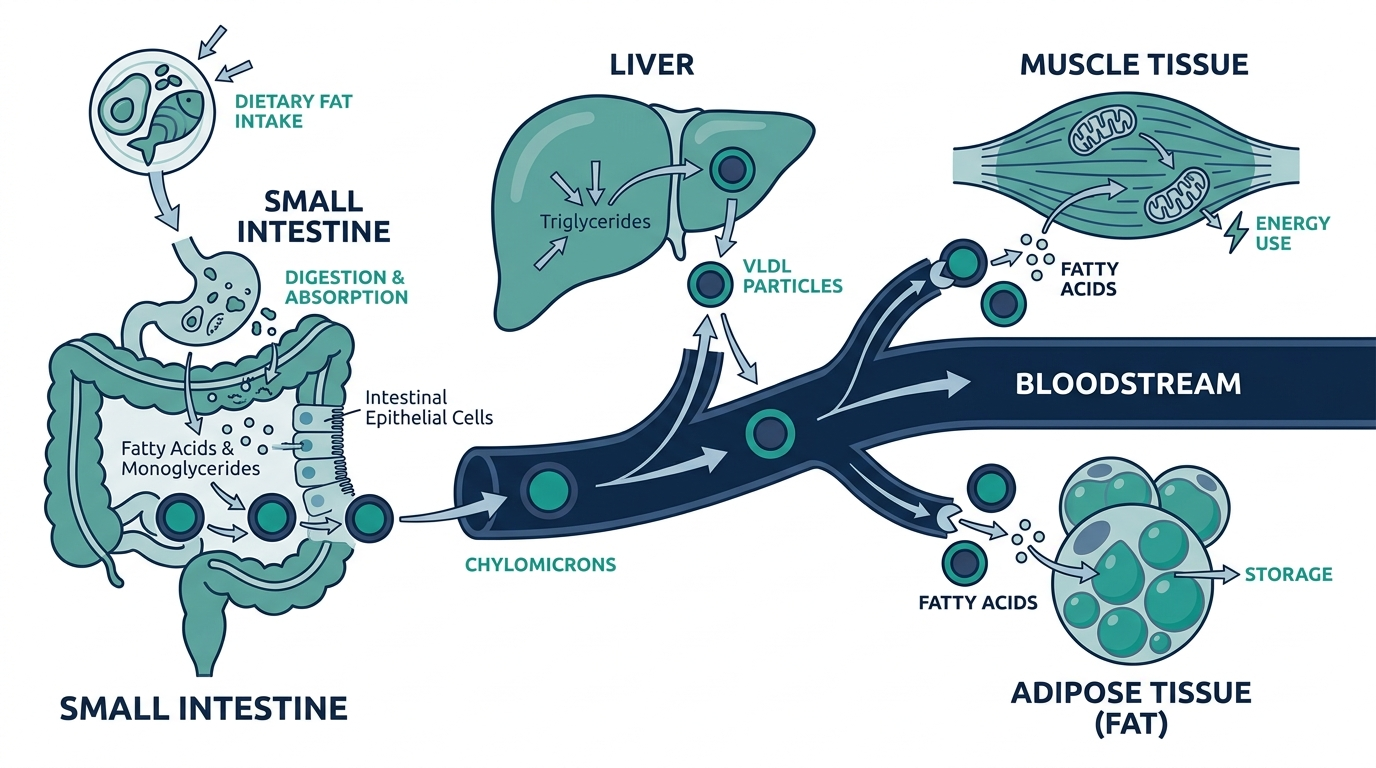
A normal fasting triglyceride level for adults is below 150 mg/dL, and a reading under 100 mg/dL is considered optimal (Cleveland Clinic). Triglycerides are the most common type of fat in your blood, and your body stores unused calories as triglycerides to use for energy later. Most clinicians use the U.S. national cutoffs from the National Cholesterol Education Program to read a fasting lipid panel.
It helps to separate normal from optimal. The guideline normal line is 150 mg/dL, but the level tied to the lowest cardiovascular risk is under 100 mg/dL, and some preventive clinicians aim closer to that mark, especially in people who already carry heart risk. Reference ranges also vary slightly by lab, so read your result against the range printed on your own report.
If your lab reports in mmol/L, as many outside the United States do, divide the mg/dL figure by about 88.5 to convert. That makes 150 mg/dL roughly 1.7 mmol/L and 100 mg/dL about 1.1 mmol/L. Same biology, different units, worth knowing if you compare results across countries or labs.
Wondering if your triglycerides are in the optimal range? See them alongside your full lipid panel. One at-home Superpower draw checks 100+ biomarkers, physician-reviewed.
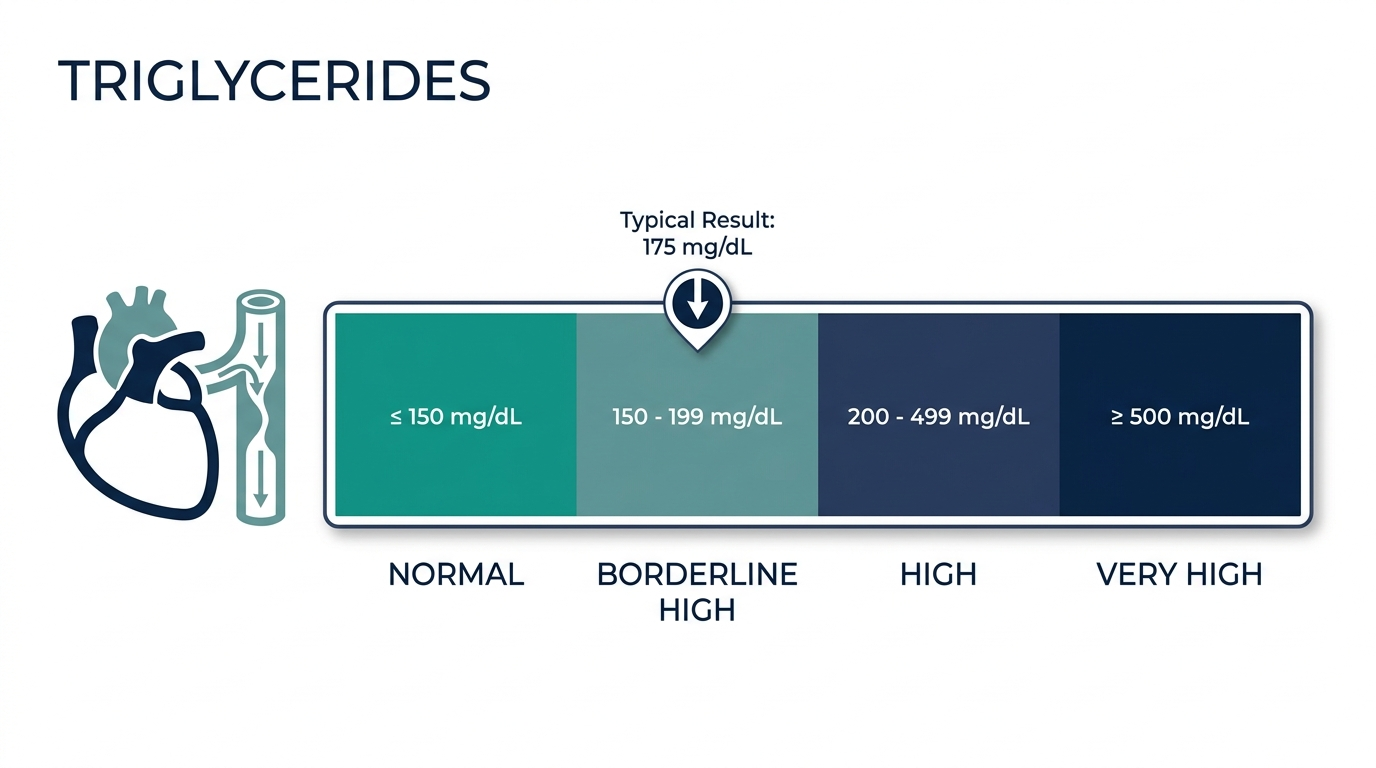
Here is how adult fasting triglycerides are classified:
- Normal: below 150 mg/dL
- Borderline high: 150 to 199 mg/dL
- High: 200 to 499 mg/dL
- Very high: 500 mg/dL or higher
These thresholds come from the same guideline framework used by the National Heart, Lung, and Blood Institute (NHLBI) and Cleveland Clinic. They apply to a fasting sample, usually drawn after 9 to 12 hours without food. Note that the cutoffs do not change with age for adults, but typical levels do shift across the lifespan, which is why age and sex context matters.
Triglycerides normal range by age
The simplest way to actually get this done
Superpower is a full-body lab membership that runs 100+ biomarkers, has each result reviewed by a doctor, and tracks your numbers year over year (about $199/year). It is what we point readers to when they would rather get one clean, complete draw than chase single tests one at a time. Here is superpower reviewed in full.
The official cutoff for “high” triglycerides does not move with age, but real-world levels do. For adults the normal target stays below 150 mg/dL, while children and teens are judged against lower, age-specific percentile values, where below 90 mg/dL is normal for ages 10 to 19 (Cleveland Clinic; NCBI Endotext). The table below pairs the standard guideline cutoffs with measured percentile values from U.S. pediatric data so you can see both the rule and the typical picture.
| Age group | Normal (target) | Borderline / elevated | High |
|---|---|---|---|
| Children 0 to 9 years | Below 75 mg/dL | 75 to 99 mg/dL | 100 mg/dL or higher |
| Children and teens 10 to 19 years | Below 90 mg/dL | 90 to 129 mg/dL | 130 mg/dL or higher |
| Adults 20 years and older | Below 150 mg/dL (optimal under 100) | 150 to 199 mg/dL | 200 mg/dL or higher |
The pediatric cutoffs come from the National Heart, Lung, and Blood Institute expert panel and are reproduced in NCBI Endotext. As a reference for what is typical rather than abnormal, U.S. percentile data show median (50th percentile) fasting triglycerides rising with age in childhood: about 48 mg/dL for boys and 57 mg/dL for girls ages 5 to 9, and about 68 mg/dL for boys and 64 mg/dL for girls ages 15 to 19 (NCBI Endotext).
How does sex change the range?
The numeric cutoffs are the same for men and women, but average levels differ, with men generally running higher than women through midlife, roughly between ages 40 and 59 (CDC NCHS). One commonly cited working range puts typical adult men around 40 to 160 mg/dL and women around 35 to 135 mg/dL, reflecting that women tend to sit a little lower for much of adult life.
This gap is not fixed. In the youngest children, girls often show slightly higher values than boys. For example, at the 95th percentile for ages 5 to 9, girls reach about 120 mg/dL versus 85 mg/dL for boys (NCBI Endotext). By adolescence and early adulthood, males pull ahead. Then the pattern shifts again later in life: after menopause, women’s triglycerides commonly rise and can approach or match men’s, partly due to the drop in estrogen. Because of these moving parts, your clinician reads your number against your age, sex, and overall cardiovascular risk rather than a single fixed line.
How do triglycerides connect to the rest of your lipid panel?
Triglycerides rarely travel alone. The number is most informative when you read it next to the other lipids on the same panel, because the combinations reveal patterns that any single value hides.
- The triglyceride to HDL ratio. Dividing your triglycerides by your HDL cholesterol gives a rough marker of insulin resistance. A ratio around 2 or below is favorable, while a higher ratio, driven by high triglycerides and low HDL together, often points toward the metabolic pattern behind type 2 diabetes and heart risk.
- Non-HDL and remnant cholesterol. Triglyceride rich particles carry cholesterol too. High triglycerides usually mean more of these remnant particles, which is why clinicians increasingly watch non-HDL cholesterol, your total cholesterol minus HDL, as a fuller picture of risk than LDL alone.
- Why very high triglycerides distort your LDL. Most labs calculate LDL rather than measure it directly, and that calculation becomes unreliable once triglycerides pass about 400 mg/dL. Above that, your LDL may be reported as unavailable or need a direct measurement, so a very high triglyceride number is also a reason your other lipids may need a second look.
This is the practical case for seeing the whole lipid panel at once rather than fixating on one line. A triglyceride of 180 with a high HDL and low LDL is a different story than the same 180 sitting on top of low HDL and high blood sugar.
How do you prepare for a triglyceride test?
Triglycerides are one of the most preparation sensitive numbers on a standard blood panel, and small mistakes the day before can swing your result by a lot. If you want a reading that reflects your baseline rather than last night, follow these:
- Fast 9 to 12 hours if your clinician asks for a fasting panel. Food, especially fat, raises triglycerides for hours, so water only is the rule before a fasting draw.
- Skip alcohol for at least 24 hours, ideally longer. Alcohol raises triglycerides sharply and is one of the most common reasons for a surprise high reading.
- Avoid a heavy, fatty meal the night before. Even with fasting, a large fat load the evening prior can still leave levels elevated in the morning.
- Do not test during an acute illness. Infection, injury, or an inflammatory flare can temporarily distort lipids, so wait a few weeks after recovering.
- Keep your usual diet in the days before. Crash dieting or a big cheat weekend right before the test both move the number, so eat normally for a truer baseline.
If you are tracking triglycerides over time, standardize the conditions: same fasting window, no alcohol beforehand, and no unusual eating the days prior. That way a change on paper reflects a real change in you.
What makes triglycerides rise or fall with age?
Triglycerides tend to drift upward from young adulthood and peak in the 40s and 50s before leveling off or easing slightly in older age (CDC NCHS). The main drivers are metabolic and behavioral rather than aging itself, which is why two people the same age can have very different numbers.
Key factors that push triglycerides up include:
- Diet: excess refined carbohydrates, sugar, and alcohol raise triglycerides quickly (NHLBI).
- Weight and activity: carrying extra weight and low physical activity both increase levels.
- Insulin resistance: prediabetes and type 2 diabetes commonly elevate triglycerides.
- Hormones: the menopausal estrogen decline lifts women’s levels.
- Medications and conditions: some drugs, an underactive thyroid, and kidney disease can raise them.
Factors that lower triglycerides include losing excess weight, cutting added sugar and alcohol, regular aerobic exercise, and choosing unsaturated fats and fiber. Because lifestyle moves the number so much, a high reading at any age is often partly reversible.
When is an out-of-range result a concern?
A fasting triglyceride level of 150 mg/dL or higher warrants attention, and a level at or above 500 mg/dL is a medical concern that needs prompt care because it raises the risk of acute pancreatitis (Cleveland Clinic; NHLBI). High triglycerides are also linked to a higher risk of heart disease and stroke, especially when paired with low HDL (“good”) cholesterol or high LDL.
Context decides how worried to be. A single borderline reading after a heavy meal or a few drinks is not the same as a repeated high fasting result. Your clinician will usually confirm with a repeat fasting test and look at the full lipid panel, your blood sugar, blood pressure, weight, and family history. Talk to a healthcare professional promptly if your fasting triglycerides are 200 mg/dL or higher, if you have diabetes or known heart disease, or if any reading reaches 500 mg/dL. A child or teen with a level at or above the age cutoff (100 mg/dL under age 10, or 130 mg/dL ages 10 to 19) should also be evaluated (NCBI Endotext).
Symptoms of very high triglycerides
Moderately high triglycerides usually cause no symptoms at all, which is why they are found on a routine panel rather than by how you feel. When levels climb very high, generally above 500 mg/dL and especially past 1,000 mg/dL, warning signs can appear: bouts of upper abdominal pain from pancreatitis, small yellowish bumps on the skin called eruptive xanthomas, and blood that looks milky or cloudy when drawn because it is thick with fat. Any of these with a very high reading is a reason for urgent care.
What to do if your triglycerides are high
The first line for high triglycerides is almost always lifestyle, because the number responds fast to it:
- Cut added sugar, refined carbs, and alcohol. These are the biggest and quickest levers. Many people see a meaningful drop within weeks of removing sugary drinks and alcohol alone.
- Move most days and lose excess weight. Regular aerobic activity and even modest weight loss both lower triglycerides.
- Favor unsaturated fats and fiber. Swapping toward fish, nuts, olive oil, and whole foods helps, and oily fish adds omega-3s that lower triglycerides directly.
- Ask about medication when needed. For persistently high levels, or very high levels with pancreatitis risk, clinicians may add prescription omega-3s, a fibrate, or a statin depending on your full risk picture.
Recheck timing depends on the starting point. After a lifestyle change, many clinicians retest in about 6 to 12 weeks. A very high result near the pancreatitis range is managed and rechecked much sooner.
A realistic example: a 46 year old with a fasting triglyceride of 260, a nightly glass or two of wine, and a desk job cuts the alcohol, drops the sugary coffees, and walks daily. A repeat panel three months later at 165 is a common and encouraging trajectory, not a fluke. Triglycerides are among the most movable numbers in the lipid panel.
Genetic and secondary causes worth knowing
Not every high triglyceride is about diet. Some people carry an inherited tendency, such as familial hypertriglyceridemia or familial combined hyperlipidemia, that keeps levels elevated despite good habits, and these run in families. Other cases are secondary, meaning another condition is driving the number: an underactive thyroid, poorly controlled diabetes, kidney disease, and certain medications, including some steroids, beta blockers, estrogen therapy, and retinoids, can all push triglycerides up. This is why a very high or stubborn reading prompts a look at thyroid, blood sugar, and your medication list, not just a diet talk.
Curious what your own levels look like?
Baseline 100+ biomarkers today and retest as life changes, all in one membership with physician review.
Frequently asked questions
Is 150 triglycerides normal?
A fasting triglyceride level of 150 mg/dL sits right at the borderline. Below 150 mg/dL is normal, and 150 to 199 mg/dL is borderline high (Cleveland Clinic). At exactly 150, most clinicians treat it as a nudge to review diet, alcohol, weight, and activity, then recheck.
What is a good triglyceride level by age?
For adults of any age, below 150 mg/dL is normal and under 100 mg/dL is optimal. For children under 10, aim below 75 mg/dL, and for ages 10 to 19, below 90 mg/dL (Cleveland Clinic; NCBI Endotext). Cutoffs do not change for adults by decade.
Do triglycerides naturally increase with age?
Yes. On average, triglycerides rise from young adulthood, peak in the 40s and 50s, then often stabilize or dip slightly in older age (CDC NCHS). The rise is driven mostly by weight, diet, and insulin resistance, so it is partly preventable.
Are triglycerides different for men and women?
The cutoffs are identical, but typical levels differ. Men usually run higher than women in midlife, roughly ages 40 to 59 (CDC NCHS). After menopause, women’s triglycerides tend to rise and can catch up to men’s because estrogen drops.
Do I need to fast for a triglyceride test?
Triglycerides are traditionally measured after 9 to 12 hours of fasting because food temporarily raises them (Cleveland Clinic). Some newer guidance accepts non-fasting panels for routine screening, but follow the specific instructions your clinician or lab gives you.
Can triglycerides be too low?
Very low triglycerides are uncommon and usually not a problem on their own. When they are extremely low, it is occasionally linked to an overactive thyroid, malnutrition, malabsorption, or a rare inherited condition, so a strikingly low value with symptoms is worth mentioning to your clinician. For most people, lower is fine.
What foods raise triglycerides the most?
Sugary drinks, sweets, white bread and other refined carbohydrates, and alcohol raise triglycerides the fastest, because the body converts excess sugar and alcohol into triglycerides efficiently. Large amounts of saturated fat contribute too. Cutting these is the quickest way to bring a high number down.
How quickly can triglycerides drop?
Faster than most lipids. Because triglycerides respond directly to recent diet and alcohol, removing sugary drinks and alcohol and improving your diet can lower them noticeably within a few weeks, and a full lifestyle change is often rechecked at about 6 to 12 weeks.
Is a non-fasting triglyceride test accurate enough?
For routine screening, a non-fasting panel is increasingly accepted and correlates well with cardiovascular risk. Non-fasting triglycerides do run somewhat higher because you have eaten, so if a non-fasting result is high, your clinician will often confirm it with a fasting draw before acting on it.
What is the difference between triglycerides and cholesterol?
They are two different fats. Triglycerides store unused calories for energy, while cholesterol builds cell membranes and hormones. Both travel in the blood on lipoprotein particles and both appear on a lipid panel, but they are measured separately, and you can have normal cholesterol with high triglycerides or the reverse.
Does exercise lower triglycerides?
Yes. Regular aerobic exercise is one of the most reliable ways to lower triglycerides, both by burning circulating fat for fuel and by improving insulin sensitivity over time. Even a single session can lower the number for a day or two, and a consistent routine produces a lasting drop.
Sources
- Cleveland Clinic, Triglycerides: Levels and Normal Range
- NCBI Endotext, Triglyceride Levels for Males and Females 5 to 19 Years of Age
- NHLBI, NIH, High Blood Triglycerides
- CDC NCHS Data Brief, Trends in Elevated Triglyceride in Adults
- American Heart Association, Triglycerides
This article is for general educational purposes and is not medical advice. It cannot diagnose or treat you and does not replace your clinician. Always discuss your lab results and any health decisions with a qualified healthcare professional.
Vital Signs Today may earn a commission if you buy through links on this page. It does not affect our editorial assessments.