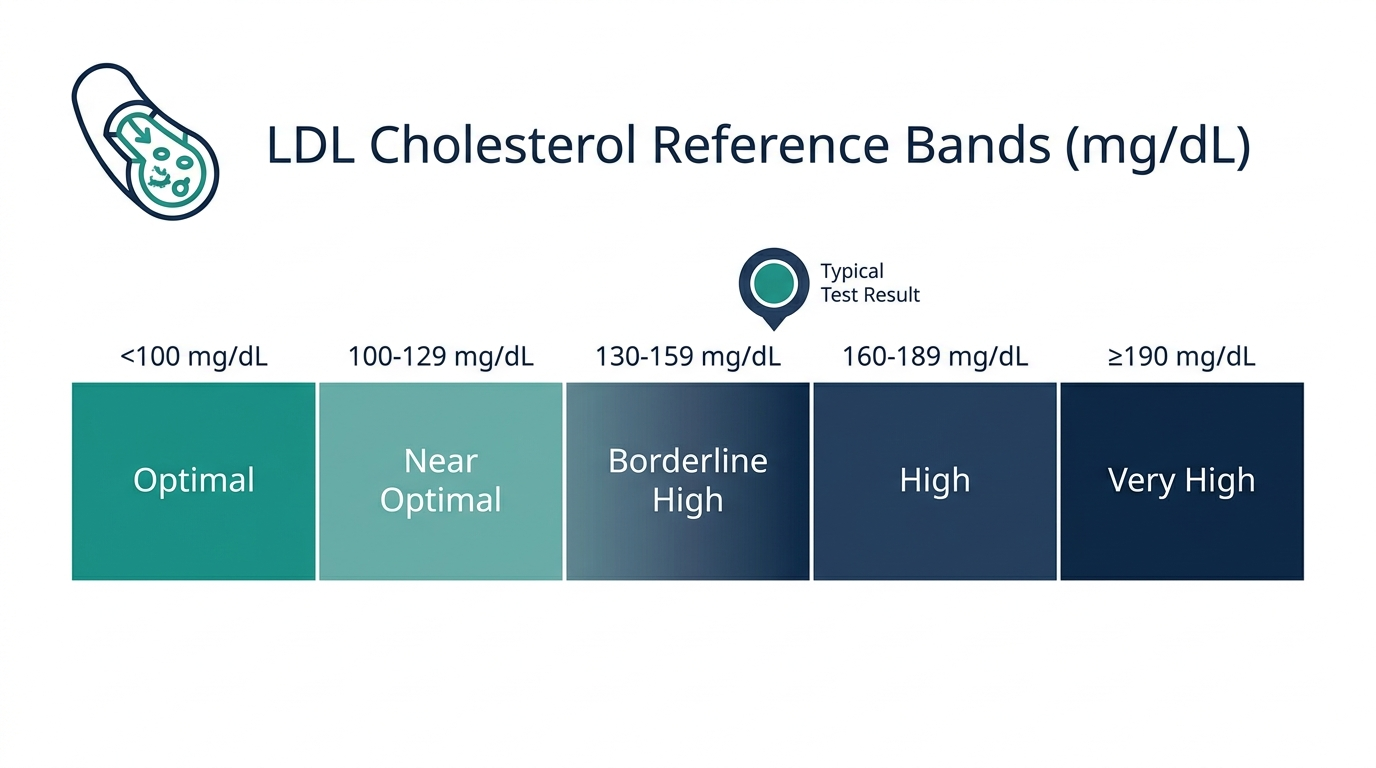
- For most adults, a normal (optimal) LDL cholesterol level is below 100 mg/dL, with 100 to 129 mg/dL counted as near optimal, according to the National Cholesterol Education Program classification used by MedlinePlus.
- For children and teens under age 20, an acceptable LDL level is below 110 mg/dL, borderline is 110 to 129 mg/dL, and high is 130 mg/dL or above, per the NHLBI pediatric guidelines.
- LDL is not a single fixed number across life: it tends to drift upward with age and is usually a few points higher in women after menopause, so the same value can mean different things at 18 and at 60.
Part of our Lipid Panel guide.
What is a normal LDL level?
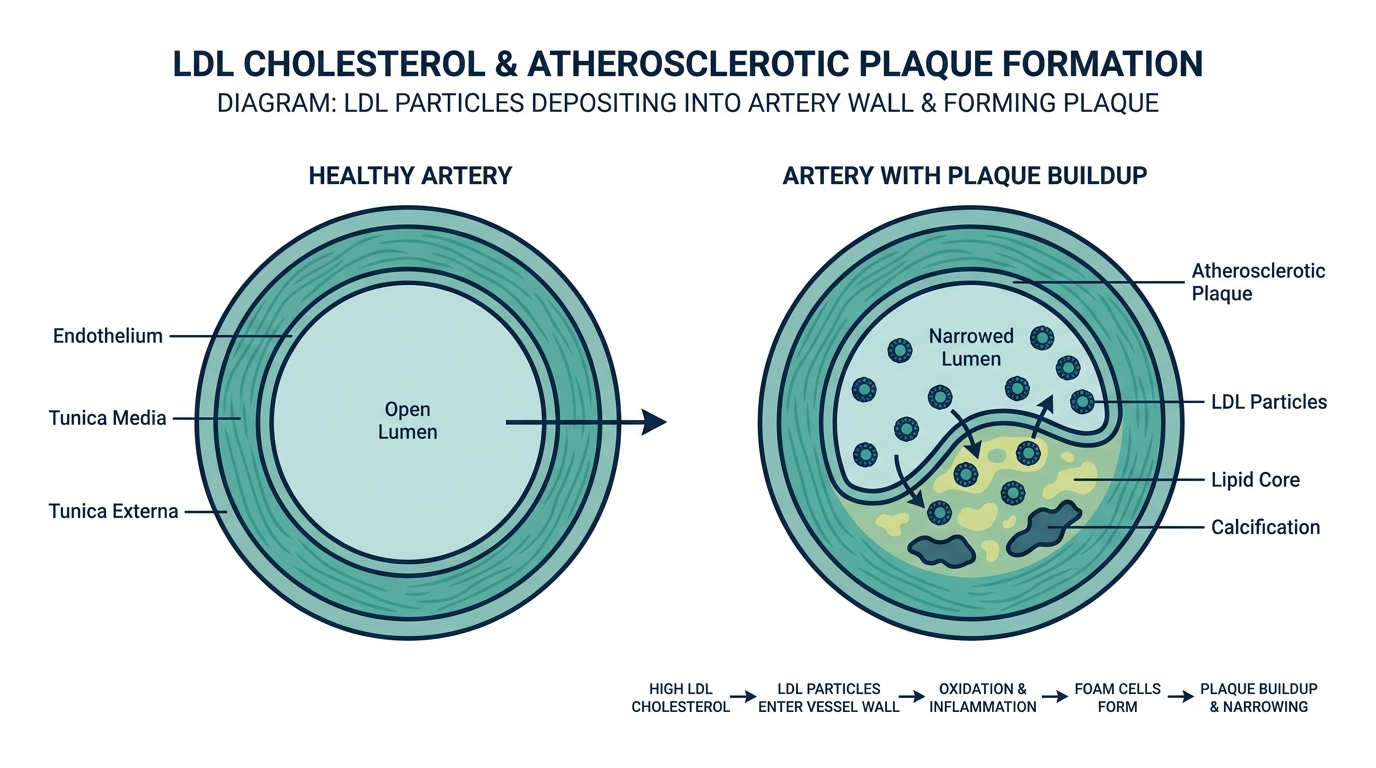
For most adults, a normal LDL cholesterol level is below 100 mg/dL, which the National Cholesterol Education Program (NCEP) labels “optimal” (MedlinePlus). LDL, the so called “bad” cholesterol, carries cholesterol into artery walls, where buildup raises heart attack and stroke risk. The standard adult categories are:
Curious where your LDL actually falls on this chart instead of just the general range? One at-home Superpower draw checks 100+ biomarkers, physician-reviewed.
- Optimal: below 100 mg/dL
- Near optimal or above optimal: 100 to 129 mg/dL
- Borderline high: 130 to 159 mg/dL
- High: 160 to 189 mg/dL
- Very high: 190 mg/dL and above
One point trips people up. “Normal” is a population label, but your personal target depends on risk. Cleveland Clinic notes that someone with a history of atherosclerosis should aim for an LDL below 70 mg/dL, well under the general optimal cutoff (Cleveland Clinic). So a value of 110 mg/dL may be fine for a low risk 25 year old and too high for a 60 year old who already had a stent.
Why LDL has no real normal, only lower and higher risk
LDL is different from most lab values because there is no level below which it stops mattering. Decades of evidence show LDL is not just a marker but a direct cause of artery plaque, and risk falls in a straight line as LDL goes lower, with no clear floor. That is why guidelines call below 100 mg/dL optimal for the general population but push high risk patients far lower, sometimes below 55 or 70 mg/dL. It is also why cumulative exposure counts: an LDL of 130 carried for thirty years does more damage than a brief spike, so catching a rising number early is worth more than it looks.
Reference ranges also vary slightly by lab and by whether the LDL was calculated or directly measured, so read your result against the range on your own report and, ideally, compare draws from the same lab.
LDL normal range by age
The simplest way to actually get this done
Superpower is a full-body lab membership that runs 100+ biomarkers, has each result reviewed by a doctor, and tracks your numbers year over year (about $199/year). It is what we point readers to when they would rather get one clean, complete draw than chase single tests one at a time. Here is superpower reviewed in full.
LDL reference values differ mainly between children and adults, not in fine age brackets within adulthood. The NHLBI pediatric panel sets an acceptable LDL below 110 mg/dL for ages 2 to 19, while adults use the NCEP optimal cutoff of below 100 mg/dL (StatPearls, Pediatric Dyslipidemia; MedlinePlus). The table below shows the acceptable upper end and the high threshold for each group.
| Age and group | Acceptable LDL (mg/dL) | Borderline (mg/dL) | High LDL (mg/dL) | Source |
|---|---|---|---|---|
| Children and teens, ages 2 to 19 (all sexes) | Below 110 | 110 to 129 | 130 or above | NHLBI / StatPearls |
| Adults 20 and older, men (optimal target) | Below 100 | 130 to 159 (borderline high) | 160 or above | NCEP / MedlinePlus |
| Adults 20 and older, women (optimal target) | Below 100 | 130 to 159 (borderline high) | 160 or above | NCEP / MedlinePlus |
| Anyone with known heart or artery disease | Below 70 (treatment goal) | Above goal | Discuss with clinician | Cleveland Clinic |
Notice the adult categories add a 100 to 129 mg/dL “near optimal” band between acceptable and borderline high, which children’s cutoffs do not use. The pediatric thresholds are slightly higher because growing bodies naturally run a touch higher, yet the high flag still lands at a lower number (130) than the adult high flag (160).
How does sex change the range?
The official LDL cutoff numbers are the same for men and women, but the typical real world value differs by sex and shifts with hormones. Before menopause, estrogen helps keep women’s LDL lower on average than men’s of the same age. After menopause, that protection fades and women’s LDL often rises to meet or exceed men’s, which is why postmenopausal women frequently see their first “borderline” result (Cleveland Clinic).
This matters for interpretation, not for the threshold. A 35 year old man and a 35 year old woman both aim for LDL below 100 mg/dL, but the woman is statistically more likely to be under it. A practical takeaway: a woman whose LDL climbs from 95 to 125 mg/dL across her early 50s is showing a classic menopausal pattern, and that change is worth a conversation even though 125 is still under the 130 borderline mark.
LDL-C, ApoB, and non-HDL: which number really matters?
The LDL on a standard panel is LDL-C, the amount of cholesterol carried inside your LDL particles. It is a good number, but it has a blind spot: it measures the cargo, not the number of particles. Two people with the same LDL-C can carry very different particle counts, and it is the particles that lodge in artery walls.
- ApoB counts every atherogenic particle directly, since each one carries a single apolipoprotein B molecule. When ApoB is available, many lipid specialists treat it as a more reliable risk marker than LDL-C, especially in people with high triglycerides, diabetes, or obesity, where LDL-C can understate the real particle burden.
- Non-HDL cholesterol, your total cholesterol minus HDL, is a free extra number already on every lipid panel. It captures LDL plus other harmful particles and is often a better predictor than LDL-C alone, with a target roughly 30 mg/dL above your LDL goal.
- Lp(a) is an inherited, LDL like particle that most people never have measured. It raises heart risk independently of LDL-C and generally stays stable for life, so it is worth checking once, particularly with a family history of early heart disease.
The practical point: if your LDL-C looks fine but you have high triglycerides or a strong family history, asking about ApoB, non-HDL, or a one time Lp(a) can reveal risk the basic number misses.
How do you prepare for an LDL test?
The LDL on most panels is not measured directly, it is calculated from your total cholesterol, HDL, and triglycerides. That calculation is what drives the prep rules, because anything that distorts triglycerides also distorts your LDL:
- Fast 9 to 12 hours when asked. A fasting sample keeps triglycerides accurate, which keeps the calculated LDL accurate. Water is fine.
- Know the triglyceride ceiling. When triglycerides run above about 400 mg/dL, the standard LDL calculation breaks down and your lab may report LDL as unavailable or switch to a direct measurement.
- Avoid alcohol and a heavy, fatty meal the day before. Both raise triglycerides and can throw off the calculated LDL.
- Do not test during acute illness or soon after a heart attack. Cholesterol drops temporarily during infection, major stress, or in the weeks after a cardiac event, so a low reading then can be misleading. Retest once recovered.
- Keep habits steady before a repeat. To compare draws honestly, test under similar conditions each time.
If your clinician orders a direct LDL or an ApoB, fasting matters less, but follow the specific instructions for the test you are given.
What makes LDL rise or fall with age?
LDL tends to climb gradually from young adulthood into the 50s and 60s, then can plateau or dip in advanced age. The drivers are partly biological and partly lifestyle. Cleveland Clinic and MedlinePlus both note that cholesterol naturally trends upward with age, which is why “optimal” is defined the same way for everyone rather than loosening for older adults (MedlinePlus).
What pushes LDL up over time:
- Slower metabolism and liver clearance: the body removes LDL particles less efficiently with age.
- Hormonal change: falling estrogen after menopause raises LDL in women.
- Diet and weight: saturated and trans fats and weight gain raise LDL at any age.
- Inactivity: low physical activity is linked to higher LDL.
- Genetics: familial hypercholesterolemia can push LDL very high regardless of habits.
What can pull it down: a diet lower in saturated fat and higher in fiber, regular exercise, weight loss, and statin or other lipid lowering medication when a clinician prescribes it.
When is an out-of-range result a concern?
An LDL above your target is a concern when it sits in the borderline high range or above, or when even a “normal” number combines with other risk factors. For most adults, an LDL of 160 mg/dL or higher is classified as high and 190 mg/dL or higher as very high, the level that often signals a genetic cause and prompts urgent treatment (StatPearls, Dyslipidemia).
Context decides everything. A single LDL number is rarely treated in isolation. Clinicians weigh it against age, blood pressure, diabetes, smoking, family history, and overall cardiovascular risk score. That is why a person with diabetes may be told to get LDL well below 100 mg/dL, while a low risk young adult at 115 mg/dL may simply be asked to improve diet and recheck. If your result is out of range, the right move is not panic but a follow up test and a risk discussion. Repeat lipid panels and a fasting test help confirm a true elevation before any medication decision.
Does high LDL cause symptoms?
Almost never on its own. High LDL is silent for years while plaque quietly builds, which is why the first sign for many people is a heart attack or stroke. The exception is very high, often genetic, LDL: familial hypercholesterolemia can leave visible signs such as fatty deposits in the tendons or eyelids and a pale ring around the cornea, and it drives heart disease decades early. An LDL of 190 or higher, or a strong family history of early heart attacks, is a reason to ask specifically about it.
What to do if your LDL is high
A high LDL is a call to act methodically, not to panic:
- Confirm it. One elevated value is repeated, usually fasting, before conclusions, since illness and lab variation move the number.
- Start with diet and activity. Cutting saturated and trans fat, adding soluble fiber, losing excess weight, and exercising regularly can meaningfully lower LDL.
- Match treatment to risk. If lifestyle is not enough or your risk is high, statins are first line, with ezetimibe and then PCSK9 inhibitors added when a bigger drop is needed.
- Recheck to steer. After a change in diet or a new medication, LDL is typically rechecked in about 6 to 12 weeks to see the effect and adjust.
A realistic example: a 52 year old man with an LDL of 165, a family history of early heart disease, and rising blood pressure trims saturated fat, starts walking daily, and begins a statin after a risk discussion. A repeat panel at 10 weeks showing LDL near 95 is a typical and reassuring response, and it also lets his clinician confirm the medication is working.
How much can lifestyle actually lower LDL?
Diet and exercise help, but it is worth having realistic expectations. Cutting saturated fat and adding soluble fiber from oats, beans, and fruit can lower LDL by a modest but real amount for most people, more if the starting diet was poor. Losing excess weight and regular exercise add to that, and they improve triglycerides and HDL at the same time. What lifestyle usually cannot do is bring a genetically very high LDL, the 190 and above range, down to target on its own, which is why those cases pair lifestyle with medication. For a borderline number in an otherwise healthy person, though, a determined diet and activity change is often enough.
Turn what you just learned into action.
Superpower lets you test 100+ biomarkers from home, then re-check them over time so you can actually see progress, physician-reviewed at every step.
Frequently asked questions
Is an LDL of 100 normal?
An LDL of exactly 100 mg/dL sits at the top of the optimal range and the start of “near optimal.” For most adults it is acceptable, but if you have diabetes or known heart disease your clinician may want it lower, sometimes below 70 mg/dL.
What is a dangerously high LDL level?
An LDL of 190 mg/dL or higher is classified as very high and is considered dangerous, since it often reflects a genetic disorder and sharply raises heart attack risk (StatPearls). Levels of 160 to 189 mg/dL are high and also warrant attention.
Does LDL increase naturally with age?
Yes. LDL tends to rise gradually from young adulthood into the 50s and 60s due to slower liver clearance, hormonal change, and lifestyle factors (MedlinePlus). The optimal target stays below 100 mg/dL at every adult age rather than loosening over time.
What is a normal LDL for a woman over 50?
The target is the same as for any adult, below 100 mg/dL, but many women over 50 see LDL rise after menopause as estrogen falls. A new borderline reading in this window is common and worth discussing with a clinician.
What LDL level requires medication?
There is no single cutoff. An LDL of 190 mg/dL or higher usually prompts statin therapy, but medication decisions also depend on age, diabetes, and overall cardiovascular risk, so a value of 130 may need treatment in a high risk person.
Can LDL be too low?
For most people, lower LDL is safer, and very low levels achieved with medication are generally well tolerated. Naturally very low LDL is occasionally linked to malnutrition, an overactive thyroid, or a rare inherited condition, so a strikingly low value without treatment may be checked, but a low LDL on therapy is usually the goal, not a problem.
How is LDL calculated?
Most labs estimate LDL rather than measure it, using your total cholesterol, HDL, and triglycerides. Because the estimate relies on triglycerides, it becomes unreliable when triglycerides are high, above about 400 mg/dL, at which point a direct LDL measurement is used instead.
Do I need to fast for an LDL test?
Usually yes for a calculated LDL, because accurate triglycerides require a 9 to 12 hour fast. Direct LDL and ApoB tests are less sensitive to fasting. Follow the specific instructions your clinician or lab provides.
Does exercise lower LDL?
Exercise has a bigger effect on triglycerides and HDL than on LDL, but regular aerobic activity, especially combined with weight loss, does lower LDL modestly and improves overall cardiovascular risk. It works best as part of a package with diet change rather than on its own.
What foods lower LDL the most?
Soluble fiber from oats, barley, beans, and apples, foods low in saturated and trans fat, nuts, and plant sterols are the most effective LDL lowering foods. Swapping saturated fats like butter and fatty meat for unsaturated fats like olive oil helps too. This pattern is sometimes called a portfolio approach because the small effects add up.
Sources
- MedlinePlus, Cholesterol Levels: What You Need to Know
- Cleveland Clinic, LDL Cholesterol: What It Is and How to Manage It
- Cleveland Clinic, Cholesterol Numbers: What Do They Mean
- StatPearls (NCBI Bookshelf), Pediatric Dyslipidemia
- StatPearls (NCBI Bookshelf), Dyslipidemia
This article is for general educational purposes and is not medical advice. It cannot diagnose or treat you and does not replace your clinician. Always discuss your lab results and any health decisions with a qualified healthcare professional.
Vital Signs Today may earn a commission if you buy through links on this page. It does not affect our editorial assessments.