
Educational content, not medical advice. Talk to a registered dietitian before making major changes to your protein intake.
Short answer: One serving of Vital Proteins Collagen Peptides (2 scoops, 20g) delivers 18g of protein and 70 calories. At 90g of protein per 100g of powder, it is one of the most protein-dense supplements on the shelf. The catch: collagen is not a complete protein. It scores a PDCAAS of 0.0 because it contains zero tryptophan, which means it cannot legally claim a “% Daily Value” for protein on its label and should not be your only protein source.
Counting grams of protein from collagen peptides? See how your body is actually using it with a full blood panel. One at-home Superpower draw checks 100+ biomarkers, physician-reviewed.
What exactly does the Vital Proteins label say?
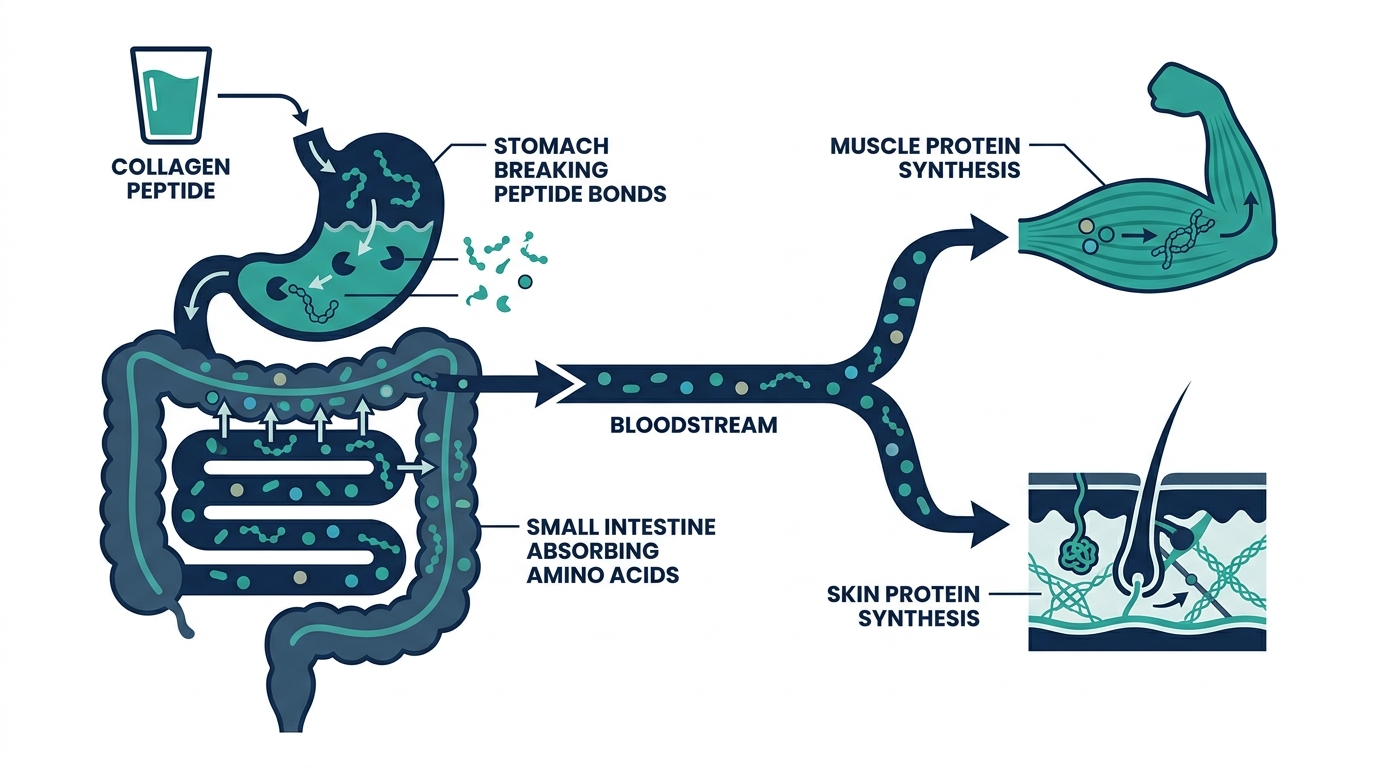
The standard unflavored Vital Proteins Collagen Peptides canister lists the following per one serving (2 scoops / 20g):
- Calories: 70
- Total Fat: 0g
- Total Carbohydrate: 0g
- Protein: 18g
- Sodium: 110mg
The single ingredient is hydrolyzed bovine collagen peptides, sourced from grass-fed, pasture-raised cows (Vital Proteins). There are no fillers, sweeteners, or additives in the original unflavored version.
A couple of details the label does not highlight. First, 18g of protein from 20g of powder means roughly 90% of the product by weight is protein. Second, because collagen’s PDCAAS (Protein Digestibility-Corrected Amino Acid Score) is 0.0 due to the missing essential amino acid tryptophan, the FDA does not permit the label to show a percent daily value for protein. You will notice that “Protein” row has no % DV column. That blank is not an oversight; it is a regulatory requirement (NCBI / Nutrients).
Full-body lab membership: 100+ biomarkers, doctor-reviewed, tracked over time.
What is the full amino acid profile of one serving?
The simplest way to actually get this done
Superpower is a full-body lab membership that runs 100+ biomarkers, has each result reviewed by a doctor, and tracks your numbers year over year (about $199/year). It is what we point readers to when they would rather get one clean, complete draw than chase single tests one at a time. Here is superpower reviewed in full.
This is where Vital Proteins Collagen Peptides earns its reputation, and also where the “incomplete protein” critique has real teeth. The 18g of protein per serving is not distributed the way whey or egg protein is. It is loaded front-heavy into three non-essential amino acids that most Western diets eat very little of (Vital Proteins amino acids page):
| Amino Acid | Per 20g Serving | Notes |
|---|---|---|
| Glycine | 4,660 mg | Most abundant; 26% of total amino acids |
| Proline | 2,860 mg | Precursor to hydroxyproline |
| Hydroxyproline | 2,140 mg | Unique to collagen; rare in other foods |
| Alanine | 1,860 mg | Non-essential; energy metabolism |
| Glutamic Acid | 1,820 mg | Non-essential; neurotransmitter precursor |
| Arginine | 1,520 mg | Semi-essential; nitric oxide pathway |
| Aspartic Acid | 1,080 mg | Non-essential |
| Lysine | 720 mg | Essential |
| Serine | 620 mg | Non-essential |
| Leucine | 580 mg | Essential; mTOR activator |
| Valine | 520 mg | Essential; BCAA |
| Phenylalanine | 460 mg | Essential |
| Threonine | 340 mg | Essential |
| Isoleucine | 240 mg | Essential; BCAA |
| Histidine | 140 mg | Essential |
| Hydroxylysine | 140 mg | Modified lysine; collagen-specific |
| Tyrosine | 120 mg | Non-essential |
| Methionine | 108 mg | Essential (lowest) |
| Tryptophan | 0 mg | Missing entirely |
Table: Per-serving amino acid breakdown from the Vital Proteins label and amino acid detail page.
Three things jump out of that table for anyone thinking seriously about protein intake.
First, glycine plus proline plus hydroxyproline account for about 47% of total amino acids per serving. No other common protein food comes close to that concentration. Meat, eggs, and whey are almost entirely devoid of hydroxyproline, a compound that appears to be absorbed into the bloodstream as intact dipeptides, meaning your tissues receive it in a form that can be incorporated directly into connective structures (PMC bioavailability study, 2024).
Second, the essential amino acids that are present (leucine, valine, isoleucine, lysine, phenylalanine, threonine, histidine, methionine) are present in lower quantities than in whey. Leucine, the primary trigger for muscle protein synthesis through the mTOR pathway, clocks in at just 580mg per serving, versus roughly 2,500 to 3,000mg in a serving of whey isolate.
Third, tryptophan is genuinely absent, not just low. That is not a manufacturing defect. Collagen protein, by its biochemical nature, does not contain tryptophan.
Does the protein in collagen count toward your daily goals?
This question comes up constantly in fitness and nutrition circles, and the honest answer is: yes, with a hard ceiling.
The protein in Vital Proteins Collagen Peptides is real protein in the sense that your body digests and uses the amino acids. Collagen actually scores well on digestibility alone. The PDCAAS bottoms out at 0.0 solely because of the absent tryptophan, not because of poor digestion.
Practically, research published in Nutrients found that up to 36% of your total daily protein intake can come from collagen peptides without compromising your indispensable amino acid requirements, as long as the remaining 64% or more comes from complete protein sources such as meat, fish, eggs, or dairy (NCBI / Nutrients, MDPI 2019).
So for someone eating 150g of protein per day, that is a ceiling of about 54g from collagen, or roughly three full servings of Vital Proteins. Most people take one serving (18g), which lands well below that ceiling.
The practical rule for macro trackers: count collagen protein toward your total, but make sure at least two-thirds of your daily protein still comes from complete sources.
Do not believe anyone telling you collagen protein “doesn’t count” because it’s incomplete. That misunderstands how amino acid metabolism works. Your body draws on a common pool of amino acids from everything you ate across the day, and glycine from collagen is every bit as usable as glycine from chicken breast. What you cannot do is replace all your protein with collagen alone.
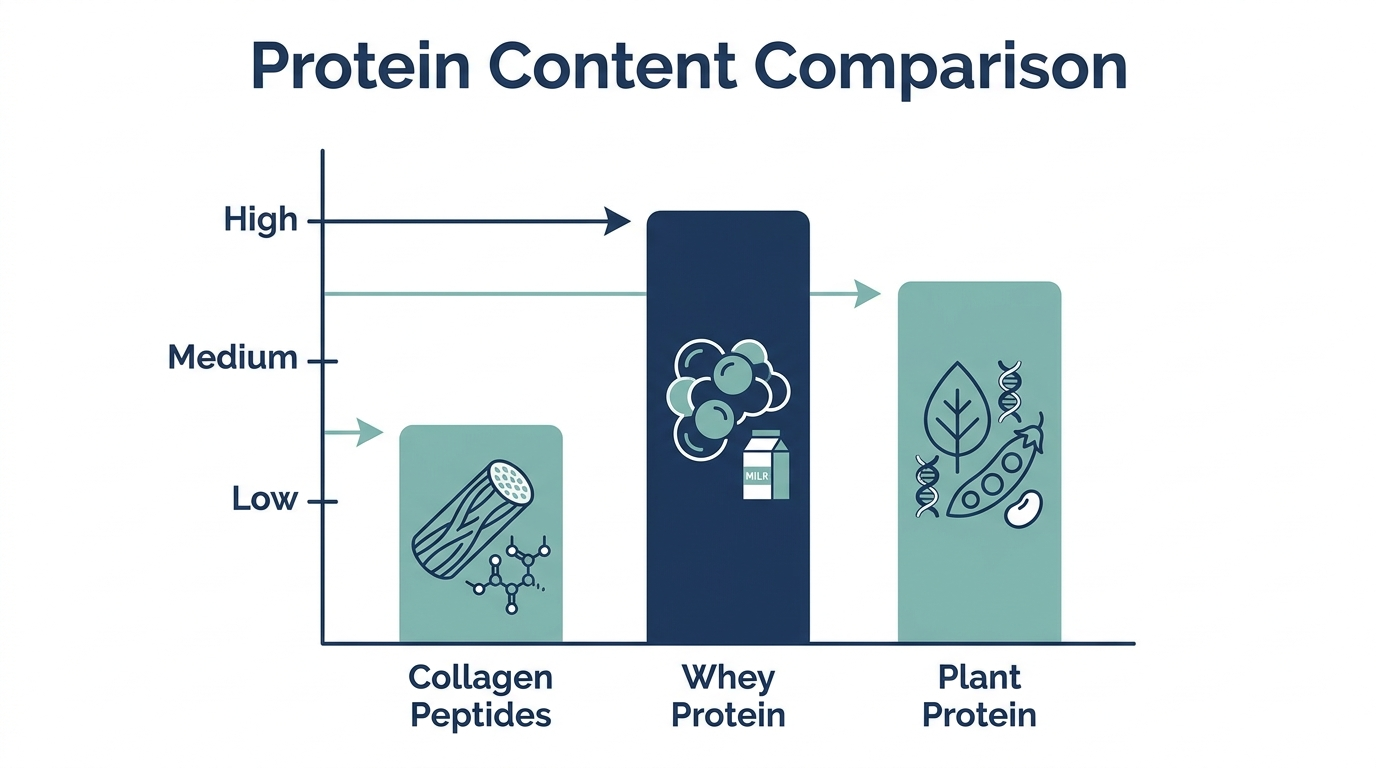
How does Vital Proteins compare to other protein sources per serving?
| Protein Source | Serving | Protein | Calories | Cal/g protein | Complete? |
|---|---|---|---|---|---|
| Vital Proteins Collagen Peptides | 20g | 18g | 70 | 3.9 | No |
| Whey Isolate (typical) | 30g | 25-27g | 110-120 | 4.3-4.5 | Yes |
| Egg White Powder | 30g | 25g | 110 | 4.4 | Yes |
| Casein Protein | 33g | 24g | 120 | 5.0 | Yes |
| Pea Protein Isolate | 30g | 20-24g | 100-120 | 4.5-5.0 | Nearly (low methionine) |
| Chicken Breast (cooked) | 85g | 26g | 128 | 4.9 | Yes |
Comparison of protein density across common sources. Collagen’s caloric efficiency is genuinely competitive.
Personally, I find it telling that collagen protein comes in at only 3.9 calories per gram of protein, which is roughly on par with leaner protein powders. The supplement industry does not always advertise this, partly because collagen’s PDCAAS score of zero makes it awkward to market as a “high-protein” product, even though it technically is.
What whey delivers that collagen cannot is the leucine surge: roughly 2,500mg of leucine per scoop of isolate versus 580mg in collagen. That leucine spike is what drives acute muscle protein synthesis, and the evidence is clear that whey outperforms collagen for building muscle tissue in controlled trials (PMC, whey vs collagen muscle synthesis).
But that is answering the wrong question for most collagen buyers. Nobody buys Vital Proteins to replace their whey. They buy it for what whey cannot provide: the glycine, hydroxyproline, and proline that tendons, ligaments, cartilage, and skin are built from and that almost no other food delivers in meaningful concentrations.
What does the research actually say collagen protein is useful for?
There is a lot of wellness-industry noise here, so it is worth being specific about what the science says versus what marketing says.
For skin: A 2025 meta-analysis of 23 randomized controlled trials found that collagen supplementation significantly improved skin hydration, elasticity, and the appearance of wrinkles. The researchers also noted that when studies funded by collagen manufacturers were removed, effects on skin elasticity became less clear, suggesting publication bias (Frontiers in Nutrition, 2025). Take skin claims with appropriate skepticism while still acknowledging the biological plausibility.
For joints: Athletes consuming 10g of collagen daily for 24 weeks showed significant improvements in joint pain during activity versus placebo in peer-reviewed trials (PMC systematic review). The mechanism is thought to involve hydroxyproline-containing dipeptides accumulating in cartilage tissue and stimulating local collagen synthesis.
For connective tissue repair: A study published in the American Journal of Clinical Nutrition found that consuming vitamin C-enriched gelatin (a collagen source) before intermittent exercise augmented collagen synthesis markers in tendons (Shaw et al., ScienceDirect). The collagen-plus-vitamin-C combination matters mechanistically: vitamin C is required for the enzyme prolyl hydroxylase to convert proline into hydroxyproline in newly synthesized collagen chains. Without adequate vitamin C, your body cannot properly stabilize new collagen.
For muscle: Whey protein, not collagen, is the tool for muscle protein synthesis. Collagen can support elderly individuals maintaining muscle mass when combined with resistance training (15g daily showed positive results in some trials), but it is not a substitute for leucine-rich complete protein when hypertrophy is the goal (Frontiers in Nutrition meta-analysis, 2025).
For gut health: Glycine, the dominant amino acid in collagen at 4,660mg per serving, plays a role in regulating tight junction proteins that control intestinal permeability. A 2024 study in npj Science of Food found anti-inflammatory activity from collagen peptides in models of ulcerative colitis, though human trial data is still emerging (Nature / npj Science of Food).
How much should you take to actually hit those research doses?
The research doses vary by goal, and one Vital Proteins serving of 18g covers most of them:
- Skin hydration and wrinkles: Studies typically use 2.5g to 10g daily. One full serving exceeds all these doses.
- Joint pain reduction: 10g daily for 24 weeks is the best-studied dose. One serving (18g) comfortably exceeds this.
- Tendon collagen synthesis (the Shaw protocol): 15g of gelatin (functionally equivalent) with vitamin C, taken 30 to 60 minutes before exercise. One serving of Vital Proteins provides 18g, so one scoop would technically be enough; two scoops matches the original study design.
- Gut health: 20g daily (split into two servings) was associated with reduced bloating in healthy women in an 8-week trial. This maps directly to one or two servings of Vital Proteins daily.
- Elderly muscle maintenance with resistance training: 15g daily. One serving again.
What almost no one discusses openly: taking your collagen serving alongside 50 to 100mg of vitamin C meaningfully increases the hydroxyproline that reaches your plasma. The vitamin C does not come with the unflavored Vital Proteins product, so take it with a glass of orange juice, a vitamin C supplement, or switch to the Vital Proteins Advanced line that includes 60mg of vitamin C per serving.
Is Vital Proteins actually a quality product?
One insider reality the brand’s marketing team will not tell you: Nestlé Health Science completed its full acquisition of Vital Proteins in February 2022. The founder, Kurt Seidensticker, who built the brand from the ground up on grass-fed sourcing standards, stepped away from operations following that acquisition (Nutra Ingredients). Whether Nestlé’s scale has helped or hurt quality standards depends on your view of large-CPG ownership of supplement brands.
The sourcing claim that matters is the bovine hide origin. Collagen peptides derived from hides (as opposed to hooves, bones, or cartilage) tend to yield a cleaner amino acid profile with more consistent molecular weight distribution. Vital Proteins uses upcycled bovine hide from grass-fed sources, which is at the better end of the category.
There have been Proposition 65 concerns raised about heavy metal contamination in collagen products generally (California’s Prop 65 requires disclosure of lead and cadmium above certain thresholds). Vital Proteins addressed this through product reformulation in specific SKUs, though this history is worth knowing if you are in California or in a population with elevated heavy metal exposure risk.
At a retail price of roughly $45 to $55 for a 20oz canister (28 servings), the cost per serving is approximately $1.60 to $2.00, or about $0.09 to $0.11 per gram of protein. That is more expensive than bulk whey isolate but comparable to other premium collagen brands and meaningfully cheaper than clinical-grade peptide supplementation.
Hydrolyzed type I & III collagen peptides, third-party tested, unflavored.
What about the flavored versions?
Vital Proteins sells a chocolate and a lemon variant alongside the unflavored original. A few things change in those SKUs:
The chocolate version at 13.5oz (28 servings) lists 11g of protein per serving rather than 18g, because the serving size drops to around 14g and the added cocoa and other ingredients displace some collagen content. If protein density is your priority, the unflavored version gives you roughly 60% more protein per serving gram.
The Vital Proteins Collagen Peptides Advanced line (also unflavored) adds hyaluronic acid and 60mg of vitamin C per serving. This is actually the version a biochemistry-literate buyer should prefer, not because hyaluronic acid ingested orally does much (the evidence is thin), but because the 60mg of vitamin C per serving is precisely the dose supported by the Shaw et al. tendon synthesis research. If you are taking collagen to support joint or connective tissue recovery, that vitamin C co-factor is doing real work.
The myth worth busting: “collagen protein doesn’t absorb”
A persistent myth claims that collagen peptides are poorly absorbed because they are “too large” to cross the intestinal wall. This was the conventional wisdom before modern bioavailability studies showed otherwise.
A 2024 randomized, double-blind crossover study published in Frontiers in Nutrition measured plasma levels of hydroxyproline-containing di- and tripeptides after oral collagen hydrolysate ingestion. All tested formulations produced relevant plasma concentrations, and the presence of intact dipeptides (not just free amino acids) in plasma confirmed that the gut absorbs meaningful amounts of collagen-specific peptide fragments (PMC / Frontiers in Nutrition 2024). These small peptides are genuinely bioactive and appear to accumulate in cartilage tissue, not just get metabolized like any other amino acid.
This matters practically because it means the specific structure of collagen peptides, not just the amino acids they release, may be part of the mechanism behind joint and skin benefits. You are not just eating expensive glycine powder.
When is collagen NOT the right protein choice?
Collagen protein is the wrong primary protein source if:
- Muscle building is your primary goal. The low leucine content (580mg vs. 2,500mg in whey) means it will not drive muscle protein synthesis the way a complete protein will. Use whey, eggs, or meat for that primary stimulus and add collagen as a supplement for connective tissue support.
- You are on a restricted calorie diet and counting every gram of protein toward satiety. Because collagen lacks tryptophan and has a PDCAAS of 0.0, high-quality protein from whey or food sources is more metabolically valuable per calorie for maintaining lean mass during a deficit.
- You have a rare genetic condition affecting amino acid metabolism. Collagen’s unusual amino acid distribution can interact with specific metabolic disorders. Talk to a clinician in those cases.
- You want to hit a protein goal without eating much else. Collagen can cover up to 36% of your daily protein intake safely, but anyone relying on it for more than a third of their protein is systematically under-delivering tryptophan, which feeds into serotonin synthesis.
Curious what your own levels look like?
Baseline 100+ biomarkers today and retest as life changes, all in one membership with physician review.
Frequently asked questions
How much protein is in one scoop of Vital Proteins Collagen Peptides?
One scoop is 10g of powder and delivers approximately 9g of protein. The label’s stated serving is two scoops (20g), which delivers 18g of protein. Some people use one scoop as a “half serving” to spread the cost or mix into a smaller volume of liquid.
Does the protein in Vital Proteins Collagen Peptides count toward my daily macro goals?
Yes, with an important caveat. The amino acids from collagen are absorbed and used by your body. However, because collagen lacks tryptophan, it scores a PDCAAS of 0.0 and FDA regulations do not permit it to show a % Daily Value on the label. Research suggests you can safely draw up to 36% of your total daily protein from collagen without compromising your essential amino acid intake, so long as the remaining protein comes from complete sources (NCBI / Nutrients 2019).
Is Vital Proteins Collagen Peptides a complete protein?
No. It contains 18 of 19 amino acids but is missing tryptophan entirely. This makes it an incomplete protein by definition. It is also relatively low in leucine and other branched-chain amino acids compared to whey.
How does collagen protein compare to whey protein?
Whey is a complete protein with all 9 essential amino acids and roughly 2,500mg of leucine per serving, making it superior for muscle protein synthesis. Collagen is superior for supplying glycine, proline, and hydroxyproline, nutrients that tendons, cartilage, skin, and gut lining require but that whey contains almost none of. Most evidence-based practitioners recommend both, not one or the other.
Should I take collagen before or after workouts?
For joint and tendon support specifically, the Shaw et al. protocol suggests consuming 15g to 20g of collagen (with 50 to 100mg of vitamin C) 30 to 60 minutes before exercise. This timing appears to elevate hydroxyproline-containing peptides in blood during the period when exercise stimulates connective tissue turnover, potentially increasing net collagen synthesis (Shaw et al., ScienceDirect). For general nutritional purposes, timing matters less.
Why does the Vital Proteins label show no % Daily Value for protein?
Because the FDA protein % DV calculation is based on PDCAAS, and collagen’s PDCAAS is 0.0 due to the absent tryptophan. A PDCAAS of zero means the product cannot legally claim a meaningful % DV for protein regardless of how many grams are in the serving. This is a labeling regulatory quirk, not evidence that the protein is useless.
How many servings are in a standard canister?
The 20oz (567g) unflavored canister provides approximately 28 servings at the 20g serving size. A 9.33oz canister provides about 13 servings. Serving count for the chocolate variant differs because the serving size is smaller.
Hydrolyzed type I & III collagen peptides, third-party tested, unflavored.
Author: Vital Signs Today Editorial Team, [credential]”]. Educational content, not medical advice. Sources linked inline.
Primary sources:
- Vital Proteins Collagen Peptides product page
- Vital Proteins amino acid breakdown
- NCBI / Nutrients: Collagen PDCAAS and dietary incorporation limits (2019)
- PMC: Absorption of bioactive peptides following collagen hydrolysate intake, crossover study (2024)
- PMC: Whey protein vs collagen for muscle protein synthesis
- PMC: Systematic review, collagen peptides for body composition and recovery (2021)
- Frontiers in Nutrition: Collagen efficacy for bone and muscle, meta-analysis (2025)
- Frontiers in Nutrition: Collagen supplementation and regenerative health (2025)
- ScienceDirect: Vitamin C-enriched gelatin before intermittent activity augments collagen synthesis (Shaw et al.)
- npj Science of Food: Anti-inflammatory activity of collagen peptides in ulcerative colitis (2024)
- Nutra Ingredients: Nestlé completes Vital Proteins acquisition (2022)
- Target listing: Vital Proteins Unflavored 20oz, 18g protein per serving
Want a real clinician to run the numbers, not a guess?
Joi + Blokes is a telehealth clinic that prescribes GLP-1 medication (Zepbound, compounded semaglutide and tirzepatide), hormone therapy (TRT, HRT), thyroid care, and peptides after a real lab panel and clinician review, with no membership or consult fee (prescriptions from about $59/month, lab panels from $149). If the scale will not budge, this is where you find out whether insulin, thyroid, or hormones are the real reason. Here is Joi + Blokes reviewed in full.
Related reading
Vital Signs Today may earn a commission if you buy through links on this page. It does not affect our editorial assessments.