
Last updated 18 June 2026. Educational content, not medical advice. Talk to your clinician before starting any supplement regimen.
Short answer: 2.5 grams per day is the minimum studied dose for skin results, 5 to 10 grams covers joint and general connective-tissue support, and 15 grams combined with resistance training is what a 2026 randomized controlled trial used to demonstrate increased type I collagen content in skeletal muscle. The single most common mistake is taking a flat “one scoop” because the bag says so, without matching the dose to the outcome you actually want.
Taking collagen for joints or skin? See the markers that actually show whether it’s working from the inside. One at-home Superpower draw checks 100+ biomarkers, physician-reviewed.
Collagen peptide dosing has a surprisingly wide research window, roughly 2.5 to 20 grams per day across published trials, and most product labels do not help you pick a number that matches your goal. Vital Proteins’ standard serving, for example, is 20 grams (two scoops), which is above the dose used in most skin studies and at the high end of joint-support research. That is not wrong. It just means the company hedged toward generous rather than toward precision.
The goal-specific breakdown below comes from actual clinical trials, not manufacturer copy. Doses, timing, and the cofactors that determine whether the amino acids reach connective tissue are all covered.
Full-body lab membership: 100+ biomarkers, doctor-reviewed, tracked over time.
Why does the right dose depend on your goal?
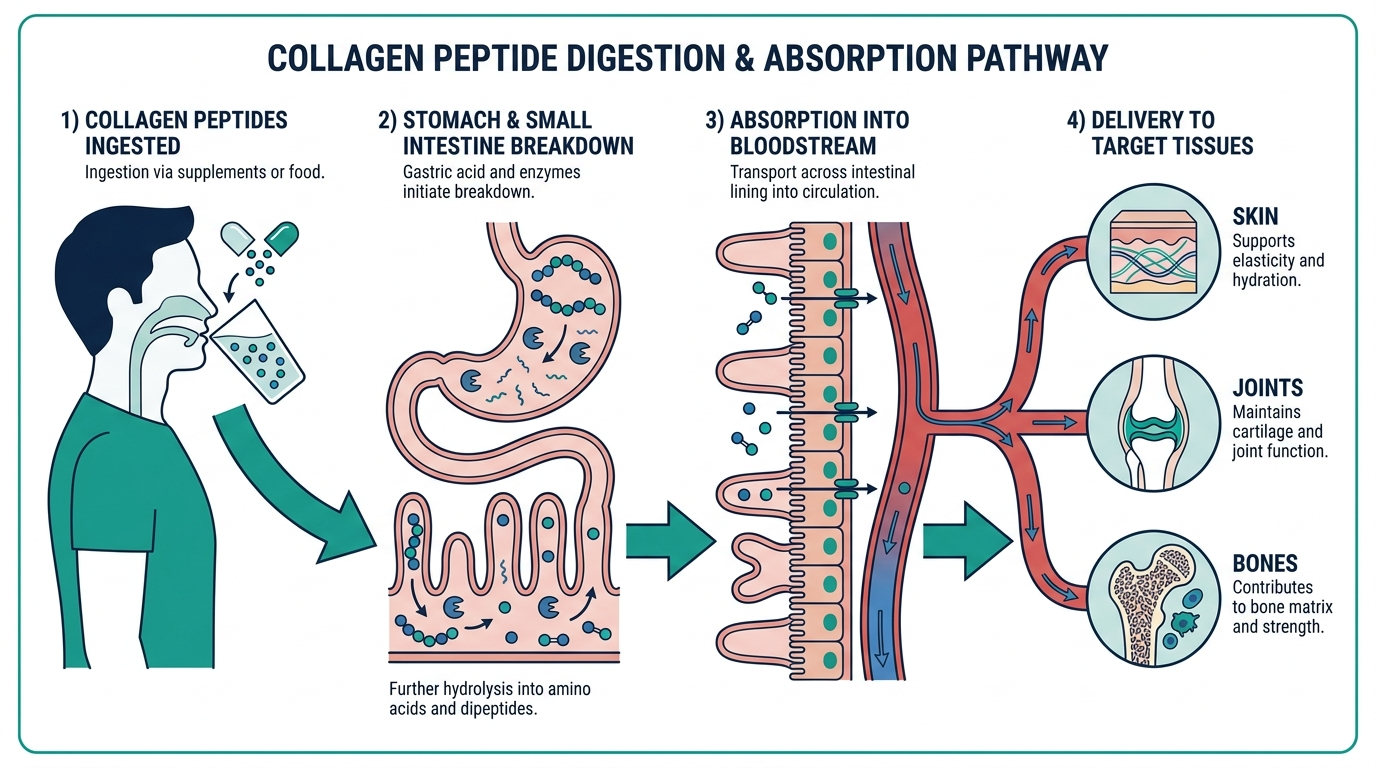
Collagen peptides are not a single-mechanism supplement. Depending on dose and timing, they work through three different pathways, and each pathway has its own optimal input.
The first pathway is substrate supply: hydrolyzed collagen breaks down into amino acids, primarily glycine, proline, and hydroxyproline, which circulate as building blocks for endogenous collagen synthesis. Plasma concentrations of the key dipeptides Pro-Hyp and Hyp-Gly peak within 30 to 60 minutes of ingestion and remain detectable for up to 24 hours. This pathway responds to almost any dose above 2.5 grams but saturates before you reach 20.
The second pathway is mechanical signaling: fibroblasts and tenocytes (tendon cells) upregulate collagen gene expression when mechanically loaded, and the presence of collagen-derived peptides in circulation during that loading window amplifies the response. This is why timing relative to exercise matters for tendon and joint outcomes specifically. A Keith Baar lab study published in the American Journal of Clinical Nutrition demonstrated that 15 grams of vitamin C-enriched gelatin consumed 60 minutes before exercise doubled collagen synthesis markers compared to 5 grams.
The third pathway is oral tolerance modulation: undenatured type II collagen (UC-II), a structurally different form, works through gut-associated immune cells to reduce inflammatory response to cartilage. It is effective at just 40 milligrams per day, a dose so small it is irrelevant as a substrate source, which is why UC-II and hydrolyzed collagen are measured on completely different scales.
The reason most dosing advice feels vague is that it blends all three mechanisms together, when in practice you are using at most one or two of them at a time.
How much collagen peptides for skin?
The most robust evidence for skin outcomes clusters at 2.5 to 5 grams per day for 8 to 12 weeks.
The VERISOL bioactive collagen peptides (Gelita AG) have been through multiple double-blind, placebo-controlled trials at 2.5 grams. Across those studies, women aged 35 to 55 showed statistically significant reduction in eye wrinkle volume by approximately 20% at 4 and 8 weeks, alongside improvements in skin elasticity, hydration, and dermal density versus placebo. VERISOL’s specific peptide profile is engineered to preferentially stimulate dermal fibroblasts, which is why 2.5 grams in that form outperforms a generic 10-gram dose in some comparisons. A 2025 randomized study published in Cosmetics confirmed that oral intake of specific bovine-derived bioactive collagen peptides has a stimulatory effect on dermal matrix synthesis and improves clinical skin parameters at this dose range.
Personally, I think the beauty industry oversells collagen while simultaneously underselling dose specificity. The “any scoop will do” messaging has created a market full of 1 to 2 gram capsules that are priced as if they are therapeutic, and a parallel market of 20-gram powders that are dosed like a protein shake. Neither is the VERISOL 2.5-gram protocol.
For skin specifically, going above 5 grams does not appear to proportionally increase benefit based on current dose-response data. What matters more than quantity at that scale is consistency, vitamin C co-ingestion, and whether the specific peptide formulation has been tested dermatologically.
How much collagen peptides for joints and tendons?
Joint and tendon support sits in the 5 to 10 gram range for hydrolyzed collagen, taken 30 to 60 minutes before activity with 50 milligrams of vitamin C.
The pre-exercise timing is not a marketing claim. Keith Baar’s 2017 vitamin C-enriched gelatin study established that taking collagen substrate before a mechanical loading bout, specifically 60 minutes before a 6-minute jump-rope protocol, doubled circulating markers of collagen synthesis compared to taking it at other times. The logic: connective tissue blood flow rises during exercise, and having Pro-Hyp and Hyp-Gly dipeptides already circulating at peak concentration during that window increases amino acid delivery to tendon and cartilage fibroblasts precisely when they are most mechanically stimulated.
A systematic review and meta-analysis in the German Journal of Sports Medicine (2024) found that collagen peptide supplementation produced statistically significant improvements in musculoskeletal performance and pain outcomes with doses ranging from 5 to 15 grams, and the benefit curve does appear to plateau somewhere around 10 grams for most outcomes outside of heavy training.
One thing worth understanding before comparing joint products: undenatured type II collagen (UC-II) and hydrolyzed collagen peptides are not interchangeable for joint support, even though both are marketed for it. UC-II at 40 milligrams works through an immune-tolerance mechanism studied in osteoarthritis and rheumatoid arthritis populations. Hydrolyzed type I collagen at 5 to 10 grams works by providing substrate. A landmark 2009 trial found 40 mg of UC-II outperformed 1,500 mg glucosamine plus 1,200 mg chondroitin for joint comfort, but that tells you nothing about how hydrolyzed type I performs, because the comparison does not exist cleanly in the literature. They are solving different problems.
Do not take UC-II dosing logic and apply it to hydrolyzed collagen, or vice versa. They are different molecules at different doses through different mechanisms.
How much collagen peptides for muscle and body composition?
This is the newest application and the one where the evidence shifted most clearly in 2026.
A randomized controlled trial published in Frontiers in Physiology in 2026, using recreationally active men in a 12-week high-load resistance training protocol, found that 15 grams of specific collagen peptides per day increased type I collagen content in skeletal muscle significantly more than placebo. The mechanism is not the same as whey protein building contractile muscle fiber. Collagen appears to reinforce the extracellular matrix around muscle, the connective scaffold that transmits force from muscle to tendon, which contributes to observed increases in fat-free mass. Collagen is low in leucine and does not trigger the same mTOR-mediated muscle protein synthesis response as whey, so it should be used alongside a high-quality protein source, not as a replacement for one.
The current weight of evidence for body composition sits at 15 grams combined with resistance training, post-workout or within the peri-workout window. Below that dose, the muscle-specific extracellular matrix benefit appears weaker.
What is the dose-by-goal summary table?
| Goal | Evidence-backed dose | Timing | Key cofactor | Duration before expecting results |
|---|---|---|---|---|
| Skin: hydration, wrinkles, elasticity | 2.5 to 5 g/day | Any consistent time | Vitamin C (50+ mg) | 8 to 12 weeks |
| Joint comfort, cartilage support | 5 to 10 g/day | 30 to 60 min pre-exercise | Vitamin C (50+ mg) | 3 to 6 months |
| Tendon / ligament repair support | 10 to 15 g/day | 60 min pre-exercise or loading | Vitamin C (50+ mg) | 3+ months |
| Skeletal muscle (with resistance training) | 15 g/day | Peri-workout | High-quality protein alongside | 12 weeks |
| Gut lining / intestinal permeability | 2.5 to 15 g/day | Flexible; with meals may suit | Zinc, glutamine often paired | 8 to 12 weeks |
| General connective-tissue maintenance | 5 to 10 g/day | Flexible | Vitamin C | Ongoing |
Does timing matter or is it mostly marketing?
Timing matters for joint and tendon goals specifically, and is largely irrelevant for skin.
For skin, the literature does not show a meaningful difference between morning, evening, or with-meals ingestion. A 2019 study confirmed hydrolyzed collagen peptides are rapidly absorbed in the small intestine and appear in bloodstream within an hour regardless of meal state, and dermal fibroblast exposure over 24 hours appears more important than peak plasma timing.
For joints and tendons, the pre-exercise window has genuine mechanistic support, as established by the Baar lab protocol. The practical implementation: mix 5 to 10 grams in juice or water with 50 milligrams of vitamin C and drink it 45 to 60 minutes before your session. Vitamin C is not optional here. It is a required cofactor for prolyl hydroxylase, the enzyme that hydroxylates proline residues during pro-collagen assembly, and without sufficient vitamin C the amino acid substrate you just provided cannot complete the synthesis step.
For body composition, peri-workout timing aligns with the 2026 Frontiers trial protocol. Taking it alongside or immediately after training appears to be the studied window.
Morning fasted intake is often recommended for convenience, not for science. If you are using collagen for skin or general connective tissue support, the timing flexibility is real and taking it whenever you will consistently remember it is the right answer.
What about collagen peptides for gut health?
The gut application is less studied than skin and joints but is attracting serious research attention as of 2025 to 2026.
Collagen provides glycine, proline, and glutamine, three amino acids that intestinal epithelial cells use for structural maintenance and tight-junction integrity. A study covered in the Collagen Stewardship Alliance’s November 2025 Science Update found that collagen-derived peptides can act as prebiotics, altering gut microbiota composition in a potentially favorable direction. A Nutrients study identified that collagen peptide supplementation in adults with gut dysfunction was associated with reductions in zonulin, a biomarker of intestinal permeability.
A clinical dose-escalation trial registered at ClinicalTrials.gov (NCT06232460) is currently evaluating 5, 10, and 20 grams of collagen powder for safety and tolerability over 12 weeks specifically in the context of gut health. Results are pending.
The current practical guidance is to use 5 to 10 grams, ideally with meals, which blunts the glycemic effect and pairs the amino acids with other nutrients that support gut lining repair. Do not expect gut results in two weeks. The studies showing measurable improvements in permeability markers ran 8 to 12 weeks.
Can you take too much collagen? What are the side effects?
There is no established upper tolerable limit for collagen peptides in the way that fat-soluble vitamins have toxicity ceilings. Collagen peptides hold GRAS (Generally Recognized As Safe) status with the FDA, and the safety literature up to 10 grams per day for six months shows no serious adverse events in healthy adults.
The practical ceiling is digestive comfort. Above 20 grams in a single dose, roughly 25% of users report bloating, fullness, or mild gastrointestinal discomfort, particularly on an empty stomach. WebMD’s clinical review notes that 2.5 to 10 grams daily is the most commonly used and studied range, and the Cleveland Clinic uses 10 to 20 grams as a daily range with higher amounts increasing the chance of digestive side effects.
If you want to work up to 15 grams for training purposes, the practical approach is to split the dose: 10 grams pre-workout and 5 grams at another meal. Splitting reduces peak gastric load and is the easiest way to avoid the fullness complaint.
A few specific cautions worth knowing: collagen peptides derived from marine sources carry shellfish and fish allergen risk. Bovine-derived products are unsuitable for those avoiding beef for dietary or religious reasons. And no large-scale randomized controlled trial has specifically evaluated collagen peptide supplementation in pregnancy as a primary intervention, so the blanket “generally safe” statement comes with meaningful uncertainty for that population, and a conversation with your OB-GYN is the right step.
Does collagen peptide quality and type change how much you need?
Yes, substantially, and this is the part almost no dosing guide addresses.
Not all 10-gram scoops are equal. Hydrolyzation degree (molecular weight of the peptide fragments) affects how much of the dose reaches connective tissue as bioactive dipeptides versus free amino acids that diffuse into the general amino acid pool. Highly hydrolyzed collagen, with molecular weights under 3 kDa, shows faster plasma absorption and higher Pro-Hyp and Hyp-Gly concentrations compared to less hydrolyzed forms at the same gram dose, according to absorption research published in Frontiers in Nutrition (2024).
Named bioactive peptide systems like VERISOL (Gelita), Peptan (Rousselot), and BCP (GELITA Bioactive Collagen Peptides) have proprietary hydrolysis profiles with dose-specific clinical data. A generic “hydrolyzed collagen” at 10 grams may or may not replicate the profile that generated a specific study’s results.
Personally, I would rather take 5 grams of a named, clinically tested ingredient like VERISOL for skin than 15 grams of an unspecified bovine collagen and assume the outcomes transfer. Look at the ingredient section on the label, not just the grams, when comparing products.
Hydrolyzed type I & III collagen peptides, third-party tested, unflavored.
A myth worth busting: collagen peptides are not the same as “eating more protein”
The most persistent misconception in this space is that collagen peptides are just an expensive way to eat protein, and you could get the same effect from any food protein source.
The amino acid profile of collagen is radically different from complete proteins like whey, egg, or soy. Collagen is approximately 33% glycine, 22% proline and hydroxyproline, and near-zero tryptophan, making it incomplete as a primary protein source. The reason it works for skin and connective tissue is precisely because glycine and hydroxyproline are the rarest amino acids in the average Western diet, and connective tissue demands them in concentrations that dietary variety rarely provides. Eating chicken breast does not replicate the 2.5-gram Pro-Hyp-dense VERISOL signal to dermal fibroblasts, because the peptide profile of a chicken breast protein digest is completely different.
The flip side is also true: for muscle protein synthesis, collagen peptides should not replace whey or another leucine-rich source, because they lack the leucine necessary to trigger mTOR signaling. The 2026 Frontiers in Physiology study was designed with collagen alongside adequate dietary protein, not instead of it.
Use collagen peptides for what they are good at. Do not ask them to be something else.
Turn what you just learned into action.
Superpower lets you test 100+ biomarkers from home, then re-check them over time so you can actually see progress, physician-reviewed at every step.
Frequently asked questions
How many grams of collagen peptides should I take per day?
It depends on the goal. Skin research uses 2.5 to 5 grams per day. Joint and tendon research uses 5 to 10 grams, taken 30 to 60 minutes before exercise with vitamin C. Body composition research paired with resistance training uses 15 grams. General connective tissue maintenance sits comfortably at 5 to 10 grams.
Is 20 grams of collagen peptides too much?
Not dangerously, but probably more than necessary unless you are combining goals (training and joint support) or split the dose across the day. Above 20 grams per sitting, digestive side effects like bloating become more common. Most clinical trials used 2.5 to 15 grams per day, and 20 grams sits at the high end of what is studied without clear additional benefit for single-goal use.
Should I take collagen peptides on an empty stomach or with food?
For joint and tendon goals, taking it 45 to 60 minutes before exercise on a relatively empty stomach aligns with the studied protocol and allows peak dipeptide plasma levels during mechanical loading. For skin or gut health goals, timing is flexible and taking it with a meal that includes vitamin C-rich food is a practical approach. Consistency over the weeks and months matters far more than the exact meal window.
Does collagen peptides work better with vitamin C?
Yes, for any goal involving connective tissue synthesis. Vitamin C is a required cofactor for prolyl hydroxylase, the enzyme that converts proline to hydroxyproline during pro-collagen assembly. Without adequate vitamin C, the amino acid substrate in circulation cannot complete the synthesis step. The studied protocol uses 50 milligrams of vitamin C alongside collagen, which is a modest dose easily covered by half a glass of orange juice or a standard supplement.
How long before I see results from collagen peptides?
Skin studies using 2.5 grams VERISOL showed measurable wrinkle reduction at 4 to 8 weeks. Joint pain and mobility improvements in clinical trials typically required 3 to 6 months of consistent supplementation. Body composition changes in the 2026 Frontiers study emerged over 12 weeks of combined collagen and resistance training. Under 4 weeks of use is not enough time to evaluate whether any dose is working for most outcomes.
Are collagen peptides safe during pregnancy?
Collagen peptides are FDA GRAS and have been used in observational studies of pregnant and postpartum women without identified safety concerns. However, no large-scale randomized controlled trial has specifically studied collagen supplementation in pregnancy, and the quality of commercial products varies widely. The right move is to discuss it with your OB-GYN, especially regarding product sourcing and any additives in the specific supplement you are considering.
Can I take collagen peptides and whey protein together?
Yes, and for the muscle and body composition goal, you probably should. Collagen lacks leucine and cannot drive mTOR-mediated muscle protein synthesis on its own. The 2026 Frontiers in Physiology study that showed increased skeletal muscle collagen content was designed as an additive intervention alongside normal dietary protein, not as a replacement. Use collagen for its extracellular matrix effects and a leucine-rich protein source for contractile muscle fiber synthesis.
Author: Vital Signs Today Editorial Team, [credential]”]. Educational content, not medical advice. Sources linked inline.
Hydrolyzed type I & III collagen peptides, third-party tested, unflavored.
Primary sources
- Frontiers in Physiology (2026): Specific collagen peptides increase type I collagen in skeletal muscle after 12 weeks of resistance training (RCT)
- PMC / American Journal of Clinical Nutrition: Vitamin C-enriched gelatin supplementation before intermittent activity augments collagen synthesis (Shaw et al., Baar lab)
- Frontiers in Nutrition (2024): Absorption of bioactive peptides following collagen hydrolysate intake, randomized double-blind crossover
- Cosmetics MDPI (2025): Oral bovine-derived bioactive collagen peptides stimulate dermal matrix synthesis and improve skin parameters
- PMC: A collagen supplement improves skin hydration, elasticity, roughness, and density (Proksch et al., VERISOL RCT)
- PMC: Effects of body composition, collagen synthesis, and recovery from joint injury and exercise: systematic review
- WebMD: Collagen Peptides clinical ingredient monograph, dosing and safety review
- German Journal of Sports Medicine (2024): Collagen peptide supplementation and musculoskeletal performance, systematic review and meta-analysis
- ClinicalTrials.gov NCT06232460: Dose-escalation study assessing safety and tolerability of collagen peptide (5, 10, 20 g) for gut health
- Collagen Stewardship Alliance: Collagen Science Update November 2025
- Vital Proteins: How much collagen should you take every day? (brand serving-size guidance)
- Happiest Baby / BubsNaturals: Collagen peptides during pregnancy, safety review
Related reading
Vital Signs Today may earn a commission if you buy through links on this page. It does not affect our editorial assessments.