
Last updated 19 June 2026. Educational content, not medical advice. Talk to a licensed clinician before adding any supplement to a medical treatment plan.
Short answer: For most adults, 10 to 15 grams of hydrolyzed collagen peptides per day is the dose with the broadest clinical support, covering skin elasticity, joint pain, and body composition. Specific skin studies get meaningful results at just 2.5 grams per day from branded hydrolysates like VERISOL. Gut and muscle goals lean toward the higher 15 to 20 gram range. The number you need depends entirely on what you are trying to accomplish, and the wrong dose for your goal is not dangerous, it is just expensive and slow.
Dialing in your daily collagen dose? Track the inflammation and skin-related markers a scale can’t show you. One at-home Superpower draw checks 100+ biomarkers, physician-reviewed.
Why does the dose question matter so much?
Most collagen products print a single serving size on the label, usually 10 to 20 grams, and leave the rest to marketing copy about “glowing skin” and “happy joints.” That label does not tell you that a 2.5-gram dose with a specific branded hydrolysate may do more for periorbital wrinkles than a generic 20-gram scoop, or that athletes looking to reduce tendon injury risk want the opposite: 15 grams timed precisely around training. The product serves the company’s margin as much as your biology.
Understanding the dose question means reading the actual trials, not the back of the container.
There is also a subtler reason to care: once you know the right dose for your goal, you quickly realize that many premium products are either underdosing you or overcharging for grams you do not need.
How are collagen peptides absorbed, and why does that shape dosing?
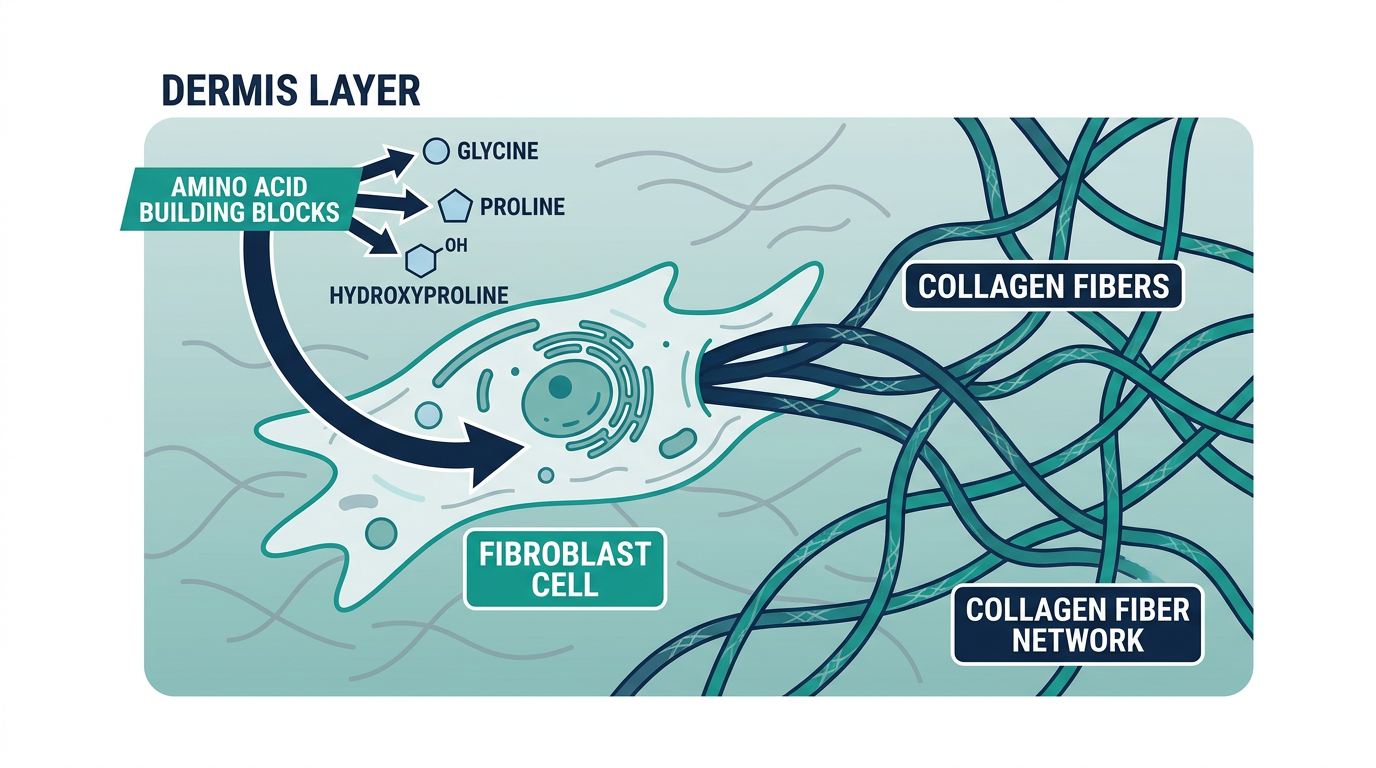
Before the dose numbers make sense, the absorption mechanism matters. When you swallow hydrolyzed collagen, it is not absorbed as intact peptides end to end. Gut enzymes break it into smaller fragments, predominantly dipeptides and tripeptides containing hydroxyproline, particularly Pro-Hyp (proline-hydroxyproline) and Hyp-Gly (hydroxyproline-glycine). These fragments reach peak concentration in blood plasma about 1 to 2 hours after ingestion, then drop to roughly half maximum at the 4-hour mark, according to research published in PMC.
These hydroxyproline-carrying dipeptides are unique to collagen. Your body recognizes them as signals to stimulate fibroblasts in skin, synovial cells in joints, and tendon-forming cells called tenocytes. Whey protein and plant protein do not produce this signal because they contain almost no hydroxyproline. That is the biological reason collagen has a separate, narrower role from general dietary protein. Research published in Nutrition Reviews puts it plainly: sources rich in proline and glycine are better suited than high-quality protein sources like whey or casein for supplying the precursors needed for connective tissue synthesis.
The implication for dosing: more is not automatically better. You are not trying to flood the system with amino acids. You are trying to deliver enough hydroxyproline-containing dipeptides to trigger a biological signal, and that signal has a ceiling where adding more grams does not add more effect.
Full-body lab membership: 100+ biomarkers, doctor-reviewed, tracked over time.
What does the clinical evidence actually say by goal?
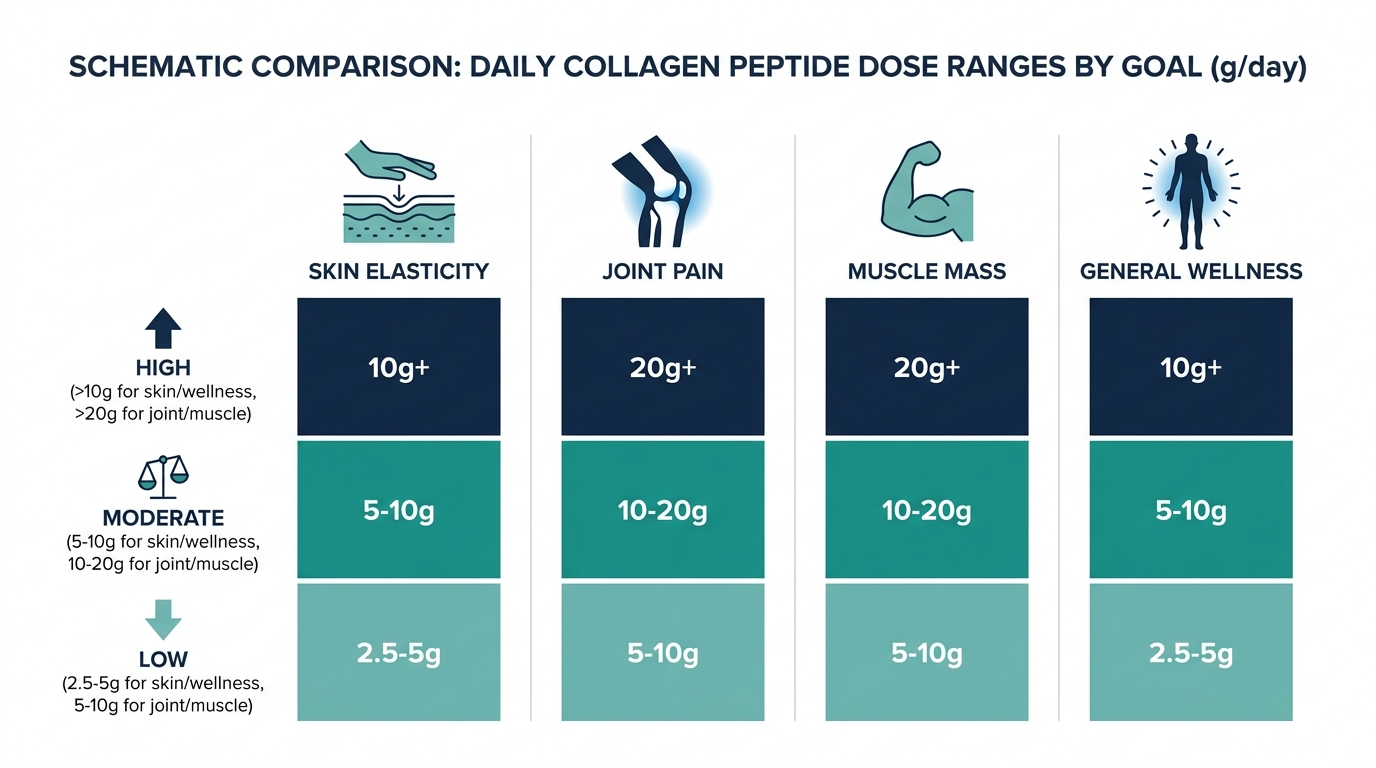
Skin: 2.5 to 10 grams per day
This is the goal with the tightest, most replicated trial data, and the numbers are probably lower than you expect.
The VERISOL hydrolysate, manufactured by Gelita, has been studied in multiple double-blind, placebo-controlled trials at 2.5 grams per day. A 2025 trial published in the journal Cosmetics enrolled 66 women ages 35 to 55 and found that 8 weeks of 2.5 grams of VERISOL per day significantly improved skin hydration, wrinkle volume, and dermal elasticity, with skin hydration gains apparent at just 4 weeks. The mechanism identified in skin biopsies was direct upregulation of type I collagen, elastin, and proteoglycan synthesis in the dermis.
A separate analysis of the Proksch et al. data found 20% reduction in periorbital wrinkle volume alongside increases in procollagen type I (+65%) and elastin (+18%). That is the headline from a 2.5-gram dose.
At 5 grams and 10 grams, multiple other trials confirm benefit, and a 2026 meta-analysis in Aesthetic Surgery Journal covering 113 randomized controlled trials and nearly 8,000 participants found standardized mean differences of 0.72 for skin elasticity and 0.58 for wrinkle reduction compared to placebo, across a range of doses.
Personally, 2.5 grams of a branded, clinically-tested hydrolysate like VERISOL outperforms 20 grams of a generic “grass-fed bovine” scoop. The branded hydrolysate has specific molecular weight distribution engineered for skin cell uptake. The generic scoop is just hydrolyzed protein sold on perceived value by weight.
Joints and joint pain: 10 to 15 grams per day
Joint research uses higher doses, and the landmark study here is a 24-week randomized, placebo-controlled trial at Penn State University, which gave athletes with activity-related joint discomfort 10 grams of collagen hydrolysate (the CH-Alpha formulation) or placebo. Those receiving collagen showed significantly lower joint pain across six distinct pain parameters at 24 weeks, published in Current Medical Research and Opinion.
A 2024 trial on bioactive collagen peptides for joint support, published in PMC, found statistically significant improvements in knee pain and joint mobility using 10 to 15 grams per day over 12 weeks in active middle-aged adults.
For undenatured type II collagen, the dose is dramatically different: 40 milligrams per day is the studied dose for osteoarthritis and joint inflammation, using a product called UC-II. This works through a different mechanism called oral tolerance rather than substrate delivery, so comparing it to hydrolyzed peptide doses is an apples-to-oranges comparison.
Muscle, body composition, and exercise recovery: 15 grams per day
Collagen is not a muscle-building protein in the traditional sense. It has a low DIAAS (Digestible Indispensable Amino Acid Score) because it lacks sufficient leucine and tryptophan to drive muscle protein synthesis. Do not believe any marketing that positions collagen as a primary protein source for muscle growth.
What collagen does well at 15 grams is connective tissue support alongside resistance training. A randomized controlled trial published in PMC gave 53 elderly sarcopenic men either 15 grams of collagen peptides or placebo during a 12-week resistance training program. The collagen group gained significantly more fat-free mass and lost more fat mass than the placebo group, suggesting that better tendon and ligament support translates to more effective training capacity.
Pre-exercise timing matters for the connective tissue effect. Research from Keith Baar’s group at UC Davis found that 15 to 20 grams of collagen with vitamin C, taken 30 to 60 minutes before exercise, doubled collagen synthesis markers in tendons versus placebo, measured by hydroxyproline in engineered ligament constructs. Timing the dose around training is not marketing fluff. It is grounded in how collagen synthesis responds to mechanical load with available substrate.
Gut health and intestinal barrier: 10 to 20 grams per day
The evidence here is thinner and more preliminary compared to skin and joints, but promising. Collagen’s gut application relies on its high glycine, proline, and glutamine content, which are the amino acids most involved in maintaining the structural integrity of the intestinal wall. A clinically relevant dose appears to start around 10 grams of collagen peptides per day, with some protocols using 20 grams for significant gut dysfunction.
A 2017 clinical observation found collagen peptides were associated with improved intestinal epithelial barrier function. A more recent trial noted reductions in zonulin, a biomarker of intestinal permeability, after consistent collagen supplementation. Larger, better-controlled trials are still needed before gut health becomes a primary indication, but the mechanism is sound.
Dose-by-goal reference table
| Goal | Studied dose range | Minimum duration to see benefit | Evidence strength |
|---|---|---|---|
| Skin elasticity, wrinkles | 2.5 to 10 g/day | 8 weeks | Strong (multiple RCTs, meta-analysis) |
| Skin hydration | 2.5 to 10 g/day | 4 weeks | Strong |
| Joint pain (activity-related) | 10 to 15 g/day | 12 to 24 weeks | Moderate-strong |
| Osteoarthritis (undenatured type II) | 40 mg/day (UC-II) | 12 weeks | Moderate |
| Connective tissue / tendon support | 15 to 20 g/day pre-exercise + vitamin C | 12 weeks | Moderate |
| Body composition (with resistance training) | 15 g/day | 12 weeks | Moderate |
| Gut barrier / intestinal permeability | 10 to 20 g/day | 8 to 12 weeks | Preliminary |
Does type I, II, or III collagen change the dose?
Largely, no, and this is one of the more important myth-busters in the supplement category.
When hydrolyzed collagen is digested, the resulting dipeptides and tripeptides are structurally identical regardless of whether the starting material was type I, type II, or type III collagen. The molecule Pro-Hyp is Pro-Hyp whether it originated in bovine hide (primarily type I and III) or chicken sternum (primarily type II). As RethinkPeptides summarizes citing a 2026 expert review, no randomized controlled trial has demonstrated that a “5-type blend” supplement outperforms a single-type product at equivalent doses for any health outcome.
The exceptions are:
– Undenatured type II collagen (UC-II): This works through a completely different immune-tolerance mechanism and is dosed at 40 mg. It must be kept undenatured; heat destroys its mechanism. Do not substitute hydrolyzed collagen for UC-II.
– Marine collagen vs. bovine collagen: Both are primarily type I. Marine collagen has a smaller average peptide size and some evidence of faster absorption, but the clinical outcome difference is small enough that it should not be the deciding factor over quality, testing, and cost.
Hydrolyzed type I & III collagen peptides, third-party tested, unflavored.
When is the best time to take collagen peptides?
Timing matters more for some goals than others.
For joint and tendon support, the pre-exercise window is the one with actual mechanistic backing: 15 to 20 grams with 50 mg or more of vitamin C, 30 to 60 minutes before a workout. The mechanical stimulus from exercise and the circulating hydroxyproline peptides from the collagen combine to drive collagen synthesis in connective tissue more efficiently than collagen taken at rest.
For skin, no clinical trial has demonstrated a meaningful difference between morning and evening dosing. The body distributes absorbed peptides to fibroblasts over several hours regardless of when the dose is taken. Morning is practical if you mix it into coffee or a smoothie; evening works equally well for people who prefer it with dinner.
For gut health, most protocols use a consistent daily dose taken with water, often in the morning before food, though this is based on practitioner convention more than published trial design.
One rule does apply across all goals: consistency over weeks beats perfect timing. An 8-week study at an irregular lower dose will not replicate what 8 weeks of daily dosing at the right amount achieves. The collagen signal is cumulative, not acute.
A practical note: vitamin C is consistently mentioned alongside collagen in synthesis research. You do not need a massive dose. The 50 to 100 mg range is sufficient, roughly the amount in a small glass of orange juice or a standard 250 mg supplement.
What happens if you take more than the studied dose?
Collagen peptides have an excellent safety profile. Unlike fat-soluble vitamins with established toxicity thresholds, there is no established Tolerable Upper Intake Level for collagen, and no-observed-adverse-effect level (NOAEL) in animal studies exceeds 2,000 mg per kilogram of bodyweight per day. For a 70 kg adult that theoretical ceiling sits at 140 grams per day, far beyond anything anyone is taking.
At doses above 20 grams, the main practical side effects are gastrointestinal: bloating, loose stools, or a lingering aftertaste, particularly with lower-quality hydrolysates that have inconsistent molecular weight distribution. These are discomfort issues, not toxicity.
The more relevant risk at high doses is opportunity cost. Taking 30 grams of collagen per day in hopes of faster skin results does not accelerate the signal proportionally. The biological response to hydroxyproline peptides saturates. You are spending money on protein with a low amino acid score that your muscle tissue would not choose for synthesis if it had alternatives.
A sensible ceiling for most people is 20 grams per day unless there is a specific clinical rationale (significant gut dysfunction, aggressive body composition goals during resistance training) that a clinician has recommended pushing higher.
The myth that collagen peptides are “just protein”
This is the counterargument you will hear from registered dietitians and sports nutrition researchers who have not followed the connective tissue literature closely, and it is mostly wrong.
The argument goes: collagen is an incomplete protein with a poor amino acid score, so you should just eat more chicken or add whey instead. That is accurate if your goal is muscle protein synthesis. It is irrelevant if your goal is skin, joint, tendon, or gut tissue, because those tissues are largely collagenous and respond specifically to hydroxyproline-containing substrates.
Whey protein contains roughly 6% proline and 2% glycine. Hydrolyzed collagen peptides contain around 23% proline and 33% glycine. The fibroblast does not care about leucine content when it is building dermal matrix. It needs proline and glycine. Whey cannot substitute for collagen in connective tissue synthesis, regardless of DIAAS score.
The nuanced truth: collagen does not replace dietary protein for muscle or whole-body nitrogen needs. It supplements it for connective tissue goals. Using both is better than a debate about which wins.
What product actually delivers the clinical dose?
Most retail collagen products use the Peptan hydrolysate (Rousselot) or VERISOL (Gelita). Both have substantial trial databases behind them. Products using these named hydrolysates are preferable to generic “hydrolyzed collagen” with no indication of the peptide fraction used.
Vital Proteins Collagen Peptides delivers 20 grams per serving from grass-fed, pasture-raised bovine hides, with the Advanced formula pairing it with 120 mg of hyaluronic acid and 100% daily value of vitamin C per serving. At 20 grams with vitamin C included, it covers the joint and connective tissue dose in one scoop.
For the skin dose at 2.5 grams, you are generally looking at purpose-formulated VERISOL products rather than a mass-market scoop. Oslo Skin Lab’s “The Solution” collagen product is one example explicitly built around the VERISOL 2.5 gram clinical trial design. Taking half a scoop of a 5 gram product that uses VERISOL is a reasonable approximation.
One thing few brands will tell you: the collagen market has no FDA oversight on dose claims, purity, or hydrolysate fraction claims. Third-party verification from organizations like ConsumerLab is the most useful independent check on whether the product delivers what the label states.
How long before you notice results?
The timeline varies by goal, and unrealistic expectations are the main reason people quit before the supplement has a chance to work.
- Skin hydration: as early as 4 weeks at 2.5 to 10 grams per day (consistent finding across multiple VERISOL and Peptan studies)
- Skin elasticity and wrinkle reduction: 8 to 12 weeks minimum
- Joint pain reduction: 12 to 24 weeks, with 24-week studies showing cleaner effects than shorter ones
- Tendon and connective tissue remodeling: 12 weeks minimum when dosed pre-exercise; collagen fibril synthesis is slow by biology
- Body composition shifts: 12 weeks of consistent dosing combined with resistance training
The biological reason for these timelines is that collagen turnover in tissue is measured in months, not days. Collagen fibril formation in skin requires synthesis, procollagen processing, secretion, fibril assembly, and cross-linking. That cycle does not respond to a 30-day challenge. Studies that report no effect at 4 weeks are often underpowered or looking at tissue endpoints that need more time, not evidence that collagen does not work.
Curious what your own levels look like?
Baseline 100+ biomarkers today and retest as life changes, all in one membership with physician review.
Frequently asked questions
How many grams of collagen per day for skin?
The strongest clinical data for skin comes from studies using 2.5 grams of VERISOL hydrolysate per day for 8 weeks, showing reduced wrinkle volume, increased skin elasticity, and improved hydration. Doses up to 10 grams have also been studied with positive outcomes. The key is using a branded, clinical-grade hydrolysate at a consistent dose for at least 8 weeks, not any generic collagen powder.
Is 20 grams of collagen per day too much?
No, 20 grams is within the studied range and has no known adverse effects beyond occasional mild digestive discomfort in some people. There is no established upper limit for collagen peptides. The more relevant question is whether 20 grams is the right dose for your goal: for skin, 2.5 to 10 grams is sufficient; for joints and connective tissue, 10 to 15 grams is the studied range; for gut health or body composition during training, 15 to 20 grams has rationale.
Should I take collagen in the morning or at night?
For joint and tendon support, timing it 30 to 60 minutes before exercise (with 50 to 100 mg of vitamin C) has the most mechanistic backing, as the combination of circulating hydroxyproline peptides and mechanical stimulus enhances connective tissue synthesis. For skin, the timing has not been shown to make a clinically meaningful difference. Morning or evening both work for skin outcomes.
Do collagen peptides work without vitamin C?
Collagen peptides provide measurable benefit on their own, as demonstrated in trials that did not include vitamin C. However, vitamin C is a cofactor for the enzyme prolyl hydroxylase, which is required for collagen cross-linking, and the pre-exercise protocol specifically pairs them together for connective tissue goals. Adding 50 mg of vitamin C alongside your collagen dose is low-cost insurance, not mandatory.
What is the difference between collagen peptides and regular collagen?
“Collagen peptides” refers to hydrolyzed collagen, where enzymatic processing has broken the large collagen proteins into shorter fragments (typically 3,000 to 5,000 Daltons) that dissolve in liquid and are absorbed as dipeptides and tripeptides in the gut. Unprocessed or gelatin collagen requires prolonged heat (bone broth) to partially break down, and its bioavailability is lower. For supplement dosing, “collagen peptides” is the form used in every cited clinical trial.
Can I get enough collagen from food instead of supplements?
Possibly, if you eat significant quantities of skin-on poultry, bone broth, tendons, or other connective-tissue-rich animal foods daily. Bone broth made from quality bones and long-simmered delivers roughly 2 to 4 grams of collagen-derived amino acids per cup, depending on preparation. To hit the 10 gram joint dose purely from bone broth, you would need 3 to 5 cups per day, consistently. Supplements are simply a more standardized and convenient delivery method at specific clinical doses.
Are collagen peptides safe for people with allergies?
Bovine collagen is derived from cow hides and contains no dairy or lactose, but could theoretically cause reactions in people with beef allergy (rare). Marine collagen is derived from fish skin and scales and is not safe for people with fish or shellfish allergies. Most quality products disclose the source clearly. Neither form contains gluten.
Author: [CAN CONFIRM: name + credential of Vital Signs Today health author/reviewer, e.g. “Medically reviewed by [name], [credential]”]. Educational content, not medical advice. Sources linked inline.
Hydrolyzed type I & III collagen peptides, third-party tested, unflavored.
Primary sources:
- VERISOL MDPI Cosmetics 2025: Bovine collagen peptides skin RCT, 2.5g dose
- PMC: Bioactive collagen peptides absorption, hydroxyproline dipeptides, double-blind crossover
- PMC: Collagen peptides + resistance training, body composition, sarcopenic men RCT
- PMC: Bioactive collagen peptides, joint pain and mobility, 12-week trial
- Nutrition Reviews: Collagen protein ingestion and musculoskeletal connective tissue remodeling
- Healthline: How much collagen per day, clinical summary
- Time: Collagen supplements skin and joints, June 2026
- PMC: Sustained effects of bioactive collagen peptides on skin parameters
- PubMed: Collagen peptides combined with vitamins, skin elasticity and joint wellbeing RCT
- Nutritional Outlook: VERISOL skin hydration, elasticity, wrinkle reduction trial
Related reading
Vital Signs Today may earn a commission if you buy through links on this page. It does not affect our editorial assessments.