
Educational content, not medical advice. Consult a registered dietitian before making significant changes to your protein intake.
Short answer: Yes, collagen peptides count as protein on a nutrition label and toward your caloric intake, but they score a 0.0 on the standard protein quality metric (PDCAAS) because they contain zero tryptophan. A 20-gram serving of Vital Proteins Collagen Peptides delivers 18 grams of protein that your body digests and uses, just not for the same jobs as whey or eggs. The practical rule from a 2019 Nutrients study: up to 36% of your total daily protein can come from collagen without dropping your diet’s overall protein quality score below a perfect 1.0, as long as the rest of your diet is reasonably varied.
Collagen counts as protein on a label, but what does your body actually show? See your real amino acid and nutrient markers. One at-home Superpower draw checks 100+ biomarkers, physician-reviewed.
The confusion comes from a real paradox: the label says protein, the math says zero quality score, and your joints and skin say it works. All three are correct. They are just measuring different things.
Why Does a Protein Source Score Zero on Quality Tests?
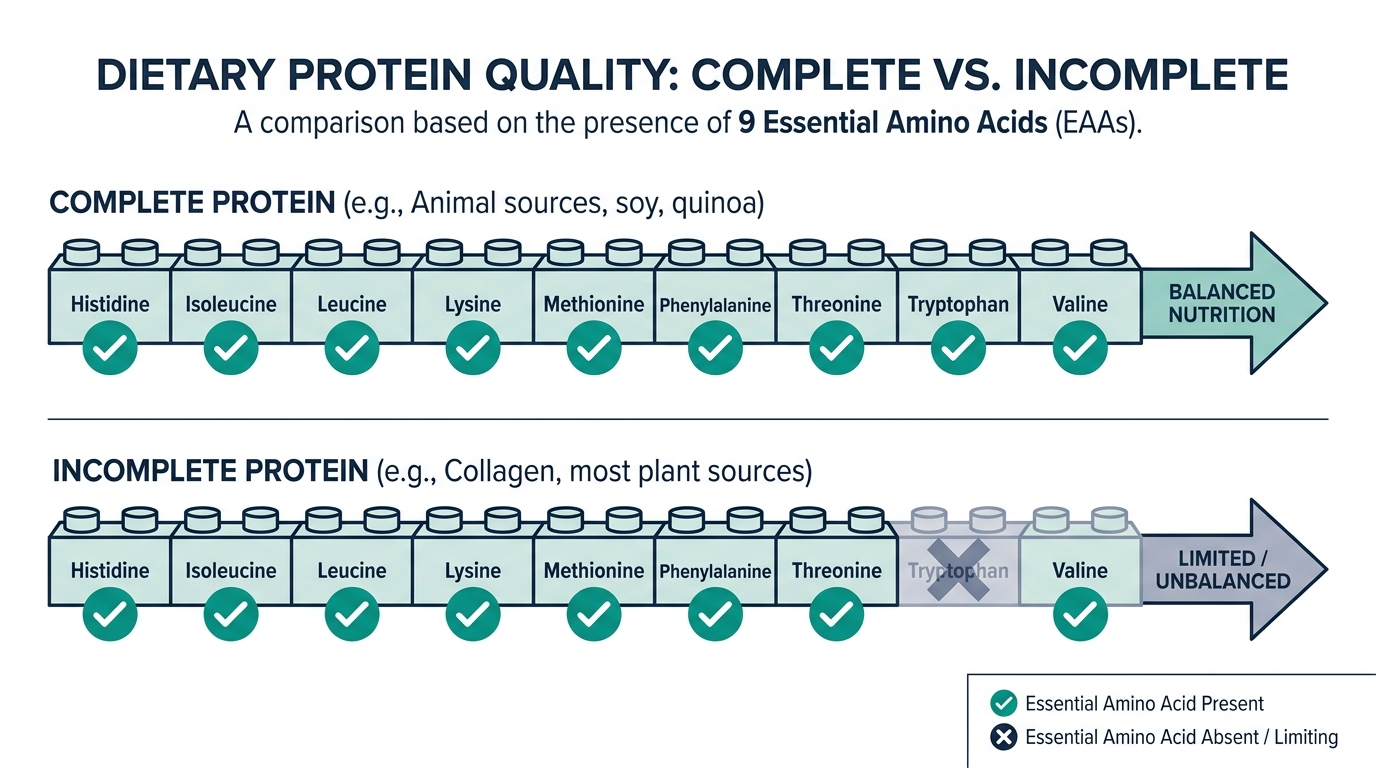
Protein quality scores like PDCAAS (Protein Digestibility-corrected Amino Acid Score) measure whether a single food can, on its own, meet all nine essential amino acid requirements. The moment any one essential amino acid reads zero, the entire score collapses to zero, regardless of how much of every other amino acid is present.
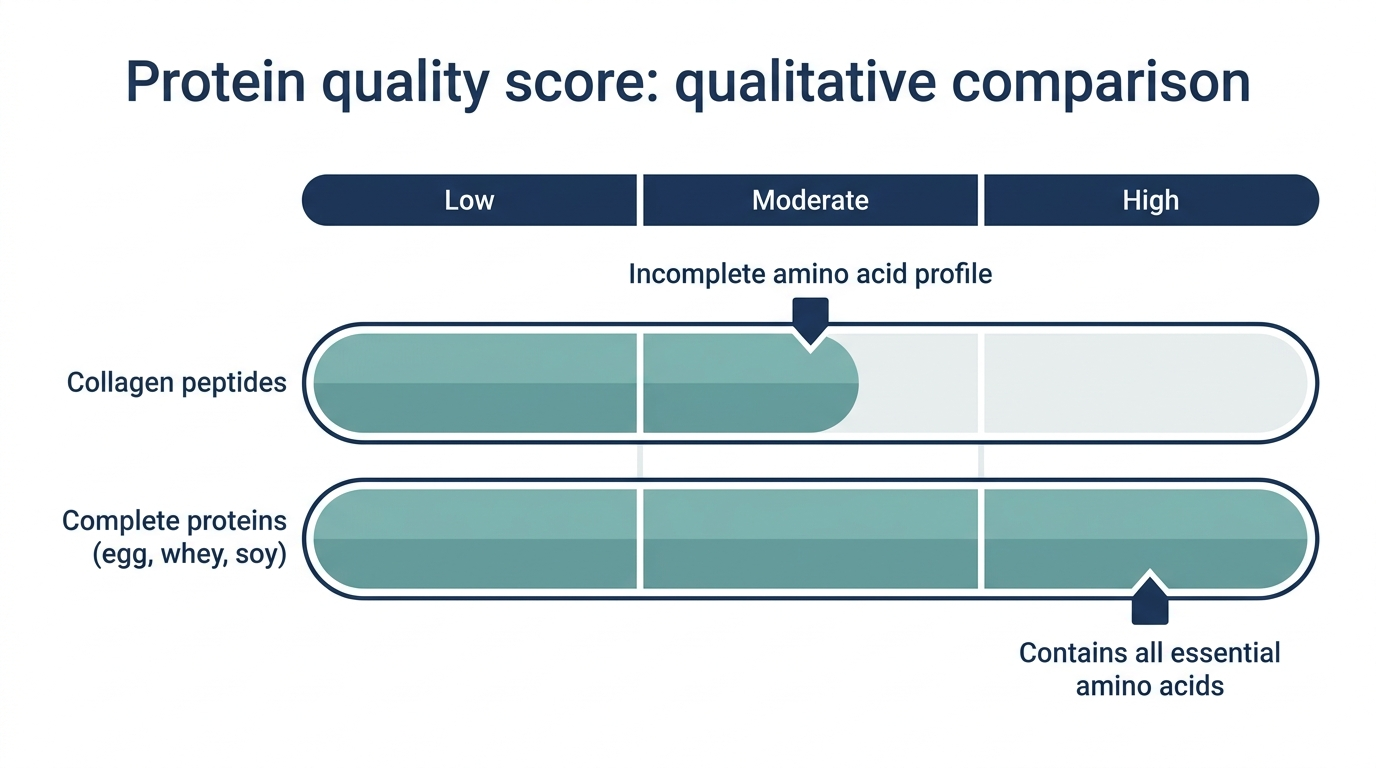
Collagen’s missing piece is tryptophan. It has none, not trace amounts, none at all. Collagen is also low in methionine and cysteine, the sulfur-containing amino acids. That gives it a PDCAAS of 0.0, the same score as plain gelatin, and far below whey (1.0) or egg white (1.0).
The PDCAAS floor is a binary trap, not a gradient, which is why collagen looks worse on paper than it performs in the real world.
What PDCAAS misses is context. No single food builds a complete human diet. The Western diet runs 31% to 67% above its tryptophan requirement just from meat, dairy, eggs, and legumes. When researchers at Gelita AG ran iterative PDCAAS calculations against USDA dietary survey data in 2019, they found that the spare tryptophan from everything else you eat fills the collagen gap completely, up to that 36% ceiling (Paul, Leser, and Oesser, Nutrients 2019).
What Makes Collagen’s Amino Acid Profile Genuinely Unique?
The simplest way to actually get this done
Superpower is a full-body lab membership that runs 100+ biomarkers, has each result reviewed by a doctor, and tracks your numbers year over year (about $199/year). It is what we point readers to when they would rather get one clean, complete draw than chase single tests one at a time. Here is superpower reviewed in full.
The conventional critique is that collagen is “incomplete,” and that framing ends the conversation before the interesting part starts. Collagen is the only significant dietary source of hydroxyproline and hydroxylysine, two amino acids your body uses almost exclusively for building connective tissue. You will not find them in chicken breast, Greek yogurt, or a whey shake.
Here is the specific breakdown worth knowing:
- About 33% of collagen’s amino acids are glycine, the simplest amino acid, which your body uses for everything from glutathione synthesis to creatine production.
- Proline and hydroxyproline together make up roughly 23% of the amino acid profile.
- Only about 14% of collagen’s total amino acid content consists of essential amino acids, compared to around 50% in whey protein.
The hydroxyproline story gets more specific when you look at absorption. A 2024 randomized crossover study in Frontiers in Nutrition tracked exactly which collagen fragments survive digestion and reach systemic circulation (Frontiers Nutrition, 2024). The dipeptide Pro-Hyp (proline-hydroxyproline) showed the highest systemic exposure. More importantly, some Gly-Pro-Hyp tripeptides are absorbed completely intact. These fragments are not random amino acid debris; they appear to signal fibroblasts in skin and joint tissue to increase collagen synthesis, which is why the molecule behaves differently from a generic protein hydrolysate.
Personally, that absorption mechanism is the most underreported fact in the entire collagen marketing conversation. You are not just eating building blocks; you are delivering a biological signal.
Can You Count Collagen Toward Your Daily Protein Goal?
For most tracking purposes, yes, with a ceiling.
A single serving of Vital Proteins Collagen Peptides (two scoops, 20g) delivers 18g of protein at 70 calories. Sports Research collagen runs 20g protein per serving at roughly $27 per 16-ounce tub. Those grams are real: your body digests and metabolizes them, and they count toward total protein intake on any nutrition tracking app. MyFitnessPal lists hydrolyzed collagen in its database and treats each gram of protein from collagen exactly the same as whey or plant protein for macro counting.
The nuance is that those 18 grams are pulling a very specific shift. They are not particularly useful for muscle protein synthesis, the process of building new contractile muscle fiber. Collagen’s leucine content is low, and leucine is the amino acid that flips the muscle-building switch. Whey runs about 10-12% leucine. Collagen runs closer to 3%.
The practical scoring system I use mentally:
| Purpose | Count collagen? | Notes |
|---|---|---|
| General daily protein target | Yes, up to 36% of total | Backed by Paul et al. 2019 PDCAAS analysis |
| Muscle hypertrophy (myofibrillar) | Partial credit only | Low leucine limits MPS stimulation |
| Skin, hair, nail support | Full credit | No other common food delivers Hyp at scale |
| Joint and tendon repair | Full credit | Structural collagen remodeling is its specialty |
| Calorie tracking | Yes | 4 kcal/g, same as all protein |
| Keto macros | Yes | Zero carbs, keto-compatible |
Full-body lab membership: 100+ biomarkers, doctor-reviewed, tracked over time.
What About Collagen Types I, II, and III?
The label often lists a Roman numeral, and it is not marketing filler. Your body makes at least a couple dozen collagen types, but three dominate the supplement conversation, and they are not interchangeable for every goal.
- Type I is the most abundant collagen in the body and the main structural protein in skin, bone, tendon, and ligament. Most hydrolyzed collagen peptide powders are predominantly type I, often with some type III, which is why they are marketed toward skin, hair, nail, and connective-tissue goals.
- Type III commonly appears alongside type I in the same tissues and supports the structure of skin and blood vessels. A powder labeled type I and III is the standard all-purpose choice.
- Type II is the collagen of cartilage specifically. It is used differently from type I and III, sometimes in a small, undenatured dose aimed at joint comfort rather than in the larger scoops used for skin and general protein. If your only goal is joint cartilage, a type II product is a different tool than a type I and III peptide powder.
The practical read: for skin, hair, general connective tissue, and counting toward protein, a hydrolyzed type I and III peptide is the workhorse. Type II is a niche joint tool, not a replacement for the everyday powder.
Does Collagen Build Muscle?
Not in the same way whey does, but the picture is more interesting than a flat no.
A 2021 randomized controlled trial published in Nutrients found that untrained men taking 15g of specific collagen peptides daily during a 12-week resistance training program gained significantly more fat-free mass and lost more fat mass than the placebo group. The collagen group’s fat-free mass increase was clinically relevant compared to both placebo and an exploratory whey comparator (Zdzieblik et al., Nutrients 2021, PMC8125453).
A June 2026 randomized controlled trial from the University of Freiburg added a mechanistic layer. Twenty-nine healthy men doing 12 weeks of high-load resistance training (70-85% of 1-rep max) who took 15g daily of BODYBALANCE collagen peptides saw intramuscular collagen type I increase by 29.8%, compared to only 9.9% in the placebo group, a roughly 3.5-fold difference with a large effect size (Jerger, Nielsen, and König, Frontiers in Physiology, June 2026). The researchers concluded that collagen accretion can occur without parallel alterations in fibroblast density, which challenges earlier assumptions about how the structural changes happen.
The honest framing: collagen does not replace whey for driving myofibrillar (contractile) muscle protein synthesis, where whey still leads clearly. But it does something whey essentially cannot: it rebuilds the structural scaffolding of the muscle and tendon, the extracellular matrix. If you are recovering from an injury, returning to training after a long break, or are over 45 and focused on injury prevention, that structural contribution is not a consolation prize.
Do not believe the marketing copy that stacks collagen next to whey and calls them interchangeable. They are not competing for the same job.
What About Skin, Joints, and Hair?
These are the areas where collagen has the strongest and most consistent clinical evidence, and where the “incomplete protein” criticism is irrelevant. Your skin fibroblasts and articular cartilage do not care about PDCAAS. They care about hydroxyproline.
A 2026 systematic review and meta-analysis in Frontiers in Medicine analyzed randomized controlled trials of oral and topical peptides for skin aging and found consistent improvements in skin elasticity, hydration, and wrinkle depth across multiple product formulations (Frontiers Medicine, 2026).
A 2025 study in npj Aging went further: a collagen amino acid supplement containing glycine, proline, and hydroxyproline in the natural collagen ratio reduced biological age by 1.4 years within 6 months in a clinical observational trial, alongside improved skin features at 3 months (npj Aging, 2025).
For joints, the proposed mechanism is a two-step one. The hydroxyproline-containing dipeptides reach cartilage tissue and signal chondrocytes to synthesize more collagen in the extracellular matrix, while also providing glycine and proline as raw materials. Whether you have osteoarthritis or are just logging hard training miles, that mechanism matters.
Clinical dosing in these studies ranges from 2.5g to 15g daily, with most skin studies using 5-10g and joint studies using 10-15g. Effective clinical doses of 2.5g to 15g represent only 4-33% of the RDA for total protein, so they sit well below the 36% ceiling even on lower-calorie diets.
Hydrolyzed type I & III collagen peptides, third-party tested, unflavored.
How Do You Choose a Quality Collagen Powder?
Collagen is a lightly regulated supplement category, which means quality varies far more than the near-identical labels suggest. A few criteria separate a product worth buying from an expensive tub of average powder.
- Hydrolyzed, not just gelatin. Look for the words hydrolyzed collagen or collagen peptides. That processing produces the low-molecular-weight di- and tripeptides that dissolve in cold liquid and drive the tissue signaling. Plain gelatin gels and does not deliver those fragments as reliably.
- Third-party testing. Because collagen is animal-sourced, it can concentrate contaminants if sourcing is careless. A product with third-party testing, ideally with the certificate available, gives you a check on heavy metals and label accuracy that the brand’s own word does not.
- Clean ingredient list. An unflavored powder is usually just collagen. Flavored versions can carry added sugar or sweeteners that matter if you are tracking macros or drinking it in coffee daily.
- Source that fits you. Bovine and porcine are the most common and cheapest. Marine collagen, from fish, is an option for those who avoid beef or pork, but anyone with a fish or shellfish allergy should steer clear. There is no true vegan collagen, only nutrients marketed to support your own collagen production.
One quiet upgrade: your body needs vitamin C to build collagen, because the enzymes that stabilize the collagen structure depend on it. Taking your peptides with a vitamin C source, or choosing a product that includes it, supports the synthesis step that the raw amino acids feed into. It is a small detail that the raw-protein framing of collagen tends to skip.
The Myth That Collagen Is Just Expensive Gelatin
This one deserves direct rebuttal.
Gelatin and collagen both come from bovine or porcine connective tissue. The difference is molecular size. Gelatin is partially hydrolyzed collagen with high molecular weight fragments that form a gel. Hydrolyzed collagen (collagen peptides) is more thoroughly hydrolyzed, producing low-molecular-weight di- and tripeptides. That distinction changes bioavailability significantly.
The 2024 Frontiers in Nutrition crossover study confirmed that lower molecular weight collagen hydrolysates produce substantially higher plasma peptide concentrations than higher-molecular-weight products. The Pro-Hyp dipeptide and Gly-Pro-Hyp tripeptide that drive the downstream signaling in tissue only appear in clinically meaningful concentrations after hydrolysis to the peptide fragment level. Gelatin does not reliably deliver those at the same concentrations.
(This is why the collagen supplement market keeps growing while plain gelatin powder mostly sits in baking aisles: the mechanism, not just the marketing, is different.)
Whether the molecular weight difference justifies a 3-5x price premium over gelatin depends entirely on your goal. For cooking and gut-mucosa support, gelatin works fine. For skin peptide signaling or joint remodeling, hydrolyzed collagen with documented low molecular weight is the evidence-backed option.
How Much Collagen Should You Actually Take?
The research-backed window:
- 2.5g to 5g daily: skin hydration and elasticity improvements. Most skin studies use this range for 8 to 12 weeks.
- 10g daily: the most commonly used dose in joint health studies.
- 15g daily: the dose used in both muscle/connective tissue studies cited above (Zdzieblik 2021, Jerger 2026).
- Maximum: up to 36% of total daily protein intake, per the Paul et al. 2019 PDCAAS analysis. On a 100g protein day, that is up to 36g of collagen. On a 140g protein day, up to 50g.
Timing matters slightly for joint and tendon applications. A 2019 study by Shaw and colleagues at the Australian Institute of Sport found that 15g of gelatin consumed 1 hour before exercise increased collagen synthesis markers in tendons more than the same dose taken at other times, suggesting that pre-exercise timing may be favorable when the target is connective tissue repair specifically.
One gram of collagen protein, like all protein, provides 4 calories. That is not a trivial number if you are adding 15-20g daily on top of a target you are already hitting.
Collagen vs. Whey: When to Use Each
Most people frame this as a choice. It does not have to be.
| Factor | Collagen peptides | Whey protein |
|---|---|---|
| PDCAAS score | 0.0 (incomplete) | 1.0 (complete) |
| Leucine content | ~3% | ~10-12% |
| Muscle protein synthesis | Low stimulation | High stimulation |
| Connective tissue support | Excellent | Minimal |
| Skin and hair support | Evidence-backed | Negligible |
| Gut tolerability | Generally excellent | Variable (lactose issues for some) |
| Calories per 20g protein | ~70-80 kcal | ~80-110 kcal |
| Mixability | Dissolves cold | Usually requires shaking |
| Cost per serving | $0.50-$1.50 | $0.80-$2.50 |
The practical split for most active adults: use whey (or a complete plant protein) as your primary protein source to hit leucine thresholds for muscle protein synthesis, and add collagen on top for connective tissue and skin goals. They complement rather than compete.
If you had to choose only one because of budget or intolerance, and your goal is muscle hypertrophy, choose whey. If your goal is skin or joint health, or you are recovering from soft-tissue injury, choose collagen. If you are 50+ and losing muscle at the same time as managing arthritic joints, strongly consider running both.
Turn what you just learned into action.
Superpower lets you test 100+ biomarkers from home, then re-check them over time so you can actually see progress, physician-reviewed at every step.
Is Collagen Safe, and Who Should Be Careful?
For most healthy adults, collagen peptides are among the better-tolerated supplements on the shelf, which is part of why the category grew so fast. Side effects, when they occur, are usually mild and digestive, a feeling of fullness, mild bloating, or an unsettled stomach, and they often ease when the dose is split or taken with food.
A few groups should pause first. Anyone with a fish or shellfish allergy should avoid marine collagen and confirm the source of any product. People who are pregnant or breastfeeding should run a new supplement past their clinician, simply because the evidence base in those groups is thin. And anyone with significant kidney disease, who has been advised to watch total protein intake, should count collagen grams toward that total rather than treating them as free, because they are real protein and add up. This is not a reason for most people to worry; it is a reason to fit collagen into the whole diet rather than bolting it on without thought.
It is also worth remembering the ceiling from earlier in a practical light. Keeping collagen under roughly a third of your total daily protein leaves plenty of room for the complete proteins that carry the tryptophan and leucine collagen lacks. The mistake is not taking collagen; it is letting it crowd out the varied protein that does the jobs collagen cannot.
FAQ
Does collagen protein count as protein in my daily macros?
Yes. Every gram of protein on a collagen label is real protein that your body digests (at about 98.4% digestibility) and metabolizes. It counts in any nutrition tracking app and toward your total daily intake. The caveat is that it is structurally incomplete, lacking tryptophan, so it should not comprise more than 36% of your total daily protein if you want your overall dietary protein to remain nutritionally adequate as a standalone system.
Is collagen a complete protein?
No. It is missing tryptophan entirely and is low in methionine and cysteine. Its PDCAAS is 0.0. That said, almost no one eats only collagen, and when consumed alongside a normal mixed diet, the missing amino acids are more than covered by other foods. The “incomplete” label is technically accurate and practically overstated for most adults.
Can collagen replace whey protein?
For muscle protein synthesis, no. Collagen’s low leucine content means it provides weak stimulation of the mTOR pathway that drives new muscle fiber synthesis. Whey, with 10-12% leucine, wins that comparison clearly. For connective tissue, skin, and joint health, collagen does things whey cannot. They are not the same tool.
How much collagen should I take per day?
Clinically tested ranges: 2.5 to 5g daily for skin outcomes, 10g for joint support, and 15g for muscle and connective tissue remodeling. The research-based upper limit for substituting regular dietary protein is 36% of total daily protein. Most people who supplement for health goals use 10-15g, which sits well below that ceiling on typical protein intakes.
Does collagen break a fast or affect ketosis?
Collagen peptides contain 0 carbohydrates and essentially no fat. They will technically break a strict fast, since they contain calories (roughly 70-80 kcal per 20g serving). They do not affect ketosis or raise insulin in any meaningful way, making them compatible with ketogenic diets. Whether a specific fasting protocol allows them depends on the goal of the fast (autophagy vs. metabolic rest vs. weight loss).
When is the best time to take collagen peptides?
For skin and general use, timing appears flexible. For joint and tendon repair specifically, research suggests taking collagen 1 hour before exercise may enhance delivery of precursor amino acids to connective tissue during the post-exercise repair window. Collagen dissolves easily in room-temperature coffee, tea, or water, making the pre-workout window practical for most people.
What is hydroxyproline and why does it matter in collagen?
Hydroxyproline is an amino acid found almost exclusively in collagen. It is not commonly obtained from other dietary proteins, and your body does not synthesize it in large amounts on its own. After you consume hydrolyzed collagen, hydroxyproline-containing dipeptides (particularly Pro-Hyp) survive intestinal digestion, appear in blood, and have been shown to signal fibroblasts in skin and chondrocytes in cartilage to increase their own collagen synthesis. It is the delivery mechanism that separates collagen peptides from other protein sources in their structural tissue effects.
Is there such a thing as vegan collagen?
Not in the literal sense. Collagen is an animal structural protein, so any powder that actually contains collagen comes from cattle, pigs, or fish. Products labeled vegan collagen are really blends of amino acids and cofactors, often glycine, proline, and vitamin C, marketed to support your body’s own collagen production. That is a different claim from delivering the Pro-Hyp and Gly-Pro-Hyp fragments that hydrolyzed animal collagen provides.
Do I still benefit from collagen if I already hit my protein target?
Possibly, but for a different reason than total protein. If you already eat enough complete protein for muscle, adding collagen does little extra for muscle building. Its value in that situation is the connective-tissue and skin signaling from the hydroxyproline fragments, which most everyday proteins do not supply. So the honest answer depends on your goal: for muscle, you may not need it; for skin, joints, and tendons, it can still add something your existing protein does not.
Marine or bovine collagen: does it matter which?
For most goals the difference is smaller than the marketing implies. Marine collagen is often promoted for slightly smaller peptide size and is a fit for people avoiding beef or pork, while bovine is cheaper and widely available. The bigger levers are that the product is genuinely hydrolyzed and third-party tested, not whether it swam or grazed. Anyone with a fish or shellfish allergy should choose bovine or porcine.
Hydrolyzed type I & III collagen peptides, third-party tested, unflavored.
Author: Vital Signs Today Editorial Team, [credential]”]. Educational content, not medical advice. Sources linked inline.
Primary sources:
– Paul, C., Leser, S., and Oesser, S. (2019). Significant Amounts of Functional Collagen Peptides Can Be Incorporated in the Diet While Maintaining Indispensable Amino Acid Balance. Nutrients, 11(5), 1079. https://www.mdpi.com/2072-6643/11/5/1079
– Jerger, S., Nielsen, J.L., and König, D. (June 2026). Specific collagen peptides supplementation increases collagen type I content in skeletal muscle after 12 weeks of high-load resistance training: a randomized controlled trial. Frontiers in Physiology. https://www.frontiersin.org/journals/physiology/articles/10.3389/fphys.2026.1839695/full
– Zdzieblik, D. et al. (2021). The Influence of Specific Bioactive Collagen Peptides on Body Composition and Muscle Strength in Middle-Aged, Untrained Men. Nutrients. https://www.ncbi.nlm.nih.gov/pmc/articles/PMC8125453/
– Frontiers in Nutrition (2024). Absorption of bioactive peptides following collagen hydrolysate intake: a randomized, double-blind crossover study. https://www.frontiersin.org/journals/nutrition/articles/10.3389/fnut.2024.1416643/full
– npj Aging (2025). A collagen amino acid composition supplementation reduces biological age in humans. https://www.nature.com/articles/s41514-025-00280-7
– Frontiers in Medicine (2026). Oral and topical peptides for skin aging: systematic review and meta-analysis. https://www.frontiersin.org/journals/medicine/articles/10.3389/fmed.2026.1618306/full
– Vital Proteins product page. https://www.vitalproteins.com/products/collagen-peptides
Related reading
Vital Signs Today may earn a commission if you buy through links on this page. It does not affect our editorial assessments.