Quick answer: Loose skin after weight loss tightens on its own for some people, but how much depends on how much weight you lost, how fast, your age, and how long the skin was stretched. Mild looseness from losing 20 to 50 pounds often improves over 6 to 24 months as collagen and elastin slowly remodel. Large amounts of excess skin after losing 100-plus pounds or after bariatric surgery rarely fully retract, and surgery (a body lift, tummy tuck, or arm/thigh lift) is the only reliable fix for that. You can support natural tightening with protein, resistance training, hydration, and not crash dieting, but no cream or supplement meaningfully shrinks loose skin.
The honest version most “how to tighten loose skin after weight loss” articles skip: skin is an organ, not a rubber band, and once the elastin scaffold inside it is stretched past a point, it does not snap back no matter how much collagen powder you swallow. What you can control is whether your skin keeps as much elasticity as possible on the way down, and whether the looseness you see is even skin at all (a lot of it is leftover fat or fluid). Below is what is normal, what is fixable, what is mostly marketing, and when the smarter move is to check what your body is actually doing underneath.
Loose skin after weight loss depends on collagen and elastin remodeling. Want to see what’s fueling (or slowing) that process in you? One at-home Superpower draw checks 100+ biomarkers, physician-reviewed.
Does skin tighten after weight loss, or is loose skin permanent?
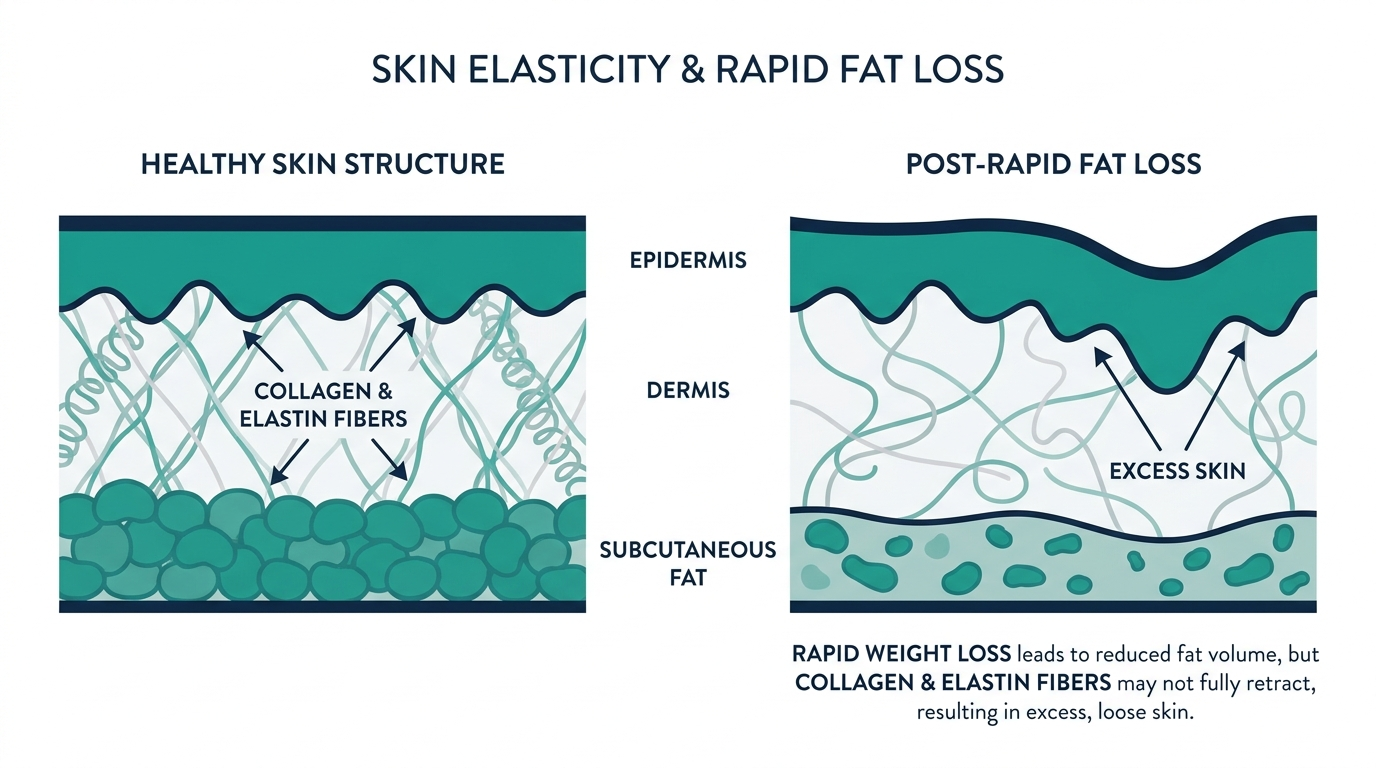
Skin does tighten after weight loss for many people, but only up to a point, and the point is set largely by how stretched it got and for how long. Your skin has two structural proteins that matter here: collagen, which gives it strength and thickness, and elastin, which lets it stretch and recoil like memory foam. When you gain a lot of weight, the skin expands to cover it. Lose that weight and the skin has to retract back over a smaller frame.
If the stretch was moderate and recent, the elastin still has spring left and the skin slowly reels itself in. If you carried 80 to 150 extra pounds for years, the elastin fibers physically fracture and the skin loses its recoil, the same way a waistband that has been stretched for a decade never goes back to its original shape. That is why a 25-year-old who lost 30 pounds over a year often sees their skin recover fully, while a 55-year-old who lost 130 pounds after bariatric surgery is usually left with hanging skin on the abdomen, arms, and thighs that will not retract without a surgeon.
So “is loose skin permanent” has an honest split answer: minor looseness is usually temporary and improves over months, while major excess skin after massive weight loss is usually permanent.
How long does it take for skin to tighten after weight loss?
The simplest way to actually get this done
Superpower is a full-body lab membership that runs 100+ biomarkers, has each result reviewed by a doctor, and tracks your numbers year over year (about $199/year). It is what we point readers to when they would rather get one clean, complete draw than chase single tests one at a time. Here is superpower reviewed in full.
For mild to moderate loose skin, expect the bulk of natural tightening to happen over 6 to 24 months after your weight stabilizes. Skin remodeling is slow because collagen turnover is slow. Your body is literally laying down and reorganizing protein fibers, and that process runs on a timeline of months to a couple of years, not weeks.
A few things speed the timeline up, and a few stall it:
- Weight stability matters more than time. Skin will not finish tightening while your weight is still bouncing. If you are still losing, regaining, and re-losing, the skin keeps getting a moving target. Tightening accelerates once your weight holds steady for a few months.
- What you think is loose skin at 3 months is often residual fat. Subcutaneous fat under the skin takes time to fully reduce, especially in the lower belly, hips, and upper arms. A lot of people panic at “loose skin” that is actually a thin fat layer that keeps shrinking through month 12.
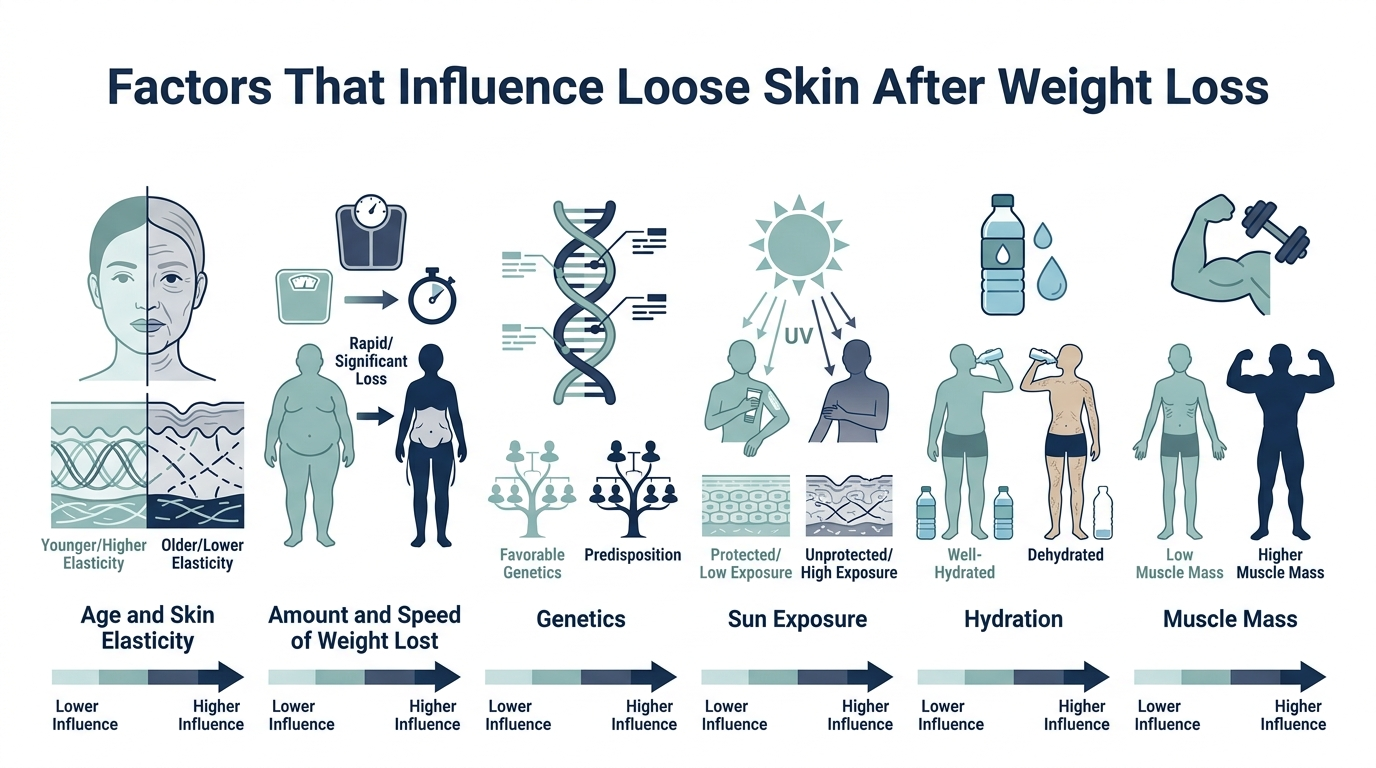
- Age slows it. After about 40, collagen production drops roughly 1% per year, and estrogen loss in perimenopause accelerates the decline, so the same amount of loss leaves more lasting looseness.
If a year and a half has passed at a stable weight and the skin is still hanging, that is roughly your final result from natural remodeling. Beyond that, only procedures change it.
How do you tighten loose skin after weight loss without surgery?
To tighten loose skin after weight loss without surgery, you give the skin its best shot at natural recoil and you fill it back out with muscle, because there is no non-surgical method that removes a true skin excess. The realistic non-surgical levers, in order of how much they actually do:
- Build muscle with resistance training. This is the single most effective thing you can do at home. Loose skin looks dramatically worse over a deflated, empty limb. Add muscle underneath (lats, delts, glutes, quads) and you fill the “envelope” back out, so the skin drapes tighter even if its total area has not changed. Two to four strength sessions a week beats any cream.
- Lose weight slowly. Aim for roughly 1 to 2 pounds a week. Slow loss gives skin time to remodel along the way instead of being left behind all at once. People who crash diet or do aggressive very-low-calorie plans get worse loose skin for the same total pounds lost.
- Eat enough protein. Collagen and elastin are made of amino acids. Most adults losing weight do best around 0.7 to 1 gram of protein per pound of goal body weight. Chronically under-eating protein during a long diet starves the exact repair machinery you need.
- Hydration and overall skin health. Well-hydrated skin is plumper and more elastic. Not a magic fix, but dehydration makes loose skin look worse, and it is free to correct.
- Don’t smoke, manage sun exposure. Smoking and chronic UV both degrade collagen and elastin directly. Quitting will not reverse hanging skin, but it stops you sabotaging the remodeling that could happen.
For more on the day-to-day routine, see how to tighten skin after weight loss naturally. And if you are still mid-journey, the better play is prevention. Read how to avoid loose skin during weight loss before you lose the next 50 pounds.
Do skin tightening creams, supplements, and devices work?
Most over-the-counter skin tightening products do very little for true loose skin, and the marketing is far ahead of the evidence. Here is an honest grade of the common options.
| Method | What it claims | Honest evidence grade | Realistic 2026 cost |
|---|---|---|---|
| Collagen powder/peptides | Rebuilds skin collagen | Weak. May modestly improve skin hydration and elasticity in studies, but will not retract hanging skin. | $20 to $50 a month |
| “Firming” creams (retinol, caffeine) | Tightens and lifts skin | Very weak for loose skin. Retinol can thicken skin texture slightly over months; does nothing for excess. | $15 to $80 per jar |
| Resistance training + protein | Fills skin back out | Strong. The most effective at-home approach. Adds muscle volume under the skin. | Low (gym or bodyweight) |
| Radiofrequency / ultrasound (in-office, e.g. Thermage, Ultherapy) | Heats deep layers to stimulate collagen | Modest. Real but subtle tightening on mild laxity, not for large excess skin. | $1,000 to $4,000 per area |
| Microneedling with RF (Morpheus8) | Tightens and remodels | Modest. Helps mild crepey skin; multiple sessions needed; not for hanging skin. | $600 to $1,500 per session |
| Body-contouring surgery (tummy tuck, body lift) | Removes excess skin | Definitive. The only reliable fix for significant loose skin. | $6,000 to $15,000-plus per area |
The pattern is clear. Cheap topicals do the least. Energy devices help only mild laxity and cost real money. Surgery is the only thing that removes a genuine skin excess. Apple cider vinegar, “detox” wraps, and waist trainers do nothing for skin structure, full stop.
When is surgery the right call for loose skin?
Surgery becomes the realistic option when you have a true skin excess that hangs in folds, will not retract after 12 to 18 months at a stable weight, and causes physical or quality-of-life problems. Common signs you are in surgical territory:
- Skin that hangs as an “apron” (a panniculus) over the lower abdomen, sometimes covering the groin.
- Rashes, chafing, or recurrent skin infections in the folds (this can make surgery medically necessary, and occasionally insurance-covered for a panniculectomy).
- Loose skin that limits movement, exercise, or fitting into clothing after major or bariatric weight loss.
The standard procedures are a tummy tuck (abdominoplasty) or panniculectomy for the belly, an arm lift (brachioplasty), a thigh lift, and a full lower body lift for people after very large losses. Surgeons generally want your weight stable for at least 6 months first, because losing more afterward creates new looseness. Talk to a board-certified plastic surgeon before deciding, and know that these are real operations with scars, recovery, and risk, not a quick touch-up.
Is it loose skin, leftover fat, or something your body is doing wrong?
Before you spend money tightening “loose skin,” confirm it is actually loose skin, because three different things get blamed on the same sag. A simple pinch test helps: grab the area. If you can pinch a thick, soft handful, that is mostly residual fat that will keep shrinking with continued fat loss and muscle building. If you pinch only a thin, draping layer with no real substance, that is true loose skin.
The third possibility is the one this site cares about most: the reason your weight, body composition, or skin is behaving strangely can be a medical signal, not a cosmetic one. Rapid or unexplained changes deserve a look under the hood:
- Sudden, unexplained weight loss with loose or hanging skin and no diet effort can point to a thyroid problem, uncontrolled diabetes, or other illness. Unintentional loss is a red flag worth investigating, including in rare cases an underlying disease (why cancer causes weight loss explains the mechanism).
- Stress and gut issues can drive weight changes that get mistaken for fat loss. See can stress cause weight loss and whether diarrhea causes weight loss for how fluid and appetite shifts play in.
- What looks like a stubborn “stall” with poor skin recovery is often a hormonal or metabolic issue underneath: low thyroid (hypothyroidism), insulin resistance, low testosterone, or perimenopause. These slow both fat loss and the collagen turnover that tightens skin.
This is the part guessing cannot solve. You cannot eyeball your fasting insulin or your TSH. If your weight or skin is doing something that does not match your effort, the move is to measure, not to keep buying creams.
Want to know what is actually stalling your weight and skin, not guess?
Superpower is a full-body lab membership that runs 100-plus biomarkers including fasting insulin, A1C, thyroid, testosterone and cortisol, has each result reviewed by a doctor, and tracks your numbers year over year so you can see what is actually stalling your weight (about $199/year). If your loss has stalled or your skin is not recovering the way it should, a single panel often shows the thyroid or insulin problem behind it. Here is Superpower reviewed in full.
What stalls people: the common loose-skin mistakes
Most of the frustration around loose skin comes from a handful of avoidable mistakes, not from bad genetics. The patterns repeat:
- Judging skin too early. People declare permanent loose skin at 2 to 3 months, when half of it is still fat and the remodeling has barely started. Give it a stable year before you judge.
- Crash dieting for speed. Dropping weight too fast (very-low-calorie diets, extreme deficits) gives skin no time to keep up and leaves you with worse looseness for the same pounds. Slow and steady literally produces a tighter result.
- Doing only cardio. Endless cardio with no resistance training burns muscle along with fat, so you end up smaller but “deflated,” and the empty skin looks looser. Lifting fills the envelope back out.
- Under-eating protein. A long diet on low protein starves collagen and muscle at the same time. This is one of the most common silent saboteurs.
- Ignoring the GLP-1 connection. People losing fast on Wegovy (semaglutide, ~15% average loss in STEP trials) or Zepbound (tirzepatide, ~20%-plus in SURMOUNT) often see more loose skin precisely because the loss is large and quick, and many lose muscle too if they skip protein and lifting. If you are on a GLP-1, the muscle-preservation work matters even more. Note that FDA-approved Wegovy and Zepbound differ from compounded semaglutide or tirzepatide, which is not FDA-approved but can be legally prescribed through a licensed clinician, and you should talk to a clinician before starting or stopping any of them.
- Treating a medical problem as a willpower problem. When the scale and skin will not cooperate despite real effort, the cause is often hormonal. Guessing wastes months. Testing answers it.
Loose skin recovery by scenario: what to actually expect
Your realistic outcome depends heavily on your situation. This table maps common scenarios to honest expectations and the best first move.
| Your situation | Will skin tighten naturally? | Best first move |
|---|---|---|
| Under 35, lost 20 to 50 lbs, slowly | Usually yes, over 6 to 18 months | Protein + lifting, be patient |
| Over 45, lost 30 to 60 lbs | Partial; some lasting looseness likely | Lifting + consider in-office RF for mild laxity |
| Lost 100-plus lbs or post-bariatric | Rarely fully; expect excess skin | Stabilize weight, consult a plastic surgeon |
| Fast loss on a GLP-1, muscle dropping | Worse if muscle is lost | Prioritize protein + resistance training now |
| Weight or skin behaving oddly vs. effort | Depends on the hidden cause | Test thyroid, insulin, hormones first |
Turn what you just learned into action.
Superpower lets you test 100+ biomarkers from home, then re-check them over time so you can actually see progress, physician-reviewed at every step.
Want a real clinician to run the numbers, not a guess?
Joi + Blokes is a telehealth clinic that prescribes GLP-1 medication (Zepbound, compounded semaglutide and tirzepatide), hormone therapy (TRT, HRT), thyroid care, and peptides after a real lab panel and clinician review, with no membership or consult fee (prescriptions from about $59/month, lab panels from $149). If the scale will not budge, this is where you find out whether insulin, thyroid, or hormones are the real reason. Here is Joi + Blokes reviewed in full.
FAQ
Will loose skin tighten after weight loss on its own?
Often yes for mild looseness, no for large excess skin. If you lost a moderate amount slowly and you are younger, the skin usually retracts noticeably over 6 to 24 months. If you lost 100-plus pounds or the skin hangs in folds, it generally will not fully retract without surgery.
How can I tighten loose skin after weight loss at home?
The most effective at-home approach is resistance training plus adequate protein, which fills the skin back out with muscle and supplies the amino acids for collagen and elastin. Add slow weight loss, good hydration, and not smoking. Creams and supplements help little for true excess skin.
Can you tighten loose skin after weight loss without surgery?
You can improve mild to moderate looseness without surgery through muscle building, protein, and time, and in-office energy treatments (radiofrequency, microneedling with RF) can add subtle tightening. But no non-surgical method removes a genuine skin excess. For significant hanging skin, surgery is the only reliable option.
How long for skin to tighten after weight loss?
Most natural tightening happens over 6 to 24 months after your weight stabilizes, because collagen remodeling is slow. Skin will not finish tightening while your weight is still fluctuating, so stabilizing first is key. After about 18 months at a stable weight, what you see is roughly your final natural result.
Does losing weight slowly really prevent loose skin?
Yes, to a meaningful degree. Losing roughly 1 to 2 pounds a week gives skin time to remodel along the way, while crash dieting leaves the skin behind and produces worse looseness for the same total pounds lost. Slow loss also makes it easier to preserve the muscle that fills skin out.
Do GLP-1 drugs like Ozempic or Zepbound cause loose skin?
They do not damage skin directly, but the large, fast weight loss they produce can leave more loose skin, and muscle loss is common if you do not eat enough protein or strength train. Wegovy and Zepbound are FDA-approved; compounded versions are not FDA-approved but can be legally prescribed by a licensed clinician. On any of them, protein and resistance training protect your result.
Does collagen powder tighten loose skin?
Not in any meaningful way for hanging skin. Some studies show collagen peptides modestly improve skin hydration and elasticity, but that is a small cosmetic effect, not retraction of stretched skin. Eating enough total protein from food matters more than any specific collagen product.
When should I see a doctor about loose skin or skin changes?
See a clinician if you have rashes or recurrent infections in skin folds, if loose skin limits movement or daily life, or if your weight changed rapidly without trying. Unintentional weight loss and unexplained body changes can signal a thyroid, metabolic, or other medical issue and deserve testing rather than a cosmetic fix.
Is it loose skin or just leftover fat?
Pinch the area. A thick, soft handful is mostly residual fat that will keep shrinking with continued fat loss and muscle building. A thin, draping layer with little substance is true loose skin. Many people misjudge fat as permanent skin at the 3-month mark and give up too early.
Vital Signs Today may earn a commission if you buy through links on this page. It does not affect our editorial assessments.