Quick answer: You cannot always avoid loose skin during weight loss, but you can sharply reduce it. The main levers are losing at a moderate pace (about 1 to 2 pounds a week), keeping muscle with resistance training, eating roughly 0.7 to 1 gram of protein per pound of goal weight, staying hydrated, and not smoking. How much loose skin you end up with comes down to how fast and how much you lost, your age, your genetics, and how long the skin was stretched. A 25 pound loss in your twenties usually rebounds on its own. A 100 pound loss in your fifties often leaves skin that only surgery fully fixes. The honest truth: creams and collagen pills do almost nothing here, and the factor most people never check is whether a hormone or insulin problem is quietly driving the whole situation.
Most loose-skin articles sell a routine of firming lotions and detox teas. Those do not work. What follows is what actually changes the outcome, where the hard limits are, and the testing step almost everyone skips before they start.
Loose skin often tracks with how your body handles protein, hormones, and healing. Curious what your own bloodwork would show? One at-home Superpower draw checks 100+ biomarkers, physician-reviewed.
How to avoid loose skin during weight loss: the levers that matter
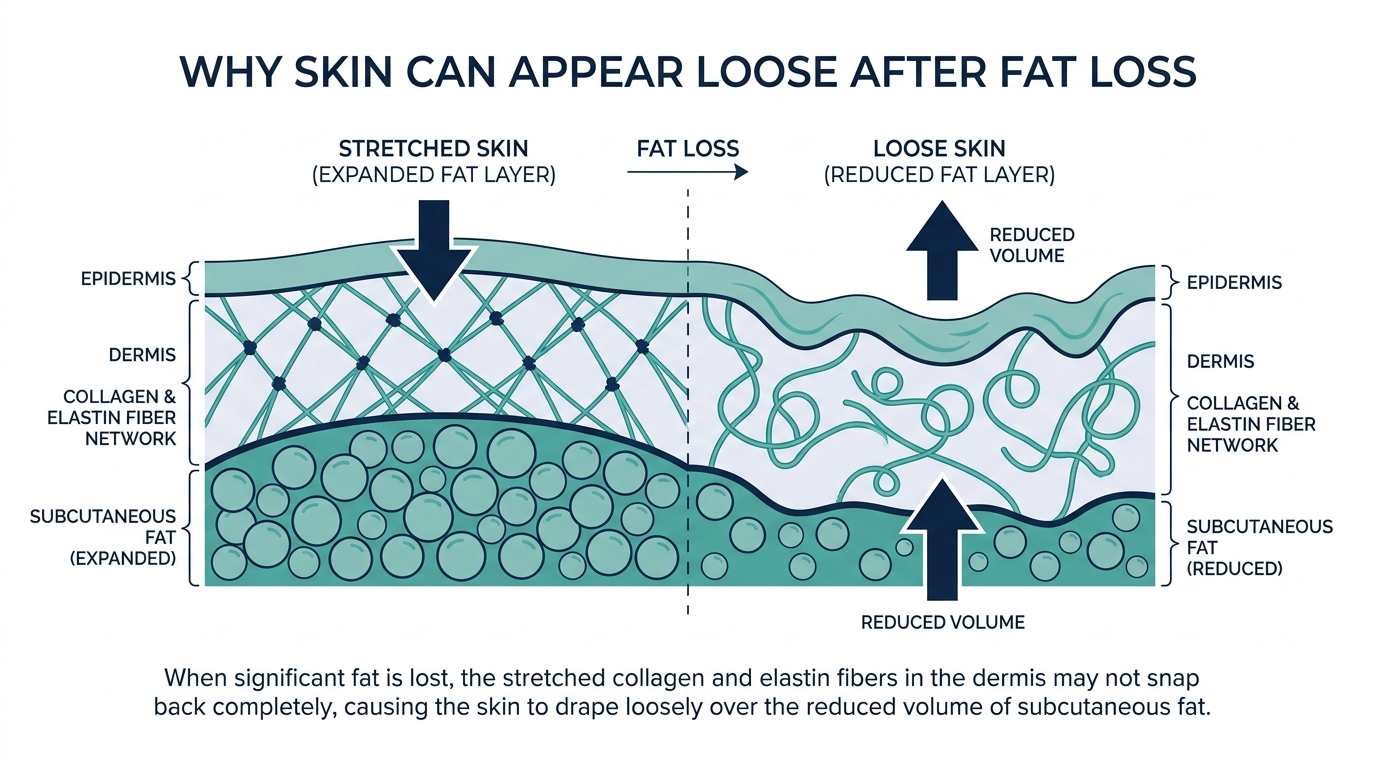
The single most controllable factor in how to avoid loose skin weight loss is the speed and size of the loss itself. Skin is elastic, but the collagen and elastin in the dermis need time to remodel as the fat underneath shrinks. Drop 70 pounds in three months and the skin envelope has no chance to contract with you. Lose that same 70 pounds over 12 to 18 months and the body can tighten the skin as it goes. That is why crash diets, very low calorie programs, and aggressive GLP-1 dose escalation tend to leave more sagging than steady, supervised loss.
Here is the practical playbook:
- Aim for 1 to 2 pounds a week. That is roughly a 500 to 1000 calorie daily deficit. Lose faster than about 1 percent of body weight per week and skin remodeling falls behind.
- Lift two to four times a week. Muscle fills the space fat vacated and pushes the skin taut from underneath. A trained arm with some loose skin looks dramatically tighter than an untrained one.
- Hit your protein. Collagen and elastin are proteins. In a deficit, low protein forces the body to scavenge amino acids from skin and muscle. Target 0.7 to 1 gram per pound of goal body weight, spread through the day.
- Stay hydrated. Well-hydrated skin is plumper and more resilient. Minor next to pace and muscle, but free.
- Do not smoke, and protect skin from sun. Both break down collagen and speed skin aging.
Notice what is missing: collagen pills, firming creams, and waist trainers. The evidence that oral collagen meaningfully tightens skin after a major loss is thin. Topical retinoids can modestly improve texture over months, but they will not lift a panniculus, the apron of skin that hangs after very large losses.
Can you avoid loose skin after weight loss completely?
The simplest way to actually get this done
Superpower is a full-body lab membership that runs 100+ biomarkers, has each result reviewed by a doctor, and tracks your numbers year over year (about $199/year). It is what we point readers to when they would rather get one clean, complete draw than chase single tests one at a time. Here is superpower reviewed in full.
No, not always, and anyone who promises otherwise is selling you something. Whether you can avoid loose skin after weight loss depends on variables you do not fully control. The honest predictors are well established.
| Factor | Lower loose-skin risk | Higher loose-skin risk |
|---|---|---|
| Amount lost | Under 50 pounds | Over 100 pounds |
| Speed of loss | 1 to 2 lb per week | Crash diet or rapid surgical loss |
| Age | Under 35 | Over 50 |
| Years you carried the weight | A few years | A decade or more |
| Sun and smoking | Minimal | Heavy |
| Muscle retained | High (resistance training) | Low (diet only) |
If you are 28, lose 30 pounds over a year, and lift the whole time, you will likely see only minor, temporary looseness that resolves over 6 to 12 months as skin remodels. If you are 55, carried 120 extra pounds for 15 years, and lost it fast, expect meaningful loose skin that no diet or workout fully reverses. That is not a discipline failure. It is biology. For the fixes once the weight is off, see our guide to how to tighten loose skin after weight loss.
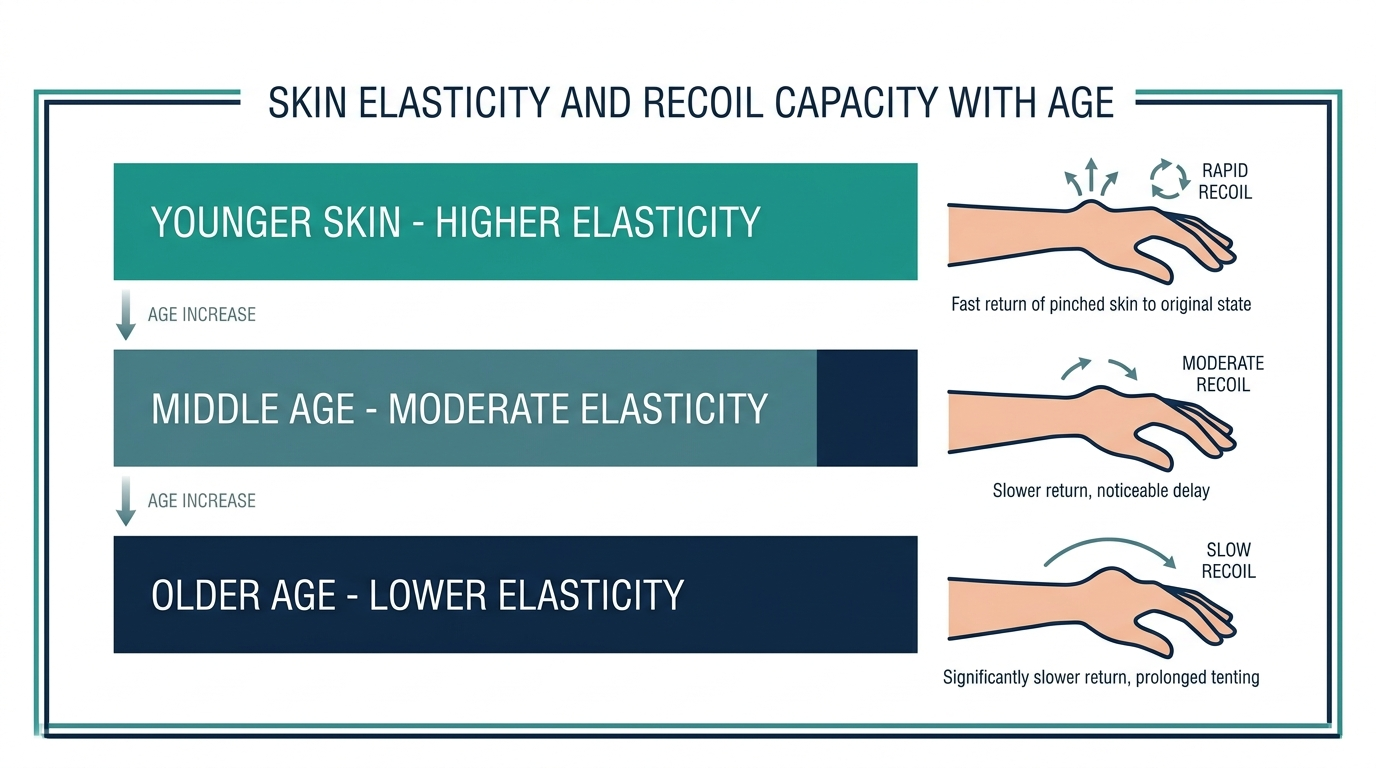
Age is the variable people underestimate. Older skin has less collagen and remodels more slowly, so to avoid loose skin during weight loss after 40 you have to stack the deck harder: lose at the gentler end (closer to 1 pound a week), treat resistance training as non-negotiable since muscle loss accelerates with age, push protein higher, and check hormones, because perimenopause, menopause, and falling testosterone all change how fat and muscle distribute and how skin holds up. If hormones are clearly part of the picture and you want medical treatment rather than guesswork, a supervised telehealth clinic that runs labs first, like Joi and Blokes, treats through real clinicians instead of the gray market.
How to avoid loose skin from weight loss on a GLP-1
The same rules apply, but the risk runs higher, because Wegovy (semaglutide) and Zepbound (tirzepatide) produce large, relatively fast losses. In the STEP trials, semaglutide averaged about 15 percent of body weight; in the SURMOUNT trials, tirzepatide averaged north of 20 percent. For someone starting at 250 pounds, that is 35 to 50-plus pounds, often inside a year. That loss profile, large and quick, is exactly the one that leaves loose skin.
What protects you on a GLP-1:
- Do not rush the dose. Titrate on the schedule a clinician sets. Faster is not better for skin or for nausea.
- Defend your muscle. GLP-1 loss can be 25 to 40 percent lean mass without training. Resistance work and high protein are the counterweight, and they directly help skin tone.
- Eat enough protein even when appetite is gone. Many people on these drugs barely feel like eating. That is when muscle and skin protein get cannibalized. Protein shakes are standard for a reason.
One precision point: FDA-approved Wegovy, Zepbound, Ozempic, Mounjaro, and Saxenda are pharmaceutical products with consistent dosing. Compounded semaglutide and tirzepatide are not FDA approved; they are legally prescribed through licensed clinicians and pharmacies, but dosing and quality vary more. Either way, do this with a supervising clinician who can pace your loss, not by chasing the steepest curve you can find. Talk to a clinician before starting or stopping any weight-loss medication.
What foods to avoid for weight loss (and which ones protect your skin)
The foods that stall weight loss are mostly the ones that deliver a lot of calories with little protein or fiber, so they neither fill you up nor protect your lean tissue. Cutting them helps the scale and, indirectly, your skin, because steady loss with enough protein keeps the skin envelope contracting.
What foods to avoid for weight loss, in rough order of impact:
- Sugar-sweetened drinks. Soda, sweet tea, juice, and the 400 calorie flavored latte. Liquid sugar barely registers as fullness, so it is the easiest way to wipe out a deficit.
- Refined snack carbs. Chips, crackers, pastries, and most cereal. High calorie, low satiety, easy to overeat.
- Ultra-processed snacks engineered to be hyper-palatable. They override your natural stop signal.
- Alcohol. Seven calories a gram, lowers inhibition around food, and disrupts sleep, which raises hunger hormones.
- Fried fast food. Calorie-dense and protein-light relative to portion.
The mirror image matters just as much: foods that protect skin and muscle during a loss are protein (eggs, fish, poultry, Greek yogurt, legumes), vitamin C for collagen synthesis (citrus, peppers, berries), zinc (shellfish, beef, pumpkin seeds), and water-rich vegetables. Do not just avoid the bad list. Load the protective one.
What fruits to avoid for weight loss?
Honestly, very few. The idea that fruit ruins weight loss is mostly a myth, because whole fruit comes with fiber and water that slow sugar absorption and fill you up. For most people, the fruit question is far less important than the soda and chips question. That said, a few situations call for portion awareness.
| Eat freely | Portion-aware | Watch the form, not the fruit |
|---|---|---|
| Berries, melon, apples, oranges, kiwi | Mango, grapes, banana, pineapple, cherries | Fruit juice, dried fruit, smoothies, canned in syrup |
| High fiber, high water, very filling | Higher natural sugar and calories per cup | Concentrated sugar, fiber stripped or diluted |
The real culprits are not fruits at all; they are processed fruit. A cup of grapes is fine. A glass of grape juice is a sugar shot with the fiber removed. Dried fruit is calorie-dense because the water is gone, so a small handful of raisins packs the sugar of a large bowl of grapes. If you have insulin resistance or diabetes, your clinician may steer you toward lower-sugar fruit (berries over mango), but for most people the answer to what fruits to avoid for weight loss is: none, just skip the juiced and dried versions.
How to avoid a weight loss plateau
Plateaus happen because your body adapts: as you lose weight you burn fewer calories at rest, and the deficit that was working shrinks until it disappears. To avoid a weight loss plateau, you adjust as your body changes instead of running the same plan forever.
- Recalculate your intake as you lose. A 220 pound body and a 185 pound body do not burn the same calories. What was a deficit at the start becomes maintenance later.
- Protect muscle so your metabolism does not crater. Resistance training and protein keep resting burn higher. This is the same lever that protects your skin.
- Track honestly for a week. Most stalls are creeping portions and untracked bites, not a broken metabolism.
- Prioritize sleep and stress. Poor sleep and chronic stress raise cortisol and hunger hormones, which stall fat loss even on a clean diet.
- Consider a diet break. A week or two at maintenance can ease the metabolic adaptation deep deficits cause.
Here is the part most plateau advice misses. Sometimes the scale will not move no matter how clean you eat, and it is not adaptation or cheating. An underactive thyroid, insulin resistance, PCOS, low testosterone, high cortisol, or perimenopause can all flatten the curve, and none of them show up on a bathroom scale.
What stalls people, and the mistakes that make loose skin worse
Most loose-skin regret traces back to a handful of avoidable errors. These are the patterns that turn a manageable amount of loose skin into a bigger one.
- Losing too fast. The number one mistake. Speed is not a virtue here. Rapid loss strips more muscle and gives skin no time to contract.
- Dieting without lifting. Diet-only loss can be a quarter to a third muscle. That muscle was holding your shape; lose it and the skin has nothing to fill it.
- Under-eating protein. In a deficit, low protein means the body breaks down lean tissue, including skin protein.
- Yo-yo dieting. Repeatedly stretching and shrinking skin over years wears out its elasticity faster than one clean loss.
- Chasing supplements over fundamentals. Collagen powder will not undo a brutal crash deficit and zero training.
There is a quieter mistake too: grinding through diets that should work while an undiagnosed condition fights you. That is not a willpower problem. It is a measurement problem.
The step almost everyone skips: measure before you cut
Here is the insider point most weight-loss content leaves out. Stubborn weight, stalled plateaus, and hair shedding can be downstream of something a lab would have flagged on day one. An underactive thyroid slows metabolism, thins hair, and dries skin all at once. Insulin resistance makes fat loss grind to a halt no matter how disciplined you are. A standard primary-care visit usually tests only a fraction of these.
If the scale will not move, or you are losing but everything else is falling apart, the smart first move is not another diet. It is seeing your actual numbers: fasting insulin, A1C, a full thyroid panel (not just TSH), ferritin, vitamin D, and sex hormones. People guess for years about a problem a single morning of bloodwork would have answered.
Want to know what is actually stalling your weight, not guess at it?
Superpower is a full-body lab membership that runs 100+ biomarkers including fasting insulin, A1C, thyroid, testosterone and cortisol, has each result reviewed by a doctor, and tracks your numbers year over year so you can see what is actually stalling your weight (about $199/year). Before you blame your skin or your discipline for a stalled loss, a panel like this tells you whether a hormone or insulin problem is driving it. Here is Superpower reviewed in full.
If you suspect one specific issue, an at-home thyroid or metabolic kit from Everlywell can confirm whether your thyroid is the culprit before you commit to a full membership. The principle in how to avoid loose skin weight loss problems is the same either way: measure first, then act.
When weight or skin changes are a medical red flag
Most loose skin is cosmetic and benign. But weight that drops without you trying, or weight changes paired with other symptoms, deserve a clinician. Unintentional weight loss is a different problem from planned dieting, and it can point to disease.
See a doctor if you are losing weight without trying, especially alongside fatigue, night sweats, or appetite loss, since persistent unexplained loss can signal serious conditions and is one reason cancer causes weight loss. Chronic digestive issues matter too, because ongoing diarrhea drains nutrients and can drive loss, as we cover in whether diarrhea causes weight loss. And do not overlook the mind-body link, since long-term stress can suppress appetite and shift metabolism, which is why stress can cause weight loss in some people.
Turn what you just learned into action.
Superpower lets you test 100+ biomarkers from home, then re-check them over time so you can actually see progress, physician-reviewed at every step.
Want a real clinician to run the numbers, not a guess?
Joi + Blokes is a telehealth clinic that prescribes GLP-1 medication (Zepbound, compounded semaglutide and tirzepatide), hormone therapy (TRT, HRT), thyroid care, and peptides after a real lab panel and clinician review, with no membership or consult fee (prescriptions from about $59/month, lab panels from $149). If the scale will not budge, this is where you find out whether insulin, thyroid, or hormones are the real reason. Here is Joi + Blokes reviewed in full.
FAQ
How can I avoid loose skin after weight loss naturally?
The natural levers are losing slowly, building muscle with resistance training, eating enough protein, staying hydrated, and protecting skin from sun and smoke. No natural method fully prevents loose skin after a very large or fast loss. For the realistic non-surgical options, see our guide on how to tighten skin after weight loss naturally.
Can you avoid loose skin after weight loss entirely?
Not always. If the loss is modest (under about 40 to 50 pounds), gradual, and you are younger, you can often avoid lasting loose skin. After very large or rapid losses, especially over age 50, some excess skin is usually unavoidable and may need professional treatment or surgery.
Will loose skin tighten on its own?
Often yes, if the loss was modest and you are younger. Skin keeps contracting for 12 to 24 months after weight stabilizes. Larger losses, older skin, and weight carried for many years are less likely to fully rebound.
Does building muscle hide loose skin?
Yes, it is one of the most effective non-surgical strategies. Muscle fills the space fat left behind and pushes the skin taut from underneath, so loose skin on a muscular limb looks noticeably tighter than the same skin over an untrained one.
Do collagen supplements help you avoid loose skin?
The evidence is weak. Some small studies show modest skin-elasticity gains from collagen peptides, but nothing suggests they prevent the loose skin that follows a large loss. Total daily protein matters far more than any collagen powder.
What foods should I avoid for weight loss?
Sugar-sweetened drinks, refined snack carbs, ultra-processed hyper-palatable snacks, alcohol, and fried fast food do the most damage, because they are calorie-dense and low in protein and fiber. Replace them with protein, vegetables, and whole fruit rather than relying on willpower alone.
What fruits should I avoid for weight loss?
For most people, none. Whole fruit comes with fiber and water that blunt the sugar and fill you up. Be portion-aware with mango, grapes, and banana, and limit fruit juice, dried fruit, and syrupy canned fruit, which concentrate sugar and strip the fiber.
How do I break a weight loss plateau?
Recalculate your calorie needs as you get lighter, protect muscle with training and protein, track honestly for a week, and fix sleep and stress. If the scale still will not budge on a genuine deficit, get thyroid, insulin, and sex hormones checked, since a medical cause may be the real brake.
Does losing weight slowly really reduce loose skin?
Yes. A moderate pace of 1 to 2 pounds a week gives skin time to remodel and preserves more muscle, both of which keep the skin envelope tighter. There is rarely a reason to lose faster unless a clinician has a specific medical reason, and faster loss tends to leave more loose skin.
Is loose skin from weight loss covered by insurance?
Sometimes. A panniculectomy may be covered when the hanging skin causes documented rashes, infections, or functional impairment. Purely cosmetic contouring, like an arm or thigh lift for appearance, is usually not covered and is paid out of pocket.
Vital Signs Today may earn a commission if you buy through links on this page. It does not affect our editorial assessments.