Quick answer: To tighten skin after weight loss naturally, lose weight slowly (about 1 to 2 pounds a week), build muscle through resistance training to fill the space under your skin, stay hydrated, eat enough protein (roughly 0.7 to 1 gram per pound of goal weight) plus vitamin C and zinc for collagen, and protect your skin from sun. These steps genuinely help mild to moderate looseness and the texture of skin. They will not erase large flaps of hanging skin after a 100-pound loss or after pregnancy and major weight swings, because that is a structural problem of stretched, collagen-depleted skin that usually needs a procedure. Realistic timelines run 6 months to 2 years for skin to retract as far as it will go.
Loose skin is the number one cosmetic fear people bring to a big weight loss, and the internet is full of creams and gadgets promising to fix it for $40. Most of that is noise. Skin is a living organ with a structural scaffold of collagen and elastin, and how much it bounces back depends on how stretched it got, how long it stayed stretched, your age, your genetics, and how fast you lost the weight. The good news is that a real chunk of what people call loose skin is not loose skin at all. It is residual fat, water, or simply skin that has not been given time to retract. That part you can influence. This guide separates what actually works from what is sold to you.
Collagen, protein status, and hormones all shape how your skin bounces back. See what your own bloodwork says about recovery. One at-home Superpower draw checks 100+ biomarkers, physician-reviewed.
Why does skin get loose after weight loss in the first place?
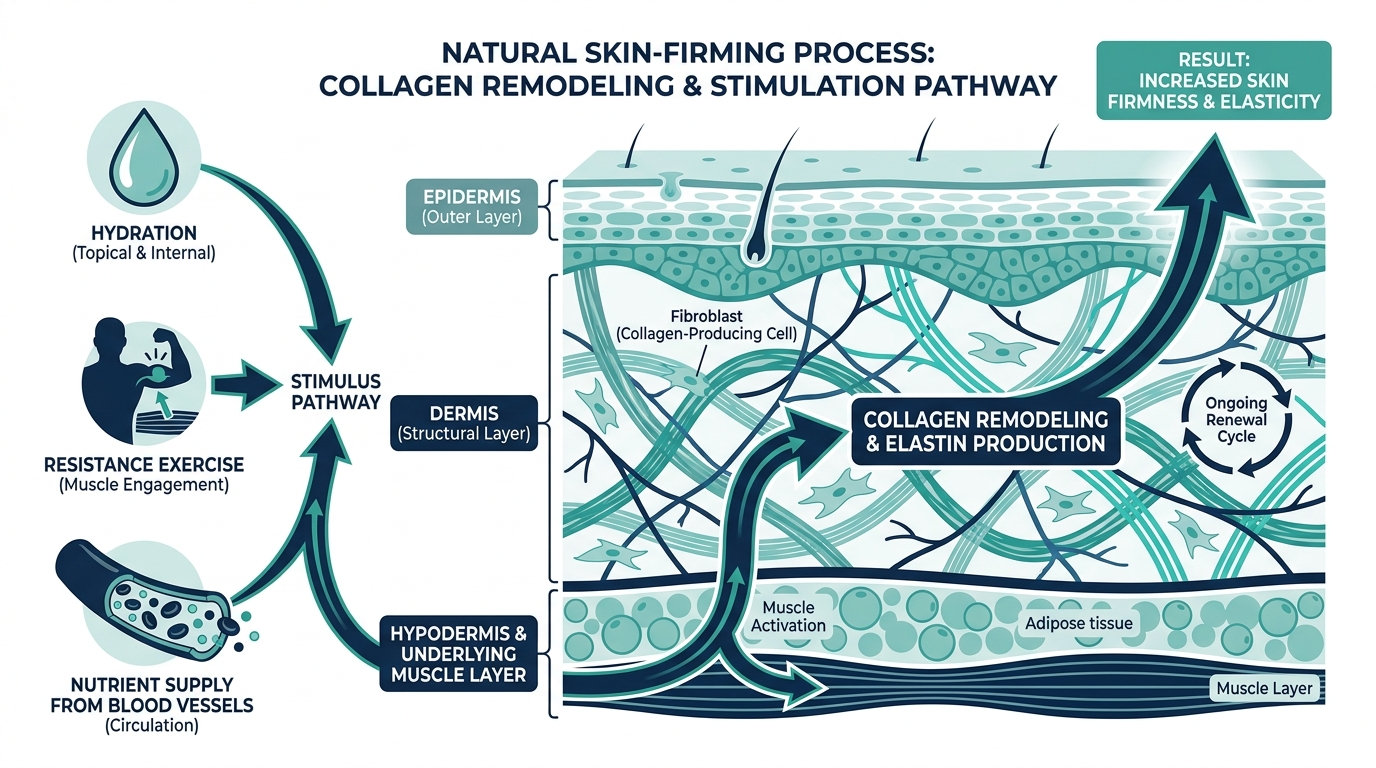
Skin loosens after weight loss because the fat underneath shrank faster than the skin could shrink with it. Your skin stretched to cover the fat you carried, and prolonged stretching breaks down the collagen and elastin fibers that give skin its snap-back. When the fat leaves, the scaffold that was damaged during years of being stretched cannot fully retract, so the skin drapes.
Three factors decide how much bounce-back you get. The first is how much weight you lost and how long you carried it. A 30-pound loss at age 30 after one year of being heavy is a very different skin situation from a 120-pound loss at age 55 carried for two decades. The second is age. Collagen production drops steadily from your mid-20s, and after menopause estrogen loss accelerates the decline, which is why skin tightening is harder in your 50s and 60s. The third is genetics, which sets your baseline elastin quality and is the part you cannot change.
Here is the insider detail most articles skip: in the first few weeks of any aggressive diet, a lot of what looks like loose, deflated skin is actually water and glycogen depletion, especially on keto or a very low-carb plan. Each gram of stored glycogen holds about 3 grams of water, so dumping glycogen makes you look softer and looser fast. That is not skin damage, and it partly reverses. This is why you should never judge your loose skin in month one. Judge it at month six and beyond.
How to tighten skin after weight loss naturally with diet and collagen
The simplest way to actually get this done
Superpower is a full-body lab membership that runs 100+ biomarkers, has each result reviewed by a doctor, and tracks your numbers year over year (about $199/year). It is what we point readers to when they would rather get one clean, complete draw than chase single tests one at a time. Here is superpower reviewed in full.
The strongest dietary lever for tightening skin after weight loss naturally is protein, because skin is built from protein and your body cannot rebuild collagen without the raw amino acids. Aim for roughly 0.7 to 1 gram of protein per pound of your goal body weight per day. For a 150-pound target that is about 105 to 150 grams daily. Under-eating protein during a diet is one of the most common reasons skin and muscle both look depleted at the end.
Beyond protein, a few nutrients have real mechanistic support for skin structure:
- Vitamin C: a required cofactor for collagen synthesis. Without it, your body literally cannot cross-link collagen properly. Citrus, peppers, and berries cover this easily.
- Zinc: involved in wound healing and skin repair. Found in meat, shellfish, seeds.
- Water: well-hydrated skin looks fuller and more elastic. Chronic dehydration makes skin look slack.
- Collagen peptides: the supplement with the most evidence, and the most overhyped. A handful of small trials suggest hydrolyzed collagen (around 2.5 to 15 grams a day) may modestly improve skin elasticity and hydration over 8 to 12 weeks. The effect is real but small, and many of the studies were industry-funded. Treat it as a minor assist, not a fix.
What does almost nothing: apple cider vinegar, detox teas, and most $40 firming creams. Topical creams cannot reach the dermis where the collagen scaffold lives, so a cream cannot rebuild structure. The one topical exception worth a mention is a retinoid (retinol or prescription tretinoin), which has decent evidence for thickening the dermis and improving skin quality over months, though it works on texture and fine wrinkling more than on large-scale draping.
Supplement and method evidence at a glance
| Approach | What it targets | Evidence strength | Realistic effect on loose skin |
|---|---|---|---|
| Adequate protein (0.7 to 1 g/lb) | Collagen and muscle raw material | Strong | Foundational, helps fill and rebuild |
| Resistance training | Muscle volume under skin | Strong | Visibly reduces mild looseness |
| Slow weight loss | Gives skin time to retract | Strong (logical) | Prevention more than cure |
| Collagen peptides | Skin elasticity, hydration | Weak to moderate | Small, slow, modest |
| Retinoids (topical) | Dermal thickness, texture | Moderate | Texture and fine lines, not big drape |
| Vitamin C, zinc, hydration | Collagen cofactors, skin fullness | Moderate | Supportive, not standalone |
| Firming creams, ACV, detox teas | Marketed as tightening | None | Negligible |
How to tighten skin after weight loss naturally with exercise
The single most effective natural move is resistance training, because muscle fills the space under loose skin and makes it sit tighter. When you lose fat, you create slack. Adding muscle volume to the same area takes up some of that slack from the inside, so the skin has less room to hang. This is why two people who both lost 50 pounds can look completely different: the one who lifted weights through the process looks firmer even with the same amount of skin.
Practical programming for skin appearance:
- Lift 3 to 4 times a week, hitting all major muscle groups, with progressive overload (gradually adding weight or reps). This is what builds the muscle that fills the skin.
- Prioritize the areas that bother you. Loose arms respond to building the triceps, deltoids, and biceps. A soft midsection responds partly to core work but mostly to overall fat loss and posture. Note that you cannot spot-reduce fat, but you can spot-build muscle.
- Do not over-rely on cardio. Excessive cardio with too little protein and no lifting can strip muscle along with fat, which makes skin look more deflated, not less.
Searches for how to tighten skin after weight loss naturally with exercise often hope for a specific magic move. There is no magic move. The mechanism is muscle volume plus overall body recomposition, and it shows up over months of consistent training, not in a 10-minute arm routine.
How to tighten face skin after weight loss naturally
Facial skin after weight loss tightens partly on its own as fat redistributes, but the face is also where aging shows first, so results depend heavily on age. When you lose significant weight, you also lose facial fat, which can leave the face looking hollow or saggy, sometimes called the ozempic face look that became common with rapid GLP-1 loss. Slower weight loss gives facial skin more time to adapt.
What genuinely helps face skin naturally:
- Sun protection. UV damage is the biggest accelerator of collagen breakdown in the face. Daily sunscreen is the most evidence-backed anti-aging step that exists.
- A retinoid at night, which over 3 to 6 months thickens the dermis and improves firmness and fine lines.
- Hydration and not crash dieting, so the face does not deflate faster than it can recover.
- Adequate protein and overall nutrition, same logic as the rest of the body.
Be honest with yourself about facial volume. Some of what reads as loose face skin is simply lost fat that gave your face its youthful fullness, and the natural options cannot replace volume the way a filler or fat transfer can. That is a cosmetic choice, not a health need.
What stalls people and the common mistakes
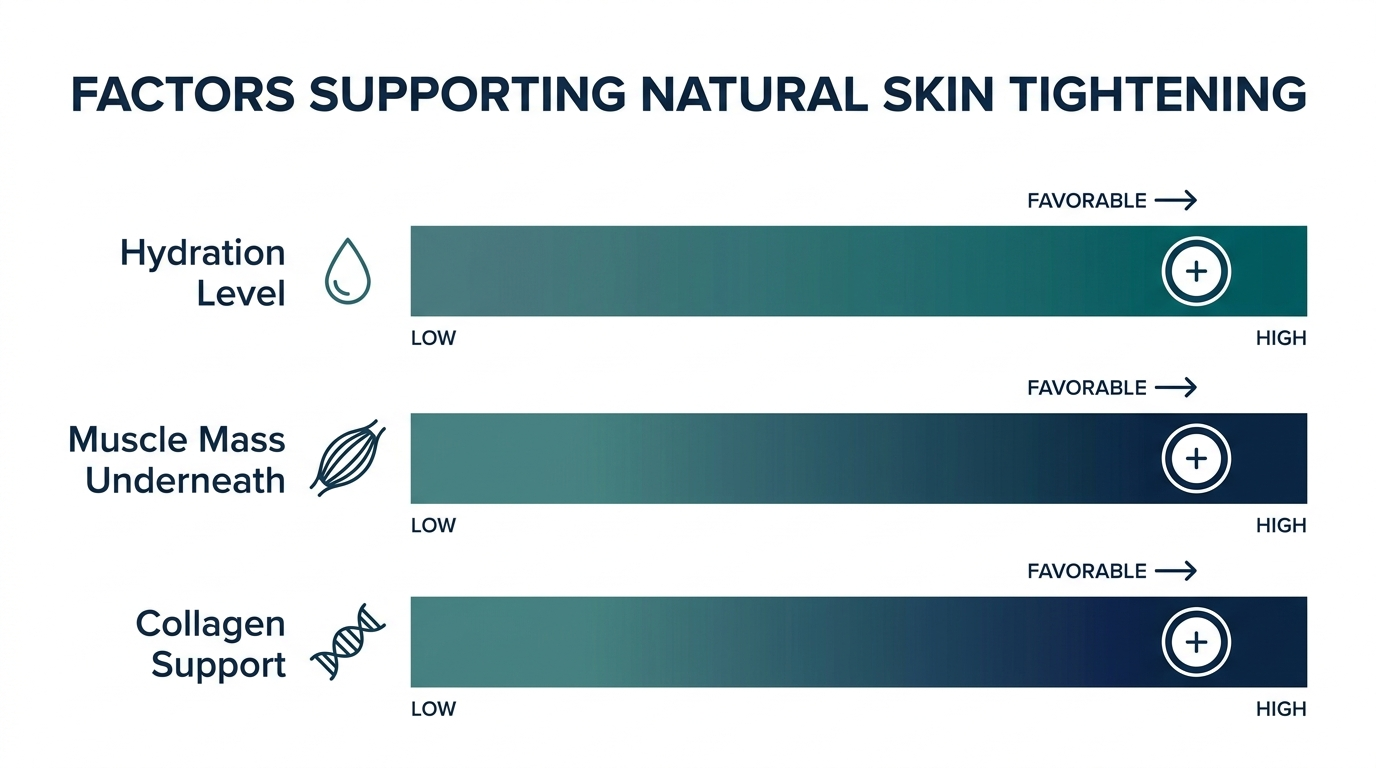
The most common mistake is judging loose skin too early and panicking into expensive fixes during the water-weight phase. Skin retraction is slow. It keeps improving for 6 months to 2 years after your weight stabilizes, and a flap that looks permanent at month two can look noticeably better at month twelve. Stabilize your weight first, then assess.
Other frequent traps:
- Losing weight too fast. Crash diets and very aggressive deficits give skin no time to adapt and tend to strip muscle, which is the worst combination for skin appearance. About 1 to 2 pounds a week is the sweet spot.
- Skipping resistance training. Dieting on cardio alone deflates you. The skin has nothing to sit against.
- Under-eating protein. You cannot rebuild what your body has no material for.
- Buying the creams. Money spent on firming creams is mostly money lost.
- Ignoring why the weight came on or will not move. This is the big one, and it is where most people are flying blind.
That last point matters more than it sounds. Plenty of people fight their weight for years and never check whether something measurable is working against them. A sluggish thyroid, high fasting insulin and insulin resistance, low testosterone, or high cortisol can all stall fat loss and quietly change body composition and skin quality. If your scale will not move no matter how clean you eat, or your skin and energy both feel off, the answer is often in your bloodwork, not in another diet. Loose skin is sometimes a downstream symptom of a metabolic picture nobody has actually looked at. The same is true when weight loss is unexpected rather than chosen, which can point to something that needs a workup. See can stress cause weight loss and does diarrhea cause weight loss for how non-diet causes show up, and why does cancer cause weight loss for the serious end of that spectrum.
Want to know what is actually driving your weight and skin, instead of guessing?
Superpower is a full-body lab membership that runs 100+ biomarkers including fasting insulin, A1C, thyroid, testosterone and cortisol, has each result reviewed by a doctor, and tracks your numbers year over year so you can see what is actually stalling your weight (about $199/year). If your weight or your skin will not respond no matter what you eat or lift, your bloodwork usually explains why. Here is Superpower reviewed in full.
How to tighten loose skin after weight loss naturally versus when to consider a procedure
Natural methods work for mild to moderate looseness, but large amounts of hanging skin after major weight loss almost always need a medical procedure to remove. There is a real ceiling on what diet, exercise, and supplements can do. They improve the quality and tightness of skin that still has enough elasticity to retract. They cannot remove tissue that has permanently lost its scaffold.
A rough way to think about it:
| Situation | Best natural lever | Realistic outcome |
|---|---|---|
| Lost 10 to 30 lb, under 40, recent | Protein, lifting, hydration, time | Often resolves well naturally |
| Lost 30 to 60 lb, mixed age | Slow loss, muscle building, retinoid, time | Noticeable improvement, some residual |
| Lost 80 lb+, or carried weight 10+ years, or post-pregnancy | Same habits to optimize, but | Hanging skin usually needs surgery (tummy tuck, body lift, arm lift) |
| Older skin (50s, 60s+) | Sun protection, retinoid, muscle | Limited retraction, manage expectations |
Between fully natural and surgery sit the in-office energy devices: radiofrequency, ultrasound (such as Ultherapy), and laser treatments that heat the dermis to stimulate collagen. These are not natural and they are not cheap, often running several hundred to a few thousand dollars per area in 2026, and they work best on mild to moderate looseness, not large flaps. For the surgical end and a fuller breakdown of options, see how to tighten loose skin after weight loss, and if you have not lost the weight yet, prevention beats correction, covered in how to avoid loose skin weight loss.
One practical note before any drug-driven weight loss: if you are losing weight on a GLP-1 medication, do it through a supervised telehealth clinician with labs rather than the gray market, and aim for a steady pace, because the same slow-and-strong rules (protein, lifting, gradual loss) protect your skin and muscle on a medication just as they do on a diet. Talk to a clinician before starting or stopping any medication.
How long does it take for skin to tighten after weight loss?
Skin keeps retracting for roughly 6 months to 2 years after your weight stabilizes, with most of the visible improvement in the first year. The exact timeline depends on the same factors that decide whether it tightens at all: amount lost, age, how long the skin was stretched, and how well you support it with protein, muscle, and hydration. Younger skin from a smaller, recent loss can look largely normal within a few months. Older skin after a large loss may improve for two years and still leave excess.
The key behavioral point is to be patient and stable. Yo-yo dieting, where you lose and regain repeatedly, repeatedly restretches the skin and is one of the worst things you can do to elasticity. Lose the weight once, at a sustainable pace, keep it off, and let the clock work in your favor.
Turn what you just learned into action.
Superpower lets you test 100+ biomarkers from home, then re-check them over time so you can actually see progress, physician-reviewed at every step.
Want a real clinician to run the numbers, not a guess?
Joi + Blokes is a telehealth clinic that prescribes GLP-1 medication (Zepbound, compounded semaglutide and tirzepatide), hormone therapy (TRT, HRT), thyroid care, and peptides after a real lab panel and clinician review, with no membership or consult fee (prescriptions from about $59/month, lab panels from $149). If the scale will not budge, this is where you find out whether insulin, thyroid, or hormones are the real reason. Here is Joi + Blokes reviewed in full.
FAQ
Can loose skin tighten on its own without doing anything?
Mild looseness often does, especially in younger people after a smaller loss, because skin naturally retracts over 6 to 24 months as collagen and elastin recover. Larger amounts of stretched skin will not fully retract on their own. Supporting it with protein, hydration, muscle building, and sun protection improves the odds and the final quality.
Do collagen supplements really tighten loose skin?
The evidence is weak to moderate. Small trials suggest hydrolyzed collagen peptides (around 2.5 to 15 grams a day) may modestly improve skin elasticity and hydration over 8 to 12 weeks, but the effect is small and many studies were industry-funded. They are a minor assist at best, not a fix for hanging skin, and getting enough total protein matters far more.
Does building muscle actually fix loose skin?
It helps significantly with mild to moderate looseness because muscle volume fills the space under the skin and takes up the slack from the inside. It does not remove skin, so it cannot fix large flaps, but for arms, legs, and a soft midsection, resistance training is the most effective natural step you can take.
Why does my face look older after losing weight?
You lose facial fat along with body fat, and that fat is part of what gives a face its youthful fullness. Rapid loss, including the ozempic face seen with fast GLP-1 weight loss, exaggerates this. Slower weight loss, sun protection, a retinoid, and good hydration help, but only added volume (filler or fat transfer) truly restores lost fat.
How fast should I lose weight to avoid loose skin?
About 1 to 2 pounds a week. This gives skin time to retract gradually and protects muscle, which fills the skin. Crash dieting strips muscle and gives skin no chance to adapt, which is the worst combination for skin appearance.
Will drinking more water tighten my skin?
Staying well hydrated makes skin look fuller and more elastic, and chronic dehydration makes it look slack, so hydration helps appearance. It will not rebuild a damaged collagen scaffold or remove genuine excess skin. Think of it as one supportive piece, not a standalone solution.
Do firming creams and apple cider vinegar work for loose skin?
No, not meaningfully. Topical creams cannot reach the dermis where the collagen structure lives, so they cannot rebuild it, and apple cider vinegar has no mechanism to tighten skin. The one topical with real evidence is a retinoid, which improves skin texture and dermal thickness over months but does not remove large draping skin.
When should I see a doctor about loose skin or stalled weight?
See a clinician if hanging skin causes rashes, infections, or rubbing sores, since those have medical and sometimes insurance-covered solutions. Also get checked if your weight will not move despite consistent diet and exercise, or if weight loss was unexpected, because thyroid, insulin, hormone, or other issues can be at play. A full-body lab panel can show whether your metabolic numbers, not your willpower, are the real obstacle.
Vital Signs Today may earn a commission if you buy through links on this page. It does not affect our editorial assessments.