Quick answer: Ordering 100 or more biomarkers a la carte at Quest Diagnostics or Labcorp without insurance typically costs $600 to $1,800 cash, depending on which tests you choose and whether you use a direct-to-consumer ordering service. Function Health charges $499 per year and covers roughly 100 panels per draw. Superpower costs about $199 per year for a comparable 100-plus biomarker panel with physician review. On a straight cost-per-biomarker basis, both memberships beat DIY a la carte pricing by a wide margin, but how much you save depends entirely on which tests you actually need.
Why the DIY Lab Math Is Harder Than It Looks
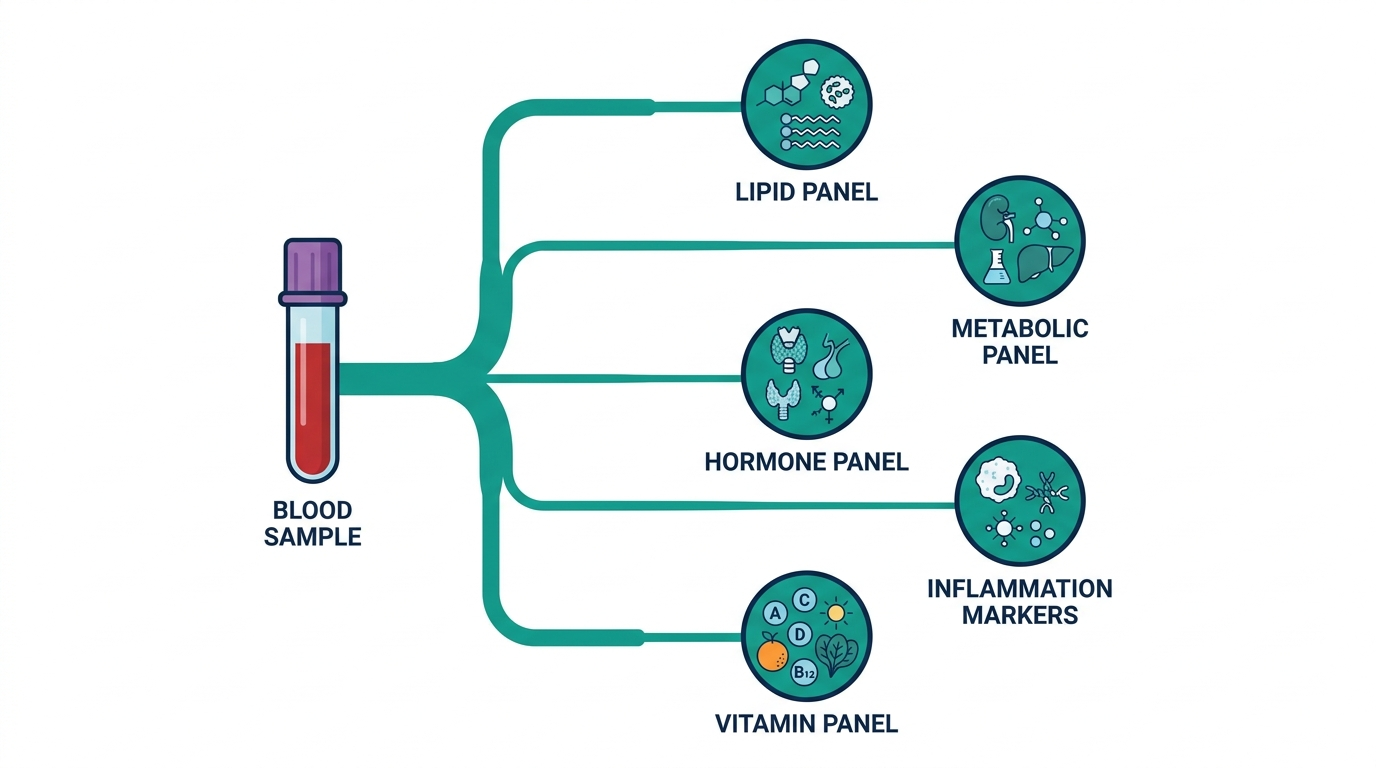
Most people who search “function health vs paying for labs yourself” assume they can just order the same tests cheaper. Sometimes they can, for a small targeted panel. For a comprehensive baseline covering lipids, metabolic function, thyroid, hormones, inflammation markers, vitamins, and CBC, the per-test costs at Quest, Labcorp, and direct-to-consumer platforms add up faster than expected.
A la carte labs can run $600 to $1,800 without insurance. See how a $199 membership with 100+ biomarkers stacks up. One at-home Superpower draw checks 100+ biomarkers, physician-reviewed.
Here is what makes the comparison tricky: labs do not sell a single “comprehensive metabolic panel” that covers everything. You are assembling a list. A basic metabolic panel (BMP) at Labcorp cash pay runs roughly $29 to $55. A lipid panel runs $25 to $60. A TSH for thyroid is $35 to $75. Each test is a separate line item, and specialty markers, especially hormones and advanced lipids, cost significantly more. By the time you build a 100-biomarker equivalent list, even with savvy ordering, you are spending real money.
Also worth knowing: services like Walk-In Lab, Any Lab Test Now, and HealthLabs offer cash-pay ordering at Quest or Labcorp draw sites. Prices on these platforms are substantially lower than walking into a lab cold, but they still price each panel individually. The savings from a membership come from bundling dozens of those panels into one annual flat fee.
What Does It Actually Cost to Order 100 Biomarkers Yourself?
To give you a realistic baseline, here is what a DIY equivalent of a 100-plus biomarker panel costs through direct-to-consumer ordering services as of 2026, broken down by category.
| Category | Panels included (examples) | Typical cash-pay range (DTC platforms) |
|---|---|---|
| Basic metabolic | CMP, BMP, electrolytes, kidney, liver | $29 to $65 |
| Lipids (standard) | Total cholesterol, LDL, HDL, triglycerides | $25 to $60 |
| Advanced lipids | ApoB, Lp(a), sdLDL, LDL particle size | $60 to $200 |
| Thyroid | TSH, free T3, free T4, reverse T3, TPO antibodies | $55 to $180 |
| Hormones (male) | Total testosterone, free testosterone, SHBG, LH, FSH, DHEA-S, estradiol, PSA | $100 to $260 |
| Hormones (female) | Estradiol, progesterone, LH, FSH, SHBG, DHEA-S, testosterone | $90 to $220 |
| Inflammation | hs-CRP, ESR, homocysteine, fibrinogen | $40 to $100 |
| Vitamins and minerals | Vitamin D (25-OH), B12, folate, magnesium, zinc, ferritin, iron panel | $60 to $150 |
| Blood count | CBC with differential | $25 to $50 |
| Blood sugar / insulin | Fasting glucose, HbA1c, fasting insulin, HOMA-IR | $45 to $120 |
| Gut and nutrition (optional) | Uric acid, GGT, albumin, prealbumin | $20 to $80 |
Adding the mid-range estimates across all categories: roughly $529 to $1,485 for a single comprehensive draw. If you add specialty markers like cortisol, IGFBP-3, or omega-3 index, the ceiling pushes higher. And that is for one draw per year. Most people who care about their health track labs twice a year. Two complete DIY draws land somewhere between $1,000 and $3,000 annually.
For more detail on what individual tests cost through different channels, our breakdown of function health add on test prices shows how add-on pricing compares to building a list from scratch.
Is Function Health Cheaper Than Labcorp or Quest?
For a large comprehensive panel, yes, Function Health is cheaper than building the equivalent a la carte at Labcorp or Quest. Function Health costs $499 per year and includes two annual draws of roughly 100 panels each, which works out to about $2.50 per biomarker per year. Even the most efficiently ordered DIY panel runs $4 to $15 per marker when you factor in specialty tests.
The catch is what you give up with DIY. Function Health provides a physician-reviewed dashboard, trend tracking over time, and reference ranges calibrated to your demographics rather than the generic lab printout ranges that are often too broad to be clinically useful. A Quest printout tells you whether you are inside a very wide population reference range. Function Health tells you whether your result is optimal for your age, sex, and goals. That difference in interpretation has real value that does not show up in a price-per-test comparison.
For a full breakdown of what the membership covers, see our function health review.

Function Health vs Direct Labs and Other DIY Ordering Platforms
Direct Labs, Walk-In Lab, Request A Test, and HealthLabs are the main cash-pay ordering platforms that let you choose tests without a doctor’s order in most states. They run samples through Quest or Labcorp draw sites, so the underlying lab quality is the same. The differences are price, test selection, and what you get back.
| Platform | Model | Approx. cost for 100-biomarker equivalent | Physician review? | Trend tracking? |
|---|---|---|---|---|
| Walk-In Lab / Direct Labs | A la carte (per test) | $400 to $900 per draw | No | No built-in dashboard |
| Any Lab Test Now | A la carte (in-store) | $500 to $1,100 per draw | No | No |
| Function Health | Annual membership ($499/yr) | Included (2 draws per year) | Yes | Yes |
| Superpower | Annual membership (~$199/yr) | Included (1 comprehensive draw) | Yes | Yes |
| Labcorp Patient (direct) | A la carte | $600 to $1,400+ per draw | No | Basic portal only |
One thing DIY advocates often miss: when you order a la carte, you get a PDF with lab reference ranges and no guidance. If your free testosterone comes back at the 12th percentile for your age, the lab report just says “in range” because it is technically above the floor. A physician-reviewed service flags that as worth discussing. That is not a minor difference for someone trying to optimize, not just survive.
Where DIY Labs Actually Make Sense
DIY ordering wins in specific situations. If you need to track one or two markers frequently, like HbA1c every three months while adjusting your diet, paying $35 to $50 per draw beats any annual membership. If you only care about a specific panel (say, a full thyroid workup or an advanced lipid panel) and have no interest in the rest, a targeted order from Walk-In Lab is fast and cheap.
DIY also wins when you want a test that memberships do not include. Function Health and Superpower cover their defined panels. If you want a specialty gut microbiome test, organic acids, or a full DUTCH hormone panel, you are ordering those separately regardless of your membership.
The math flips toward membership once you want a comprehensive baseline covering 8 or more categories. At that point, individual test costs exceed the membership fee within the first draw, sometimes before you have even added the specialty markers.
If you are trying to understand what insurance covers and what it does not, our piece on does insurance cover function health explains the gaps and what cash pay actually buys you that insurance-ordered labs often will not.
What People Get Wrong About the Cost Comparison
The most common mistake is pricing a DIY panel using only the cheapest tests. Someone builds a $200 panel of basics and concludes DIY is cheaper. But a $200 panel does not include advanced lipids, full thyroid, free hormones, or vitamin D. Add those and you are at $500 to $600 quickly, and that is before any specialty markers.
A second mistake: ignoring the phlebotomy fee. Some DIY platforms charge a separate draw fee of $8 to $25 at the lab. That is minor on a big order but worth knowing.
A third, subtler mistake: comparing a single-year DIY cost to a membership cost without factoring in frequency. Function Health includes two draws per year. If you only draw once with DIY, you are comparing $499 to $400 to $600 for one draw. If you draw twice, you are comparing $499 to $800 to $1,400 for two draws. The membership advantage is proportional to how often you want data.
People also underestimate repeat ordering friction. With a membership, you schedule a draw and go. With DIY, you rebuild the order list every time, re-enter payment, re-select draw sites. Over two or three years, that friction leads most people to either draw less often or stop entirely.
Superpower as a Lower-Cost Alternative to Both
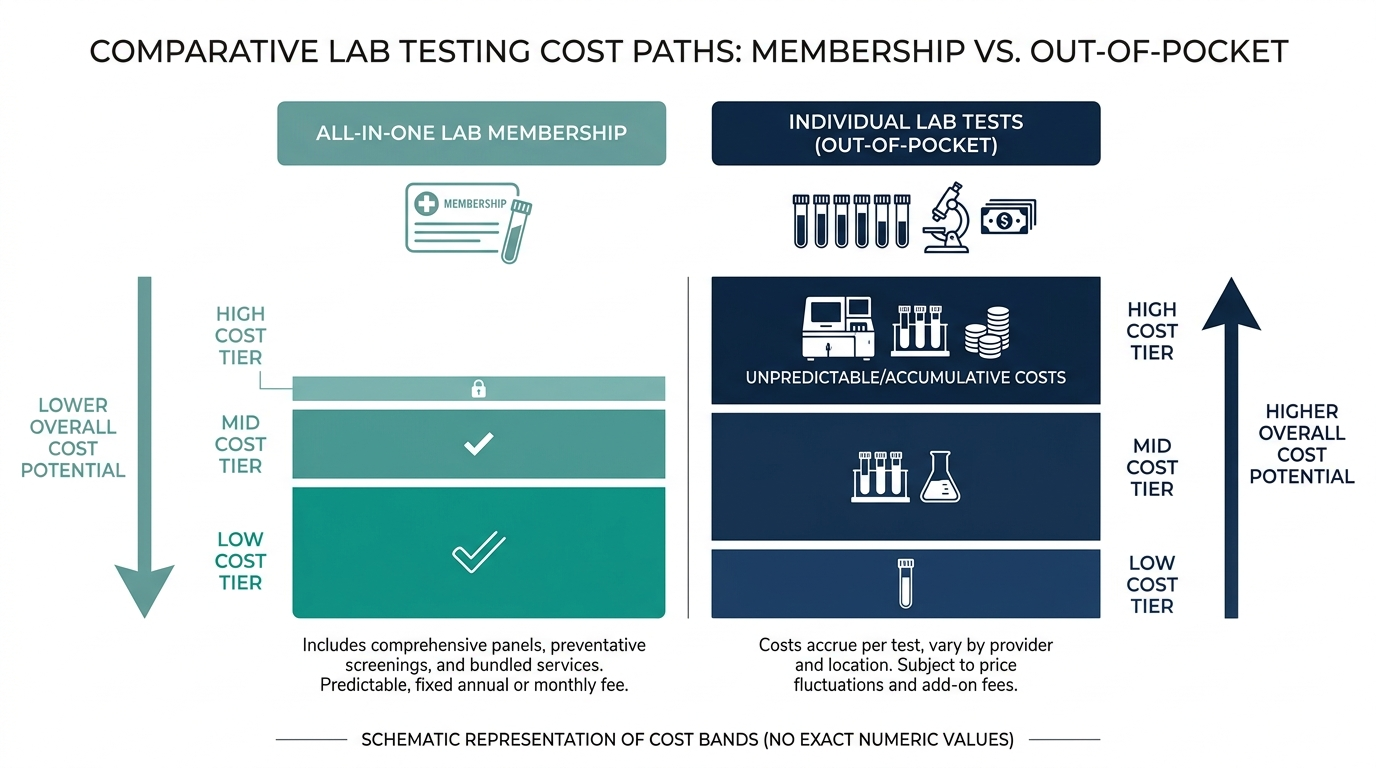
Superpower at about $199 per year occupies a specific niche: more comprehensive than most DIY orders would be at that price, physician-reviewed, and substantially cheaper than Function Health. The panel covers 100-plus biomarkers including advanced lipids (ApoB, Lp(a)), full thyroid, hormones, metabolic markers, and vitamins. Results come with a doctor’s interpretation and are tracked over time.
For the cost comparison, $199 versus $400 to $900 for a single comparable DIY draw is the clearest case where the math strongly favors membership. You would spend more than $199 just on the advanced lipid and hormone portions of a DIY order.
The simplest way to actually get this done
Superpower is a full-body lab membership that runs 100+ biomarkers, has each result reviewed by a doctor, and tracks your numbers year over year (about $199/year). It is what we point readers to when they would rather get one clean, complete draw than chase single tests one at a time. Here is superpower blood test reviewed in full.
Function Health Cost Breakdown: Are You Paying for What You Use?
Function Health at $499 per year is worth the price if you use both annual draws and engage with the dashboard and physician review. If you draw once and ignore the follow-up, you are paying $499 for a single lab visit. That is roughly comparable to one well-designed DIY draw, but you could have spent less.
The membership makes most financial sense for people who: draw twice a year, actively track trends across time, want physician interpretation flagging subclinical patterns, and value the friction reduction of a single platform for ordering and results. For that profile, $499 is a reasonable price versus DIY alternatives costing $800 to $1,400 for equivalent coverage and frequency.
For a complete accounting of what Function Health charges beyond the base membership, see our piece on function health cost, which covers add-ons, add-on panel pricing, and how the total changes if you use specialty testing.
Uninsured, Medicare, and HSA/FSA Considerations
Cash-pay patients without insurance have the most to gain from membership pricing. The uninsured often pay the highest a la carte rates (hospital-adjacent lab rates can be 3x to 5x what direct-to-consumer platforms charge), and they rarely have an ordering physician. Memberships function as a quasi-insurance mechanism: flat annual fee, known cost, broad coverage.
HSA and FSA funds can generally be applied to lab testing as a qualified medical expense. Both Function Health and Superpower accept HSA/FSA payment. If you have a funded HSA from a high-deductible health plan, using those pre-tax dollars reduces the effective out-of-pocket cost by your marginal tax rate, often 22% to 32%. A $199 Superpower membership effectively costs $135 to $155 after the tax benefit.
Medicare beneficiaries have labs partially covered under Part B for medically necessary testing. However, Medicare does not cover preventive or elective comprehensive panels ordered outside of a physician’s office protocol. Members on Medicare who want a full baseline panel typically pay out of pocket for anything beyond what their primary care physician orders. Memberships like Function Health and Superpower are explicitly designed for that gap.
For minors, most direct-to-consumer lab ordering requires patients to be 18 or older. Memberships have the same restriction. Pediatric comprehensive panels need to be ordered through a physician.
The Hidden Cost of a Wasted Draw: Prep and Timing
Every cost comparison ignores the most expensive line item of all: a draw you have to repeat because the results were invalid. Whether you go DIY or membership, a mistimed or improperly prepared draw can force a retest, and that doubles the cost of the affected panels. A few rules protect your investment.
- Fast correctly for the markers that need it. Fasting glucose, fasting insulin, and a standard lipid panel are most accurate after 9 to 12 hours without food. Water and most prescription medications are fine, but check with your prescriber. A non-fasting lipid draw can inflate triglycerides and make an otherwise clean panel look concerning.
- Time hormone draws. Testosterone runs highest in the morning, so most labs prefer a draw before 10 a.m. For menstruating women, sex hormones like estradiol and progesterone shift dramatically across the cycle, so a random-day draw can be uninterpretable. Cycle day matters more than the price of the test.
- Skip biotin before the draw. High-dose biotin supplements, common in hair and nail products, can distort certain immunoassay results, notably thyroid and some hormone tests. Many labs advise pausing biotin for two to three days beforehand.
- Avoid drawing right after intense exercise or an illness. A hard workout can transiently raise markers like CK and even hs-CRP, and a recent cold can spike inflammatory markers. If you want a clean baseline, draw on a normal, rested day.
None of this shows up in a price table, but a repeated draw is the single easiest way to blow up your cost-per-biomarker math. Good prep is free and protects everything downstream.
How to Build the Cheapest DIY List That Still Means Something
If you decide DIY is right for your situation, you can hold the cost down without gutting the clinical value. The trick is spending on the markers that actually change decisions and skipping the ones that rarely move or rarely matter. A defensible lean panel usually looks like this:
- Core metabolic and cardiovascular: CMP, CBC, a standard lipid panel plus ApoB, HbA1c, and fasting insulin. This cluster catches the highest-yield risks (glucose regulation and atherosclerotic risk) for a modest cost.
- One inflammation marker: hs-CRP is the highest-value single inflammatory test for most people.
- Targeted micronutrients: vitamin D and ferritin cover the two deficiencies most likely to be both common and correctable.
- Thyroid, only if symptomatic: a TSH alone is cheap; reserve the full free T3, free T4, and antibody workup for when the TSH is off or symptoms point that way.
- Hormones, only if relevant: add sex hormones when you have a specific reason (symptoms, a protocol, or a baseline goal), not reflexively, since this is one of the priciest categories.
Built this way, a targeted DIY draw stays lean while still covering the markers most likely to trigger action. The moment your “must have” list crosses roughly seven or eight distinct panels, though, the arithmetic starts favoring a flat-fee membership, because each additional a la carte line item stacks up faster than the membership’s marginal cost.
A Worked Break-Even Example
Numbers make the trade-off concrete. Consider a health-focused 45-year-old who wants a comprehensive baseline plus a follow-up six months later to see whether lifestyle changes moved the needle.
- DIY path: a comprehensive a la carte draw covering the categories in the table above lands in the mid hundreds of dollars per draw at direct-to-consumer prices. Two such draws in a year, plus the repeat friction of rebuilding the order each time, realistically totals well into four figures once specialty markers are included.
- Function path: the $499 annual fee already covers two draws of roughly 100 panels each, so the marginal cost of that second draw is effectively zero.
- Superpower path: at about $199 for one comprehensive annual draw with physician review, this is the lowest entry point, and it fits the person who wants one clean yearly baseline rather than a twice-a-year cadence.
The break-even logic is simple: the more comprehensive the panel and the more often you draw, the more decisively a membership wins. DIY only holds its cost advantage for small, infrequent, targeted panels. If you value the physician read and trend dashboard on top of the raw tests, the membership advantage widens further, because those are services you cannot buy back cheaply on the a la carte side.
Curious what your own levels look like?
Baseline 100+ biomarkers today and retest as life changes, all in one membership with physician review.
FAQ
Is Function Health cheaper than Labcorp for a full panel?
For a comprehensive 100-biomarker equivalent draw, Function Health at $499 per year covering two draws is cheaper than building the same panel a la carte at Labcorp, which would cost $500 to $900 or more for a single draw using direct-to-consumer ordering. If you want two draws per year, the savings are even larger. The direct Labcorp patient portal (without a DTC intermediary) is often more expensive still.
What does it cost to run 100 biomarkers yourself without a membership?
Using direct-to-consumer platforms like Walk-In Lab, Direct Labs, or HealthLabs to order the equivalent of a 100-plus biomarker panel, expect to pay $400 to $900 for a carefully selected list, and $700 to $1,400 if you add advanced lipids, full hormones, and specialty markers. Prices vary by platform and whether you catch promotional pricing. Two draws per year doubles that cost.
Can I order the same tests as Function Health myself?
You can order most of them individually through direct-to-consumer services in most states (there are a handful of states with restrictions on self-ordered labs). The challenge is that Function Health curates specific assay types, for example using NMR for LDL particle analysis rather than standard calculated LDL, and you may not be ordering identical tests even if the names look the same. The physician review layer also cannot be replicated by ordering yourself.
Is Superpower cheaper than Function Health?
Yes. Superpower costs roughly $199 per year versus Function Health’s $499 per year. Superpower covers 100-plus biomarkers in a single comprehensive annual draw with physician review and longitudinal tracking. Function Health includes two draws per year. If you want two comprehensive draws annually, Function Health has an arguable structural advantage. For once-per-year comprehensive testing, Superpower offers more value per dollar. See the full superpower blood test review for what is included.
Do Function Health or Superpower use Quest or Labcorp for draws?
Both services use established national lab networks, primarily Quest Diagnostics and Labcorp, for sample collection and processing. You typically schedule at a nearby draw site that is already in your area. The underlying laboratory quality is the same as what a physician would order through those networks. The difference is in panel curation, result interpretation, and the membership model for access.
Can I use insurance to pay for these memberships?
Neither Function Health nor Superpower accept insurance for their membership fees. They are direct-to-consumer wellness memberships, not insurance-billable services. You can use HSA or FSA funds, which functionally reduces the cost by your tax rate. Some of the individual tests within these panels might be reimbursable if your physician also orders them separately through insurance, but the membership itself is a cash transaction. For more on this, our piece on does insurance cover function health covers the nuances.
What tests are not included in either membership?
Comprehensive gut microbiome testing, DUTCH hormone metabolite urine panels, heavy metals (beyond basic), food sensitivity panels, genetic testing, and most specialized autoimmune antibody panels are not included in standard Function Health or Superpower memberships. These require either add-on purchases or separate ordering. Function Health offers an add-on marketplace; Superpower has a more limited add-on menu. If you need those specialty tests routinely, factor that into your total cost comparison.
How does the a la carte math change if I only want a few tests?
For small targeted panels of three to six tests, DIY a la carte ordering almost always wins. A basic lipid panel, HbA1c, and vitamin D ordered through Walk-In Lab might cost $60 to $90 total. No membership needed. The crossover point where a membership beats DIY is roughly seven or more distinct panels per draw, after which the flat fee is cheaper than individual line items. Talk to a clinician about which tests are genuinely warranted given your health history before committing to either approach.
Vital Signs Today may earn a commission if you buy through links on this page. It does not affect our editorial assessments.