
Educational content, not medical advice. Consult a licensed clinician before starting any peptide therapy.
Short answer: Peptides are used in over 130 FDA-approved drugs, in skincare serums sold at every pharmacy, in telehealth programs that produced an average 20.2% body-weight loss in a 2025 head-to-head trial, and in a grey-market research category undergoing the largest regulatory reshaping in decades. The word covers a lot of very different things, and the safety and legal status of each use are nothing alike.
Peptides touch everything from skincare to weight loss. Want to know what your own hormones and markers are doing right now? One at-home Superpower draw checks 100+ biomarkers, physician-reviewed.
Peptides are short chains of 2 to 50 amino acids, smaller than proteins and small enough to act as biological messengers rather than structural building blocks. According to NIH StatPearls, what makes them clinically interesting is specificity: a given peptide sequence fits a receptor like a key, triggering one action (release this hormone, stimulate this repair pathway, inhibit this enzyme) without necessarily affecting everything else. That precision is why pharmaceutical chemists love them, why dermatologists put them in $300 serums, and why longevity clinics now build entire protocols around them.
This guide covers every major application, the current evidence, and the regulatory reality in 2026 so you are not comparing a prescription drug to a research-chemical vial as though they are the same thing.
Why are peptides suddenly everywhere?
The honest answer is that they are not sudden. Insulin, the first peptide drug ever isolated, was synthesized in 1922. Oxytocin was approved in 1953. What changed is two things happening at the same time: the commercial explosion of GLP-1 weight-loss drugs starting in 2021, and a parallel surge in direct-to-consumer longevity culture that brought previously obscure research peptides into mainstream fitness forums.
The global peptide therapeutics market is now estimated at roughly $58 to $102 billion depending on the analyst, and more than 170 peptide-based compounds are in active clinical development as of early 2026. That pipeline matters because it tells you where the research is heading, not just where it has been.
The frustrating thing about the word “peptide” in 2026 is that it spans insulin glargine prescribed by an endocrinologist, a copper peptide serum at Sephora, and a lyophilized vial from a grey-market vendor with no label or accountability. Those three things share a chemistry definition and almost nothing else.
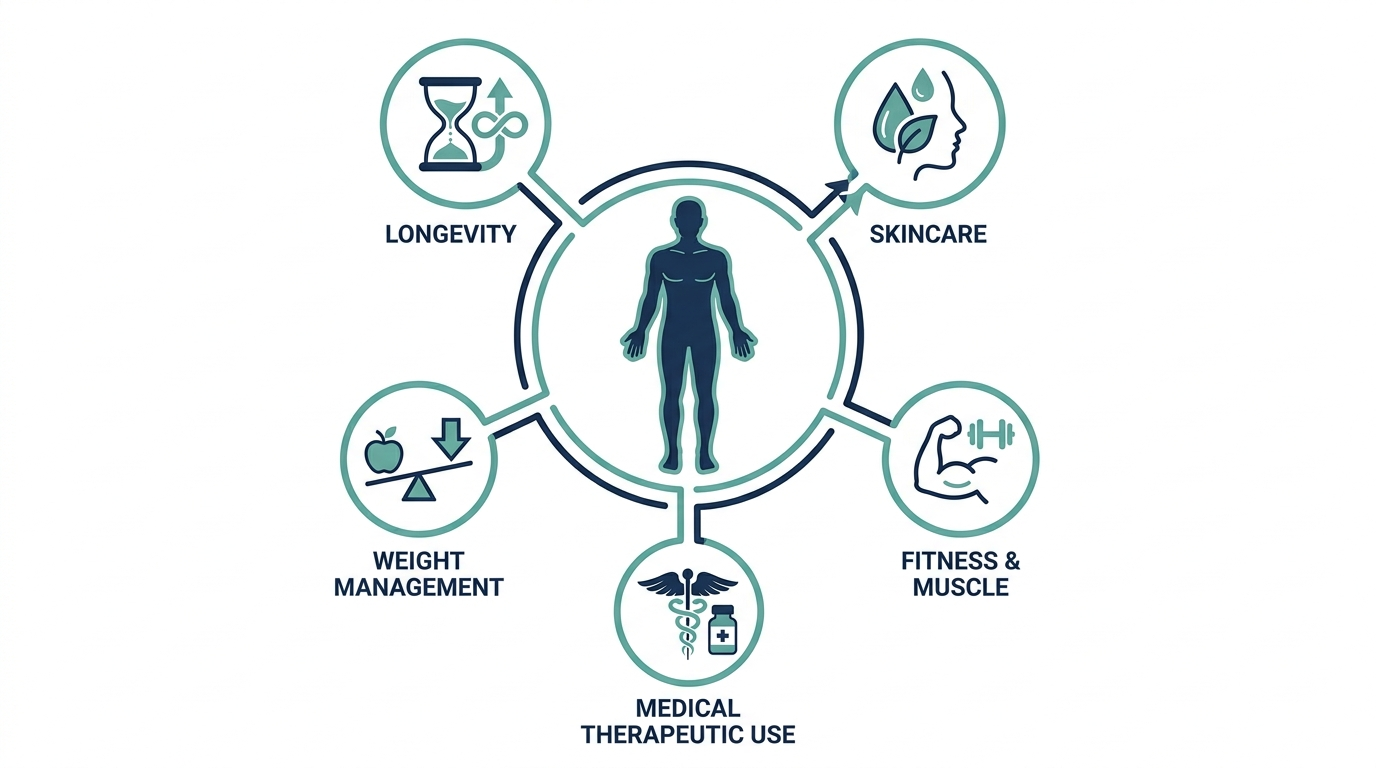
What are the main uses of peptides, mapped clearly?
The simplest way to actually get this done
Superpower is a full-body lab membership that runs 100+ biomarkers, has each result reviewed by a doctor, and tracks your numbers year over year (about $199/year). It is what we point readers to when they would rather get one clean, complete draw than chase single tests one at a time. Here is superpower reviewed in full.
Before going into depth, here is the honest landscape. These are not equal categories.
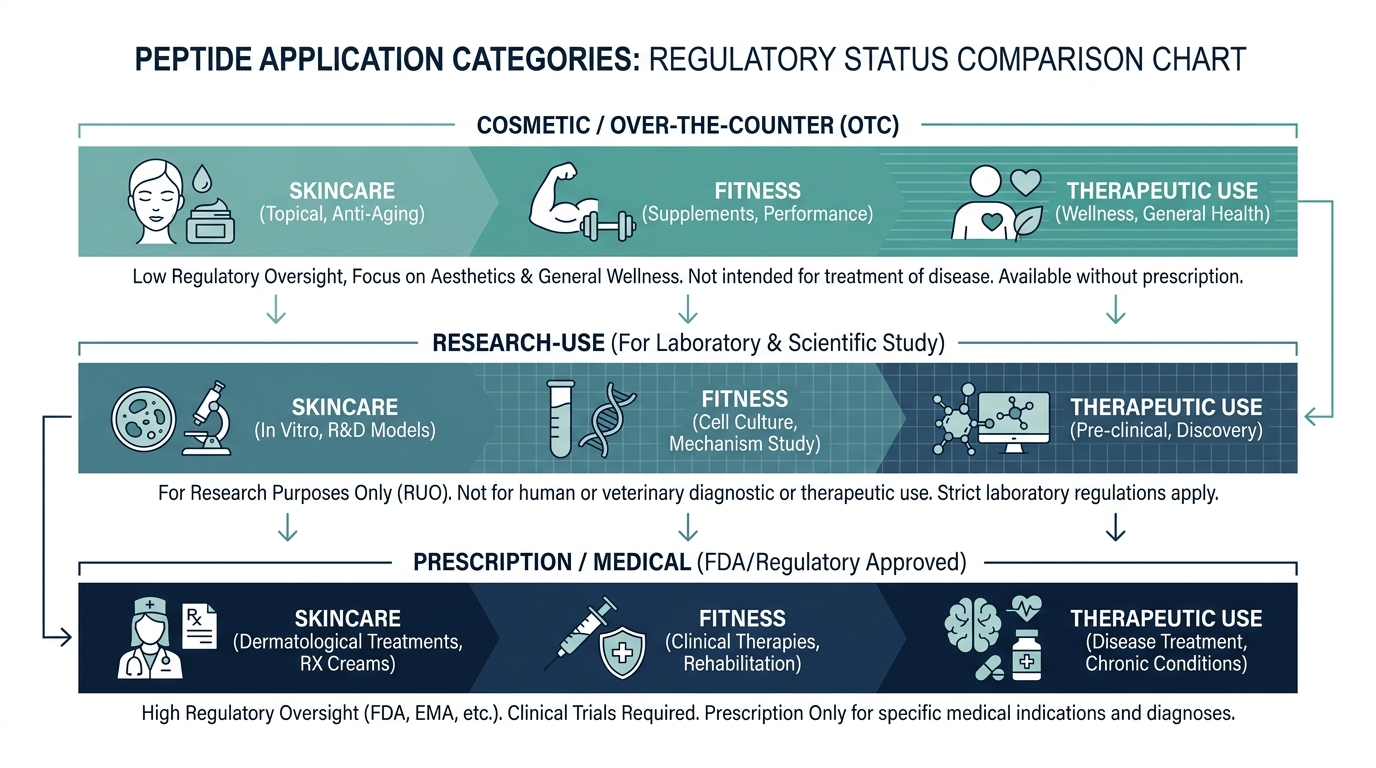
| Use Category | Examples | Regulatory Status | Where You Get It |
|---|---|---|---|
| Prescription drugs | Semaglutide, tirzepatide, sermorelin, tesamorelin, insulin | FDA-approved | Licensed prescriber + pharmacy |
| Cosmetic / OTC supplement | Collagen peptides (oral), copper peptide serums (topical GHK-Cu), Matrixyl | Legal, OTC | Retail, brand sites |
| Compounding pharmacies | NAD+, glutathione, sermorelin, select others | Legal with prescription | Telehealth + 503A pharmacy |
| Thawing grey zone | BPC-157, TB-500, CJC-1295, Ipamorelin | PCAC review July 23 2026 | Currently only grey-market or telehealth pioneers |
| Research-use only | Retatrutide, melanotan II, epithalon | Not approved for human use | Research-chemical vendors only |
The category a peptide falls into changes everything: the evidence base, the safety net, the price, and what happens if something goes wrong. Running them together is the most common mistake in this space.
What are peptides used for in weight loss and metabolic health?
This is the application that made peptides a household word, and the results are real.
GLP-1 (glucagon-like peptide-1) receptor agonists mimic a gut hormone that tells the brain you are full, slows gastric emptying, and improves insulin secretion. Semaglutide (Ozempic for diabetes, Wegovy for obesity) and tirzepatide (Mounjaro for diabetes, Zepbound for obesity) are the category leaders.
The most important number in this space right now comes from SURMOUNT-5, published in the New England Journal of Medicine in May 2025: a 72-week head-to-head trial of tirzepatide versus semaglutide in adults with obesity showed an average weight reduction of 20.2% with tirzepatide versus 13.7% with semaglutide. Those are not anecdotal forum numbers. They are controlled trial numbers.
Earlier data from the SURMOUNT-1 trial showed mean weight reductions of 15.0% at the 5mg tirzepatide dose, 19.5% at 10mg, and 20.9% at 15mg versus 3.1% for placebo. Real-world retrospective studies tend to show lower results, roughly 8 to 12% at 12 months, because not all patients reach trial-level doses.
Retatrutide, the next-generation triple agonist (GLP-1, GIP, and glucagon receptors simultaneously), showed 7.2% to 17.5% body-weight reduction at 24 weeks in its Phase II trial. Phase III results are expected later in 2026. It is investigational, not approved, and not safely purchasable outside a clinical trial.
Full-body lab membership: 100+ biomarkers, doctor-reviewed, tracked over time.
What are peptides used for in skin and anti-aging?
This is the category where peptides are genuinely accessible at any budget, and where the evidence is cleaner than the marketing admits.
The mechanism: proteins like collagen are too large to penetrate the skin’s surface. Short peptide sequences, particularly under 1,000 daltons molecular weight, pass through and signal cells to synthesize more collagen, elastin, and hyaluronic acid. The skin interprets these fragments as evidence of breakdown and responds by producing more structural matrix. That is not a metaphor. It is how messenger peptides actually work.
Topical peptides found in clinical-grade formulations include:
- Matrixyl (Palmitoyl Pentapeptide-4): proven to reduce wrinkle depth and boost collagen production in controlled studies
- Argireline (Acetyl Hexapeptide-3): reduces expression lines by mildly interfering with neurotransmitter release at the muscle level, sometimes called “topical Botox” though that comparison is an oversell
- Copper peptide GHK-Cu: has extensive in-vitro evidence for tissue remodeling and wound healing; also available as an injectable research peptide (a completely different risk class, worth saying clearly)
- SNAP-8: targets expression lines specifically, typically included in eye-area products
Oral collagen peptides have accumulated enough RCT data that the benefits are no longer speculative. A 2022 randomized, double-blind, placebo-controlled study in PubMed showed that 12 weeks of low-molecular-weight collagen peptide supplementation significantly improved crow’s feet scores, skin roughness, elasticity, hydration, and transepidermal water loss versus placebo. A 2025 study published in MDPI Cosmetics on bovine-derived bioactive collagen peptides at 2.5g daily found significant improvement in eye wrinkle volume and skin elasticity within 4 weeks.
Personally, oral collagen at 2.5g to 10g daily is the one peptide application I would suggest to almost anyone with no caveats, because the evidence is solid, the product is food-grade, and the risk is essentially zero. The same cannot be said for most things in this article.
The dose matters more than the brand. A serum claiming “peptide-powered” results from trace amounts of signal peptides buried in a thick silicone base is not the same thing as a clinically formulated product where the active sits at its effective concentration. Ingredient position on the label tells you roughly how much is in there.
What are peptides used for in muscle growth and athletic recovery?
Growth hormone secretagogues (GHSs) are the peptide class used for lean body composition, recovery, and age-related performance. They do not add synthetic growth hormone. They stimulate the pituitary to release more of the body’s own.
Sermorelin is FDA-approved (as a diagnostic agent for GH deficiency), prescribed through telehealth for general GH support, sleep quality, and body composition. It costs roughly $175 to $225 a month through a licensed provider, compared to $600 to $1,200 or more per month for synthetic HGH injections. This is one of the clearest cases where the legal route is also the economical one.
Ipamorelin directly stimulates GH release with high selectivity, meaning it typically does not raise cortisol, prolactin, or hunger signals the way older secretagogues like GHRP-6 did. It is commonly stacked with CJC-1295 (a GHRH analogue) for a sustained GH pulse. Results, including improvements in lean mass, sleep quality, and recovery, typically require 6 to 12 weeks of consistent use to become noticeable. Both are in the grey zone: widely used through telehealth, under review for formal compounding status, and not available legally without a prescription.
Do not believe the forum claims that peptide secretagogues produce HGH gains comparable to exogenous HGH injections. The mechanism is different. Secretagogues amplify the body’s own pulsatile GH release; they do not override the hypothalamic-pituitary feedback loop the way synthetic HGH does. That is both the limitation and the safety feature.
BPC-157 is the most-requested recovery peptide, particularly for tendon, ligament, and gut healing. A 2026 NCBI review describes its proposed mechanism as targeting angiogenesis and nitric oxide pathways involved in tissue repair. The regulatory situation: on April 15, 2026, the FDA removed BPC-157 from its 503A Category 2 list (the substances considered high risk for compounding), and a PCAC committee review is scheduled for July 23, 2026. If the committee places it on Category 1, licensed compounding pharmacies can legally produce it. Until then, it sits in a documented legal grey zone, neither prohibited nor authorized for compounding.
What are peptides used for in medicine and drug development?
This is the part most health consumers do not see, but it is where the serious science lives.
The FDA has approved more than 80 peptide-based therapeutics, with approximately 130 counting all peptide-class drugs across categories. Four new peptide and oligonucleotide drugs received FDA approval in 2024 alone. The applications span:
Endocrinology: insulin analogues (glargine, lispro, aspart), glucagon for hypoglycemia rescue, GLP-1 drugs for type 2 diabetes and obesity, tesamorelin (FDA-approved for HIV-related lipodystrophy, and used off-label by longevity clinics)
Oncology: Leuprolide acetate (Lupron) for prostate cancer, Lutetium Lu-177 vipivotide tetraxetan (Pluvicto) for metastatic castration-resistant prostate cancer, and peptide-drug conjugates (PDCs) that use tumor-targeting peptide sequences to deliver cytotoxic payloads directly into cancer cells, similar in concept to antibody-drug conjugates but with better tissue penetration and lower manufacturing cost. Several PDCs are in active clinical trials targeting somatostatin, GnRH, and integrin receptors.
Cardiovascular: vasopressin analogues for vasodilatory shock, natriuretic peptides (nesiritide) for acute heart failure
Antimicrobials: the most interesting emerging application, with AI-designed antimicrobial peptides (AMPs) advancing toward clinical testing. Modified versions of the human cathelicidin LL-37 are in preclinical development for resistant bacterial infections. Machine learning models trained on known AMP sequences are generating novel sequences optimized for specific bacterial targets, several of which showed potent activity in animal infection models.
Autoimmune conditions: thymosin peptides, regulatory T-cell inducers, and IL-10 pathway modulators have completed Phase III trials showing statistically significant reductions in autoimmune disease activity, per Peptide Protocol Wiki’s 2026 pipeline review.
The drug pipeline currently includes more than 170 peptide-based compounds in active clinical development. For a condition like antibiotic-resistant infection, where small-molecule drugs have largely exhausted their options, peptide antibiotics represent one of the most promising structural alternatives.
What are peptides NOT used for? (Myth-busting)
Myth: oral peptide supplements trigger the same effects as injections. Most therapeutic peptides are destroyed by digestive enzymes before they reach systemic circulation. Oral collagen peptides work because they are absorbed as small fragments that act as local signals; they do not arrive intact in your bloodstream and travel to target tissue. An oral BPC-157 supplement is a different product in a meaningful biological sense from an injected one. The evidence base for oral BPC-157 is far thinner than for the injectable form.
Myth: “peptide” on a label means clinically proven. A product can contain peptides that have no human evidence at the doses formulated, and still legally call itself a peptide product. Matrixyl has solid evidence at the right concentration. A peptide buried at position 15 on an ingredient list almost certainly does not.
Myth: research-use-only peptides are safe because they are “natural” or “endogenous.” BPC-157 is derived from a gastric protein. That origin story does not tell you anything about the safety of injecting a research-chemical version of it at an unverified dose with no clinician involved. Endogenous does not mean safe at any dose or via any route.
Myth: telehealth peptide clinics are just selling the same thing as grey-market vendors. A legitimate telehealth provider bundles a prescription, a named 503A pharmacy, baseline labs, clinical oversight, and accountability. A research vial bundles none of those. The molecule might be structurally similar. Everything around it is completely different.
What is the right peptide for what you want? (A practical map)
Full-body lab membership: 100+ biomarkers, doctor-reviewed, tracked over time.
Here is the practical routing based on what you are trying to accomplish:
Weight loss: Tirzepatide or semaglutide through a licensed telehealth provider. These are FDA-approved, the evidence base is the best in the entire peptide category, and the 2025 head-to-head trial data makes this the clearest recommendation I can give. Do not buy a research-grade GLP-1 peptide from a vendor. The compounded shortages window has closed (the FDA declared tirzepatide shortage resolved in October 2024, semaglutide in February 2025), and the grey-market alternatives are not clinically supervised.
Skin health: Start with oral collagen peptides (2.5g to 10g daily, bovine or marine hydrolyzed) and a topical with Matrixyl or copper peptide GHK-Cu at effective concentration. Both are OTC, evidence-backed, and low risk. This is the category where the consumer market has genuine products.
General recovery, sleep, body composition: Sermorelin through a licensed telehealth provider. It is the most accessible and evidence-supported prescription peptide for non-disease longevity goals, at a cost far below HGH.
Injury recovery (tendon, gut): BPC-157 is the most popular choice, but its compounding status is in transition pending July 2026 PCAC review. A compliant telehealth provider will be able to offer it through a pharmacy once the review concludes and permits it. The smart move is to wait for that legal clarification rather than source it through research vendors.
Turn what you just learned into action.
Superpower lets you test 100+ biomarkers from home, then re-check them over time so you can actually see progress, physician-reviewed at every step.
FAQ: What are peptides used for?
What is the difference between a peptide and a protein?
Length and function, mostly. Both are chains of amino acids. Peptides are typically 2 to 50 amino acids and act primarily as signaling molecules: hormones, neurotransmitters, and receptor ligands. Proteins are longer chains (usually 50+ amino acids) that do structural and enzymatic work. Insulin is a 51-amino-acid peptide that functions as a metabolic hormone. Collagen is a structural protein assembled partly from collagen-derived peptide fragments.
Are peptides safe?
Depends entirely on which peptide, what dose, what route of administration, and whether there is clinical oversight. Oral collagen peptides at 2.5g to 10g daily have an excellent safety record across multiple RCTs. FDA-approved GLP-1 drugs have known side-effect profiles (nausea, vomiting, rare pancreatitis) managed under clinical supervision. Injectable research peptides sourced from unverified vendors have none of that framework. Safety is not a property of “peptides” as a category.
Do collagen peptide supplements actually work?
Yes, with caveats. Oral supplementation with low-molecular-weight hydrolyzed collagen has shown statistically significant improvements in skin wrinkle depth, elasticity, and hydration in multiple double-blind, placebo-controlled RCTs at doses of 2.5g to 10g daily over 8 to 12 weeks. The mechanism is absorption of small peptide fragments that signal dermal fibroblasts to increase collagen production. The effect is real but modest, and it requires consistent daily use.
What peptides are FDA-approved?
More than 80, including: insulin analogues (glargine, lispro, aspart), semaglutide (Ozempic, Wegovy), tirzepatide (Mounjaro, Zepbound), sermorelin, tesamorelin, leuprolide, oxytocin, vasopressin, glucagon, and Lutetium Lu-177 vipivotide tetraxetan (Pluvicto). The full list spans endocrinology, oncology, cardiovascular medicine, antimicrobials, and rare diseases.
What peptides are used for muscle growth?
Sermorelin and Ipamorelin/CJC-1295 are the most commonly prescribed through licensed telehealth for body composition. They are growth hormone secretagogues, meaning they stimulate the body’s own GH release rather than adding synthetic HGH. Results take 6 to 12 weeks. TB-500 and BPC-157 are used for recovery by the grey-market longevity community, with regulatory status in transition as of mid-2026.
Are peptides legal to buy?
Three different legal realities exist simultaneously. Prescription peptides are legal through a licensed prescriber and pharmacy. OTC collagen peptides and topical copper peptide serums are legal anywhere. Research-chemical peptides are legal to sell for laboratory use only, not legal to self-administer. The regulatory grey zone is actively shifting in 2026, with the FDA and HHS signaling that BPC-157 and 13 other peptides may move to Category 1 (permitted compounding) status following the July 2026 PCAC meeting.
Why do GLP-1 peptides cause weight loss?
GLP-1 (glucagon-like peptide-1) is a gut hormone released after eating. GLP-1 receptor agonists mimic this signal, suppressing appetite through the hypothalamus, slowing gastric emptying so food stays in the stomach longer, and improving insulin secretion in a glucose-dependent manner. The combined effect reduces caloric intake substantially enough to produce 13.7% to 20.9% mean body-weight loss in clinical trials, without requiring willpower-based caloric restriction.
The one thing worth knowing before you research further
Peptides are not a uniform category of supplements. They are a class of biological molecules that spans the most precisely targeted drugs in modern medicine, a legitimate evidence-based skincare application, a well-regulated prescription longevity therapy category, and a grey market that in 2026 is undergoing active enforcement and regulatory consolidation simultaneously.
The question is not whether peptides work. For weight loss, the data is unambiguous. For skin collagen, it is solid. For GH secretagogues, it is real but requires clinical context. For the research-only compounds, the evidence is preliminary and the safety framework nonexistent.
The question is always: which peptide, which application, and through which channel?
Full-body lab membership: 100+ biomarkers, doctor-reviewed, tracked over time.
Author: Vital Signs Today Editorial Team, [credential]”]. Educational content, not medical advice. Sources linked inline.
Primary sources:
– SURMOUNT-5 tirzepatide vs. semaglutide, NEJM 2025
– NIH StatPearls: Biochemistry, Peptide
– Oral Supplementation of Low-Molecular-Weight Collagen Peptides, PubMed 2022
– FDA 503A bulk drug substances list
– FDA removes 12 peptides from Category 2, April 2026, Newtropin
– BPC-157 FDA reclassification 2026, AgeMD
– FDA-approved peptides list 2026, PeptideStack
– Anticancer peptides, Frontiers/PMC
– BPC-157 therapy NCBI 2026
– Peptides in clinical trials 2026, Peptide Protocol Wiki
– Sermorelin guide, InnerBody 2026
– Bovine collagen peptides skin study, MDPI Cosmetics 2025
– Peptide-based agents for cancer treatment, PMC
Want a real clinician to run the numbers, not a guess?
Joi + Blokes is a telehealth clinic that prescribes GLP-1 medication (Zepbound, compounded semaglutide and tirzepatide), hormone therapy (TRT, HRT), thyroid care, and peptides after a real lab panel and clinician review, with no membership or consult fee (prescriptions from about $59/month, lab panels from $149). If the scale will not budge, this is where you find out whether insulin, thyroid, or hormones are the real reason. Here is Joi + Blokes reviewed in full.
Related reading
Vital Signs Today may earn a commission if you buy through links on this page. It does not affect our editorial assessments.