
Educational content, not medical advice. Talk to a licensed clinician before beginning any supplement regimen.
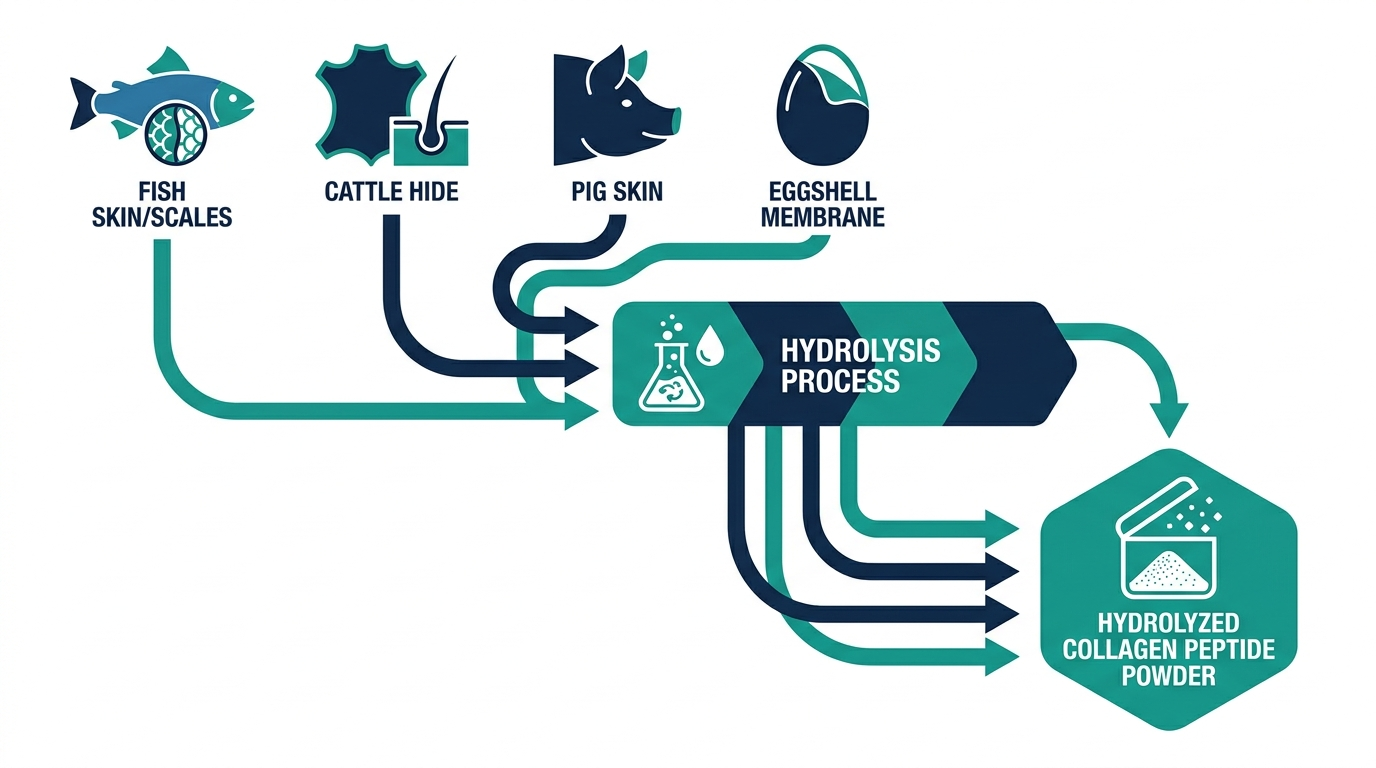
Short answer: Collagen peptides come from the connective tissue of animals, most commonly bovine (cattle) hides, fish skin and scales, pork skin, and chicken cartilage. The raw collagen is extracted, purified, then broken into short peptide chains through enzymatic hydrolysis. You cannot get them from plants, because plants do not contain collagen.
Knowing your collagen’s animal source is nice to know. Knowing your own inflammation and joint markers is more useful. One at-home Superpower draw checks 100+ biomarkers, physician-reviewed.
The word “peptides” on the label is a processing descriptor, not a source. It tells you the protein has been cut down into smaller fragments of under 10,000 daltons so your gut can absorb them more easily. Everything before that step depends entirely on the animal it came from, and that is where most consumers stop reading.
Here is what the label rarely tells you but genuinely matters: different sources produce different collagen types, different amino acid ratios, and different molecular weights. A bovine powder and a marine powder sitting side by side at the same price point are not interchangeable, and understanding the gap takes about five minutes.
Full-body lab membership: 100+ biomarkers, doctor-reviewed, tracked over time.
What is collagen before it becomes a peptide?
Collagen is the most abundant protein in the animal kingdom, making up roughly 25 to 35 percent of total body protein in mammals. Structurally it is a triple helix: three left-handed polypeptide chains twisted around each other into a single right-handed rope. That rope is what gives tendons their pull strength, skin its resistance to tearing, and cartilage its load-bearing capacity.
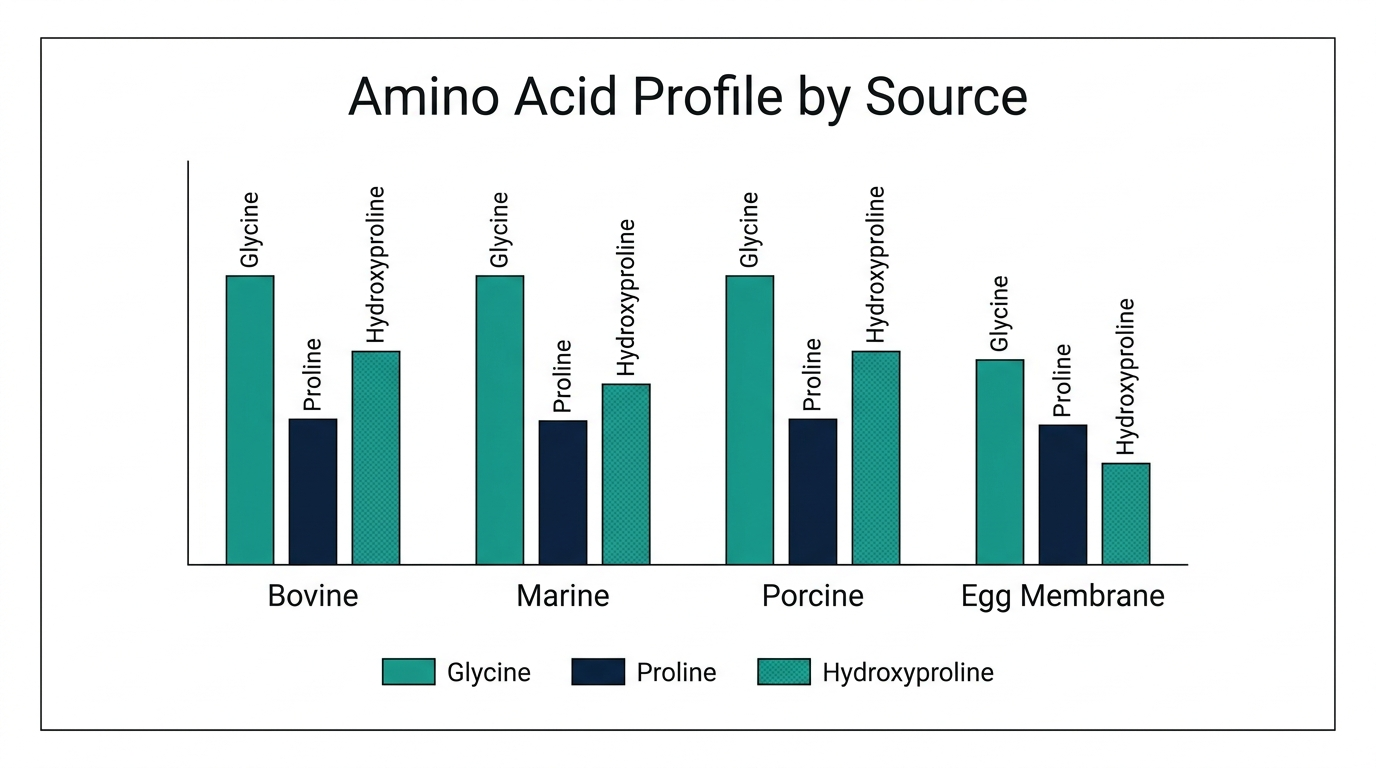
The defining amino acid sequence is glycine-X-Y repeating along the entire length, where X is most often proline and Y is most often hydroxyproline. About 57 percent of the amino acids in collagen are just those three: glycine, proline, and hydroxyproline. That ratio is what makes collagen protein different from whey or casein, and why it cannot be replaced by just eating more chicken breast.
Your body makes its own collagen through fibroblast cells, but production peaks in your mid-20s, then drops about 1 percent per year. By age 80, collagen production in sun-protected skin is approximately 75 percent lower than in young adults. That decline is why the supplement category exists.
How are collagen peptides actually made?
The manufacturing process has four main stages, and most supplement brands do not describe any of them on the label.
Stage 1: Raw material preparation. Hides, fish skins, bones, or cartilage arrive from slaughterhouses or seafood processors. They are washed and degreased with heat and chemical solutions to remove fat, blood, and membranes. For bones, an additional demineralization step removes calcium. Nothing is added at this stage, only impurities are removed.
Stage 2: Extraction and gelatin formation. The cleaned material is treated with hot water (typically 60 to 90°C), which denatures the triple helix structure and releases soluble gelatin. This is the same transformation that happens when you simmer a joint overnight to make bone broth. The result is liquid gelatin, which is still high-molecular-weight collagen at around 100,000 to 300,000 daltons. At this size, it gels when cooled and is essentially indigestible as a supplement.
Stage 3: Enzymatic hydrolysis. This is the step that transforms gelatin into “peptides.” Specific proteolytic enzymes, including proteases like papain, alcalase, and trypsin, are added to the gelatin solution. They cleave the peptide bonds in a controlled way, cutting the large chains into fragments averaging 3,000 to 10,000 daltons. The manufacturer can tune the enzyme blend, temperature, and reaction time to target a specific average molecular weight. Skin health applications often aim for low-molecular-weight fractions around 2,000 to 3,000 daltons, while joint support products sometimes target slightly larger fractions. This is a detail almost no brand publishes, but it matters for absorption.
Stage 4: Filtration, concentration, and spray drying. The hydrolyzed solution is filtered to remove residual enzymes and impurities, concentrated, and then spray dried into the white powder sold on store shelves. The final product is highly soluble, almost flavorless, and shelf-stable for two or more years.
The industry uses the phrase “cold-processed” loosely. Enzymatic hydrolysis does use moderate heat, around 50 to 60°C. Any brand claiming its peptides are truly “raw” is stretching the term.
Which animal sources produce collagen peptides?
Bovine (cattle): the market leader at roughly 42 percent share
Bovine collagen peptides come from cattle hides and, in some products, bones. Hides are the outer skin that remains after leather processing, which makes bovine collagen a byproduct of the beef and leather industries. The dominant types are Type I and Type III, the same two that form the structural scaffold of human skin, tendons, ligaments, bones, and blood vessels.
Vital Proteins, currently the best-selling collagen brand in the US, sources its unflavored Collagen Peptides powder from grass-fed, pasture-raised bovine hides in Brazil. Each 20-gram serving delivers 18 grams of collagen protein with 19 amino acids. The product has no artificial additives and is paleo and keto friendly.
Bovine collagen’s advantage is amino acid density. It delivers high concentrations of glycine and proline, the rate-limiting precursors for your body’s own collagen synthesis. Its disadvantage is molecular weight: bovine peptides are typically in the 5,000 to 8,000 dalton range before fractionation, which is slightly larger than marine. Grass-fed sourcing also adds a cost premium, though no published clinical trial has confirmed that grass-fed bovine peptides outperform conventional in absorption or skin outcomes.
Marine (fish): fastest growing segment, smallest molecular weight
Marine collagen peptides are extracted primarily from fish skin and scales, byproducts of the seafood processing industry. Fish skins and scales are the two principal commercial sources, with tilapia, cod, snapper, and salmon the most common species used commercially. Some premium products specify cold-water species like Greenland halibut, which have been studied for in vivo skin hydrating efficacy.
Marine collagen is almost exclusively Type I. Its headline advantage is molecular weight: marine peptides typically average around 2,000 daltons, roughly half that of standard bovine fractions. In a 2024 randomized crossover study measuring plasma concentrations after a 10-gram dose, free hydroxyproline increased by an average factor of 7.2 for fish collagen versus 6.2 for bovine, suggesting modestly faster or more complete absorption from the marine source. That said, the researchers concluded that “independently of source and molecular weight, all collagen hydrolysates yielded relevant plasma concentrations,” so the gap is real but not dramatic.
The marine collagen segment held about 25 to 28 percent of the global market in 2025 and is growing faster than any other source category, driven by demand in premium beauty and by consumers who avoid red meat for ethical or religious reasons.
Porcine (pig): underappreciated and highly similar to human collagen
Pork skin collagen rarely gets its own spotlight, but it deserves one. Porcine collagen has a genetic and structural similarity to human collagen that is arguably closer than bovine. It is primarily Types I and III, and has been used in pharmaceutical collagen applications, wound dressings, and surgical meshes for decades because of that compatibility.
In a 2024 absorption study, porcine collagen actually showed the highest plasma hydroxyproline increase of the three sources tested, with an average factor of 9.9 compared to 7.2 for fish and 6.2 for bovine. That is a meaningful difference that almost no supplement brand mentions, because pork is excluded from halal and kosher diets and markets itself less aggressively than grass-fed bovine or wild-caught marine.
Chicken: the joint-specific source
Chicken collagen comes primarily from sternal cartilage and sometimes from chicken sternums, feet, and connective tissue. Unlike the other sources, chicken is the primary commercial source of Type II collagen, the collagen that makes up articular cartilage in joints.
Type II collagen works differently from Type I. Rather than providing tensile strength in sheets, it supports compressive loads in cartilage tissue. Supplementing with undenatured Type II collagen (often labeled UC-II) aims to trigger oral tolerance in the gut, reducing autoimmune-like destruction of cartilage. A 2025 randomized, double-blind, placebo-controlled trial published in Frontiers in Nutrition found that low-molecular-weight collagen peptides significantly improved knee function scores in osteoarthritis patients over 12 weeks.
If joint support is your primary goal, chicken cartilage is the more targeted choice. If skin and body composition are the goal, bovine or marine Type I is more appropriate.
Eggshell membrane: the multi-type outlier
Eggshell membrane is the thin film lining the inside of an egg. It is a surprisingly complex source: it contains Types I, V, and X collagen in a single matrix, along with hyaluronic acid, chondroitin sulfate, and glucosamine. No other single source provides that combination. The European Food Safety Authority reviewed egg membrane collagen peptides as a novel food in 2025, confirming safety at studied doses.
The downside is scale: eggshell membrane is harder to produce in large quantities than hide or fish skin, which keeps it mostly in premium multi-collagen formulas rather than high-gram standalone powders.
Source comparison: which should you pick?
| Source | Primary collagen type | Best for | Typical MW | Dietary notes |
|---|---|---|---|---|
| Bovine (hide) | Type I + III | Skin, hair, nails, bones | 5,000-8,000 Da | Not halal/kosher |
| Marine (fish skin/scales) | Type I | Skin elasticity, anti-aging, absorption speed | ~2,000 Da | Halal/kosher-friendly; shellfish allergy rare but possible |
| Porcine (pig skin) | Type I + III | Similar to bovine; high absorption | 3,000-5,000 Da | Not halal/kosher |
| Chicken (sternal cartilage) | Type II | Joint cartilage, osteoarthritis | Variable | Halal-friendly in most certifications |
| Eggshell membrane | Type I, V, X | Multi-target; joint + skin | Variable | Egg allergy risk |
Do not believe any brand that tells you one source is “the only collagen your body can use.” Your body receives all collagen peptides as free amino acids and small dipeptides after digestion anyway. The differences are in starting material richness, Type I versus Type II targeting, and molecular weight entering the gut.
Does the source matter for absorption?
This is the question that cuts through a lot of marketing noise, and the honest answer is: less than brands imply, but not zero.
The 2024 Frontiers in Nutrition crossover study tested 10-gram single doses of fish, porcine, and bovine collagen hydrolysates with different molecular weights (bovine tested at both 2,000 and 5,000 daltons) in healthy adults. All sources produced meaningful increases in plasma hydroxyproline. Porcine showed the highest peak increase (factor 9.9), fish was in the middle (7.2), and bovine showed the lowest increase (6.2). Within bovine, the 2,000-dalton fraction absorbed better than the 5,000-dalton fraction.
The practical implication: if you are optimizing every variable, lower molecular weight and porcine or marine sources edge out standard bovine on pure absorption speed. But no source failed. The more impactful variable is probably total daily dose and consistency.
On that note: a 2024 randomized trial testing 2.5 grams daily for six weeks showed improvements in facial wrinkles and skin hydration. A 2025 meta-analysis in the American Journal of Medicine pooling 23 randomized controlled trials with 1,474 participants confirmed that oral collagen supplementation significantly improves skin hydration, elasticity, and wrinkle depth across sources and doses. Most of the successful trials used 2.5 to 10 grams per day.
Personally, I think the collagen-source obsession misses a bigger lever: most people are inconsistent with timing and dose. Ten grams daily for 12 weeks of any well-tested source will outperform 30 grams daily of the “superior” source taken for two weeks.
What about vegan collagen? Does it come from plants?
Plants do not contain collagen. Full stop. No plant source produces the glycine-proline-hydroxyproline triple helix.
What “vegan collagen” products actually contain are either collagen-stimulating nutrients (vitamin C, zinc, silica, specific amino acids) or, in newer products, recombinant human collagen produced through precision fermentation. In precision fermentation, yeast or bacterial cells are engineered to carry human collagen genes and then grown in large bioreactors to produce the protein. Companies like Geltor have commercialized this approach, with their HumaColl21 appearing in Korean beauty products since 2019.
Recombinant fermentation-derived collagen is not the same as extracting collagen peptides from bovine hide. It produces smaller quantities, costs more, and currently supplies mostly cosmetic rather than supplement markets. The distinction matters because a supplement labeled “vegan collagen” at $30 is almost certainly selling you collagen-boosting nutrients, not actual collagen. That may still be useful, but it is a different product.
Myth-buster: do collagen peptides go straight to your skin?
No. The peptides you swallow do not teleport to your dermis. After digestion, collagen peptides are broken down in the small intestine into free amino acids, dipeptides (two amino acid chains), and tripeptides. These absorb into the bloodstream. The body then uses those amino acid building blocks wherever it prioritizes at that moment, which could be skin, joints, bone, gut lining, or any other collagen-containing tissue.
What the research suggests is that two specific dipeptides, hydroxyproline-proline (Hyp-Pro) and proline-hydroxyproline (Pro-Hyp), survive digestion intact and appear in the bloodstream in meaningful concentrations after a collagen dose. These fragments are thought to signal fibroblasts to ramp up collagen synthesis. That is the proposed mechanism for why collagen supplementation improves skin outcomes in trials, even though the consumed collagen never literally “becomes” skin collagen in a direct pathway.
The implication: the source animal matters less than whether the supplement provides enough hydroxyproline-rich peptides to drive that signaling. Marine and porcine sources may have a slight edge on this specific metric, but all sources provide it to some degree.
Hydrolyzed type I & III collagen peptides, third-party tested, unflavored.
Are there any safety concerns tied to source?
For most healthy adults, no. Collagen peptides from bovine, marine, porcine, and chicken sources are classified as Generally Recognized as Safe (GRAS) by the US FDA, and hydrolyzed gelatin products have held that status for decades.
A few edge cases worth knowing:
- Heavy metals in marine collagen: Fish accumulate mercury, cadmium, and lead in their tissues. Reputable marine collagen brands test for heavy metals and publish limits. If a brand does not publish this data, ask for it or choose one that does.
- BSE (mad cow disease) from bovine: This concern was mainstream 20 years ago. Modern bovine collagen supplements use hide, not brain or spinal cord. The FDA and EU both have strict sourcing controls for BSE-risk tissues, and no supplement brand operating legally in the US or EU can source from restricted materials. The risk is essentially theoretical for commercially produced supplements.
- Shellfish cross-reactivity: Some marine collagen is processed in facilities that also handle shellfish. People with shellfish allergies should look for products that explicitly certify no shared equipment.
- Eggshell membrane: New to the European novel foods list in 2025. If you have egg allergies, skip this source.
Don’t just read about your health, track it.
A single result is a snapshot. Superpower re-tests 100+ markers over time so you can watch them move as you change sleep, food, and training.
Frequently asked questions
Where do collagen peptides come from?
Commercially, the main sources are bovine hides (42 to 44 percent of the global market), fish skin and scales (25 to 28 percent), pork skin, chicken sternal cartilage, and eggshell membrane. All go through enzymatic hydrolysis to produce the short-chain peptides sold in supplements and food products.
Is marine collagen better than bovine collagen?
They are different, not better or worse across the board. Marine collagen (primarily Type I) has a lower average molecular weight, which appears to give it a modest absorption advantage. Bovine collagen (Types I and III) offers a higher daily dose per gram and supports a broader range of connective tissue goals. For pure skin focus, marine has a slight edge on absorption speed. For general body composition and connective tissue support, bovine holds its own. The 2024 crossover study found all sources produced meaningful plasma increases.
Can collagen peptides come from plants?
No. Plants do not contain collagen. Products labeled “vegan collagen” contain either collagen-stimulating nutrients or, in premium cases, recombinant collagen from precision fermentation. Both are different from animal-derived collagen peptide supplements.
What is the molecular weight of collagen peptides?
Commercial collagen peptides typically range from 2,000 to 10,000 daltons after enzymatic hydrolysis. Lower molecular weight fractions (around 2,000 to 3,000 daltons) show faster plasma uptake and are often marketed for skin health. Higher fractions are sometimes used for joint-support formulations.
What type of collagen does bovine give you?
Primarily Type I and Type III. Type I makes up about 90 percent of total body collagen and provides structural integrity to skin, bone, tendons, and ligaments. Type III is abundant in skin, muscles, and blood vessel walls. Bovine hide collagen delivers both.
What type of collagen does marine give you?
Almost exclusively Type I collagen, the most abundant collagen type in skin. Marine collagen does not provide Type II (joint cartilage) or Type III in meaningful amounts.
How much collagen do most supplements contain?
Typical serving sizes in powders range from 10 to 20 grams. Most clinical trials showing skin or joint benefit used 2.5 to 10 grams daily. Vital Proteins Collagen Peptides delivers 18 grams of collagen protein per 20-gram scoop.
Hydrolyzed type I & III collagen peptides, third-party tested, unflavored.
Author: Vital Signs Today Editorial Team, [credential]”]. Educational content, not medical advice. Sources linked inline.
Primary sources:
– Absorption of bioactive peptides following collagen hydrolysate intake: 2024 RCT crossover study, Frontiers in Nutrition
– Decreased Collagen Production in Chronologically Aged Skin, PMC (1% per year decline data)
– Collagen Peptides effects on body composition and recovery, PMC systematic review
– Low-molecular-weight collagen peptides in knee osteoarthritis RCT, Frontiers in Nutrition 2025
– Effects of Collagen Supplements on Skin Aging meta-analysis, American Journal of Medicine 2025
– Safety of egg membrane collagen peptides as novel food, EFSA Journal 2025
– Collagen Peptides Manufacturing Process, Funingpu
– Vital Proteins Collagen Peptides product page
– Marine vs Bovine Collagen, Metabolic Skincare
– Plant-based Recombinant Human Collagen, BioProcess International
– Amandean: Does Marine Collagen Come From Fish Scales or Skin?
– Collagen market size data, Precedence Research
Related reading
Vital Signs Today may earn a commission if you buy through links on this page. It does not affect our editorial assessments.