
Educational content, not medical advice. Talk to a licensed dermatologist before making changes to any medical skincare regimen.
Short answer: A peptide in a skin care product is a short chain of amino acids, typically 2 to 10 links long, that acts as a messenger inside your skin. The most clinically studied ones, such as GHK-Cu (copper tripeptide-1) and Palmitoyl Pentapeptide-4 (the active in Matrixyl), tell fibroblast cells to make more collagen. In a 2024 clinical trial, a daily 0.05% GHK-Cu serum applied for 12 weeks raised collagen density by an average of 28% in 21 women, with the top quartile reaching a 51% increase.
Curious if your skin’s collagen decline shows up anywhere else in your body? A full biomarker panel can tell you. One at-home Superpower draw checks 100+ biomarkers, physician-reviewed.
That number is real, and it is also carefully bounded. Not every peptide works at every concentration, not every serum contains enough to reproduce what the study used, and not every claim on a peptide label has a clinical trial behind it. This guide untangles all of it.
Why does your skin care routine keep mentioning peptides?
Collagen loss is the central story of skin aging. Your skin makes peak collagen in your mid-20s, then production drops roughly 1% per year after that. By the time visible lines appear, your dermis has lost a meaningful share of its structural scaffolding, and no moisturizer addresses that deficit at the source.
Peptides became interesting to cosmetic formulators because they can, in theory, reach the fibroblast cells that manufacture collagen and tell them to do more of it. The concept originated in pharmaceutical wound-healing research in the 1970s, when Loren Pickart at the Veterans Administration identified GHK (glycine-histidine-lysine) as the fragment in blood plasma that triggered tissue repair. The commercial skin care industry caught up about two decades later, and has since built a multi-billion-dollar category around variations on that basic biology.
The result is a crowded, noisy market. Some peptides have genuine RCT (randomized controlled trial) data. Some have in-vitro lab data that has never been replicated in human skin. Some appear on INCI labels at concentrations so small a chemist would call them cosmetic dusting. Knowing which is which is the whole game.
What is a peptide, exactly, in plain terms?
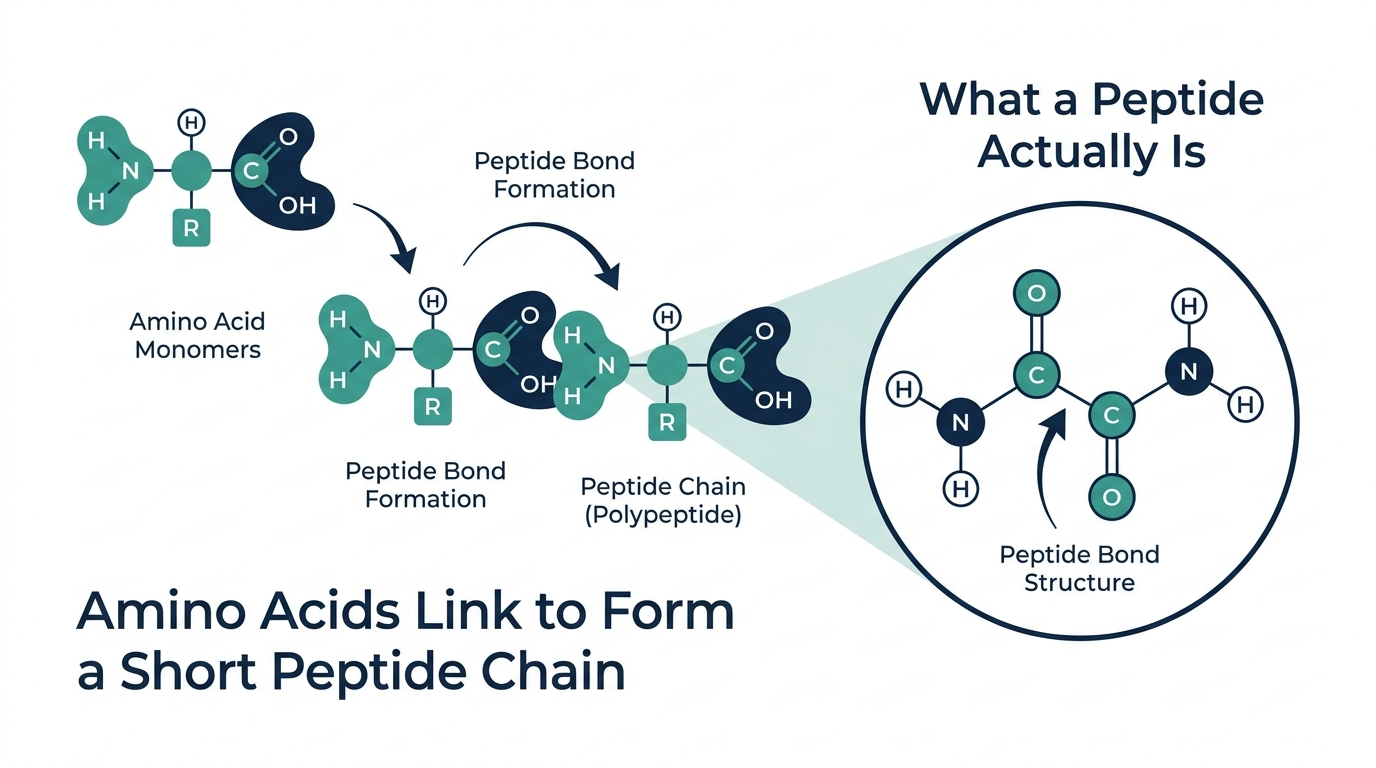
A peptide is a protein that stopped growing early. Proteins are built from amino acids linked together in chains: strings of 50 or more amino acids are proteins, while strings of 2 to 49 are peptides. Your skin’s structural proteins, collagen, elastin, and fibronectin, are made from chains hundreds of amino acids long. Peptides are the short fragments, and short turns out to be useful because smaller molecules are easier to deliver through the skin barrier.
The analogy that actually helps: think of collagen as a long sentence in your skin’s language, and a peptide as a short phrase that carries a specific meaning. The phrase “increase collagen production” does not need to be a whole novel to be understood.
When a specific sequence of amino acids lands on a receptor on a fibroblast cell, it triggers a response. Signal peptides prompt collagen synthesis. Carrier peptides, like GHK-Cu, deliver copper, a cofactor that collagen-assembling enzymes require. Neurotransmitter-inhibiting peptides block the acetylcholine release that causes muscle contraction, softening expression lines the way Botox does, but far more mildly and topically. Enzyme-inhibiting peptides block matrix metalloproteinases, the enzymes that degrade your existing collagen.
Four functional families, four different mechanisms. Most serums marketed as “peptide” products contain at least one from each category, whether or not the label tells you that.
Which peptides have the strongest clinical evidence?
Not all peptides are equal, and the evidence gap between the top tier and the rest is significant. Here is the honest ranking based on human trial data as of mid-2026:
| Peptide (INCI name) | Category | Best evidence | Effective topical concentration |
|---|---|---|---|
| GHK-Cu (Copper Tripeptide-1) | Carrier / Signal | Multiple RCTs; 28% avg collagen increase at 0.05%; modulates 4,000+ genes per Broad Institute analysis | 0.1 to 1% topical |
| Palmitoyl Pentapeptide-4 (Matrixyl) | Signal | 2009 RCT with histological collagen confirmation at 3% concentration | 3 to 4% for measurable effect |
| Palmitoyl Tripeptide-1 + Palmitoyl Tetrapeptide-7 (Matrixyl 3000) | Signal + Anti-inflammatory | Strong cosmetic trial data at 3% combined; widely replicated | 3% blend |
| Acetyl Hexapeptide-3 / -8 (Argireline) | Neurotransmitter inhibitor | 27% wrinkle depth reduction at 10% concentration in a 2002 trial, confirmed again in 2021 research | 10% for documented results |
| Palmitoyl Tripeptide-38 (Matrixyl Synthe’6) | Signal | Stimulates 6 skin matrix components simultaneously | 2 to 5% |
| SNAP-8 (Acetyl Octapeptide-3) | Neurotransmitter inhibitor | Comparative advantage over Argireline in some trials; reduces expression wrinkle depth | 10% |
Two things stand out in that table. First, GHK-Cu has the deepest scientific history, tracing back to original pharmaceutical research, not cosmetic marketing. Second, Argireline at 10% has reproducible results, but most serums do not use it at 10%. A product that lists Argireline 12th on the INCI is almost certainly using it below the concentration that the studies used.
The myth worth busting: “peptides are too big to penetrate skin”
Do not believe the blanket claim that topical peptides cannot penetrate the skin and therefore all peptide serums are overpriced moisturizers. It is outdated, and it misrepresents both the biology and the formulation science.
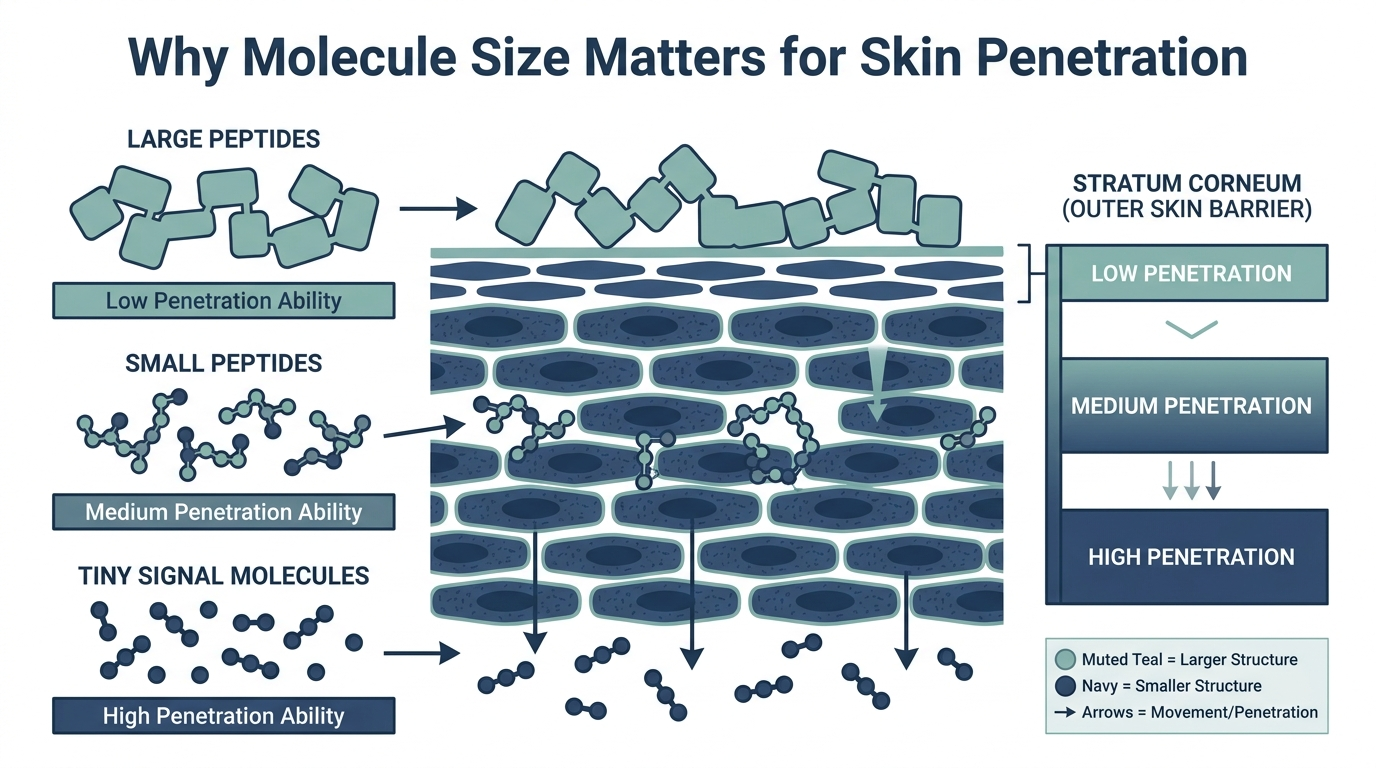
The traditional 500 Dalton rule holds that substances above 500 Dalton molecular weight do not penetrate the stratum corneum. Many therapeutic peptides are larger than that, which led to early skepticism. The problem with applying that rule here is threefold.
First, the peptides with the strongest cosmetic evidence, GHK-Cu (338 Da), Matrixyl/Pal-KTTKS (802 Da with fatty acid), and Argireline (888 Da), are either below the cutoff or use fatty acid coupling (the “palmitoyl” prefix) to make them more lipid-soluble and better able to cross the skin barrier. The palmitoyl chain is not there for the name; it is a deliberate delivery mechanism.
Second, some peptides work through surface-level receptor signaling without needing to penetrate all the way to the dermis. Even partial penetration into the viable epidermis can trigger cascades that reach fibroblasts below.
Third, modern formulation uses liposomes, nanoparticles, and peptide-lipid conjugates specifically to improve depth of delivery. A 2026 review on topical bioactive peptides from Baylor College of Medicine explicitly recommended looking for products formulated with liposomes or nano-systems for this reason. Products from the same peptide ingredient but different delivery vehicles can perform very differently.
Personally, the question I ask now is not “can this peptide penetrate?” but “is this peptide at the right concentration in the right delivery system?” Those are the variables that separate results from theater.
How do you read a peptide product label and actually know what you are buying?
This is where most shoppers leave money on the table, and where brands hide a lot of sins.
The INCI (International Nomenclature of Cosmetic Ingredients) list runs in descending order of concentration down to 1%, then anything below 1% can appear in any order. The practical consequence: if Palmitoyl Tripeptide-1 appears 20th on a 30-ingredient list, it is almost certainly below the 1% threshold, and likely far below the 3% that Matrixyl clinical studies used.
The insider trick: look for the peptide’s position relative to preservatives. Most preservatives like phenoxyethanol or sodium benzoate appear at 0.5 to 1% in finished products. If your peptide appears after those, you are below the range where you have any right to expect the clinical-trial result.
A second trap is the “peptide complex” label. Matrixyl 3000, the commercial complex, is actually a diluted mixture of Palmitoyl Tripeptide-1 and Palmitoyl Tetrapeptide-7. When a manufacturer uses 4% of the Matrixyl 3000 complex, the actual peptide content of the finished product is roughly 0.0004% and 0.0002%, which is far below the concentrations used in the published trials. The complex name sounds potent. The math is not.
What actually matters on the label:
- Peptide appears before the preservative system (signals above 1% range)
- The specific peptide INCI name is listed, not just a branded complex name
- The product has a third-party clinical test, or the manufacturer publishes the concentration it uses
Most brands do not publish concentrations voluntarily. The ones that do, like The Ordinary, which explicitly states “1% GHK-Cu” in their Multi-Peptide + Copper Peptides serum, deserve credit for that transparency.
Full-body lab membership: 100+ biomarkers, doctor-reviewed, tracked over time.
The four categories of skin care peptides, with real product examples
Signal peptides
Signal peptides tell your skin to produce more structural proteins. The Matrixyl family is the benchmark here. Matrixyl (Palmitoyl Pentapeptide-4) is the original, validated in a 2009 randomized controlled trial that used both histological staining and wrinkle measurement; it showed measurable collagen I, III, and IV increases at 3% concentration over 12 weeks.
Matrixyl Synthe’6 (Palmitoyl Tripeptide-38) is the upgrade, targeting six matrix components simultaneously: collagen I, III, and IV, fibronectin, hyaluronic acid, and laminin-5. This broader coverage is why newer premium formulas favor it over the original Matrixyl.
Carrier peptides
GHK-Cu is the category, and it is not just another peptide. It is the most heavily studied cosmetic peptide in the published literature, with a track record stretching back to Loren Pickart’s original wound-healing research at the Veterans Administration. Its primary job is delivering copper to lysyl oxidase, the enzyme that cross-links collagen fibers into a stable matrix. Without enough copper, new collagen fibers cannot be properly assembled.
In a human comparison study, topical GHK-Cu increased collagen density in 70% of volunteers, outperforming both vitamin C and retinoic acid groups in the same trial. For an over-the-counter topical ingredient, that is a remarkable benchmark comparison.
The commercial options span a wide price range. The Ordinary Multi-Peptide + Copper Peptides 1% Serum at $32 for 30 mL is the most transparent budget option, listing “1% GHK-Cu” on the product page. NIOD Copper Amino Isolate Serum 3 (CAIS3) at $93 for 30 mL uses a 1:1 ratio of GHK-Cu and GHK for a more isolate-focused formula. Allies of Skin Copper Tripeptide and Ectoin Advanced Repair Serum at $199 for 30 mL adds ectoin for barrier repair and is accepted by the National Eczema Association.
Neurotransmitter-inhibiting peptides
Argireline (Acetyl Hexapeptide-3 or -8) is the most recognized in this category. It competes with SNAP-25, a protein that triggers acetylcholine release at the neuromuscular junction. Less acetylcholine means less muscle contraction; less contraction means expression lines soften over repeated use.
The honest qualifier: the 27% wrinkle depth reduction documented in published trials was at 10% concentration, applied twice daily for 28 days. Most commercial serums do not declare their Argireline concentration. SNAP-8 (Acetyl Octapeptide-3) works through a similar mechanism and has shown a comparative advantage over Argireline in some formulations for dynamic wrinkle reduction.
Enzyme-inhibiting peptides
These work on the degradation side rather than the synthesis side. Matrix metalloproteinases (MMPs) are enzymes that break down existing collagen, elastin, and hyaluronic acid. Soy-derived peptides and certain Palmitoyl Oligopeptide + Tetrapeptide-7 combinations inhibit MMP activity, slowing the pace at which UV damage and inflammation dismantle your existing matrix. Think of them as the goalkeeper on the collagen preservation team, less glamorous than the scorers but essential to the final result.
Oral collagen peptides versus topical: what the 2026 evidence actually shows
A landmark systematic review and meta-analysis published in Frontiers in Medicine in 2026 analyzed 19 randomized controlled trials covering 1,341 participants with a mean age of 50.2. The findings are more nuanced than most supplement marketing admits.
Oral polypeptides showed a pooled mean difference of MD = 1.5 for wrinkle reduction (statistically significant, p = 0.01) and MD = 16.50 for skin hydration improvement. Oral tripeptides outperformed topical formulations across most metrics in that pooled analysis. Skin brightness improved significantly (MD = 2.40, p < 0.01) and skin roughness decreased (MD = -8.47, p = 0.05). These are real, reproducible numbers from the largest evidence synthesis on the topic to date.
Topical peptides showed “minimal impact” on wrinkle reduction in that same pooled analysis, though the reviewers noted high heterogeneity (I squared = 84 to 100%) driven by different peptide types, concentrations, and measurement methods. In plain terms: pooling a study on 3% Matrixyl with one on a 0.01% mixed-peptide moisturizer tells you relatively little about what either one actually does in isolation.
The practical takeaway is not “oral beats topical” across the board. It is that oral hydrolyzed collagen at 2.5 to 10 grams per day has a consistent, reproducible evidence base for hydration, brightness, and roughness improvement, while topical peptides at clinical concentrations have targeted benefits, especially for collagen induction (GHK-Cu) and expression line reduction (Argireline), that oral collagen does not replicate. The approaches address different parts of the problem and work best together.
Hydrolyzed type I & III collagen peptides, third-party tested, unflavored.
How to use a peptide serum: layering without canceling out your other actives
The most common mistake is using copper peptides directly alongside a high-dose vitamin C (L-ascorbic acid) product. L-ascorbic acid is formulated at pH 2.5 to 3.5 to stay active, and that low pH can oxidize the copper in GHK-Cu, reducing both the peptide’s efficacy and potentially generating free radicals from the oxidized copper. Not catastrophic, but you are paying for a reaction you did not want.
The cleanest protocol for a routine that includes vitamin C, retinol, and peptides:
Morning: Cleanser, L-ascorbic acid vitamin C serum (wait 60 to 90 seconds for full absorption), peptide serum (signal or neurotransmitter-inhibiting type; skip copper here), moisturizer, SPF.
Evening: Cleanser, copper peptide serum (GHK-Cu formulas work well here, pH-neutral, no conflict), wait 10 to 15 minutes, retinol, moisturizer.
The “wait before retinol” step is not fussiness: retinol at pH above 5.5 degrades faster than at neutral pH, and applying it over a still-wet peptide layer can dilute absorption for both. Letting the peptide serum set first costs 10 minutes and costs nothing else.
Peptides and hyaluronic acid are completely compatible and layer in any order. Niacinamide is similarly safe to combine in the same step. There is no conflict.
For beginners with no active ingredients in their routine yet, peptides are actually the lowest-risk entry point. They do not cause purging, are not photosensitizing, and the most common reaction is nothing at all. That low drama profile is precisely why some dermatologists recommend them as the first “active” in any new routine.
What can a peptide serum realistically do in 12 weeks?
Expectations matter here, because the marketing sets them too high and the skeptics set them too low.
What has been documented in trials using clinical-grade concentrations:
- Skin hydration: measurable improvement within 2 to 4 weeks for well-formulated peptide products and oral collagen
- Collagen density: 28% average increase over 12 weeks with daily 0.05% GHK-Cu (Asterwood clinical data, n = 21)
- Wrinkle depth reduction: 27% at 10% Argireline twice daily for 28 days
- Skin firmness and texture: improvements at 12 weeks in sun-damaged skin with GHK-Cu cream (n = 71 women)
What you should not expect:
- Reversal of deep structural damage from years of UV exposure in weeks
- Results equivalent to a prescription retinoid or in-office collagen induction treatment
- Consistent outcomes from a product whose peptide appears at the tail end of a 35-ingredient list
The ceiling for a well-formulated, correctly used topical peptide serum is modest improvement in fine lines, texture, and firmness over 8 to 12 weeks, with hydration benefits arriving first. That is a real, worthwhile outcome. It is not the “Botox in a bottle” marketing language you will see on some labels. The gap between those two descriptions is largely the gap between what the research shows and what the packaging promises.
Don’t just read about your health, track it.
A single result is a snapshot. Superpower re-tests 100+ markers over time so you can watch them move as you change sleep, food, and training.
FAQ: peptides in skin care products
What does “peptide” mean on a skincare label?
It means the product contains at least one short chain of amino acids (2 to 10 links) designed to signal, support, or stimulate a skin process. Look for the specific INCI name: Palmitoyl Tripeptide-1, Copper Tripeptide-1, Acetyl Hexapeptide-3, or similar. A label that only says “peptide complex” without naming the actual INCI is giving you less information than you deserve.
Are peptides safe for all skin types?
Yes, with limited exceptions. Peptides are “usually well-tolerated with minimal side effects,” according to Dr. Oyetewa Asempa, director of the Skin of Color Clinic at Baylor Medicine. Patch testing is recommended for highly reactive or compromised barrier skin, not because peptides are aggressive, but as standard practice for any new active. There is no photosensitization risk with peptides, unlike retinoids.
Can I use peptides every day?
Yes. Unlike retinol, which requires a ramp-up period, or AHAs, which require spacing to prevent over-exfoliation, peptides can be used morning and evening from day one. Twice-daily use is what the Argireline trials that documented 27% wrinkle reduction actually used.
What is GHK-Cu and why does it appear in so many premium serums?
GHK-Cu is glycine-L-histidine-L-lysine complexed with a copper ion. It is the most studied cosmetic peptide in the published literature, with original pharmaceutical research in wound healing dating to the 1970s. Topically, it stimulates collagen synthesis, activates antioxidant enzymes, and modulates the expression of over 4,000 human genes according to Broad Institute genomic mapping. It is genuinely one of the few cosmetic ingredients where the clinical evidence keeps accumulating rather than thinning out under scrutiny.
Do peptides work better than retinol?
They work differently and address different mechanisms. Retinol increases cell turnover and directly upregulates collagen gene expression. Peptides work via receptor signaling without the irritation, purging, and mandatory sun-avoidance that retinol requires. For sensitive skin, rosacea, or anyone who cannot tolerate retinol, peptides fill a genuinely useful role. Most dermatologists recommend using both in a complementary routine rather than choosing between them.
Why do some peptide serums cost $30 and others cost $200?
The price difference reflects formulation quality, peptide type and concentration, delivery system sophistication, and brand positioning, not always in that order. A $32 serum that discloses “1% GHK-Cu” is more useful than a $150 serum that lists its peptide ingredient 18th with no concentration disclosed. Price is not a reliable proxy for efficacy. Transparency about concentration is.
Can I take peptide supplements instead of using a serum?
For collagen support, oral hydrolyzed collagen peptides (2.5 to 10 grams per day) have a solid evidence base for hydration, roughness, and wrinkle reduction per the 2026 Frontiers in Medicine meta-analysis of 1,341 participants. For targeted effects like copper delivery to the dermis or neurotransmitter-inhibiting action for expression lines, topical application is the correct route. The two approaches address different problems and work best together.
Hydrolyzed type I & III collagen peptides, third-party tested, unflavored.
Author: [CAN XAC NHAN: ten + credential tac gia/reviewer health cua Vital Signs Today, vd “Medically reviewed by [name], [credential]”]. Educational content, not medical advice. Sources linked inline.
Primary sources:
- Frontiers in Medicine (2026): Oral and topical peptides for skin aging, systematic review and meta-analysis of 19 RCTs, 1,341 participants — https://www.frontiersin.org/journals/medicine/articles/10.3389/fmed.2026.1618306/full
- Baylor College of Medicine Blog, Dr. Oyetewa Asempa on peptides in skincare (March 2026) — https://blogs.bcm.edu/2026/03/30/what-you-need-to-know-about-peptides/
- PeptideDeck evidence-ranked guide to skin peptides (2026) — https://www.peptidedeck.com/peptides/peptides-for-skin
- Asterwood Copper Peptides Guide (2026), GHK-Cu trial data — https://www.asterwood.co/blogs/skincare/copper-peptides-guide-2026
- Innerbody Best Copper Peptide Serum (2026), product pricing and formulation comparison — https://www.innerbody.com/best-copper-peptide-serum
- Chemists Corner forum: actual peptide concentrations in commercial products — https://chemistscorner.com/cosmeticsciencetalk/discussion/actual-concentrations-of-peptide-real-or-ppm-in-skin-care-products/
- MDPI Cosmetics (2025): Peptides in Cosmetics, pharmaceutical breakthroughs to skincare innovations — https://www.mdpi.com/2079-9284/12/3/107
- Grand Ingredients: GHK-Cu Peptide Clinical Evidence and Skin Benefits — https://grandingredients.com/copper-peptides-clinical-benefits/
- Glimmer Goddess: How to Layer Copper Peptides With Retinol, Vitamin C and Other Actives — https://glimmergoddess.com/blogs/skin-school/how-to-layer-copper-peptides-with-retinol-vitamin-c-other-actives
- Superpower blood test membership and biomarkers — https://superpower.com/blood-test-for-biomarkers
Related reading
Vital Signs Today may earn a commission if you buy through links on this page. It does not affect our editorial assessments.