
Last updated 18 June 2026. Educational content, not medical advice. Epitalon is not approved by the FDA for human use. Consult a licensed clinician before using any peptide.
Short answer: Epitalon (also written Epithalon, chemical sequence Ala-Glu-Asp-Gly) is a synthetic four-amino-acid peptide studied primarily for three things: activating the enzyme telomerase to lengthen telomeres, restoring age-related melatonin decline by acting on the pineal gland, and extending healthy lifespan in multiple animal models. A 2025 study at Brunel University London confirmed telomere lengthening in human cell lines, and the FDA scheduled its first formal PCAC review of epitalon for July 24, 2026, specifically for the insomnia indication.
Epitalon is studied for telomeres and sleep, so what do your own inflammation and hormone markers say right now? One at-home Superpower draw checks 100+ biomarkers, physician-reviewed.
Why do people care so much about a four-amino-acid peptide?
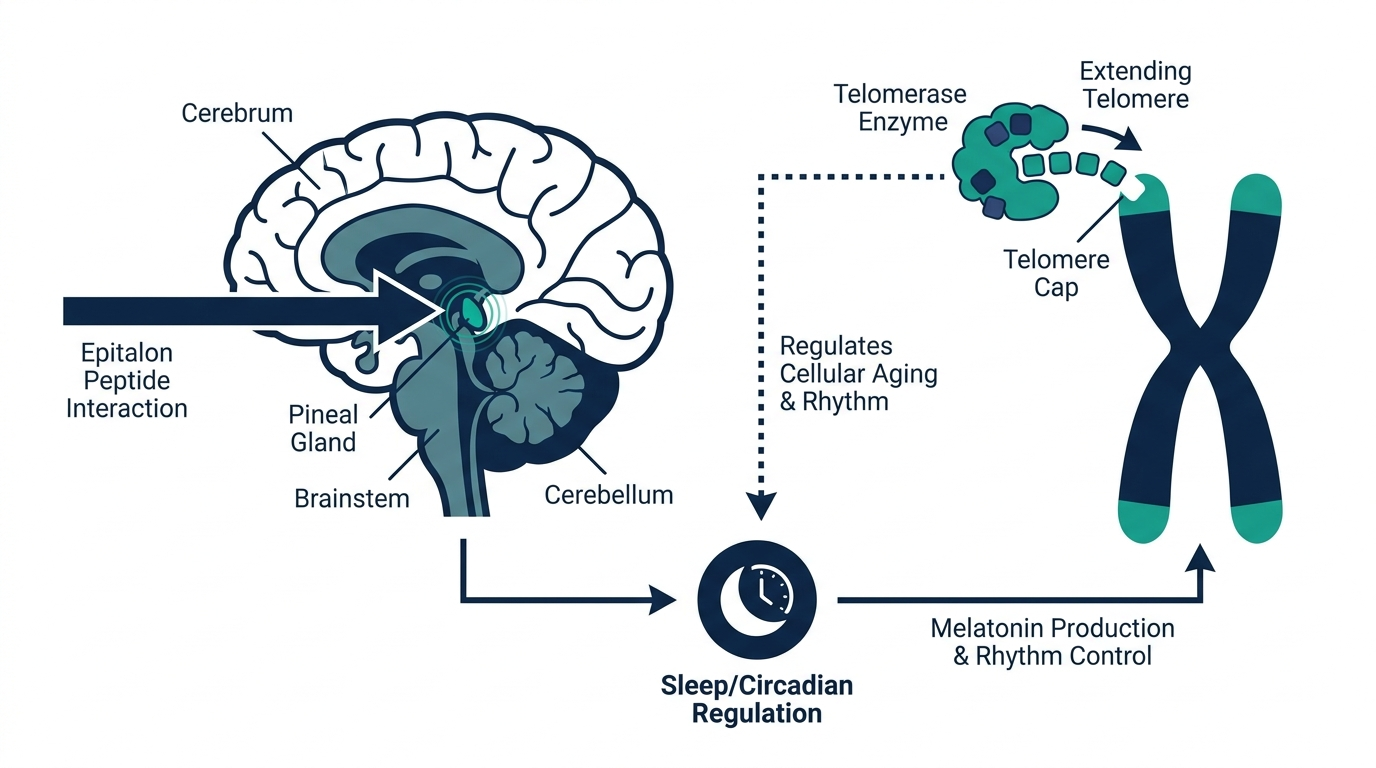
Most anti-aging compounds target one mechanism. Epitalon has a plausible claim on two of the most studied ones simultaneously: telomere biology and circadian melatonin regulation. That combination is unusual, and it explains why a peptide that emerged from Soviet-era Russian research is now attracting attention from Western longevity clinics and, for the first time, a formal FDA advisory committee.
The compound comes from work that started at the St. Petersburg Institute of Bioregulation and Gerontology under Dr. Vladimir Khavinson, who isolated a natural polypeptide from bovine pineal glands called epithalamin. Epitalon is the synthetic, four-amino-acid version of that extract. The sequence Alanyl-Glutamyl-Aspartyl-Glycyl is short enough to be chemically stable, inexpensive to synthesize, and well-absorbed.
Full-body lab membership: 100+ biomarkers, doctor-reviewed, tracked over time.
What does epitalon actually do at the cellular level?
The primary mechanism that drew the most research attention is telomerase activation. Telomeres are the repetitive DNA sequences capping the ends of chromosomes. Each time a normal cell divides, telomeres shorten slightly. When they become too short, the cell stops dividing and enters senescence, a state linked to tissue aging, inflammation, and age-related disease. The enzyme telomerase can add back those repetitive sequences, but most somatic (non-reproductive) cells express very little of it after early development.
Epitalon appears to upregulate telomerase in normal cells. The most rigorous recent confirmation comes from a 2025 study published in Biogerontology by Al-Dulaimi et al. at Brunel University London, the first detailed independent investigation outside Khavinson’s group. The team treated breast cancer cell lines (21NT, BT474) and normal epithelial and fibroblast cells with epitalon, then measured telomere length. In normal cells, they found dose-dependent telomere extension through upregulation of hTERT (the catalytic subunit of telomerase). In cancer cells, telomere extension occurred through an alternative mechanism called ALT (Alternative Lengthening of Telomeres). That distinction matters, which I will come back to below.
The second mechanism is pineal gland regulation. The pineal gland produces melatonin, the hormone that governs circadian rhythm and sleep onset. Output from the pineal gland declines significantly with age, and that decline correlates with the fragmented, shallow sleep common in older adults. In aged Rhesus monkeys, epitalon treatment not only stimulated melatonin production but normalized both melatonin and cortisol circadian rhythms in a time-of-day-dependent manner. At the cellular level, studies in rat pinealocytes showed epitalon upregulates AANAT, a key enzyme in the melatonin biosynthesis pathway, and protective effects in aged human pinealocytes suggest a tissue-specific rejuvenating action on the gland itself.
Both mechanisms, telomere maintenance and circadian restoration, converge on a shared downstream outcome: slower cellular aging. That convergence is why researchers in the longevity field treat epitalon differently from a single-target supplement.
What does the research say about specific uses?
Longevity and lifespan extension
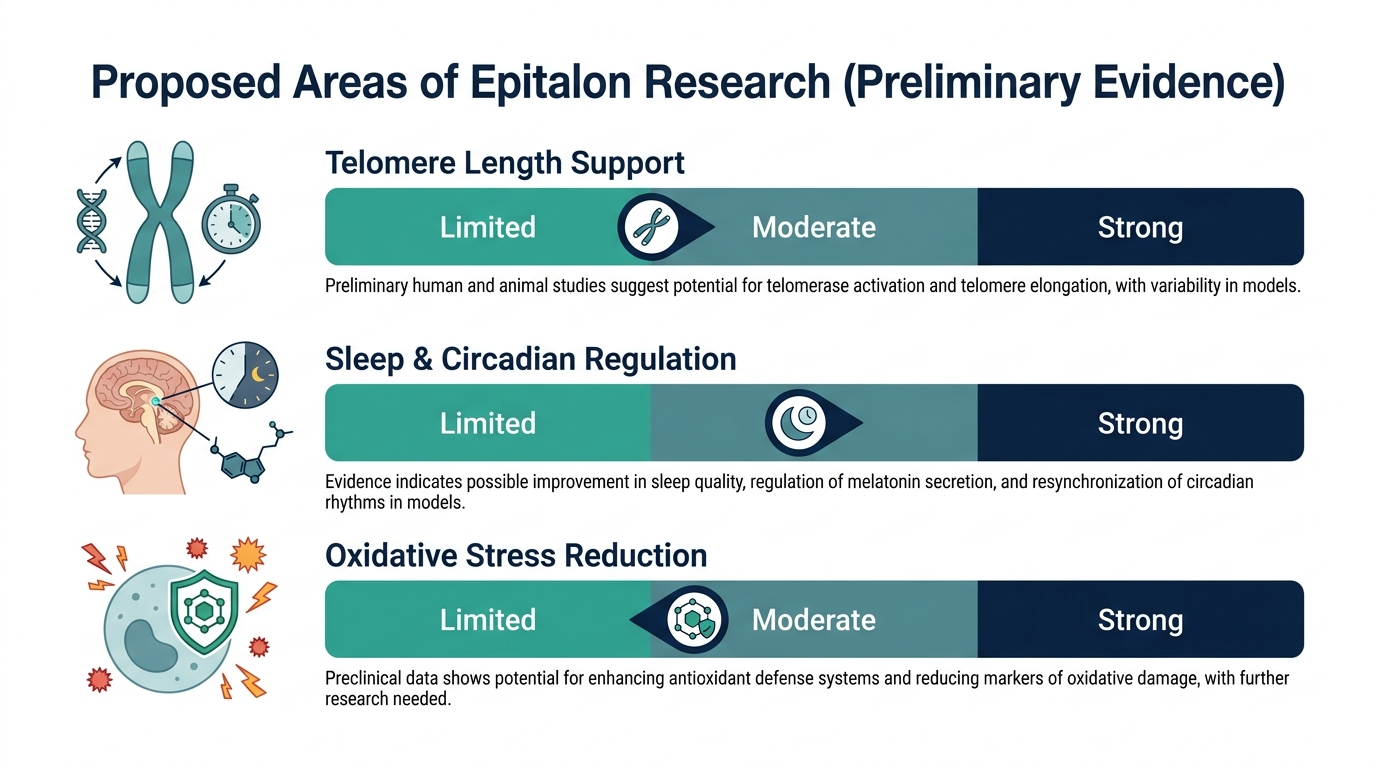
Animal data across multiple species remains the most extensive evidence base. In aged CBA mice, epitalon treatment produced a 13.7% increase in mean lifespan. A separate study in Biogerontology (Anisimov and Khavinson) found that in SHR mice, epitalon did not extend mean lifespan but did reduce the rate of age-related physiological decline and alter tumor incidence. Fruit fly studies (Drosophila melanogaster) also showed extended lifespan. Primate data is rarer, but those aged Rhesus monkey studies showing circadian normalization are meaningful given how closely primate neuroendocrinology mirrors human aging.
Human data remains thin by Western clinical trial standards. Khavinson’s institute published a series of open-label studies in older adults that reported improvements in sleep quality, mood, energy, and general well-being. These lack the randomized placebo-controlled design that Western regulators require, and the FDA’s advisory committee review in July 2026 will have to reckon with the fact that most supporting data is Russian-language and from a narrow set of research groups.
Sleep and insomnia
This is the indication the FDA is formally reviewing. The pineal mechanism is the most biologically direct pathway: epitalon acts on pinealocytes to upregulate melatonin biosynthesis. Unlike exogenous melatonin supplements, which deliver a dose of the hormone directly and are consumed within hours, epitalon stimulates the gland itself to produce more melatonin in its natural circadian rhythm. The distinction is clinically meaningful, because age-related insomnia is less about insufficient total melatonin and more about blunted amplitude and shifted timing of the nightly melatonin curve.
The FDA’s Pharmacy Compounding Advisory Committee has scheduled a formal review of epitalon specifically for the insomnia indication on July 24, 2026, as part of its evaluation of seven peptides for the 503A Bulks List. The public comment docket (FDA-2025-N-6895) accepted comments through July 9, 2026. If the committee recommends Category 1 (permitted for compounding) status for the insomnia use, licensed compounding pharmacies could legally prescribe epitalon with a physician’s order, which would be a significant regulatory shift.
Antioxidant and immune function
A study in aging rats found that epitalon increased the activity of three antioxidant enzymes: superoxide dismutase, glutathione peroxidase, and glutathione-S-transferase. These are the cell’s primary defenses against oxidative damage, and their activity declines with age in most tissues. Separately, research documented that epitalon treatment in aged animals partially restored NK (natural killer) cell cytotoxicity against tumor targets, suggesting an immune-rejuvenating component that may contribute to the oncostatic effects seen in mouse studies.
Retinal and vision health
One of the less discussed but genuinely interesting research threads involves retinal degeneration. The pineal gland and the retina share a common embryological origin and both express melatonin receptors. A study published on ResearchGate (Khavinson and Razumovsky) found that epitalon prolonged functional retinal integrity in rats with hereditary retinitis pigmentosa and reported positive clinical effects in the majority of patients with pigmental retinal degeneration. The studies are small, and the evidence is preliminary, but the mechanism via pineal-retinal connectivity is biologically coherent.
How does epitalon compare to other longevity approaches?
| Compound | Primary mechanism | Human trial evidence | Current legal route |
|---|---|---|---|
| Epitalon (AEDG) | Telomerase activation + pineal melatonin restoration | Limited open-label (Russia); 2025 cell-line confirmation | Research only; PCAC review July 2026 for compounding |
| NMN / NR | NAD+ replenishment, sirtuin activation | Multiple randomized controlled trials | OTC supplement (oral) |
| Semax | BDNF upregulation, cognitive support | Small Russian open-label studies | Research only; also in July 2026 PCAC review |
| Sermorelin | GH secretagogue, GH-axis restoration | Some telehealth-prescribed clinical data | Prescription, telehealth available now |
| Melatonin | Direct circadian supplement | Extensive human trials for jet lag, insomnia | OTC supplement |
The table shows an honest gap. NMN has more randomized human trial data. Melatonin has decades of human use. Sermorelin is already fully accessible through telehealth. What epitalon has that none of these offers is a documented telomerase-activation mechanism confirmed by independent Western researchers in 2025, plus the pineal mechanism in a single compound. Whether that combination justifies the regulatory and sourcing complexity of accessing it today is a question a clinician should help you answer.
Personally, the comparison that resonates is epitalon versus exogenous melatonin supplements for the sleep use case. If your goal is a better night’s sleep tonight, melatonin at 0.5 to 1 mg is cheap, OTC, and extensively studied. If your goal is restoring the pineal gland’s capacity to generate its own rhythm, which is what actually deteriorates with aging, epitalon addresses the upstream cause rather than the symptom. Those are different interventions with different time horizons.
What is the current FDA and legal status?
Epitalon is not approved by the FDA for any indication. It is not a scheduled controlled substance, so possession is not a criminal matter. The legal landscape in mid-2026 looks like this:
As a research chemical: Epitalon is sold by research vendors labeled “for laboratory use only.” This is the same grey-market framework that applies to BPC-157 and TB-500. The “research use” label legally transfers all risk to the buyer. It is not the same as pharmaceutical grade, and no independent oversight confirms what is in a specific vial.
For compounding: The FDA removed epitalon from its 503A Category 2 list (substances presenting safety concerns) on April 15, 2026 and scheduled the PCAC meeting for July 24, 2026. If the committee recommends it for Category 1 for the insomnia indication, licensed 503A compounding pharmacies with a physician prescription could legally provide it. That decision has not been made as of the time of writing.
Telehealth access: A small number of longevity clinics (Huemn Longevity in Houston is one example that lists epitalon therapy openly as of mid-2026) offer it as part of a supervised anti-aging protocol. The legal basis varies; some use international sourcing, some are getting ahead of an anticipated Category 1 decision. The right questions to ask any clinic: which compounding pharmacy fills the prescription, what is the pharmacy’s regulatory standing, and can they provide batch-level quality documentation.
Do not believe any clinic or vendor claiming epitalon is “FDA approved” or “fully legal for human use” in mid-2026. Neither is true. What is true is that the regulatory path toward legal compounding access is more open now than at any point in the peptide’s US history.
Telehealth GLP-1 program with provider visits and pharmacy coordination.
What do insiders know that the supplement blogs skip?
Three things rarely appear in the “epitalon benefits” articles that circulate on fitness sites:
First, the ALT finding in cancer cells is not a reason to panic, but it deserves attention. The 2025 Brunel University study showed that in cancer cell lines, epitalon extended telomeres through ALT rather than telomerase. ALT (Alternative Lengthening of Telomeres) is a mechanism that some cancers use to maintain their immortality. This does not mean epitalon causes cancer in normal tissues, where it acted through conventional telomerase upregulation. But it does mean that anyone with active or recent cancer, or a significant family cancer history, should discuss epitalon with an oncologist before considering it, not a wellness telehealth platform. The 2025 paper is the first Western investigation to surface this distinction clearly, and most vendor sites have not processed it yet.
Second, most of the supporting human data was generated by one group. Vladimir Khavinson’s institute at St. Petersburg has produced the vast majority of the human and animal studies on epitalon over 40-plus years. That is extraordinary depth from one lab, but it also creates a reproducibility question. The Al-Dulaimi 2025 cell-line study is genuinely important precisely because it is the first detailed confirmation from an independent Western group outside Khavinson’s network. One independent replication is not a clinical trial, but it is the beginning of the external validation the compound needed.
Third, the PCAC review scope is narrow. The FDA is evaluating epitalon specifically for the insomnia indication on the insomnia indication. The broader anti-aging, telomere, and longevity claims that dominate consumer-facing epitalon content are not part of the committee’s review. A favorable insomnia ruling in July 2026 would open the compounding door for that one use; it would not validate or legalize the broader longevity protocol that most buyers actually want it for. The distinction is important for anyone expecting a regulatory green light on the full use case.
When should you NOT use epitalon?
Epitalon is not the right first step for most people and may be genuinely contraindicated for some. Avoid or postpone if any of these apply:
- Active cancer or remission within five years. The ALT mechanism in cancer cell lines (confirmed 2025) is enough reason to require oncologist clearance first.
- No baseline labs. Starting a compound that affects cellular replication and hormonal rhythms without knowing your baseline inflammatory markers, hormone levels, and metabolic indicators is an experiment you cannot read. Get the labs first.
- Expecting OTC-supplement convenience. Epitalon as a research peptide requires reconstitution from lyophilized powder, dose calculation, and subcutaneous injection. It is not a capsule.
- Pregnant, breastfeeding, or planning pregnancy. No safety data exists for these populations.
- Under 30 without a clinical reason. The strongest evidence base involves age-related decline in telomerase activity and pineal function. These are later-life phenomena, and most researchers who discuss epitalon frame its use case as adults over 40 with measurable decline in relevant biomarkers.
Curious what your own levels look like?
Baseline 100+ biomarkers today and retest as life changes, all in one membership with physician review.
Frequently asked questions
What is epitalon peptide used for?
Epitalon is studied for three primary uses: activating telomerase to slow or reverse telomere shortening, restoring the pineal gland’s melatonin output to improve sleep and circadian rhythm in older adults, and extending healthy lifespan in animal models. It is also researched for antioxidant effects, immune support, and retinal protection. None of these uses is FDA-approved as of mid-2026.
Is epitalon legal in the United States?
Epitalon is not a controlled substance and is not illegal to possess. It is sold legally by research vendors as “for laboratory use only,” a label that transfers all risk to the buyer and does not imply pharmaceutical quality. The FDA is reviewing epitalon for potential addition to the 503A compounding list for the insomnia indication, with a PCAC meeting on July 24, 2026. A favorable ruling would open the door to licensed compounding pharmacy access with a prescription.
How is epitalon different from melatonin supplements?
Melatonin supplements deliver exogenous hormone that peaks and clears within hours. Epitalon acts upstream, stimulating the pineal gland’s own melatonin biosynthesis pathway. For people whose pineal gland has lost capacity with age, the distinction matters: one replaces the output, the other attempts to restore the source. Melatonin has vastly more human trial data. Epitalon has a more mechanistically targeted action for age-related pineal decline.
What was the key 2025 epitalon study?
Al-Dulaimi et al. at Brunel University London published a study in Biogerontology (September 2025) confirming that epitalon increases telomere length in human cell lines through telomerase upregulation in normal cells, and through ALT activity in cancer cell lines. It was the first detailed independent investigation outside Khavinson’s group and represents a significant step toward Western scientific validation of the telomere mechanism.
Can you get epitalon through a doctor?
As of mid-2026, a small number of licensed longevity telehealth clinics offer epitalon as part of supervised protocols. The regulatory path toward licensed compounding pharmacy access is progressing, with the PCAC review pending. The safest route is a clinician who requires baseline labs, prescribes through a named and verifiable compounding pharmacy, and provides follow-up monitoring rather than one who simply ships a vial after a checkbox intake.
What is the typical protocol researchers use?
Community research protocols commonly described in the literature and on forums are 5 to 10 mg per day for 10 to 20 consecutive days, cycled every four to six months. A 2023 case report documented a 44-year-old who self-administered 5 mg/day subcutaneous for 10 days in three cycles and reported improvements in biological age markers and telomere length. This is not a clinical recommendation. Any dosing protocol should come from a licensed clinician with knowledge of your baseline labs.
Does epitalon cause cancer?
No evidence from animal or human studies shows epitalon causes cancer. The 2025 Brunel study found that epitalon extended telomeres in cancer cell lines through the ALT mechanism, which raised a theoretical question about interaction with existing cancer cells rather than initiation of new ones. Anyone with a personal or significant family cancer history should discuss this with an oncologist before considering epitalon.
Telehealth GLP-1 program with provider visits and pharmacy coordination.
Author: Vital Signs Today Editorial Team, [credential]”]. Educational content, not medical advice. Sources linked inline.
Primary sources:
– Al-Dulaimi et al. (2025), “Epitalon increases telomere length in human cell lines through telomerase upregulation or ALT activity,” Biogerontology, Springer
– Anisimov & Khavinson, “Effect of Epitalon on biomarkers of aging, life span and spontaneous tumor incidence in female Swiss-derived SHR mice,” Biogerontology
– Khavinson & Razumovsky, “Pineal-regulating tetrapeptide epitalon improves eye retina condition in retinitis pigmentosa,” ResearchGate
– FDA PCAC Meeting July 2026: 7 Peptides Under Review, PeptideBond.com
– FDA to Review 7 Peptides for Compounding List in July 2026, HealingMaps
– Epitalon FDA Status 2026, Newtropin
– Epitalon: The Pineal Gland Peptide Under FDA Review for Insomnia, HealingMaps
– Epitalon (AEDG): A Pineal-Derived Synthetic Peptide, Superpower.com
– Overview of Epitalon: Highly Bioactive Pineal Tetrapeptide, PubMed/PMC
– Epitalon Wikipedia entry
Related reading
Vital Signs Today may earn a commission if you buy through links on this page. It does not affect our editorial assessments.