
Educational content, not medical advice. Talk to a licensed clinician before starting any peptide therapy. FDA-approved options require a prescription.
Short answer: A peptide for weight loss is a short chain of amino acids that signals your body to eat less, burn more fat, or release growth hormone. The most clinically proven examples are GLP-1 receptor agonists: semaglutide (Wegovy) and tirzepatide (Zepbound), which delivered up to 22.5% mean body-weight loss in the SURMOUNT-1 trial and require a prescription from a licensed provider.
GLP-1 peptides like semaglutide work by changing your biology, so what does your own metabolic panel look like right now? One at-home Superpower draw checks 100+ biomarkers, physician-reviewed.
What exactly is a peptide, and why does it matter for weight?
A peptide is a molecule made of two to fifty amino acids linked by chemical bonds called peptide bonds. Think of amino acids as individual Lego bricks, and a peptide as a short, specific sequence of those bricks designed to fit a particular receptor, like a key cut for one lock.
Your body already makes hundreds of its own peptides. Insulin, the hormone that shuttles glucose into cells, is a 51-amino-acid peptide. GLP-1 (glucagon-like peptide-1) is a 30-amino-acid peptide released by L-cells in your small intestine within minutes of eating. It tells your brain you are full, tells your pancreas to release insulin, and slows how fast food leaves your stomach.
Here is the problem: your body degrades its own natural GLP-1 within two to three minutes. The signal flares and dies. Pharmaceutical peptides for weight loss are essentially engineered copies of natural hormones with one job: stay active long enough to keep doing what the natural version can only do for a moment.
This is why semaglutide works at a weekly injection and a glass of water does not. Same biology, different half-life.
Why do some peptides cause weight loss at all?
Three distinct mechanisms drive weight-loss peptides, and understanding which one a given compound uses tells you almost everything about its risk profile and realistic results.
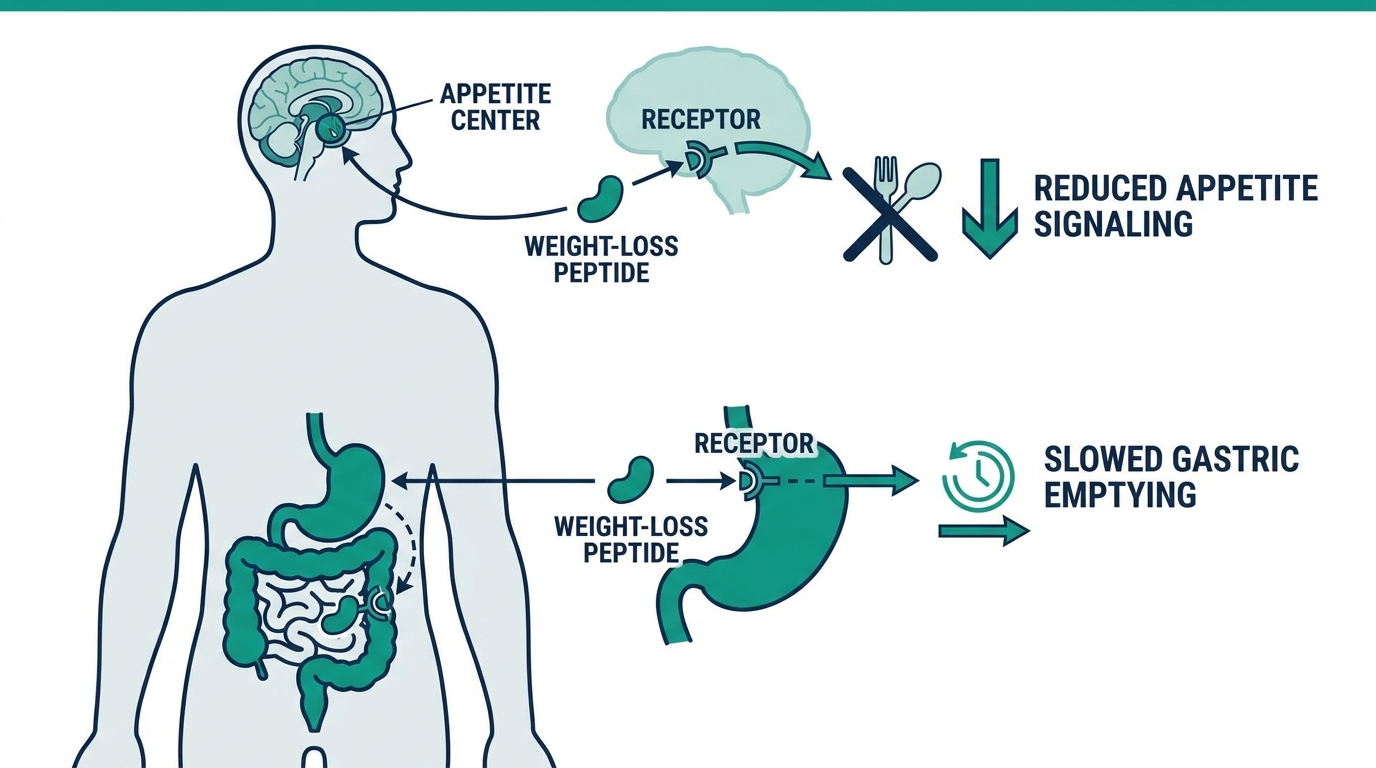
Mechanism 1: Appetite suppression via the brain. GLP-1 receptor agonists cross the blood-brain barrier and act directly on the hypothalamus, the brain region that regulates hunger. By binding GLP-1 receptors there, they turn down the volume on the hunger signal. Patients on semaglutide routinely report that food simply becomes less interesting, not that they are white-knuckling through cravings.
Mechanism 2: Slowing gastric emptying. GLP-1 agonists delay how fast your stomach empties into the small intestine. You feel full longer after a smaller meal. This is also the mechanism behind most GI side effects: nausea, reported by roughly 44% of semaglutide users in clinical trials, is essentially your stomach adapting to a slower transit rate.
Mechanism 3: Growth hormone secretagogues and fat metabolism. A separate category of weight-loss peptides works upstream of the above. CJC-1295 and ipamorelin, for example, stimulate the pituitary gland to release more growth hormone. Growth hormone promotes lipolysis, the breakdown of stored fat into free fatty acids. Unlike GLP-1 agonists, these are not FDA-approved for weight loss, and their evidence base is far thinner.
Full-body lab membership: 100+ biomarkers, doctor-reviewed, tracked over time.
Which peptides actually have clinical evidence for weight loss?
Not all peptides are equal. The honest spectrum runs from “proven in phase 3 trials with hundreds of thousands of patients” down to “interesting rodent data, nothing in humans yet.”
| Peptide | Mechanism | Evidence level | Legal route in 2026 |
|---|---|---|---|
| Semaglutide (Wegovy, Ozempic) | GLP-1 receptor agonist | Phase 3, FDA-approved | Prescription telehealth or clinic |
| Tirzepatide (Zepbound, Mounjaro) | GLP-1 + GIP dual agonist | Phase 3, FDA-approved | Prescription telehealth or clinic |
| Oral semaglutide (Wegovy pill) | GLP-1 receptor agonist | Phase 3 OASIS 4, FDA-approved Jan 2026 | Prescription telehealth or clinic |
| Retatrutide | GLP-1 + GIP + glucagon triple agonist | Phase 3, NOT yet approved | None (investigational) |
| CJC-1295 + Ipamorelin | GHRH + ghrelin receptor | Small human studies only | Grey zone / compounding pending |
| Sermorelin | GHRH analog | Approved for GH deficiency | Prescription (not weight-specific) |
| BRP peptide | Brain appetite center (novel) | Animal studies only, April 2026 | Not available |
The table shows a pattern worth memorizing: the only peptides with reproducible human evidence for meaningful fat loss are GLP-1 and dual-agonist drugs. Everything else is either investigational or in an early research phase.
What do the real trial numbers look like?
The trial data for the approved GLP-1 drugs is genuinely striking, which is why the category is generating so much noise.
Tirzepatide (SURMOUNT-1, NEJM 2022, 2,539 participants over 72 weeks): mean weight loss of 16% at the 5 mg dose, 21.4% at 10 mg, and 22.5% at 15 mg, versus 2.4% for placebo. At the highest dose, 63% of participants lost at least 20% of body weight. No weight-loss drug had ever crossed that threshold in a phase 3 trial before.
Semaglutide (STEP-1, NEJM 2021, 1,961 participants over 68 weeks): mean weight loss of 14.9% versus 2.4% for placebo. About one-third of participants lost 20% or more of body weight.
Oral semaglutide (OASIS 4, ACC 2025, 307 participants): the 25 mg once-daily pill delivered 16.6% mean weight loss at 64 weeks with full adherence, and one-third of adherent participants reached 20% or more. This is the format that launched in January 2026 and removed the needle barrier for many patients.
Retatrutide (TRIUMPH program, 2025 to 2026): Eli Lilly’s triple agonist is not yet approved, but the phase 3 data is extraordinary. In TRIUMPH-4, participants lost an average of 32.3 kg (about 71.2 lbs) over 68 weeks. The June 2026 TRIUMPH-1 readout confirmed 28.3% average weight loss in 2,339 patients. The FDA submission is estimated for Q4 2026 or early 2027.
Personally, the retatrutide numbers are the first time I have seen clinical data that looks like science fiction. 28 to 30% average body weight reduction in phase 3 would rewrite obesity medicine. But “not yet approved” means there is no legitimate way to obtain it outside of a clinical trial right now, and grey-market versions failed independent purity testing badly.
Semaglutide versus tirzepatide: what the second receptor actually adds
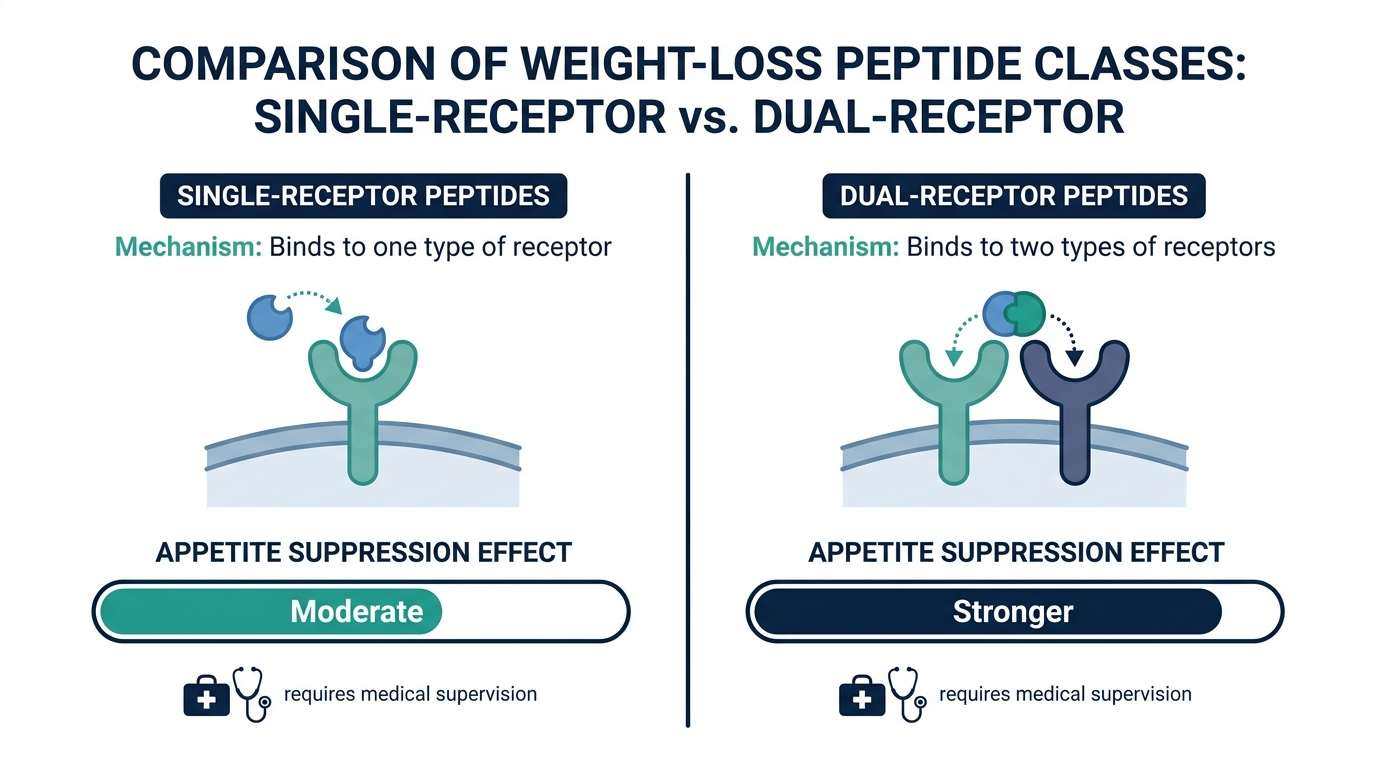
The two approved front-runners are both peptides, but they are not the same tool. Semaglutide activates a single receptor, the GLP-1 receptor. Tirzepatide activates two, GLP-1 plus GIP, another gut hormone involved in insulin response and fat handling. In head-to-head trial data, the dual agonist produced larger average weight loss, which is why tirzepatide sits at the top of the numbers you saw above.
That does not automatically make tirzepatide the right choice for everyone. Individual response varies a lot. Some people tolerate one far better than the other, insurance and pharmacy access differ, and the lowest effective dose that controls appetite matters more than chasing the biggest number. The practical read is that both are legitimate, evidence-backed options, and the decision belongs with a prescribing clinician who can weigh your history, your tolerance, and your cost reality rather than a chart of trial averages.
The myth you will see everywhere: “collagen peptides help you lose weight”
Do not believe the marketing that lumps collagen peptides and GLP-1 drugs together as the same category of “peptide for weight loss.”
Collagen peptides are fragments of hydrolyzed collagen protein, used in supplements and added to coffee and smoothies. They are food. One study found collagen intake increased GLP-1 secretion slightly, which the supplement industry promptly turned into “collagen is like Ozempic.” It is not. The satiety effect of collagen is dramatically lower than a GLP-1 receptor agonist, and no collagen supplement has ever produced the 5 to 22% weight loss seen in GLP-1 drug trials.
Collagen does have real applications: it is a useful protein source that can help preserve lean mass during any weight-loss program, including GLP-1 drug use, and it supports skin elasticity when rapid weight loss causes loose skin. Those are legitimate benefits. Just not fat-burning.
The simplest way to actually get this done
Superpower is a full-body lab membership that runs 100+ biomarkers, has each result reviewed by a doctor, and tracks your numbers year over year (about $199/year). It is what we point readers to when they would rather get one clean, complete draw than chase single tests one at a time. Here is superpower reviewed in full.
The muscle-loss problem nobody talks about until after you start
Here is something most weight-loss content skips: approximately 25 to 40% of the weight lost on GLP-1 drugs is lean mass, not fat. Clinical trials show roughly 40% of semaglutide weight loss comes from lean tissue, not purely fat. This is not unique to peptide drugs, it is typical of any significant caloric deficit, but the speed and magnitude of GLP-1-driven weight loss can amplify it.
The practical fix, backed by current evidence: consume 1.2 to 2 grams of protein per kilogram of body weight daily, distributed across meals, and combine that with structured resistance training. Evidence presented at Endo 2025 showed higher protein intake significantly protected muscle mass in GLP-1 users. The medication handles appetite; the protein and training handle what you keep.
The question everyone asks last: what happens when you stop?
This is the part the ads leave out, and it is arguably the most important thing to understand before you start. GLP-1 drugs treat obesity the way blood pressure medication treats hypertension. They work while you take them, and the underlying biology reasserts itself when you stop. In the trial follow-up data, patients who came off semaglutide regained a large share of the weight they had lost within about a year, and their metabolic improvements drifted back toward baseline too.
The takeaway is not that the drugs fail. It is that they are a long-term tool for a chronic condition, not a short course you finish. Appetite is regulated by hormones, and when you remove the signal that was turning hunger down, hunger returns. This is exactly why the lifestyle scaffolding matters so much: the protein, the resistance training, and the eating habits you build while the medication makes appetite manageable are what give you a fighting chance to hold results if you ever taper off. Plan for the long game from day one, and have the taper conversation with your clinician rather than stopping cold on your own.
What about the next generation: BRP and beyond?
In April 2026, Stanford Medicine researchers published findings on a naturally occurring molecule called BRP, a 12-amino-acid peptide the human body already makes. In animal tests, a single injection of BRP before a meal cut food intake by up to 50% within an hour, and two weeks of daily injections in obese mice produced fat loss with no nausea or muscle wasting. Stanford researchers say BRP acts directly on the brain’s appetite-control center through a different pathway than GLP-1, without the GI side effects.
BRP is early-stage research. There is no human trial data yet. The reason to know about it: it confirms that the category of peptide-based weight-loss interventions is still expanding fast, and the next approved drug in five years may work differently from everything currently available.
Also on the horizon: UBT251, a next-generation amylin analog from Novo Nordisk, showed approximately 20% weight loss in early 2026 data and may eventually offer an alternative for patients who do not tolerate GLP-1 side effects well.
Who is actually a candidate, and who should not touch these?
The FDA-approved GLP-1 drugs are cleared for adults with obesity, generally a body mass index of 30 or higher, or a BMI of 27 or higher when paired with a weight-related condition such as type 2 diabetes, high blood pressure, or sleep apnea. That is the population where the benefit-to-risk math is strongest. Using them purely to drop a few vanity pounds at a normal weight is a different risk calculation, and one a clinician should make with you, not for you.
Some people should avoid GLP-1 drugs outright. They are contraindicated in anyone with a personal or family history of medullary thyroid carcinoma or the genetic syndrome MEN2, and in people with a history of pancreatitis they are used with real caution. Pregnancy is a clear stop. Growth hormone secretagogues carry their own hard line: because they raise growth hormone and IGF-1, they are off the table for anyone with an active cancer or a cancer history. None of this is meant to scare you away from a proven therapy. It is the reason a real intake and a real medical history exist, and the reason the grey-market route that skips all of it is the genuinely dangerous one.
What does getting a weight-loss peptide actually involve in 2026?
The path depends entirely on which peptide and which legal lane.
For FDA-approved GLP-1 drugs (semaglutide, tirzepatide, oral semaglutide): a telehealth clinic is the most accessible route. Platforms like Ro, Found, Hone Health, and Defy Medical connect you with a licensed clinician via video, do a baseline intake, and write a prescription sent to a compounding or brand-name pharmacy. Costs range from $150 to $500 per month depending on the provider, dose, and whether insurance applies. Beginning July 1, 2026, eligible Medicare patients may access FDA-approved GLP-1 drugs for weight loss at $50 per month through the Medicare GLP-1 Bridge Program.
For CJC-1295, ipamorelin, and sermorelin: these are available through licensed telehealth and anti-aging clinics after a consultation and labs. Sermorelin typically runs $175 to $225 per month.
For research peptides (BPC-157, retatrutide, melanotan, etc.): these are sold online labeled “for research use only” and are not legal for human use. The FDA has been actively enforcing in this space since late 2024. Grey-market vendors can disappear overnight and have no accountability for purity. Retatrutide vials sold by research vendors have failed independent purity testing at alarming rates. The licensed clinical route is not just safer; for the peptides that matter most, it is becoming the cheaper route as compounding pharmacies come back online after regulatory revisions.
Telehealth GLP-1 program with provider visits and pharmacy coordination.
What are the real side effects?
GLP-1 drugs: nausea is the most common, reported by 30 to 44% of users in clinical trials, along with vomiting, constipation, and diarrhea. Most GI effects peak in the first 20 weeks and are dose-dependent. Dose escalation protocols exist specifically to reduce them. Rare but serious: pancreatitis risk and thyroid C-cell tumor risk in rodents (not confirmed in humans at therapeutic doses, but worth discussing with a clinician). Muscle loss: 25 to 40% of weight lost is lean mass without resistance training and adequate protein.
GH secretagogues (CJC-1295, ipamorelin): common effects include water retention, tingling, mild hunger spikes, and injection-site reactions. Because they raise growth hormone and IGF-1, they are contraindicated in anyone with a history of cancer or active malignancy.
Research peptides in general: unknown. The risk is not just the compound’s pharmacology, it is what you are actually injecting. Independent testing has found research-vendor products ranging from 75% to 99% purity. Reconstitution errors, wrong dosing math, and contaminated bacteriostatic water are real variables that a licensed pharmacy eliminates entirely.
Turn what you just learned into action.
Superpower lets you test 100+ biomarkers from home, then re-check them over time so you can actually see progress, physician-reviewed at every step.
Frequently asked questions
What is a peptide for weight loss in simple terms?
A short chain of amino acids that signals your body to eat less, release fat from storage, or produce more growth hormone. The best-proven examples are the GLP-1 drugs semaglutide and tirzepatide, which require a prescription.
Are GLP-1 drugs really peptides?
Yes. Semaglutide is a 31-amino-acid peptide, a modified analog of the natural GLP-1 hormone. Tirzepatide is a 39-amino-acid synthetic peptide that activates two receptors simultaneously. Calling them “peptide drugs” is accurate and precise.
How much weight can you realistically lose on a weight-loss peptide?
With the FDA-approved GLP-1 drugs, clinical trials show 14 to 22.5% mean body-weight loss over 68 to 72 weeks. Individual results vary. The trials require participants to follow a lifestyle program (diet and exercise), so the medication does not do the work alone.
Are peptides for weight loss safe?
The FDA-approved GLP-1 drugs have extensive clinical trial data showing a favorable safety profile at therapeutic doses, with known, manageable side effects. Research-grade injectable peptides sold by grey-market vendors have no such data, no purity guarantee, and no prescriber behind them.
Can you get peptides for weight loss without a prescription?
Collagen peptide supplements are sold over the counter but do not produce clinically meaningful fat loss. For the peptides that actually work at scale (semaglutide, tirzepatide), you need a prescription. Telehealth clinics have made that access far easier and faster than a traditional doctor visit.
What is retatrutide and why is everyone talking about it?
Retatrutide is a triple-agonist peptide from Eli Lilly in late-stage clinical trials. Phase 3 data from June 2026 showed 28.3% mean weight loss, the highest ever recorded in an obesity drug trial. It is not yet FDA-approved. Grey-market versions are circulating but have failed purity testing. The legitimate path is waiting for approval or enrolling in a clinical trial.
Is the nausea from GLP-1 peptides permanent?
No. GI side effects are dose-dependent and typically peak in the first 12 to 20 weeks. A standard slow escalation protocol, starting at 0.25 mg semaglutide and increasing every four weeks, is specifically designed to minimize them. Most patients who stay on the medication report GI issues resolve significantly by month three to four.
Do you have to take a weight-loss peptide forever?
For most people, keeping the weight off means staying on some maintenance dose, because obesity is a chronic condition and appetite rebounds when the drug is stopped. Some patients work with a clinician to taper to a lower dose over time while leaning hard on protein, training, and eating habits. Stopping abruptly on your own is the most common route to fast regain.
Does insurance cover GLP-1 drugs for weight loss?
It is inconsistent. Coverage is more common when there is a diagnosis like type 2 diabetes and less reliable for weight loss alone, and it varies by plan and employer. Many people end up paying cash through telehealth or compounding pharmacies, which is why the monthly cost range is so wide. Check your specific plan rather than assuming.
What would I actually recommend?
Start with a metabolic blood panel before you call any clinic. You want to know your fasting insulin, HbA1c, IGF-1, and inflammatory markers before choosing a peptide, because those numbers tell you which mechanism addresses your actual biology rather than the one generating the most social media buzz.
From there, the clinical evidence is not subtle: if fat loss is the goal, GLP-1 drugs are the only peptide class with replicated, large-scale human proof. CJC-1295 and ipamorelin may offer complementary benefits if your growth hormone axis is the problem, but that requires labs to confirm, not a forum thread.
Do not start with a research vendor. The enforcement environment in 2026 means the grey-market peptide landscape is thinning fast. Retatrutide, the most searched weight-loss peptide right now, failed purity testing in multiple independent analyses of grey-market vials. The same amount of money buys you into a telehealth program with a real prescription and a pharmacist standing behind it.
Telehealth GLP-1 program with provider visits and pharmacy coordination.
Author: Vital Signs Today Editorial Team. Educational content, not medical advice. Sources linked inline.
Primary sources:
– SURMOUNT-1 tirzepatide trial, Eli Lilly investor release: https://investor.lilly.com/news-releases/news-release-details/lillys-tirzepatide-delivered-225-weight-loss-adults-obesity-or
– OASIS 4 oral semaglutide trial, ACC Journal Scans: https://www.acc.org/latest-in-cardiology/journal-scans/2025/09/24/16/40/oasis-4
– TRIUMPH-1 retatrutide phase 3, Eli Lilly investor release: https://investor.lilly.com/news-releases/news-release-details/lillys-triple-agonist-retatrutide-delivered-powerful-weight-loss
– Stanford BRP peptide discovery, ScienceDaily: https://www.sciencedaily.com/releases/2026/04/260412221946.htm
– Semaglutide clinical outcomes systematic review, PMC: https://pmc.ncbi.nlm.nih.gov/articles/PMC11887937/
– Muscle loss on GLP-1s, Mass General: https://advances.massgeneral.org/endocrinology/article.aspx?id=1601
– GLP-1 half-life and endogenous production, Wikipedia/Fellahealth: https://www.fellahealth.com/guide/does-your-body-naturally-produce-glp1
– GLP-1 cost guide 2026, TelehealthAlly: https://www.telehealthally.com/guides/glp1-cost-guide
– GELITA collagen vs GLP-1 satiety comparison: https://www.gelita.com/en/knowledge/blog/using-collagen-peptides-support-weight-loss-and-manage-glp-1-side-effects-obesity-treatment
– Protein intake and muscle preservation on GLP-1s, Endocrine Society: https://www.endocrine.org/news-and-advocacy/news-room/endo-annual-meeting/endo-2025-press-releases/haines-press-release
Want a real clinician to run the numbers, not a guess?
Joi + Blokes is a telehealth clinic that prescribes GLP-1 medication (Zepbound, compounded semaglutide and tirzepatide), hormone therapy (TRT, HRT), thyroid care, and peptides after a real lab panel and clinician review, with no membership or consult fee (prescriptions from about $59/month, lab panels from $149). If the scale will not budge, this is where you find out whether insulin, thyroid, or hormones are the real reason. Here is Joi + Blokes reviewed in full.
Related reading
Vital Signs Today may earn a commission if you buy through links on this page. It does not affect our editorial assessments.