Educational content, not medical advice. Talk to a licensed clinician before starting any medication.
Short answer: Yes. Wegovy (semaglutide) is a 31-amino-acid synthetic peptide, engineered to mimic the gut hormone GLP-1 while resisting the enzyme that wipes out native GLP-1 within two minutes. Three precise molecular modifications stretch its half-life to roughly seven days, making once-weekly dosing possible. It is as much a peptide as BPC-157 or sermorelin, just an FDA-approved, prescription one with decades of clinical evidence behind it.
Wegovy is a lab-engineered peptide mimicking your own GLP-1. Curious what your natural metabolic markers look like right now? One at-home Superpower draw checks 100+ biomarkers, physician-reviewed.
Most people asking “is Wegovy a peptide?” are really asking one of two very different questions. The first is biochemical: what is this drug, chemically? The second is practical: if Wegovy is a peptide, does that mean those research-peptide sites sell something equivalent? The answer to the first question is yes, it is a peptide. The answer to the second is firmly no, and the gap between the two is worth understanding before spending a dollar.
Wegovy sits at the intersection of the prescription drug world and the peptide world, and it is the clearest example of why those worlds are not the same thing, even when the molecule is. Let me walk through the chemistry, the clinical data, the 2026 regulatory landscape, and where you can legitimately get it.
What does it mean to call something a peptide?
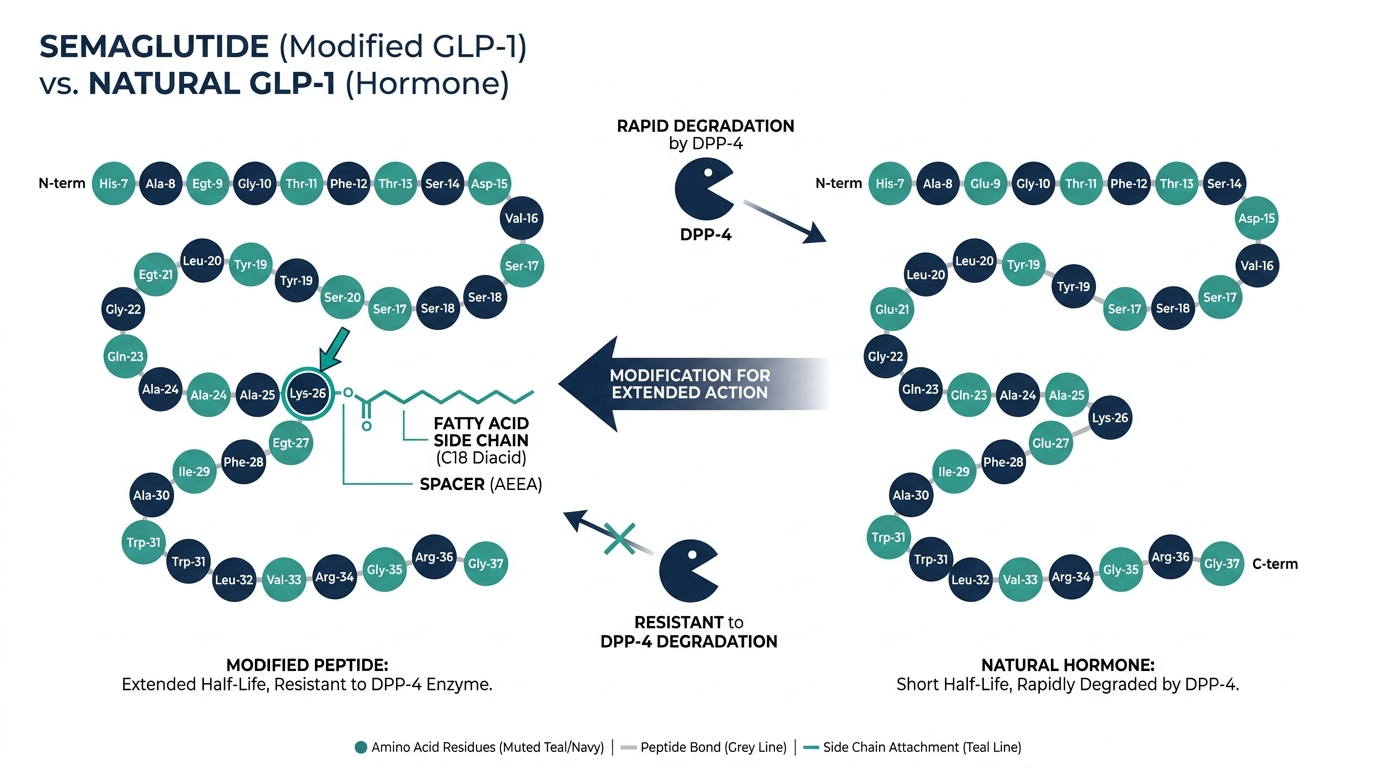
A peptide is a chain of amino acids linked by peptide bonds. When that chain is under roughly 50 amino acids, biochemists call it a peptide. Between 50 and a few hundred, it starts blending into protein territory. Semaglutide, the active molecule in Wegovy, is a 31-amino-acid chain with a molecular weight of approximately 4,113 Da, sitting squarely in the middle of the peptide range.
For context: natural insulin is a 51-amino-acid peptide. BPC-157, the gut-healing research peptide popular in biohacking circles, is a 15-amino-acid peptide. Sermorelin, prescribed through telehealth for growth hormone support, is a 29-amino-acid peptide. Semaglutide, at 31 amino acids, fits comfortably in the same category.
The reason peptides generally require injection is straightforward: swallow a peptide and digestive enzymes in the stomach and small intestine break the amino-acid chain apart before it reaches the bloodstream. It becomes nutrition, not medicine.
The one notable exception with semaglutide is the oral Wegovy pill, which the FDA approved in late 2025. It reaches the bloodstream through a clever absorption enhancer called SNAC (sodium N-[8-(2-hydroxybenzoyl) aminocaprylate), which temporarily permeabilizes the stomach wall. Even so, oral bioavailability is far lower than the injection.
How semaglutide differs from your body’s own GLP-1
The simplest way to actually get this done
Superpower is a full-body lab membership that runs 100+ biomarkers, has each result reviewed by a doctor, and tracks your numbers year over year (about $199/year). It is what we point readers to when they would rather get one clean, complete draw than chase single tests one at a time. Here is superpower reviewed in full.
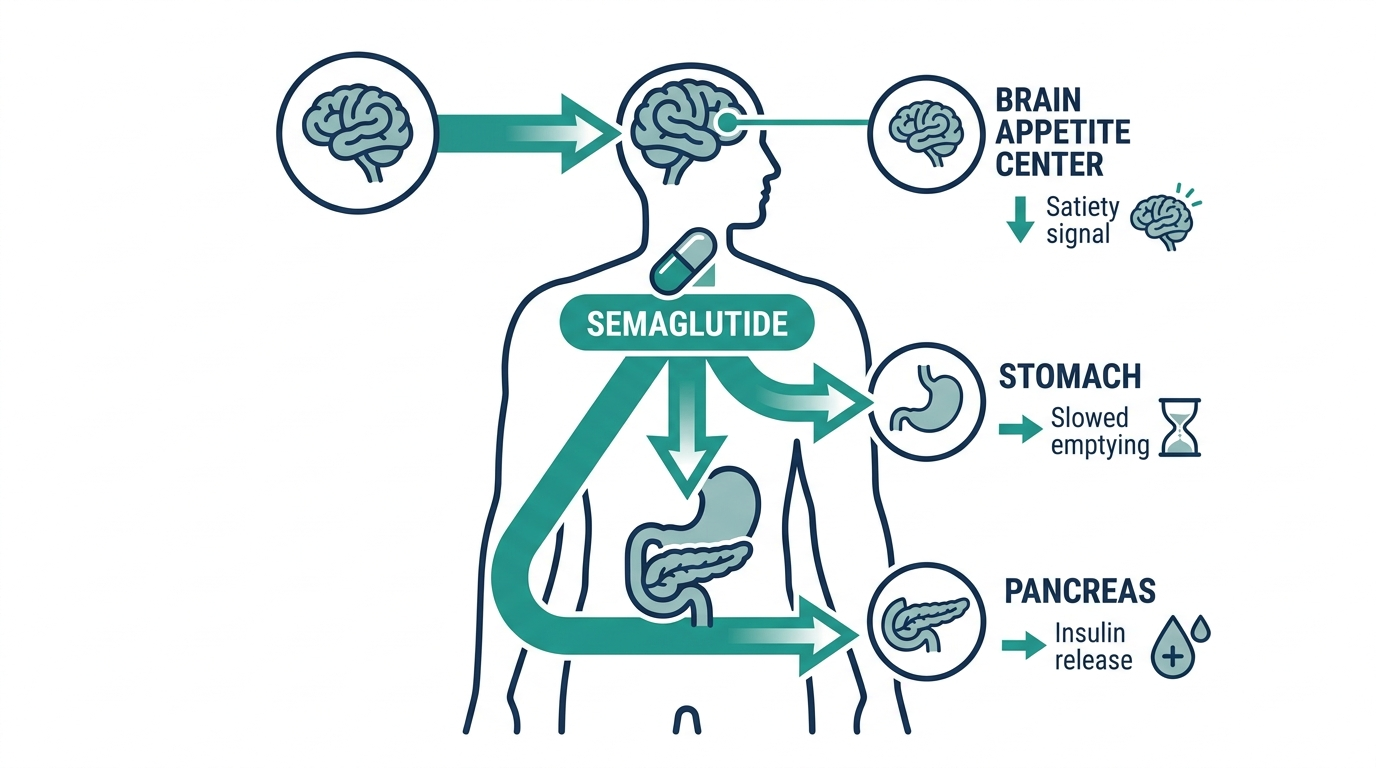
Your gut already makes a GLP-1 peptide. Specialized L-cells lining the small intestine and colon release it within minutes of eating, and it does most of what Wegovy is famous for: it signals the pancreas to release insulin, tells the brain you are full, slows gastric emptying so you absorb carbohydrates more slowly, and damps glucagon to prevent blood sugar spikes.
The problem with native GLP-1 as a therapy is its half-life. Natural GLP-1 is degraded by an enzyme called DPP-4 within roughly 1.5 to 2 minutes of entering the bloodstream. You would need a continuous intravenous drip to use it clinically, which is why it is never prescribed as a drug itself.
Novo Nordisk’s engineers spent years solving that problem. The solution was semaglutide, which shares 94% sequence homology with native human GLP-1 but carries three targeted modifications that transform a two-minute hormone into a seven-day drug.
Modification one, position 8: In native GLP-1, position 8 is an alanine residue. DPP-4 recognizes and cleaves the molecule right there. Semaglutide swaps that alanine for alpha-aminoisobutyric acid (Aib), a bulkier molecule that creates steric hindrance. DPP-4 can no longer fit its active site onto the chain. The primary clearance pathway is blocked.
Modification two, position 34: Arginine replaces lysine at position 34. This is essentially a site-clearance step, freeing up position 26 for the critical third modification.
Modification three, position 26 fatty acid chain: A C18 fatty diacid (stearic acid derivative) is attached to lysine at position 26 via a short spacer. This chain binds tightly to albumin, the body’s most abundant plasma protein. Albumin is too large to be filtered by the kidneys, so anything riding on albumin circulates for weeks. Semaglutide essentially hitches a slow ride. The result is a half-life of approximately 165 to 184 hours, or roughly seven days, enabling once-weekly subcutaneous dosing.
That is the full picture of what “peptide” means in the Wegovy context: a short amino-acid chain, engineered to evade the body’s normal cleanup machinery, carrying a fat tail that anchors it in circulation for a week.
Is Wegovy the same peptide as Ozempic?
Yes, with one important difference: the approved use and the dose. Both Wegovy and Ozempic contain semaglutide, the same 31-amino-acid molecule. Ozempic is approved for type 2 diabetes management at doses of 0.5 mg, 1 mg, or 2 mg once weekly. Wegovy is approved specifically for chronic weight management at a maintenance dose of 2.4 mg once weekly.
The off-label prescribing of Ozempic for weight loss is partly what created the drug shortage that dominated headlines from 2022 to 2025. People with diabetes lost access to Ozempic because people without diabetes were using it for weight loss, driving Novo Nordisk to expand capacity and formally launch Wegovy as the weight-management-specific brand.
Personally, the Ozempic-versus-Wegovy confusion frustrates me because it obscures the real distinction, which is the dose. Same molecule, different dose target. Wegovy at 2.4 mg produces meaningfully more weight loss than Ozempic at 1 or 2 mg, and that dose difference is why Wegovy was separately approved and separately studied.
Full-body lab membership: 100+ biomarkers, doctor-reviewed, tracked over time.
What does the clinical data actually show?
Wegovy is one of the most studied weight-loss medications in history. The clinical picture as of 2026 is specific, not vague.
The pivotal STEP 1 trial, published in the NEJM, enrolled 1,961 adults with obesity and no diabetes. At 68 weeks on the 2.4 mg dose, participants lost an average of 14.9% of body weight versus 2.4% for placebo. Nearly 70% of participants lost at least 10% of their body weight.
For cardiovascular outcomes, the SELECT trial enrolled 17,604 patients with established cardiovascular disease and overweight or obesity but no diabetes. Over up to five years, Wegovy reduced the risk of major adverse cardiovascular events (heart attack, stroke, cardiovascular death) by 20% compared to placebo. The FDA approved this new cardiovascular indication in March 2024.
Then in March 2026, the FDA approved Wegovy HD (semaglutide 7.2 mg), a higher-dose formulation. The STEP UP trial showed 20.7% mean body weight loss over 72 weeks at the 7.2 mg dose, roughly six percentage points more than the standard 2.4 mg. Notably, one-third of participants on the higher dose lost 25% or more of their body weight. The approval used an accelerated 54-day review timeline, the first drug approved under the FDA Commissioner’s National Priority Voucher pilot program.
The oral Wegovy pill (semaglutide 25 mg daily) was also approved, based on the OASIS 4 trial showing 16.6% mean weight loss at 64 weeks with full adherence. Novo Nordisk launched it in the US in early January 2026, making Wegovy the first oral GLP-1 receptor agonist approved for weight management.
| Formulation | Dose | Mean weight loss | Key trial | FDA approval |
|---|---|---|---|---|
| Wegovy injection (standard) | 2.4 mg weekly | 14.9% at 68 weeks | STEP 1 | June 2021 |
| Wegovy (cardiovascular indication) | 2.4 mg weekly | 20% MACE reduction | SELECT | March 2024 |
| Wegovy pill (oral) | 25 mg daily | 16.6% at 64 weeks | OASIS 4 | Late 2025 |
| Wegovy HD injection | 7.2 mg weekly | 20.7% at 72 weeks | STEP UP | March 2026 |
The real-world numbers run lower than trial figures, averaging 8 to 12% body weight loss due to adherence gaps and dose-holding when side effects occur. Still, no over-the-counter supplement comes close to any of those numbers, which is the core reason the “natural peptide” angle on weight loss remains a compelling piece of marketing with thin evidence behind it.
The myth: “research peptides can replicate what Wegovy does”
Do not believe anyone telling you that a vial of research-grade semaglutide or retatrutide you reconstitute at home is equivalent to Wegovy. The molecule itself may be similar, but everything surrounding it is not.
A prescription Wegovy pen contains pharmaceutical-grade semaglutide, manufactured under Good Manufacturing Practice (GMP) conditions, with identity verification, purity testing, and dose accuracy guaranteed by a licensed pharmaceutical company accountable to the FDA. The formulation is purpose-built for subcutaneous injection with exactly 2.4 mg per dose, no measurement required.
A research vial is a lyophilized powder of unknown provenance. You reconstitute it yourself with bacteriostatic water, calculate the dose using concentration math (get one decimal wrong and your dose is off by a factor of ten), draw it with an insulin syringe, and inject it with no pharmacist, no physician, and no safety net. The independent testing platform Finnrick has found research semaglutide batches failing purity checks and identity verification. You are the QC lab, the pharmacist, and the nurse simultaneously.
More concretely: the FDA resolved the semaglutide shortage on February 21, 2025, setting enforcement deadlines of April 22, 2025 (503A compounding pharmacies) and May 22, 2025 (503B outsourcing facilities) for wind-down of compounded semaglutide. Courts denied the legal challenges. As of mid-2025, compounding an “essentially a copy” version of Wegovy is no longer legally permissible. Any site still openly selling injectable compounded semaglutide is either operating outside the law or using a creative workaround that puts the legal and safety risk entirely on the buyer.
The research-peptide forums will still point you toward grey-market “sema” vendors. I understand the appeal. The price difference between a compounded vial and a Novo Nordisk pen is real. But the enforcement and safety landscape shifted completely in 2025, and the grey-market reason to go that route has essentially evaporated.
How does Wegovy compare to other peptides used for weight loss?
The phrase “peptides for weight loss” covers a very wide range, from fully approved medications like Wegovy to experimental research compounds, and the difference in evidence quality is enormous.
| Peptide | Type | Weight loss evidence | Legal route in the US |
|---|---|---|---|
| Semaglutide (Wegovy) | FDA-approved GLP-1 agonist | 14.9% to 20.7% in RCTs | Prescription via licensed clinician or telehealth |
| Tirzepatide (Zepbound) | FDA-approved GIP/GLP-1 dual agonist | 22.5% in SURMOUNT-1 | Prescription via licensed clinician or telehealth |
| Retatrutide | Investigational GIP/GLP-1/glucagon triple agonist | Phase 3 in progress; Phase 2 showed 24% | Research only, no prescription route |
| CJC-1295 + Ipamorelin | GH secretagogues | No robust weight-loss RCTs | Compounding grey zone, shifting toward licensed |
| Sermorelin | GH secretagogue | Indirect (muscle/fat composition) | Telehealth, $175 to $225 per month |
| BPC-157 | Gut and tissue repair peptide | No weight-loss evidence | Regulatory status shifting; not a weight-loss peptide |
The gap between Wegovy and the research compounds in the table is not a matter of opinion. Wegovy has thousands of peer-reviewed studies, two decades of clinical development, and five years of post-market safety data. Retatrutide, despite impressive Phase 2 numbers, does not yet have Phase 3 completion or an approved indication. The others have no weight-loss-specific RCT evidence at all.
Telehealth GLP-1 program with provider visits and pharmacy coordination.
What does getting Wegovy actually cost and look like in 2026?
The pricing landscape changed significantly in early 2026 when Novo Nordisk launched its direct subscription model, competing with telehealth platforms that had been eating into its market share.
List price: Wegovy’s official list price is approximately $1,349 per month for the injection. That number is largely irrelevant for most buyers because almost no one pays it.
With commercial insurance: Novo Nordisk reports that 90% of patients with commercial insurance pay $0 to $25 per month. Coverage is uneven, but a growing share of employer plans cover it, particularly after the SELECT cardiovascular trial data.
Self-pay via subscription: Through Novo Nordisk’s March 2026 subscription program, cash-paying patients pay $149 per month for the titration doses (up to 1.5 mg) and $199 per month for the 4 mg and 2.4 mg maintenance doses, with savings of up to $1,200 per year on 12-month plans. The Wegovy pill starts at $149 per month for the lowest dose.
Telehealth platforms: Hims & Hers charges $39 for the first month and $149 per month thereafter. Noom Med starts at $129. Ro, LifeMD, and WeightWatchers are also authorized partners in the Novo Nordisk program.
Medicare: The SELECT trial data opened a coverage path. Medicare Part D does not cover weight-loss medications, but it does cover medications for cardiovascular risk reduction. Because Wegovy now carries an approved cardiovascular indication, patients with established cardiovascular disease and overweight or obesity may qualify, a loophole worth checking with a clinician.
One thing none of these programs will change: there is no insurance coverage and no subsidy for obesity treatment that is purely elective without a qualifying comorbidity. Budget for the full cost before starting if you do not have a qualifying condition.
Can you get semaglutide without a prescription?
No, not legally in the US as of mid-2026. Injectable semaglutide requires a prescription from a licensed physician, nurse practitioner, or physician assistant. The compounding pharmacy window that briefly existed when Ozempic and Wegovy were on the FDA shortage list closed formally in spring 2025.
What you will find if you search aggressively are three categories of grey-market options, and all three carry real problems.
First, research-grade semaglutide labeled “for laboratory research only,” sold in vials with no dosing guidance. This is not a therapeutic product. The label is a legal disclaimer, and the liability is entirely yours.
Second, offshore telehealth services that prescribe without a real clinical review. Same-day prescriptions with no lab work required, no follow-up built in, and pricing dramatically below market are the tells. These services are often sourcing from non-compliant compounders or research-chemical vendors and dressing it in a clinical interface.
Third, services selling peptides described as “GLP-1 support” or “natural semaglutide alternatives” that are actually herbal supplements with no mechanism of action comparable to semaglutide. This is marketing, not medicine.
The right move in 2026 is straightforward: use a licensed telehealth provider that requires a real intake, prescribes brand-name Wegovy through a verified pharmacy, and builds follow-up labs into the program. The prescription process takes about 15 minutes online, the cost has dropped to a genuinely accessible level, and the molecule you receive is the one that showed 14.9% body weight loss in a 1,961-person randomized controlled trial.
Don’t just read about your health, track it.
A single result is a snapshot. Superpower re-tests 100+ markers over time so you can watch them move as you change sleep, food, and training.
Frequently asked questions
Is Wegovy a peptide or a biologic?
Both, depending on how you define the terms. Wegovy contains semaglutide, a 31-amino-acid synthetic peptide, which places it in the peptide class chemically. It is also classified as a biologic by the FDA because it is a large, complex molecule derived from biological engineering rather than small-molecule chemical synthesis. The distinction matters primarily for patent and regulatory reasons, not for how it works in your body.
Is Wegovy the same as semaglutide?
Yes. Wegovy is the brand name for the 2.4 mg weekly formulation of semaglutide, approved specifically for chronic weight management. Ozempic is the brand name for the 0.5 mg to 2 mg weekly formulation, approved for type 2 diabetes. Same molecule, different dose targets and approved indications.
How does Wegovy compare to other GLP-1 peptides for weight loss?
Among FDA-approved options, Wegovy (semaglutide 2.4 mg) produces roughly 14.9% mean body weight loss. Wegovy HD (7.2 mg) reaches 20.7%. Tirzepatide (Zepbound), a dual GLP-1 and GIP agonist with 39 amino acids, produces 22.5% mean weight loss in the SURMOUNT-1 trial. Investigational molecules like retatrutide show 24% in Phase 2 data, but have no approved route yet.
Can I buy Wegovy without a prescription?
Not legally. Wegovy requires a prescription in the US. Compounded semaglutide, which briefly filled the gap during the shortage, is no longer legally permitted for essentially a copy of Wegovy since the FDA resolved the shortage and enforcement deadlines passed in spring 2025. The legitimate route is telehealth, with brand-name Wegovy available starting at $149 per month through Novo Nordisk’s own subscription program.
Is the Wegovy pill (oral semaglutide) also a peptide?
Yes. The oral Wegovy pill, approved in late 2025 and launched in January 2026, contains the same 31-amino-acid semaglutide peptide. The pill uses an absorption enhancer called SNAC to get the peptide through the stomach wall without being fully digested. The OASIS 4 trial showed 16.6% mean weight loss at 64 weeks, comparable to the injectable.
What is the difference between Wegovy and a research peptide like BPC-157 or CJC-1295?
Wegovy is an FDA-approved medication manufactured under GMP standards, dispensed through a licensed pharmacy with a prescription, and backed by decades of clinical evidence in tens of thousands of patients. BPC-157 and CJC-1295 are research-grade peptides with no FDA approval for any indication, no verified manufacturing standards, and no robust weight-loss clinical data. They exist in completely different legal and evidence tiers, even though they are all chemically classified as peptides.
Does Wegovy work long-term, or does weight come back?
Clinical evidence shows that weight regain occurs when Wegovy is stopped. The STEP 4 trial found that participants who discontinued semaglutide regained about two-thirds of the weight lost over the following year. This suggests the drug treats obesity as an ongoing condition, not a fixed one, and most clinicians now approach it as a long-term or indefinite therapy rather than a short course.
Telehealth GLP-1 program with provider visits and pharmacy coordination.
Author: [CAN XAC NHAN: ten + credential tac gia/reviewer health cua Vital Signs Today, vd “Medically reviewed by [name], [credential]”]. Educational content, not medical advice. Sources linked inline.
Primary sources:
– Semaglutide, StatPearls, NIH
– Semaglutide molecular structure, Wikipedia
– The Discovery and Development of Semaglutide, Frontiers in Endocrinology
– STEP 1 trial results, Novo Nordisk Medlink
– SELECT trial FDA approval, March 2024
– Wegovy HD 7.2 mg FDA approval, HCPLive
– Oral Wegovy OASIS 4 trial, AJMC
– FDA GLP-1 compounding policy statement
– Novo Nordisk Wegovy subscription program, PR Newswire
– Wegovy cost and coverage, Novo Nordisk
– Wegovy results 2026, Wegovy.us.com
Want a real clinician to run the numbers, not a guess?
Joi + Blokes is a telehealth clinic that prescribes GLP-1 medication (Zepbound, compounded semaglutide and tirzepatide), hormone therapy (TRT, HRT), thyroid care, and peptides after a real lab panel and clinician review, with no membership or consult fee (prescriptions from about $59/month, lab panels from $149). If the scale will not budge, this is where you find out whether insulin, thyroid, or hormones are the real reason. Here is Joi + Blokes reviewed in full.
Related reading
Vital Signs Today may earn a commission if you buy through links on this page. It does not affect our editorial assessments.