Last updated 18 June 2026. Educational content, not medical advice. Tirzepatide is a prescription-only FDA-approved medication. Speak with a licensed clinician before starting or changing any treatment.
Short answer: Yes. Tirzepatide is a 39-amino-acid synthetic peptide with a molecular weight of 4,813.45 Daltons, making it chemically a peptide in every technical sense. What makes it unusual is that no naturally occurring peptide in your body works quite like it: Eli Lilly’s chemists engineered it to activate two separate hormone receptors at once, which is why it produces weight loss numbers that look unlike anything a single-receptor drug has achieved.
Tirzepatide is a 39-amino-acid peptide reshaping metabolism. See what your own metabolic and hormone markers look like before you start. One at-home Superpower draw checks 100+ biomarkers, physician-reviewed.
So what actually makes something a peptide?
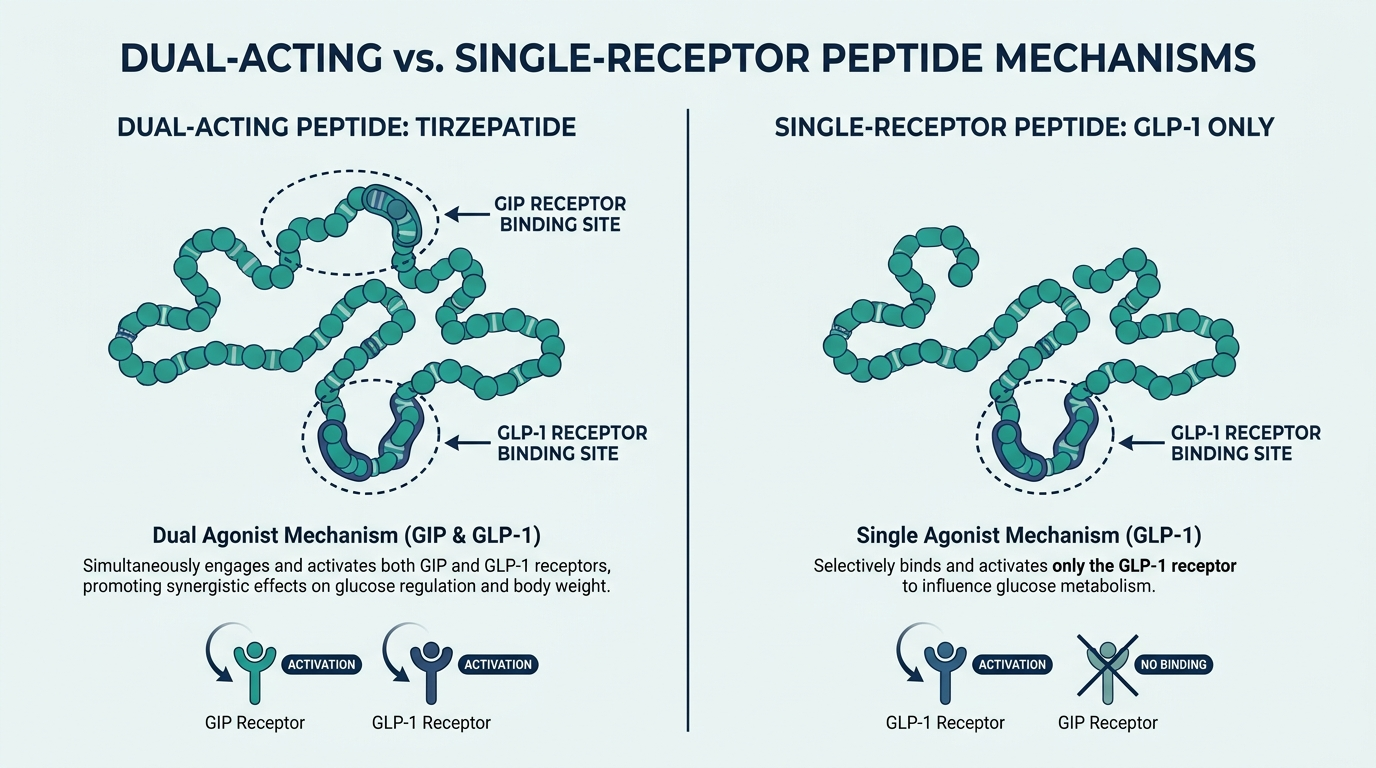
Before asking whether tirzepatide qualifies, it helps to know the boundary. A peptide is a chain of amino acids linked by peptide bonds, typically fewer than 50 amino acids long. Proteins are peptide chains too, but they fold into complex three-dimensional structures and generally exceed 50 amino acids. By that definition, tirzepatide’s 39-amino-acid backbone is firmly a peptide.
The word “synthetic” matters here. Tirzepatide does not exist anywhere in nature. It was designed from scratch by studying the native sequence of GIP (glucose-dependent insulinotropic polypeptide), one of the body’s own incretin hormones, then grafting in GLP-1 receptor activity and modifying the structure to survive in the bloodstream for days rather than minutes. Native GIP and GLP-1 are also peptides, and they both get degraded within minutes by an enzyme called DPP-4. Tirzepatide is the version that lasts.
Incretin hormones are gut-derived peptides that amplify insulin release after a meal. Both GIP and GLP-1 are incretins, which is why drugs that mimic them are called incretin mimetics, one of the less intuitive terms in metabolic medicine.
What is tirzepatide’s chemical structure, exactly?
Tirzepatide’s molecular formula is C225H348N48O68, and it carries three structural modifications that do not appear in any natural peptide:
1. Two alpha-aminoisobutyric acid (Aib) residues. At positions 2 and 13, tirzepatide substitutes Aib, a non-natural amino acid, in place of the standard residues found in native GIP. This single change is why DPP-4 cannot cleave it: the enzyme’s active site cannot grab the modified backbone.
2. A C20 fatty diacid chain at position 20. Attached via a hydrophilic linker to lysine-20, this fatty acid tail binds reversibly to serum albumin, the most abundant protein in blood. Once bound, the peptide is shielded from renal filtration and enzymatic degradation. The result is an elimination half-life of approximately 5 days, which is what makes once-weekly injections pharmacologically rational. After a full week, roughly 40% of the injected dose is still circulating, so the next injection adds to a residual pool rather than starting from zero.
3. An amidated C-terminus. The carboxyl end of the chain is chemically capped, adding another layer of resistance to the carboxypeptidase enzymes that would otherwise nibble it from the tail.
Semaglutide (Ozempic, Wegovy) uses a similar albumin-binding trick, a C18 fatty diacid via lysine-26, but its backbone derives from GLP-1 and spans only 31 amino acids. Tirzepatide is eight amino acids longer, primarily based on GIP, and activates a second receptor entirely. That structural difference is what separates a 13.7% average weight loss (semaglutide in the STEP-8 head-to-head) from a 20.2% average loss (tirzepatide in the same trial).
Why two receptors instead of one?
Here is the part most “what is tirzepatide” articles skip over, and it changes how you think about the weight-loss numbers.
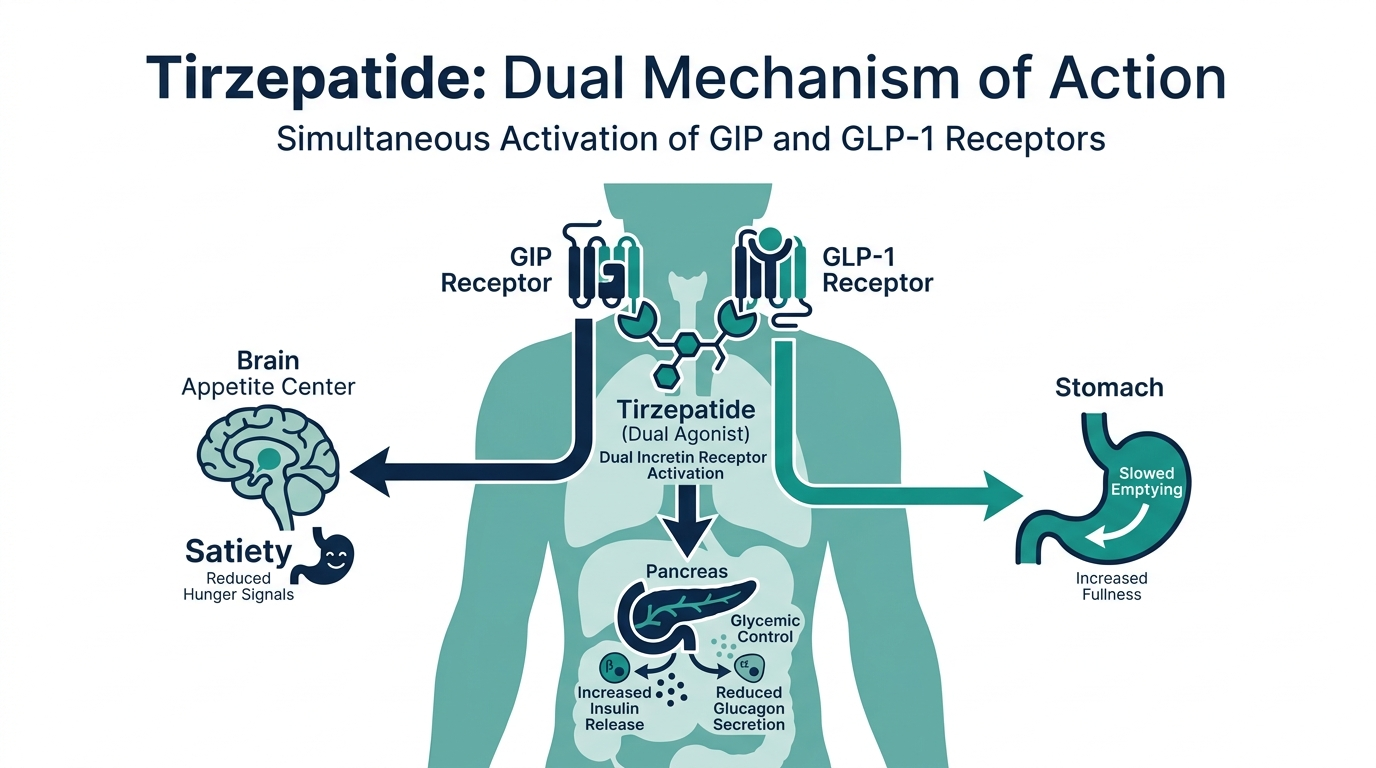
GLP-1 receptors sit in the brain’s appetite centers, the pancreas, and the gut. Activating them slows gastric emptying, suppresses appetite, and boosts insulin secretion. That mechanism, on its own, produces meaningful weight loss. GIP receptors do something different: they act in fat tissue, in the central nervous system (separately from GLP-1 pathways), and in the pancreas, but they also modulate glucagon in a direction that reduces the nausea many patients experience from pure GLP-1 agonists.
The dual hit appears to do more than add the two effects together. Tirzepatide is described in pharmacology literature as an imbalanced and biased dual agonist: it binds the GIP receptor with the same affinity as native GIP but engages GLP-1 receptors with roughly five-fold weaker affinity than native GLP-1. That sounds like a limitation, but it isn’t. The bias matters because it reduces GLP-1-mediated nausea while still driving the appetite suppression. In clinical practice, tirzepatide’s gastrointestinal tolerability is somewhat better than high-dose semaglutide for many patients, even though it produces stronger weight loss.
Personally, I find this one of the more elegant pieces of pharmaceutical engineering in recent memory: the “weakness” at the GLP-1 receptor turns out to be a feature, not a bug.
What the clinical trials actually showed
“Tirzepatide causes weight loss” is true, but the numbers deserve precision, because they reset expectations for what a peptide-based drug can do.
SURMOUNT-1 enrolled 2,539 adults without diabetes who had obesity or overweight plus a weight-related condition. After 72 weeks of once-weekly injections, mean body-weight reductions were 15.0% at 5 mg, 19.5% at 10 mg, and 20.9% at 15 mg, versus 3.1% for placebo. At the 15 mg dose, one in three participants lost more than 25% of their starting body weight.
SURMOUNT-2 tested the same drug in a harder population: 938 adults with obesity AND type 2 diabetes. The 15 mg dose still delivered 15.7% mean weight loss at 72 weeks, and baseline HbA1c dropped from 8.0% to 5.9%, with 49% of tirzepatide-treated patients reaching a normal HbA1c below 5.7% without severe hypoglycemia.
Head-to-head vs. semaglutide (SURMOUNT-5): tirzepatide 10 mg and 15 mg produced an average 20.2% body weight reduction versus 13.7% with semaglutide 2.4 mg over 72 weeks, a 47% relative improvement.
SURMOUNT-OSA (2024): The FDA approved Zepbound in December 2024 as the first prescription medicine for moderate-to-severe obstructive sleep apnea in adults with obesity, based on a 52-week trial showing 25 or more fewer breathing interruptions per hour slept, on average.
Do not believe any claim that tirzepatide is “just like” semaglutide, only more expensive. The structural difference between a 31-amino-acid GLP-1 analog and a 39-amino-acid dual GIP/GLP-1 peptide is real chemistry, and the clinical gap is real data.
Full-body lab membership: 100+ biomarkers, doctor-reviewed, tracked over time.
Tirzepatide vs. semaglutide: a structural comparison
| Feature | Tirzepatide (Mounjaro / Zepbound) | Semaglutide (Ozempic / Wegovy) |
|---|---|---|
| Amino acid count | 39 | 31 |
| Molecular weight | 4,813.45 Da | 4,113.58 Da |
| Backbone derived from | GIP sequence | GLP-1 sequence |
| Receptors activated | GIP + GLP-1 (dual) | GLP-1 (mono) |
| Fatty acid chain | C20 diacid at Lys-20 | C18 diacid at Lys-26 |
| Half-life | ~5 days | ~7 days |
| Dosing | Once weekly | Once weekly |
| Mean wt loss (highest dose, no T2D) | ~20.9% at 72 weeks | ~14.9% at 68 weeks |
| FDA approvals | T2D (2022), Obesity (2023), OSA (2024) | T2D (2017), Obesity (2021) |
| Brand-name cost (LillyDirect/self-pay) | $299-$449/month | ~$499-$650+/month retail |
The half-life difference is worth understanding: semaglutide’s ~7-day half-life gives it a flatter weekly curve; tirzepatide’s ~5-day half-life means levels taper a bit more toward the end of the week, which some patients notice as a slight return of appetite on day 6-7 before their next injection. Neither is superior; they are different engineering choices.
Is tirzepatide a research peptide like BPC-157 or retatrutide?
No, and this distinction matters enormously for anyone searching “tirzepatide peptide” while shopping research-chemical sites.
Tirzepatide is an FDA-approved drug dispensed only by prescription. It is not a “research use only” compound. It is not sold legally in unlabeled vials at $60 per vial on peptide vendor websites. Any site selling tirzepatide as a research peptide is either selling something mislabeled, an outright counterfeit, or a degraded or diluted product, and unlike buying a questionable vial of BPC-157, you would be buying a counterfeit of a drug with a specific dose-titration schedule and known side effect profile. That is a different category of risk.
The FDA removed tirzepatide from its drug shortage list on 2 October 2024, which ended the window for compounding pharmacies to mass-produce tirzepatide copies. Enforcement deadlines hit 503A pharmacies on 18 February 2025 and 503B outsourcing facilities on 19 March 2025. The FDA has since sent more than 135 warning letters to compounders and telehealth companies still operating in that space. So compounded tirzepatide is now, in nearly all cases, either illegal or operating under a narrow documented-medical-necessity exception that your telehealth provider needs to justify explicitly.
The practical upshot: the only legitimate route for tirzepatide in 2026 is brand-name Zepbound or Mounjaro, obtained through a licensed prescriber.
The simplest way to actually get this done
Superpower is a full-body lab membership that runs 100+ biomarkers, has each result reviewed by a doctor, and tracks your numbers year over year (about $199/year). It is what we point readers to when they would rather get one clean, complete draw than chase single tests one at a time. Here is superpower reviewed in full.
How do you actually get tirzepatide in 2026?
The legitimate access path has gotten simpler and cheaper than many patients realize.
LillyDirect self-pay program: Eli Lilly sells Zepbound single-dose vials directly, without insurance, at a capped price: $299/month for the 2.5 mg starting dose, $399 for 5 mg, and $449 for all doses from 7.5 mg through 15 mg. Each monthly prescription is 4 vials, one per week. You need a prescription, which any telehealth provider can issue after a clinical intake.
Telehealth providers: Platforms such as Hims, Hers (forhers.com), Ro Body, Calibrate, and Sequence now connect patients to prescribers who can authorize Zepbound. Bundled costs including prescriber fees typically run $199 to $349 per month at lower doses, stepping up as the dose titrates. Several platforms have pivoted to facilitating access to the brand-name LillyDirect vials directly, cutting out the now-restricted compounding route.
Retail pharmacies: Brand-name Zepbound is available at Walmart, CVS, Walgreens, and independent pharmacies. Without insurance, retail list price runs approximately $1,086 per month. GoodRx coupons and savings programs can reduce that meaningfully, but the LillyDirect self-pay path is almost always cheaper for the cash-pay patient.
Insurance: Zepbound has broader commercial coverage than Wegovy did at launch, and Medicare Part D plans began covering obesity drugs in January 2026 under the Inflation Reduction Act’s expanded provisions. Check your formulary first.
Telehealth GLP-1 program with provider visits and pharmacy coordination.
What to expect once you start: the peptide in your body
Understanding tirzepatide’s pharmacokinetics as a peptide changes how you interpret your own experience on the drug.
After a subcutaneous injection, tirzepatide is absorbed from the injection site over several hours, then enters systemic circulation. The C20 fatty acid tail binds to albumin within minutes, extending circulation time. Steady state is reached after 4 to 5 weeks of consistent dosing, when plasma levels stabilize at roughly 2.1 times the first-dose concentration. This explains why most patients feel little effect in week one, more in weeks three and four, and the full appetite suppression only after the first month or so.
Dose titration (starting at 2.5 mg, stepping up every 4 weeks toward the maintenance dose of 5 mg, 10 mg, or 15 mg) is partly about tolerability and partly about this steady-state dynamic. Jumping to 15 mg immediately would flood the GIP and GLP-1 receptors before the body has adapted, causing significantly more nausea, vomiting, and gastroparesis risk. The titration schedule is pharmacology, not marketing caution.
Side effects are real and common, particularly nausea (reported in 17-22% of patients in trials), diarrhea (13-17%), vomiting (9-11%), and constipation (6-11%). The gastrointestinal effects are direct consequences of the dual receptor mechanism: GLP-1 slows gastric emptying, and when that process is amplified by a GIP component, some patients feel it acutely. Most symptoms resolve by weeks 8-12 as the body adapts to the peptide’s presence.
What actually happens to your weight, and what happens if you stop?
The trial averages are real, but they describe people who stayed on the drug for 72 weeks with clinical support, and that context matters more than the headline percentage. Weight comes off fastest in the first several months, then the curve flattens as your body settles at a new set point and the appetite suppression becomes your new normal rather than a novelty. A plateau is not failure. It is the expected shape of the response, and chasing the early rate of loss by under-eating on top of the drug is how people get into trouble with muscle loss and fatigue.
That muscle-loss point deserves emphasis, because it is the most common mistake on GLP-1 and dual-agonist therapy. When you lose weight quickly on strong appetite suppression, a meaningful share of what comes off can be lean mass unless you defend it. Two habits protect muscle: keep protein intake up, roughly 1.2 to 1.6 grams per kilogram of body weight for most adults losing weight, and do resistance training two or three times a week. The drug handles appetite. It does not decide whether the weight you lose is fat or muscle. You do, through protein and lifting.
The harder truth is what happens when you stop. In the published extension data, people who discontinue tend to regain a substantial portion of the lost weight over the following year, because the underlying biology that set their appetite and set point never changed, the drug was simply overriding it. This is why clinicians increasingly frame tirzepatide as a long-term metabolic treatment, closer to blood-pressure medication than to a short course you finish. If you go in expecting a temporary boost, the regain can feel like personal failure when it is really just pharmacology switching off.
The myth tirzepatide marketing quietly perpetuates
There is a framing that tirzepatide is somehow not a “real” peptide because it is synthetic and engineered, while BPC-157 or sermorelin are the “authentic” peptide therapies. This distinction does not hold up to basic biochemistry.
BPC-157 is a 15-amino-acid synthetic peptide that does not exist in its injectable form in nature. Sermorelin is a 29-amino-acid synthetic peptide designed to mimic the first 29 amino acids of endogenous growth hormone releasing hormone. Every therapeutic peptide you encounter in the supplement and longevity space is, to some degree, a designed molecule. The difference with tirzepatide is not that it is “more synthetic” but that it has cleared three decades of FDA clinical trials, has its safety and efficacy data published in the New England Journal of Medicine, and is dispensed through a licensed pharmacy with a labeled dose. The research-peptide world would call that a disadvantage because of the cost. It is actually the opposite.
Don’t just read about your health, track it.
A single result is a snapshot. Superpower re-tests 100+ markers over time so you can watch them move as you change sleep, food, and training.
Frequently asked questions
Is tirzepatide a peptide or a protein?
It is a peptide. Tirzepatide is a 39-amino-acid chain with a molecular weight of 4,813.45 Daltons. Proteins typically exceed 50 amino acids and fold into tertiary structures; tirzepatide is a linear synthetic peptide with modifications that extend its half-life and add dual-receptor activity.
How is tirzepatide different from GLP-1 peptides like semaglutide?
Semaglutide is a 31-amino-acid peptide that activates only the GLP-1 receptor, while tirzepatide is a 39-amino-acid peptide that activates both the GIP and GLP-1 receptors. In clinical head-to-head trials, tirzepatide produced 47% more weight loss on average than semaglutide at their respective highest doses (20.2% vs. 13.7% body weight over 72 weeks).
Is tirzepatide FDA-approved?
Yes. Tirzepatide (as Mounjaro) was approved for type 2 diabetes in May 2022. As Zepbound, it was approved for chronic weight management in adults with obesity in November 2023, and for moderate-to-severe obstructive sleep apnea in adults with obesity in December 2024.
Can I buy tirzepatide as a research peptide?
No. Tirzepatide is an FDA-approved prescription drug, not a research-use-only compound. The FDA shortage window that allowed compounded tirzepatide from 503A and 503B pharmacies closed in early 2025. Any site selling it as a “research peptide” in unlabeled vials is operating outside the law, and the product’s identity and purity are unverifiable.
How long does tirzepatide stay in your system?
Tirzepatide has an elimination half-life of approximately 5 days. After stopping, it takes roughly 25 to 30 days (5 half-lives) for the drug to clear your system. During active dosing, steady-state plasma levels are reached after 4 to 5 weeks of once-weekly injections.
What does tirzepatide cost in 2026 without insurance?
Through Eli Lilly’s self-pay program on LillyDirect, brand-name Zepbound costs $299/month for 2.5 mg, $399 for 5 mg, and $449 for all doses from 7.5 mg to 15 mg. Telehealth-bundled programs (Hims, Hers, Ro Body) typically run $199 to $349/month at lower doses, usually facilitating access to LillyDirect vials.
Why do I feel tirzepatide more after week 4 than week 1?
Because steady-state plasma levels are not reached until after 4 to 5 weeks of consistent once-weekly dosing. Plasma concentration stabilizes at roughly 2.1 times the first-dose level. The titration schedule and the delayed “full effect” experience are both consequences of this pharmacokinetic reality, not a placebo effect or gradual drug tolerance.
Will I lose muscle on tirzepatide?
You can, and it is the main avoidable downside. Rapid weight loss under strong appetite suppression pulls from lean mass as well as fat unless you keep protein high (roughly 1.2 to 1.6 grams per kilogram of body weight per day for most adults) and train against resistance a few times a week. The medication controls hunger; it does not protect muscle. That part is on your food and your training.
What happens to my weight if I stop tirzepatide?
Most people regain a large share of the lost weight within about a year of stopping, because the drug was overriding an appetite and set-point biology that did not itself change. That is why clinicians tend to treat it as a long-term therapy rather than a short course. Any decision to stop should be a conversation with your prescriber, ideally with a plan to protect the progress you made.
Do I still need to diet and exercise on tirzepatide?
The drug does much of the appetite work for you, which is exactly why it works, but the quality of the weight you lose still depends on protein intake and resistance training, and long-term maintenance still depends on habits. Think of tirzepatide as making a hard job manageable, not as replacing the job entirely.
Telehealth GLP-1 program with provider visits and pharmacy coordination.
Author: Vital Signs Today Editorial Team, [credential]”]. Educational content, not medical advice. Sources linked inline.
Primary sources:
- Tirzepatide structural biology, PNAS 2022
- Tirzepatide as imbalanced dual GIP/GLP-1 agonist, JCI Insight
- SURMOUNT-1 trial results, Eli Lilly press release
- SURMOUNT-2 results, Healio
- Zepbound OSA approval, Eli Lilly press release
- Tirzepatide molecular chemistry, The Journal of Peptide Science
- Tirzepatide half-life pharmacokinetics, Halflife Labs
- Tirzepatide shortage end and compounding deadlines, Harris Beach Murtha
- FDA compounded GLP-1 warning letters, Pharmacy Times
- LillyDirect self-pay pricing, PeptideDeck
- Tirzepatide FDA approval status 2026, GLP3 Planner
Want a real clinician to run the numbers, not a guess?
Joi + Blokes is a telehealth clinic that prescribes GLP-1 medication (Zepbound, compounded semaglutide and tirzepatide), hormone therapy (TRT, HRT), thyroid care, and peptides after a real lab panel and clinician review, with no membership or consult fee (prescriptions from about $59/month, lab panels from $149). If the scale will not budge, this is where you find out whether insulin, thyroid, or hormones are the real reason. Here is Joi + Blokes reviewed in full.
Related reading
Vital Signs Today may earn a commission if you buy through links on this page. It does not affect our editorial assessments.