
Last updated 18 June 2026. Educational content, not medical advice. Retatrutide is an investigational drug, not FDA-approved, and is not available by commercial prescription. Speak with a licensed clinician before starting any weight-loss therapy.
Short answer: Yes. Retatrutide is a synthetic 39-amino acid peptide developed by Eli Lilly (compound code LY3437943). It is a triple agonist that simultaneously activates the receptors for GLP-1, GIP, and glucagon, making it structurally and pharmacologically distinct from semaglutide (GLP-1 only) and tirzepatide (GLP-1 plus GIP). In the TRIUMPH-1 Phase 3 trial, announced May 21, 2026, participants on the 12 mg dose lost an average of 28.3% of body weight at 80 weeks, with 45.3% losing 30% or more. It is not yet FDA-approved, and no commercial prescription path exists in 2026.
Retatrutide activates three metabolic pathways at once. See what your own metabolic markers look like before an investigational drug ever does. One at-home Superpower draw checks 100+ biomarkers, physician-reviewed.
What exactly is a peptide, and does retatrutide qualify?
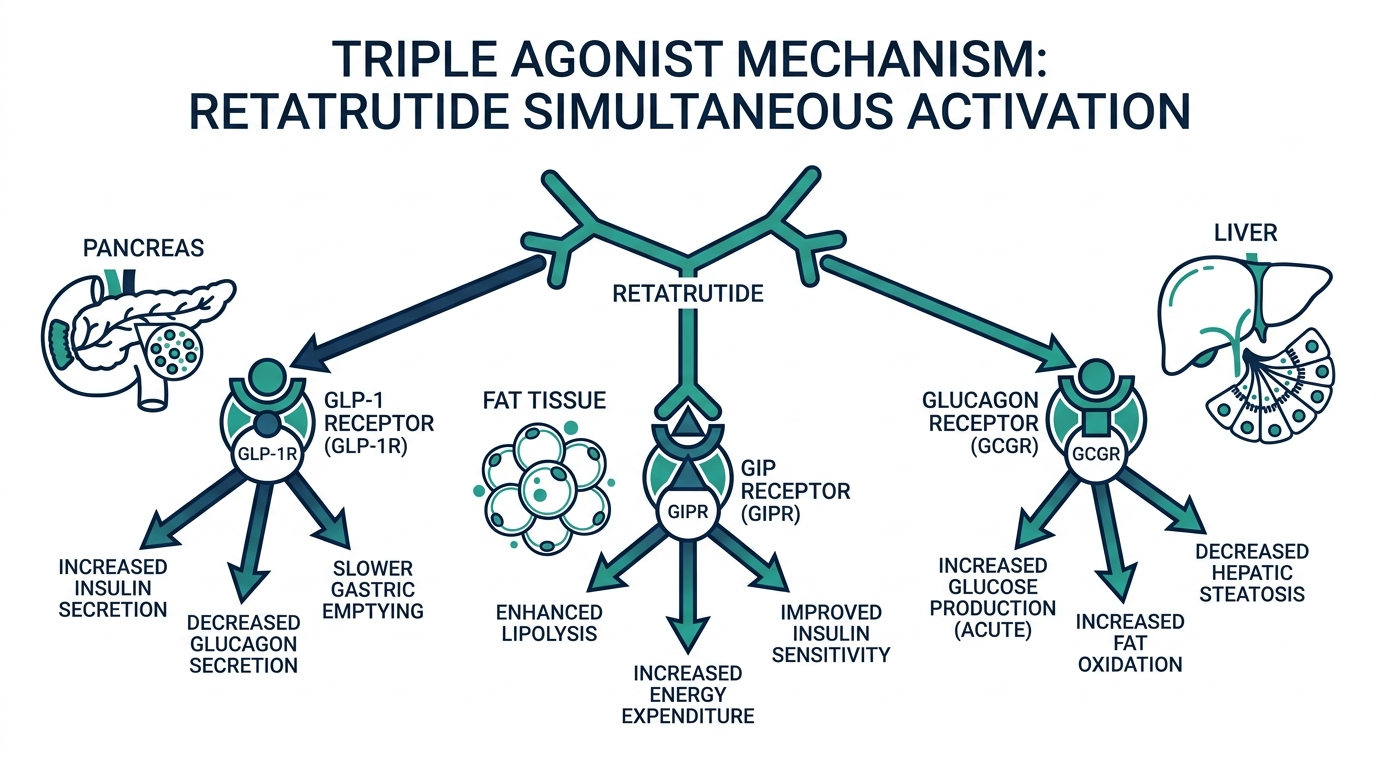
A peptide is a chain of amino acids joined by peptide bonds. By that definition, retatrutide qualifies without debate. It is a synthetic 39-amino acid compound built on a GIP peptide backbone, meaning Eli Lilly’s chemists used native GIP as the starting scaffold and then made precise modifications to achieve three-receptor activity in a single molecule.
Peptides exist on a spectrum. At the small end you have dipeptides like carnosine (two amino acids). Insulin is 51 amino acids. Retatrutide, at 39 amino acids with a molecular weight around 4,813 Da, sits firmly in the mid-range therapeutic peptide category alongside GLP-1 analogs like semaglutide and exenatide.
The word “peptide” in the weight-loss conversation covers two very different categories: pharmaceutical peptides engineered in licensed facilities under GMP conditions, and grey-market “research” peptides sold online with variable quality and zero clinical oversight. Retatrutide exists in the pharmaceutical category only. Any “retatrutide” sold as a research peptide is an unverified chemical that may or may not contain what the label claims.
Full-body lab membership: 100+ biomarkers, doctor-reviewed, tracked over time.
What makes retatrutide structurally different from semaglutide and tirzepatide?
This is the question worth spending time on, because the structure difference is not cosmetic.
Semaglutide (Ozempic, Wegovy) is a GLP-1 receptor agonist. It mimics one hormone. Tirzepatide (Mounjaro, Zepbound) is a dual agonist for GLP-1 and GIP receptors. It mimics two. Retatrutide adds a third: the glucagon receptor (GCGR). Three distinct receptors, one molecule, one weekly injection.
The potency hierarchy measured by EC50 values in the Nature Cell Discovery structural study is telling:
- GIP receptor (GIPR): 0.0643 nM, the strongest binding
- GLP-1 receptor (GLP-1R): 0.775 nM
- Glucagon receptor (GCGR): 5.79 nM, the weakest but functionally critical binding
Retatrutide’s backbone contains three non-standard amino acid substitutions that most people have never heard of. Aib2 (amino isobutyric acid) at position 2 blocks an enzyme called DPP4 from cleaving the peptide, which would otherwise destroy it within minutes. An alpha-methyl-leucine at position 13 is essential for normal GIP activity. And a C20 fatty diacid chain attached at position 17 through a AEEA linker binds the peptide loosely to albumin in the bloodstream, slowing clearance and producing a half-life of approximately 6 days, which supports once-weekly subcutaneous dosing.
That fatty acid attachment trick is not unique to retatrutide. Semaglutide uses the same albumin-binding strategy. But the triple-receptor backbone is genuinely new territory.
Why does the glucagon receptor piece matter so much?
Here is an insider detail that most explainer articles skip over. GLP-1 and GIP agonists primarily suppress appetite. They make you eat less. That is effective, but it has a ceiling, and the body adapts by lowering its resting energy expenditure as weight drops, the so-called metabolic adaptation problem.
Glucagon receptor activation adds a different lever. The GCGR arm increases hepatic energy expenditure and promotes lipolysis, the breakdown of stored fat for fuel. In preclinical models, glucagon drives thermogenesis in brown adipose tissue and raises basal metabolic rate. Human trials have not confirmed that the energy expenditure effect alone is as large as animal models suggested, but the liver fat data is striking: in the Phase 2 steatosis trial published in Nature Medicine, 86% of participants on the 12 mg dose achieved normal liver fat (below 5%) by week 24.
Personally, the glucagon arm is what makes the 28.3% mean weight loss number credible to me as something mechanistically different, not just a higher dose of the same mechanism. The three pathways genuinely combine: GLP-1 slows gastric emptying and signals satiety centrally, GIP enhances insulin sensitivity in fat tissue, and glucagon pushes the liver to burn more fuel. Each adds to the others rather than overlapping.
Do not believe the “GLP-3” label that floats around social media for retatrutide. Eli Lilly itself has noted that “triple agonist” is the accurate term. “GLP-3” does not correspond to any real receptor class in human physiology.
What happens to muscle when you lose 28% of your body weight?
Here is the part of the headline number that the percentage hides: not all of the weight lost is fat. Across the GLP-1 and dual-agonist literature, a meaningful fraction of total weight lost is lean mass, including skeletal muscle. The exact proportion varies by study and by how lean mass is measured, but the direction is consistent. When the body sheds weight quickly, some of what leaves is muscle, not just adipose tissue.
This matters more than most people appreciate. Muscle is metabolically active tissue. Losing it lowers resting energy expenditure, which is the same metabolic adaptation problem that makes long-term weight maintenance hard. Lose a large share of your weight as muscle and you arrive at a lower number on the scale with a slower engine and a higher risk of regain if the drug is ever stopped.
The practical takeaway for anyone considering a drug this potent: the injection does the appetite work, but protecting muscle is on you. Adequate protein intake and consistent resistance training are not optional add-ons here, they are what decides whether 28% lost is the kind of weight you actually wanted gone. And that is a good argument for tracking more than the scale, which brings us to the numbers that matter.
Which biomarkers should you track on a metabolic drug like this?
Whether you eventually take retatrutide, are on tirzepatide or semaglutide today, or are simply trying to lose weight the slow way, the scale is the least informative number in the process. The markers that tell you whether your metabolism is genuinely getting healthier sit in a blood panel, not on a bathroom scale.
The short list worth watching:
- HbA1c, fasting glucose, and fasting insulin. The core of insulin resistance. GLP-1 class drugs improve these, and watching them move is how you confirm the metabolic benefit is real, not just cosmetic.
- ALT and AST (liver enzymes), plus a liver fat estimate where available. The glucagon arm of retatrutide targets liver fat directly, and mildly elevated liver enzymes are one of the most common quiet findings in people carrying extra weight.
- A full lipid panel, especially triglycerides and HDL. These often improve with weight loss and are a better early signal of metabolic change than LDL alone.
- Thyroid (TSH, free T4) and, for many people, testosterone or other hormones. An underactive thyroid or low testosterone can be the actual reason the scale will not move, and no injection fixes that.
- Kidney markers (creatinine, eGFR) and electrolytes. Worth a baseline before and during rapid weight loss, especially if GI side effects lead to dehydration.
A single reading is a snapshot. What you want is the trend: the same markers drawn before you start and again a few months in, so you can see whether the number on the scale is tracking with real metabolic repair rather than just a smaller body carrying the same underlying problems.
The simplest way to actually get this done
Superpower is a full-body lab membership that runs 100+ biomarkers, has each result reviewed by a doctor, and tracks your numbers year over year (about $199/year). It is what we point readers to when they would rather get one clean, complete draw than chase single tests one at a time. Here is superpower reviewed in full.
What do the clinical trial numbers actually say?
The Phase 2 trial (Jastreboff et al., published 2023) was the first signal. At 48 weeks, the 12 mg group lost a mean of 24.2% of body weight compared to 2.1% on placebo, with 83% of participants achieving 15% or greater weight loss.
The Phase 3 program, the TRIUMPH trials, moved at speed given the size of the signal:
TRIUMPH-4 (December 2025): 2,110 participants with obesity and knee osteoarthritis. Average weight loss at 68 weeks was 28.7% on the 12 mg dose, roughly 71.2 lbs. A notable side finding: substantial reduction in osteoarthritis-related pain scores, which made this the first obesity trial to show simultaneous weight and pain benefit.
TRIUMPH-1 (May 21, 2026): 2,339 adults with obesity or overweight plus at least one comorbidity, without type 2 diabetes. This is the pivotal trial. Results at 80 weeks:
| Dose | Mean weight loss | Proportion losing 30%+ |
|---|---|---|
| 4 mg | 19.0% | Not reported separately |
| 9 mg | 25.9% | Not reported separately |
| 12 mg | 28.3% (about 70.3 lbs / 31.9 kg) | 45.3% |
| Placebo | 3.9% | N/A |
At 104 weeks in a prespecified blinded extension with a higher-BMI subgroup, the 12 mg cohort averaged 30.3% weight loss. For context: typical bariatric surgery achieves 25 to 35% total body weight loss. Retatrutide is approaching surgical outcomes from a weekly injection.
TRANSCEND-T2D-1 (March/June 2026): Phase 3 in type 2 diabetes. Significant reductions in HbA1c and weight, confirming the cardiometabolic profile extends to the diabetic population.
The side effect profile is what you would expect from this drug class, and then slightly more. Nausea hit 42.4% of TRIUMPH-1 participants on 12 mg, vomiting 25.3%, and diarrhea 32.0%. These are higher rates than seen with tirzepatide, which is not surprising given the glucagon arm adds another pathway affecting gastric motility. Most events were mild to moderate and clustered around each dose escalation step. One unique signal worth watching: dysesthesia (abnormal skin sensations) appeared in about 1 in 5 participants on the 12 mg dose, an effect not seen with other GLP-1 class drugs and one the research community is still characterizing.
Discontinuation for adverse events was 11.3% in TRIUMPH-1, which is comparable to the Phase 3 tirzepatide data.
Retatrutide vs. semaglutide vs. tirzepatide: the honest comparison
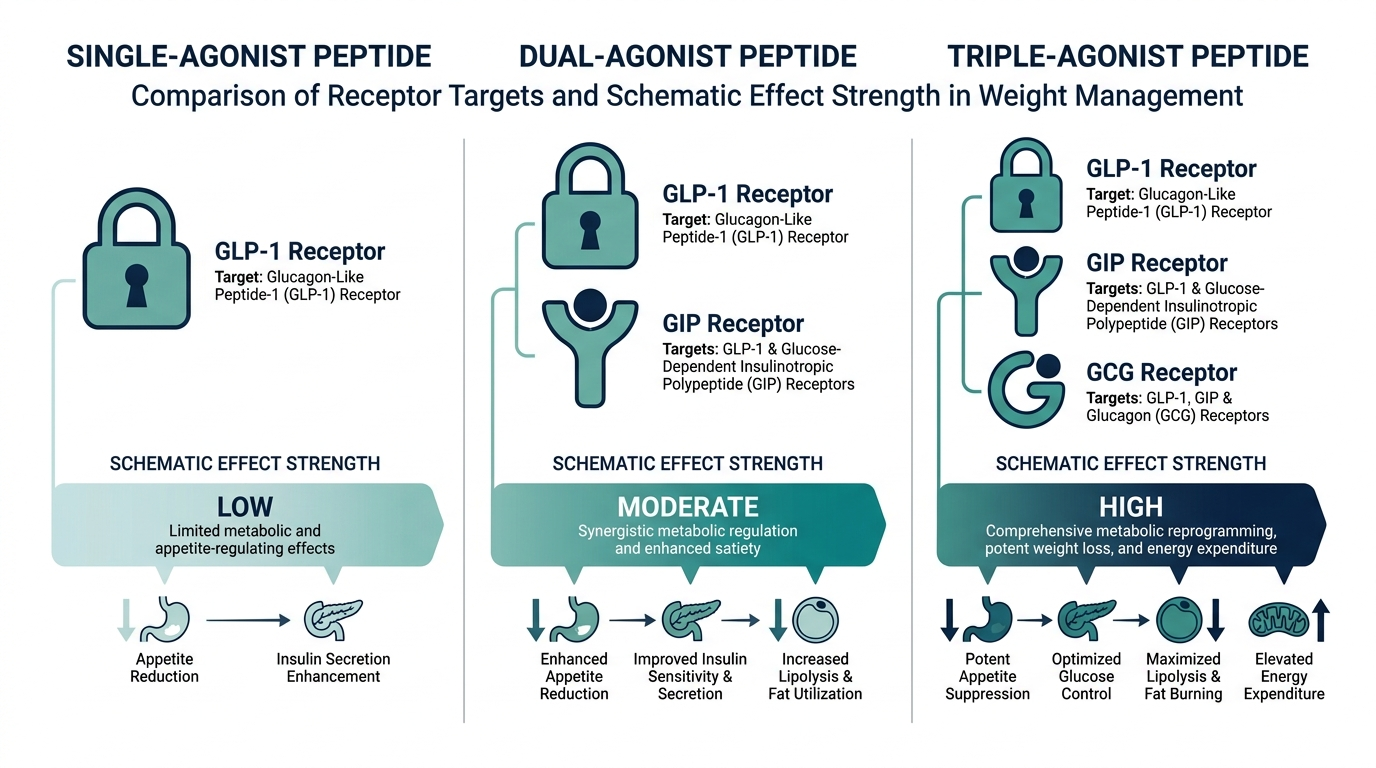
The numbers across approved and investigational drugs are now mature enough to compare properly, though direct head-to-head trials do not exist yet.
| Drug | Mechanism | Phase 3 peak mean weight loss | Dosing | FDA status (June 2026) |
|---|---|---|---|---|
| Semaglutide (Wegovy) | GLP-1 agonist | ~15% at 68 weeks (2.4 mg) | Weekly injection | Approved |
| Tirzepatide (Zepbound) | GLP-1 + GIP dual agonist | 22.5% at 72 weeks (15 mg, SURMOUNT-1) | Weekly injection | Approved |
| Retatrutide | GLP-1 + GIP + glucagon triple agonist | 28.3% at 80 weeks (12 mg, TRIUMPH-1) | Weekly injection | Investigational |
The progression is not a coincidence. Each added receptor target has incrementally raised the efficacy ceiling. Whether that ceiling keeps rising with future multi-agonists or whether 28 to 30% represents a biological plateau for injectable metabolic drugs is a genuinely open question.
One thing is clear from the comparison: retatrutide’s efficacy lead over approved options is real and substantial. Whether the modestly higher GI side effect burden and the unexplained dysesthesia signal represent acceptable tradeoffs for the weight loss gain is a clinical judgment that belongs between a patient and a physician, not a research peptide vendor.
What is the FDA approval timeline for retatrutide?
As of June 2026, retatrutide is investigational. No NDA (New Drug Application) has been filed with the FDA. Eli Lilly has signaled that regulatory submission is expected in late 2026 or early 2027, following complete TRIUMPH data collection. Under standard FDA review timelines, approval could arrive in late 2027 to Q1 2028, or earlier under priority review.
There is no PDUFA date, no approved indication, and no commercial prescription route in 2026. Any website claiming to offer prescriptions for retatrutide is making a claim it cannot legally support.
The three legitimate ways to access retatrutide today are narrow:
- Enrollment in an active clinical trial. Eli Lilly’s ongoing studies are registered on ClinicalTrials.gov. NCT05929066 is the TRIUMPH maintenance trial. Enrollment eligibility criteria are specific, and site availability varies by geography.
- Expanded access (compassionate use). For patients with serious obesity-related complications who have exhausted approved alternatives and cannot enroll in a trial. This requires a physician to contact Eli Lilly directly. Approval is granted case by case and is not a routine pathway.
- Wait for commercial approval, expected 2027 to 2028, at which point licensed telehealth clinics will likely offer it alongside existing GLP-1 options.
The fourth apparent option, grey-market research peptides labeled “retatrutide,” is not a legitimate access pathway. It deserves its own section.
Telehealth GLP-1 program with provider visits and pharmacy coordination.
What about “research peptide” retatrutide sold online?
This is the part of the conversation that gets loud on forums and quiet on the websites selling the product, so here is the honest version.
Selling synthetic peptides labeled “for research use only” occupies a legal grey zone in the US. The label is a commercial device, not a quality certification. Buying such a product is legal for most individuals in most states. Using it on yourself is a different matter: the label’s protection evaporates the moment the vial is used for human self-administration, and the FDA has made that position explicit with enforcement actions in 2025 and 2026.
The quality problem with grey-market retatrutide is documented publicly. The independent testing database Finnrick Analytics has tested 2,980 samples of retatrutide from 185 vendors over roughly 18 months through June 2026. Among those vendors, 66 received an “E” (Bad) grade and 4 received “F” (Fraud) grades. Some samples contained zero detectable active compound. Quantity variance from the advertised amount reached up to 47% in the 95th percentile of tested samples.
Retatrutide, specifically, was the molecule that got Peptide Sciences a failing grade across 37 batches before that vendor shut down in March 2026. The lesson from that sequence is that even the most prominent, longest-operating grey-market vendor shipped retatrutide product that an independent lab rejected, repeatedly, without buyers knowing.
The peptide that shows the most dramatic clinical results in controlled Eli Lilly trials is also the molecule where grey-market quality control has been the most openly documented as a problem. Those two facts together should give anyone pause.
For the research vendor space, the cross-check that matters is Finnrick’s vendor rating, not the testimonials on the vendor’s own page. Among the retatrutide-specific ratings, vendors with “A” (Great) grades include Paradigm Peptide and Peptide Partners, based on consistent third-party HPLC and mass spectrometry results. A real COA for retatrutide should show HPLC purity above 98% and a mass spectrometry identity confirmation that it is LY3437943 specifically, not a structurally similar analogue.
This article does not link to research-chemical vendors, and will not do so. The reason is not legal caution, it is that in 2026, with licensed telehealth access to proven GLP-1 drugs maturing rapidly and retatrutide approval two years away, the risk-adjusted case for sourcing the investigational compound from a grey market is genuinely hard to make. The clinical retatrutide that produced 28.3% weight loss was pharmaceutical-grade, dosed precisely, and administered with full safety monitoring. The grey-market version shares only the name.
Don’t just read about your health, track it.
A single result is a snapshot. Superpower re-tests 100+ markers over time so you can watch them move as you change sleep, food, and training.
Frequently asked questions
Is retatrutide a peptide or a small molecule drug?
Retatrutide is a peptide, specifically a 39-amino acid synthetic peptide. It is not a small molecule (typically defined as under 500 Da). Retatrutide has a molecular weight of approximately 4,813 Da. In pharmacological terms it falls in the same class as semaglutide and tirzepatide, injectable therapeutic peptides, not an oral small molecule like the upcoming orforglipron.
Is retatrutide the same as a GLP-1?
Retatrutide acts on the GLP-1 receptor as part of its mechanism, but calling it “a GLP-1” is incomplete. It simultaneously activates two additional receptors, GIP and glucagon. The “GLP-3” label that circulates online is not accurate; no such receptor exists in human physiology. Triple agonist is the correct term.
Is retatrutide FDA-approved in 2026?
No. As of June 2026, retatrutide is investigational. Eli Lilly has signaled NDA submission for late 2026 or early 2027, with approval projected 2027 to 2028. No commercial prescription pathway exists yet.
How much weight can you lose on retatrutide?
In the TRIUMPH-1 Phase 3 trial (2,339 participants, results published May 2026), participants on the 12 mg dose lost an average of 28.3% of body weight at 80 weeks. In a higher-BMI extension subgroup, the average reached 30.3% at 104 weeks. These are the controlled trial numbers with pharmaceutical-grade drug, supervised dosing, and full safety monitoring.
Can you buy retatrutide legally right now?
Access in 2026 is limited to enrollment in active Eli Lilly clinical trials or a case-by-case expanded access (compassionate use) approval. Grey-market “research peptide” versions exist but are investigational and unregulated, with documented quality issues including mislabeled compounds and substantial quantity variance. Commercial prescriptions are not available yet.
How does retatrutide differ from tirzepatide?
Both are injectable peptides dosed weekly. Tirzepatide is a GLP-1 and GIP dual agonist (FDA-approved, marketed as Mounjaro and Zepbound). Retatrutide adds the glucagon receptor, which is believed to increase energy expenditure and hepatic fat clearance beyond what the GLP-1/GIP combination achieves. Phase 3 peak mean weight loss is 22.5% for tirzepatide vs. 28.3% for retatrutide, though direct head-to-head data does not yet exist.
What are the main side effects of retatrutide?
The Phase 3 TRIUMPH-1 data showed nausea in 42.4%, diarrhea in 32.0%, and vomiting in 25.3% of participants on the 12 mg dose. Most events were mild to moderate and peaked around each dose escalation. A unique signal not seen with other GLP-1 class drugs is dysesthesia (abnormal skin sensations) in about 1 in 5 participants on 12 mg, still being characterized. Discontinuation for adverse events was 11.3%.
Do you lose muscle on retatrutide?
Some of the weight lost on any GLP-1 class drug is lean mass, not just fat. The exact proportion depends on the study and the measurement method, but the pattern is consistent across the drug class. That is why clinicians who prescribe these drugs push protein intake and resistance training, and why body composition and strength are worth tracking alongside weight. Losing a large share of your weight as muscle leaves you lighter but with a slower metabolism and a higher risk of regain.
Will the weight come back if you stop retatrutide?
Weight regain after stopping is well documented across the whole GLP-1 class, because the drugs treat appetite and metabolism while they are in the body, not permanently. In the tirzepatide withdrawal data, a substantial portion of lost weight returned within a year of stopping. There is no reason to expect retatrutide to behave differently. Anyone planning to use one of these drugs should think of it as a long-term or maintenance tool, and should build the food, protein, and training habits that protect the result if the drug is ever discontinued.
How does retatrutide compare to bariatric surgery?
The peak trial numbers overlap: retatrutide reached roughly 28 to 30% mean weight loss in its highest-dose groups, and bariatric surgery typically produces 25 to 35% total body weight loss. That said, surgery is a one-time procedure with durable anatomical changes and its own risk profile, while retatrutide is a weekly injection that has to be continued. They are not interchangeable, and the choice belongs in a conversation with a physician who knows your full history.
Telehealth GLP-1 program with provider visits and pharmacy coordination.
Author: Vital Signs Today Editorial Team, [credential]”]. Educational content, not medical advice. Sources linked inline.
Primary sources:
- Eli Lilly: What to know about retatrutide
- AJMC: TRIUMPH-1 Phase 3 results, 30.3% weight loss
- PR Newswire: Lilly TRIUMPH-1 press release (May 2026)
- PMC: Retatrutide, a Game Changer in Obesity Pharmacotherapy
- Nature Cell Discovery: Structural insights into triple agonism at GLP-1R, GIPR and GCGR manifested by retatrutide
- Nature Medicine: Retatrutide for MASLD Phase 2a trial
- PMC: Structural insights into the triple agonism, full text
- Eli Lilly medical: Mechanism of action of retatrutide
- Finnrick: Retatrutide vendor testing database (2,980 samples, 185 vendors)
- ClinicalTrials.gov: TRIUMPH maintenance study NCT05929066
- FDA: Warning letter Gram Peptides, March 2026
- AJMC: Retatrutide approval status and FDA timeline 2026
Want a real clinician to run the numbers, not a guess?
Joi + Blokes is a telehealth clinic that prescribes GLP-1 medication (Zepbound, compounded semaglutide and tirzepatide), hormone therapy (TRT, HRT), thyroid care, and peptides after a real lab panel and clinician review, with no membership or consult fee (prescriptions from about $59/month, lab panels from $149). If the scale will not budge, this is where you find out whether insulin, thyroid, or hormones are the real reason. Here is Joi + Blokes reviewed in full.
Related reading
Vital Signs Today may earn a commission if you buy through links on this page. It does not affect our editorial assessments.