
Last updated 18 June 2026. Educational content, not medical advice. Talk to a board-certified dermatologist before overhauling your routine.
Short answer: Peptides are short chains of amino acids, typically 2 to 50 units long, that act as molecular signals telling your skin cells to produce more collagen, elastin, and other structural proteins. The most studied topical peptide, GHK-Cu (copper tripeptide-1), showed a 55.8% reduction in wrinkle volume versus a control serum in clinical trials published in peer-reviewed literature, and it does this by activating gene expression pathways, not by sitting on the surface the way a moisturizer does.
Peptide serums claim to rebuild collagen from the outside. See what’s happening with your collagen markers from the inside. One at-home Superpower draw checks 100+ biomarkers, physician-reviewed.
So why does every serum suddenly contain peptides?
Peptides are not new. Loren Pickart, a biochemist at the University of Minnesota, first isolated GHK (glycine-histidine-lysine) from human plasma in 1973 and spent the next two decades documenting what it does to fibroblasts. Palmitoyl pentapeptide-4, the active ingredient in Matrixyl, launched in cosmetics in 2000 after a double-blind clinical trial published in the International Journal of Cosmetic Science showed a 37% reduction in deep wrinkle volume at 3% concentration over six months.
What changed is not the science. What changed is the manufacturing cost. Peptide synthesis dropped from prohibitively expensive to mainstream in the 2010s, and now the same actives that once appeared only in $200 department-store creams show up in $22 serums from The Ordinary. The global peptide skincare market is projected at USD 1.45 billion in 2026 and growing at 8.9% annually, according to IntelMarketResearch. That growth is a manufacturing story as much as a science story.
The consequence: the word “peptides” on a label now covers everything from a rigorously studied collagen-signaling molecule to a cheap filler ingredient included in trace amounts for label appeal. Knowing the difference requires understanding what type of peptide you are looking at and what the evidence actually says.
Full-body lab membership: 100+ biomarkers, doctor-reviewed, tracked over time.
What exactly is a peptide, and why does the skin care?
Proteins are the structural material of your skin. Collagen provides tensile strength; elastin lets it snap back; keratin forms the surface barrier. All three are made of amino acids arranged in chains. A peptide is any chain shorter than a full protein, generally fewer than 50 amino acids strung together.
The reason skin responds to topical peptides at all comes down to cell signaling. When collagen breaks down from UV exposure, enzymatic degradation, or normal aging, the fragments released include small peptides that function as distress signals. Fibroblasts read those fragments and ramp up production of new collagen to replace what was lost. Cosmetic peptides are engineered to mimic that signal, telling fibroblasts to produce collagen without waiting for the real breakdown to occur first.
The elegant part: they are lying to your skin, in the most productive way possible.
This is biologically distinct from just applying a moisturizer or exfoliant. Moisturizers improve the feel of existing skin. Peptides communicate with cells about building new structural material. Whether topical peptides penetrate deeply enough to actually reach fibroblasts in meaningful concentrations is a real debate, covered below, but the mechanism when they do get there is well-documented.
What are the four main types of peptides in skincare?
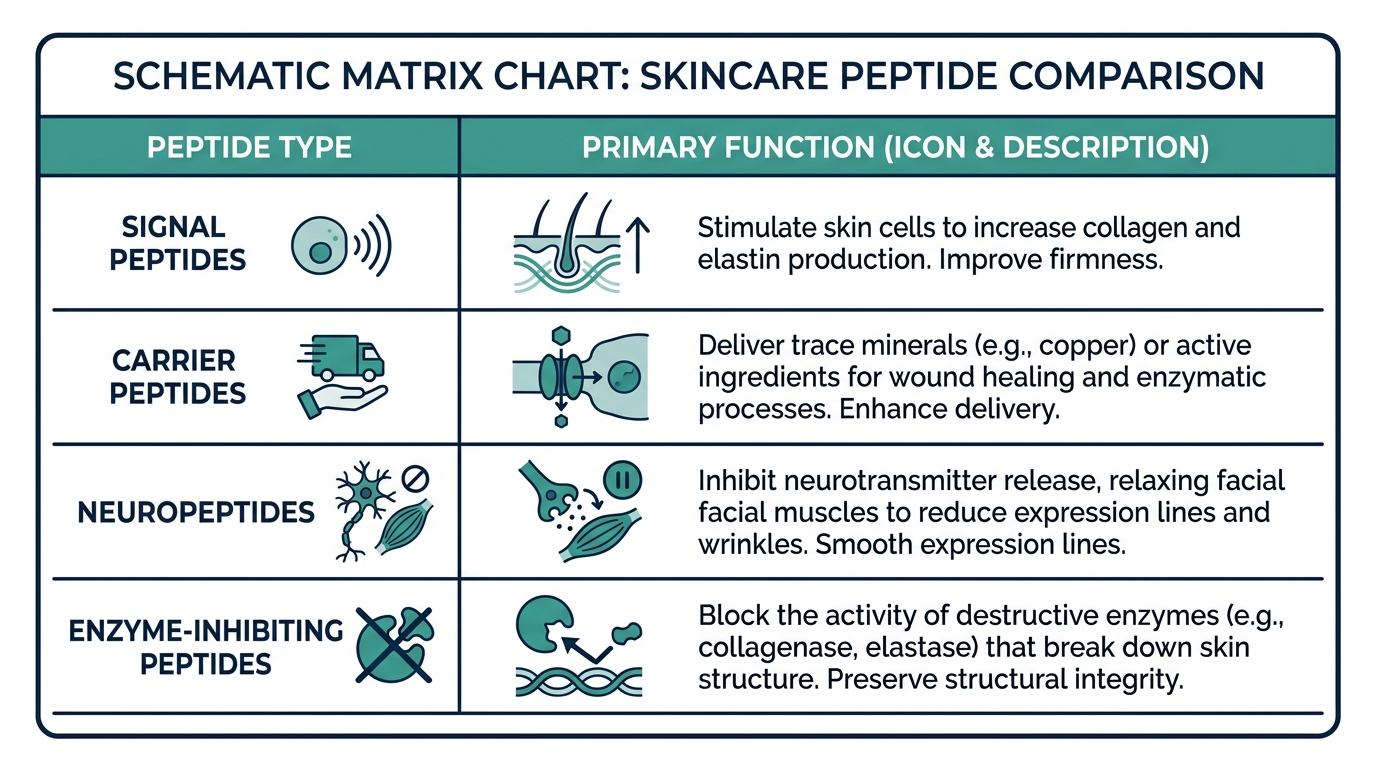
Not all peptides do the same thing. The four categories in most formulations target completely different biology.
Signal peptides
Signal peptides stimulate fibroblasts to synthesize collagen, elastin, or glycosaminoglycans. Palmitoyl pentapeptide-4 (sold as Matrixyl by Sederma) is the canonical example. The palmitoyl group on the front is a fatty acid chain added to make the peptide more lipophilic and better able to cross the stratum corneum. Matrixyl Synthe’6, a second-generation variant, targets six components of the skin matrix rather than just one. The clinical study data from Sederma showed a 37% wrinkle volume reduction at 3% concentration, which is enough to call it a peer-reviewed signal peptide, not marketing copy.
Enzyme-inhibitor peptides (carrier peptides)
Carrier peptides physically transport trace minerals into skin cells to initiate repair processes. GHK-Cu is the most studied: it binds copper (II) ions and acts as a copper delivery system to fibroblasts, triggering angiogenesis, collagen and elastin synthesis, and antioxidant gene expression. According to a comprehensive 2018 review in PMC/NIH, GHK-Cu affects gene expression in approximately 31.2% of human genes with a 50% or greater expression change, increasing 59% and suppressing 41%. That is an unusually broad impact for a topical cosmetic ingredient.
Human plasma levels of GHK decline naturally with age: roughly 200 ng/mL at age 20, dropping to around 80 ng/mL by age 60. Topical application is, in part, attempting to replace what the body stops making.
Neurotransmitter-inhibiting peptides
Acetylhexapeptide-3, marketed as Argireline, blocks the release of neurotransmitters at the neuromuscular junction, reducing the force of facial muscle contractions that deepen expression lines over time. It is sometimes called a topical Botox, though that comparison overstates the effect. At 10% concentration, peer-reviewed trials showed a 27% reduction in wrinkle depth after 28 days in the periorbital area. At over-the-counter concentrations of 2 to 5%, the effect is more modest.
Personally, I find the Argireline comparison to Botox unhelpful to consumers. It sets an expectation no topical product can meet, and then people dismiss the real benefit, which is a 20 to 27% measurable reduction in wrinkle depth with regular use, as underwhelming.
Enzyme-inhibitor peptides (matrix metalloproteinase inhibitors)
Soy-derived bowman-birk inhibitor and similar peptides work by blocking the enzymes (matrix metalloproteinases, or MMPs) that break down collagen in the dermis. Instead of telling cells to make more collagen, they slow the rate of destruction. This is a fundamentally different intervention and one that tends to be understated because “protecting what you have” is a harder marketing story than “building new collagen,” even though it may be equally valuable.
Do peptides actually penetrate the skin? (The honest answer)
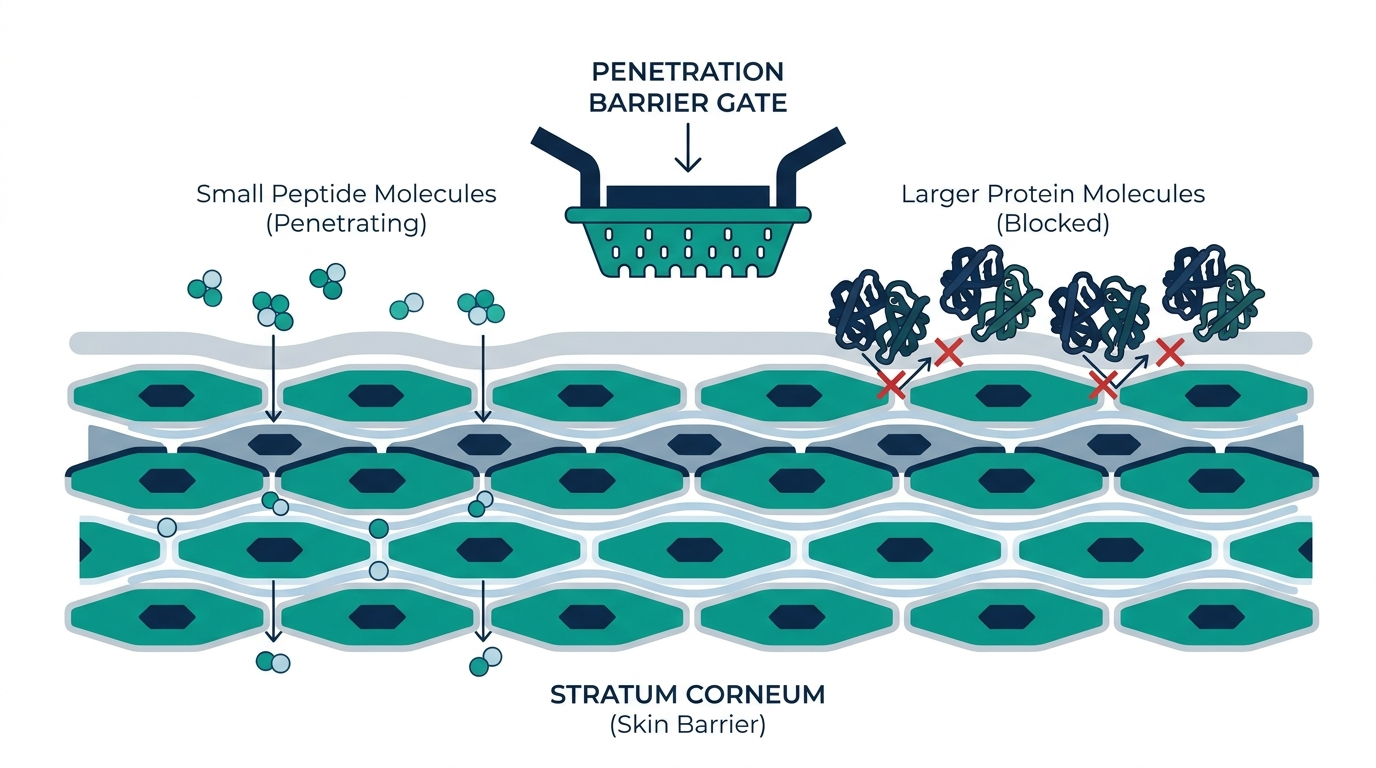
This is the single most legitimate criticism of peptide skincare and the one most brand marketing conveniently omits. The 500 Dalton rule, described in a widely cited paper by Bos and Meinardi, states that molecules above 500 Da in molecular weight have difficulty crossing the intact stratum corneum. Most bioactive peptides range from 500 to 2,000+ Daltons depending on length.
The formulation solutions to this problem are real but imperfect. Palmitoylation (adding a fatty acid chain) improves lipid solubility and stratum corneum crossing. Encapsulation in liposomes improves delivery. Nanoparticle carriers are in late-stage research. A 2025 ScienceDirect paper on skin-penetrating peptides documented short peptide sequences of 6 to 30 amino acids capable of acting as permeation enhancers, suggesting the delivery problem is being actively solved.
The pragmatic takeaway: the best-formulated topical peptides, particularly palmitoylated signal peptides and the small GHK-Cu tripeptide (molecular weight approximately 340 Da, well under the 500 Da threshold), do penetrate in clinical conditions. The larger neurotransmitter inhibitors work partly at the skin surface and in the upper dermal layers. A peptide serum applied to intact, sun-damaged skin in a controlled trial is a different pharmacokinetic scenario from the same serum slapped on post-exfoliation. The clinical trial results are real; the degree to which you reproduce them at home depends heavily on your skin barrier status and how you apply the product.
Do not believe any brand that tells you a 10-amino-acid peptide “deeply penetrates to the dermis” without a delivery system. And do not believe anyone who says no topical peptide gets through at all. The truth is in the formulation details.
How does GHK-Cu copper peptide compare to retinol?
This is the comparison that actually matters for most skincare shoppers, because retinol remains the highest-evidence topical anti-aging ingredient and any new active earns its place relative to that standard.
| Ingredient | Primary mechanism | Irritation potential | Time to results | Best evidence |
|---|---|---|---|---|
| Retinol (0.1% to 1%) | Increases cell turnover, stimulates collagen via retinoic acid receptor | Moderate to high (flaking, redness common) | 12 to 24 weeks | Numerous RCTs, FDA-recognized efficacy |
| GHK-Cu (0.5% to 3%) | Cell signaling, collagen/elastin synthesis, gene expression | Very low, anti-inflammatory | 8 to 12 weeks | 12-week RCTs; 31.6% wrinkle reduction vs. Matrixyl; 55.8% vs. control |
| Matrixyl 3000 (3%) | Stimulates collagen type I and III via signal peptide | Very low | 12 to 24 weeks | Published double-blind trial, 37% deep wrinkle volume reduction |
| Argireline (10%) | Inhibits muscle contraction-driven wrinkle formation | Very low | 4 to 8 weeks | 27% wrinkle depth reduction at 10% concentration |
| Vitamin C (L-ascorbic acid, 10-20%) | Antioxidant, collagen cofactor, mild brightening | Moderate at high pH | 8 to 16 weeks | Strong RCT evidence for photoaging reversal |
A 12-week facial cream study with GHK-Cu in 71 women showed increased skin density and thickness, reduced laxity, and improved wrinkle depth and clarity. In a separate thigh-skin application study, 70% of participants showed improved collagen production, compared to 50% with vitamin C and 40% with retinoic acid at comparable timelines, according to data cited in the 2018 PMC review.
The practical implication: copper peptides and retinol are not competitors, they are complementary. Retinol drives cell turnover and is best at clearing sun damage. GHK-Cu and signal peptides support new structural protein synthesis and are better tolerated by sensitive or rosacea-prone skin. Many dermatologists now recommend using retinol on alternating nights with a copper-peptide serum to get both mechanisms without stacking irritation potential.
Hydrolyzed type I & III collagen peptides, third-party tested, unflavored.
Which peptide serums are actually worth buying in 2026?
The price range for peptide serums is enormous, from $22 to over $300, and price correlates only weakly with efficacy at this point. What matters is concentration, peptide type, and delivery chemistry.
The Ordinary Multi-Peptide + Copper Peptides 1% ($32 for 30 mL) remains the most defensible budget choice in 2026. It contains copper tripeptide-1 at a declared 1% concentration, Matrixyl 3000 and Matrixyl Synthe’6, and Argirelox (an Argireline-adjacent peptide complex). At this price point, no comparable brand offers that peptide stack. Reviews on Nordstrom score it 4.1/5, with users noting measurable texture improvement within 4 to 6 weeks of consistent PM use.
NIOD CAIS 3:1 (Copper Amino Isolate Serum), the sister brand’s flagship copper peptide serum, runs approximately $65 to $90 for 30 mL and uses a 3% copper amino isolate complex in a different solvent system than The Ordinary’s aqueous base. The higher solubility of the copper complex in this formulation may improve penetration, though head-to-head human clinical data comparing the two is not published.
Olay Regenerist Collagen Peptide 24 (~$35 for 1.7 oz) sits in the mass-market tier and pairs collagen peptides with niacinamide for a combined approach to barrier support and structural protein signaling. The 2026 review from Agile Skincare noted consistent 24-hour hydration maintenance, which is its strongest documented attribute.
One thing most review sites will not tell you: the molecular weight of the peptides in the product is rarely disclosed on the label. When buying from a less-known brand, search for the INCI name and check its Dalton weight before assuming it reaches the dermis.
How should you layer peptides with other actives?
Peptides are among the lowest-friction actives in skincare. They do not destabilize at skin pH the way vitamin C does. They do not require a specific penetration window the way retinoids do. But sequencing still matters for practical reasons.
Morning routine: Vitamin C (L-ascorbic acid), then a niacinamide layer if used, then sunscreen. Reserve peptides for the evening if you use high-concentration vitamin C, since acidic pH can hydrolyze some peptide bonds over time. At formulation pH levels in most serums, the effect is minimal, but the cautious approach keeps your vitamin C in the AM and your peptides in the PM.
Evening routine: After cleansing, apply a peptide serum to dry skin. Wait 10 to 15 minutes, then apply retinol or a retinoid if you use one. Copper peptides applied before retinol appear to buffer the initial irritation during retinol adjustment periods, an insight I wish more dermatologists shared upfront with new retinol users. The sequence is counterintuitive since most guides say apply lighter products first, but the buffering effect is a real benefit, not just marketing.
What pairs well: Hyaluronic acid (draws water into skin where peptides are working), niacinamide (anti-inflammatory, barrier-supporting), ceramides (occlusive base that holds everything in). No real incompatibilities.
What to avoid: Pairing copper peptides with alpha-lipoic acid or high-concentration direct acids on the same application. Copper ions can act as pro-oxidants in very low pH environments, theoretically undermining the antioxidant benefit. Most well-formulated serums buffer this at the manufacturing stage, but layering a copper peptide serum directly under a 20% glycolic acid toner is not something any trial has validated.
What does the 2026 clinical research actually say?
The Frontiers in Medicine systematic review and meta-analysis published in 2026, covering 19 randomized controlled trials and 1,341 participants, found that peptides significantly improved skin hydration and brightness, with a modest pooled effect on wrinkle reduction (mean difference 0.27, p = 0.04). Oral polypeptides drove the strongest wrinkle effect (MD = 1.5, p = 0.01), while topical peptides showed more consistent results for hydration than for elasticity or density.
Two honest reads of that data: first, 19 RCTs with 1,341 participants is a real evidence base, not a handful of sponsored studies. Second, the effect size on wrinkles is modest at the population level, which is consistent with topical actives generally (retinol’s effect sizes in the same framework are also more modest than before-and-after photos suggest). The dermatological consensus in 2026 holds that peptides are safe, well-tolerated, evidence-backed ingredients for anti-aging, not miracle actives, and not placebo either.
A separate 2025 Cosmetics review in MDPI confirmed that GHK-Cu specifically is “a novel active ingredient that improves collagen synthesis, enhances skin cell proliferation, and decreases inflammation,” with the immune-modulating and gene-activating effects placing it in a mechanistic category above typical moisturizing actives.
Common myths about peptides in skincare, addressed directly
Myth: Topical collagen creams deliver collagen to your skin. False. Collagen molecules weigh 300,000+ Daltons. Applying collagen in a cream deposits it on the surface where it functions as a film-forming humectant. No collagen molecule is crossing the stratum corneum. What signal peptides do is different and much more interesting: they instruct your fibroblasts to make their own collagen, from the inside. The marketing conflates both ideas deliberately.
Myth: Oral collagen supplements and topical peptide serums are interchangeable. They are not. Oral collagen is hydrolyzed into small peptides during digestion, and multiple trials now support improved skin hydration and modest elasticity benefits from oral intake of 2.5 to 10 grams daily. The 2026 Frontiers meta-analysis showed oral polypeptides had a stronger wrinkle-reduction effect than topical in that particular dataset. But the two routes affect different things: oral delivery affects systemic collagen turnover; topical delivery, when it works, acts at the specific application site. A well-designed routine uses both.
Myth: More peptides in a formula is better. Concentration and type matter more than count. A serum listing 11 peptides at trace amounts each will likely underperform a serum with three peptides at clinically studied concentrations. “Multi-peptide” on a label is not a quality signal; it is a marketing descriptor. Look for named actives (GHK-Cu, palmitoyl tripeptide-1, acetylhexapeptide-3) at disclosed percentages.
Curious what your own levels look like?
Baseline 100+ biomarkers today and retest as life changes, all in one membership with physician review.
Frequently asked questions
Are peptides suitable for all skin types?
Yes, with no notable contraindications across skin type categories. Peptides are among the best-tolerated actives in dermatology and are specifically recommended for sensitive and rosacea-prone skin that cannot tolerate retinoids or strong acids. They are safe during pregnancy (unlike retinol), though topical formulations have not been specifically tested in pregnant populations and individual clinical guidance still applies.
How long do peptides take to work?
Clinical trials for signal peptides like Matrixyl show measurable collagen density changes at 12 weeks with histological confirmation. Argireline-type effects on expression lines can appear in 4 to 8 weeks. GHK-Cu trials showed measurable skin thickness and density changes at 8 to 12 weeks. Real-world use takes longer: six months of consistent daily application is a reasonable minimum before drawing conclusions.
Can you use peptides every day?
Yes. Unlike retinoids, which require titration periods to avoid irritation, most peptide serums are tolerated at daily, even twice-daily, application from the first use. The exception is if you are combining a copper-peptide product with strong acids in the same routine step, which is not recommended in any protocol.
Do copper peptides fade dark spots?
Not directly. GHK-Cu’s primary mechanisms are collagen synthesis, wound healing, and anti-inflammation, not melanin inhibition. However, its anti-inflammatory effect can indirectly reduce post-inflammatory hyperpigmentation (PIH) after acne or irritation. For true brightening and dark spot reduction, vitamin C, niacinamide, or alpha-arbutin remain the targeted options.
What is the difference between GHK-Cu and Matrixyl?
Both are signal/carrier peptides that ultimately increase collagen production, but through different mechanisms. GHK-Cu is a tripeptide that binds copper and acts as a carrier to deliver copper ions to fibroblasts, triggering a broad regenerative response affecting 31% of human gene expression. Matrixyl (palmitoyl pentapeptide-4) is a signal peptide that mimics a collagen fragment to trigger collagen type I and III synthesis directly. They are complementary, not duplicative.
Are peptides the same as growth factors?
No, though they operate in overlapping territory. Growth factors (like EGF, TGF-beta) are proteins with much higher molecular weights and more complex receptor interactions. Peptides are smaller and more stable in cosmetic formulations. Growth factors in skincare are a separate and more controversial category, partly because their large molecular weight raises the same penetration questions, but at an even higher molecular weight than most peptides.
Why do some peptide serums turn blue?
The blue or green tint in some copper peptide serums, including some NIOD formulations, comes from the copper (II) ion itself. It is a reliable visual cue that the copper is in its active chelated form and has not been reduced to inactive copper (I). A colorless copper peptide serum is not necessarily inferior, since some formulations use buffering chemistry that keeps the copper active without the visible color, but the blue-green tint in a declared copper peptide product is not a cosmetic accident.
Author: Vital Signs Today Editorial Team, [credential]”]. Educational content, not medical advice. Sources linked inline.
Primary sources (verify live before publish):
– Frontiers in Medicine: Oral and topical peptides for skin aging, systematic review and meta-analysis of RCTs (2026)
– PMC/NIH: Regenerative and Protective Actions of the GHK-Cu Peptide in the Light of the New Gene Data (2018)
– ScienceDirect: Skin-penetrating peptides, enhancing skin permeation for transdermal delivery (2025)
– Peptide Journal: Matrixyl Clinical Studies, Anti-Wrinkle Evidence
– IntelMarketResearch: Active Peptide Cosmetics Market Outlook 2026-2034
– The Ordinary: Multi-Peptide + Copper Peptides 1% product page
– Medical Xpress / The Conversation: Copper peptides, these powerful molecules are worth the skincare hype (January 2026)
Related reading
Vital Signs Today may earn a commission if you buy through links on this page. It does not affect our editorial assessments.