
Educational content, not medical advice. Talk to a licensed clinician before starting any peptide therapy.
Short answer: A peptide is not technically a protein, but every protein is built from the same raw material: amino acids strung together by peptide bonds. The dividing line comes down to chain length and three-dimensional structure. Chains of roughly 2 to 50 amino acids are called peptides; chains longer than that, which fold into stable three-dimensional shapes, are called proteins. In practice, the FDA draws the cutoff at 40 amino acids for regulatory purposes, while most biochemistry textbooks use 50. Insulin, the most famous example, sits right on the fence at 51 amino acids and a molecular weight of 5,808 Daltons, which is why you will see it called both a “peptide hormone” and a “protein” depending on the textbook.
The line between a peptide and a protein comes down to chain length. Want to see the real biomarkers built from those chains in you? One at-home Superpower draw checks 100+ biomarkers, physician-reviewed.
So what exactly are peptides made of?
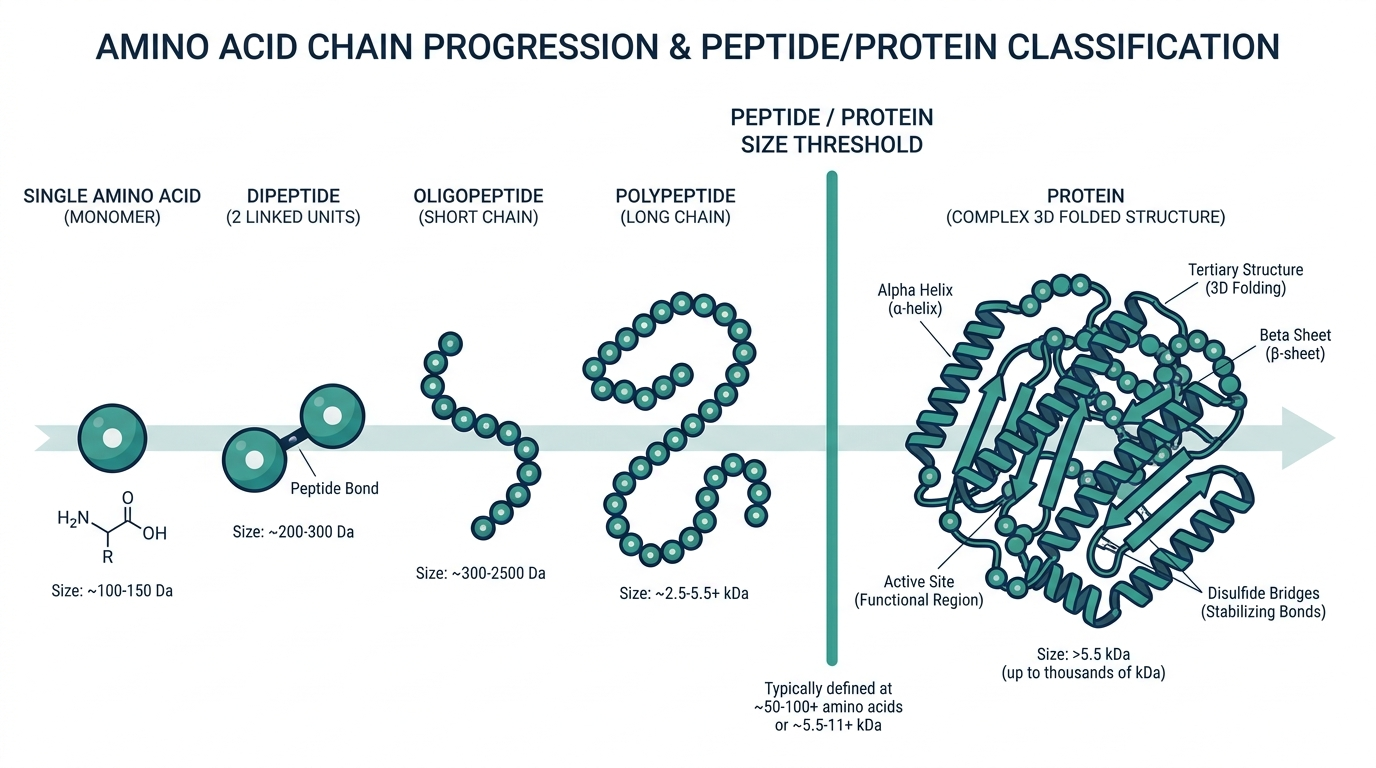
Both peptides and proteins are chains of amino acids. The body uses 20 standard amino acids, each with a different chemical side chain, and it links them together through a peptide bond, a covalent bond formed when the carboxyl group of one amino acid reacts with the amino group of the next, releasing a water molecule. That dehydration reaction is why each amino acid unit inside a finished chain is technically called a “residue” rather than a free amino acid: the reaction consumed part of it.
Two amino acids joined this way make a dipeptide. Three make a tripeptide. Up to around 20, chemists use the prefix “oligo” (oligopeptide). Above 20, the term polypeptide appears. Above roughly 50 residues, or above about 5,000 to 6,000 Daltons in molecular weight, most scientists start calling the molecule a protein, though no single international standard pins the number exactly.
The peptide bond itself is unusually stable: it resists denaturation by heat or urea, and its partial double-bond character limits rotation, which gives even short peptides a surprising degree of structural rigidity.
Where is the actual boundary between a peptide and a protein?
This is where the question gets genuinely interesting, and most popular articles get it wrong by pretending the line is crisp.
Dr. Mark Blaskovich at the University of Queensland, one of the leading researchers in medicinal peptide chemistry, puts the fuzzy zone at 50 to 100 amino acids, acknowledging there is no strict scientific consensus. The NIH StatPearls entry on peptides uses 50 as the working threshold. The FDA, which has regulatory skin in the game, settled on 40 amino acids as the peptide ceiling for its 2018 biological product definition. Anything at or below 40 amino acids is regulated as a small-molecule drug, not a biologic, which changes the entire approval pathway.
Here is a practical size table:
| Molecule | Amino acid count | Molecular weight | Category |
|---|---|---|---|
| Oxytocin (“love hormone”) | 9 | ~1,007 Da | Peptide, clearly |
| GLP-1 (endogenous) | 30 | ~3,298 Da | Peptide, clearly |
| Semaglutide (Ozempic) | 31 | 4,114 Da | Peptide (FDA: drug, not biologic) |
| Exenatide (Byetta) | 39 | ~4,187 Da | Peptide (just under FDA’s 40 AA line) |
| Insulin | 51 | 5,808 Da | The textbook borderline case |
| Hemoglobin (one chain) | 141 | ~15,700 Da | Protein, clearly |
| Albumin | 585 | ~66,500 Da | Protein, clearly |
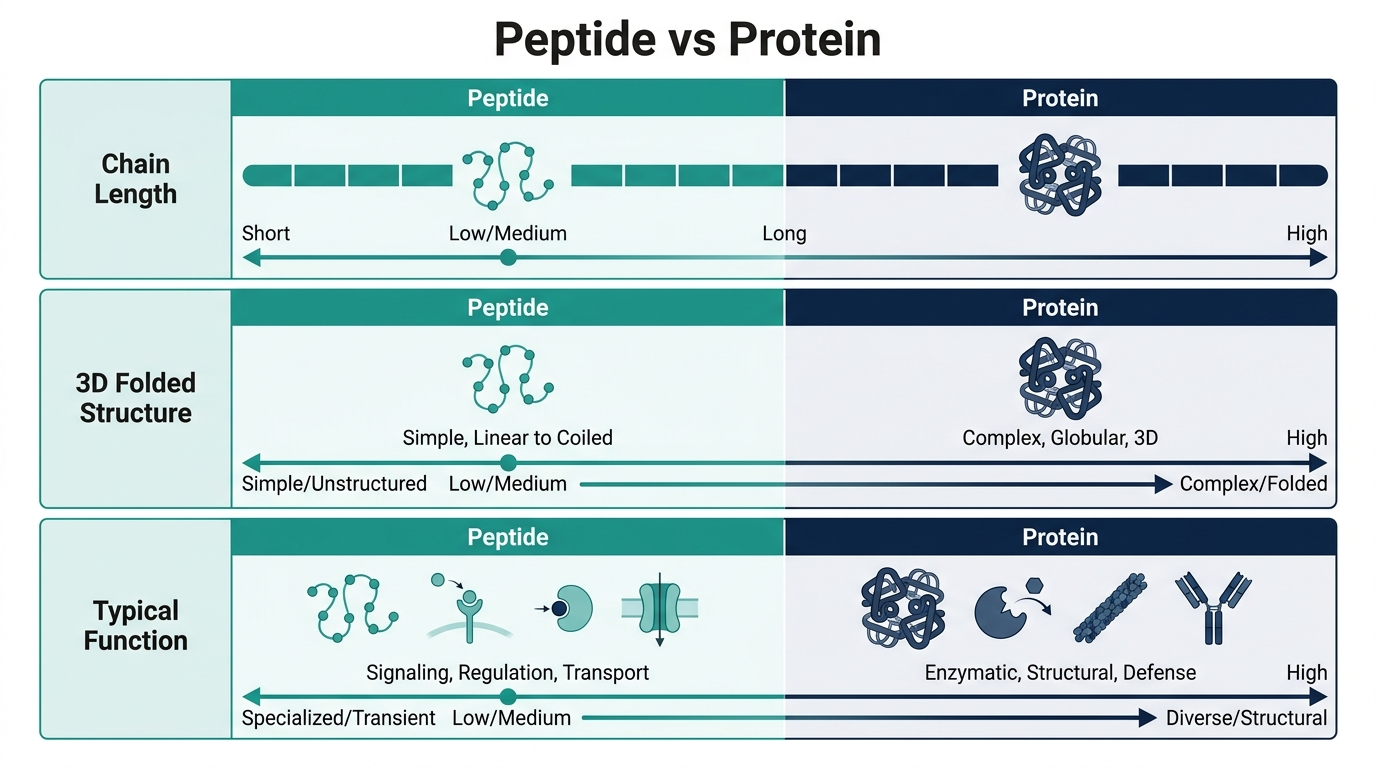
The key functional distinction is not just length. Proteins fold into stable secondary, tertiary, and sometimes quaternary structures (alpha-helices, beta-sheets, multi-chain complexes) that give them structural or catalytic roles. Peptides, being shorter, generally do not maintain a fixed three-dimensional shape in solution. They flex, which makes them fast-acting signaling molecules but also makes them more vulnerable to enzymatic degradation.
Does the body produce its own peptides?
Constantly, and in enormous variety. The NIH lists major peptide categories including peptide hormones, neuropeptides, and antimicrobial peptides. Some well-known examples:
Oxytocin and vasopressin are each 9 amino acids long. They are produced by the hypothalamus and released by the pituitary, and between them they govern uterine contractions, milk letdown, kidney water retention, blood pressure, and large swaths of social behavior and stress response.
GLP-1 (glucagon-like peptide-1) is a 30-amino-acid incretin hormone secreted by L-cells in the small intestine after you eat. It signals the pancreas to release insulin, slows gastric emptying, and suppresses appetite. Its only problem as a natural molecule: it is destroyed by the enzyme DPP-4 within 2 to 3 minutes of release. That is exactly why drug developers engineered semaglutide: a 31-amino-acid analog with amino acid substitutions and a fatty-acid chain that lets it survive for roughly 7 days in the body.
Beta-endorphins are the body’s endogenous opioids, 31 amino acids, produced during exercise and stress to modulate pain.
Antimicrobial peptides like defensins are produced by immune cells to punch holes in bacterial membranes. They represent one of the oldest arms of innate immunity, evolutionarily.
Full-body lab membership: 100+ biomarkers, doctor-reviewed, tracked over time.
Is insulin a peptide or a protein?
Insulin is the question that breaks every clean rule about peptide vs. protein, which makes it the best teaching example in the field.
Insulin is a 51-amino-acid, 5,808-Dalton molecule made of two chains (the A-chain, 21 residues, and the B-chain, 30 residues) linked by two disulfide bridges. It folds into a defined three-dimensional structure, which is protein-like behavior. But at 51 amino acids it barely clears the most common 50-residue threshold, and at 5,808 Da it is barely above the 5,000 Da molecular weight criterion. The FDA’s 40-amino-acid cutoff would classify it as a biologic, not a peptide drug. Indeed, insulin is regulated and approved as a biologic.
Personally, I find insulin to be the clearest illustration that “peptide vs. protein” is a working convenience, not a law of nature. The molecule does not know which side of a human-drawn line it sits on. What matters for the clinician is function and regulation; what matters for the chemist is structure and synthesis method.
Do not believe anyone who tells you the peptide-protein boundary is sharp. It is not. Even the FDA and the biochemistry textbooks draw the line at different numbers, and the scientific literature acknowledges there is no universal consensus.
What about collagen? Is it a peptide or a protein?
Collagen is a protein, specifically the most abundant structural protein in the human body, making up about 30% of total protein mass. Native collagen is a large triple-helix molecule assembled from three polypeptide chains, each roughly 1,400 amino acids long and about 100,000 Daltons per chain. Unambiguously a protein.
What you buy in supplement form is different: hydrolyzed collagen (collagen peptides). Enzymatic hydrolysis breaks those massive chains down into short fragments, typically under 6,000 Daltons, well within peptide territory. Those smaller fragments survive digestion and are absorbed differently than intact collagen protein would be.
A 2024 randomized crossover study published in Frontiers in Nutrition tracked the bioavailability of these absorbed peptides and confirmed that specific di- and tripeptides rich in hydroxyproline (the amino acid marker for collagen) actually reach systemic circulation intact. A 2025 double-blind, placebo-controlled trial studied low-molecular-weight collagen peptides in knee osteoarthritis and found statistically significant improvements in pain and function scores. So “collagen peptides” is not marketing language. It describes a genuinely different molecular form with different absorption kinetics compared to the original protein.
The practical upshot: when a label says “collagen peptides” or “hydrolyzed collagen,” you are buying the pre-digested, peptide-sized fragments, not the intact structural protein. Both come from the same source; they just differ in molecular weight after processing.
Are GLP-1 drugs peptides?
Yes, and that is not a trivial point. It explains why they work and why they have to be injected (or formulated with special oral absorption enhancers, as Rybelsus does).
Semaglutide (Ozempic, Wegovy) is a 31-amino-acid, 4,114 Dalton synthetic peptide modeled on the body’s own GLP-1 hormone. It has 94% structural similarity to natural human GLP-1, with a few strategic modifications: a substitution at position 8 to resist DPP-4 degradation, and a long fatty-acid chain attached at position 26 that lets it bind albumin in the bloodstream and extend its half-life from 2 minutes (natural GLP-1) to roughly 7 days. Tirzepatide (Mounjaro, Zepbound) is a dual GIP/GLP-1 agonist at 39 amino acids, also squarely in peptide territory, and just under the FDA’s 40-amino-acid biologic threshold.
The peptide nature of these drugs is exactly why oral delivery is hard. Peptides are digested in the gut, and the same enzymes that break down food proteins attack them before they can absorb. Rybelsus (oral semaglutide) gets around this using a permeation enhancer called SNAC (sodium N-[8-(2-hydroxybenzoyl)amino] caprylate) that temporarily disrupts the stomach lining to allow absorption. It works, but less predictably than injection.
The GLP-1 class alone generated over $70 billion in combined sales in 2025, making them the best-selling peptide drugs in pharmaceutical history, and arguably the best-selling drugs of any kind.
Full-body lab membership: 100+ biomarkers, doctor-reviewed, tracked over time.
What is the difference between a peptide, a polypeptide, and a protein?
These three terms exist on a single continuum, and the exact boundaries are conventions rather than natural laws:
Peptide covers chains of 2 to roughly 50 amino acids (NIH convention) or 2 to 40 (FDA convention). They tend to be flexible, lack stable tertiary structure, and act primarily as signaling molecules. Examples: oxytocin, vasopressin, GLP-1, BPC-157.
Polypeptide is a structural term for any chain of amino acids linked by peptide bonds, regardless of length. You can call a 200-residue chain a polypeptide, and you can call a dipeptide one too. The word describes the chemistry, not the size category. In practice, “polypeptide” is most commonly used for chains too long to call a peptide but not yet folded into a functional protein.
Protein is a polypeptide (or multiple polypeptides) that has folded into a defined three-dimensional structure capable of carrying out a biological function: enzymatic catalysis, structural support, immune recognition, oxygen transport, and more. Above roughly 50 residues and 5,000 to 6,000 Daltons, chains gain enough length to sustain stable folds. Hemoglobin has 574 amino acids across four chains. Albumin has 585. Titin, the largest known protein in the human body, has 34,350 amino acids and is essentially the spring mechanism inside muscle sarcomeres.
The myth worth busting: proteins are not “better” or more important than peptides. The body’s most potent signaling molecules, the hormones that regulate hunger, bonding, pain, blood pressure, and blood sugar, are short peptides. They are potent precisely because they are small enough to diffuse quickly, bind tightly to specific receptors, and be inactivated fast when the signal needs to stop.
How does the pharmaceutical industry use this distinction?
More than 100 peptide drugs are FDA-approved as of 2026, and over 1,200 more are in clinical trials globally. The peptide therapeutics market hit roughly $56 billion in 2026 revenues and is projected to approach $87 billion by 2035, driven primarily by GLP-1 agonists for metabolic disease and peptide-based oncology drugs.
The peptide-vs-protein distinction matters in drug development for two reasons. First, regulatory pathway: the FDA’s 40-amino-acid cutoff determines whether a new molecule requires a traditional New Drug Application (peptide) or a Biologics License Application (protein/biologic). BLAs are more expensive and more complex to manufacture, which is why tirzepatide at 39 amino acids and semaglutide at 31 were deliberately kept under the protein threshold. Second, synthesis method: peptides below about 50 amino acids can be made by solid-phase peptide synthesis (SPPS), a chemical process that does not require living cells. Larger proteins require cell-based biomanufacturing (bacterial fermentation, Chinese hamster ovary cells, etc.), which is slower, more expensive, and harder to scale.
The April 2026 FDA approval of orforglipron, Eli Lilly’s once-daily oral GLP-1 receptor agonist that is actually a small non-peptide molecule, represents a deliberate attempt to escape the delivery problems that come with peptide chemistry entirely. That approval signals where the industry is heading: molecules that mimic peptide hormone activity without the peptide structure.
Why does this question matter for someone buying supplements or considering therapy?
Because the regulatory and safety picture for a product depends entirely on which category it falls into.
Collagen peptides (protein hydrolysate supplements): sold over the counter, classified as food/dietary supplement, no prescription needed, safety profile well established. Completely different regulatory lane from injectable peptides.
Cosmetic topical peptides like GHK-Cu (copper peptide): classified as cosmetics. Sold openly. Legal to apply to skin. Injecting them is a different regulatory and risk category entirely.
Prescription peptide drugs like semaglutide, sermorelin, tesamorelin: FDA-approved, prescribed by licensed clinicians, dispensed by licensed pharmacies. Safest route if your goal is therapeutic effect with accountability.
Research-use-only peptides like BPC-157, TB-500, CJC-1295: marketed for laboratory use, not for human injection. The “research use only” label is not a technicality that dissolves when you decide to self-inject. It means the compound has not cleared FDA safety review for human use, and no licensed clinician has verified your dose. The regulatory door for some of these is currently opening for licensed compounding pharmacies, which may make the legal route easier in late 2026 or 2027 for BPC-157 and similar molecules.
Understanding that “peptide” spans collagen powder, Ozempic, oxytocin, and grey-market research vials is the most important single thing you can take from this article. They share a molecular definition and nothing else about their legal status, safety, or evidence base.
Full-body lab membership: 100+ biomarkers, doctor-reviewed, tracked over time.
Don’t just read about your health, track it.
A single result is a snapshot. Superpower re-tests 100+ markers over time so you can watch them move as you change sleep, food, and training.
Frequently asked questions
Is a peptide the same thing as a protein?
No. Both are built from amino acids linked by peptide bonds, but peptides are shorter chains (typically under 50 amino acids) that generally lack stable three-dimensional structure. Proteins are longer chains that fold into defined shapes and carry out structural or catalytic functions. Every protein contains peptide bonds, but not every peptide is a protein.
What is the difference between a peptide and a protein in simple terms?
Think of amino acids as Lego bricks. A peptide is a short row of 2 to 50 bricks snapped together. A protein is a longer chain of 50 or more bricks that has coiled and folded into a specific three-dimensional shape like a key, an enzyme, or a scaffold. The bricks and the snap mechanism are identical; the difference is length and shape.
Is insulin a peptide or a protein?
Both, depending on the convention you apply. Insulin is 51 amino acids and 5,808 Daltons, which places it right on the border between the two. It folds into a defined structure (protein-like), but it was historically classified and studied as a peptide hormone. The FDA regulates it as a biologic.
Are GLP-1 drugs like Ozempic peptides?
Yes. Semaglutide (Ozempic, Wegovy) is a 31-amino-acid synthetic peptide modeled on the body’s own GLP-1 hormone. Tirzepatide (Mounjaro, Zepbound) is 39 amino acids. Both fall well within the peptide size range and below the FDA’s 40-amino-acid biologic threshold for small-molecule drug classification.
Is collagen a peptide?
Native collagen is a protein, one of the largest structural proteins in the body. “Collagen peptides” or “hydrolyzed collagen” refer to collagen that has been broken down into short fragments (typically under 6,000 Daltons) through enzymatic hydrolysis, reducing the intact protein to peptide-sized pieces that absorb differently.
Can the body tell the difference between a peptide and a protein?
Functionally, yes, though not by those labels. The digestive system breaks dietary proteins down into peptides and then into free amino acids. Short peptides are absorbed by specific transporters in the gut wall. Very short peptides (di- and tripeptides) can actually be absorbed intact, while larger polypeptides require further digestion. The body’s receptors are designed to recognize specific peptide sequences regardless of whether we label the molecule a “peptide” or a “protein.”
What does “peptide bond” mean?
A peptide bond is the covalent chemical bond that links one amino acid to the next in a chain. It forms through a condensation (dehydration) reaction: the carboxyl group (-COOH) of one amino acid and the amino group (-NH2) of the next lose a water molecule and join as -CO-NH-. This bond is the defining feature shared by all peptides and proteins.
Author: Vital Signs Today Editorial Team, [credential]”]. Educational content, not medical advice. Sources linked inline.
Primary sources:
- Biochemistry, Peptide (StatPearls, NIH)
- Definition of the Term “Biological Product” (FDA Federal Register 2018)
- Explainer: Peptides vs proteins (University of Queensland, IMB)
- Absorption of bioactive peptides following collagen hydrolysate intake (Frontiers in Nutrition, 2024)
- Efficacy of low-molecular-weight collagen peptides in knee osteoarthritis (Frontiers in Nutrition, 2025)
- Semaglutide molecular structure and properties (PickPeptides)
- GLP-1: The Naturally Produced Hormone (PCCA)
- Oxytocin and vasopressin: signalling and behavioural modulation (PMC 2021)
- Peptide Statistics 2026 (OneTwenty)
- Peptide Therapeutics Market 2026 (Precedence Research)
- FDA bulk drug substances under 503A
- Insulin (Wikipedia)
Related reading
Vital Signs Today may earn a commission if you buy through links on this page. It does not affect our editorial assessments.