
Last updated June 2026. Educational content, not medical advice. Talk to a licensed clinician before starting any hormone or peptide therapy.
Short answer: Yes. Human growth hormone (HGH) is a 191-amino acid polypeptide with a molecular weight of 22,124 daltons, which makes it a peptide hormone by definition. But it is not the same thing as the “growth hormone peptides” marketed in telehealth clinics today. Those are much smaller secretagogue molecules that tell your pituitary to produce more of its own HGH. The two are connected by biology but are not interchangeable in practice, in regulation, or in cost.
HGH is a 191-amino-acid hormone your pituitary makes naturally. Want to see how your own hormone levels compare? One at-home Superpower draw checks 100+ biomarkers, physician-reviewed.
So is HGH actually a peptide or a protein?
This is the question that trips up even people who follow the space closely, because the answer depends on which definition you use.
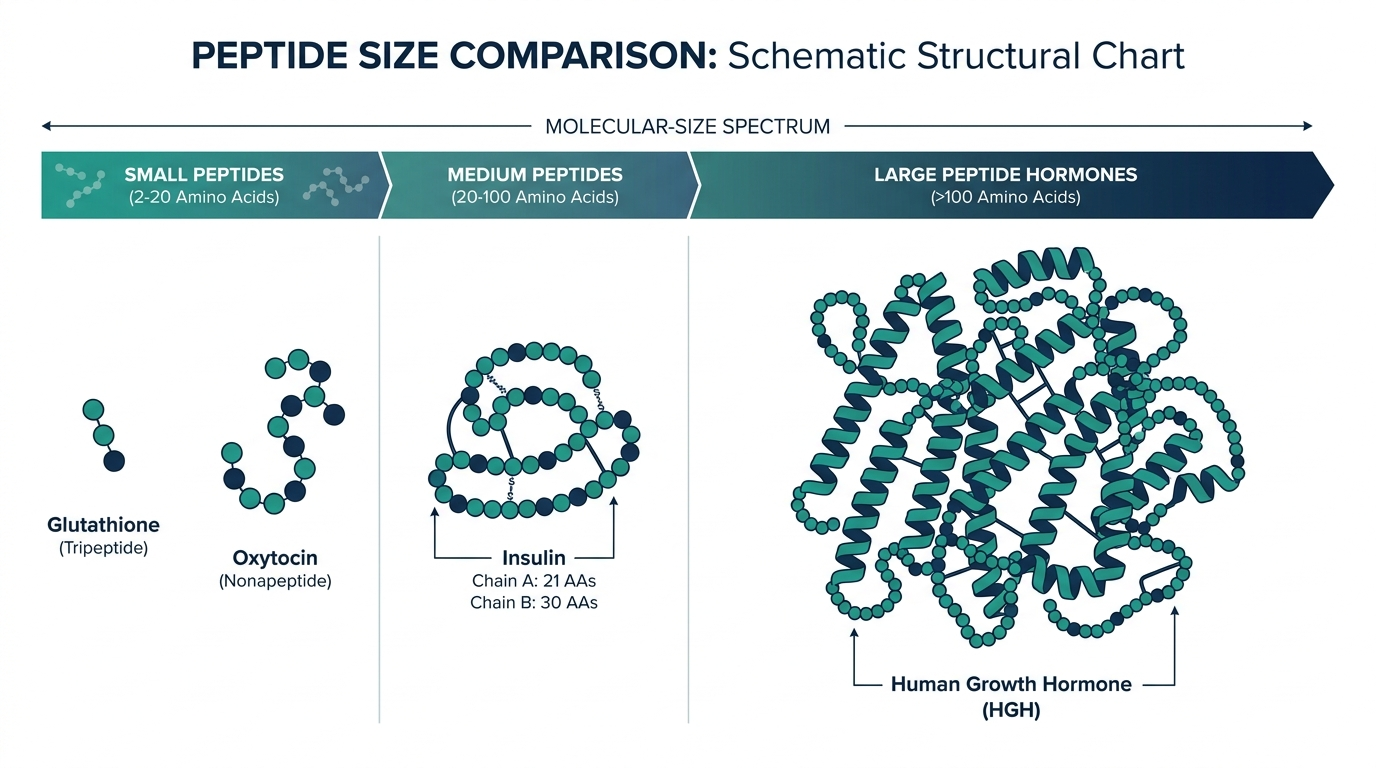
Technically, any chain of amino acids is a peptide. A “protein” is simply a peptide long enough to fold into a stable three-dimensional shape, with most textbooks drawing the line somewhere between 50 and 100 residues. HGH, at 191 amino acids, exceeds that threshold, so it is both: a polypeptide chain that folds into a functional protein with four antiparallel alpha-helices.
In clinical and popular usage, however, “peptide hormone” is the standard classification, and that is what you will see on FDA regulatory filings and in endocrinology textbooks. So when someone asks “is HGH a peptide?” the short answer is yes, and the longer answer is that it is a large, structurally complex polypeptide that behaves more like a protein in the body than a simple amino acid chain.
The confusion matters because the word “peptide” gets used for everything from a 5-amino acid skin serum ingredient to a 191-residue hormone. Context always determines which is actually being discussed.
Full-body lab membership: 100+ biomarkers, doctor-reviewed, tracked over time.
What is HGH made of, exactly?
The simplest way to actually get this done
Superpower is a full-body lab membership that runs 100+ biomarkers, has each result reviewed by a doctor, and tracks your numbers year over year (about $199/year). It is what we point readers to when they would rather get one clean, complete draw than chase single tests one at a time. Here is superpower reviewed in full.
HGH, also called somatotropin, is a single-chain polypeptide of 191 amino acids with two disulfide bridges that give it structural stability. Its molecular formula is C990H1529N263O299S7. The four-helix bundle structure is not decorative: those helices are the binding surface the growth hormone receptor recognizes, and without them the molecule does not work.
Your pituitary gland produces HGH in somatotropic cells located in the lateral wings of the anterior lobe. Secretion is pulsatile, with the largest pulses occurring during deep sleep. Basal GH levels run below 5 ng/mL throughout the day; the peaks triggered during sleep reach 13 to 72 ng/mL, depending on age, body composition, and sleep quality.
The HGH you get in a prescription vial is recombinant somatropin, meaning it is biosynthesized in bacteria or yeast using the human gene sequence. The result is bio-identical to the pituitary-produced version: the same 191-amino acid chain. An older version of synthetic HGH (somatrem) carried an extra methionine residue and is no longer sold. Modern brands, Norditropin, Genotropin, Humatrope, Omnitrope, and several others, are all 191-amino acid recombinant somatropin.
Is HGH a steroid? This myth refuses to die
No. HGH and anabolic steroids are structurally unrelated and work through completely different mechanisms.
Anabolic steroids are derivatives of testosterone, a cholesterol-based steroid with a four-ring carbon backbone. They are lipid-soluble, cross cell membranes directly, and bind to intracellular androgen receptors that then travel to the nucleus and switch on muscle-building genes. HGH cannot do any of that. At 22,000+ daltons, it is far too large to diffuse through a cell membrane, so it binds to receptors on the outside of cells instead, triggering the JAK2/STAT5 signaling pathway that then instructs the liver to produce IGF-1.
Personally, I think the steroid conflation persists because both are associated with performance enhancement and both are controlled substances. But calling HGH a steroid is like calling insulin a steroid because both get injected. The chemistry has nothing in common.
The practical difference matters: the side effects and detection profiles are different, the legal status is different (HGH is a Schedule III controlled substance; anabolic steroids are Schedule III as well but under separate statutes), and the physiology they manipulate is different.
What are “HGH peptides” then? And why is everyone talking about them?
Here is the insider distinction most mainstream articles blur: “HGH peptides” or “growth hormone peptides” are not HGH. They are smaller molecules, called secretagogues, that signal your pituitary gland to produce and release more of its own HGH. You are not supplying the hormone from outside. You are turning up the volume on your own pituitary’s output.
The two main classes:
GHRH analogs mimic growth hormone-releasing hormone (GHRH), the 44-amino acid signal that comes from the hypothalamus. Sermorelin is the best-known, a truncated version of GHRH at 29 amino acids. CJC-1295 is a modified GHRH analog engineered for a much longer half-life. Tesamorelin (brand name Egrifta) is the only FDA-approved GHRH analog, approved specifically for HIV-associated lipodystrophy.
GHRPs (growth hormone-releasing peptides) work through a different receptor entirely: the ghrelin receptor, or GHS-R1a. Ipamorelin is the cleanest of these because it triggers GH release without the cortisol and prolactin spikes seen in older compounds like GHRP-6. Ipamorelin is typically 5 to 6 amino acids, not 191.
The clinically popular stack today is CJC-1295 combined with ipamorelin, because the two mechanisms are complementary. As of April 2026, both CJC-1295 and ipamorelin were removed from the FDA’s Category 2 restricted compounding list, with formal review of compounding eligibility scheduled for July 2026, meaning the legal route through telehealth clinics is about to become much cleaner.
How does HGH actually work in the body?
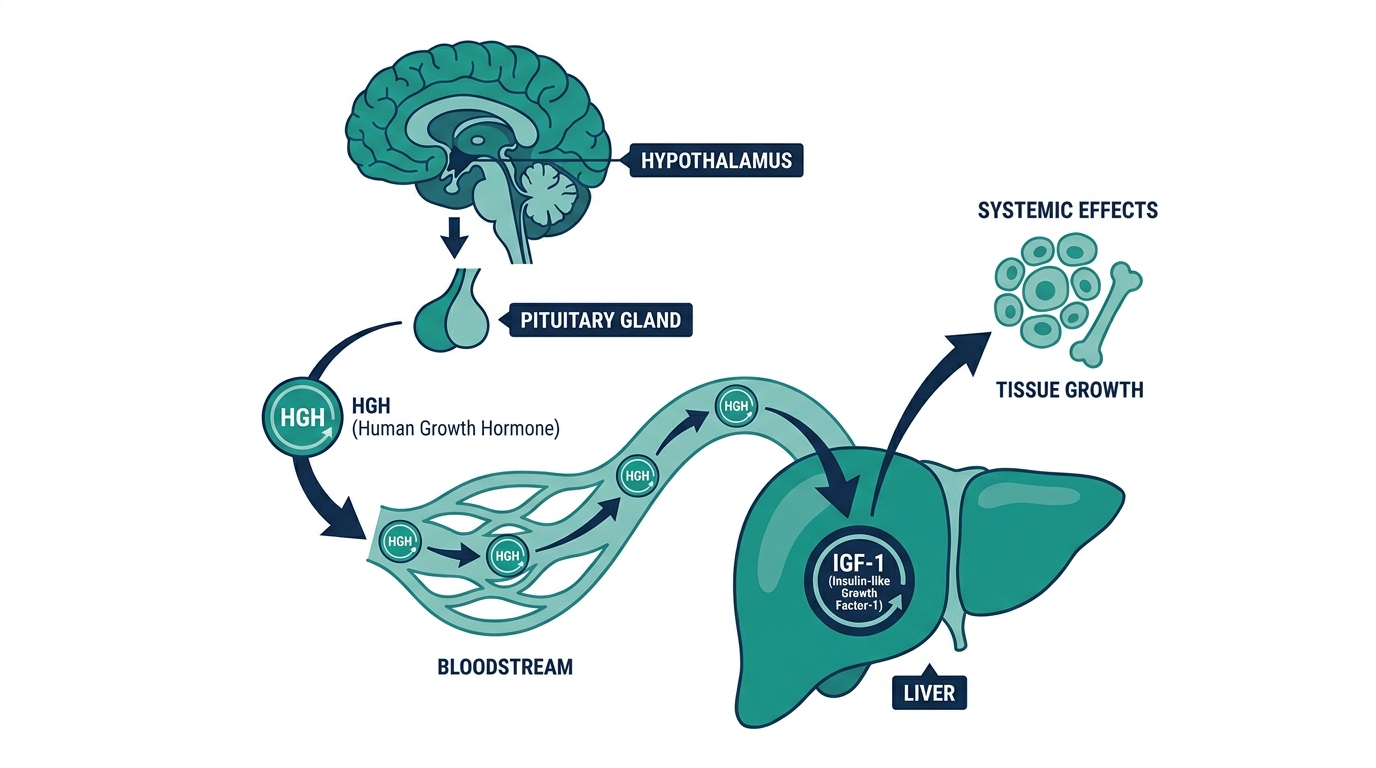
HGH does not directly build muscle or burn fat in most tissues. It sets off a downstream hormonal relay, and IGF-1 is the main messenger that actually reaches muscle cells.
The sequence runs like this:
- Your hypothalamus secretes GHRH, which travels down to the anterior pituitary.
- The pituitary releases a pulse of HGH into circulation.
- HGH binds to receptors in the liver and activates the JAK2/STAT5 pathway.
- The liver produces IGF-1, which enters circulation and reaches muscle, bone, and connective tissue.
- IGF-1 binds its own receptor and triggers the PI3K/Akt/mTOR cascade, the cellular machinery for protein synthesis, satellite cell recruitment, and tissue repair.
This is why IGF-1 is the standard clinical proxy for growth hormone status. Random GH measurements are almost useless because HGH’s half-life in circulation is only 10 to 20 minutes. By the time you draw blood and run the assay, the pulse has already cleared. IGF-1, produced continuously by the liver, reflects the average GH output over days and is stable enough to measure reliably.
HGH vs. secretagogue peptides: a direct comparison
| Feature | Recombinant HGH (somatropin) | Secretagogue peptides (sermorelin, CJC/ipamorelin) |
|---|---|---|
| Molecule size | 191 amino acids, 22,124 Da | 5 to 44 amino acids, 500 to 3,500 Da |
| Mechanism | Replaces endogenous GH directly | Stimulates pituitary to release its own GH |
| Release pattern | Single spike, not pulsatile | Preserves natural pulsatile rhythm |
| Pituitary feedback | Shuts down natural production via negative feedback | Feedback loop remains intact |
| Half-life | ~3.4 hours; GH elevated up to 12 hours post-injection | Sermorelin ~10 min; each dose triggers 2-4 hr GH pulse |
| FDA status | Multiple approved brands (Norditropin, Genotropin, etc.) | Tesamorelin approved (Egrifta); sermorelin, CJC/ipamorelin through compounding |
| 2026 cost (adults, out of pocket) | $2,400 to $4,800/month | $175 to $400/month via telehealth |
| Acromegaly / supraphysiologic risk | Higher with overuse | Lower; pituitary self-limits output |
| Insurance coverage | Limited to documented severe deficiency (IGF-1 <84 ng/mL) | Not covered; out of pocket |
The cost gap alone explains why clinics have largely moved to secretagogues for optimization and wellness clients. The risk profile also matters: injecting supraphysiologic HGH from outside suppresses the hypothalamic-pituitary-GH axis through negative feedback, which means the pituitary eventually reduces its own output. Secretagogues avoid this because the pituitary still controls the spigot.
What is the difference between IGF-1 and HGH?
Many people use these interchangeably, but they are different hormones with different properties.
HGH is the upstream signal produced by the pituitary. It has a short half-life, peaks during sleep, and its primary job is to instruct the liver. IGF-1 is the liver’s response: a more stable downstream hormone that circulates for hours and directly reaches target tissues. IGF-1 is what actually docks on muscle cells and tells them to grow.
One insider point worth knowing: IGF-1 levels decline steadily with age even in healthy adults, partly because aging impairs the pituitary’s GH pulsatility and partly because the liver becomes less responsive to GH signaling. This is why a 50-year-old with a “normal” IGF-1 level for their age may still have substantially lower anabolic drive than they had at 25. The reference ranges are age-adjusted, which can mask functional decline.
Do not believe the claim that a normal IGF-1 rules out GH insufficiency. Studies estimate that 30% to 40% of adults with documented GH deficiency have IGF-1 levels within the normal range for their age group. The diagnosis, when there is a real clinical question, requires a stimulation test, not just a reference-range check.
How do you test growth hormone status, and what throws the numbers off?
Because HGH itself clears the blood in minutes, the practical starting test is IGF-1, a single blood draw that reflects average GH output over days. It does not require fasting and can be drawn at any time of day, which is one of its real advantages over trying to catch a fleeting GH pulse. But a few things move the number in ways worth knowing before you read too much into one result. Acute illness, significant undernutrition or crash dieting, and liver disease all lower IGF-1, since the liver is where it is produced. Oral estrogen tends to lower it as well, while good nutritional status and adequate protein nudge it upward.
If you are tracking IGF-1 over time, draw it under similar conditions each time, ideally not during an illness or an aggressive diet, and compare against the same lab’s range, since assays differ between labs. Remember that the ranges are age-adjusted, so a result flagged as normal can still sit low relative to what that person carried a decade earlier. One borderline value is not a diagnosis. When there is a genuine clinical question of deficiency, the stimulation test done in a supervised setting remains the standard, and no at-home panel replaces it.
What are the risks of exogenous HGH that nobody leads with?
Exogenous HGH therapy carries real risks that get underplayed in optimization content.
The most cited concern is acromegaly, the syndrome of excessive bone and tissue growth caused by chronically elevated GH and IGF-1. Hands, feet, and facial features enlarge, joints deteriorate, and carpal tunnel syndrome develops. The SAGhE European cohort study, which followed more than 24,000 patients treated with childhood HGH, found a higher-than-expected rate of certain cancers at follow-up, a finding that has informed ongoing FDA monitoring of somatropin. The risk is not clearly established at therapeutic doses in adults with actual deficiency, but it is enough that responsible clinicians do not prescribe HGH outside of documented need.
Common side effects at therapeutic doses include fluid retention, joint pain, carpal tunnel syndrome, elevated blood glucose, and headache. All are dose-dependent, which is why titration and lab monitoring matter.
The subtler risk is axis suppression. Injecting HGH from outside raises serum GH and IGF-1, which sends a negative feedback signal to the hypothalamus to reduce GHRH output. The pituitary then cuts back its own production. If therapy is discontinued abruptly, the axis does not recover immediately. This rebound effect does not occur with secretagogue peptides, because they work upstream rather than bypassing the axis.
Telehealth GLP-1 program with provider visits and pharmacy coordination.
What are the signs of low growth hormone in adults?
Adult growth hormone deficiency has a real symptom picture, but it is frustratingly nonspecific, which is why it is both underdiagnosed in real patients and easy to sell to people who do not have it. The classic cluster includes an increase in body fat, especially around the abdomen, alongside a loss of lean muscle and reduced exercise capacity that shows up as getting winded or fatigued faster than the same person did years earlier. Many patients also report low mood, reduced motivation, poor concentration, and a general sense of diminished vitality. Thinner and drier skin, a gradual loss of bone density, and unfavorable shifts in cholesterol can accompany it.
The problem is that every one of those symptoms overlaps with ordinary aging, poor sleep, low testosterone, thyroid dysfunction, depression, and plain deconditioning. That overlap is exactly why a real diagnosis rests on documented pituitary pathology plus a stimulation test, not on a symptom checklist and a wellness questionnaire. If a clinic hands you a low growth hormone diagnosis off a symptom quiz alone, you are looking at a sales funnel, not medicine.
Who actually gets prescribed HGH in 2026?
Prescription somatropin in the United States is approved for specific indications: adult growth hormone deficiency (AGHD), which requires stimulatory testing to confirm, pediatric short stature from documented GHD, Turner syndrome, Prader-Willi syndrome, chronic kidney disease-related growth failure, HIV-associated wasting (Serostim brand), and short bowel syndrome (Zorbtive brand).
Adult GHD requires documented pituitary disease, hypothalamic damage, or trauma as context, plus a failed GH stimulation test. A low IGF-1 alone is not enough for most insurance plans. The exception is patients with three or more other pituitary hormone deficiencies plus a very low IGF-1 (below 0 standard deviation score), who may be diagnosed without stimulation testing.
The practical result: if you are a healthy adult interested in HGH for body composition or longevity, you will not qualify for prescription somatropin under any legitimate clinical pathway. The secretagogue route, via sermorelin or CJC-1295/ipamorelin from a telehealth clinic, is both the affordable path and the medically appropriate one for optimization outside of a diagnosed deficiency.
Even on the secretagogue path, keep expectations calibrated. These compounds nudge your own pituitary output upward within a physiologic range; they do not flood the body with hormone the way a supraphysiologic HGH dose does. Users generally report better sleep quality first, often within the first few weeks, followed by gradual changes in recovery, body composition, and skin over months. Anyone promising dramatic overnight muscle gain or fat loss from sermorelin or a CJC-1295/ipamorelin stack is overselling. The honest framing is a modest, slow optimization that depends heavily on sleep, training, and protein intake being handled at the same time.
How is HGH classified legally? Can you buy it?
In the United States, HGH (somatropin) is a controlled substance under the Anabolic Steroid Control Act of 1990, and its distribution for purposes other than the FDA-approved indications is a federal felony, not a civil penalty. The DEA explicitly covers HGH under this statute.
This is meaningfully different from most prescription drugs: you can prescribe an off-label medication and the prescribing doctor carries the risk. With HGH, the law specifies the permitted diagnoses, and prescribing it for anti-aging or athletic performance is prosecutable on both the prescriber and the patient. This is not a regulatory technicality that is routinely overlooked; there have been federal prosecutions of clinics and anti-aging doctors for HGH prescribing outside approved indications.
Recombinant secretagogue peptides, sermorelin, CJC-1295, and ipamorelin, are not HGH and are not under the same statute. Their regulation runs through the FDA’s compounding framework, which is why the 2026 regulatory changes for Category 1/2 classification matter so much for access.
Curious what your own levels look like?
Baseline 100+ biomarkers today and retest as life changes, all in one membership with physician review.
Frequently asked questions
Is HGH a peptide or a steroid?
HGH is a peptide hormone, specifically a 191-amino acid polypeptide with a molecular weight of 22,124 daltons. It is not a steroid. Steroids are cholesterol-derived lipid compounds with a four-ring backbone. HGH is an amino acid chain that binds to cell-surface receptors rather than crossing into cells the way steroids do.
What is the difference between HGH and peptides?
In common usage, “peptides” in the hormonal context usually refers to growth hormone secretagogues: sermorelin, CJC-1295, ipamorelin, and similar compounds. These are much smaller molecules (5 to 44 amino acids) that stimulate your pituitary to produce its own HGH, rather than supplying HGH from outside. HGH itself is technically also a peptide by structure, but clinically the two categories are quite distinct.
Is HGH a peptide hormone?
Yes. Peptide hormones are hormones made of amino acid chains rather than lipids or steroids. HGH meets that definition precisely. Its classification as a peptide hormone places it in the same broad category as insulin (51 amino acids), glucagon (29 amino acids), and IGF-1 (70 amino acids), all of which share the property of binding to cell-surface receptors rather than entering cells directly.
Can HGH peptides replace actual HGH?
Not identically, but for most optimization and wellness applications the secretagogue approach is preferred. Secretagogues preserve the pituitary feedback loop, cost 10 to 20 times less than recombinant HGH, carry a lower risk of axis suppression, and do not carry the same federal legal restrictions. For documented severe adult GH deficiency with pituitary pathology, recombinant HGH remains the standard of care.
What does IGF-1 have to do with HGH?
IGF-1 is the primary downstream mediator of HGH’s anabolic effects. HGH signals the liver to produce IGF-1, and it is IGF-1 that actually reaches muscle and bone cells and triggers the PI3K/Akt/mTOR growth pathway. Because HGH clears the bloodstream in 10 to 20 minutes, IGF-1 is the standard clinical proxy for measuring growth hormone status over time.
What does recombinant mean in recombinant HGH?
It means the molecule was synthesized using recombinant DNA technology: the human GH gene was inserted into bacteria or yeast, which then produce the identical 191-amino acid protein. The result is bio-identical to pituitary-produced HGH. All current FDA-approved somatropin brands (Norditropin, Genotropin, Humatrope, Omnitrope, Saizen, and others) are recombinant.
How do I know if my growth hormone is low?
IGF-1 is the most practical starting point. A standard blood draw measures circulating IGF-1, which reflects average GH output over days. Keep in mind that reference ranges are age-adjusted, and 30 to 40 percent of adults with documented GH deficiency can show a “normal” age-adjusted IGF-1. If symptoms persist and IGF-1 is borderline, a stimulatory test in a clinical setting is the diagnostic standard, not further blood panels alone.
Are growth hormone secretagogue peptides safe?
For most healthy adults using them under clinician supervision, the cleaner secretagogues like ipamorelin have a favorable short-term profile, precisely because the pituitary self-limits how much GH it will release. Common side effects are mild: injection-site irritation, transient water retention, tingling, or a brief flushing sensation. The bigger unknowns are the thin long-term data and the quality control on compounded products, which is why sourcing through a licensed pharmacy rather than a research-chemical website matters. Anyone with active cancer or a history of it should avoid raising GH and IGF-1 without oncology input.
Will HGH or secretagogues make me look younger?
The marketing leans hard on skin and anti-aging, and the reality is more modest. Better sleep and improved IGF-1 signaling can improve skin thickness and hydration somewhat over months, but neither HGH nor secretagogues reverse aging or replace the fundamentals. The people who see the most from them are usually the ones who also fixed sleep, resistance training, and protein intake, which produce much of the benefit on their own.
Author: Vital Signs Today Editorial Team. Educational content, not medical advice. Sources linked inline.
Telehealth GLP-1 program with provider visits and pharmacy coordination.
Primary sources:
- Growth hormone, Wikipedia: molecular structure, amino acid count, half-life, secretion pattern
- FDA Drug Safety Communication: Ongoing safety review of somatropin
- DEA Diversion Control: HGH fact sheet
- Diagnosing Growth Hormone Deficiency in Adults, PMC/NIH
- SAGhE European cohort study: Cancer risks after childhood GH treatment, JCEM
- IGF-1 vs HGH: Mechanisms and Synergy, Swolverine
- Sermorelin vs HGH comparison 2026, PeakedLabs
- Best ipamorelin vs sermorelin 2026, Yahoo Finance/ReadyRx
- Best growth hormone secretagogues guide, PeptideDeck
- Superpower IGF-1 testing and 100+ biomarker panel
- Sermorelin cost guide 2026, IvyRx
- Growth hormone therapy cost 2026, GoodRx Norditropin pricing
- Growth hormone and aging: a clinical review, Frontiers in Aging 2025
Related reading
Vital Signs Today may earn a commission if you buy through links on this page. It does not affect our editorial assessments.